


832-677-4620 / 281-570-5804
It's not about JUST BEING Online, Its about BEING FOUND Online

When Pay Per Click Is Worth the Investment for B2B

Author Archives: Andy Alagappan

About Andy Alagappan

By Andy Alagappan : Call US for a FREE 30 MIN Web Site Marketing and Lead Generation analysis and Video Strategy consulting @ 832-677-4620 .281-570-5804 .

A procurement manager and supplier representative discuss a replacement-parts inquiry that began with a paid-search result.

When Pay Per Click Is Worth the Investment for B2B

For a B2B company, pay per click is worth the investment when the customers it brings in generate enough profit to cover acquisition costs within an acceptable timeframe. Expensive clicks can still be economical for a specialized industrial supplier. Cheap clicks can be wasteful if they attract buyers your sales team cannot serve.

The decision should start with deal economics, evidence of demand and your ability to turn inquiries into business. This guide focuses on paid search and provides a practical framework for deciding whether to invest, run a limited test or put the budget elsewhere.

Start with the business case, not the channel

Paid search gives you access to people actively looking for something. It does not guarantee that enough of those people need your particular product, meet your minimum order requirements or have purchasing authority.

Before approving a budget, identify the commercial problem the campaign should solve. A manufacturer with unused production capacity might want additional RFQs for one profitable product line. A technical service provider entering Houston might need visibility among local procurement teams before its organic rankings develop.

In both cases, pay per click has a defined job: acquire suitable demand that the business can fulfill profitably. “Get more traffic” is not a sufficient investment case.

A useful starting question is whether acquiring one additional customer would create meaningful economic value after delivery costs, sales effort and marketing expenses. If that answer is unclear, work on the financial assumptions before buying traffic.

Check whether searchers are close enough to buying

Search demand and purchasing readiness are different. Someone researching equipment specifications may be months away from issuing an RFQ. Someone searching for an authorized replacement-parts supplier may have an immediate operational need.

Comparison searches sit between those extremes. Consider a shopper using an engagement-ring retailer comparison to evaluate suppliers, quality and customization. The search has commercial value, but the shopper may still need help choosing rather than an immediate checkout prompt.

B2B buyers make similar distinctions. “Industrial filtration options” and “custom filtration skid quote” call for different expectations and conversion paths. Fund the buying stages you can support, not every query that mentions your product category.

Calculate a pay per click investment ceiling

Start with the gross profit an acquired customer is likely to produce, not just contract revenue. Then decide how much of that profit the business can spend to acquire the customer while preserving its required return.

Suppose an initial contract produces $50,000 in revenue and carries a 40% gross margin after delivery costs. That leaves $20,000 in gross profit before sales and marketing expenses. Management might choose a $6,000 acquisition-cost ceiling to preserve room for overhead, risk and profit.

That ceiling is a business decision, not an industry benchmark. A company with tight cash reserves or unpredictable project costs may need a lower limit.

Use a consistent calculation:

Customer acquisition cost = total acquisition expenses ÷ customers won.

Include media spend, agency or internal campaign costs, landing-page work and attributable sales-handling expenses. Leaving those costs out can make an otherwise weak campaign look attractive.

Pressure-test the assumptions before spending

The following illustration assumes $6,000 in advertising spend at an average $20 cost per click, producing 300 visits. Another $2,000 covers campaign support, setup and attributable lead handling. Total acquisition expenses are therefore $8,000.

Assumption or outcome Base scenario Downside scenario
Visits 300 300
Visitor-to-qualified-lead rate 5% 3%
Qualified leads 15 9
Qualified-lead-to-customer rate 20% 10%
Expected customers 3 0.9
Cost per expected customer About $2,667 About $8,889

These are hypothetical assumptions, not typical B2B results. Fractional customers represent forecast averages, not actual sales outcomes.

Under the base scenario, pay per click falls below the $6,000 acquisition ceiling. Under the downside scenario, it exceeds that ceiling. The investment is therefore sensitive to conversion performance and needs validation before expansion.

A small sample can also produce substantially different realized results. Forecasting three customers does not mean a pilot will win exactly three deals.

Use realistic customer value and cash timing

Repeat purchases can improve the economics, but do not justify today's spending with an unsupported lifetime-value estimate. Start with the first contract or a conservative value based on documented repeat business.

For project-based industrial companies, gross margin may vary considerably by job. A large custom order can consume engineering time, expedited freight or installation support that reduces its contribution. Model the kinds of contracts the campaign is likely to attract, not your most profitable historical exception.

Cash timing matters too. An acquisition cost can be acceptable on paper while the business waits through a long sales cycle, delivery period and payment term. Set a maximum acceptable payback period alongside the acquisition-cost ceiling.

Confirm that the business can convert additional demand

A profitable forecast is useful only if operations can support it. Check whether the company has available capacity, can serve the target geography and can quote the work being advertised.

For pay per click to justify additional funding, sales must also be able to handle inquiries consistently. A campaign targeting urgent maintenance needs is a poor fit for a business that regularly takes several days to respond.

The landing page should make the offer and eligibility clear. Buyers need to understand what you supply, which applications you support and what information is required for a useful quote. Relevant specifications and service boundaries can matter more than polished but vague sales language.

Agree on what counts as a qualified lead

Marketing and sales should define qualification before the test begins. For example, an inquiry might qualify only if it matches your service area, product capability, minimum project size and purchasing need.

A form submission alone should not settle the question. Job seekers, students and requests for products you do not sell can inflate apparent performance without creating revenue potential.

Record rejection reasons as well as accepted leads. The website's guide to B2B PPC metrics that reflect commercial value provides additional context for evaluating results beyond clicks and form fills.

An industrial supplier's estimator checks a printed paid-search forecast beside a drafted quotation and cost calculations on a workshop bench.

Run a bounded test rather than an open-ended commitment

A pilot should answer a specific commercial question. For example: can paid search generate qualified RFQs for a particular service at an acquisition cost the business can sustain?

Choose a narrow offer and market so the result is interpretable. Combining unrelated product lines, locations and buyer types can conceal which parts of the investment work.

Treat pay per click as a controlled experiment with an agreed spending limit, review schedule and decision criteria. Separate initial setup expenses from recurring costs so you can evaluate both the pilot's total economics and the likely economics of continued operation.

Document the assumptions that matter most: expected click costs, qualified-lead rate, sales conversion rate and time to revenue. Use previous sales data where it applies, but recognize that referrals and paid-search leads may behave differently.

The test budget should be affordable even if it produces no customers. A pilot funded with money the company needs for payroll or essential operations carries the wrong level of risk.

Evaluate mature lead cohorts, not just the latest month

B2B sales often close after the advertising invoice has been paid. Comparing this month's spend only with this month's wins can make a developing campaign appear worse than it is. Counting every open opportunity as future revenue creates the opposite problem.

Track leads by the period in which they were acquired, then follow their progression through qualification, quoting and closed business. Where your systems support it, Google Ads offline conversion imports can help connect advertising interactions with later sales events.

With pay per click, early results should be judged against the stage the cohort has actually reached. A recent group of leads can reveal qualification quality and quoting activity, but it cannot yet establish a six-month sales conversion rate.

If there are too few accepted leads to support a reliable conclusion, report the uncertainty rather than labeling the campaign a success or failure.

Decide whether to scale, revise or stop

The next decision should follow the economics and sales evidence, not a platform's recommendation to increase spend.

Decision Evidence that supports it
Scale cautiously Mature customer acquisition cost is below the ceiling, payback is acceptable and fulfillment capacity remains available
Continue a limited test Qualified demand is appearing, but too few leads have completed the sales cycle
Revise the approach Sales feedback identifies a specific mismatch in offer, geography or buyer expectations
Pause investment Acquisition economics exceed the ceiling or the business cannot serve the demand profitably

Increase budgets in measured steps. Marginal traffic may cost more or convert differently from the initial audience, so a successful small campaign does not guarantee the same economics at a larger scale.

Pay per click also needs to compete with other uses of the budget. If the main obstacle is weak technical content or insufficient buyer education, organic work may deserve priority. The comparison of organic and paid marketing for B2B businesses can help clarify that allocation decision.

Frequently Asked Questions

Is paid search worth it for a business with a long sales cycle? It can be, provided customer value supports acquisition costs and the business can finance the wait for revenue. Track lead cohorts through the sales cycle instead of expecting every month's advertising spend to produce immediate closed deals.

How much should a B2B company spend on its first test? Set the budget around a focused commercial question, plausible traffic costs and the amount you can afford to lose. There is no universal minimum that makes a test reliable. Very limited traffic may leave substantial uncertainty even after the budget is spent.

Does a high cost per click mean the investment is poor? No. Click cost is only one input. A costly click that leads to a profitable contract can be worthwhile, while inexpensive traffic can fail to generate any suitable opportunities. Evaluate total acquisition cost and payback.

When should a company avoid paid search? Delay pay per click when margins are unclear, tracking cannot distinguish suitable inquiries or sales cannot respond effectively. It may also be a poor fit when relevant search demand is too limited or another channel offers a better route to the same buyers.

Build the investment case before launching

A defensible plan identifies the offer, the target buyer, the acquisition-cost ceiling and the evidence required to continue spending. It also states what would trigger a pause.

For Houston-based B2B and industrial businesses, B2B Inbound Marketing offers PPC management, SEO and inbound marketing strategy. When requesting a proposal, share your margins, sales-cycle length, target market and available capacity. Those inputs help frame the discussion around an affordable path to new business rather than traffic alone.

An industrial supplier's organized production and packing area gives buyers a view of the operation behind its online claims.

What Every SEO Website Needs to Convert More Buyers

An SEO website should do more than attract visitors. For a B2B or industrial business, it should help the right buyer confirm that you can handle the job, find evidence that reduces risk and take a useful next step. A high-ranking page that leaves those questions unanswered can generate traffic without producing qualified inquiries.

The most valuable improvements often sit between discovery and contact: clearer qualification information, more usable proof and a quote process that prepares both the buyer and your sales team.

Find the decision gaps that stop buyers

Start with a commercial page that receives relevant search traffic, such as a service, product category or manufacturing capabilities page. Review it as someone evaluating a supplier, not as someone checking keyword placement.

A prospective customer usually needs to make three decisions:

  • Fit: Can this company meet our technical requirements, location needs and purchasing constraints?
  • Confidence: Is there enough evidence to justify putting this supplier on our shortlist?
  • Action: What should we submit, and what happens after we contact them?

These decisions expose weaknesses that ranking reports cannot. A page might describe a service accurately but omit the materials supported. It might display customer logos without explaining the work completed. Or it might offer a contact form without saying whether it accepts requests for quotations.

Treat unanswered buying questions as conversion barriers. Fixing them helps visitors assess suitability before anyone spends time on a sales call.

Build an SEO website around buyer fit

The fastest route to more useful inquiries is not necessarily a more persuasive headline. It may be a clearer explanation of who you serve and which projects you can accept.

For industrial companies, suitability can depend on process capabilities, tolerances, materials, production volume or service territory. For professional services, it may depend on business size, project scope or the systems involved.

Place the most important qualification information on the relevant commercial page rather than requiring visitors to search through company information or downloadable brochures.

Buyer question Information that helps answer it
Can you handle our application? Supported applications, materials or project types
Does our order fit your operation? Actual volume requirements or project constraints
Can you serve our location? Clear delivery coverage or service territory
What affects timing and cost? The inputs needed to assess schedule and pricing
Are there requirements you cannot meet? Relevant exclusions and capability limits

Publish only information your team can stand behind. If lead times vary, explain what determines them instead of presenting an unreliable standard turnaround.

For example, someone exploring OEM manufacturing for a martial arts brand will have different purchasing questions from someone buying finished products at retail. Customization requirements, samples and production quantities become relevant considerations. The page should reflect that buying context rather than rely on generic claims about quality.

Put credible proof beside the claim it supports

An SEO website becomes easier to evaluate when evidence appears where the buyer needs it. A separate testimonials page can help, but it should not be the only place visitors encounter proof.

If a page claims experience with a particular application, include a relevant project example nearby. If it mentions a certification, identify its scope accurately and make supporting documentation available when appropriate.

Make project examples useful to a purchasing team

A strong example explains the customer's challenge, the work performed and the outcome you can substantiate. Photos of completed work may add context, but a photo alone does not explain whether your business can solve a similar problem.

When confidentiality limits what you can publish, describe the application without disclosing protected details. An anonymized account of a manufacturing challenge is more useful than an unsupported statement that you serve major companies.

Avoid implying that one project's result is guaranteed for every customer. Separate demonstrated experience from promises about future performance.

Replace broad assurances with specific information

“Reliable service” tells a buyer little. An explanation of your documented inspection process, project communication approach or quoting requirements gives them something to assess.

Your B2B content should support the conversion decision, not simply repeat sales language. Specific evidence helps a prospect explain internally why your company deserves consideration.

Help the whole buying group evaluate your business

The person who finds your company through search may not approve the purchase. An engineer might identify a supplier, procurement might compare terms and an operations manager might assess implementation risk.

An SEO website should give these people information they can share without losing the context of your offer. That does not require a separate page for every job title. It requires commercial pages that cover the distinct concerns involved in a purchase.

Make important pages easy to forward

Imagine a visitor emailing your capabilities page to a colleague. Would that colleague understand what you provide, what evidence supports your claims and how to request the next step?

A useful page stands on its own. It includes a clear service description, relevant qualification details and a specific contact route. Important information should not depend on a rotating banner or a conversation that has not happened yet.

Downloadable specification sheets can support this process when maintained, dated where appropriate and consistent with the web page. Keep essential information available on the page as well, so buyers do not have to download a document just to establish basic fit.

Shareability matters because B2B evaluation often continues after the original search session ends.

Offer a next step that matches the purchase

“Contact us” is sometimes sufficient, but complex purchases benefit from a more descriptive action. A buyer may need to request a quote, submit specifications or discuss project feasibility.

An SEO website should make the next step clear without asking visitors to commit beyond their current stage. Someone researching requirements may not be ready for a sales call, while someone with an approved project may want to submit drawings immediately.

Explain the request before presenting the form

Describe what the buyer should provide and how your team uses it. If drawings, quantities or delivery locations are needed to prepare a quotation, say so. If the first conversation determines feasibility rather than price, make that distinction clear.

Do not advertise response times unless your team can consistently meet them. A realistic explanation of the process is more credible than an unsupported promise of immediate contact.

Give research-stage visitors a useful alternative

A specifications page, application guide or relevant project example can help someone who is not ready to inquire. The alternative should advance their evaluation, not distract them with an unrelated newsletter signup.

Keep one primary action visually clear on each commercial page. Supporting actions can remain available without competing equally for attention.

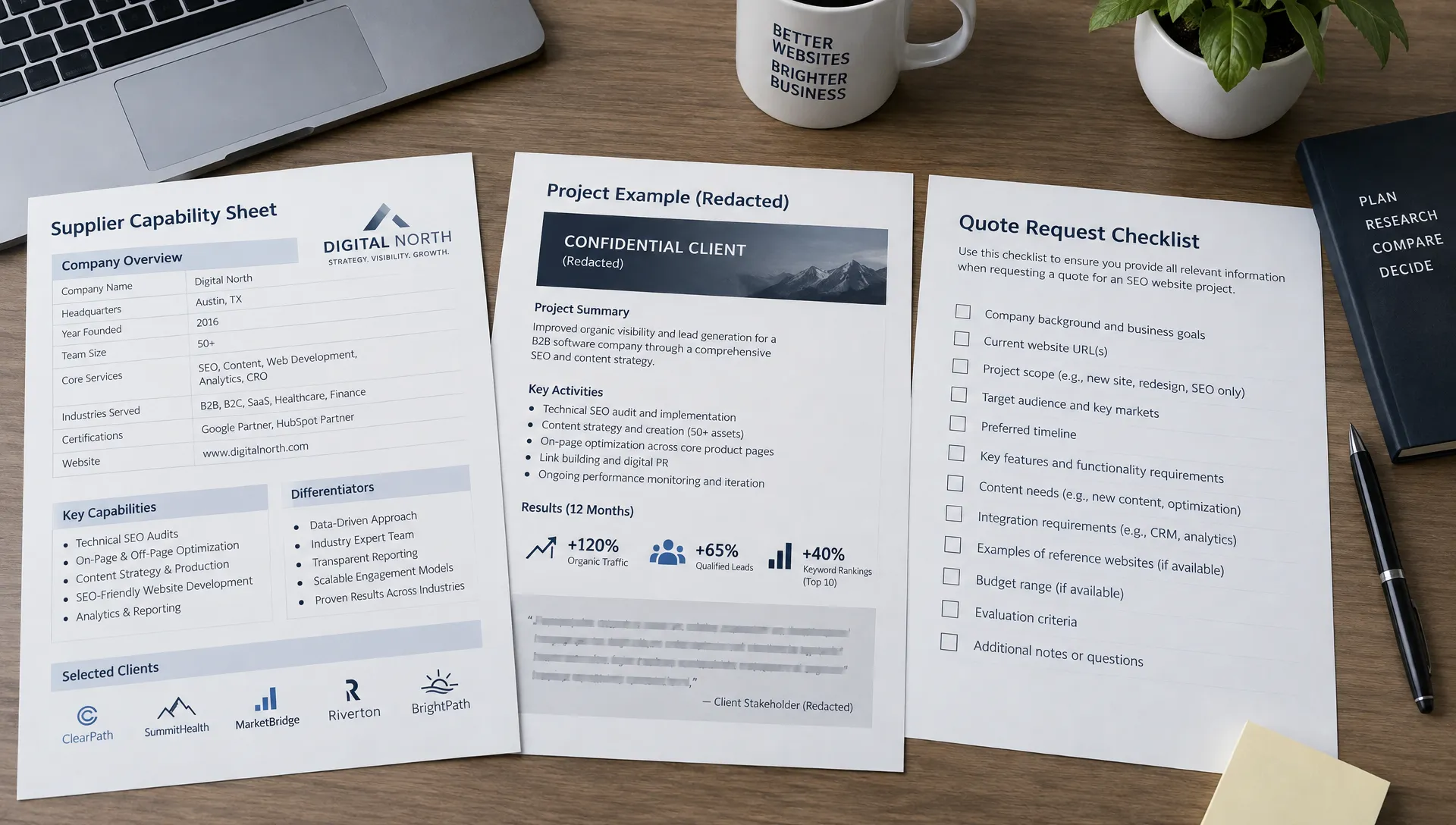
A supplier capability sheet, redacted project example, and quote request checklist lie together on a conference table for evaluating an SEO website.

Remove friction without removing qualification

A shorter form is not automatically a better form. Removing every qualifying question may increase submissions while leaving sales with inquiries it cannot assess.

For an SEO website, the better goal is to ask for the smallest amount of information needed to take the promised next step. A general consultation request and a detailed quotation request should not necessarily use identical fields.

Make optional fields visibly optional. Explain unfamiliar requirements and use labels that remain visible while people type. Test the form on a phone, including error messages, file uploads and the confirmation state.

Check the experience beyond the form

Slow pages, broken phone links and inaccessible controls can interrupt an otherwise strong buying experience. Google’s Core Web Vitals guidance covers loading performance, responsiveness and visual stability, but passing those checks does not prove that a page answers purchasing questions.

Technical usability and decision clarity need separate reviews. A fast page can still leave buyers uncertain, and a persuasive page can still fail if its submission process breaks. A structured approach to website optimization for better conversion rates helps address both problems.

Connect the inquiry to a prepared sales response

The conversion experience continues after submission. A buyer who provides detailed requirements should not immediately receive a generic reply asking for the same information again.

An SEO website needs a reliable handoff between the page, the inquiry system and the person responsible for responding. Before adding more traffic, verify that legitimate submissions reach the right team and that important context survives the transfer.

Where your systems support it, retain the page associated with the inquiry, the requested service and the details the buyer submitted. Review privacy requirements before collecting or passing additional visitor information.

Define ownership and next steps

Assign responsibility for reviewing new inquiries. Establish how your team handles requests that are incomplete, outside your capabilities or ready for a quotation.

The confirmation message should acknowledge receipt and explain what happens next. It should not promise that every request will receive a quote if feasibility still needs to be checked.

This operational work directly affects the value of your marketing. Better page content cannot compensate for lost submissions or a follow-up process that ignores the buyer's needs.

Measure progress toward sales, not just form fills

More inquiries are valuable only when they support the business. Spam, supplier solicitations and unsuitable projects can make conversion reports look healthy without creating sales opportunities.

Evaluate an SEO website using both website behavior and downstream lead quality. Keep definitions consistent so a change in reporting does not look like an improvement in performance.

Measure What it helps you understand
Valid organic inquiries Whether search visits produce legitimate requests
Sales-accepted inquiries Whether those requests fit your agreed qualification criteria
Quote or opportunity progression Whether inquiries advance beyond initial contact
Common disqualification reasons Which expectations or requirements need clarification
Outcomes by landing page Which commercial pages support useful buyer actions

Review these measures together. If submissions rise but sales acceptance falls, the page may be attracting or encouraging the wrong prospects. If qualified inquiries arrive but rarely progress, investigate follow-up, pricing fit and missing decision information.

Use buyer feedback to choose the next change. Repeated questions about order quantities suggest a qualification gap. Repeated requests for the same documentation suggest that evidence is hard to find.

For low-traffic B2B pages, small differences between short reporting periods can be misleading. Combine quantitative data with inquiry reviews before declaring a change successful.

Frequently asked questions

Can an SEO website convert buyers without online checkout? Yes. In B2B markets, a meaningful conversion may be a qualified quote request, a specification submission or a project discussion. These actions support a purchase, but they should not be reported as completed sales.

Should pricing appear on every commercial page? Not necessarily. When pricing depends on specifications, volume or scope, explain those factors and what information is required for an estimate. Publish fixed prices or ranges only when they accurately represent the offer.

Which page should we improve first? Start with a commercial page that attracts relevant visitors but produces few qualified inquiries. Review buyer fit, supporting evidence, the next step and the inquiry handoff before changing cosmetic details.

How do we know whether a change worked? Compare valid inquiries and sales progression, not just total submissions. Also check whether recurring buyer questions or disqualification reasons have changed.

Turn your highest-value pages into better buying tools

Choose one important commercial page and review it with someone who handles customer inquiries. Identify the unanswered question that most often delays or disqualifies a purchase, then address it with accurate information.

For support connecting search visibility with buyer action, B2B Inbound Marketing offers SEO, inbound marketing strategy, web content writing and web design services for B2B and industrial businesses.

An engineer explains a pump application to a purchasing manager at a factory, sharing the expertise behind B2B search and social content.

Search Engine Optimization Social Media Strategies for B2B

For B2B companies, search engine optimization social media strategies should connect two buyer behaviors: searching for answers and evaluating expertise through professional networks. An engineer might find a technical guide through Google, notice the author's LinkedIn explanation later and share both with a purchasing manager. Those interactions can support the same sales opportunity, even when they happen weeks apart.

The goal is not to publish identical content everywhere or chase reactions. It is to make useful expertise discoverable, distribute it to relevant people and bring interested buyers back to a website that answers their next question.

For manufacturers, industrial suppliers and professional service firms, that requires a shared workflow between subject matter experts, content marketers and sales, with clear measures for qualified demand.

How search engine optimization social media strategies connect

SEO helps buyers discover pages that answer a search query. Social media helps distribute ideas, build familiarity and start conversations with people who may not be actively searching yet. They serve different functions, but they can draw from the same expertise.

Social engagement should not be treated as a direct Google ranking lever. A LinkedIn post receiving hundreds of reactions does not establish that the linked page deserves a higher search position. Public accessibility, crawlability and link treatment also vary across platforms.

The practical value of search engine optimization social media coordination comes from reaching relevant people who can read, share, cite or act on your content. Social conversations can also reveal questions worth answering on your website.

Google's SEO Starter Guide discusses promoting content to help interested people discover it. That supports a sensible distribution approach, not a promise that social popularity produces rankings.

Keep the distinction clear: optimize website content for search usefulness and use social channels to extend its reach among potential buyers.

Start with buyer questions, not a posting calendar

Collect language from sales and technical conversations

Before choosing post formats, identify what prospects need to understand before they can purchase. Sales calls, proposal questions, support requests and public industry discussions provide useful starting points.

For an industrial pump supplier, those questions might concern fluid compatibility, maintenance access or the information needed for a quotation. A purchasing manager may ask about availability and supplier reliability, while an engineer focuses on operating conditions.

Record the question, buyer role, decision stage and evidence needed to answer it. Then check relevant search results to see whether buyers encounter product pages, technical guides or comparison articles. This keeps content aligned with actual information needs rather than whichever topic generated the most reactions last week.

Build one source asset with several useful derivatives

A productive search engine optimization social media workflow begins with a substantial website resource, then adapts selected insights for each channel. The source might be a selection guide, application note, troubleshooting article or documented case study.

Give that resource a named technical reviewer where appropriate, clear explanations and evidence you have permission to publish. Do not invent performance figures or expose customer information to make the content more persuasive.

From the source, create a short expert explanation, a visual comparison and a demonstration clip. Each derivative should deliver useful information on its own, with a link when the website provides necessary detail.

The principles behind search-focused content writing help keep the main resource useful and structured. Social distribution then introduces specific parts of that resource to different audiences instead of repeating the same promotional summary.

Match distribution to the buying committee

B2B purchases often involve several people with different concerns. A technical post that interests an engineer may do little for a finance director unless it explains the operational or financial implications.

Use buyer roles to guide the angle, supporting evidence and next step. The following examples are planning suggestions, not guaranteed channel-performance outcomes.

Buyer role Website resource Social content angle Relevant next step
Engineer Application or selection guide Explain a design constraint and its trade-offs Review technical requirements
Operations manager Maintenance or implementation guide Show how to address an operational problem Discuss the application
Procurement lead Supplier evaluation checklist Explain documentation, service coverage or quotation requirements Request supplier information
Executive sponsor Documented business case Connect the project to cost, risk or capacity Explore project scope

A search engine optimization social media plan should prioritize channels where those people actually participate. LinkedIn can support professional discussion, YouTube can make demonstrations discoverable and specialist communities can surface detailed questions.

Start with one primary channel and one supporting format. Expand when your team can maintain useful participation, not simply because another platform exists. In industry communities, follow participation rules and answer the question before introducing a commercial link.

Make profiles and destination pages agree

A prospect should not have to reconcile conflicting descriptions of your company across Google, LinkedIn and your website. Keep the business name, service scope, locations and contact details consistent. Use profile descriptions that explain what you supply and who you serve.

A cross-industry example illustrates the value of this clarity: All About Smiles, serving Ettalong and Kincumber, presents its dental services, practice locations and booking options on its homepage. The transferable principle is making the service, location and next action easy to identify, not applying consumer dental marketing tactics to industrial sales.

For a B2B supplier, the equivalent might be stating product capabilities, supported regions and the information required for an enquiry. Make sure the social profile sends visitors to a page that fulfills that description.

Turn social conversations into better website answers

Publishing should start a feedback loop. Assign someone to review substantive comments and questions, then bring unresolved issues to a technical specialist.

For example, a post about equipment selection might generate questions about installation clearance. If the website guide does not address that constraint, add an explanation, a verified illustration or a link to the relevant specification. Reply to the original discussion with the useful answer rather than a generic invitation to contact sales.

This makes search engine optimization social media collaboration more valuable than a one-way publishing schedule: real questions improve the source material, and the improved material supports future distribution.

Track recurring themes, not isolated opinions. A question appearing repeatedly in sales conversations and social discussions deserves more attention than a provocative comment from someone outside your market.

Short demonstrations can help when a written explanation is difficult to follow. Show the relevant process and keep claims within what the demonstration establishes. For discoverability beyond the social feed, apply B2B video SEO tactics to titles, supporting page content and transcripts where appropriate.

An industrial engineer and marketer review a technical guide and buyer questions beside pump photographs at a worktable.

Measure qualified demand across both channels

Separate visibility from sales relevance

Search impressions, post reach and video views help explain exposure. They do not establish whether the right accounts are considering your business.

Measure the journey in stages: discovery, useful website engagement, enquiry and sales acceptance. Google Search Console can show search queries and page performance. Website analytics can show visits from social links and subsequent actions. CRM records can connect enquiries to account fit and opportunity progress when those details are captured.

For search engine optimization social media campaigns, a useful scorecard includes:

  • Search discovery: Relevant nonbranded queries and visits to the source resources.
  • Social relevance: Substantive engagement from target roles or identifiable target accounts.
  • Website response: Visits to related capability pages, enquiry starts and completed enquiries.
  • Sales quality: Enquiries accepted by sales and opportunities associated with the content journey.

Define these measures before publishing. Otherwise, a popular post can look successful even when it attracts people your company cannot serve.

Use campaign tags without overstating attribution

Apply consistent UTM parameters to links from social posts to your website. For example, utm_source=linkedin&utm_medium=social&utm_campaign=pump_selection provides a recognizable source, medium and campaign label. Keep naming conventions consistent and distinguish paid promotion from organic posting.

Do not add campaign tags to internal website links. Those links are part of the visitor's journey, not a new acquisition campaign.

Attribution remains incomplete. A buyer may see a post, return through branded search and later submit an enquiry from another device. Ask how prospects heard about you and preserve that answer alongside tracked source data rather than forcing one source to explain every interaction.

Once visitors arrive, the destination page must make the next step relevant. Connecting this measurement approach with SEO strategies that support better lead flow helps prevent distribution activity from ending at a page that leaves buyers unsure what to do.

Build a practical 90-day operating rhythm

Days 1–30: establish the source and baseline

Choose one priority offering, one buyer group and one recurring question. Review the existing website answer, current search visibility and available sales evidence. Assign a technical reviewer, a content owner and someone responsible for distribution and measurement.

Keep the first search engine optimization social media initiative narrow enough to evaluate: one strong resource, a small set of channel-specific derivatives and a clear enquiry path. Record baseline performance before making changes so later comparisons have context.

Days 31–60: distribute and participate

Publish the source resource and schedule derivative content around its distinct insights. Have knowledgeable team members contribute their own explanations when they are comfortable doing so, rather than requiring identical reposts.

Monitor relevant discussions and answer substantive questions. If you test paid social distribution, set a defined audience, budget and objective, then report it separately from organic activity. Review whether visitors find the linked content useful and whether the audience matches your intended buyer group.

Days 61–90: improve and decide what to repeat

Review search queries, social responses, website behavior and sales feedback together. Look for gaps: the right people may see the post but find the destination too general, or a useful guide may receive little distribution.

Improve the weakest step before increasing output. Update unclear explanations, replace weak hooks or make the next action more specific. Repeat topics that generate relevant questions and qualified enquiries, not merely high reach.

Ninety days is an operating cycle, not a guaranteed ranking or revenue timeline. B2B search competition, sales cycles and available evidence will affect what you can conclude.

Frequently asked questions

Does social media directly improve Google rankings? Do not assume likes, shares or follower counts directly increase a page's Google ranking. Social distribution can help people discover content and may lead to citations, links or business enquiries, but those outcomes are separate from the engagement count itself.

Which platform should a B2B company prioritize? Choose based on buyer participation and the content you can produce credibly. LinkedIn may suit professional conversations, YouTube may suit demonstrations and specialist communities may suit technical questions. Start where you can reach relevant people and participate consistently.

Should social posts copy the website article? Usually, adapt a specific insight to the platform instead. A search engine optimization social media strategy works better when the website contains the complete answer and each post offers a useful explanation suited to its audience. Link when readers need deeper detail, not as a substitute for providing value in the post.

How often should the team publish? Set a cadence your subject matter experts can support without sacrificing accuracy. A carefully reviewed resource with several useful follow-up posts can be more valuable than frequent generic updates. Adjust the schedule using audience response, team capacity and sales relevance.

Connect your content, distribution and enquiry strategy

If your SEO and social activity operate separately, start by choosing one buyer question and building a shared plan around it. Define the source resource, distribution angles, destination page and sales-quality measures before publishing.

B2B Inbound Marketing offers SEO, social media marketing, inbound strategy and web content writing. Discuss your priority offering and current enquiry process to identify where coordinated content and distribution could better support your business.

A purchasing manager and engineer discuss a product specification beside factory equipment, the kind of buyer conversation a B2B site should support.

How to Choose a Web Agency for a High-Performing B2B Site

Choosing a web agency for a B2B website means evaluating more than design quality. Your site must help technical buyers find relevant information, give procurement teams confidence and turn qualified interest into conversations your sales team can use. A polished homepage cannot compensate for missing specifications, confusing navigation or an inquiry form that never reaches the right person.

The strongest selection process starts with business requirements, tests an agency’s evidence and makes delivery expectations explicit. Use the framework below to compare candidates before committing to a redesign or new build.

Start with a measurable business brief

Before requesting proposals, define what the website needs to accomplish. “Modernize our website” is a design preference, not a business objective.

For an industrial supplier, the priority might be generating more suitable requests for quotes. For a professional services firm, it might be helping prospects understand expertise before booking a consultation. Those goals require different content, navigation and conversion paths.

Create a short brief covering four essentials:

  • Priority audiences: Identify the engineers, purchasing managers, executives or channel partners the site must serve.
  • Primary actions: Specify whether visitors should request a quote, download technical documents, contact a specialist or schedule a discussion.
  • Current obstacles: Document missing information, poor mobile usability, weak search visibility or unreliable inquiry handling.
  • Operational requirements: Name the systems, approval processes and internal teams involved in maintaining the site.

Include baseline data where available, such as qualified inquiries, form completion rates and the proportion of submissions sales accepts. Separate these business outcomes from launch requirements that can be tested immediately.

A web agency should translate your brief into a proposed approach, measurable deliverables and clear assumptions. If its response jumps straight to colors and page layouts, ask how those decisions support your business goals.

Test whether the team understands B2B buyers

B2B purchasing often involves several people evaluating different risks. An engineer may need tolerances and compatibility information. Procurement may need supplier credentials and delivery details. An executive may want evidence that your company can handle the engagement.

Ask candidates to explain how these needs will shape the site architecture. A useful answer identifies distinct journeys rather than treating every visitor as someone ready to submit a contact form.

For example, a manufacturer’s product page might need specifications, application guidance, downloadable drawings and a clear quote request. A consulting service page might need scope boundaries, project examples and an explanation of the engagement process.

Evaluate buyer journeys, not visual similarity

Portfolio examples from other industries can still reveal useful thinking. East Melbourne Dental Group offers a familiar service-business comparison: patients need to understand treatment options before choosing an appointment path. An industrial buyer likewise needs clear options, but may require technical evidence and internal approval before making an inquiry.

The comparison is about information needs, not evidence that a consumer-focused design will work unchanged for B2B.

Ask the web agency to walk through one realistic buying scenario from your business. Can it explain what the visitor needs to learn, which evidence reduces uncertainty and what an appropriate next step looks like? That discussion reveals more than a gallery of attractive homepages.

Ask for evidence beyond portfolio screenshots

A portfolio shows what an agency can display. It does not necessarily show what it planned, built or improved.

Choose two or three relevant projects and ask about the original problem, the team’s responsibilities and the decisions behind the finished site. Establish whether the agency handled strategy, content, development, migration or only visual design.

When a candidate reports increased conversions, ask how conversions were defined. More submissions can include spam, job applications and inquiries outside the client’s service area. Better evidence distinguishes total inquiries from leads that meet agreed qualification criteria.

Results also need context. Changes in advertising spend, traffic mix or sales follow-up can affect performance independently of the website. A credible explanation acknowledges those factors rather than attributing every improvement to the redesign.

Ask to speak with a client who had comparable complexity, such as a large product catalog, technical content or multiple internal approvers. Useful reference questions cover communication, scope changes, launch problems and post-launch support.

The web agency should also identify who will actually work on your project. Confirm the roles responsible for strategy, writing, design, development and quality assurance, including any subcontracted work. The people presenting the proposal may not be the people delivering it.

Set technical acceptance criteria before signing

Technical quality should be defined in the scope, not assumed from a responsive mockup. Ask how the team will test representative templates, key forms and important buyer journeys.

The web agency should propose acceptance criteria for mobile usability, accessibility, performance and inquiry handling. These criteria need a testing method and an owner, not simply a promise to follow best practices.

Area Evidence to request before launch
Mobile usability Tests of navigation, tables, downloads and forms on agreed device sizes
Performance Results for representative page types, with known limitations explained
Accessibility Agreed testing coverage for keyboard use, labels, contrast and error messages
Inquiry handling Successful test submissions, notifications and CRM routing where included
SEO migration An approved URL map, redirect testing and checks of indexability
Editing Demonstration that your team can update agreed content without developer assistance

For performance, Google’s Core Web Vitals guidance defines “good” thresholds as Largest Contentful Paint of 2.5 seconds or less, Interaction to Next Paint of 200 milliseconds or less and Cumulative Layout Shift of 0.1 or less, assessed at the 75th percentile of real user visits. A new site may not yet have sufficient field data, so distinguish pre-launch lab testing from post-launch monitoring.

Use WCAG 2.2 to define accessibility expectations, including the target conformance level and manual testing scope. An automated scan alone does not establish conformance.

For redesigns, require URL mapping and redirects where addresses change. These on-site SEO checks for B2B websites provide useful context when reviewing what the proposal includes.

How do you compare web agency proposals fairly?

Proposals are difficult to compare when one includes content migration and another assumes your staff will handle it. Normalize the scope before comparing prices.

Ask each candidate to specify page templates, content responsibilities, integrations, revision rounds, testing, training and post-launch support. Record exclusions alongside inclusions. “CRM integration,” for example, could mean anything from a simple form connection to more complex routing and data mapping.

Use an agreed scorecard to prevent presentation quality from dominating the decision. The weighting below is an example, not an industry benchmark. Adjust it to your project’s risks.

Selection criterion Evidence to evaluate Suggested weight
B2B strategy and audience understanding Discovery approach, buyer journeys and content plan 25%
Technical delivery Testing approach, integration experience and migration plan 25%
Relevant project evidence Comparable work, references and explained results 20%
Scope and commercial clarity Deliverables, exclusions, change process and ongoing costs 20%
Working relationship Named team, communication and approval process 10%

Score candidates against the same evidence rather than giving points for unsupported claims.

Compare total ownership costs as well as the initial build. Hosting, software licenses, maintenance and future content changes can materially affect the budget. Ask what happens when requirements change and how additional work is estimated and approved.

A higher fee may reflect more complete delivery, but price alone proves neither quality nor suitability.

A B2B marketing manager and industrial engineer compare an agency proposal with site navigation plans, product specifications and a scope checklist spread across a conference table.

Protect ownership and make ongoing work practical

A successful launch should not leave your company dependent on an outside team for every small change.

Confirm that your business controls its domain registration and has appropriate access to hosting, analytics, the content management system and other essential accounts. Ask who owns custom design assets and code, which components use third-party licenses and whether any proprietary system limits your ability to move providers.

The contract should distinguish your content and data from licensed software. It should also explain what is handed over if the relationship ends.

Verify the editing experience

Request a demonstration using tasks your staff will actually perform. These might include updating a product specification, adding a service page or replacing a technical document. A system can be technically editable while still being awkward for a marketing coordinator to use.

Check that training, documentation and access permissions are included where needed. Also clarify who handles software updates, backups, security monitoring and recovery, with responsibilities documented rather than assumed.

Before appointing a web agency, agree on the difference between correcting a defect and requesting an enhancement. Establish the support period, response expectations and billing process. That distinction helps prevent disagreements when a post-launch request falls outside the original scope.

Require a launch plan that includes sales and marketing

Launch is a coordinated change to a business system, not simply the moment a new design goes live.

Your sales team should test inquiry handling before launch. Marketing should verify tracking and campaign destinations. Subject-matter experts should approve technical claims. Assign one person on your side to consolidate feedback and authorize decisions.

A practical launch checklist should cover:

  • Inquiry testing: Check submissions, confirmation messages, notifications and any included CRM connections.
  • Search continuity: Verify important redirects, indexability, internal links and sitemap availability.
  • Campaign continuity: Confirm that active advertising links reach suitable pages and agreed tracking still works.
  • Content approval: Obtain sign-off on specifications, service descriptions, certifications and legal requirements.
  • Recovery planning: Document backups, rollback responsibilities and the escalation contact if something fails.

These tasks require coordination between SEO, PPC and website conversion, especially when paid campaigns are already driving visitors to the site.

Agree on post-launch review points to inspect technical issues, visitor behavior and lead quality. Early data may reveal problems, but a low-volume B2B site needs time to establish meaningful conversion trends.

The web agency should explain what it will monitor and how findings become prioritized improvements. Avoid making revenue guarantees a substitute for a delivery plan: sales outcomes also depend on demand, offer quality, traffic sources and follow-up.

Frequently asked questions

Should a B2B company choose a local agency? Local availability can help with workshops, facility visits and access to subject-matter experts. It is not a substitute for relevant capabilities. Compare industry understanding, delivery evidence and communication practices, whether the team is in Houston or working remotely.

How much should a B2B website cost? Cost depends on content volume, custom functionality, integrations, migration complexity and support requirements. Ask for itemized scope and ongoing costs rather than relying on a generic price range. Comparable proposals are more useful than a low headline quote with unclear exclusions.

How long does a B2B website project take? The schedule depends on discovery, content readiness, development complexity and approvals. A web agency should provide milestone dependencies and identify what your team must supply. Ask how delayed feedback or new requirements affect the launch date.

Should SEO be included in a redesign? SEO requirements should influence architecture, content and migration planning from the start. If another provider handles ongoing SEO, clarify responsibilities between teams. Existing traffic can be put at risk when important URLs or content change without a migration plan.

What is the biggest warning sign in a proposal? Unclear accountability. If a proposal does not identify deliverables, exclusions, testing responsibilities and ownership, you cannot reliably judge what you are buying. Ask for those details before signing, even when the portfolio looks strong.

Choose a partner against your business requirements

The right partner can explain how the site will support your buyers, demonstrate the ability to deliver and commit to clear responsibilities. Use your brief, evidence checks and acceptance criteria to make the decision.

For businesses considering a new site or redesign, discuss your B2B website goals with B2B Inbound Marketing. Its services include responsive web design, website redesign, SEO, PPC and inbound marketing, providing a starting point for evaluating your website alongside your wider lead-generation needs.

Two staff members sort website pages by priority on a table, showing the planning work behind search optimization for a complex B2B website.

Search Optimization Priorities for Complex B2B Websites

Complex B2B websites rarely struggle because they lack pages. They struggle because too many pages compete for the same queries, hide important conversion paths or fail to connect technical detail with buyer intent. Effective search optimization for these sites means deciding what matters first, then improving the pages and systems that influence qualified pipeline.

For industrial companies, manufacturers, distributors, engineering firms and technical service providers, a website often grows through product launches, acquisitions, regional offices, legacy PDFs and one-off landing pages. Over time, the site may contain valuable information, but search engines and buyers both have to work too hard to find it.

The priority is not to publish more content immediately. The priority is to make the site easier to crawl, easier to understand and easier to act on. That requires a structured approach that balances technical SEO, information architecture, content quality and lead generation.

Why complex B2B websites need a different SEO order

A simple local service website might only need a few core pages, a clear offer and consistent local signals. A complex B2B site has different problems. It may include product families, model numbers, technical data sheets, compliance documentation, distributor pages, industry pages and multiple contact points.

In that environment, search optimization has to protect the buyer journey from fragmentation. An engineer may arrive through a specification query. A plant manager may search by application. A procurement lead may compare vendors. A senior executive may only care about risk, delivery capability and proof.

If all those audiences land on thin pages with similar titles, vague messaging and no next step, rankings alone will not solve the revenue problem. The site needs a hierarchy that tells search engines which pages are most important and tells buyers where to go next.

This is why the first question should not be, “Which keyword has the highest volume?” It should be, “Which pages help the right buyer move closer to a qualified conversation?” That shift changes the order of work.

Build search optimization around business-critical pages

The best starting point is a page priority map. Identify the pages that already influence leads, RFQs, demos, calls or sales conversations. These pages may not have the most traffic, but they often have the most commercial value.

For complex B2B sites, search optimization should focus first on pages tied to revenue, differentiation and buyer confidence. That usually includes core service pages, product category pages, application pages, industry pages and high-intent educational content.

Page type Common issue Priority action
Product category pages Too broad or too thin Clarify use cases, specs, internal links and calls to action
Application pages Weak connection to real search intent Add problem language, industry context and proof
Technical resource pages Hidden from navigation or search Improve titles, summaries, schema and links from related pages
Location or market pages Repetitive copy Add local relevance, service scope and credible examples
Conversion pages Poor trust signals Improve forms, proof, FAQs and next-step clarity

A page priority map also prevents random optimization. Without it, teams often spend weeks refining low-impact blog posts while the main product or service pages remain unclear. If you need a broader framework for choosing first actions, the article on what an SEO specialist should prioritize first is a useful companion to this page-level approach.

Map intent to page type, not just keywords

Keyword research still matters, but complex B2B websites need intent mapping more than keyword volume chasing. A query like “industrial pump corrosion resistance” might need an application page, a material selection guide or a product category page, depending on what the buyer is trying to solve.

At this stage, search optimization becomes a routing exercise. Each important query theme should have a best destination, and each destination should serve a clear role in the buyer journey.

A practical intent map should separate informational searches, comparison searches, specification searches and vendor-selection searches. This keeps your site from creating five similar pages for one topic and no strong page for the query that actually converts.

Fix crawl and indexation before expanding content

Many B2B websites carry years of technical baggage. Common issues include duplicate product pages, outdated PDFs, parameter URLs, faceted navigation, staging remnants, broken redirects and orphaned content. Search engines may still find the site, but they may waste time on the wrong pages.

For complex sites, search optimization fails when crawl paths do not match business priorities. If a product filter generates hundreds of near-duplicate URLs, or if old pages still receive links after a redesign, authority is diluted before content even has a chance to perform.

Start with crawlable navigation, clean indexation rules, canonical tags where needed and a sitemap that reflects your current site architecture. Make sure important pages are not buried six clicks deep while outdated pages remain easy to discover.

Internal linking is one of the strongest tools available to a complex B2B site. It tells search engines which pages are central, connects related topics and helps buyers move from learning to evaluation.

A product page should link to relevant applications. An application page should link to supporting product families, case examples and technical resources. A technical article should point to the service or product page that can solve the problem.

This is also where basic checks matter. Title tags, headings, duplicate copy, broken links and weak calls to action can hold back even a well-planned site. A structured review like these on-site SEO checks for B2B websites can help identify issues that are easy to miss during day-to-day marketing work.

Make content useful for technical buyers and decision makers

Complex B2B content has to satisfy more than one reader. Engineers want specifications, tolerances, compatibility, standards and implementation details. Procurement wants vendor credibility. Operations leaders want risk reduction. Executives want outcomes and confidence.

Strong search optimization connects those needs without turning every page into a brochure. A high-performing page should explain the problem, define the solution, show fit, address constraints and make the next step obvious.

For example, a specialized service page can use certifications, process details, service scope and visual proof to reduce uncertainty. Even outside industrial B2B, a technical service provider such as Ceramic Works' certified coating and detailing content shows how proof points, service descriptions and quote paths can help buyers understand what is being offered before they contact the company.

The same principle applies to manufacturers, distributors and B2B service providers. Buyers do not need exaggerated claims. They need enough precise information to decide whether your company belongs on the shortlist.

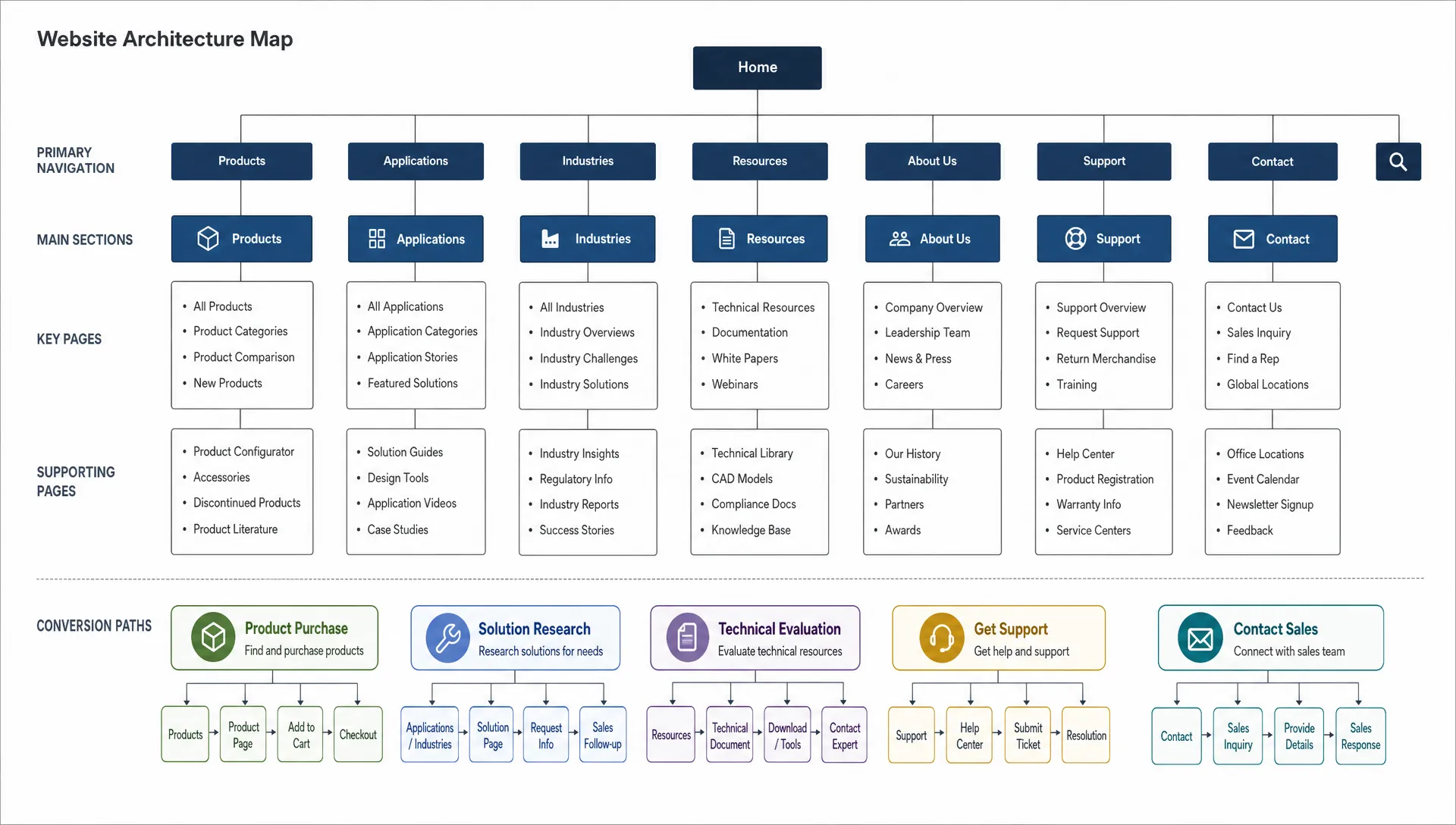
A website architecture map shows product pages, application pages, technical resources, and conversion paths for a complex B2B site.

Replace thin capability claims with proof

Many B2B websites say they are experienced, reliable or innovative. Those claims are not wrong, but they are rarely enough. Search engines and buyers both respond better to specific evidence.

Proof can include certifications, supported industries, materials handled, service regions, project examples, equipment capabilities, compliance requirements, turnaround expectations and practical FAQs. If confidentiality prevents naming customers, explain the type of project, constraint or environment instead.

Effective search optimization uses proof to strengthen both rankings and conversions. A page with clear technical depth is more likely to satisfy search intent, and a page with credible evidence is more likely to generate a qualified inquiry.

Align site architecture with how buyers evaluate options

A complex B2B website should not be organized only around how the company sees itself. It should reflect how buyers compare solutions. That means your navigation, page hierarchy and content hubs should match the way prospects search, evaluate and narrow choices.

If buyers search by industry, industry pages need depth. If they search by problem, application pages need to be easy to find. If they search by product type, category pages need enough substance to rank and convert.

This is where SEO and design decisions overlap. Navigation labels, template layouts, page modules, form placement and internal links all affect organic performance. The article on search engine optimization website design for better leads explores this connection in more detail.

The practical goal is simple: a visitor should know where they are, why the page matters and what to do next within a few seconds. A crawler should also be able to identify the relationship between your most important pages without guessing.

Prioritize technical performance where it affects lead quality

Technical SEO is not only about passing automated tests. For complex B2B sites, performance issues often show up as lost trust, lower crawl efficiency and poor form completion.

Good search optimization should include page speed, mobile usability, clean code, secure browsing, stable layouts, structured data where appropriate and accessible content. Large images, scripts from old tools, uncompressed PDFs and slow forms can all reduce performance.

Pay close attention to pages that receive high-intent traffic. If a visitor reaches a quote page, distributor page or product page from search, the experience should be fast and predictable. Forms should be clear. Phone numbers should be easy to find. Downloads should work. Pages should not shift while the visitor is reading or trying to submit information.

Also review JavaScript-rendered content. If important specifications, FAQs or internal links are difficult for search engines to access, the page may look complete to a human but incomplete to a crawler.

Use PPC, sales and CRM data to decide what comes next

SEO teams often work from keyword tools alone. Complex B2B companies usually have better data available, even if it is scattered across systems.

Paid search reports can reveal which terms attract serious buyers. Sales teams know which questions appear before a qualified opportunity. CRM data can show which industries, services or product categories produce the best-fit leads.

When that data informs search optimization, priorities become sharper. A page that ranks in position eight for a high-margin service may deserve more attention than a blog post that ranks in position three for a broad informational query.

This is also a good reason to review PPC and SEO together. If paid campaigns are converting for certain phrases, those phrases may deserve stronger organic landing pages. If organic pages attract traffic but no leads, the problem may be intent mismatch, weak conversion paths or insufficient proof.

Measure SEO by qualified movement, not pageviews

Traffic is useful, but it is not the final scorecard for a complex B2B website. A page can attract thousands of visitors and still fail if those visitors are students, job seekers or unqualified buyers.

A better scorecard includes organic inquiries, RFQs, form completions, assisted conversions, calls from organic landing pages, technical downloads, demo requests and movement from informational pages to commercial pages. For long sales cycles, assisted conversions and account-level engagement may be more meaningful than last-click attribution.

Mature search optimization also tracks content decay. Important pages can lose visibility when competitors publish better resources, when product details become outdated or when internal links change during site updates.

Review priority pages quarterly. Look for ranking changes, conversion changes, crawl errors, title duplication, content gaps and form performance. A complex website is never truly finished, but it can be managed with discipline.

A practical 90-day priority plan

A 90-day plan helps teams avoid overcommitting. The goal is not to repair every page. The goal is to create measurable progress on the pages most likely to influence revenue.

Timeframe Priority Outcome
Days 1 to 15 Identify business-critical pages, conversion paths and top organic entry points A ranked list of pages that deserve attention first
Days 16 to 30 Audit crawl, indexation, duplicate content and internal linking A technical cleanup plan tied to page priority
Days 31 to 60 Improve titles, headings, copy depth, proof points and calls to action on key pages Stronger intent match and clearer buyer paths
Days 61 to 75 Update navigation, internal links and content hub relationships Better topical clarity and page discovery
Days 76 to 90 Measure leads, rankings, assisted conversions and engagement quality A practical roadmap for the next optimization cycle

This plan works because it connects technical fixes with buyer behavior. It avoids the common mistake of treating SEO as a disconnected checklist.

Frequently Asked Questions

What is the first search optimization priority for a complex B2B website? Start with the pages that influence qualified leads and revenue. Once those pages are identified, review their crawlability, intent match, internal links, proof points and conversion paths.

Should a complex B2B site create more content or improve existing pages first? Improve existing high-value pages first if they already receive impressions, rankings or sales attention. New content is useful when it fills a real intent gap, not when it duplicates pages already on the site.

How often should B2B companies audit large websites? Priority pages should be reviewed at least quarterly. Larger technical audits may be scheduled twice a year, especially after redesigns, CMS changes, product launches or major navigation updates.

Why do complex B2B websites often have duplicate SEO problems? Duplicate issues usually come from similar product pages, copied service descriptions, URL parameters, old campaign pages or regional pages with minimal unique information. These issues dilute relevance and make page priority harder for search engines to understand.

Need a clearer path for your B2B website?

If your website has grown into a large mix of product pages, service pages, technical resources and legacy content, a focused SEO plan can help turn that complexity into a lead-generation advantage.

B2B Inbound Marketing helps businesses improve visibility through SEO, PPC, inbound strategy, content and web-related marketing services. If you need a practical review of what to fix first, start with a focused look at the pages that matter most to your pipeline.

A procurement lead and project manager review a comparison article and quote form in an industrial office.

How SEO Marketing Turns Industrial Expertise Into Pipeline

Industrial companies rarely suffer from a shortage of knowledge. They know their equipment, process controls, materials, tolerances, field conditions and compliance requirements. The problem is that buyers often cannot see that expertise until very late in the sales process. SEO marketing closes that gap by turning internal know-how into searchable content that attracts engineers, plant managers, procurement teams and executives before they are ready to request a quote.

In industrial markets, the buyer's first question is often technical, not promotional. Someone searches for a failure mode, a specification, a comparison between materials or a way to reduce downtime. If your website answers that question clearly, your company becomes part of the buying conversation earlier than competitors who only publish product brochures.

Why industrial expertise does not automatically become pipeline

Technical expertise usually lives in sales calls, engineering notes, maintenance manuals, project histories and the experience of senior people. That information helps close deals, but it does not create visibility if it remains offline or buried in PDFs that search engines and buyers struggle to use.

Industrial buyers also research with very specific language. A manufacturer looking for corrosion-resistant components may not search for a broad product category first. They may search by operating temperature, fluid type, standard, application or failure problem. A website that only says “high-quality solutions” misses the terms real buyers use when they have a concrete need.

This is why organic SEO remains essential for industrial companies that sell complex products or services. Search visibility gives your expertise a public path to the market. It turns answers you already provide privately into assets that can generate qualified demand over time.

How SEO marketing turns expertise into buyer-ready content

SEO marketing is most valuable for industrial firms when it does more than chase rankings. It should translate specialized knowledge into pages that match buyer intent, reduce uncertainty and guide prospects toward the next step.

Start with the problems buyers already search for

Good industrial content starts with the questions that appear before a purchase. These may include troubleshooting queries, product selection searches, safety concerns, capacity calculations or replacement questions. For example, a buyer may search “why pump seals fail in abrasive slurry” long before searching for a specific supplier.

The goal is not to publish generic educational content. The goal is to map your expertise to buying-stage questions. A top-of-funnel article can explain the problem, a comparison page can clarify options and an application page can show where your solution fits.

In industrial markets, SEO marketing works best when keyword research is paired with input from sales and technical teams. Sales can reveal objections. Engineers can explain constraints. Customer service can identify recurring problems. Search data then shows how buyers phrase those needs.

Translate technical depth into commercial proof

Industrial buyers need confidence. A page that explains a technical mechanism is useful, but a page that connects that mechanism to lower downtime, safer operation or better lifecycle cost is stronger. This is where expertise becomes pipeline instead of just information.

That translation matters because industrial buying decisions often involve multiple stakeholders. Engineering may care about performance, operations may care about reliability, finance may care about total cost and procurement may care about supplier risk. Teams that market complex products can learn from approaches like industrial marketing training for complex buying decisions, where stakeholder insight and trade-off thinking are central to better decisions.

A strong content program makes those trade-offs visible. Instead of saying a component is durable, explain the conditions that shorten service life, the design choices that improve reliability and the situations where one option is not the right fit. That kind of clarity builds trust.

Build a content architecture that mirrors the industrial buying process

A strong SEO marketing program does not rely on isolated blog posts. It organizes content around the way buyers move from problem recognition to vendor evaluation. Industrial prospects may take weeks or months to move through that journey, so your website needs useful entry points for each stage.

Buyer stage What the buyer needs Useful content type Pipeline role
Problem identification Understand the issue and its cost Troubleshooting guides, failure explanations Attracts early-stage qualified traffic
Solution exploration Compare approaches and constraints Application pages, material comparisons Builds preference and trust
Vendor evaluation Reduce risk and validate fit Case studies, capability pages, FAQs Supports sales conversations
Purchase justification Explain value to internal stakeholders ROI pages, lifecycle cost content Helps buyers make the business case

This structure helps buyers self-educate without removing the need for sales. In fact, it often improves sales conversations because prospects arrive with context. They know the issue, understand possible solutions and can ask more specific questions.

The architecture also helps search engines understand your topical depth. A manufacturer with connected content around applications, specifications, industries and problems sends a clearer signal than a site with scattered posts that do not support core service pages.

Make conversion paths match buyer readiness

Traffic does not become pipeline by accident. Once a buyer reaches a useful page, the next step must match their level of readiness. An engineer reading a technical guide may not want a sales call yet, but they may download a specification sheet, use a calculator or ask for application guidance.

SEO marketing should connect each content type to a conversion path that feels natural. Early-stage pages can invite readers to compare options or review a technical resource. Mid-funnel pages can offer product selection help. Bottom-of-funnel pages should make quote requests, consultations or proposal inquiries easy to find.

For industrial companies, the quality of the conversion matters more than the raw number of form fills. A small number of relevant inquiries from plant managers, engineers or procurement teams is usually worth more than a large volume of vague contacts. That is the same principle behind industrial lead generation that reaches real buyers, where the focus is on fit rather than vanity metrics.

A marketing specialist and engineer review a content map beside search notes and pipeline pages in a working office.

Use PPC, social and web design to strengthen organic pipeline

Search optimization is more effective when it is not treated as a separate channel. PPC can test which messages attract high-intent clicks. Social media can distribute technical content to niche audiences. A responsive website can make long-form content easier to read for buyers researching from job sites, airports or plant offices.

SEO marketing also benefits from paid search data because industrial keyword volumes can be small. A PPC campaign may quickly reveal which phrases bring serious prospects and which ones attract students, job seekers or unrelated buyers. Those insights can shape organic pages and improve conversion copy.

The website itself matters just as much. Slow pages, confusing navigation, weak calls to action and thin product information can waste qualified search traffic. Industrial buyers do not need flashy design, but they do need clarity, fast access to technical information and a path to contact someone who understands their application.

This is why SEO and online marketing work better together than as disconnected tasks. The strongest results come from aligning search visibility, paid campaigns, content, web design and conversion strategy around the same buyer journey.

Measure pipeline, not just rankings

Rankings are useful, but they are not the final measure of success. An industrial page can rank well for a broad term and still produce weak leads. Another page may draw fewer visitors but consistently attract high-value prospects because it matches a specific application or problem.

Good SEO marketing measurement connects search performance with business outcomes. Track which pages generate qualified inquiries, which topics appear in sales conversations and which organic leads progress into opportunities. If possible, connect form submissions and phone calls to CRM stages so marketing can see what becomes real pipeline.

Useful metrics include organic sessions from priority industries, conversions by page type, assisted conversions, quote requests, sales-qualified leads and opportunity value. Over time, these metrics show which expertise deserves more content investment.

A practical review rhythm can be simple. Each quarter, identify the pages that attract qualified visitors, the pages that rank but do not convert and the technical topics sales teams wish buyers understood sooner. That feedback loop keeps SEO tied to revenue instead of treating it as a reporting exercise.

Common mistakes that keep expertise from producing leads

The most common mistake is writing only about the company. Industrial buyers care about capabilities, but they usually begin with their own problem. Content that leads with “we are a leading provider” often misses the search intent behind real buying journeys.

Another mistake is making content too shallow. Buyers of industrial products can spot generic writing quickly. If a page could apply to any supplier in any industry, it probably will not build confidence. Specificity is an advantage when it explains materials, operating environments, tolerances, standards, service conditions or selection criteria.

Companies also lose pipeline when they hide useful information behind sales gates too early. Not every resource needs to be public, but buyers need enough detail to decide whether your company belongs on their shortlist. A balanced approach gives away practical guidance while reserving custom engineering, pricing and detailed recommendations for direct conversations.

Finally, many firms stop after publishing. SEO marketing requires maintenance because products change, competitors publish new content and buyer language evolves. Updating strong pages is often more valuable than constantly producing new pages with no clear purpose.

Frequently Asked Questions

How long does SEO marketing take to create industrial pipeline? Timelines vary by competition, website condition and content depth. Many industrial companies should think in quarters rather than weeks, especially when targeting technical topics and long sales cycles.

What type of industrial content generates the best leads? Application pages, troubleshooting guides, comparison pages and technical FAQs often perform well because they match specific buyer problems. The best format depends on how your buyers research solutions.

Should industrial companies use PPC while building SEO? Yes, PPC can create immediate visibility and provide keyword data while organic pages gain traction. It is especially useful for testing messaging in small or specialized markets.

Can SEO work for low-volume industrial keywords? Yes. Low-volume keywords can be highly valuable when they indicate a specific need, application or buying situation. One qualified inquiry from a narrow technical search can be worth far more than broad traffic.

Turn expertise into a searchable sales asset

Industrial firms already have the raw material for strong marketing: technical knowledge, field experience and proof that their solutions work. The opportunity is to make that expertise findable, understandable and connected to the buyer's next step.

If your company needs a practical plan for SEO, PPC, inbound strategy or web content that supports long industrial sales cycles, B2B Inbound Marketing in Houston can help turn search visibility into better conversations with real prospects.

Two coworkers review a service page, keyword list, and lead form as they plan SEO search engine optimization for B2B growth.

SEO Search Engine Optimization Basics for B2B Growth

For B2B companies, seo search engine optimization is the practical work of helping the right buyers find your business before they speak with a salesperson. It is not just about ranking for broad keywords. It is about showing up when an engineer, procurement manager, facility director or business owner is trying to define a problem, compare options or choose a vendor.

That distinction matters because B2B growth rarely comes from casual website visits. It comes from qualified prospects who trust what they find, understand your expertise and have a clear next step when they are ready to talk. The basics below focus on that kind of search visibility, the kind that supports pipeline instead of simply inflating traffic reports.

Start With the Economics of B2B Search Intent

B2B search is usually slower, more specific and more evidence-driven than consumer search. A buyer may search for a problem, a specification, a compliance need, a service type, a regional supplier or a comparison between two approaches. Each search represents a different stage of the buying journey.

In this context, seo search engine optimization begins with intent mapping. Before writing a page or changing a title tag, identify what the searcher is trying to accomplish. A plant manager looking for “industrial pump maintenance Houston” is much closer to vendor evaluation than someone searching “why pumps fail.” Both searches can matter, but they need different content.

For most B2B websites, useful keyword groups fall into a few practical categories: problem searches, solution searches, service searches, comparison searches and local or regional searches. The strongest SEO plans connect all of them, so early educational content can lead naturally toward service pages, case examples, inquiry forms or sales conversations.

Build a Technical Foundation Search Engines Can Read

A search engine has to find, crawl, understand and index your pages before those pages can generate leads. Technical SEO does not need to be mysterious, but it does need to be consistent. If your site loads slowly, hides important content, duplicates pages or blocks crawlers, strong writing alone will not solve the problem.

The technical side of seo search engine optimization includes site speed, mobile usability, clean navigation, secure HTTPS pages, crawlable internal links and indexable content. B2B websites often struggle here after years of small edits, plugin changes, product additions or redesigns that were not planned around search visibility.

SEO Search Engine Optimization Basics for Crawlability

An XML sitemap helps search engines discover the pages you want them to evaluate. It does not guarantee rankings, but it can make the structure of a website easier to process, especially when there are many service pages, articles or location pages. For example, an XML sitemap index can point search engines to separate sitemap files for posts, pages, services and other content types.

A robots.txt file, canonical tags and redirects also deserve attention. These elements tell search engines what to access, which version of a page should be treated as primary and where old URLs have moved. When they are misconfigured, good pages can disappear from search results or compete against each other.

Strengthen On-Page Signals Before Publishing More Content

Many B2B companies rush to publish new articles before fixing the pages they already have. That can waste effort. A service page with vague headings, weak metadata and unclear copy may be close to ranking, but it needs sharper relevance signals before it can perform.

Good on-page seo search engine optimization gives each important page a clear job. The title tag should reflect the search intent. The H1 should explain the page topic. Subheadings should organize the buyer’s questions. The body copy should describe the problem, the service, the audience, the process and the next step without forcing keywords into every paragraph.

Internal links are part of this work. They help search engines understand how pages relate to each other and they help visitors move through the site. If you want a practical checklist for improving existing pages, review these on-site SEO checks every B2B website needs and apply them to your highest-value service pages first.

Create Content That Builds B2B Trust

B2B content has to do more than answer a simple question. It needs to reduce uncertainty. Buyers are often comparing risk, vendor credibility, technical fit, budget impact and implementation complexity. Thin content will not support that decision.

For a B2B team, seo search engine optimization content should show subject matter depth. That can include use cases, process explanations, industry terminology, qualification criteria, maintenance considerations, buying checklists and answers to objections that sales teams hear every week.

The table below summarizes how common page types support the buyer journey.

Page type Best search intent Growth role
Educational article Problem research Attracts early-stage buyers and builds familiarity
Service page Vendor or solution evaluation Converts qualified visitors into inquiries
Comparison page Option evaluation Helps buyers understand tradeoffs and fit
Case study or project story Proof and risk reduction Builds confidence before a sales conversation
FAQ section Objection handling Clarifies details that might block conversion

A desk holds printed buyer journey maps and keyword clusters beside notes on SEO search engine optimization steps for B2B lead growth.

The best content often comes from inside the business. Sales calls, proposal questions, technical support issues and customer onboarding conversations reveal the language buyers actually use. Turning those questions into structured pages can produce content that is both search-friendly and genuinely useful.

Connect Rankings to Conversion Paths

Ranking is not the finish line. If a visitor lands on a page and cannot tell what you do, who you serve or how to take the next step, the ranking has limited business value. B2B SEO should be tied to conversion planning from the start.

This is where seo search engine optimization becomes part of lead generation rather than a separate marketing task. Each important page should have a logical next action. That could be requesting a proposal, calling the company, using a lead calculator, downloading a guide or moving to a more specific service page.

Calls to action should match the page intent. A high-level educational article may not need an aggressive sales pitch, but it should still guide the reader toward a relevant next step. A service page, on the other hand, should make it easy for a qualified buyer to contact you. For a deeper look at this connection, the article on SEO optimization strategies that support better lead flow explains how search visibility and conversion paths work together.

Use PPC and Organic SEO Together When It Makes Sense

SEO and PPC are often treated as separate channels, but B2B companies can learn faster when the two inform each other. Paid search can reveal which terms generate inquiries, which ad messages attract the right audience and which landing pages convert. Organic SEO can then use those insights to prioritize content and page improvements.

A balanced approach to seo search engine optimization does not mean ignoring paid media. It means understanding the role of each channel. PPC can create immediate visibility for high-value searches. Organic SEO builds durable visibility that can keep producing traffic and leads over time. If you are weighing that long-term value, this guide to organic search engine optimization for long-term growth offers a useful companion perspective.

For industrial and B2B service companies, the strongest results often come from coordinated planning: SEO pages that build authority, PPC campaigns that test demand and remarketing or social campaigns that keep the company visible during a long buying cycle.

Measure What Supports Real B2B Growth

Traffic is useful, but it is not the only metric that matters. A small number of qualified visitors can be more valuable than a large number of visitors who never become prospects. B2B measurement should focus on search visibility, lead quality and movement through the buyer journey.

A practical seo search engine optimization dashboard should separate leading indicators from business outcomes. Leading indicators show whether the work is gaining traction. Business outcomes show whether the effort is helping sales.

Metric What it tells you Why it matters
Indexed pages Whether search engines can access key content Visibility depends on discoverability
Organic impressions Whether pages are appearing for relevant searches Early signal before traffic grows
Organic clicks Whether searchers choose your result Measures relevance of titles and descriptions
Form submissions or calls Whether visitors take action Connects SEO to lead generation
Lead quality feedback Whether inquiries match your ideal customer Prevents traffic growth from becoming noise

Review these metrics monthly, but avoid changing strategy every few days. B2B search performance usually needs time because sales cycles are longer, competition can be specialized and trust-building content accumulates value gradually.

Put the Basics Into a 90-Day B2B SEO Plan

A 90-day plan keeps the work practical. Start with the pages that are closest to revenue, usually core service pages, industry pages and high-intent local pages. Fix technical issues that block crawling or conversion, then improve content depth and internal linking.

During the first month, audit the website, identify priority keywords by intent and repair obvious technical problems. During the second month, improve high-value pages and publish content that fills buyer journey gaps. During the third month, review early performance, refine calls to action and expand the topics that are showing signs of traction.

The goal of seo search engine optimization is not to complete a one-time checklist. It is to build a search presence that keeps improving as your website becomes clearer, more useful and more aligned with how real buyers search.

Frequently Asked Questions

Is SEO still useful for B2B companies with long sales cycles? Yes. Long sales cycles make search visibility more valuable because buyers often research quietly before contacting vendors. Strong SEO helps your company appear during those early research moments and again when the buyer is closer to making a decision.

How long does B2B SEO take to work? Timelines vary based on competition, website condition, content quality and search demand. Some technical and on-page fixes can show movement sooner, but meaningful B2B growth from organic search usually comes from consistent improvement over several months.

What is the difference between SEO and PPC for B2B growth? PPC buys visibility for selected searches, while organic SEO earns visibility through technical quality, relevance and authority. Many B2B companies benefit from both because PPC can create immediate data and SEO can build durable search presence.

Do small industrial companies need SEO? Yes, if buyers search online for their services, capabilities or location. A smaller company can compete by focusing on specific services, regional relevance, technical clarity and pages that answer the questions buyers ask before making contact.

What should a B2B company fix first? Start with the pages that have the strongest commercial value. Make sure they are crawlable, fast, clearly written and aligned with the search intent of qualified buyers. Then build supporting content around the problems and questions that lead buyers to those services.

Build a Search Foundation That Supports Better Leads

If your website is attracting the wrong visitors or relying too heavily on referrals and paid traffic, a focused B2B search strategy can create a more dependable path to qualified inquiries. Andy Alagappan’s Houston-based inbound marketing work brings SEO, PPC, web content and campaign strategy together around visibility, rankings and lead generation.

The right next step is to evaluate where your current website stands: what searchers can find, what they understand when they arrive and whether the page gives them a reason to act. From there, SEO becomes a growth system instead of a guessing game.

A marketing director and sales manager review SEM and SEO plans beside a quote request form in a conference room.

Search Engine Marketing and Search Engine Optimization Compared

When leadership asks where the next marketing dollar should go, search engine marketing and search engine optimization often end up in the same conversation. That makes sense. Both are designed to put your company in front of people who are already using search engines to solve a problem, compare suppliers or request pricing. The difference is how fast you show up, how you pay for visibility and what kind of long-term asset you build.

For B2B and industrial companies, this comparison should not be reduced to “paid versus free.” SEO is not free once you account for strategy, content, technical work and ongoing maintenance. PPC is not simply expensive traffic if it is connected to buyer intent, landing pages and lead qualification. The real value of comparing search engine marketing and search engine optimization is knowing when each one supports revenue, not just rankings or clicks.

The practical difference in one sentence

Search engine marketing, often called SEM, usually refers to paid visibility in search results today. In practice, that means paid search ads in platforms such as Google Ads or Microsoft Advertising. Your company bids on keywords, writes ads, sends visitors to a landing page and pays when someone clicks.

Search engine optimization, or SEO, focuses on earning unpaid visibility in organic search results. That work includes technical site improvements, content creation, internal linking, authority building, page speed, user experience and ongoing updates to keep pages useful.

Historically, SEM was sometimes used as a broad umbrella for all search marketing, including SEO. In modern marketing conversations, most teams use SEM to mean paid search. That is the definition this article uses.

Comparison point SEM, paid search SEO, organic search
Visibility speed Often fast after launch Usually slower, often months
Cost model Pay per click, plus management Pay for strategy, content and implementation
Control High control over keywords, copy and targeting Less direct control over ranking timing
Longevity Traffic stops when spend stops Strong pages can keep attracting traffic
Best use Testing, urgent demand and specific offers Compounding visibility and authority

For most B2B teams, search engine marketing and search engine optimization should be compared by business purpose. A campaign for emergency part replacement, for example, may need paid search immediately. A technical article explaining how to choose a pump, valve, coating, material or service provider may be better suited to SEO because buyers revisit educational content throughout a longer sales cycle.

Where SEM wins

SEM is strongest when speed, targeting and message control matter. If your company is launching a new service line, entering a new regional market or promoting a time-sensitive offer, paid search can put you in the results before organic pages have had time to gain traction.

It is also useful for keyword testing. A company may think that prospects search for “industrial filtration systems,” but paid campaigns might reveal that better leads come from more specific phrases tied to applications, materials, compliance needs or replacement cycles. That information can later shape SEO content.

SEM works best when it is not treated as a traffic faucet. The click is only the first step. The landing page has to match the query, explain the offer, build trust and make the next action clear. For complex B2B purchases, that action may not be “buy now.” It may be requesting a quote, downloading a specification sheet, scheduling a consultation or asking an engineer to review a requirement.

Where SEO wins

SEO is strongest when your buyers research before contacting sales. Industrial and B2B search behavior often includes technical questions, comparison searches, vendor qualification searches and problem-based searches. A well-structured website can meet those searches with product pages, application pages, service pages, case content and technical explainers.

Search engine marketing and search engine optimization differ most clearly in how they create value over time. A paid search ad can produce leads quickly, but every visit has a media cost. A strong organic page may require more work up front, but it can continue attracting qualified visitors long after publication if it remains accurate and competitive.

SEO also supports trust. When buyers repeatedly find your company while researching a topic, they start to associate your brand with competence. That does not replace sales outreach, trade shows or referrals, but it gives those efforts a stronger foundation. If your team needs a clearer business-facing explanation, this guide to an SEO definition marketing teams can use to make decisions is a useful companion.

Cost, risk and timeline

SEM and SEO both require budget discipline, but they carry different financial risks. With SEM, waste usually shows up quickly. If campaigns target the wrong queries, use broad match without controls or send visitors to weak landing pages, the budget can disappear without creating qualified opportunities.

With SEO, waste can be quieter. A company may publish months of content that attracts visitors who will never buy, or it may redesign a site without protecting existing rankings. Technical issues can also limit performance even when the content is strong.

Factor SEM consideration SEO consideration
Early learning Data can arrive quickly Insights build over time
Budget pressure Spend is visible every day Costs are spread across workstreams
Main waste risk Paying for low-intent clicks Creating content with no buyer fit
Long-term value Depends on continued spend Can compound if maintained
Reporting focus Cost per lead and lead quality Rankings, organic leads and assisted pipeline

A practical plan acknowledges both timelines. Paid search can cover urgent demand and test messages. SEO can build the durable presence that reduces overdependence on paid traffic later.

How search engine marketing and search engine optimization work together

The best search strategies do not force SEM and SEO into separate silos. Paid search data can identify which terms convert, which messages earn clicks and which offers attract qualified inquiries. SEO data can reveal recurring questions, high-performing topics and pages that already show organic promise.

When search engine marketing and search engine optimization are planned together, the company can avoid paying forever for every click while also avoiding the mistake of waiting six months for demand that paid search could capture today. For example, PPC can support high-value keywords while SEO content is being built. Once organic pages start ranking, paid spend can shift toward tests, competitive terms or keywords where organic results are difficult to win.

This integrated approach also improves sales alignment. If both paid and organic campaigns are mapped to the same buying stages, sales teams can see which inquiries came from early research, which came from urgent vendor searches and which came from comparison terms. For a deeper look at budget coordination, see this guide on using PPC and SEO together without wasting budget.

A conference room table holds keyword maps, ad notes, organic content plans, and lead quality reports for a B2B search strategy.

Choosing the right mix for B2B and industrial markets

The right mix depends on market maturity, sales cycle length, competition, margins and urgency. A startup with no organic visibility may need SEM to generate immediate learning. A mature industrial supplier with a deep product catalog may gain more from technical SEO, improved site architecture and stronger application pages.

Search engine marketing and search engine optimization should also be shaped by geography. A Houston industrial service company may care about regional visibility, facility proximity and local buyer trust. A national manufacturer may care more about product category terms, distributor searches and technical specifications.

The same intent logic applies outside industrial markets. A local healthcare provider like a Manhattan pain relief and chiropractic clinic needs pages and campaigns that match urgent, location-specific searches, just as a Houston manufacturer needs pages that match process-specific industrial queries. Search intent changes by industry, but the discipline stays the same: match the searcher’s problem, location, urgency and decision stage.

A simple decision framework

Before assigning budget, start with the searcher’s intent. A keyword that signals immediate vendor selection deserves different treatment than a keyword that signals early education. The mistake many companies make is judging every keyword by search volume alone.

Use these questions to guide the mix:

  • How soon do we need leads? If the answer is this month, SEM may need to play a larger early role.
  • Do we already have authority in this topic? If yes, SEO improvements may generate faster gains than starting from zero.
  • Is the keyword expensive because it is valuable or because it is broad? High CPC is not automatically bad, but low intent is.
  • Can sales handle the inquiries we generate? More leads are not useful if they are poorly qualified.
  • Do we have pages that deserve to rank? If not, SEO requires content and technical work before it can perform.

A balanced plan may use paid search for bottom-of-funnel terms, SEO for educational and comparison content and remarketing or follow-up campaigns for visitors who are not ready to contact sales. The proportions can change as data improves.

What to measure beyond clicks

Clicks are easy to count, but they do not prove marketing performance. For B2B and industrial companies, better reporting connects search activity to lead quality, opportunity creation and revenue influence. That means looking at form submissions, phone calls, quote requests, conversion rates, sales acceptance and closed opportunities where possible.

Search engine marketing and search engine optimization should be judged with different primary metrics, but the final business question is the same: are we attracting the right people and helping them move toward a buying decision?

For SEM, watch cost per qualified lead, wasted spend, impression share on priority terms, conversion rate by landing page and lead quality by campaign. For SEO, watch organic leads, rankings for commercially relevant terms, growth in non-branded traffic, engagement on key pages and assisted conversions.

Attribution will rarely be perfect, especially in long sales cycles. A buyer may discover your company through an organic article, return through a paid ad, talk to sales after a referral and convert months later. The goal is not perfect credit assignment. The goal is enough visibility to invest more in what is clearly helping and stop funding what is not.

If you are evaluating outside support, a good agency conversation should focus on lead quality rather than traffic volume alone. This article on search engine marketing services that deliver better leads expands on that distinction.

Common mistakes when comparing the two

One common mistake is assuming SEO is only content. Content matters, but technical structure, internal links, crawlability, page experience and site architecture all affect performance. A helpful article buried on a confusing website may never reach its potential.

Another mistake is treating SEM as a shortcut around weak positioning. Paid search can place your offer in front of the right person, but it cannot make an unclear offer persuasive. If the ad, landing page and sales follow-up do not align, the campaign will struggle.

A third mistake is separating teams too much. If PPC managers, SEO specialists, web developers and sales leaders never share data, each channel makes decisions with partial information. Search works better when the team agrees on priority markets, buyer language, qualification criteria and follow-up expectations.

FAQ

Is SEM better than SEO? SEM is better for speed, testing and controlled targeting. SEO is better for compounding visibility, authority and long-term organic traffic. Most B2B companies need both at different stages.

How long does SEO take compared with paid search? Paid search can begin generating traffic soon after launch, assuming the campaign and landing pages are set up correctly. SEO usually takes longer because search engines need to crawl, evaluate and rank pages against competitors.

Should a small B2B company start with SEM or SEO? If the company needs immediate leads and has a clear offer, SEM can produce faster learning. If the sales cycle is research-heavy and the company has limited budget for ongoing clicks, SEO may deserve earlier investment.

Can search engine marketing and search engine optimization use the same keywords? Yes, but they do not always need to. Some keywords are worth targeting with both paid and organic visibility. Others may be too expensive for paid search but ideal for SEO, or too urgent to wait for organic rankings.

What is the biggest sign the strategy is working? The strongest sign is not simply more traffic. It is more qualified inquiries from the types of buyers your company can serve profitably.

Need a clearer search strategy?

Search engine marketing and search engine optimization are not competing tactics. They are different ways to reach buyers who are already expressing intent. The strongest strategy uses SEM for speed, testing and targeted demand capture, while SEO builds the authority and visibility that support long-term growth.

For Houston B2B and industrial companies, the right answer depends on your market, sales cycle, website condition and lead goals. Andy Alagappan’s team supports SEO, PPC, inbound marketing strategy, web content and related search marketing services for businesses that need more than traffic. They need better opportunities from the right searchers.

A manager compares search results, customer email, and a service brochure in an office.

How to Choose SEO Key Words That Attract Qualified Buyers

Choosing SEO key words is not just about finding phrases with high search volume. For B2B, industrial and service businesses, the real goal is to attract people who have a defined problem, a budget path and a reason to talk to a supplier. Traffic matters only when it can become qualified inquiries, sales conversations and revenue.

Many keyword lists fail because they are built from tools first and buyers second. A keyword tool can show demand, difficulty and related phrases, but it cannot tell you whether a searcher is a plant manager looking for a vendor, a student doing homework or a competitor checking the market. That judgment has to come from business context.

Why buyer intent matters more than raw search volume

A broad phrase can look attractive because thousands of people search it every month. The problem is that broad phrases often include mixed intent. Some searchers want definitions, some want a quick answer, some want images and only a small percentage may be evaluating a vendor.

For companies with long sales cycles, niche products or technical buyers, lower-volume searches often produce better opportunities. A phrase such as “industrial pump repair company Houston” will never win a volume contest against “pump repair,” but it reveals location, service need and likely commercial intent.

High-volume phrases can hide low-fit traffic

If your sales team cannot serve most of the people behind a keyword, that keyword is not a priority. A national manufacturer, local industrial service firm and software consultant may all see the same phrase in a keyword tool, but the value of that phrase depends on who is searching and what they need next.

A better question than “How many people search this?” is “Would we want a sales conversation with this person if they converted?” That shift turns keyword research into lead-quality planning instead of traffic chasing.

A practical framework for SEO key words that bring sales-ready traffic

The best keyword strategy starts by sorting searches by intent. In most B2B markets, searches fall into three practical groups: learning, evaluating and buying. Each group can support growth, but they should not be treated the same.

Search intent What the buyer is trying to do Example phrase pattern Best content type
Educational Understand a problem or method how to reduce equipment downtime Blog article or guide
Evaluation Compare options, vendors or approaches predictive maintenance software vs manual inspections Comparison page or detailed article
Purchase intent Find a provider, quote or solution industrial maintenance company near me Service page or landing page

Educational terms can build trust early. Evaluation terms help buyers narrow options. Purchase-intent terms usually deserve the strongest conversion path, including proof, clear calls to action and fast access to a proposal or consultation.

If you want a broader step-by-step process for research mechanics, this guide on how to choose keywords for search engine optimization covers the foundation. The framework here focuses specifically on choosing terms that are more likely to attract qualified buyers.

Start with buyer problems, not keyword tools

The strongest SEO key words often come from sales calls, proposal requests, customer emails and service conversations. Tools can expand the list later, but real buyer language shows how prospects describe pain before they know your preferred terminology.

A manufacturer may talk about “asset reliability,” while the buyer searches “machine keeps shutting down.” A cybersecurity consultant may sell “managed detection and response,” while the prospect searches “how to know if our network was breached.” Both versions matter, but the buyer’s words are usually better for early discovery.

Mine the language closest to revenue

Look at recent inquiries and closed deals. What problems did the best customers mention before they bought? What phrases appeared in request-for-quote forms? What questions came up repeatedly in sales meetings?

You can also review industry forums, customer support notes and PPC search terms if you are running paid campaigns. PPC data is especially useful because it shows the exact queries that produced clicks and conversions, not just estimated keyword demand.

In certification training, for example, a search for “what is cloud computing” is broad and early-stage, while a search for “AWS practice questions” or “certification readiness tracking” suggests a learner closer to taking action. A platform offering certification exam prep and practice tests would naturally prioritize the second type of language because it connects to a specific goal and a clearer conversion path.

Separate educational, evaluation and purchase-intent terms

A common mistake is expecting every article to produce immediate leads. Some terms educate. Some nurture comparison. Some capture active demand. You need all three in a mature SEO program, but you should know the job of each keyword before writing the page.

For B2B companies, the buying journey is rarely one search and one form fill. A prospect may read a technical guide, return later through a comparison search and convert after visiting a service page. That is why keyword mapping matters.

Match the page type to the decision stage

Educational searches usually need clear explanations and practical insight. Evaluation searches need trade-offs, use cases, selection criteria and proof. Purchase searches need trust signals, service clarity, location relevance if applicable and a frictionless way to take the next step.

If your company uses a blog as part of its growth strategy, this article on building an SEO blog that attracts qualified buyers explains how topic planning can support the full buyer journey.

A marketing strategist reviews a keyword map with educational, evaluation, and purchase search categories that connect SEO key words to qualified leads.

Qualify SEO key words before you commit resources

Before you assign writers, designers or developers to a page, qualify the keyword like you would qualify a lead. A phrase may be relevant, but still not worth immediate investment if the buyer fit is weak, the sales value is low or the search results do not match your offer.

Use a simple review process before you add a term to your content plan:

  • Business fit: The searcher has a problem your company actually solves.
  • Buyer role: The likely searcher has influence over research, recommendation or purchase.
  • Commercial path: The term can lead naturally to a service, consultation, demo, quote or proposal.
  • Content match: You can create a page that satisfies the search better than current results.
  • Proof available: You have examples, experience, technical knowledge or process detail to make the page credible.

This filter prevents your SEO plan from filling up with topics that look useful in a spreadsheet but never move a serious prospect closer to contact.

Prioritize SEO key words by fit and conversion value

Once you have a qualified list, the next step is prioritization. Search volume still matters, but it should be one factor among several. In a niche B2B market, a term with 30 searches per month can be valuable if five of those searches come from the right buyers.

A lightweight scoring model can help your team make consistent decisions without overcomplicating the process.

Factor What to evaluate Score from 1 to 5
Buyer fit Does the search likely come from your ideal customer profile? Low to high fit
Intent strength Is the searcher learning, comparing or ready to act? Informational to purchase-ready
Revenue potential Could this query lead to a meaningful deal? Low to high value
Ranking realism Can your site compete with the current results? Difficult to realistic
Content advantage Can you offer better detail, clarity or proof? Weak to strong advantage

The score is not meant to replace judgment. It gives marketing, sales and leadership a shared way to discuss priorities. A keyword with modest volume but strong buyer fit, high deal potential and realistic competition should often outrank a broad phrase with weak intent.

Use sales value to break ties

When two terms appear equal, choose the one closer to revenue. If one phrase attracts researchers and another attracts buyers asking about pricing, implementation, service areas or vendor criteria, the second phrase should usually move higher in the plan.

That does not mean ignoring top-of-funnel content. It means your production calendar should not be dominated by topics that educate people your company will never sell to.

Use SERP evidence before writing the page

Search engine results pages show what Google believes searchers want. Before targeting SEO key words, review the current results manually. Do not rely only on difficulty scores.

Look at the page types that already rank. Are they how-to guides, product pages, local service pages, comparison articles, videos or directories? If every result is a beginner guide, a hard-sell service page may struggle. If the results are filled with vendors and quote pages, a general educational article may not match intent.

Check for signs of qualified demand

The search results can also reveal whether a phrase has commercial weight. Ads, vendor pages, review sites, comparison pages and pricing discussions all suggest that companies are willing to compete for that demand. That does not automatically make the term right for you, but it deserves attention.

You should also note the language competitors use. Are they emphasizing speed, compliance, local response, technical depth, certifications, cost savings or long-term support? Those themes can help you understand what buyers may be comparing before they contact anyone.

Build pages that answer the buyer’s next question

Choosing the right phrase is only half the job. The page also has to move the visitor forward. If the keyword suggests a technical problem, the content should explain the problem, show the consequences, describe solution options and make the next step obvious.

For B2B and industrial pages, generic writing is a common conversion killer. Buyers want to know whether you understand their environment, constraints and decision process. A page that ranks but fails to create confidence will produce traffic without inquiries.

Strong conversion-focused SEO content usually includes:

  • A clear explanation of the problem the buyer searched for.
  • Evidence that your company understands the buyer’s industry or use case.
  • Practical criteria for making a decision.
  • A natural path to contact, quote request, consultation or next resource.

For more on turning search visits into actual inquiries, see these copywriting SEO tips that turn visits into inquiries.

Measure lead quality, not just rankings

A keyword can rank well and still be the wrong keyword. That is why reporting should connect search performance to business outcomes when possible. Rankings, impressions and clicks are useful early indicators, but qualified inquiries, sales-accepted leads and pipeline influence matter more.

Review which pages generate form fills, phone calls, proposal requests and meaningful sales conversations. Then compare those outcomes with the original search intent. You may find that some high-traffic articles support awareness but rarely produce leads, while a smaller service page consistently attracts better-fit prospects.

This feedback should change your keyword priorities over time. Keep investing in terms that attract real buyers. Improve pages that bring traffic but lose visitors. Retire or deprioritize terms that produce poor-fit inquiries.

Common mistakes when choosing SEO key words

The most costly keyword mistakes are usually strategic, not technical. Businesses often choose terms because competitors rank for them, because a tool reports high volume or because internal teams prefer industry jargon.

Avoid these traps:

  • Chasing broad terms before owning specific buyer-intent phrases.
  • Ignoring location, industry, application or buyer-role modifiers.
  • Treating every keyword as a blog topic instead of matching page type to intent.
  • Writing for search engines without giving buyers a clear next step.
  • Measuring success only by rankings instead of lead quality.

Good keyword strategy is selective. It says no to weak-fit traffic so your team can say yes to searches that match your market, offer and sales process.

Frequently Asked Questions

How many SEO key words should one page target? One page should usually focus on one primary search intent, supported by closely related phrases. If two phrases reflect different buyer needs, they likely deserve separate pages.

Are low-volume keywords worth targeting for B2B companies? Yes, if the searcher is a strong fit and the term connects to a valuable product or service. In specialized markets, low-volume searches can produce better leads than broad, high-volume phrases.

Should service pages or blog posts target buyer-intent searches? It depends on the search results and the buyer’s need. Purchase-intent phrases often fit service pages or landing pages, while educational phrases usually fit blog posts or guides.

How often should a company review its keyword strategy? Review priority terms at least quarterly, especially if your market, services, competitors or sales goals change. Lead-quality data should guide updates more than rankings alone.

Turn keyword selection into qualified lead flow

Choosing SEO key words that attract qualified buyers requires more than a keyword tool. It takes knowledge of your buyers, a clear view of search intent, honest prioritization and content that helps the right prospect take the next step.

For Houston B2B, industrial and service companies, the opportunity is not to rank for every possible phrase. It is to build a search presence around the problems, comparisons and purchase signals that matter to your best customers. If you want that strategy connected to SEO execution, content and lead generation, see how SEO services help B2B firms win better leads.

A content calendar shows blog topics, search intent notes, and next-step links for B2B lead generation.

How Blog and SEO Work Together to Generate B2B Leads

For B2B and industrial companies, the phrase “blog and seo” may sound like a content marketing basics topic, but the real value appears when both are built around lead quality. A blog gives your company a place to answer buyer questions in depth. SEO helps the right buyers find those answers when they are actively researching a problem, supplier, process or solution.

That pairing matters because B2B buyers rarely convert after one search or one page visit. They compare options, ask technical questions, review credibility signals and look for evidence that a vendor understands their industry. A well-planned blog gives them that evidence, while SEO connects each post to a real search need.

How blog and seo work together in B2B lead generation

A blog without SEO can become a library nobody visits. SEO without useful content can generate impressions but fail to create trust. Together, they form a practical lead generation system: discover what buyers are searching for, publish useful answers, guide readers to the next step and measure which topics produce qualified inquiries.

This is especially important in B2B markets where search volume may be lower than consumer markets, but buyer value is higher. A niche industrial query might attract fewer visitors, yet one good lead can justify months of content investment.

The blog creates depth and authority

Your website’s core service pages should explain what you do, who you serve and why a buyer should contact you. Blog content can go deeper. It can explain common failures, compare approaches, define technical terms, answer procurement questions and show how your team thinks.

When blog and seo are planned together, each article becomes more than a post. It becomes a targeted entry point for a specific buyer question, often earlier in the decision process than a service page can reach.

SEO connects that depth to demand

SEO gives structure to blog planning. Instead of writing only about company news or broad industry opinions, you can identify queries that reflect real buyer intent. Some searches reveal early education needs, such as “how to reduce downtime in manufacturing.” Others show evaluation intent, such as “industrial marketing agency for manufacturers.”

The goal is not to chase every keyword. The goal is to match business priorities with search intent, then create content strong enough to earn attention from the right companies.

Why B2B buyers respond to helpful search content

Most B2B buyers want to reduce risk before they talk to sales. They look for vendors who understand their constraints, speak their language and can explain options clearly. A strong blog helps your company show that expertise before a form fill or phone call happens.

In industrial and technical markets, this can be even more valuable. Buyers may need to justify decisions internally, compare specifications or educate non-technical stakeholders. If your blog helps them do that, your company becomes part of their buying process earlier.

Search intent is the bridge between traffic and leads

Not all traffic is equally valuable. A blog post that attracts students, job seekers or broad curiosity clicks may look good in analytics but produce little revenue. A post that answers a specific operational, purchasing or technical question may bring fewer visits but better sales conversations.

That is why blog and seo should be evaluated by lead relevance, not just rankings. The best content strategy attracts people who match your ideal customer profile and gives them a clear reason to continue.

Buyer intent stage Typical search behavior Blog content that supports leads
Problem awareness Searches symptoms, risks or causes Educational guides, issue explainers, troubleshooting posts
Solution research Compares methods or service types Comparison articles, process breakdowns, strategy posts
Vendor evaluation Looks for proof, fit and expertise Case-focused posts, service explainers, industry-specific pages
Decision support Needs internal justification ROI discussions, checklists, implementation guides

Turning blog traffic into a lead path

Getting a visitor to your blog is only the first step. To generate B2B leads, the page must help the reader move from information gathering to action. That does not mean every post should push a hard sales message. It means each article should offer a logical next step based on the reader’s intent.

For example, a top-of-funnel post might point readers to a more detailed guide. A middle-of-funnel post might invite them to review an SEO service page, a website redesign resource or a consultation form. The path should feel helpful rather than forced.

If your team is still defining the foundation, a guide on how to build an SEO blog that attracts qualified buyers can help align topics with the actual questions prospects ask before they contact a vendor.

Use calls to action that match the reader’s readiness

A visitor reading a basic educational post may not be ready to request a proposal. They may be ready to download a checklist, read a related article or compare solution options. A visitor reading a specific service-related post may be much closer to a sales conversation.

Blog and seo perform better when calls to action reflect that difference. Instead of using the same CTA everywhere, match the offer to the intent of the page.

A B2B marketing team maps blog topics, buyer intent, lead forms, and sales follow-up on a whiteboard.

Strengthen the page around conversion signals

The blog post itself should be easy to scan, technically sound and connected to relevant pages on your site. Include clear headings, helpful examples, internal links and visible next steps. If the content discusses a service you offer, link naturally to a page that explains that service in more detail.

For instance, companies that want a deeper look at how search visibility turns into inquiries can review how search engine optimization services drive B2B leads. That kind of internal path helps readers continue learning while giving search engines a clearer view of your site structure.

The lead generation loop after a form fill

A blog can influence a buyer long before they submit a form, but the handoff after conversion is just as important. If someone downloads a resource, asks a question or requests information, the follow-up should reflect what they were reading and what problem they likely want to solve.

This is where blog and seo connect with inbound marketing operations. The article brings in the right visitor, the form captures interest and the follow-up process helps determine whether the lead is a fit.

Segment leads by topic and intent

A form submission from a pricing-related page should not be treated the same as a newsletter signup from an educational article. Topic, page type and CTA all provide useful signals. A reader who spends time on multiple posts about industrial SEO may need a different follow-up than someone researching responsive web design or PPC management.

Basic segmentation can help sales teams prioritize outreach. It also helps marketing teams understand which content themes attract serious buyers instead of casual readers.

Add automation without losing the human touch

Marketing automation can help with prompt follow-up, lead routing and nurturing, but it works best when the workflows are simple and tied to clear goals. For smaller B2B companies, it is usually better to start with a few practical triggers than to build a complex system nobody maintains.

A useful next step is reviewing these marketing automation scenarios for SMEs, which explain practical workflows such as form follow-up, qualification, routing, nurturing and reactivation. Those scenarios fit well with a blog-driven lead generation strategy because they turn content engagement into timely action.

What to measure when blog and seo support B2B leads

Rankings matter, but they should not be the only scoreboard. A blog post that ranks well but never contributes to a lead path may need a stronger CTA, better internal links or a clearer connection to buyer intent. A post with modest traffic may be highly valuable if it influences qualified prospects.

The best measurement approach combines SEO visibility, engagement and lead quality. That means looking beyond pageviews and asking whether the content helps the sales pipeline.

Metric What it tells you Why it matters for B2B
Organic impressions Whether search engines are showing the content Helps identify visibility opportunities
Organic clicks Whether searchers choose your result Shows title and meta relevance
Engagement on page Whether readers find the content useful Signals topic fit and content quality
Assisted conversions Whether content contributes before a lead form Captures influence across a longer buying journey
Lead quality Whether inquiries match ideal customers Keeps the strategy tied to revenue potential

Review content by business value

A quarterly content review can reveal which posts deserve updates, which need better conversion paths and which should be consolidated. B2B industries change, customer questions evolve and competitors publish new content. Your blog should not sit untouched after publication.

If content is attracting the wrong audience, revisit the keyword target and search intent. If it is attracting the right audience but not converting, review the CTA, internal links and page experience. Strong SEO content writing for B2B conversions keeps the reader’s business problem at the center rather than writing only for search engines.

Common mistakes that weaken the strategy

Many companies invest in blogging but never connect it to a real SEO or lead generation plan. They publish sporadically, choose topics based on internal preferences or write posts that answer questions their customers are not asking. Over time, the blog becomes an archive rather than a growth asset.

Another common mistake is treating blog content as separate from the rest of the website. A post should support service pages, product pages, contact points and sales conversations. If a reader finishes the article and has nowhere useful to go, the content has done only half its job.

Avoid writing for volume alone

High publishing frequency is not a strategy by itself. A smaller number of well-researched posts can outperform a large batch of thin content, especially in specialized B2B markets. Each article should have a purpose: attract a defined audience, answer a meaningful question and guide the reader toward a next step.

Blog and seo work best when quality, structure and business relevance are treated as one system. That system should help buyers understand their problem, evaluate their options and recognize your company as a credible resource.

Frequently Asked Questions

How long does it take for a blog to generate B2B leads through SEO? It often takes several months for SEO-driven blog content to gain traction, especially in competitive markets. Timing depends on site authority, content quality, technical SEO, keyword difficulty and how well the posts are connected to conversion paths.

Should every B2B blog post target a keyword? Every post should have a clear search or buyer intent, but not every article needs to chase a high-volume keyword. Some valuable posts answer niche questions that produce fewer visits but stronger leads.

How often should a B2B company publish blog content? Consistency matters more than raw frequency. Many B2B companies do better with two high-quality, strategically planned posts per month than with weekly posts that lack depth or intent.

Can blog and seo support paid search campaigns too? Yes. Blog performance can reveal buyer questions, objections and wording that improve PPC landing pages and ad messaging. PPC data can also show which topics convert quickly enough to deserve more organic content investment.

Build a blog that brings in better B2B leads

A successful B2B blog is not just a publishing calendar. It is a search-driven lead generation asset that helps buyers find you, trust you and take the next logical step. When SEO guides topic selection and blog content supports buyer education, your website becomes more useful to prospects and more valuable to your sales team.

If your company needs help connecting content, SEO, PPC and inbound strategy, B2B Inbound Marketing in Houston can help you build a stronger path from search visibility to qualified leads.