
SEO gets the credit for rankings, but rankings are only one part of how a business wins online. A potential customer still has to recognize your company, trust your expertise, understand your offer, compare options and decide to take the next step. That is where SEO and online marketing work better as one system rather than separate activities.
For B2B and industrial companies, this matters even more. Buyers often research quietly before contacting sales. They search for technical answers, visit several vendor websites, compare capabilities and look for proof that a company understands their industry. SEO helps them find you. Online marketing helps keep them engaged long enough to become a qualified lead.
The difference between SEO and online marketing
SEO, or search engine optimization, focuses on improving organic visibility in search engines. It includes keyword research, technical optimization, content planning, on-page improvements, internal linking, local signals and authority building. A clear SEO program helps your pages appear when prospects search for problems, products, services or suppliers related to your business.
Online marketing is broader. It includes SEO but also pay-per-click advertising, social media marketing, inbound campaigns, video marketing, landing pages, web content, email nurturing, conversion optimization and website design. These channels work together to move a prospect from initial awareness to a sales conversation.
If your team is still treating SEO as a technical checklist, it may help to rethink the role of search in business decisions. A practical SEO definition marketing teams can use connects keywords, content and rankings to lead quality, sales intent and revenue opportunities.
Why SEO alone rarely captures the full opportunity
SEO is powerful because it compounds over time. A strong technical foundation and useful content can continue attracting qualified visitors long after the page is published. The challenge is that organic traffic does not automatically become pipeline.
A visitor may read one article and leave. A purchasing manager may bookmark your page and return weeks later. An engineer may share a product page internally but never fill out a form. A business owner may search your company name after seeing your ad, social post or video. If your marketing systems are disconnected, those touchpoints are easy to miss.
SEO brings search intent into your website. Online marketing turns that intent into a connected experience. Paid campaigns can test messages quickly. Social media can reinforce credibility. Video can explain complex services. Web design can guide visitors toward the right action. Content can answer objections before sales gets involved.
The real advantage is not choosing between SEO and other marketing channels. The advantage comes from making each channel better because of what the others reveal.
How integrated search and online marketing multiply results
Buyer intent becomes the campaign foundation
Search data shows what your market is asking for. It reveals pain points, product terminology, local modifiers, comparison terms and industry language. When SEO research is shared across the marketing team, those insights can shape much more than web pages.
The same buyer intent can inform PPC campaigns, landing page copy, social content, video topics, sales enablement material and lead magnet ideas. For example, if prospects frequently search for emergency pump repair in Houston, that phrase is not only an SEO target. It can become a paid ad group, a service page, a short explainer video and a social post that speaks directly to plant managers dealing with downtime.
PPC accelerates what SEO learns slowly
SEO often takes time because search engines need to crawl, index and evaluate content. PPC can produce feedback faster. Ad campaigns show which keywords attract clicks, which messages generate form submissions and which landing pages convert at a profitable rate.
That paid search data can improve SEO priorities. If a phrase converts well in PPC, it may deserve a stronger organic landing page. If a headline increases paid conversions, it may also improve organic page titles or meta descriptions. If a keyword burns budget without qualified leads, it may not be worth heavy SEO investment.
For businesses weighing both channels, the benefit is not just more traffic. A combined approach improves decision-making, which is why SEO and PPC campaigns often perform better together than either channel does in isolation.
Content builds trust after the click
Search visibility gets a prospect to your website, but content gives them a reason to stay. This is especially true in complex markets where buyers need evidence, not slogans. They want to see specifications, applications, comparisons, case-based explanations, service areas, process details and practical answers.
A company offering specialized products, such as crypto mining hardware and hosting solutions, cannot rely only on generic visibility. Buyers need to understand equipment options, hosting reliability, repair support and operating considerations before they feel confident enough to inquire. The same principle applies to industrial suppliers, B2B service firms and technical contractors. SEO attracts the searcher, but useful online marketing content builds the confidence needed to take action.
Social and video extend the life of search content
A well-researched SEO article should not sit quietly on the website. It can be repurposed into LinkedIn posts, short videos, email snippets, sales talking points and PPC landing page copy. This extends the reach of the original search work and gives prospects more ways to encounter the same message.
Video is particularly helpful when the service is hard to explain in a few lines of text. A short video can show a process, introduce a facility, answer a common question or explain what happens after a prospect requests a quote. When the video is embedded on a relevant page and supported with optimized copy, it can support both user experience and search performance.
Web design turns attention into action
Traffic without clear next steps creates waste. SEO can bring the right visitor to a page, but web design decides whether that visitor understands the offer, trusts the company and knows how to proceed.
Good design supports SEO through fast loading pages, clear navigation, mobile usability, logical site structure and readable content. It supports lead generation through visible calls to action, strong page hierarchy, trust signals and forms that do not create unnecessary friction. For a deeper look at this connection, review how SEO and web design services drive better conversions.
| Marketing function | When it works alone | When it works with SEO |
|---|---|---|
| PPC | Generates fast traffic but can become expensive without learning loops | Tests keywords, offers and messaging that improve organic priorities |
| Social media | Builds awareness but may not capture active demand | Promotes SEO content and keeps the brand visible between searches |
| Web design | Improves appearance but may miss search intent | Creates pages that rank, inform and convert qualified visitors |
| Content writing | Publishes useful information but may lack targeting | Answers real search questions and supports each stage of the buyer journey |
| Video marketing | Explains services visually but may be hard to discover | Enhances optimized pages and increases engagement with complex topics |
A practical framework for making SEO and online marketing work together
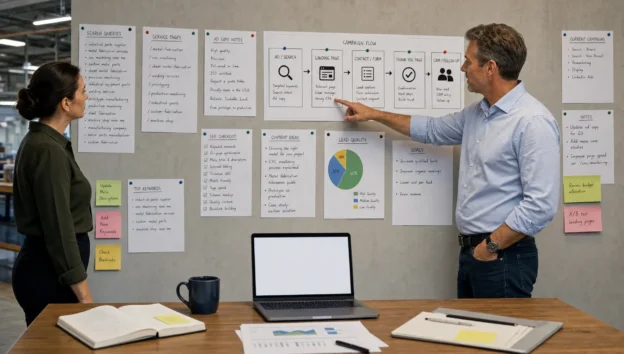
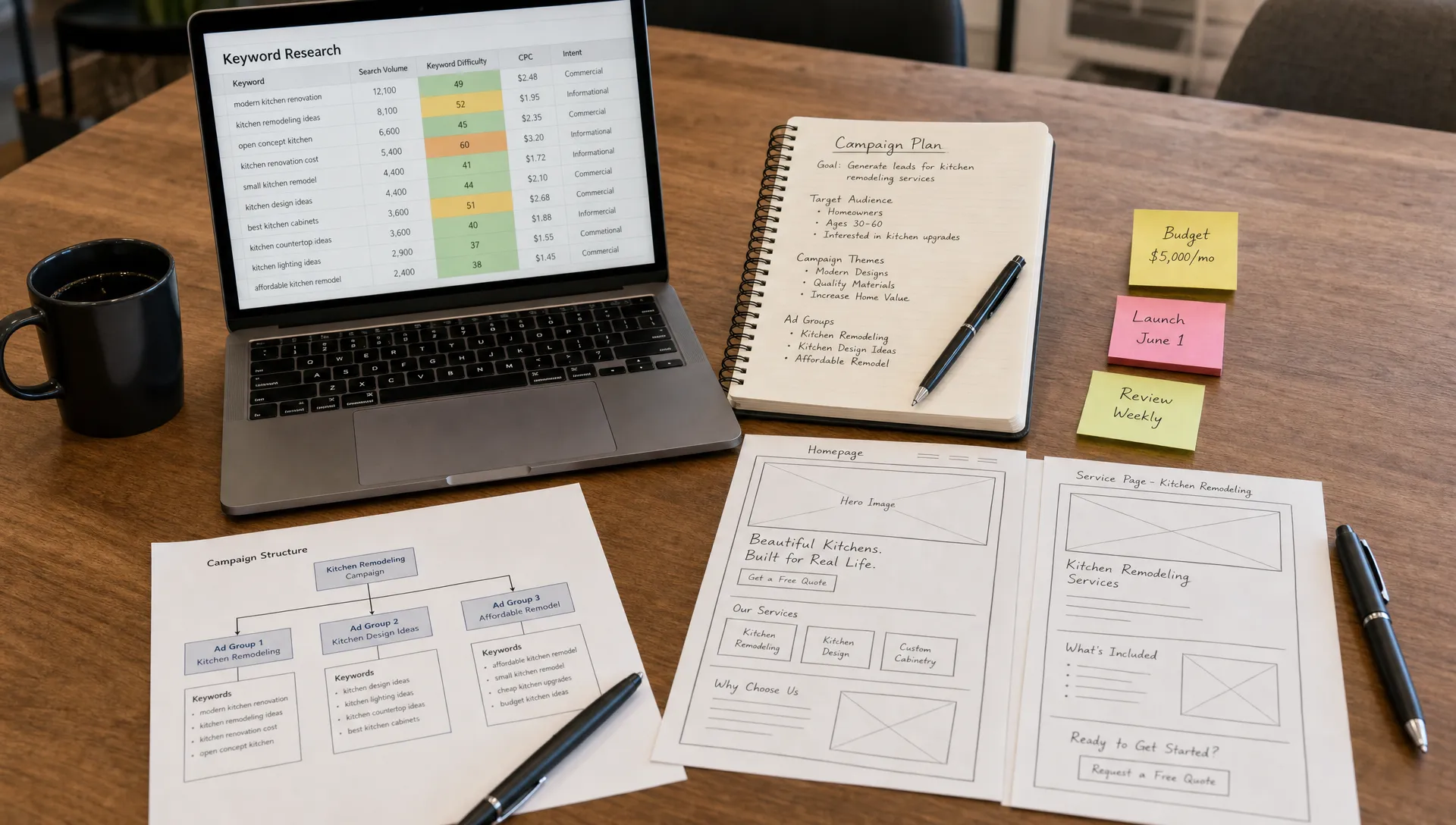
Integration does not require a complicated technology stack. It requires a shared plan. When SEO, paid media, content and web design are planned around the same business goals, each channel becomes easier to measure and improve.
Start with the business goal
Before choosing keywords or campaigns, define the commercial objective. Do you need more quote requests from Houston manufacturers? More distributor inquiries? More service calls from a specific region? More visibility for a new product line?
A goal like increase traffic is too vague. A goal like increase qualified RFQ submissions from industrial buyers in Texas gives the marketing team a clearer target. It affects keyword selection, page structure, ad targeting, content depth and conversion tracking.
Build a shared keyword and audience map
A useful keyword map should include more than search volume. It should identify intent, buyer stage, location relevance, industry language and the likely next step. Some terms are informational, such as how does industrial dust collection work. Others are commercial, such as industrial dust collector supplier Houston.
When everyone uses the same map, campaigns become more consistent. PPC avoids bidding on terms that SEO is already winning unless extra visibility is valuable. Content writers understand which questions matter. Designers understand which pages need stronger calls to action. Sales teams can tell marketing which terms produce better conversations.
Turn core pages into campaign hubs
Your most important service and product pages should not be passive brochures. They should act as hubs for search, ads, social posts and sales follow-up. A strong hub page usually includes a clear explanation of the service, buyer-specific benefits, common applications, supporting content, proof points and a direct conversion path.
From there, related blog posts can answer specific questions and link back to the hub. PPC campaigns can send high-intent visitors to a focused version of the page. Social updates can highlight individual sections. Sales can use the same page when responding to prospects who need background information.
Use paid and organic data together
Search Console, analytics platforms, ad reports and CRM feedback should not live in separate silos. If organic traffic is increasing but leads are poor, the issue may be intent mismatch. If PPC leads are strong but expensive, SEO may be able to capture more of that demand over time. If a page gets traffic but few inquiries, the issue may be copy, layout or offer clarity.
Useful performance indicators include:
- Organic visibility for commercially relevant keywords
- Paid conversion rate by keyword group
- Landing page conversion rate by source
- Form submissions that become qualified sales conversations
- Cost per qualified lead across paid and organic channels
- Assisted conversions from visitors who return through multiple channels
The goal is not to give every channel equal credit. The goal is to understand how buyers actually move through the decision process.
What this means for B2B and industrial companies
B2B and industrial marketing often involves longer buying cycles, multiple stakeholders and technical requirements. A plant manager may care about uptime. A purchasing team may care about vendor reliability. An engineer may care about specifications. An owner may care about cost, risk and speed.
SEO can create entry points for each of those concerns. Online marketing can connect those entry points into a stronger journey. A technical article may attract engineers. A service page may convert urgent buyers. A PPC campaign may capture high-intent searches. A case-focused post on LinkedIn may reassure executives. A redesigned landing page may reduce friction for quote requests.
For Houston businesses, local relevance also matters. Prospects may search with regional terms because they want local service, faster response or knowledge of Gulf Coast industries. SEO can capture those searches, but online marketing can reinforce the local advantage through location-specific landing pages, targeted ads, relevant content and clear contact paths.
Common mistakes that keep SEO and online marketing separated
Many companies do not fail because they ignore marketing. They fail because each activity is planned in a vacuum. The SEO vendor works on rankings, the ad team works on clicks, the designer works on appearance and the sales team judges leads after the fact.
| Mistake | Better approach |
|---|---|
| Choosing SEO keywords without sales input | Ask sales which terms, industries and problems produce better-fit leads |
| Sending paid traffic to generic pages | Build landing pages that match the ad promise and buyer intent |
| Publishing content without conversion paths | Add relevant next steps, internal links and inquiry options |
| Redesigning a site without SEO planning | Protect rankings, improve structure and align pages with search demand |
| Measuring traffic without lead quality | Track which sources produce qualified conversations and opportunities |
The fix is usually coordination, not more activity. A smaller number of well-aligned campaigns can outperform a larger number of disconnected tactics.
Frequently Asked Questions
How do SEO and online marketing work together? SEO helps prospects find your business through organic search. Online marketing supports the rest of the journey through paid ads, content, social media, video, web design and conversion strategy. Together, they attract better traffic and give visitors more reasons to become leads.
Is SEO more important than PPC? It depends on the goal and timeline. SEO is valuable for long-term visibility and compounding traffic. PPC is useful for speed, testing and highly targeted campaigns. Many B2B companies get better results when PPC data informs SEO and SEO reduces long-term dependence on paid clicks.
Can social media help SEO? Social media does not replace SEO, but it can expand the reach of optimized content. When useful articles, videos and landing pages are shared with the right audience, they can generate more brand searches, engagement and referral traffic.
What should be planned first, SEO or web design? They should be planned together. Site structure, navigation, page speed, mobile usability and content layout all affect search performance and conversions. Designing first and adding SEO later often leads to rework.
How long does it take to see results from an integrated strategy? PPC can produce data quickly, sometimes within weeks. SEO usually takes longer because organic visibility builds over time. The best timeline depends on competition, website condition, content quality and campaign consistency.
Turn visibility into measurable demand
SEO and online marketing work better together because buyers do not move in a straight line. They search, compare, leave, return, ask internal questions and look for reasons to trust a provider. Your marketing needs to support that full path.
B2B Inbound Marketing helps businesses improve online visibility through SEO, PPC, inbound strategy, social media marketing, video SEO, web-related services and content support. If your website is getting traffic but not enough qualified leads, the next step is to align search, campaigns and conversion strategy around the same business goal.