



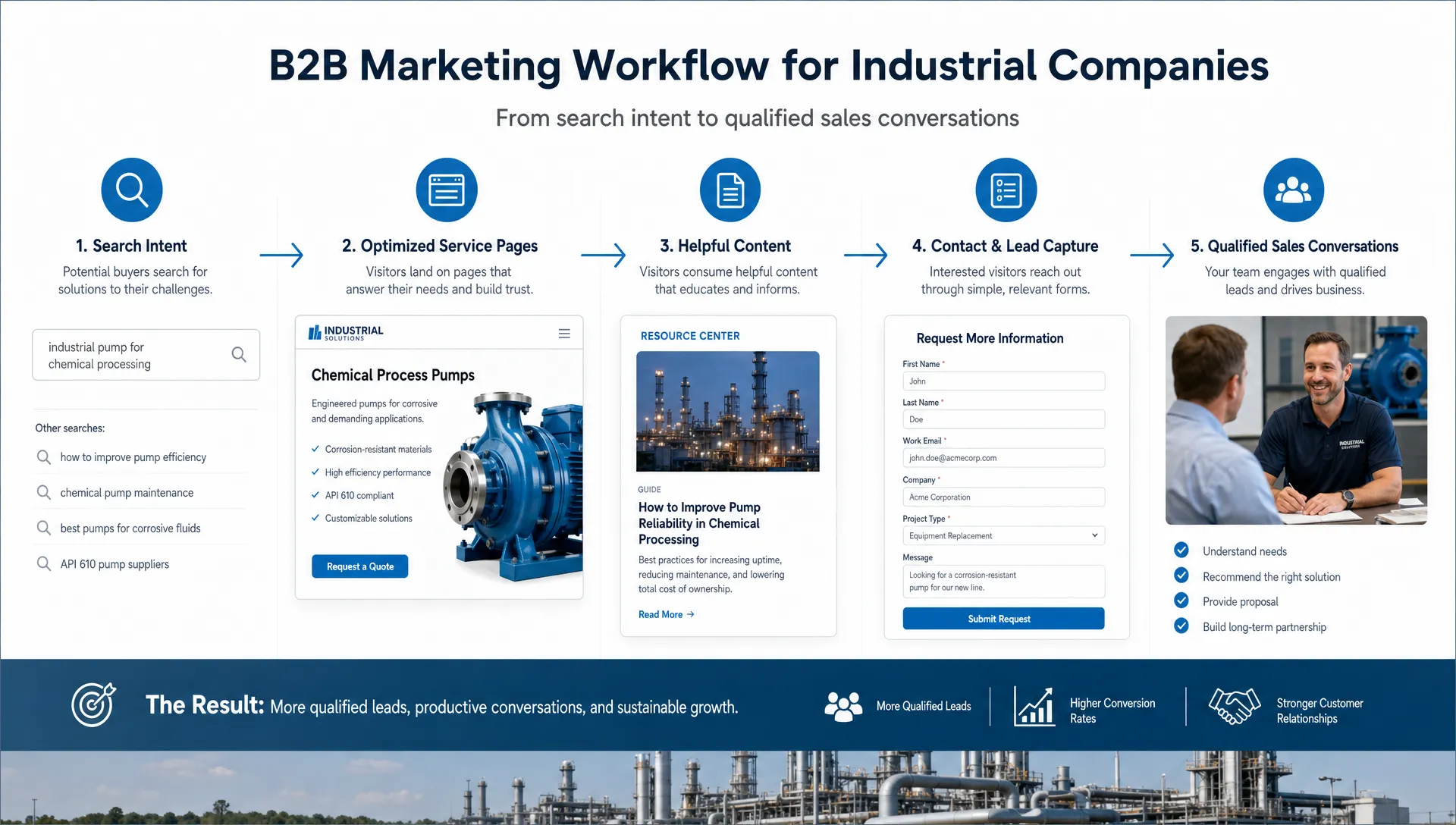
For B2B companies, the best leads often begin long before a prospect fills out a form or speaks with sales. A plant manager searches for a more reliable supplier. A procurement team compares technical specifications. A founder looks for software that solves a workflow problem. In each case, search is where intent becomes visible.
That is why search engine optimization services are not just about rankings. Done well, SEO connects your business with buyers who are already researching a problem, evaluating options, or preparing to contact a vendor. For B2B and industrial companies, this can turn a website from a digital brochure into a steady source of qualified opportunities.
Why SEO matters so much in B2B lead generation
B2B buying cycles are usually longer, more technical, and more committee-driven than consumer purchases. A prospect may visit your site multiple times, compare competitors, download resources, and review your expertise before ever making contact.
According to Gartner research on the B2B buying journey, buyers spend only a small portion of their purchase journey meeting with potential suppliers. Much of the decision-making happens independently through online research, internal discussions, and content review.
SEO helps your business appear during that independent research phase. If your website answers the right questions, proves credibility, and makes the next step easy, search traffic becomes a lead generation asset instead of just a traffic metric.
For companies that sell complex services, industrial products, SaaS solutions, or high-value B2B offers, visibility is not optional. If your business is not showing up when buyers search, competitors are shaping the conversation before your sales team gets a chance.
How SEO services turn search intent into B2B leads
Search engines reveal what buyers care about in real time. A prospect searching for industrial pump repair Houston has a different level of intent than someone searching how industrial pumps work. Both searches can matter, but they require different content, calls-to-action, and follow-up paths.
Professional SEO services help map those searches to the buyer journey. Instead of chasing every keyword with search volume, a strong B2B SEO strategy prioritizes terms that indicate business relevance, decision intent, and lead potential.
| Buyer stage | Search behavior | SEO opportunity | Lead generation goal |
|---|---|---|---|
| Awareness | Searches symptoms, problems, or educational topics | Publish helpful guides and explainers | Build trust and attract early demand |
| Consideration | Compares solutions, methods, vendors, or categories | Create comparison pages and service content | Capture qualified prospects researching options |
| Decision | Searches providers, pricing signals, locations, case studies, or consultations | Optimize landing pages and conversion paths | Generate form fills, calls, quote requests, or meetings |
| Post-research validation | Looks for reviews, expertise, credentials, and proof | Strengthen authority content and brand visibility | Reduce friction before sales contact |
The value of SEO in B2B is not simply that it brings visitors. It brings visitors with context. A buyer arrives through a keyword that shows what they need, how urgent the need may be, and what information will move them closer to action.
The core SEO services that drive lead quality
Effective SEO is a system. Rankings, content, technical performance, analytics, and conversion strategy all support each other. When one part is weak, leads suffer.
Technical SEO makes your website easier to find and use
Before content can generate leads, search engines need to crawl, understand, and index your pages. Technical SEO addresses issues such as site structure, page speed, mobile usability, indexation, redirects, broken links, and schema markup where appropriate.
For B2B websites, technical problems can quietly block growth. A service page may not rank because it is buried too deep in the site. A slow landing page may lose buyers before the form loads. Duplicate or thin pages may confuse search engines about which page should rank.
Good technical SEO improves both search visibility and user experience. That matters because B2B buyers often review your website during work hours, on multiple devices, and under time pressure. If the site feels outdated, slow, or difficult to navigate, it can damage trust before the sales conversation starts.
If your team is still building the foundation, it can help to revisit the basics of search engine optimization fundamentals before investing heavily in content or paid campaigns.
Keyword strategy focuses on business intent, not vanity volume
Many businesses make the mistake of targeting broad keywords because they receive more searches. But in B2B SEO, a smaller-volume keyword can be far more valuable if it reflects a buyer with a specific need.
For example, an industrial company may get more value from ranking for custom metal fabrication for oil and gas equipment than from a broad term like metal fabrication. A software company may prefer CRM implementation consultant for manufacturers over CRM tips.
A B2B keyword strategy should consider:
- Buyer role, such as engineer, procurement manager, operations leader, founder, or marketing director
- Industry language, including technical terms, compliance requirements, part names, and service categories
- Geographic intent, especially for regional service providers or Houston-based industrial businesses
- Commercial signals, such as vendor, consultant, quote, service, supplier, agency, cost, or near me
- Pain points that indicate urgency, such as downtime, low conversion rate, poor rankings, failed campaigns, or lost leads
The goal is to build a keyword map that reflects how real buyers search, not just what SEO tools show as high volume.
Content builds trust before the sales conversation
B2B prospects rarely convert after reading one page. They need evidence that your company understands their problem, has relevant experience, and can guide them toward a solution.
That is where content becomes a lead generation tool. Service pages capture commercial demand. Blog articles answer common questions. Case studies demonstrate results. FAQs remove friction. Comparison content helps prospects evaluate options. Technical resources support buyers who need to justify a decision internally.
Google’s own guidance encourages creating helpful, reliable, people-first content. For B2B companies, that means content should not be generic. It should reflect real industry knowledge, buyer objections, implementation concerns, and practical next steps.
A strong SEO content plan usually includes a mix of:
- Core service pages that clearly explain what you offer and who it is for
- Educational articles that answer early-stage buyer questions
- Industry-specific landing pages for high-value verticals
- Case studies or proof pages that support sales conversations
- Conversion-focused pages for consultations, quotes, demos, or audits
When content matches the buyer journey, SEO does more than attract traffic. It warms up prospects so sales teams spend less time explaining the basics and more time discussing fit.
Conversion-focused SEO turns visits into leads
Traffic alone does not pay the bills. A page can rank well and still fail if visitors do not understand what to do next. That is why lead-focused SEO includes conversion rate optimization, not just keyword rankings.
A good B2B landing page should make the value proposition clear within seconds. It should explain who the service is for, what problem it solves, what makes the provider credible, and how the buyer can take the next step. Forms should be simple enough to complete, calls-to-action should be visible, and trust signals should be easy to find.
For industrial and professional service companies, common conversion actions include quote requests, consultation forms, phone calls, downloadable guides, newsletter signups, product inquiries, and assessment requests. Not all conversions are equal, but each one can help identify where a buyer is in the journey.
If your website already receives traffic but does not produce enough inquiries, the issue may not be visibility. It may be messaging, page layout, weak calls-to-action, or a complicated form. The article on whether your website is losing leads explores several practical fixes that can support stronger conversion performance.
Local and industry SEO can increase lead relevance
For many B2B firms, especially in Houston and industrial markets, location and industry relevance are major lead quality factors. A national keyword may bring traffic, but a regional or sector-specific keyword may bring buyers who are easier to serve and more likely to convert.
Local SEO can help companies appear for searches tied to a city, service area, or nearby supplier need. This includes optimizing location signals, service pages, business listings, and content that reflects local market expertise. For a Houston-based B2B company, this can be especially valuable when prospects prefer a partner familiar with regional industries such as energy, manufacturing, logistics, construction, engineering, or professional services.
Industry SEO goes a step further by aligning content with vertical-specific language. A general page about marketing services may attract broad interest. A page about industrial SEO for manufacturers, engineering firms, or B2B service providers can attract buyers who immediately recognize the relevance.
The more precisely your SEO strategy reflects the market you want to serve, the more likely your traffic is to become qualified leads.
SEO and PPC work better together for B2B demand
SEO is a compounding channel. PPC is a faster feedback channel. In many B2B campaigns, the two work best together.
PPC can test keyword intent, messaging, offers, and landing pages before SEO content has had time to rank. SEO can then use those insights to build long-term organic visibility around terms that prove they attract qualified traffic. At the same time, organic rankings can reduce dependence on paid clicks over time, while PPC can support priority campaigns, competitive keywords, and remarketing.
This is especially useful in B2B markets where search volumes are lower and every qualified lead matters. If a paid search campaign shows that a specific term produces strong quote requests, that keyword may deserve a dedicated SEO page. If an SEO article generates traffic but few leads, PPC landing page testing may reveal a better call-to-action.
For businesses weighing both channels, the guide on the benefits of SEO and PPC campaigns explains why combining them can improve visibility, traffic, and lead generation.
Measuring SEO leads the right way
B2B SEO measurement should go beyond ranking reports. Rankings matter because they create visibility, but the real business question is whether SEO is helping generate qualified pipeline.
At minimum, a B2B SEO program should track organic traffic, keyword growth, form submissions, phone calls, conversion rates, and assisted conversions. More mature programs should connect SEO activity to CRM data so the company can see which keywords, pages, and campaigns produce sales-qualified leads and revenue opportunities.
| Metric | What it tells you | Why it matters for B2B leads |
|---|---|---|
| Organic sessions | Whether search visibility is bringing visitors | Shows audience growth from non-paid search |
| Ranking keywords | Which topics and pages are gaining visibility | Helps evaluate content and optimization progress |
| Organic conversions | Forms, calls, downloads, or inquiries from SEO traffic | Connects SEO to lead generation |
| Conversion rate by page | Which pages turn visitors into leads | Identifies pages that need stronger messaging or CTAs |
| Lead quality | Whether inquiries match your ideal customer profile | Prevents traffic growth from becoming a vanity metric |
| Pipeline influence | Opportunities and revenue connected to organic search | Shows the business impact of SEO |
The most useful SEO reporting answers three questions: Are we attracting the right audience? Are those visitors converting? Are those leads valuable to sales?
For a deeper look at business impact, review the discussion on ROI benefits from an SEO campaign, especially if your leadership team needs to compare SEO against other marketing investments.
What to look for in B2B search engine optimization services
Choosing an SEO partner is not just about finding someone who can improve rankings. For B2B lead generation, the provider needs to understand your buyers, your sales cycle, and your commercial goals.
A strong SEO service provider should ask about your ideal customer profile, margins, sales process, geographic priorities, high-value services, competitive landscape, and current lead quality. If the conversation is only about traffic, backlinks, or keyword counts, the strategy may not be aligned with revenue.
Look for an approach that includes clear discovery, technical review, keyword strategy, content planning, on-page optimization, conversion recommendations, reporting, and ongoing refinement. B2B SEO is rarely a one-time project. Search behavior changes, competitors publish new content, and your business priorities evolve.
The best SEO campaigns become more effective over time because they build data. You learn which topics attract the right visitors, which landing pages convert, which offers generate sales conversations, and which industries respond best to your message.
Common mistakes that prevent SEO from generating leads
Many companies invest in SEO but do not see meaningful lead growth because the campaign is not connected to buyer intent or conversion strategy.
One common mistake is publishing blog content without supporting service pages. Educational articles may attract visitors, but if the site lacks strong commercial pages, buyers may not know what you offer. Another mistake is optimizing for broad keywords that bring unqualified traffic. This can make reports look positive while sales teams see little improvement.
Weak calls-to-action are also a major issue. If a buyer reads a helpful article but cannot easily request a quote, schedule a consultation, or find a relevant service page, the lead opportunity may be lost. Similarly, companies often ignore older content that already ranks. Updating those pages with better information, internal links, and clearer conversion paths can produce faster gains than starting from scratch.
Finally, some businesses measure SEO success too early or too narrowly. Organic search takes time, especially in competitive B2B markets. But once pages gain authority and rankings stabilize, they can produce leads month after month without paying for every click.
Frequently Asked Questions
How long does it take for SEO services to generate B2B leads? Most B2B SEO campaigns need several months to build momentum, especially if the website has technical issues, limited content, or strong competitors. Some improvements, such as optimizing existing pages or fixing conversion problems, can create earlier gains.
Are search engine optimization services better than PPC for B2B leads? SEO and PPC serve different roles. SEO builds long-term organic visibility and trust, while PPC can generate faster traffic and test offers. Many B2B companies get better results by using both channels together.
What makes B2B SEO different from consumer SEO? B2B SEO usually targets longer buying cycles, niche keywords, multiple decision-makers, and higher-value conversions. The content must educate, build trust, and support sales conversations, not just attract quick clicks.
How do you know if SEO leads are qualified? Track more than form volume. Compare organic leads against your ideal customer profile, sales conversations, opportunity creation, deal size, and close rate. CRM integration can make this much clearer.
Do industrial companies need SEO? Yes. Industrial buyers often research suppliers, specifications, services, and solutions online before contacting vendors. SEO helps industrial companies appear during that research and convert relevant searches into inquiries.
Turn search visibility into qualified B2B opportunities
B2B SEO works best when it is tied directly to lead generation. The right strategy helps your company appear for valuable searches, educate buyers, build credibility, and guide prospects toward a sales conversation.
If your business wants to improve rankings, attract better-fit visitors, and turn your website into a stronger lead generation channel, B2B Inbound Marketing can help with SEO, PPC, inbound strategy, web content, and related digital marketing services for B2B and industrial companies.