



More website traffic is not a growth strategy if the people arriving are students, job seekers, price shoppers or companies outside your service area. For B2B and industrial firms, the real goal is narrower and more valuable: get found by buyers who understand the problem, have a business reason to act and are willing to start a sales conversation.
That is where search engine marketing services should earn their budget. Done well, search marketing connects SEO, paid search, landing pages, content and analytics around one question: which searchers are most likely to become qualified opportunities?
For a Houston manufacturer, distributor, engineering firm or B2B service provider, better leads usually come from precision rather than volume. The campaign has to target the right intent, explain the right value and measure the right outcome.
What “better leads” means in search engine marketing
A better lead is not simply a contact form submission. It is a prospect with a relevant need, a reasonable fit and enough intent to justify sales follow-up.
In B2B search marketing, lead quality usually depends on four factors. The first is fit, such as industry, company type, location, project size or application. The second is intent, meaning the searcher is looking for a solution, vendor, quote or technical answer that suggests a buying process is underway. The third is context, including what page they viewed, which query brought them there and what information they shared. The fourth is measurability, because marketing cannot improve lead quality if every form fill is treated the same.
This matters because B2B search behavior is often technical and specific. A maintenance manager searching for “industrial pump repair Houston” is in a different stage than someone searching “how does a centrifugal pump work.” Both searches can be useful, but they should not receive the same campaign, landing page or success metric.
Why many search campaigns generate weak leads
Poor lead quality rarely comes from one mistake. It is usually the result of disconnected decisions: broad keywords, generic ad copy, thin landing pages and reporting that rewards activity instead of revenue potential.
A common problem is targeting keywords that are too broad. Terms like “automation,” “coatings,” “software” or “industrial services” may have search volume, but they also attract mixed audiences. A stronger SEM strategy separates educational searches from commercial searches and gives each one a realistic role in the funnel.
Another issue is conversion tracking that counts every action as equal. A newsletter signup, careers page inquiry, vendor solicitation and RFQ request should not sit in the same bucket. If they do, campaign optimization tools receive the wrong signals and budgets drift toward cheap conversions instead of qualified opportunities.
Landing pages also play a major role. If a paid search ad promises a specific capability but sends visitors to a broad homepage, the visitor has to do the work. In technical B2B markets, that friction can be enough to lose a serious buyer.
The search engine marketing services that improve lead quality
Effective search engine marketing services are not limited to running ads. They combine demand research, organic visibility, paid media, conversion design and sales feedback. Each service should contribute to a cleaner path from search query to qualified conversation.
| SEM service | How it improves lead quality | Warning sign when it is missing |
|---|---|---|
| Search intent research | Separates researchers, buyers and comparison shoppers | Campaigns chase high-volume keywords with weak fit |
| SEO strategy | Builds visibility for technical and commercial searches over time | Traffic grows without stronger inquiries |
| PPC management | Captures high-intent demand quickly and controls spend | Ad budget is spent on irrelevant clicks |
| Landing page optimization | Matches the visitor’s need with proof, clarity and a next step | Visitors bounce or submit vague inquiries |
| Conversion tracking | Shows which campaigns produce sales-ready leads | Reports focus only on clicks and impressions |
| Sales feedback loops | Helps marketing optimize for opportunity quality | Marketing celebrates leads sales does not want |
For many companies, SEO and PPC are treated as separate projects. That is a missed opportunity. PPC data can reveal which terms convert quickly, while SEO can build durable visibility around high-value topics that would be expensive to buy every month. If you want a deeper look at the organic side, this guide on how an SEO marketing service improves lead quality explains why intent and qualification matter more than rankings alone.
Paid search and SEO should support the same buyer journey
Paid search is useful when a prospect is ready to compare vendors, request pricing or solve an urgent problem. SEO is often stronger for building trust earlier in the process, especially when buyers need technical explanations, application guidance or proof that a provider understands their industry.
The best results usually come when both channels share the same strategy. A paid campaign can test messaging before a company invests in a full content buildout. Organic search can reduce dependency on paid clicks for recurring informational and mid-funnel topics. Retargeting can bring prior visitors back when they are closer to a decision.
That is why search should not be managed in a silo. It works better when connected to web design, content, social media, video and sales enablement. The same principle is covered in more detail in this article on how SEO and online marketing work better together.
Companies with limited internal bandwidth also need to decide how campaign execution will be managed. Some use a local SEM partner, some build in-house and others supplement their team with managed digital marketing support when they need help coordinating ongoing execution, reporting and optimization.
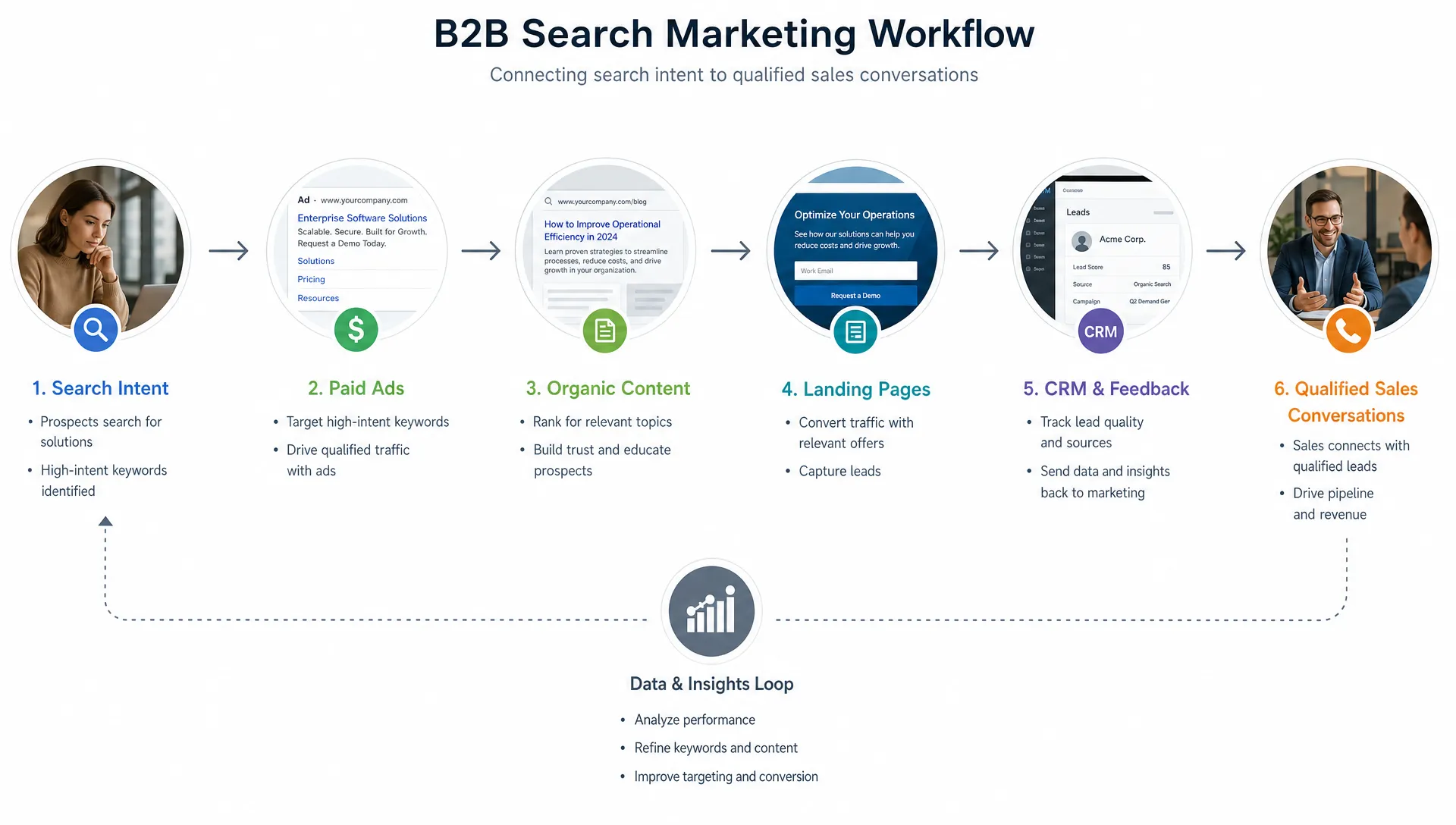
A lead-focused SEM process should look like this
Strong search engine marketing services start before ads go live. The early work determines whether the campaign will attract the right buyers or simply spend budget on available traffic.
- Audit current visibility and lead sources: Review organic rankings, paid search data, analytics, form submissions, call sources and CRM notes. The goal is to see which channels already produce meaningful conversations.
- Map keywords by intent: Group search terms by problem, application, service, industry, location and buying stage. This prevents educational keywords from being judged like RFQ keywords.
- Fix conversion tracking: Track forms, calls, quote requests, downloads and other actions separately. If possible, connect marketing data to CRM outcomes so campaigns can optimize for qualified leads.
- Build focused campaigns and pages: Match each campaign to a clear offer, service line or buyer need. Specific pages usually outperform general pages because they reduce confusion.
- Review search terms and lead quality regularly: Remove irrelevant queries, refine match types, update negative keywords and compare lead data with sales feedback.
- Improve the website around buyer questions: Use search data to strengthen service pages, FAQs, case-oriented content and calls to action.
This process is especially valuable for industrial and technical firms because the buying journey often includes multiple stakeholders. The person searching may be an engineer, plant manager, procurement lead or business owner. SEM has to make sense to each of them without watering the message down.
Landing pages can make or break lead quality
Even the best search campaign will struggle if the website does not support the buyer’s next step. A visitor who clicked an ad for a specific service should not have to navigate through unrelated pages to find capabilities, service areas, technical fit or contact options.
A strong SEM landing page usually includes a clear headline, concise service explanation, proof of experience, relevant industries served, trust signals and a direct call to action. For B2B services, the page should also qualify the inquiry without creating a form so long that serious buyers abandon it.
This is where SEO and web design overlap. Search engines need crawlable, relevant pages, but buyers need clarity and confidence. If the site structure, speed or message is weak, both paid and organic performance can suffer. For more on that connection, see this breakdown of search engine optimization website design for better leads.
Metrics that reveal whether lead quality is improving
Clicks and impressions are useful diagnostic metrics, but they do not prove lead quality. A campaign can have a strong click-through rate and still fail commercially if the inquiries are unqualified.
The most useful SEM reporting connects visibility to pipeline behavior. At minimum, B2B firms should separate raw lead volume from qualified lead volume. Over time, the reporting should show which campaigns, keywords and pages are producing serious opportunities.
| Metric | What it tells you | How to use it |
|---|---|---|
| Cost per qualified lead | How much it costs to generate a lead sales accepts | Compare campaigns by business value, not only cost |
| Lead-to-opportunity rate | Whether inquiries become real sales opportunities | Identify weak targeting or landing page gaps |
| Search term relevance | Whether ads appear for the right queries | Add negative keywords and refine match types |
| Form quality | Whether prospects provide useful project details | Adjust form fields and page messaging |
| Call quality | Whether phone leads match target customers | Review call recordings or sales notes where allowed |
| Assisted conversions | Whether search helps buyers before final contact | Avoid undervaluing educational SEO or remarketing |
Google Ads and analytics platforms can report many of these signals, but the most important insight often comes from sales. If the sales team says leads are too small, too far away, outside the target industry or not ready to buy, that feedback should shape the next round of keyword, ad and landing page decisions.
How to choose search engine marketing services for better leads
When evaluating a provider, ask how they define success. If the answer focuses only on rankings, traffic or cost per click, the strategy may not be mature enough for B2B lead generation.
A stronger partner should be able to explain how they will identify buyer intent, protect budget from irrelevant searches, improve landing pages and report on lead quality. They should also ask about your sales process, margins, ideal customers, service areas and disqualifying factors.
Look for practical answers to questions like these:
- How will campaigns distinguish between research searches and buying searches?
- Which conversions will be treated as primary goals?
- How often will search terms, negative keywords and lead quality be reviewed?
- Will SEO and PPC insights be shared across channels?
- How will landing pages be tested or improved?
- What information does sales need to provide for optimization?
The right provider does not need to promise instant results. They should offer a clear operating rhythm: research, launch, measure, refine and connect results to business outcomes.
Common mistakes B2B companies should avoid
The first mistake is assuming more traffic will automatically create more sales. In specialized markets, a smaller number of qualified visitors can outperform a large audience with weak fit. Search strategy should be built around profitable demand, not vanity metrics.
The second mistake is letting campaigns run without sales input. Marketing data shows what people clicked and submitted. Sales data shows whether those people were worth pursuing. Both are needed.
The third mistake is using the same message for every buyer. A plant manager may care about downtime. A procurement lead may care about supplier reliability. An owner may care about total cost and responsiveness. Search pages should address the buyer’s immediate concern while still supporting the broader decision.
The fourth mistake is stopping too early. SEO takes time to compound, and PPC campaigns need enough data to filter waste and find stronger pockets of demand. The key is not patience by itself, but disciplined iteration.
Frequently Asked Questions
What are search engine marketing services? Search engine marketing services help businesses get found through paid search, SEO, landing pages, content and analytics. For B2B companies, the goal is usually to attract qualified inquiries rather than general traffic.
How do SEM services improve lead quality? They improve lead quality by targeting higher-intent keywords, filtering irrelevant searches, matching landing pages to buyer needs and using conversion data to optimize campaigns around qualified prospects.
Is PPC or SEO better for B2B leads? PPC can generate visibility quickly for high-intent searches, while SEO builds long-term visibility and trust. Many B2B companies get better results when both channels support the same buyer journey.
How long does it take to see better leads from SEM? Paid search can begin producing data quickly, but improving lead quality usually requires several rounds of search term review, landing page refinement and sales feedback. SEO often takes longer but can create lasting visibility.
What should a B2B company track besides clicks? Track qualified leads, lead-to-opportunity rate, cost per qualified lead, call quality, form quality and which keywords or pages produce sales conversations.
Turn search visibility into stronger sales conversations
If your campaigns are generating clicks but not the right conversations, the issue may not be search itself. It may be the way search intent, landing pages and lead tracking are connected.
B2B Inbound Marketing helps companies improve online visibility through SEO, PPC, inbound strategy, web content and related digital marketing services. To discuss search engine marketing services built around better leads, visit Andy Alagappan and start with a focused conversation about your goals, market and current lead flow.