

When leadership asks where the next marketing dollar should go, search engine marketing and search engine optimization often end up in the same conversation. That makes sense. Both are designed to put your company in front of people who are already using search engines to solve a problem, compare suppliers or request pricing. The difference is how fast you show up, how you pay for visibility and what kind of long-term asset you build.
For B2B and industrial companies, this comparison should not be reduced to “paid versus free.” SEO is not free once you account for strategy, content, technical work and ongoing maintenance. PPC is not simply expensive traffic if it is connected to buyer intent, landing pages and lead qualification. The real value of comparing search engine marketing and search engine optimization is knowing when each one supports revenue, not just rankings or clicks.
The practical difference in one sentence
Search engine marketing, often called SEM, usually refers to paid visibility in search results today. In practice, that means paid search ads in platforms such as Google Ads or Microsoft Advertising. Your company bids on keywords, writes ads, sends visitors to a landing page and pays when someone clicks.
Search engine optimization, or SEO, focuses on earning unpaid visibility in organic search results. That work includes technical site improvements, content creation, internal linking, authority building, page speed, user experience and ongoing updates to keep pages useful.
Historically, SEM was sometimes used as a broad umbrella for all search marketing, including SEO. In modern marketing conversations, most teams use SEM to mean paid search. That is the definition this article uses.
| Comparison point | SEM, paid search | SEO, organic search |
|---|---|---|
| Visibility speed | Often fast after launch | Usually slower, often months |
| Cost model | Pay per click, plus management | Pay for strategy, content and implementation |
| Control | High control over keywords, copy and targeting | Less direct control over ranking timing |
| Longevity | Traffic stops when spend stops | Strong pages can keep attracting traffic |
| Best use | Testing, urgent demand and specific offers | Compounding visibility and authority |
For most B2B teams, search engine marketing and search engine optimization should be compared by business purpose. A campaign for emergency part replacement, for example, may need paid search immediately. A technical article explaining how to choose a pump, valve, coating, material or service provider may be better suited to SEO because buyers revisit educational content throughout a longer sales cycle.
Where SEM wins
SEM is strongest when speed, targeting and message control matter. If your company is launching a new service line, entering a new regional market or promoting a time-sensitive offer, paid search can put you in the results before organic pages have had time to gain traction.
It is also useful for keyword testing. A company may think that prospects search for “industrial filtration systems,” but paid campaigns might reveal that better leads come from more specific phrases tied to applications, materials, compliance needs or replacement cycles. That information can later shape SEO content.
SEM works best when it is not treated as a traffic faucet. The click is only the first step. The landing page has to match the query, explain the offer, build trust and make the next action clear. For complex B2B purchases, that action may not be “buy now.” It may be requesting a quote, downloading a specification sheet, scheduling a consultation or asking an engineer to review a requirement.
Where SEO wins
SEO is strongest when your buyers research before contacting sales. Industrial and B2B search behavior often includes technical questions, comparison searches, vendor qualification searches and problem-based searches. A well-structured website can meet those searches with product pages, application pages, service pages, case content and technical explainers.
Search engine marketing and search engine optimization differ most clearly in how they create value over time. A paid search ad can produce leads quickly, but every visit has a media cost. A strong organic page may require more work up front, but it can continue attracting qualified visitors long after publication if it remains accurate and competitive.
SEO also supports trust. When buyers repeatedly find your company while researching a topic, they start to associate your brand with competence. That does not replace sales outreach, trade shows or referrals, but it gives those efforts a stronger foundation. If your team needs a clearer business-facing explanation, this guide to an SEO definition marketing teams can use to make decisions is a useful companion.
Cost, risk and timeline
SEM and SEO both require budget discipline, but they carry different financial risks. With SEM, waste usually shows up quickly. If campaigns target the wrong queries, use broad match without controls or send visitors to weak landing pages, the budget can disappear without creating qualified opportunities.
With SEO, waste can be quieter. A company may publish months of content that attracts visitors who will never buy, or it may redesign a site without protecting existing rankings. Technical issues can also limit performance even when the content is strong.
| Factor | SEM consideration | SEO consideration |
|---|---|---|
| Early learning | Data can arrive quickly | Insights build over time |
| Budget pressure | Spend is visible every day | Costs are spread across workstreams |
| Main waste risk | Paying for low-intent clicks | Creating content with no buyer fit |
| Long-term value | Depends on continued spend | Can compound if maintained |
| Reporting focus | Cost per lead and lead quality | Rankings, organic leads and assisted pipeline |
A practical plan acknowledges both timelines. Paid search can cover urgent demand and test messages. SEO can build the durable presence that reduces overdependence on paid traffic later.
How search engine marketing and search engine optimization work together
The best search strategies do not force SEM and SEO into separate silos. Paid search data can identify which terms convert, which messages earn clicks and which offers attract qualified inquiries. SEO data can reveal recurring questions, high-performing topics and pages that already show organic promise.
When search engine marketing and search engine optimization are planned together, the company can avoid paying forever for every click while also avoiding the mistake of waiting six months for demand that paid search could capture today. For example, PPC can support high-value keywords while SEO content is being built. Once organic pages start ranking, paid spend can shift toward tests, competitive terms or keywords where organic results are difficult to win.
This integrated approach also improves sales alignment. If both paid and organic campaigns are mapped to the same buying stages, sales teams can see which inquiries came from early research, which came from urgent vendor searches and which came from comparison terms. For a deeper look at budget coordination, see this guide on using PPC and SEO together without wasting budget.
Choosing the right mix for B2B and industrial markets
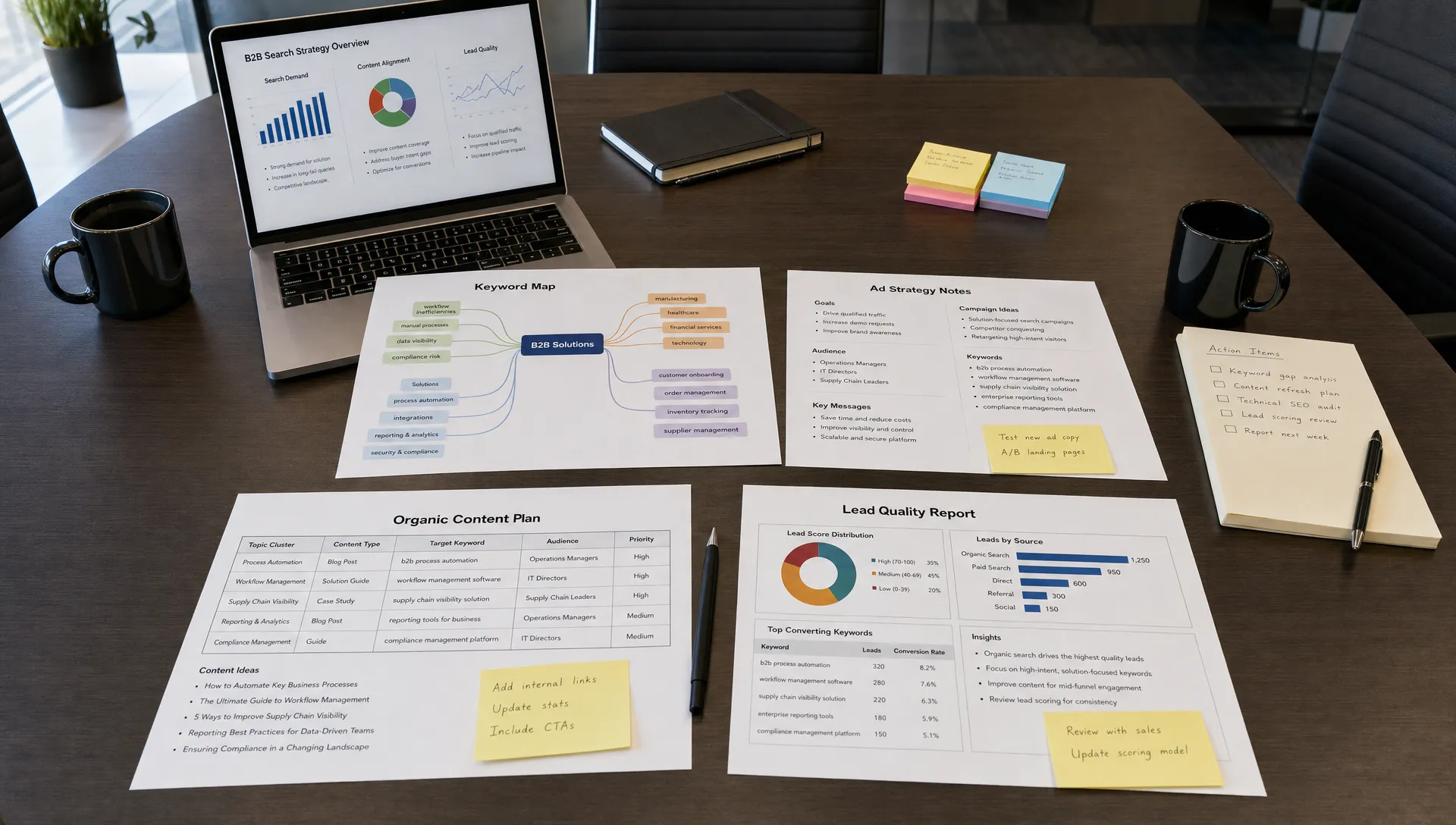
The right mix depends on market maturity, sales cycle length, competition, margins and urgency. A startup with no organic visibility may need SEM to generate immediate learning. A mature industrial supplier with a deep product catalog may gain more from technical SEO, improved site architecture and stronger application pages.
Search engine marketing and search engine optimization should also be shaped by geography. A Houston industrial service company may care about regional visibility, facility proximity and local buyer trust. A national manufacturer may care more about product category terms, distributor searches and technical specifications.
The same intent logic applies outside industrial markets. A local healthcare provider like a Manhattan pain relief and chiropractic clinic needs pages and campaigns that match urgent, location-specific searches, just as a Houston manufacturer needs pages that match process-specific industrial queries. Search intent changes by industry, but the discipline stays the same: match the searcher’s problem, location, urgency and decision stage.
A simple decision framework
Before assigning budget, start with the searcher’s intent. A keyword that signals immediate vendor selection deserves different treatment than a keyword that signals early education. The mistake many companies make is judging every keyword by search volume alone.
Use these questions to guide the mix:
- How soon do we need leads? If the answer is this month, SEM may need to play a larger early role.
- Do we already have authority in this topic? If yes, SEO improvements may generate faster gains than starting from zero.
- Is the keyword expensive because it is valuable or because it is broad? High CPC is not automatically bad, but low intent is.
- Can sales handle the inquiries we generate? More leads are not useful if they are poorly qualified.
- Do we have pages that deserve to rank? If not, SEO requires content and technical work before it can perform.
A balanced plan may use paid search for bottom-of-funnel terms, SEO for educational and comparison content and remarketing or follow-up campaigns for visitors who are not ready to contact sales. The proportions can change as data improves.
What to measure beyond clicks
Clicks are easy to count, but they do not prove marketing performance. For B2B and industrial companies, better reporting connects search activity to lead quality, opportunity creation and revenue influence. That means looking at form submissions, phone calls, quote requests, conversion rates, sales acceptance and closed opportunities where possible.
Search engine marketing and search engine optimization should be judged with different primary metrics, but the final business question is the same: are we attracting the right people and helping them move toward a buying decision?
For SEM, watch cost per qualified lead, wasted spend, impression share on priority terms, conversion rate by landing page and lead quality by campaign. For SEO, watch organic leads, rankings for commercially relevant terms, growth in non-branded traffic, engagement on key pages and assisted conversions.
Attribution will rarely be perfect, especially in long sales cycles. A buyer may discover your company through an organic article, return through a paid ad, talk to sales after a referral and convert months later. The goal is not perfect credit assignment. The goal is enough visibility to invest more in what is clearly helping and stop funding what is not.
If you are evaluating outside support, a good agency conversation should focus on lead quality rather than traffic volume alone. This article on search engine marketing services that deliver better leads expands on that distinction.
Common mistakes when comparing the two
One common mistake is assuming SEO is only content. Content matters, but technical structure, internal links, crawlability, page experience and site architecture all affect performance. A helpful article buried on a confusing website may never reach its potential.
Another mistake is treating SEM as a shortcut around weak positioning. Paid search can place your offer in front of the right person, but it cannot make an unclear offer persuasive. If the ad, landing page and sales follow-up do not align, the campaign will struggle.
A third mistake is separating teams too much. If PPC managers, SEO specialists, web developers and sales leaders never share data, each channel makes decisions with partial information. Search works better when the team agrees on priority markets, buyer language, qualification criteria and follow-up expectations.
FAQ
Is SEM better than SEO? SEM is better for speed, testing and controlled targeting. SEO is better for compounding visibility, authority and long-term organic traffic. Most B2B companies need both at different stages.
How long does SEO take compared with paid search? Paid search can begin generating traffic soon after launch, assuming the campaign and landing pages are set up correctly. SEO usually takes longer because search engines need to crawl, evaluate and rank pages against competitors.
Should a small B2B company start with SEM or SEO? If the company needs immediate leads and has a clear offer, SEM can produce faster learning. If the sales cycle is research-heavy and the company has limited budget for ongoing clicks, SEO may deserve earlier investment.
Can search engine marketing and search engine optimization use the same keywords? Yes, but they do not always need to. Some keywords are worth targeting with both paid and organic visibility. Others may be too expensive for paid search but ideal for SEO, or too urgent to wait for organic rankings.
What is the biggest sign the strategy is working? The strongest sign is not simply more traffic. It is more qualified inquiries from the types of buyers your company can serve profitably.
Need a clearer search strategy?
Search engine marketing and search engine optimization are not competing tactics. They are different ways to reach buyers who are already expressing intent. The strongest strategy uses SEM for speed, testing and targeted demand capture, while SEO builds the authority and visibility that support long-term growth.
For Houston B2B and industrial companies, the right answer depends on your market, sales cycle, website condition and lead goals. Andy Alagappan’s team supports SEO, PPC, inbound marketing strategy, web content and related search marketing services for businesses that need more than traffic. They need better opportunities from the right searchers.