
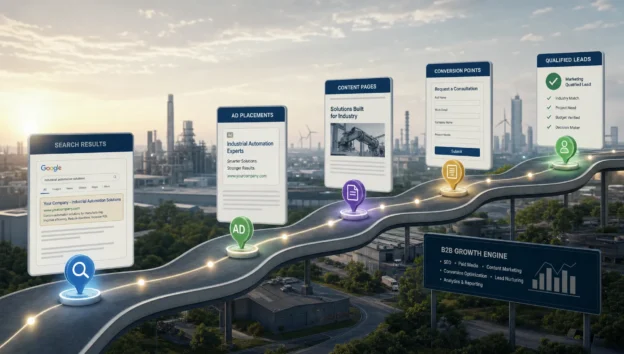
B2B growth rarely comes from a single campaign, a redesigned homepage, or a few social media posts. It comes from a repeatable system that helps the right buyers find your business, understand your expertise, trust your process, and take the next step with confidence.
That is where an online marketing agency can become a growth partner instead of just a vendor. For B2B companies, especially industrial, technical, and professional service firms, digital marketing has to do more than create awareness. It must support long buying cycles, educate multiple decision-makers, and turn complex offerings into clear reasons to start a conversation.
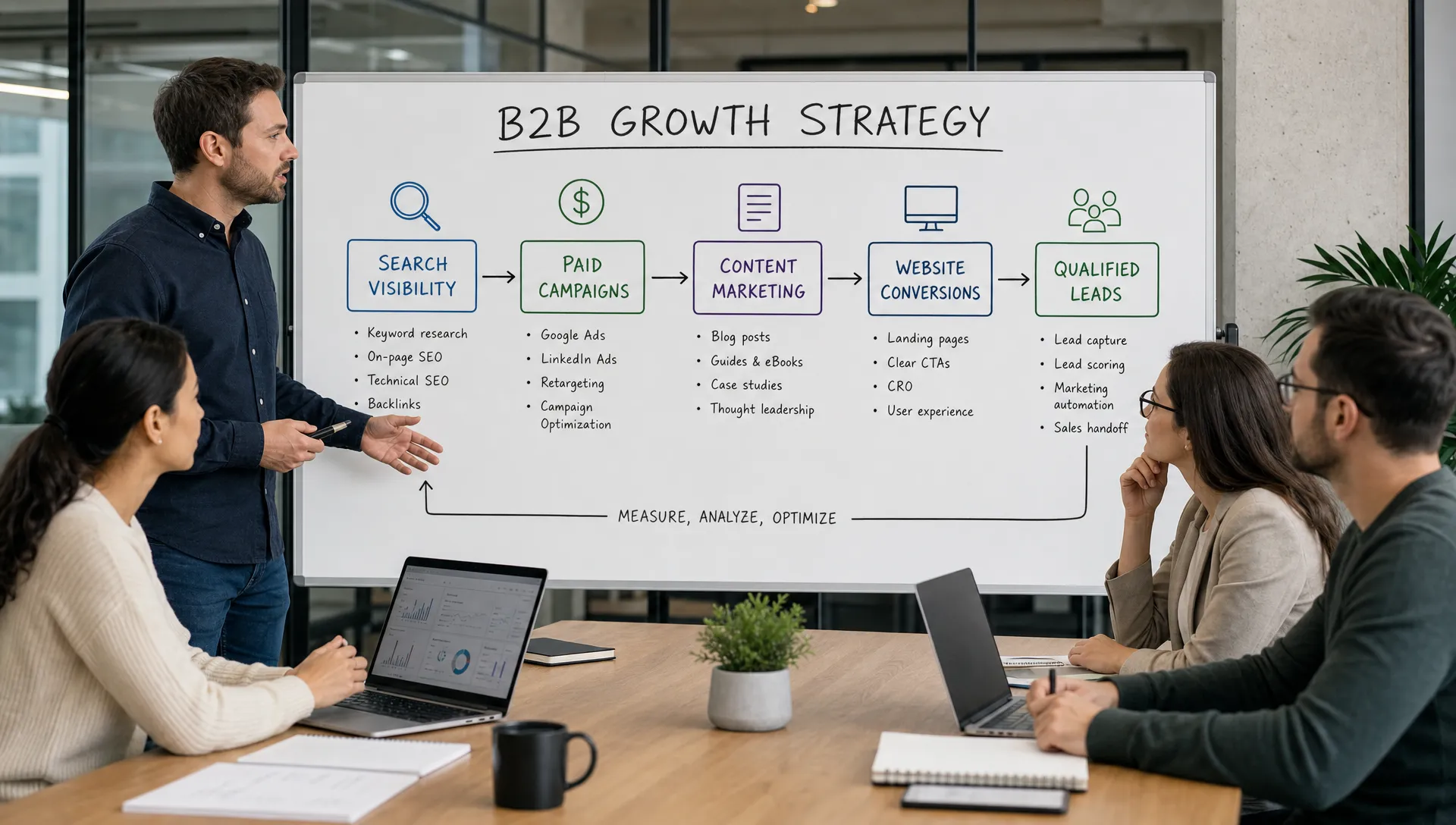
The best agencies help connect strategy, search visibility, paid campaigns, content, web experience, and lead generation into one measurable growth engine.
Why B2B growth needs a different marketing approach
B2B buyers behave differently from consumer buyers. They research heavily, compare options quietly, involve multiple stakeholders, and often delay direct contact until they already have a shortlist. In industrial and service-based markets, a buyer may need to evaluate technical capabilities, compliance requirements, location, delivery capacity, past performance, and pricing model before requesting a proposal.
That means your marketing has to work before your sales team ever speaks to the prospect.
A B2B growth strategy must answer questions such as:
- Can prospects find your company when they search for a specific solution?
- Does your website explain what you do clearly enough for technical and non-technical decision-makers?
- Are your pages built to convert visitors into inquiries, quote requests, or consultation calls?
- Do your campaigns target buyers by intent, industry, geography, and stage of the buying process?
- Can you measure which activities are contributing to qualified leads and revenue opportunities?
An online marketing agency supports B2B growth by building the systems behind these answers. Rather than treating SEO, PPC, content, social media, and web design as disconnected activities, the agency aligns them around the buyer journey.
The agency’s first job: clarify positioning and buyer intent
Before campaigns begin, a strong agency works to understand your market. This is especially important in B2B, where the difference between a low-quality lead and a serious opportunity can be significant.
For example, a manufacturer, engineering firm, distributor, or industrial service provider may serve a narrow set of buyers with very specific problems. Ranking for broad keywords might generate traffic, but it may not generate sales-ready inquiries. The better opportunity is often found in high-intent searches that describe the application, location, problem, equipment type, compliance requirement, or service need.
This is why strategy comes before execution. An agency should help identify:
- Your most profitable customer segments
- The problems buyers are trying to solve
- The phrases prospects use when researching solutions
- The objections that prevent them from contacting sales
- The content gaps between awareness and decision
- The conversion points that make sense for your sales cycle
This foundation helps marketing support growth with precision. If you want a deeper look at visibility as the starting point, the article on whether your business is visible on the web explains why discoverability matters for B2B buyers before they contact a supplier or service provider.
How an online marketing agency supports the B2B growth system
A growth-focused agency does not simply bring more visitors to your website. It improves the full path from search to sale. Each marketing channel has a role, and each role should connect to a business outcome.
| Growth area | What the agency supports | Why it matters for B2B |
|---|---|---|
| Market positioning | Messaging, audience definition, value proposition, offer clarity | Helps buyers quickly understand why your company is relevant |
| SEO | Technical optimization, keyword strategy, content planning, on-page improvements | Captures demand from prospects actively researching solutions |
| PPC | Search ads, campaign targeting, landing pages, budget management | Generates faster visibility for high-intent searches and priority markets |
| Content marketing | Blog posts, service pages, case-style content, FAQs, educational resources | Builds trust and supports long decision cycles |
| Website experience | Page structure, calls to action, mobile usability, conversion paths | Turns visitors into leads instead of losing them to confusion |
| Social and video marketing | Distribution, credibility building, search-friendly media assets | Expands reach and reinforces expertise across channels |
| Reporting | Lead tracking, campaign performance, search visibility, conversion analysis | Shows what is working and where to improve |
For B2B companies, the most important word in that table is “system.” Growth becomes more predictable when every channel reinforces the others.
Search visibility turns buyer research into opportunity
Most B2B buyers begin with research. They may not search for your company name at first. They search for the problem, category, service, equipment, specification, or local provider they need.
Search engine optimization helps your business appear during that research process. A capable agency will usually look at technical SEO, site structure, service page quality, content depth, internal linking, local relevance, and the quality of calls to action. For B2B companies, SEO also means matching content to intent.
A buyer searching “industrial pump repair Houston” is much closer to action than someone searching “how pumps work.” Both may matter, but they should not be treated the same. The first search may need a service page, proof of capability, and a quote request. The second may need educational content that introduces expertise earlier in the journey.
This is why SEO for B2B should be tied to lead generation, not vanity traffic. The goal is to attract the right visitor and guide that person toward a useful next step. For more on that connection, see how search engine optimization services drive B2B leads through intent-focused content and conversion planning.
PPC helps B2B companies compete where timing matters
SEO builds durable visibility, but it takes time. Pay-per-click advertising can help B2B companies reach buyers faster, especially when entering a new market, promoting a priority service, or competing for high-value search terms.
For B2B, PPC should be managed carefully because clicks can be expensive and broad targeting can waste budget. An online marketing agency can support growth by refining keyword match types, excluding irrelevant searches, testing landing pages, tracking conversions, and adjusting spend based on lead quality.
Good PPC management also considers the buying stage. Some campaigns may target urgent service needs. Others may promote downloadable resources, consultation requests, or quote forms. The campaign structure should reflect the real sales process, not just the desire for more clicks.
Content builds trust before the sales conversation
In B2B markets, trust is often built through education. Buyers want to know whether your company understands their industry, their risks, their terminology, and their decision criteria. Content gives your business a way to demonstrate that expertise before a prospect fills out a form.
An agency can help turn internal knowledge into useful public-facing assets. This might include service pages, comparison articles, technical explainers, industry-specific blog posts, FAQ sections, landing page copy, and video-friendly content. The key is to write for real buyers, not just search engines.
Effective B2B content usually does one or more of the following:
- Explains a complex service in plain language
- Helps buyers evaluate options or requirements
- Answers common sales questions before a call
- Shows industry familiarity and credibility
- Supports SEO by targeting relevant search intent
- Gives sales teams useful material to share with prospects
This is where inbound marketing becomes especially valuable. Instead of interrupting buyers who may not be ready, inbound content attracts people already trying to solve a problem. If your team is building that foundation, this overview of inbound marketing online explains how SEO, content, and digital channels work together to attract targeted audiences.
Website design and conversion paths turn attention into leads
A website can generate traffic and still fail as a growth tool. If visitors cannot quickly understand your services, industries, location, credibility, or next step, they may leave without contacting you.
For B2B companies, website conversion does not always mean an immediate purchase. It might mean a consultation request, RFQ submission, phone call, contact form, downloadable resource, or proposal enquiry. The conversion path should match how buyers prefer to engage.
An online marketing agency can support better conversion by improving page hierarchy, calls to action, form placement, mobile responsiveness, trust signals, service page copy, and navigation. For industrial and technical companies, clarity is especially important. A buyer should not have to guess whether you serve their market or solve their problem.
Strong B2B web pages typically include:
- A clear explanation of the service or solution
- Industries or applications served
- Specific problems addressed
- Proof points such as experience, capabilities, or results when available
- Practical next steps such as request a quote, schedule a consultation, or contact the team
The goal is not to make every page aggressive. The goal is to make every page useful and purposeful.
Lead quality improves when marketing and sales share feedback
B2B growth depends on lead quality, not just lead volume. A campaign that produces many unqualified inquiries can waste sales time. A campaign that produces fewer but better-fit opportunities may be far more valuable.
This is why an agency should pay attention to feedback from sales teams. Which leads became serious conversations? Which keywords produced poor-fit inquiries? Which landing pages attracted the right industries? Which questions came up repeatedly during sales calls?
When sales feedback informs marketing, campaigns improve over time. SEO content becomes more relevant. PPC budgets shift toward stronger terms. Website copy addresses real objections. Calls to action become more aligned with buyer readiness.
This feedback loop is one of the most overlooked advantages of working with an agency that understands B2B markets. Growth is not just launched. It is refined.
Compliance and trust are part of modern B2B marketing
As digital marketing becomes more data-driven, B2B companies must also consider privacy, governance, and responsible lead handling. Contact forms, analytics tools, email campaigns, advertising pixels, and customer data all create obligations that should not be ignored.
An online marketing agency can help coordinate marketing practices with your internal policies, but companies may also need specialized support for privacy and compliance requirements. Organizations operating across regulated markets can benefit from external governance, risk, and compliance guidance to ensure that marketing growth does not create unnecessary data protection risk.
Trust is a growth factor. Buyers want to work with companies that handle information professionally, communicate clearly, and operate responsibly.
The metrics that show whether B2B marketing is working
B2B marketing performance should be measured across the full funnel. Traffic matters, but it is only one signal. Rankings matter, but they are not the final business outcome. Leads matter, but only if they are qualified.
A good agency helps define the right metrics based on your goals, sales cycle, and available tracking.
| Metric | What it reveals | Why it supports growth decisions |
|---|---|---|
| Organic visibility | Whether your business appears for relevant searches | Shows if SEO is expanding your reach with target buyers |
| Paid search conversion rate | How well ads and landing pages turn clicks into inquiries | Helps improve budget efficiency |
| Lead source | Where inquiries originate | Shows which channels contribute to pipeline |
| Form and call conversions | How visitors take action | Identifies website performance issues and opportunities |
| Content engagement | Which pages attract and assist buyers | Guides future content planning |
| Lead quality feedback | Whether inquiries match sales criteria | Keeps campaigns focused on revenue potential |
| Cost per qualified lead | What it costs to generate a viable opportunity | Supports smarter budget allocation |
For many B2B companies, the most valuable reporting combines marketing data with sales context. If a report shows traffic growth but no improvement in inquiry quality, the strategy needs adjustment. If paid search produces fewer leads but stronger opportunities, the campaign may be doing its job.
What to look for in an online marketing agency for B2B growth
The right agency should understand that B2B marketing is not the same as e-commerce, local consumer marketing, or brand awareness alone. You want a partner that can think strategically, execute consistently, and communicate in business terms.
Look for an agency that can:
- Connect SEO, PPC, content, and website improvements to lead generation goals
- Understand technical or service-based buying processes
- Build campaigns around buyer intent instead of generic traffic
- Explain reporting clearly and honestly
- Collaborate with sales teams to improve lead quality
- Recommend practical next steps based on data
- Balance short-term campaigns with long-term organic growth
It is also important to set realistic expectations. B2B growth takes time because trust, rankings, content authority, and sales pipeline all develop over months, not days. PPC can create faster visibility, but even paid campaigns need testing and refinement. SEO and inbound marketing build compounding value, but they require patience and consistency.
How B2B growth compounds over time
The strongest benefit of working with an online marketing agency is not one campaign. It is the compounding effect of coordinated improvements.
A better service page can improve SEO rankings, increase PPC conversion rates, support sales conversations, and reduce confusion for buyers. A helpful blog post can attract early-stage prospects, answer common questions, and internally link to a high-intent service page. A well-managed paid campaign can reveal keyword data that informs SEO strategy. A website redesign can increase the value of every visitor from every channel.
That is how digital marketing becomes a growth asset. Each improvement makes the next one more effective.
For B2B companies in competitive markets such as Houston, this matters. Buyers have more options, more information, and less patience for unclear messaging. A structured online marketing approach helps your business stay visible, credible, and ready when prospects begin searching.
Frequently Asked Questions
How does an online marketing agency help B2B companies grow? An online marketing agency helps B2B companies grow by improving search visibility, managing paid campaigns, creating useful content, strengthening website conversions, and tracking which channels generate qualified leads.
Is SEO or PPC better for B2B growth? Both can be valuable. SEO builds long-term visibility and authority, while PPC can generate faster traffic for high-intent searches. Many B2B companies benefit from using both together, with PPC providing immediate data and SEO building compounding value.
How long does B2B online marketing take to show results? Timelines vary by market, competition, website condition, budget, and sales cycle. PPC can often produce earlier signals, while SEO and inbound marketing typically require consistent work over several months to build stronger visibility and lead flow.
What makes B2B marketing different from B2C marketing? B2B marketing usually involves longer sales cycles, higher-value decisions, multiple stakeholders, technical evaluation, and a greater need for trust-building content. The strategy must focus on qualified opportunities, not just broad reach.
What should a B2B company prepare before hiring an agency? It helps to prepare information about your ideal customers, priority services, sales process, common buyer questions, competitive advantages, current website performance, and lead quality goals.
Build a more predictable B2B growth engine
An online marketing agency supports B2B growth by connecting strategy with execution. The value is not simply more traffic. The value is better visibility, clearer messaging, stronger conversion paths, and a marketing system that helps the right buyers take action.
If your company needs support with SEO, PPC, inbound marketing strategy, social media marketing, video SEO, web content, or website improvements, B2B Inbound Marketing can help you focus your digital efforts around visibility and lead generation. Start by reviewing your current online presence, then identify the gaps that are keeping qualified buyers from finding and contacting your business.