



Complex B2B websites rarely struggle because they lack pages. They struggle because too many pages compete for the same queries, hide important conversion paths or fail to connect technical detail with buyer intent. Effective search optimization for these sites means deciding what matters first, then improving the pages and systems that influence qualified pipeline.
For industrial companies, manufacturers, distributors, engineering firms and technical service providers, a website often grows through product launches, acquisitions, regional offices, legacy PDFs and one-off landing pages. Over time, the site may contain valuable information, but search engines and buyers both have to work too hard to find it.
The priority is not to publish more content immediately. The priority is to make the site easier to crawl, easier to understand and easier to act on. That requires a structured approach that balances technical SEO, information architecture, content quality and lead generation.
Why complex B2B websites need a different SEO order
A simple local service website might only need a few core pages, a clear offer and consistent local signals. A complex B2B site has different problems. It may include product families, model numbers, technical data sheets, compliance documentation, distributor pages, industry pages and multiple contact points.
In that environment, search optimization has to protect the buyer journey from fragmentation. An engineer may arrive through a specification query. A plant manager may search by application. A procurement lead may compare vendors. A senior executive may only care about risk, delivery capability and proof.
If all those audiences land on thin pages with similar titles, vague messaging and no next step, rankings alone will not solve the revenue problem. The site needs a hierarchy that tells search engines which pages are most important and tells buyers where to go next.
This is why the first question should not be, “Which keyword has the highest volume?” It should be, “Which pages help the right buyer move closer to a qualified conversation?” That shift changes the order of work.
Build search optimization around business-critical pages
The best starting point is a page priority map. Identify the pages that already influence leads, RFQs, demos, calls or sales conversations. These pages may not have the most traffic, but they often have the most commercial value.
For complex B2B sites, search optimization should focus first on pages tied to revenue, differentiation and buyer confidence. That usually includes core service pages, product category pages, application pages, industry pages and high-intent educational content.
| Page type | Common issue | Priority action |
|---|---|---|
| Product category pages | Too broad or too thin | Clarify use cases, specs, internal links and calls to action |
| Application pages | Weak connection to real search intent | Add problem language, industry context and proof |
| Technical resource pages | Hidden from navigation or search | Improve titles, summaries, schema and links from related pages |
| Location or market pages | Repetitive copy | Add local relevance, service scope and credible examples |
| Conversion pages | Poor trust signals | Improve forms, proof, FAQs and next-step clarity |
A page priority map also prevents random optimization. Without it, teams often spend weeks refining low-impact blog posts while the main product or service pages remain unclear. If you need a broader framework for choosing first actions, the article on what an SEO specialist should prioritize first is a useful companion to this page-level approach.
Map intent to page type, not just keywords
Keyword research still matters, but complex B2B websites need intent mapping more than keyword volume chasing. A query like “industrial pump corrosion resistance” might need an application page, a material selection guide or a product category page, depending on what the buyer is trying to solve.
At this stage, search optimization becomes a routing exercise. Each important query theme should have a best destination, and each destination should serve a clear role in the buyer journey.
A practical intent map should separate informational searches, comparison searches, specification searches and vendor-selection searches. This keeps your site from creating five similar pages for one topic and no strong page for the query that actually converts.
Fix crawl and indexation before expanding content
Many B2B websites carry years of technical baggage. Common issues include duplicate product pages, outdated PDFs, parameter URLs, faceted navigation, staging remnants, broken redirects and orphaned content. Search engines may still find the site, but they may waste time on the wrong pages.
For complex sites, search optimization fails when crawl paths do not match business priorities. If a product filter generates hundreds of near-duplicate URLs, or if old pages still receive links after a redesign, authority is diluted before content even has a chance to perform.
Start with crawlable navigation, clean indexation rules, canonical tags where needed and a sitemap that reflects your current site architecture. Make sure important pages are not buried six clicks deep while outdated pages remain easy to discover.
Tighten internal links and topic relationships
Internal linking is one of the strongest tools available to a complex B2B site. It tells search engines which pages are central, connects related topics and helps buyers move from learning to evaluation.
A product page should link to relevant applications. An application page should link to supporting product families, case examples and technical resources. A technical article should point to the service or product page that can solve the problem.
This is also where basic checks matter. Title tags, headings, duplicate copy, broken links and weak calls to action can hold back even a well-planned site. A structured review like these on-site SEO checks for B2B websites can help identify issues that are easy to miss during day-to-day marketing work.
Make content useful for technical buyers and decision makers
Complex B2B content has to satisfy more than one reader. Engineers want specifications, tolerances, compatibility, standards and implementation details. Procurement wants vendor credibility. Operations leaders want risk reduction. Executives want outcomes and confidence.
Strong search optimization connects those needs without turning every page into a brochure. A high-performing page should explain the problem, define the solution, show fit, address constraints and make the next step obvious.
For example, a specialized service page can use certifications, process details, service scope and visual proof to reduce uncertainty. Even outside industrial B2B, a technical service provider such as Ceramic Works' certified coating and detailing content shows how proof points, service descriptions and quote paths can help buyers understand what is being offered before they contact the company.
The same principle applies to manufacturers, distributors and B2B service providers. Buyers do not need exaggerated claims. They need enough precise information to decide whether your company belongs on the shortlist.
Replace thin capability claims with proof
Many B2B websites say they are experienced, reliable or innovative. Those claims are not wrong, but they are rarely enough. Search engines and buyers both respond better to specific evidence.
Proof can include certifications, supported industries, materials handled, service regions, project examples, equipment capabilities, compliance requirements, turnaround expectations and practical FAQs. If confidentiality prevents naming customers, explain the type of project, constraint or environment instead.
Effective search optimization uses proof to strengthen both rankings and conversions. A page with clear technical depth is more likely to satisfy search intent, and a page with credible evidence is more likely to generate a qualified inquiry.
Align site architecture with how buyers evaluate options
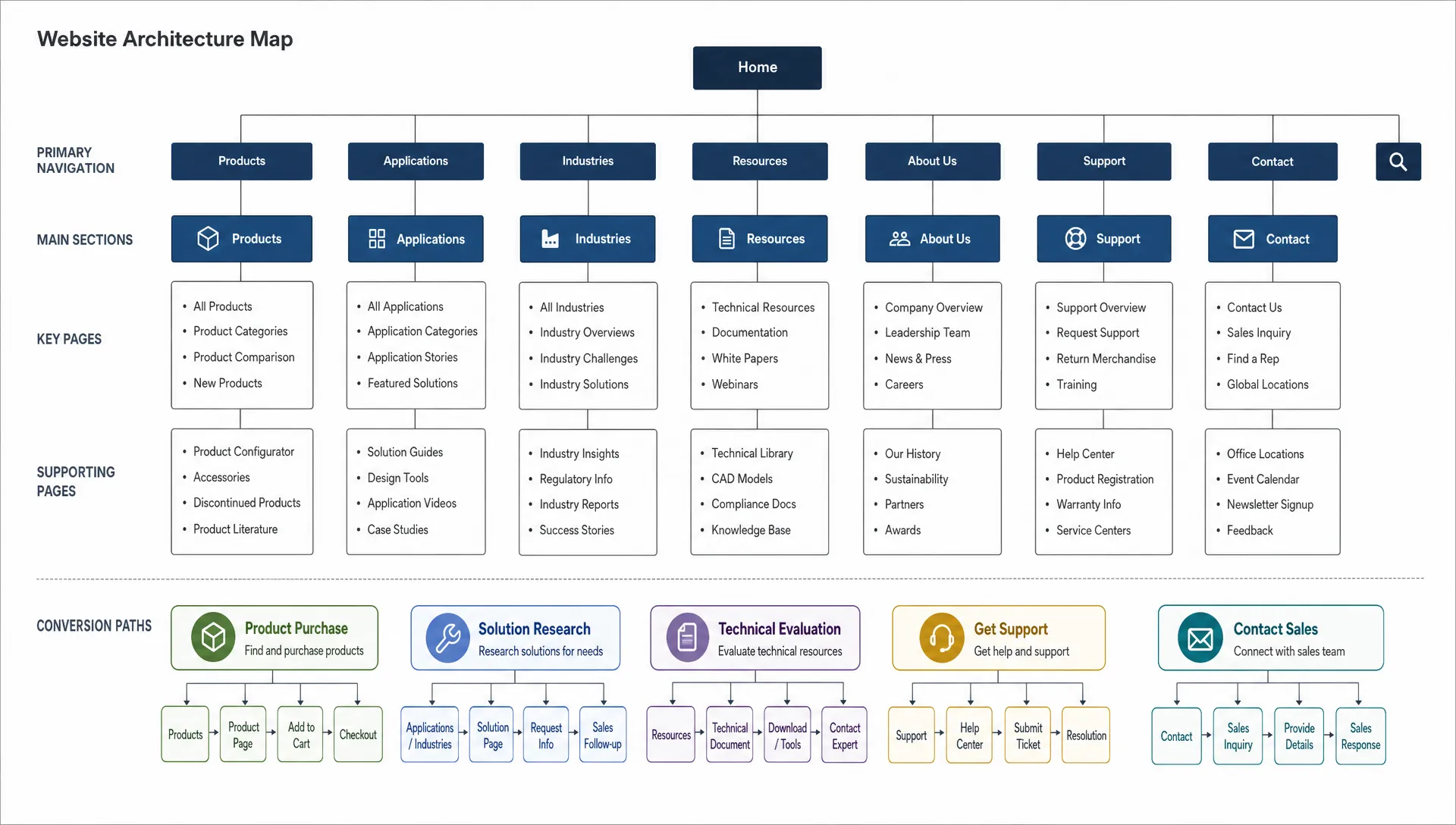
A complex B2B website should not be organized only around how the company sees itself. It should reflect how buyers compare solutions. That means your navigation, page hierarchy and content hubs should match the way prospects search, evaluate and narrow choices.
If buyers search by industry, industry pages need depth. If they search by problem, application pages need to be easy to find. If they search by product type, category pages need enough substance to rank and convert.
This is where SEO and design decisions overlap. Navigation labels, template layouts, page modules, form placement and internal links all affect organic performance. The article on search engine optimization website design for better leads explores this connection in more detail.
The practical goal is simple: a visitor should know where they are, why the page matters and what to do next within a few seconds. A crawler should also be able to identify the relationship between your most important pages without guessing.
Prioritize technical performance where it affects lead quality
Technical SEO is not only about passing automated tests. For complex B2B sites, performance issues often show up as lost trust, lower crawl efficiency and poor form completion.
Good search optimization should include page speed, mobile usability, clean code, secure browsing, stable layouts, structured data where appropriate and accessible content. Large images, scripts from old tools, uncompressed PDFs and slow forms can all reduce performance.
Pay close attention to pages that receive high-intent traffic. If a visitor reaches a quote page, distributor page or product page from search, the experience should be fast and predictable. Forms should be clear. Phone numbers should be easy to find. Downloads should work. Pages should not shift while the visitor is reading or trying to submit information.
Also review JavaScript-rendered content. If important specifications, FAQs or internal links are difficult for search engines to access, the page may look complete to a human but incomplete to a crawler.
Use PPC, sales and CRM data to decide what comes next
SEO teams often work from keyword tools alone. Complex B2B companies usually have better data available, even if it is scattered across systems.
Paid search reports can reveal which terms attract serious buyers. Sales teams know which questions appear before a qualified opportunity. CRM data can show which industries, services or product categories produce the best-fit leads.
When that data informs search optimization, priorities become sharper. A page that ranks in position eight for a high-margin service may deserve more attention than a blog post that ranks in position three for a broad informational query.
This is also a good reason to review PPC and SEO together. If paid campaigns are converting for certain phrases, those phrases may deserve stronger organic landing pages. If organic pages attract traffic but no leads, the problem may be intent mismatch, weak conversion paths or insufficient proof.
Measure SEO by qualified movement, not pageviews
Traffic is useful, but it is not the final scorecard for a complex B2B website. A page can attract thousands of visitors and still fail if those visitors are students, job seekers or unqualified buyers.
A better scorecard includes organic inquiries, RFQs, form completions, assisted conversions, calls from organic landing pages, technical downloads, demo requests and movement from informational pages to commercial pages. For long sales cycles, assisted conversions and account-level engagement may be more meaningful than last-click attribution.
Mature search optimization also tracks content decay. Important pages can lose visibility when competitors publish better resources, when product details become outdated or when internal links change during site updates.
Review priority pages quarterly. Look for ranking changes, conversion changes, crawl errors, title duplication, content gaps and form performance. A complex website is never truly finished, but it can be managed with discipline.
A practical 90-day priority plan
A 90-day plan helps teams avoid overcommitting. The goal is not to repair every page. The goal is to create measurable progress on the pages most likely to influence revenue.
| Timeframe | Priority | Outcome |
|---|---|---|
| Days 1 to 15 | Identify business-critical pages, conversion paths and top organic entry points | A ranked list of pages that deserve attention first |
| Days 16 to 30 | Audit crawl, indexation, duplicate content and internal linking | A technical cleanup plan tied to page priority |
| Days 31 to 60 | Improve titles, headings, copy depth, proof points and calls to action on key pages | Stronger intent match and clearer buyer paths |
| Days 61 to 75 | Update navigation, internal links and content hub relationships | Better topical clarity and page discovery |
| Days 76 to 90 | Measure leads, rankings, assisted conversions and engagement quality | A practical roadmap for the next optimization cycle |
This plan works because it connects technical fixes with buyer behavior. It avoids the common mistake of treating SEO as a disconnected checklist.
Frequently Asked Questions
What is the first search optimization priority for a complex B2B website? Start with the pages that influence qualified leads and revenue. Once those pages are identified, review their crawlability, intent match, internal links, proof points and conversion paths.
Should a complex B2B site create more content or improve existing pages first? Improve existing high-value pages first if they already receive impressions, rankings or sales attention. New content is useful when it fills a real intent gap, not when it duplicates pages already on the site.
How often should B2B companies audit large websites? Priority pages should be reviewed at least quarterly. Larger technical audits may be scheduled twice a year, especially after redesigns, CMS changes, product launches or major navigation updates.
Why do complex B2B websites often have duplicate SEO problems? Duplicate issues usually come from similar product pages, copied service descriptions, URL parameters, old campaign pages or regional pages with minimal unique information. These issues dilute relevance and make page priority harder for search engines to understand.
Need a clearer path for your B2B website?
If your website has grown into a large mix of product pages, service pages, technical resources and legacy content, a focused SEO plan can help turn that complexity into a lead-generation advantage.
B2B Inbound Marketing helps businesses improve visibility through SEO, PPC, inbound strategy, content and web-related marketing services. If you need a practical review of what to fix first, start with a focused look at the pages that matter most to your pipeline.