
Tag Archives: Industrial marketing

How the Right SEO Firm Helps Industrial Brands Grow - Main Image

How the Right SEO Firm Helps Industrial Brands Grow

Industrial brands do not grow from traffic alone. They grow when engineers, plant managers, procurement teams, distributors, and executive buyers can find the right information at the exact moment they are researching a problem, comparing vendors, or building a business case.

That is where the right SEO firm matters. For an industrial company, SEO is not just about ranking for broad keywords. It is about translating complex products, long sales cycles, technical specifications, and regional service capabilities into a search strategy that attracts qualified B2B buyers.

A strong industrial SEO program helps your brand become visible before the request for quote, before the supplier shortlist, and before a competitor has already shaped the buyer’s thinking.

Why industrial brands need a different SEO approach

Industrial buyers search differently from consumers. They often use technical terminology, part numbers, materials, tolerances, industry applications, regulatory language, and problem-specific phrases. A buyer may not search for “best manufacturer.” They may search for “316 stainless steel fabrication for food processing,” “hazardous area control panel supplier,” or “industrial pump repair Houston.”

That means a generic SEO strategy can miss the real opportunity. Industrial brands need a partner that understands how B2B buying decisions unfold, where technical content fits, and why lead quality matters more than raw visitor volume.

According to Gartner’s research on the B2B buying journey, buyers spend only a limited portion of their purchase process meeting with potential suppliers. Much of the decision-making happens through independent research. If your website does not answer technical, commercial, and trust-building questions during that research phase, your sales team may never get the chance to compete.

The right SEO firm helps you close that visibility gap.

What the right SEO firm actually changes

An industrial SEO partner should not treat your website as a brochure. It should treat it as a growth asset that supports visibility, lead generation, sales enablement, and trust.

A capable firm will usually focus on four outcomes:

  • Attracting searchers with genuine buying or research intent.
  • Improving technical website performance so search engines can crawl and understand important pages.
  • Building content that explains products, applications, industries served, and problems solved.
  • Turning organic traffic into measurable inquiries, calls, quote requests, and sales conversations.

This matters because industrial buyers often need confidence before they contact a vendor. They want proof that you understand their application. They want to see relevant capabilities. They want specs, process details, service areas, case examples, certifications, and clear next steps.

If your site ranks but does not persuade, SEO is incomplete. If your content persuades but cannot be found, your expertise stays hidden.

For a deeper look at how search visibility becomes lead generation, Andy Alagappan’s article on how search engine optimization services drive B2B leads explains the connection between buyer intent, optimized pages, and conversion-focused content.

Industrial SEO starts with buyer intent, not keyword volume

Many industrial terms have lower search volume than consumer keywords. That does not make them less valuable. In fact, a phrase with 30 searches a month can be highly profitable if it represents a buyer looking for a specialized product, custom service, or urgent supplier solution.

The job of an SEO firm is to separate informational searches from commercial opportunities. For example, “what is powder coating” may attract early-stage researchers, while “powder coating services for aluminum parts” may indicate a more qualified buyer. Both can be useful, but they need different content and different conversion paths.

Industrial SEO strategy should account for:

  • Product categories and subcategories.
  • Application-specific searches.
  • Industry-specific needs.
  • Location-based demand.
  • Problem and failure-mode searches.
  • Replacement part, repair, and maintenance queries.
  • Comparison and vendor evaluation searches.

Consider how a buyer researching durable industrial assets behaves. Whether the product is specialty valves, fabricated components, process controls, or premium shipping containers, the search journey usually begins with a practical need and a specific set of questions. SEO should make your business visible for those moments, not just for broad brand terms.

Generic SEO vs. industrial SEO

The difference between a generalist approach and an industrial-focused approach is often the difference between empty traffic and qualified pipeline.

Area Generic SEO approach Industrial SEO approach
Keyword research Prioritizes high-volume terms Prioritizes intent, product fit, applications, and lead quality
Content Writes broad blog posts Builds technical pages, application guides, FAQs, and service pages
Conversion strategy Measures traffic and form fills Tracks quote requests, qualified inquiries, calls, and sales opportunities
Site structure Optimizes main pages only Organizes products, industries, capabilities, and locations for search
Reporting Focuses on rankings Connects organic performance to pipeline and revenue indicators
Sales alignment Works mostly with marketing Uses input from sales, engineering, and customer service teams

A strong SEO firm does not need to be an engineer, but it must know how to extract expertise from your team and turn it into search-friendly content without watering it down.

Technical SEO is especially important for industrial websites

Industrial websites often grow over many years. Product pages get added, PDFs accumulate, old pages remain live, and website redesigns happen without a clear search strategy. Over time, this can create crawl issues, duplicate content, slow pages, broken links, thin product descriptions, and confusing navigation.

Google’s Search Essentials emphasize that websites need to be accessible, crawlable, useful, and trustworthy. For industrial brands, technical SEO supports all of those requirements.

A good SEO firm will examine issues such as:

  • Whether search engines can crawl important product and service pages.
  • Whether page titles and headings reflect actual buyer queries.
  • Whether product categories are organized around how buyers search.
  • Whether critical content is trapped inside PDFs instead of indexable web pages.
  • Whether site speed, mobile usability, and page experience create friction.
  • Whether old or outdated pages are weakening search performance.

This work is not glamorous, but it is foundational. If search engines cannot understand your pages, and buyers cannot easily find the information they need, even excellent content may underperform.

Content turns industrial expertise into discoverable authority

Most industrial companies already have expertise. The challenge is that much of it sits inside sales conversations, engineering notes, quote responses, installation experience, and customer service calls. SEO content brings that expertise to the surface.

The right SEO firm will help turn internal knowledge into useful, searchable content, such as product category pages, application guides, technical explainers, comparison pages, troubleshooting articles, industry landing pages, and local service pages.

The goal is not to publish content for the sake of publishing. The goal is to answer the questions buyers ask before they are willing to engage.

For example, an industrial manufacturer might need content that explains material selection, lead times, quality standards, custom capabilities, maintenance considerations, installation requirements, or common causes of equipment failure. A service provider might need pages for emergency repair, preventive maintenance, field service, regional coverage, and industry-specific use cases.

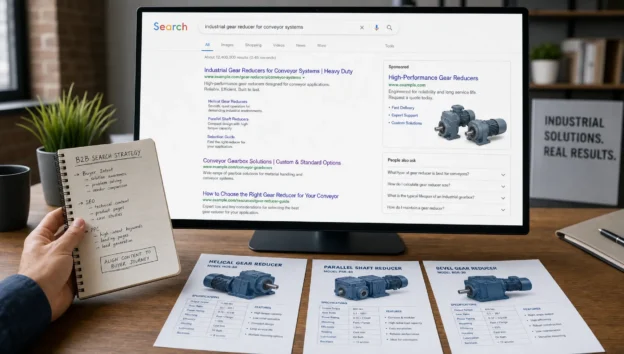
An indoor marketing planning scene with product samples, printed specification sheets, and a factory floor visible through the window, showing how technical expertise becomes organized content for search visibility.

The right SEO firm aligns search with the sales process

Industrial SEO should never live in isolation from sales. Your sales team knows which inquiries are valuable, which questions come up repeatedly, which industries are growing, and which leads are a poor fit.

An effective SEO partner will use that feedback to refine strategy. If a page generates many inquiries but few qualified opportunities, the content may need clearer qualification language. If sales keeps hearing the same technical objection, that topic may deserve a dedicated page. If a high-margin service is underrepresented on the website, it may need a stronger search presence.

This is where SEO becomes more than marketing activity. It becomes a way to support the full revenue cycle.

Good alignment can help answer questions like:

  • Which organic keywords are driving qualified inquiries?
  • Which landing pages influence RFQs or consultation requests?
  • Which industries produce the best lead quality?
  • Which content helps sales shorten education time?
  • Which topics reveal unmet buyer demand?

For industrial brands with long sales cycles, this alignment is critical. A visitor may read multiple pages, return weeks later, share a link internally, then contact sales after internal approval. SEO reporting should reflect that complexity rather than judging performance only by last-click form fills.

Measuring growth from industrial SEO

The right SEO firm should help leadership understand what is working. Rankings are useful, but they are not the final business outcome. Industrial brands need reporting that connects visibility to qualified demand.

Metric Why it matters for industrial growth
Organic visibility for priority topics Shows whether the brand is appearing for relevant products, services, and applications
Qualified organic traffic Helps distinguish real prospects from unqualified visitors
Conversion rate by page type Identifies which product, service, or industry pages produce inquiries
Calls, forms, and RFQs Measures direct lead generation from organic search
Assisted conversions Captures SEO’s role in longer buying journeys
Lead quality feedback Connects marketing performance to sales reality
Pipeline or revenue influence Helps leadership evaluate SEO as a growth investment

This is also where expectations matter. SEO is not usually an instant-results channel. It builds momentum through better site structure, stronger content, improved authority, and continuous optimization. For industrial companies, the payoff can be significant because a single qualified lead may represent a substantial contract or long-term customer relationship.

If leadership needs a clearer framework for evaluating returns, reviewing the ROI benefits from an SEO campaign can help connect SEO activity to measurable business outcomes.

Signs you have found the right SEO firm

Choosing an SEO partner is not just about finding someone who knows search algorithms. It is about finding a team that can understand your market, ask better questions, and connect SEO execution to industrial growth.

Look for a firm that asks about your margins, sales cycle, best-fit customers, service regions, product priorities, quoting process, and lead quality. Those questions reveal whether they are thinking like a growth partner or simply selling deliverables.

A strong industrial SEO firm should be able to explain how it will:

  • Identify high-intent search opportunities.
  • Improve technical website performance.
  • Build content around products, services, applications, and industries.
  • Support local or regional visibility when relevant.
  • Coordinate SEO with PPC, content writing, web design, and inbound strategy.
  • Report on business outcomes, not just rankings.

You should also expect honesty. Not every keyword is worth pursuing. Not every page needs a blog post. Not every traffic increase is valuable. The right partner will help you prioritize what supports growth.

If your company is seeing stagnant organic leads, declining search visibility, rising paid media costs, or poor lead quality, it may be time to review the warning signs in this guide on when to hire search engine optimization consultants.

Mistakes industrial brands should avoid

One common mistake is treating SEO as a one-time website project. A redesign may improve appearance, but search growth usually requires ongoing research, optimization, content development, measurement, and refinement.

Another mistake is focusing only on broad keywords. A manufacturer may want to rank for a general term like “industrial equipment,” but the better opportunity may be application-specific, product-specific, or regional searches with much stronger buying intent.

A third mistake is hiding critical information in PDFs. Spec sheets and catalogs can be useful, but important product and service information should also exist on crawlable web pages. That gives search engines more context and gives buyers a better experience.

Finally, many companies underuse their internal experts. Engineers, estimators, technicians, salespeople, and customer support teams all hear the questions buyers care about. A good SEO process captures those insights and turns them into useful content.

How industrial SEO supports PPC and inbound marketing

SEO works best when it is part of a broader inbound marketing system. PPC can generate near-term visibility for high-value searches while SEO builds long-term organic presence. Social media can support credibility and distribution. Web design can improve conversion paths. Content writing can help buyers move from research to inquiry.

For industrial brands, this integrated approach is especially useful because buyers often need multiple touches before contacting sales. They might find a blog article through organic search, return through a branded search, compare a service page, then convert through a paid ad or direct visit.

A qualified SEO firm understands that growth rarely comes from one tactic alone. The real advantage comes from making every channel support the same commercial strategy.

Frequently Asked Questions

Why should an industrial company hire an SEO firm? An industrial company should hire an SEO firm when it needs more qualified visibility in search results, better lead quality, stronger technical website performance, and content that supports complex B2B buying decisions.

How is industrial SEO different from regular SEO? Industrial SEO focuses more heavily on technical terminology, niche products, long sales cycles, application-specific searches, regional demand, and lead quality. It must connect search strategy with sales conversations and buyer research behavior.

How long does SEO take for industrial brands? Timelines vary based on competition, website condition, content depth, and market demand. Many industrial brands should expect SEO to build gradually over months, with stronger results coming from consistent optimization and content development.

What should an SEO firm report on? An SEO firm should report on rankings and traffic, but also on qualified organic visits, conversions, RFQs, phone calls, assisted conversions, lead quality, and pipeline indicators when that data is available.

Can SEO work with PPC for industrial marketing? Yes. SEO and PPC often work well together. PPC can create immediate visibility for priority terms, while SEO builds durable organic presence and reduces dependence on paid traffic over time.

Build a search strategy that supports industrial growth

The right SEO firm helps industrial brands do more than appear in search results. It helps them become easier to find, easier to trust, and easier to choose.

For manufacturers, distributors, fabricators, service providers, and B2B industrial companies, that means building a website and content strategy around real buyer intent, technical credibility, and measurable lead generation.

If your industrial brand is ready to improve visibility, attract better leads, and connect SEO with inbound marketing, PPC, content, and web strategy, B2B Inbound Marketing can help you plan the next step with a practical growth-focused approach.
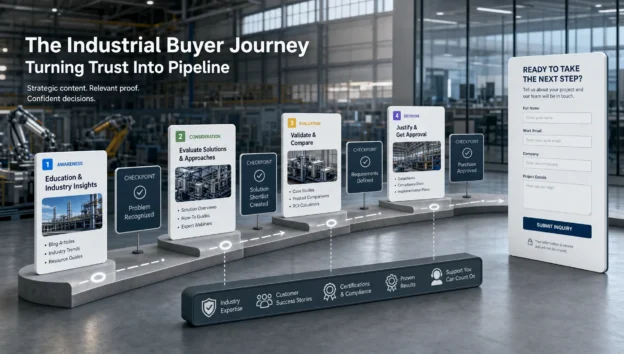

Web Content Marketing That Builds Trust and Pipeline - Main Image

Web Content Marketing That Builds Trust and Pipeline

Your next best customer may not be ready to talk to sales yet. They may be comparing suppliers, checking technical fit, looking for proof, or trying to understand whether your company can reduce risk. In that moment, your website content is not just marketing collateral. It is the first sales conversation.

That is why effective web content marketing has to do more than drive traffic. For B2B, industrial, and technical service companies, content must build confidence, answer high-stakes questions, and create a path from anonymous visitor to qualified opportunity.

The companies that win are not always the ones publishing the most. They are the ones publishing the most useful, believable, and buyer-focused content at every stage of the decision process.

Why Trust Is the Real Conversion Point

B2B buyers rarely convert after one page view. They move through a long path of discovery, comparison, internal discussion, budget review, and vendor validation. In industrial and technical markets, the buying committee may include operations, engineering, procurement, finance, and executive leadership. Each person needs different evidence before they are willing to engage.

That means trust is not a soft brand metric. It is a pipeline requirement.

A buyer may ask questions like these before they ever submit a form:

  • Does this company understand our industry?
  • Can they solve our specific problem, or are they using generic claims?
  • Do they have proof of results?
  • Are they transparent about process, limitations, and next steps?
  • Will talking to sales be helpful, or will it waste time?

Web content marketing gives you the opportunity to answer those questions before a salesperson enters the conversation. When done well, it reduces uncertainty and makes the next step feel safe.

For Houston-based B2B companies, manufacturers, distributors, energy service providers, industrial suppliers, and professional service firms, this is especially important. Buyers are often evaluating high-value decisions where failure is expensive. They do not need hype. They need clarity.

The Difference Between Traffic Content and Pipeline Content

Traffic content is built to attract visitors. Pipeline content is built to move the right visitors toward action.

Both matter, but they are not the same. A top-of-funnel article may explain a general industry trend, while a pipeline-focused page might compare solutions, answer procurement objections, or show a measurable business outcome. The most effective content strategy connects these assets rather than treating them as separate projects.

A strong content system usually includes three layers:

Content layer Buyer intent Best examples Pipeline role
Educational content I need to understand the problem Blog posts, guides, explainers, industry updates Attracts qualified visitors and builds early trust
Evaluation content I need to compare options Service pages, solution pages, FAQs, comparison pages Helps buyers shortlist your company
Proof content I need confidence before taking action Case studies, testimonials, results pages, technical examples Reduces risk and supports conversion

If your website only has educational content, buyers may learn from you but convert elsewhere. If it only has service pages, you may miss buyers who are still defining their problem. The goal is to create a connected journey that meets people where they are and guides them forward.

This is where a structured approach such as a Content, Traffic, and Promotion strategy becomes useful. Content earns attention, traffic brings the right visitors, and promotion ensures your best assets do not sit quietly on your website.

What Trustworthy Web Content Looks Like

Trustworthy content is specific. It uses the language of the buyer, not just the language of the seller. It explains what matters, what can go wrong, how decisions are made, and what a prospect should consider before moving forward.

In industrial marketing, that may mean explaining lead times, compliance concerns, service areas, technical constraints, product applications, maintenance factors, or implementation risks. In B2B services, it may mean clarifying process, deliverables, timelines, pricing variables, or the difference between similar solutions.

Transparency is one of the fastest ways to build credibility. A simple example outside B2B industrial marketing is how service marketplaces help buyers make decisions by showing practical cost information, such as platforms where homeowners can compare tradespeople's costs before they book. The lesson for B2B marketers is not to copy that model exactly. It is to recognize that buyers trust companies that help them understand value, cost drivers, and expectations before asking for a commitment.

Your website can create the same type of confidence by explaining:

  • What affects project scope or price
  • What information is needed for an accurate recommendation
  • What results are realistic and what is not guaranteed
  • What makes one solution better suited than another
  • What happens after a prospect submits an inquiry

The more uncertainty your content removes, the easier it becomes for a qualified buyer to take the next step.

Build Around Buyer Risk, Not Just Keywords

SEO matters. Keywords matter. But the best web content marketing begins with buyer risk.

In many B2B campaigns, content planning starts and ends with search volume. That can lead to generic posts that rank for broad terms but do not influence revenue. A better question is: what does the buyer need to believe before they contact us?

For example, an industrial equipment supplier may need content that proves reliability, delivery capability, technical knowledge, and service responsiveness. A B2B software company may need content that answers integration, onboarding, security, and ROI questions. A marketing services provider may need content that explains strategy, reporting, lead quality, and long-term visibility.

This is why social proof matters. Case studies, testimonials, customer examples, reviews, and performance snapshots make claims easier to believe. If you are not sure how to use credibility assets without sounding self-promotional, this guide on how social proof can strengthen your marketing is a useful starting point.

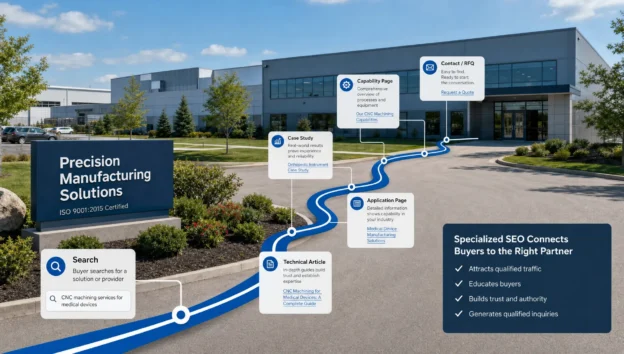
A marketing team standing in front of a large wall-mounted buyer journey map, with content assets, trust signals, and pipeline stages connected from awareness to sales inquiry; indoor strategy room, medium-wide composition, people present and the map clearly visible.

The Content Assets That Move Buyers Toward Sales

A buyer-ready website needs more than blog posts. Blog content can create visibility and educate the market, but pipeline growth usually depends on deeper assets that help visitors make decisions.

The most valuable assets often include service pages that clearly explain who the offer is for, what problem it solves, and what outcomes buyers can expect. These pages should not be thin summaries. They should answer the objections a sales team hears every week.

Case studies and results-focused stories are equally important. They show that your company can turn strategy into outcomes. For example, a focused SEO effort that generated more qualified leads is more persuasive than a general claim about better rankings. A practical example is this article on how an SEO campaign brought 67% more qualified leads to a B2B tech company.

Comparison and decision-support content also play a major role. Buyers often search for alternatives, pros and cons, cost factors, or best-fit scenarios. If your website avoids these topics, buyers will find answers elsewhere, often from competitors or third-party sites that do not fully understand your strengths.

High-converting B2B websites typically include a balanced mix of content types:

Content type Trust-building purpose Conversion opportunity
Detailed service pages Shows expertise and fit Proposal inquiry, consultation request
Case studies Proves outcomes Sales conversation, demo, quote request
FAQs Removes objections Contact form, next-step CTA
Technical articles Demonstrates knowledge Newsletter signup, resource download
Industry pages Shows market familiarity Targeted lead capture
Video content Adds clarity and human presence Website engagement, assisted conversion

The key is to make every page responsible for a job. Some pages attract. Some educate. Some qualify. Some convert. A content strategy becomes more powerful when each page has a clear purpose.

Optimize for Search Without Losing the Human Buyer

Search optimization is still foundational for web content marketing, but modern SEO cannot be reduced to keyword placement. Search engines are better at understanding usefulness, topical depth, and whether a page satisfies intent. Buyers are also more selective. They can quickly detect shallow content written only to rank.

A strong B2B content page should include the terms buyers use, but it should also demonstrate real understanding. That means answering follow-up questions, showing examples, addressing trade-offs, and organizing information so busy decision-makers can scan quickly.

For industrial and technical companies, avoid oversimplifying complex topics. Buyers often appreciate depth when it helps them make a better decision. At the same time, do not bury the answer. Start with the practical takeaway, then provide supporting detail.

Your content should be easy for search engines to understand and easy for humans to trust. That usually means clear headings, descriptive page titles, concise introductions, internal links to related resources, and strong calls to action that match the buyer's stage.

Search behavior is also changing as AI summaries, zero-click results, and platform-based research affect traditional website traffic. That does not make content less valuable. It makes authority, usefulness, and brand recognition more important. If you are seeing traffic patterns shift, this discussion of what is happening as website traffic is declining explains why marketers need to think beyond raw visits.

Measure Content by Pipeline Impact

Many companies measure content by page views alone. That is incomplete. A blog post with thousands of visitors but no qualified engagement may be less valuable than a technical service page that attracts fewer visitors but influences real opportunities.

Pipeline-focused measurement connects content to business outcomes. This does not mean every article needs to produce a direct lead immediately. Some content assists conversions over time. The goal is to understand which topics and pages help buyers move forward.

Useful metrics include:

Metric What it reveals Why it matters
Organic traffic by topic Which problems attract buyers Helps prioritize future content
Engagement on key pages Whether visitors find content useful Shows quality of attention
Form submissions by landing page Which pages create inquiries Connects content to lead generation
Assisted conversions Which assets support buyer journeys Shows influence beyond last click
Sales feedback Which content answers real objections Aligns marketing with revenue conversations
Lead quality Whether content attracts the right audience Prevents traffic growth without pipeline growth

The best reporting combines marketing analytics with sales insight. If prospects mention a guide during sales calls, if a case study shortens the decision cycle, or if a technical article brings in better-qualified inquiries, those are meaningful signals.

Common Mistakes That Weaken Trust

Many content programs fail because they focus on activity instead of usefulness. Publishing more does not automatically create more pipeline. In some cases, it creates a cluttered website that makes decision-making harder.

One common mistake is writing for everyone. B2B buyers want to see themselves in your content. If your copy could apply to any company in any market, it will not build much confidence. Industry-specific examples, use cases, and pain points make your message more credible.

Another mistake is hiding important information. Companies often avoid discussing pricing factors, process, timelines, or limitations because they fear losing leads. In reality, qualified buyers appreciate clarity. Content that educates buyers tends to filter out poor-fit inquiries and improve sales conversations.

A third mistake is separating content from sales. Your sales team knows the objections, questions, and decision criteria that matter most. Those insights should become pages, FAQs, guides, and comparison content. If marketing and sales do not share information, content will stay too generic.

Finally, some companies treat content as a one-time website project. Trust is built over time. Markets change, buyer questions evolve, and search results shift. Your content needs regular updates, not just occasional redesigns.

A Practical 90-Day Web Content Marketing Plan

If your website has content but does not consistently generate qualified leads, start with a focused 90-day improvement plan. The goal is not to rebuild everything at once. The goal is to identify the highest-impact gaps and improve the buyer journey.

  • Audit your top service and solution pages for clarity, proof, and conversion paths.
  • Interview sales or customer-facing teams to collect common buyer questions and objections.
  • Identify three to five content gaps that affect high-intent buyers, such as FAQs, comparison pages, or case studies.
  • Refresh existing pages before creating new ones if they already have rankings or relevant traffic.
  • Add stronger calls to action that match the page intent, such as proposal inquiry, consultation, or related resource.

This type of plan keeps content tied to business goals. It also helps teams avoid random publishing, where new articles are created without a clear role in the pipeline.

Frequently Asked Questions

What is web content marketing? Web content marketing is the strategic use of website content, such as blog posts, service pages, case studies, FAQs, and guides, to attract the right audience, build trust, and move prospects toward a business goal.

How does web content marketing build pipeline? It builds pipeline by answering buyer questions, improving search visibility, proving expertise, reducing perceived risk, and giving visitors clear next steps when they are ready to engage.

Is blogging enough for B2B content marketing? Blogging is valuable, but it is not enough by itself. B2B companies also need decision-stage content such as service pages, proof assets, comparison content, and strong conversion paths.

How often should a B2B company update website content? High-value pages should be reviewed regularly, especially when services, buyer questions, search rankings, or competitive conditions change. Content that influences leads and sales deserves ongoing attention.

What makes industrial web content different? Industrial content often needs more technical depth, more proof, and clearer explanations of risk, process, specifications, service capability, and operational impact.

Turn Content Into a Trust and Pipeline Asset

Web content marketing works best when it is treated as a revenue system, not a publishing checklist. The right content helps buyers find you, understand you, trust you, and take the next step with confidence.

For B2B and industrial companies, that means combining SEO, inbound strategy, clear messaging, useful content, and conversion-focused web pages. If your website is getting traffic but not enough qualified inquiries, or if your content does not reflect the expertise of your business, it may be time to rethink the strategy behind every page.

A focused content plan can turn your website into a stronger sales asset, one that supports visibility today and pipeline growth over the long term.

When to Hire Search Engine Optimization Consultants - Main Image

When to Hire Search Engine Optimization Consultants

B2B companies often wait to bring in SEO help until traffic drops, leads slow down, or a competitor starts showing up everywhere in Google. By then, the work is usually more expensive and the timeline is less forgiving. The better question is not whether SEO matters, but when outside expertise becomes the smartest move.

Hiring search engine optimization consultants makes sense when organic visibility has become a business constraint. That might mean your sales team needs more qualified leads, your website is not converting, your paid search costs are rising, or your internal team is too busy to build a consistent search strategy.

For industrial, manufacturing, SaaS, and professional service companies, SEO is not just a marketing tactic. It is how buyers find technical answers, compare vendors, validate credibility, and decide who belongs on the shortlist.

The simplest answer: hire before SEO becomes urgent

SEO takes time because it depends on several moving parts: technical site health, content quality, topical authority, user experience, backlinks, and search engine trust. A consultant can help accelerate progress, but no ethical SEO expert can turn organic search into an overnight channel.

That is why the best time to hire is usually before a major problem becomes obvious. If you wait until rankings have collapsed after a redesign, competitors have captured your highest-intent keywords, or sales leadership needs pipeline immediately, you are starting from behind.

Google’s own Search Essentials make it clear that discoverability depends on crawlable pages, useful content, and a site that can be understood by search engines. A skilled consultant turns those broad principles into a practical roadmap for your business, your market, and your buyers.

Signs it is time to hire search engine optimization consultants

Your organic leads have plateaued or declined

A steady decline in organic traffic is one warning sign, but B2B companies should look deeper than visits. If traffic is flat while form submissions, quote requests, phone calls, demo inquiries, or consultation bookings are slowing down, the issue may be search intent.

Your website may be attracting visitors who are researching broadly but not buyers who are ready to evaluate a vendor. Consultants can analyze which pages bring qualified visitors, which keywords align with sales conversations, and where content gaps are keeping prospects from moving forward.

For B2B organizations, the goal is not simply more traffic. It is more of the right traffic. That is why a lead-focused SEO strategy should connect keyword research, content planning, technical optimization, and conversion paths. If this is the challenge you are facing, it helps to understand how search engine optimization services drive B2B leads before deciding what type of support you need.

Competitors dominate the searches that matter

Search your most valuable non-branded terms. Do competitors appear for product categories, service applications, comparison searches, local terms, or technical questions that your ideal customers ask?

If the answer is yes, they are not just getting traffic. They are shaping buyer expectations before your sales team has a chance to speak. In industrial and B2B markets, that early visibility can influence vendor lists, RFQ opportunities, and trust.

A consultant can identify where competitors are winning, why they are ranking, and which opportunities are realistic for your site. Sometimes the answer is better service pages. Sometimes it is technical content, industry-specific landing pages, improved internal linking, or stronger authority signals.

Your PPC costs keep rising

Paid search is valuable, especially when you need immediate visibility. But if your company depends too heavily on PPC for every lead, customer acquisition costs can become uncomfortable.

SEO and PPC should work together. PPC can validate which keywords convert, while SEO can build long-term visibility around proven search themes. If you are spending more every quarter just to maintain the same lead volume, it may be time to invest in organic search as a compounding asset.

An SEO consultant can review paid search data, identify terms worth targeting organically, and help you reduce dependence on paid clicks over time without shutting down campaigns that are already working.

You are planning a website redesign or migration

One of the most expensive SEO mistakes happens during a website redesign. Companies launch a better-looking site but lose rankings because URLs change, redirects are missing, content is removed, metadata is ignored, or key pages become harder for search engines to crawl.

If you are redesigning your website, moving to a new CMS, changing domains, restructuring navigation, or consolidating content, hire SEO help before launch. Consultants can create a migration plan, protect high-performing pages, map redirects, review staging environments, and monitor indexation after the new site goes live.

A redesign should improve both brand perception and search performance. Without SEO oversight, it can unintentionally erase years of organic equity.

Your website gets visitors but not enough inquiries

Sometimes the problem is not ranking. It is conversion.

A page may appear in search results and receive traffic, but fail to explain your offer clearly, answer buyer objections, show proof, or guide visitors to take the next step. This is especially common on technical B2B websites where content is written from an internal perspective instead of a buyer’s perspective.

SEO consultants should not stop at keywords. They should examine whether high-value pages match intent, communicate credibility, and provide clear conversion paths. For many companies, the biggest gains come from pairing SEO with website optimization services that improve conversion rates, so the traffic you already have produces more opportunities.

Your content is active but unfocused

Many companies publish blog posts, social updates, and product content without a clear search strategy. The result is activity without momentum.

A consultant can turn scattered content into a structured system. That includes mapping topics to the buyer journey, prioritizing pages that support revenue, avoiding keyword overlap, and building content around real customer questions.

This is also where content quality matters more than ever. AI-assisted writing can support research and drafting, but it cannot replace original expertise, customer insight, technical accuracy, or first-hand experience. In a market where AI rewriting and detector-avoidance prompts are easy to find, strong SEO consultants should help you publish content that is genuinely useful, accurate, and aligned with your brand rather than content that is merely rewritten to pass a surface-level check.

Technical SEO issues keep recurring

If your site has broken links, duplicate pages, slow load times, crawl errors, poor mobile performance, messy URL structures, or indexation problems, your content may not reach its full potential.

Technical SEO is especially important for larger websites, ecommerce catalogs, manufacturer part pages, resource libraries, multi-location sites, and older CMS platforms. Search engines need to access, understand, and prioritize your pages. Users need a fast, clear experience.

When technical issues keep resurfacing, outside expertise can help separate urgent problems from minor warnings and create a practical implementation plan for developers.

Business moments when hiring sooner pays off

Some situations create natural windows for SEO investment. If you are approaching one of these moments, waiting can create avoidable rework.

Business situation Why SEO consulting helps Best time to involve a consultant
Website redesign Protects rankings, redirects, content value, and crawlability Before design and development decisions are finalized
New product or service launch Builds search demand capture around buyer questions and use cases During positioning and content planning
Expansion into a new market Identifies local, regional, or industry-specific search opportunities Before launch campaigns begin
PPC budget increases Finds organic opportunities from paid search performance data Before paid media becomes the only lead source
Sales team reports weak leads Aligns content and pages with buyer intent As soon as lead quality becomes a recurring issue
Competitor visibility improves Diagnoses ranking gaps and authority differences Before competitors become the default choice

The cost of waiting is not always visible immediately. But delayed SEO can mean missed rankings, higher paid media costs, weaker brand credibility, and months of catch-up work. If you are debating whether to postpone, consider the business consequences of delaying SEO campaign implementation before pushing it to another quarter.

When you may not need outside SEO help yet

Not every company needs to hire a consultant immediately. If your business model, offer, or target market is still unclear, SEO may not be the first priority. Search strategy works best when it is built around a defined audience and a clear value proposition.

You may not need a consultant yet if your only goal is leads by next week. In that case, PPC, outbound sales, referrals, or direct campaigns may be better short-term options. SEO can support revenue, but it is not a quick replacement for immediate demand generation.

You may also be able to wait if your website is small, your market is not competitive, your internal team has SEO experience, and your organic traffic is already producing qualified inquiries. Even then, a periodic audit can help catch issues before they grow.

What good consultants should actually do

The right consultant does more than produce a keyword list. Effective SEO consulting should connect strategy, execution, measurement, and business outcomes.

A strong engagement usually includes:

  • Business and buyer discovery: Understanding your offers, margins, sales cycle, ideal customers, differentiators, and common objections.
  • Technical SEO audit: Reviewing crawlability, indexation, site architecture, page speed, mobile performance, redirects, canonical tags, structured data, and CMS limitations.
  • Keyword and intent research: Identifying how buyers search at different stages, from early education to vendor evaluation.
  • Content strategy: Prioritizing service pages, product pages, application pages, case studies, blog topics, and resources based on business value.
  • On-page optimization: Improving titles, headings, internal links, copy, metadata, calls to action, and page structure.
  • Measurement planning: Defining goals, conversion events, reporting cadence, and the metrics that matter to leadership.

For industrial and B2B companies, consultants should also understand that search behavior is often specific and technical. A buyer may search by application, material, compliance need, part type, process, location, or problem. Generic SEO advice rarely goes far enough.

Consultant, agency, or in-house hire?

The right resource depends on your goals, workload, and internal capabilities. A consultant is often best when you need senior strategy, audits, prioritization, and guidance. An agency can be better when you need hands-on execution across SEO, PPC, content, web design, and campaign management. An in-house hire makes sense when SEO is a permanent, daily function with enough work to justify a full-time role.

Option Best fit Watch out for
SEO consultant Strategic direction, audits, roadmaps, expert guidance, team training May still require internal or external execution support
Digital marketing agency Strategy plus implementation across multiple channels Requires clear goals and communication to avoid scattered activity
In-house SEO specialist Ongoing ownership of search performance and internal coordination Hiring one person may not cover technical, content, analytics, and development needs

A conference room desk with printed keyword maps, industrial product brochures, conversion notes, and performance charts arranged for an SEO planning discussion.

For many B2B companies, the best answer is a hybrid model. A consultant or agency provides specialized expertise, while internal subject matter experts contribute technical knowledge, customer insight, and sales feedback.

A five-question test for timing

If you are unsure whether now is the right time, ask these questions:

  • Do we know which search terms produce qualified opportunities? If not, you may be missing the difference between traffic and revenue potential.
  • Are our most important pages ranking for high-intent searches? If not, competitors may be capturing buyers closer to a decision.
  • Can our internal team diagnose technical SEO problems confidently? If not, an audit can prevent wasted content investment.
  • Do we have a content plan tied to the sales cycle? If not, publishing more may not solve the real problem.
  • Can we measure organic conversions accurately? If not, leadership may not trust SEO even when it is working.

If you answered no to two or more, a consultant can likely create clarity and direction.

Questions to ask before hiring SEO consultants

The hiring process should reveal how a consultant thinks, not just what they promise. Look for someone who asks about your business model, not only your rankings.

Good questions include:

  • How will you connect SEO recommendations to leads and revenue? The answer should include conversion tracking, buyer intent, and page-level performance.
  • What will you need from our team? B2B SEO often requires input from sales, product, engineering, leadership, or customer service.
  • How do you prioritize SEO tasks? A good consultant separates high-impact work from low-value checklist items.
  • What does reporting look like? Reports should explain progress, blockers, next steps, and business meaning, not just charts.
  • How do you approach content in technical industries? The best answer includes subject matter expertise, accuracy, and buyer usefulness.

Be cautious of anyone who guarantees specific rankings, promises instant results, hides their methods, focuses only on backlinks, or recommends mass-produced content without understanding your market.

What the first 90 days should look like

The first month should focus on discovery and diagnosis. This includes analytics access, keyword research, technical review, competitor analysis, conversion tracking review, and interviews with key stakeholders. The goal is to understand what is blocking performance and where the biggest opportunities are.

The second month should move into prioritization and implementation. That may include fixing technical issues, improving core service pages, rewriting titles and headings, strengthening internal links, building a content calendar, or refining conversion paths.

The third month should show early indicators and a clearer operating rhythm. SEO results may not fully mature in 90 days, especially in competitive B2B markets, but you should see completed improvements, cleaner reporting, better strategic focus, and signs that pages are moving in the right direction.

A consultant should also help your team understand what is happening and why. SEO should not feel like a black box.

How to measure whether hiring was worth it

SEO success should be measured by business progress, not vanity metrics alone. Traffic matters, but only when it is relevant. Rankings matter, but only when they support buyer intent. Content output matters, but only when it builds authority and helps prospects take the next step.

Useful metrics include qualified organic traffic, rankings for high-intent terms, form submissions, calls, quote requests, demo requests, assisted conversions, conversion rate by landing page, and revenue influenced by organic search.

For B2B companies with long sales cycles, it is also important to track leading indicators. A technical fix, improved page structure, stronger internal linking, and better content alignment can create measurable momentum before closed revenue appears.

Frequently Asked Questions

How early should I hire search engine optimization consultants before a website redesign? Ideally, involve an SEO consultant before the site architecture, URL structure, content plan, and CMS decisions are finalized. Waiting until launch often means fixing preventable problems after rankings have already been affected.

Can an SEO consultant help if we already have a marketing team? Yes. Many consultants work alongside internal teams by providing audits, strategy, prioritization, technical guidance, content direction, and performance measurement. Your team still brings essential brand, product, and customer knowledge.

How long does it take to see SEO results? Some technical and on-page improvements can show early movement within weeks, but meaningful organic growth often takes several months. Competitive B2B markets usually require consistent work across content, technical SEO, authority, and conversion optimization.

Should I hire an SEO consultant or spend more on PPC? If you need leads immediately, PPC can help. If you want to build durable visibility and reduce overreliance on paid clicks, SEO is important. Many companies use PPC and SEO together, using paid data to guide organic priorities.

What is the biggest mistake companies make when hiring SEO help? The biggest mistake is hiring for tactics without a business strategy. SEO should be tied to buyer intent, lead quality, conversion paths, and sales outcomes, not just keyword rankings.

Ready to decide if SEO consulting is the right next step?

If your website is not producing the visibility, leads, or search rankings your business needs, now may be the right time to get expert guidance. B2B Inbound Marketing helps companies improve online visibility through SEO, PPC, inbound strategy, content, social media marketing, video SEO, and web-related marketing services.

Start by reviewing where your best leads should be coming from, which competitors are winning in search, and whether your website is ready to convert qualified visitors. When you are ready for a practical plan, visit Andy Alagappan B2B Inbound Marketing to explore how search strategy can support your next stage of growth.

Paid Per Click Advertising Tips for High-Value B2B Sales - Main Image

Paid Per Click Advertising Tips for High-Value B2B Sales

High-value B2B sales do not behave like consumer ecommerce or low-ticket lead generation. A single deal may involve six months of research, several stakeholders, technical validation, procurement review, and a large budget decision. That changes how paid per click advertising should be planned, measured, and optimized.

For industrial suppliers, SaaS companies, engineering firms, manufacturers, and specialized service providers, the goal is not simply to get more clicks. The goal is to attract the right accounts, capture serious buying intent, and give sales teams conversations that can turn into revenue.

The following tips focus on PPC for complex B2B sales, where lead quality matters more than lead volume and where one qualified opportunity can justify an entire campaign.

Start with deal economics, not keyword volume

Many PPC campaigns begin with keyword research. For high-value B2B, they should begin with business math.

Before setting bids or budgets, define what a qualified opportunity is worth. If your average contract value is $50,000, $250,000, or more, a high cost per lead may be acceptable if the lead is a true fit. If your sales team spends weeks chasing unqualified inquiries, even a low cost per lead can be expensive.

At minimum, clarify these numbers before launching or rebuilding a campaign:

  • Average deal value
  • Gross margin or lifetime value
  • Lead-to-opportunity conversion rate
  • Opportunity-to-customer close rate
  • Acceptable cost per qualified lead
  • Acceptable cost per sales opportunity

This helps prevent one of the most common B2B PPC mistakes: optimizing for the cheapest conversions instead of the most valuable ones. A $40 lead from a student, job seeker, or residential buyer may look good in Google Ads. A $400 lead from a plant manager actively sourcing a custom industrial solution may be far better.

Target buying intent, not just topic relevance

In high-value B2B campaigns, keyword relevance is not enough. A keyword can be relevant to your industry but still attract the wrong audience.

For example, a company selling industrial water treatment systems may be tempted to bid on broad terms like “water treatment” or “filtration system.” Those terms can pull in homeowners, students, DIY researchers, and low-value consumer searches. A more precise phrase such as “industrial wastewater treatment system supplier” may have lower search volume but much stronger commercial intent.

Use keyword groups that reflect the buyer’s stage and seriousness. This table shows how to think about intent:

Keyword type Example Typical intent PPC priority
Broad educational “what is predictive maintenance” Research and learning Useful for remarketing, lower priority for search
Problem aware “reduce downtime in manufacturing equipment” Exploring solutions Good for content offers and early-stage leads
Solution aware “industrial equipment monitoring software” Comparing solution categories Strong PPC opportunity
Vendor or supplier intent “industrial pump repair company Houston” Looking for a provider High priority
Specification or quote intent “custom stainless steel tank manufacturer quote” Near buying decision Highest priority

The highest-value campaigns often focus on fewer keywords with stronger buying signals. You may not get thousands of clicks, but the clicks you do receive are more likely to come from buyers with budget, urgency, and a defined need.

Build campaigns around the ideal customer profile

Paid search can become expensive when campaigns are built around what you sell rather than who should buy it. For B2B, the ideal customer profile should shape your campaign structure.

A strong ICP may include industry, company size, geography, technical needs, buying triggers, compliance requirements, and typical decision-makers. For a Houston-based industrial marketing campaign, location may matter. For a national B2B software campaign, industry and company size may matter more.

Translate that ICP into practical PPC decisions. Use geographic targeting where service areas are limited. Adjust ad copy to filter for commercial or industrial buyers. Exclude audiences and search terms that suggest consumer, academic, employment, or repair-only intent when those are not profitable.

This is especially important for specialized B2B companies because the wrong click can look deceptively close to the right click. “Industrial,” “commercial,” “OEM,” “enterprise,” “manufacturer,” “supplier,” and “custom” can all help qualify traffic when used honestly and naturally in keywords, ads, and landing pages.

Use negative keywords aggressively

For high-value B2B sales, negative keywords are not a minor cleanup task. They are central to protecting budget.

Search campaigns often waste money on terms that are related to your market but not related to your buyers. Common B2B negative keyword categories include jobs, salaries, training, free templates, consumer products, DIY searches, definitions, images, PDFs, used equipment, and unrelated locations.

A company selling enterprise cybersecurity consulting, for example, may not want clicks for “cybersecurity salary,” “free cybersecurity course,” or “home antivirus software.” A manufacturer may need to exclude “residential,” “small parts,” “cheap,” or “used” depending on the offer.

Search term reviews should happen regularly, especially in the first weeks of a campaign. If your campaign is already spending but not producing qualified leads, a structured audit like this guide on fixing a pay per click campaign that wastes budget can help identify where spend is leaking.

Write ads that qualify, not just attract

High click-through rates are useful only when the right people are clicking. In B2B PPC, ad copy should attract qualified buyers and gently discourage poor-fit traffic.

Instead of writing generic benefit statements, use copy that reflects the real buying situation. Mention the specific application, buyer type, industry, location, or scale when relevant. “Industrial Automation Integration for Manufacturers” is more qualifying than “Automation Solutions.” “Request a Consultation for Multi-Site Facilities” is more precise than “Contact Us Today.”

Good B2B ad copy often answers three questions quickly:

  • Is this for a business like mine?
  • Does this company understand my use case?
  • Is this worth discussing with my team?

Google’s own documentation explains that ad relevance, expected click-through rate, and landing page experience are components of Quality Score. While Quality Score is not the only measure that matters, tightly aligned keywords, ads, and landing pages can improve both efficiency and lead quality.

Send traffic to focused landing pages

A strong B2B PPC campaign can fail if it sends visitors to a generic homepage. High-value buyers usually need reassurance before they fill out a form or request a quote. They want to know whether you understand their industry, whether your solution fits their problem, and what the next step involves.

A good PPC landing page should match the keyword and ad promise. If the ad is about industrial SEO services, the landing page should not force the visitor to search through a general marketing services page. If the ad targets emergency equipment repair, the page should make response expectations and service areas clear.

For high-value B2B offers, include conversion-focused elements such as:

  • A clear headline that mirrors the buyer’s need
  • Industry-specific proof points, when available
  • A concise explanation of the process
  • Technical or commercial differentiators
  • A short form that asks only necessary questions
  • A phone number for urgent or complex inquiries
  • Trust signals such as certifications, case examples, or recognizable industries served

If visitors are clicking but not converting, the issue may not be the campaign. It may be the page experience. This is where reviewing whether your website is losing leads becomes just as important as adjusting bids.

A B2B marketing strategist reviews a paid search campaign plan beside a sales funnel diagram, keyword notes, and lead qualification criteria on a conference table.

Track offline sales outcomes, not only form fills

A form submission is not the same as revenue. In high-value B2B sales, many of the most important outcomes happen after the click: qualification calls, proposals, demos, plant visits, procurement reviews, and closed deals.

If your PPC reporting stops at “conversions,” the campaign may optimize toward the wrong leads. A campaign that generates 40 form fills but no qualified opportunities is not better than a campaign that generates 8 form fills and 3 serious sales conversations.

Use conversion tracking, CRM data, call tracking, and offline conversion imports where appropriate. Google Ads provides guidance on importing offline conversions, which can help connect ad clicks to later-stage sales actions. For B2B campaigns, this is one of the most important ways to teach ad platforms what a valuable lead actually looks like.

A better reporting structure might separate conversions into stages:

Stage What it measures Why it matters
Inquiry Form fill, call, chat, or email Shows initial response from traffic
Marketing qualified lead Fits basic ICP and need Filters out obvious poor-fit contacts
Sales qualified lead Sales team confirms potential value Connects PPC to pipeline quality
Opportunity Deal is opened in CRM Shows real revenue potential
Closed won Customer generated from PPC Measures true return on ad spend

This approach makes budget decisions much clearer. You can increase spend on campaigns that create pipeline and reduce spend on campaigns that only create activity.

Use value-based bidding carefully

Automated bidding can be useful, but it depends on the quality of your data. If a platform only sees all form fills as equal, it may optimize for the easiest forms to generate. That can hurt high-value B2B campaigns.

When possible, assign different values to different conversion actions. A quote request from a qualified company may deserve more weight than a newsletter signup. A phone call lasting several minutes may be more valuable than a quick accidental click. A closed-won opportunity should matter far more than an early-stage content download.

Value-based bidding works best when you have enough conversion data and clean tracking. If data is thin, start with tighter manual control or conservative automated strategies while you build reliable signals. The key is not to let the algorithm chase volume before you have defined quality.

Align PPC with SEO for complex buying journeys

High-value B2B buyers rarely convert from one search. They may search a problem, compare solution categories, read technical content, review vendors, and then return weeks later through a branded search or direct visit.

That is why PPC and SEO should not operate in silos. PPC can capture urgent demand and test messaging quickly. SEO can build long-term visibility and educate buyers across the research journey. Together, they give your company more opportunities to appear when buyers are forming opinions.

For example, PPC can target high-intent quote and supplier searches while SEO supports educational and comparison topics. If PPC data shows that certain phrases convert into qualified opportunities, those phrases can guide future content. If SEO pages rank for important technical searches, they can be used as remarketing audiences or supporting assets.

For a broader view of how these channels work together, see these practical benefits of SEO and PPC campaigns for B2B visibility and lead generation.

Segment by industry, service, and sales motion

Many B2B advertisers group too many services into one campaign. This makes it harder to control budget, write relevant ads, and judge performance accurately.

If you serve multiple industries or offer multiple solutions, segment campaigns around meaningful differences. A campaign for “industrial marketing services” should not necessarily share the same landing page, ad copy, and keywords as a campaign for “B2B SaaS lead generation.” A manufacturer selling both custom fabrication and repair services may need separate campaigns because the buyer intent and sales process are different.

Useful segmentation options include industry, geography, product line, urgency, company size, and sales stage. The right structure depends on budget and search volume. Over-segmentation can make data too thin, but under-segmentation makes optimization too vague.

The test is simple: if two groups of buyers need different messages, different landing pages, or different sales follow-up, they probably deserve separate campaign treatment.

Build remarketing for long sales cycles

In B2B, a buyer may visit your site long before they are ready to speak with sales. Remarketing helps keep your company visible during that evaluation period.

Remarketing should not simply repeat the same “Contact Us” message to every visitor. A better approach is to match follow-up messages to the visitor’s behavior. Someone who read a technical article may need an educational guide. Someone who visited a pricing, quote, or service page may be ready for a consultation offer. Someone who viewed a case study may benefit from a comparison or proof-focused message.

Use remarketing to support the buyer’s internal conversation. B2B buyers often need to persuade other stakeholders, so ads that reinforce credibility, risk reduction, technical expertise, or business outcomes can be more effective than ads that only push for immediate conversion.

Make sales follow-up part of the PPC system

Even the best PPC campaign can underperform if lead follow-up is slow or generic. High-value buyers often contact multiple vendors, and response quality can influence who gets included in the buying process.

Marketing and sales should agree on what happens after a PPC lead converts. Define response times, qualification questions, CRM fields, lead source tracking, and feedback loops. Sales should know which keyword theme, campaign, or landing page produced the lead because that context can improve the first conversation.

For example, a lead from a “request quote” campaign should be handled differently than a lead from an educational guide. One may be ready for pricing and technical discussion. The other may need nurturing before a sales call makes sense.

The feedback loop is equally important. Sales teams should report which leads are qualified, which are poor fit, and which objections appear repeatedly. That information can improve keywords, negative keywords, ad copy, landing pages, and offers.

Watch the right PPC metrics

High-value B2B PPC requires a different scorecard than simple lead generation. Click-through rate and cost per click matter, but they do not tell the full story.

Focus on metrics that connect advertising to pipeline quality:

Metric What it tells you Why it matters for high-value B2B
Search impression share How often ads show for target searches Reveals missed demand due to budget or rank
Cost per qualified lead Spend divided by leads that fit ICP More useful than cost per raw lead
Lead-to-opportunity rate Percentage of leads accepted by sales Shows whether targeting is attracting serious buyers
Pipeline value from PPC Potential revenue influenced by campaigns Connects PPC to business impact
Close rate by campaign Which campaigns create customers Helps shift budget toward profitable sources
Sales cycle length by source Time from lead to closed deal Helps evaluate PPC beyond short-term form fills

Do not make major decisions based on a few days of data unless the waste is obvious. B2B buying cycles are longer, and some campaigns need time to produce qualified opportunities. However, do review search terms, lead quality, and tracking early so budget does not drift into poor-fit traffic.

Avoid common mistakes in high-value B2B PPC

The most damaging mistakes are usually strategic, not technical. They happen when campaigns are optimized for platform metrics rather than sales outcomes.

Common issues include bidding on overly broad keywords, using one landing page for every audience, treating all conversions equally, ignoring offline sales data, and failing to exclude poor-fit searches. Another frequent problem is underinvesting in the landing page. In expensive B2B categories, a better page can be more profitable than constantly adjusting bids.

A practical rule: if you cannot explain why a keyword, ad, and landing page should produce a qualified sales conversation, the campaign probably needs refinement.

Frequently Asked Questions

What is the best paid per click advertising strategy for B2B sales? The best strategy is to focus on high-intent keywords, strong qualification, dedicated landing pages, and tracking that connects leads to pipeline and closed revenue. For high-value B2B sales, lead quality should matter more than raw lead volume.

How much should a B2B company spend on PPC? Budget depends on average deal value, competition, target geography, and sales goals. Instead of choosing a budget only by cost per click, calculate what a qualified opportunity is worth and set a test budget large enough to generate meaningful data.

Are broad match keywords bad for B2B PPC? Not always, but they require careful control. Broad match can uncover new queries, but in niche B2B markets it can also attract irrelevant traffic. Use strong negative keyword lists, conversion tracking, and regular search term reviews.

Should B2B PPC campaigns use landing pages or send traffic to the homepage? Dedicated landing pages are usually better because they can match the buyer’s search intent, industry, and next step. A homepage may work for branded searches, but non-branded campaigns often need more focused messaging.

How long does it take to know if a B2B PPC campaign is working? Early signs such as search term quality and form relevance can appear within weeks. True performance, including opportunities and closed deals, may take longer because high-value B2B sales cycles often involve multiple stakeholders and extended evaluation.

Turn B2B PPC into qualified pipeline

Paid search can be a powerful channel for high-value B2B sales, but only when it is built around buyer intent, lead quality, and revenue outcomes. The companies that win are not always the ones with the biggest budgets. They are often the ones with clearer targeting, better landing pages, cleaner tracking, and tighter sales alignment.

If your PPC campaigns are generating clicks but not the right conversations, it may be time to review the strategy behind the spend. For B2B companies that need stronger visibility, better leads, and more accountable campaign management, Andy Alagappan’s B2B inbound marketing services can help connect PPC, SEO, and inbound strategy around measurable growth.

What Search Engine Marketing Still Gets Right in 2026 - Main Image

What Search Engine Marketing Still Gets Right in 2026

Search engine marketing has been declared “changed forever” so many times that it is easy to assume the old fundamentals no longer matter. AI answers, privacy restrictions, rising ad costs, zero-click search, and more crowded results pages have all changed how buyers discover vendors.

Yet for B2B and industrial companies, search is still one of the most practical ways to reach buyers when they are actively looking for a solution. A plant manager searching for “industrial pump repair Houston,” a procurement team comparing vendors, or an operations leader researching compliance requirements is not casually browsing. They are signaling a need.

That is what search engine marketing still gets right in 2026: it connects your business to visible buyer intent. The tactics have evolved, but the underlying advantage remains. If your company understands what buyers search, builds useful answers, and measures outcomes beyond clicks, search can still become a dependable source of qualified leads.

Search Engine Marketing Still Captures Stated Intent

Search engine marketing works because it starts with a query. Unlike many forms of digital advertising that interrupt someone’s attention, search responds to a question, problem, comparison, or purchase need the buyer has already expressed.

For B2B companies, this matters because buying cycles are long and complex. Buyers may not be ready to speak with sales during their first search. They may be trying to understand a process, diagnose a problem, compare service providers, or justify a budget internally. Search gives your company a way to be useful at each of those moments.

In practical terms, search engine marketing includes paid search campaigns, organic SEO, landing pages, content strategy, local visibility, and conversion tracking. The strongest programs do not treat these as separate silos. They use search behavior to understand demand and then build a path from discovery to lead generation.

That is why keyword volume alone is no longer the best measure of opportunity. A low-volume technical search can be more valuable than a broad keyword with thousands of impressions if the technical search reveals buying intent. In industrial and B2B marketing, specificity often beats scale.

Paid search remains valuable in 2026 because it can test demand quickly. Organic visibility takes time, especially in competitive industries. A PPC campaign can help a company learn which search terms convert, which messages attract qualified prospects, and which landing pages create friction.

This does not mean every click is worth buying. CPC inflation and automated bidding have made discipline more important. Smart advertisers are more selective. They separate brand, competitor, service, and informational campaigns. They exclude irrelevant searches. They use landing pages built around the visitor’s intent rather than sending every click to the homepage.

Paid search is also useful when a business needs visibility for high-intent terms where organic rankings are not yet strong. If your company is launching a new service area, entering a new market, or competing in a local industrial niche, PPC can create immediate presence while SEO builds over time.

SEM advantage Why it still matters in 2026 Practical use
Intent data Search terms reveal what buyers actually ask for Use PPC and SEO data to refine content and offers
Speed Paid campaigns can test demand quickly Validate service pages, messaging, and calls to action
Compounding value Organic content can keep attracting qualified traffic Build durable pages around recurring buyer questions
Local relevance Many B2B searches still include location or service area Optimize for regional visibility and trust signals
Measurability Search can be tied to forms, calls, quotes, and pipeline Track qualified leads, not just traffic

The biggest mistake is treating paid search as a traffic machine instead of a learning system. The best campaigns teach you which problems matter, which offers resonate, and which visitors are close enough to a buying decision to justify more investment.

SEO Still Compounds When It Is Built Around Usefulness

Organic search has become harder, but not less important. Google’s results now include more rich snippets, AI-generated summaries, local packs, video results, shopping modules, and forum-style content. That means a business cannot rely on thin service pages or repetitive blog posts and expect steady growth.

What still works is useful, well-structured content that answers real buyer questions better than competing pages. Google’s own guidance emphasizes creating helpful, reliable, people-first content, which is still the right standard for long-term search performance. Technical SEO, site speed, crawlability, internal linking, page experience, and clear topical coverage all support that goal.

For a B2B company, the opportunity is not just to rank for broad keywords. It is to create a search presence around the complete buying journey. That may include educational articles, industry-specific service pages, comparison pages, FAQs, case-oriented content, local pages, and conversion-focused quote pages.

If your foundation needs work, a practical comprehensive SEO checklist can help identify gaps in technical optimization, content quality, and on-page structure before you invest more heavily in campaigns.

The key is to stop asking, “How many keywords can we rank for?” and start asking, “Which buyer problems should we be known for?” That shift keeps SEO aligned with business development rather than vanity traffic.

SEO and PPC Still Work Better Together

Search engine marketing is strongest when paid and organic teams share information. PPC can identify converting queries before a company commits months of content investment. SEO can reduce long-term dependence on paid clicks by earning visibility for recurring buyer questions. Together, they create more surface area in search results and more data for decision-making.

This is especially helpful in B2B markets where buyers return to search several times before contacting a vendor. A prospect might first read an educational article, later compare service options, then finally search your brand name before requesting a proposal. If you only measure the last click, you miss the role search played earlier in the journey.

The strategic value of combining channels is why many companies still see strong results from integrated SEO and PPC campaigns rather than treating each channel as a separate budget line.

Channel Best role What to measure
Paid search Immediate visibility and fast message testing Qualified leads, cost per opportunity, search term quality
Organic SEO Long-term authority and recurring demand capture Rankings, engaged visits, assisted conversions, lead quality
Local search Regional trust and service-area visibility Calls, direction requests, local form fills, reviews
Content Education and sales enablement Time on page, scroll depth, return visits, influenced pipeline

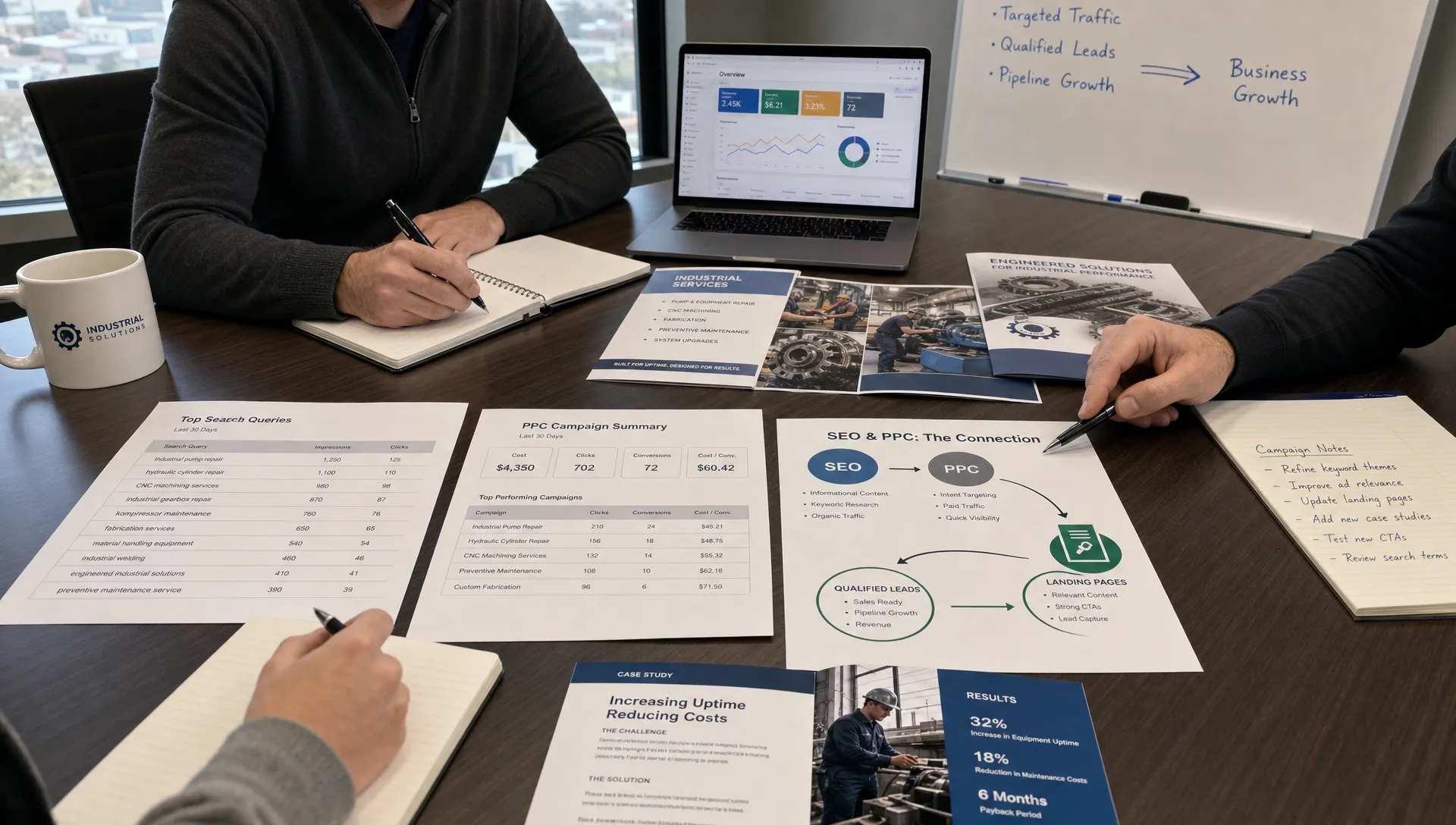
A meeting room table covered with printed search query reports, campaign notes, industrial service brochures, and simple charts showing how SEO and PPC insights connect to qualified B2B leads.

What Search Gets Right for B2B and Industrial Buyers

Search remains effective for B2B because buyers do so much independent research before they contact sales. Gartner has long reported that B2B buyers spend a limited share of their buying journey meeting with potential suppliers, which means vendors need to be discoverable before a sales conversation begins.

This is where search engine marketing fits naturally. It supports the way modern buyers behave. They investigate first, shortlist quietly, and only then reach out. If your company is absent during that research phase, you may never know you were considered.

Industrial search behavior is often even more intent-rich than consumer search. Buyers may use part numbers, certifications, materials, service areas, technical problems, equipment names, or compliance terms. These searches might not generate huge traffic, but they can attract visitors with real operational needs.

For example, a broad phrase like “manufacturing marketing” may attract a wide audience. A specific phrase like “CNC machine repair service quote Houston” signals a very different level of readiness. Search engine marketing still gets this right because it allows companies to prioritize precision.

The same principle applies to content. A general article can build awareness, but a detailed page answering a specific purchasing or technical question may generate more qualified leads. In B2B, relevance is often more valuable than reach.

What Has Changed in 2026

The channels still work, but the playbook has changed. Search marketers need to adapt to a results page where answers, ads, local results, videos, and AI-generated experiences compete for attention.

AI-powered search has made answer quality more important. If your content is vague, generic, or copied from competitors, it is less likely to earn visibility in classic organic results or AI-influenced discovery experiences. This is why SEO, answer engine optimization, and generative engine optimization now overlap. The distinctions are useful, but the shared goal is simple: make your expertise clear enough for people and machines to understand. For a deeper discussion of that shift, see why SEO, AEO, and GEO are not just acronyms.

Privacy has also changed measurement. Marketers have less perfect visibility into every touchpoint. Cookie limitations, consent requirements, and platform modeling mean attribution is more directional than absolute. That does not make measurement useless. It means businesses need to combine analytics with CRM data, call tracking, form quality, sales feedback, and pipeline reporting.

The search results page has also become more competitive. Winning a click is no longer the only goal. Sometimes the goal is brand recognition, inclusion in the buyer’s shortlist, or visibility in a local pack. Sometimes a buyer sees your company several times before taking action. Search engine marketing in 2026 needs to account for those assisted moments.

A Practical 2026 SEM Playbook

The companies getting the most from search engine marketing now are not chasing every trend. They are building disciplined systems around buyer intent, content quality, and measurable business outcomes.

  1. Map searches to the buying journey: Separate educational, comparison, local, and quote-ready searches so each page or campaign has a clear purpose.
  2. Prioritize high-intent terms: Do not ignore low-volume technical terms if they indicate a serious buyer problem or service need.
  3. Build pages before scaling spend: A strong landing page with clear proof, service details, and a focused call to action usually improves both PPC and SEO results.
  4. Use PPC data to guide SEO: Search terms, ad copy tests, and conversion patterns can reveal which topics deserve organic content investment.
  5. Use SEO data to improve PPC: Organic pages that attract engaged visitors can inspire paid campaign structure, negative keywords, and better landing page copy.
  6. Measure lead quality: Track which forms, calls, and quote requests become real opportunities, not just which campaigns generate the most clicks.
  7. Strengthen trust signals: Include clear service areas, industry experience, certifications, process details, testimonials where appropriate, and easy contact options.
  8. Review monthly, not annually: Search behavior, competitors, and ad costs shift too quickly for a set-it-and-forget-it approach.

This playbook is not flashy, but it is durable. The basics still matter because B2B buyers still need clear answers, credible vendors, and a low-friction way to make contact.

Mistakes Search Marketers Should Leave Behind

Some older SEM habits are less effective in 2026. The most common problem is optimizing for platform metrics instead of business outcomes. A campaign can have a high click-through rate and still produce weak leads. A blog post can attract traffic and still fail to support sales.

Another mistake is separating content from conversion. Educational pages should not read like aggressive sales pitches, but they should still guide the reader toward a sensible next step. That might be a related service page, a contact form, a quote request, or a deeper technical resource.

It is also risky to rely too heavily on automation without strategy. Automated bidding and AI-assisted campaign tools can help, but they need clean conversion data, relevant landing pages, and human oversight. If the system is optimizing toward low-quality form fills, it can spend efficiently in the wrong direction.

Finally, companies should stop treating SEO as a one-time website project. Search visibility is an ongoing asset. Competitors publish new content, Google changes how results appear, and buyer questions evolve. The companies that review and improve consistently tend to outperform those that redesign once and disappear.

Frequently Asked Questions

Is search engine marketing still worth it in 2026? Yes. Search engine marketing is still valuable because it reaches buyers who are actively researching problems, vendors, services, or solutions. The strongest results come from combining paid search, SEO, useful content, and lead-quality measurement.

Is SEM the same as PPC? Not always. Some marketers use SEM to mean paid search only, while others use it more broadly to include SEO, PPC, landing pages, and search-focused conversion strategy. For B2B growth, it is usually more useful to think of SEM as the full system for gaining visibility in search.

How has AI changed search engine marketing? AI has made search results more answer-focused and competitive. Businesses now need clearer expertise, better structured content, and stronger authority signals. Generic content is less effective, while specific and helpful content has become more important.

Should B2B companies invest in SEO or PPC first? It depends on goals and timelines. PPC can generate immediate visibility and useful data, while SEO builds long-term authority and lowers dependence on paid clicks. Many B2B companies benefit from using both together.

What should industrial companies measure beyond clicks? Industrial companies should measure qualified form submissions, phone calls, quote requests, cost per qualified lead, sales accepted leads, opportunity value, and influenced pipeline. Clicks are useful, but they are not the final business outcome.

Bring Search Engine Marketing Back to Business Growth

Search engine marketing still works in 2026 because buyers still search when they need answers. What has changed is the level of discipline required. Winning now means understanding intent, improving content quality, aligning SEO and PPC, and measuring the leads that actually matter.

For B2B and industrial companies that want a more practical search strategy, B2B Inbound Marketing helps businesses improve online visibility through SEO, PPC, inbound marketing, and related web marketing services. If search is bringing traffic but not enough qualified leads, it may be time to rebuild the strategy around buyer intent and measurable growth.

A Brief on Inbound Marketing

The inbound marketing is a type of marketing strategy that is adopted by many companies to promote their products, services and sometimes the company itself. In the process of inbound marketing the publicity of the company is done through e-newsletters, eBooks, whitepapers, podcasts, blogs, social media marketing and SEO.

Through these forms of the media the company tries to bring their consumers closer to the company. The benefit of inbound marketing is that the company gains more attention of the consumers by making the company easy to find and in turn draws consumers to the website. All these are possible by generating interesting content for the websites of the companies. The inbound marketing is generally defined by three phases. Those are found, convert and analyze.

Through the complex type of inbound marketing the companies try to reach out to their potential consumers at different levels of product or brand awareness.

By Andy Alagappan : Call US for a FREE 30 MIN web site analysis and Video Strategy consulting @ 281-570-5804