


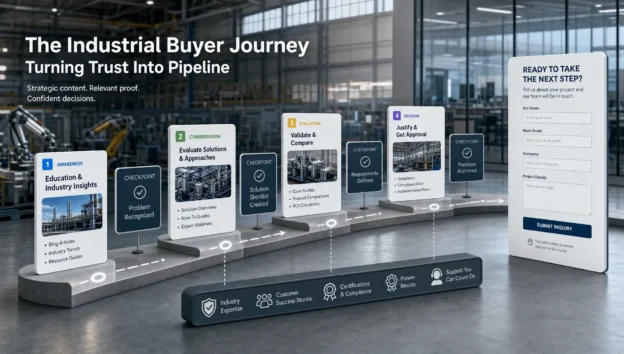
Your next best customer may not be ready to talk to sales yet. They may be comparing suppliers, checking technical fit, looking for proof, or trying to understand whether your company can reduce risk. In that moment, your website content is not just marketing collateral. It is the first sales conversation.
That is why effective web content marketing has to do more than drive traffic. For B2B, industrial, and technical service companies, content must build confidence, answer high-stakes questions, and create a path from anonymous visitor to qualified opportunity.
The companies that win are not always the ones publishing the most. They are the ones publishing the most useful, believable, and buyer-focused content at every stage of the decision process.
Why Trust Is the Real Conversion Point
B2B buyers rarely convert after one page view. They move through a long path of discovery, comparison, internal discussion, budget review, and vendor validation. In industrial and technical markets, the buying committee may include operations, engineering, procurement, finance, and executive leadership. Each person needs different evidence before they are willing to engage.
That means trust is not a soft brand metric. It is a pipeline requirement.
A buyer may ask questions like these before they ever submit a form:
- Does this company understand our industry?
- Can they solve our specific problem, or are they using generic claims?
- Do they have proof of results?
- Are they transparent about process, limitations, and next steps?
- Will talking to sales be helpful, or will it waste time?
Web content marketing gives you the opportunity to answer those questions before a salesperson enters the conversation. When done well, it reduces uncertainty and makes the next step feel safe.
For Houston-based B2B companies, manufacturers, distributors, energy service providers, industrial suppliers, and professional service firms, this is especially important. Buyers are often evaluating high-value decisions where failure is expensive. They do not need hype. They need clarity.
The Difference Between Traffic Content and Pipeline Content
Traffic content is built to attract visitors. Pipeline content is built to move the right visitors toward action.
Both matter, but they are not the same. A top-of-funnel article may explain a general industry trend, while a pipeline-focused page might compare solutions, answer procurement objections, or show a measurable business outcome. The most effective content strategy connects these assets rather than treating them as separate projects.
A strong content system usually includes three layers:
| Content layer | Buyer intent | Best examples | Pipeline role |
|---|---|---|---|
| Educational content | I need to understand the problem | Blog posts, guides, explainers, industry updates | Attracts qualified visitors and builds early trust |
| Evaluation content | I need to compare options | Service pages, solution pages, FAQs, comparison pages | Helps buyers shortlist your company |
| Proof content | I need confidence before taking action | Case studies, testimonials, results pages, technical examples | Reduces risk and supports conversion |
If your website only has educational content, buyers may learn from you but convert elsewhere. If it only has service pages, you may miss buyers who are still defining their problem. The goal is to create a connected journey that meets people where they are and guides them forward.
This is where a structured approach such as a Content, Traffic, and Promotion strategy becomes useful. Content earns attention, traffic brings the right visitors, and promotion ensures your best assets do not sit quietly on your website.
What Trustworthy Web Content Looks Like
Trustworthy content is specific. It uses the language of the buyer, not just the language of the seller. It explains what matters, what can go wrong, how decisions are made, and what a prospect should consider before moving forward.
In industrial marketing, that may mean explaining lead times, compliance concerns, service areas, technical constraints, product applications, maintenance factors, or implementation risks. In B2B services, it may mean clarifying process, deliverables, timelines, pricing variables, or the difference between similar solutions.
Transparency is one of the fastest ways to build credibility. A simple example outside B2B industrial marketing is how service marketplaces help buyers make decisions by showing practical cost information, such as platforms where homeowners can compare tradespeople's costs before they book. The lesson for B2B marketers is not to copy that model exactly. It is to recognize that buyers trust companies that help them understand value, cost drivers, and expectations before asking for a commitment.
Your website can create the same type of confidence by explaining:
- What affects project scope or price
- What information is needed for an accurate recommendation
- What results are realistic and what is not guaranteed
- What makes one solution better suited than another
- What happens after a prospect submits an inquiry
The more uncertainty your content removes, the easier it becomes for a qualified buyer to take the next step.
Build Around Buyer Risk, Not Just Keywords
SEO matters. Keywords matter. But the best web content marketing begins with buyer risk.
In many B2B campaigns, content planning starts and ends with search volume. That can lead to generic posts that rank for broad terms but do not influence revenue. A better question is: what does the buyer need to believe before they contact us?
For example, an industrial equipment supplier may need content that proves reliability, delivery capability, technical knowledge, and service responsiveness. A B2B software company may need content that answers integration, onboarding, security, and ROI questions. A marketing services provider may need content that explains strategy, reporting, lead quality, and long-term visibility.
This is why social proof matters. Case studies, testimonials, customer examples, reviews, and performance snapshots make claims easier to believe. If you are not sure how to use credibility assets without sounding self-promotional, this guide on how social proof can strengthen your marketing is a useful starting point.

The Content Assets That Move Buyers Toward Sales
A buyer-ready website needs more than blog posts. Blog content can create visibility and educate the market, but pipeline growth usually depends on deeper assets that help visitors make decisions.
The most valuable assets often include service pages that clearly explain who the offer is for, what problem it solves, and what outcomes buyers can expect. These pages should not be thin summaries. They should answer the objections a sales team hears every week.
Case studies and results-focused stories are equally important. They show that your company can turn strategy into outcomes. For example, a focused SEO effort that generated more qualified leads is more persuasive than a general claim about better rankings. A practical example is this article on how an SEO campaign brought 67% more qualified leads to a B2B tech company.
Comparison and decision-support content also play a major role. Buyers often search for alternatives, pros and cons, cost factors, or best-fit scenarios. If your website avoids these topics, buyers will find answers elsewhere, often from competitors or third-party sites that do not fully understand your strengths.
High-converting B2B websites typically include a balanced mix of content types:
| Content type | Trust-building purpose | Conversion opportunity |
|---|---|---|
| Detailed service pages | Shows expertise and fit | Proposal inquiry, consultation request |
| Case studies | Proves outcomes | Sales conversation, demo, quote request |
| FAQs | Removes objections | Contact form, next-step CTA |
| Technical articles | Demonstrates knowledge | Newsletter signup, resource download |
| Industry pages | Shows market familiarity | Targeted lead capture |
| Video content | Adds clarity and human presence | Website engagement, assisted conversion |
The key is to make every page responsible for a job. Some pages attract. Some educate. Some qualify. Some convert. A content strategy becomes more powerful when each page has a clear purpose.
Optimize for Search Without Losing the Human Buyer
Search optimization is still foundational for web content marketing, but modern SEO cannot be reduced to keyword placement. Search engines are better at understanding usefulness, topical depth, and whether a page satisfies intent. Buyers are also more selective. They can quickly detect shallow content written only to rank.
A strong B2B content page should include the terms buyers use, but it should also demonstrate real understanding. That means answering follow-up questions, showing examples, addressing trade-offs, and organizing information so busy decision-makers can scan quickly.
For industrial and technical companies, avoid oversimplifying complex topics. Buyers often appreciate depth when it helps them make a better decision. At the same time, do not bury the answer. Start with the practical takeaway, then provide supporting detail.
Your content should be easy for search engines to understand and easy for humans to trust. That usually means clear headings, descriptive page titles, concise introductions, internal links to related resources, and strong calls to action that match the buyer's stage.
Search behavior is also changing as AI summaries, zero-click results, and platform-based research affect traditional website traffic. That does not make content less valuable. It makes authority, usefulness, and brand recognition more important. If you are seeing traffic patterns shift, this discussion of what is happening as website traffic is declining explains why marketers need to think beyond raw visits.
Measure Content by Pipeline Impact
Many companies measure content by page views alone. That is incomplete. A blog post with thousands of visitors but no qualified engagement may be less valuable than a technical service page that attracts fewer visitors but influences real opportunities.
Pipeline-focused measurement connects content to business outcomes. This does not mean every article needs to produce a direct lead immediately. Some content assists conversions over time. The goal is to understand which topics and pages help buyers move forward.
Useful metrics include:
| Metric | What it reveals | Why it matters |
|---|---|---|
| Organic traffic by topic | Which problems attract buyers | Helps prioritize future content |
| Engagement on key pages | Whether visitors find content useful | Shows quality of attention |
| Form submissions by landing page | Which pages create inquiries | Connects content to lead generation |
| Assisted conversions | Which assets support buyer journeys | Shows influence beyond last click |
| Sales feedback | Which content answers real objections | Aligns marketing with revenue conversations |
| Lead quality | Whether content attracts the right audience | Prevents traffic growth without pipeline growth |
The best reporting combines marketing analytics with sales insight. If prospects mention a guide during sales calls, if a case study shortens the decision cycle, or if a technical article brings in better-qualified inquiries, those are meaningful signals.
Common Mistakes That Weaken Trust
Many content programs fail because they focus on activity instead of usefulness. Publishing more does not automatically create more pipeline. In some cases, it creates a cluttered website that makes decision-making harder.
One common mistake is writing for everyone. B2B buyers want to see themselves in your content. If your copy could apply to any company in any market, it will not build much confidence. Industry-specific examples, use cases, and pain points make your message more credible.
Another mistake is hiding important information. Companies often avoid discussing pricing factors, process, timelines, or limitations because they fear losing leads. In reality, qualified buyers appreciate clarity. Content that educates buyers tends to filter out poor-fit inquiries and improve sales conversations.
A third mistake is separating content from sales. Your sales team knows the objections, questions, and decision criteria that matter most. Those insights should become pages, FAQs, guides, and comparison content. If marketing and sales do not share information, content will stay too generic.
Finally, some companies treat content as a one-time website project. Trust is built over time. Markets change, buyer questions evolve, and search results shift. Your content needs regular updates, not just occasional redesigns.
A Practical 90-Day Web Content Marketing Plan
If your website has content but does not consistently generate qualified leads, start with a focused 90-day improvement plan. The goal is not to rebuild everything at once. The goal is to identify the highest-impact gaps and improve the buyer journey.
- Audit your top service and solution pages for clarity, proof, and conversion paths.
- Interview sales or customer-facing teams to collect common buyer questions and objections.
- Identify three to five content gaps that affect high-intent buyers, such as FAQs, comparison pages, or case studies.
- Refresh existing pages before creating new ones if they already have rankings or relevant traffic.
- Add stronger calls to action that match the page intent, such as proposal inquiry, consultation, or related resource.
This type of plan keeps content tied to business goals. It also helps teams avoid random publishing, where new articles are created without a clear role in the pipeline.
Frequently Asked Questions
What is web content marketing? Web content marketing is the strategic use of website content, such as blog posts, service pages, case studies, FAQs, and guides, to attract the right audience, build trust, and move prospects toward a business goal.
How does web content marketing build pipeline? It builds pipeline by answering buyer questions, improving search visibility, proving expertise, reducing perceived risk, and giving visitors clear next steps when they are ready to engage.
Is blogging enough for B2B content marketing? Blogging is valuable, but it is not enough by itself. B2B companies also need decision-stage content such as service pages, proof assets, comparison content, and strong conversion paths.
How often should a B2B company update website content? High-value pages should be reviewed regularly, especially when services, buyer questions, search rankings, or competitive conditions change. Content that influences leads and sales deserves ongoing attention.
What makes industrial web content different? Industrial content often needs more technical depth, more proof, and clearer explanations of risk, process, specifications, service capability, and operational impact.
Turn Content Into a Trust and Pipeline Asset
Web content marketing works best when it is treated as a revenue system, not a publishing checklist. The right content helps buyers find you, understand you, trust you, and take the next step with confidence.
For B2B and industrial companies, that means combining SEO, inbound strategy, clear messaging, useful content, and conversion-focused web pages. If your website is getting traffic but not enough qualified inquiries, or if your content does not reflect the expertise of your business, it may be time to rethink the strategy behind every page.
A focused content plan can turn your website into a stronger sales asset, one that supports visibility today and pipeline growth over the long term.