


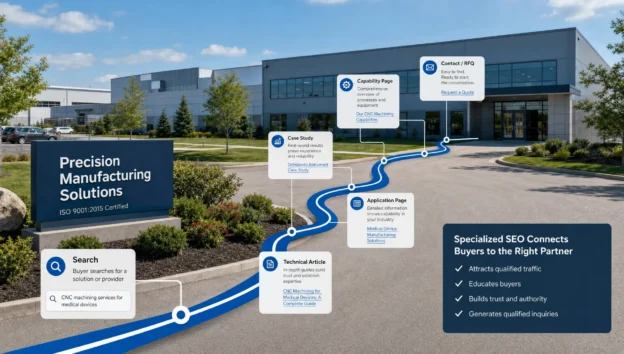
Industrial brands do not grow from traffic alone. They grow when engineers, plant managers, procurement teams, distributors, and executive buyers can find the right information at the exact moment they are researching a problem, comparing vendors, or building a business case.
That is where the right SEO firm matters. For an industrial company, SEO is not just about ranking for broad keywords. It is about translating complex products, long sales cycles, technical specifications, and regional service capabilities into a search strategy that attracts qualified B2B buyers.
A strong industrial SEO program helps your brand become visible before the request for quote, before the supplier shortlist, and before a competitor has already shaped the buyer’s thinking.
Why industrial brands need a different SEO approach
Industrial buyers search differently from consumers. They often use technical terminology, part numbers, materials, tolerances, industry applications, regulatory language, and problem-specific phrases. A buyer may not search for “best manufacturer.” They may search for “316 stainless steel fabrication for food processing,” “hazardous area control panel supplier,” or “industrial pump repair Houston.”
That means a generic SEO strategy can miss the real opportunity. Industrial brands need a partner that understands how B2B buying decisions unfold, where technical content fits, and why lead quality matters more than raw visitor volume.
According to Gartner’s research on the B2B buying journey, buyers spend only a limited portion of their purchase process meeting with potential suppliers. Much of the decision-making happens through independent research. If your website does not answer technical, commercial, and trust-building questions during that research phase, your sales team may never get the chance to compete.
The right SEO firm helps you close that visibility gap.
What the right SEO firm actually changes
An industrial SEO partner should not treat your website as a brochure. It should treat it as a growth asset that supports visibility, lead generation, sales enablement, and trust.
A capable firm will usually focus on four outcomes:
- Attracting searchers with genuine buying or research intent.
- Improving technical website performance so search engines can crawl and understand important pages.
- Building content that explains products, applications, industries served, and problems solved.
- Turning organic traffic into measurable inquiries, calls, quote requests, and sales conversations.
This matters because industrial buyers often need confidence before they contact a vendor. They want proof that you understand their application. They want to see relevant capabilities. They want specs, process details, service areas, case examples, certifications, and clear next steps.
If your site ranks but does not persuade, SEO is incomplete. If your content persuades but cannot be found, your expertise stays hidden.
For a deeper look at how search visibility becomes lead generation, Andy Alagappan’s article on how search engine optimization services drive B2B leads explains the connection between buyer intent, optimized pages, and conversion-focused content.
Industrial SEO starts with buyer intent, not keyword volume
Many industrial terms have lower search volume than consumer keywords. That does not make them less valuable. In fact, a phrase with 30 searches a month can be highly profitable if it represents a buyer looking for a specialized product, custom service, or urgent supplier solution.
The job of an SEO firm is to separate informational searches from commercial opportunities. For example, “what is powder coating” may attract early-stage researchers, while “powder coating services for aluminum parts” may indicate a more qualified buyer. Both can be useful, but they need different content and different conversion paths.
Industrial SEO strategy should account for:
- Product categories and subcategories.
- Application-specific searches.
- Industry-specific needs.
- Location-based demand.
- Problem and failure-mode searches.
- Replacement part, repair, and maintenance queries.
- Comparison and vendor evaluation searches.
Consider how a buyer researching durable industrial assets behaves. Whether the product is specialty valves, fabricated components, process controls, or premium shipping containers, the search journey usually begins with a practical need and a specific set of questions. SEO should make your business visible for those moments, not just for broad brand terms.
Generic SEO vs. industrial SEO
The difference between a generalist approach and an industrial-focused approach is often the difference between empty traffic and qualified pipeline.
| Area | Generic SEO approach | Industrial SEO approach |
|---|---|---|
| Keyword research | Prioritizes high-volume terms | Prioritizes intent, product fit, applications, and lead quality |
| Content | Writes broad blog posts | Builds technical pages, application guides, FAQs, and service pages |
| Conversion strategy | Measures traffic and form fills | Tracks quote requests, qualified inquiries, calls, and sales opportunities |
| Site structure | Optimizes main pages only | Organizes products, industries, capabilities, and locations for search |
| Reporting | Focuses on rankings | Connects organic performance to pipeline and revenue indicators |
| Sales alignment | Works mostly with marketing | Uses input from sales, engineering, and customer service teams |
A strong SEO firm does not need to be an engineer, but it must know how to extract expertise from your team and turn it into search-friendly content without watering it down.
Technical SEO is especially important for industrial websites
Industrial websites often grow over many years. Product pages get added, PDFs accumulate, old pages remain live, and website redesigns happen without a clear search strategy. Over time, this can create crawl issues, duplicate content, slow pages, broken links, thin product descriptions, and confusing navigation.
Google’s Search Essentials emphasize that websites need to be accessible, crawlable, useful, and trustworthy. For industrial brands, technical SEO supports all of those requirements.
A good SEO firm will examine issues such as:
- Whether search engines can crawl important product and service pages.
- Whether page titles and headings reflect actual buyer queries.
- Whether product categories are organized around how buyers search.
- Whether critical content is trapped inside PDFs instead of indexable web pages.
- Whether site speed, mobile usability, and page experience create friction.
- Whether old or outdated pages are weakening search performance.
This work is not glamorous, but it is foundational. If search engines cannot understand your pages, and buyers cannot easily find the information they need, even excellent content may underperform.
Content turns industrial expertise into discoverable authority
Most industrial companies already have expertise. The challenge is that much of it sits inside sales conversations, engineering notes, quote responses, installation experience, and customer service calls. SEO content brings that expertise to the surface.
The right SEO firm will help turn internal knowledge into useful, searchable content, such as product category pages, application guides, technical explainers, comparison pages, troubleshooting articles, industry landing pages, and local service pages.
The goal is not to publish content for the sake of publishing. The goal is to answer the questions buyers ask before they are willing to engage.
For example, an industrial manufacturer might need content that explains material selection, lead times, quality standards, custom capabilities, maintenance considerations, installation requirements, or common causes of equipment failure. A service provider might need pages for emergency repair, preventive maintenance, field service, regional coverage, and industry-specific use cases.

The right SEO firm aligns search with the sales process
Industrial SEO should never live in isolation from sales. Your sales team knows which inquiries are valuable, which questions come up repeatedly, which industries are growing, and which leads are a poor fit.
An effective SEO partner will use that feedback to refine strategy. If a page generates many inquiries but few qualified opportunities, the content may need clearer qualification language. If sales keeps hearing the same technical objection, that topic may deserve a dedicated page. If a high-margin service is underrepresented on the website, it may need a stronger search presence.
This is where SEO becomes more than marketing activity. It becomes a way to support the full revenue cycle.
Good alignment can help answer questions like:
- Which organic keywords are driving qualified inquiries?
- Which landing pages influence RFQs or consultation requests?
- Which industries produce the best lead quality?
- Which content helps sales shorten education time?
- Which topics reveal unmet buyer demand?
For industrial brands with long sales cycles, this alignment is critical. A visitor may read multiple pages, return weeks later, share a link internally, then contact sales after internal approval. SEO reporting should reflect that complexity rather than judging performance only by last-click form fills.
Measuring growth from industrial SEO
The right SEO firm should help leadership understand what is working. Rankings are useful, but they are not the final business outcome. Industrial brands need reporting that connects visibility to qualified demand.
| Metric | Why it matters for industrial growth |
|---|---|
| Organic visibility for priority topics | Shows whether the brand is appearing for relevant products, services, and applications |
| Qualified organic traffic | Helps distinguish real prospects from unqualified visitors |
| Conversion rate by page type | Identifies which product, service, or industry pages produce inquiries |
| Calls, forms, and RFQs | Measures direct lead generation from organic search |
| Assisted conversions | Captures SEO’s role in longer buying journeys |
| Lead quality feedback | Connects marketing performance to sales reality |
| Pipeline or revenue influence | Helps leadership evaluate SEO as a growth investment |
This is also where expectations matter. SEO is not usually an instant-results channel. It builds momentum through better site structure, stronger content, improved authority, and continuous optimization. For industrial companies, the payoff can be significant because a single qualified lead may represent a substantial contract or long-term customer relationship.
If leadership needs a clearer framework for evaluating returns, reviewing the ROI benefits from an SEO campaign can help connect SEO activity to measurable business outcomes.
Signs you have found the right SEO firm
Choosing an SEO partner is not just about finding someone who knows search algorithms. It is about finding a team that can understand your market, ask better questions, and connect SEO execution to industrial growth.
Look for a firm that asks about your margins, sales cycle, best-fit customers, service regions, product priorities, quoting process, and lead quality. Those questions reveal whether they are thinking like a growth partner or simply selling deliverables.
A strong industrial SEO firm should be able to explain how it will:
- Identify high-intent search opportunities.
- Improve technical website performance.
- Build content around products, services, applications, and industries.
- Support local or regional visibility when relevant.
- Coordinate SEO with PPC, content writing, web design, and inbound strategy.
- Report on business outcomes, not just rankings.
You should also expect honesty. Not every keyword is worth pursuing. Not every page needs a blog post. Not every traffic increase is valuable. The right partner will help you prioritize what supports growth.
If your company is seeing stagnant organic leads, declining search visibility, rising paid media costs, or poor lead quality, it may be time to review the warning signs in this guide on when to hire search engine optimization consultants.
Mistakes industrial brands should avoid
One common mistake is treating SEO as a one-time website project. A redesign may improve appearance, but search growth usually requires ongoing research, optimization, content development, measurement, and refinement.
Another mistake is focusing only on broad keywords. A manufacturer may want to rank for a general term like “industrial equipment,” but the better opportunity may be application-specific, product-specific, or regional searches with much stronger buying intent.
A third mistake is hiding critical information in PDFs. Spec sheets and catalogs can be useful, but important product and service information should also exist on crawlable web pages. That gives search engines more context and gives buyers a better experience.
Finally, many companies underuse their internal experts. Engineers, estimators, technicians, salespeople, and customer support teams all hear the questions buyers care about. A good SEO process captures those insights and turns them into useful content.
How industrial SEO supports PPC and inbound marketing
SEO works best when it is part of a broader inbound marketing system. PPC can generate near-term visibility for high-value searches while SEO builds long-term organic presence. Social media can support credibility and distribution. Web design can improve conversion paths. Content writing can help buyers move from research to inquiry.
For industrial brands, this integrated approach is especially useful because buyers often need multiple touches before contacting sales. They might find a blog article through organic search, return through a branded search, compare a service page, then convert through a paid ad or direct visit.
A qualified SEO firm understands that growth rarely comes from one tactic alone. The real advantage comes from making every channel support the same commercial strategy.
Frequently Asked Questions
Why should an industrial company hire an SEO firm? An industrial company should hire an SEO firm when it needs more qualified visibility in search results, better lead quality, stronger technical website performance, and content that supports complex B2B buying decisions.
How is industrial SEO different from regular SEO? Industrial SEO focuses more heavily on technical terminology, niche products, long sales cycles, application-specific searches, regional demand, and lead quality. It must connect search strategy with sales conversations and buyer research behavior.
How long does SEO take for industrial brands? Timelines vary based on competition, website condition, content depth, and market demand. Many industrial brands should expect SEO to build gradually over months, with stronger results coming from consistent optimization and content development.
What should an SEO firm report on? An SEO firm should report on rankings and traffic, but also on qualified organic visits, conversions, RFQs, phone calls, assisted conversions, lead quality, and pipeline indicators when that data is available.
Can SEO work with PPC for industrial marketing? Yes. SEO and PPC often work well together. PPC can create immediate visibility for priority terms, while SEO builds durable organic presence and reduces dependence on paid traffic over time.
Build a search strategy that supports industrial growth
The right SEO firm helps industrial brands do more than appear in search results. It helps them become easier to find, easier to trust, and easier to choose.
For manufacturers, distributors, fabricators, service providers, and B2B industrial companies, that means building a website and content strategy around real buyer intent, technical credibility, and measurable lead generation.
If your industrial brand is ready to improve visibility, attract better leads, and connect SEO with inbound marketing, PPC, content, and web strategy, B2B Inbound Marketing can help you plan the next step with a practical growth-focused approach.