
Search engine marketing has been declared “changed forever” so many times that it is easy to assume the old fundamentals no longer matter. AI answers, privacy restrictions, rising ad costs, zero-click search, and more crowded results pages have all changed how buyers discover vendors.
Yet for B2B and industrial companies, search is still one of the most practical ways to reach buyers when they are actively looking for a solution. A plant manager searching for “industrial pump repair Houston,” a procurement team comparing vendors, or an operations leader researching compliance requirements is not casually browsing. They are signaling a need.
That is what search engine marketing still gets right in 2026: it connects your business to visible buyer intent. The tactics have evolved, but the underlying advantage remains. If your company understands what buyers search, builds useful answers, and measures outcomes beyond clicks, search can still become a dependable source of qualified leads.
Search Engine Marketing Still Captures Stated Intent
Search engine marketing works because it starts with a query. Unlike many forms of digital advertising that interrupt someone’s attention, search responds to a question, problem, comparison, or purchase need the buyer has already expressed.
For B2B companies, this matters because buying cycles are long and complex. Buyers may not be ready to speak with sales during their first search. They may be trying to understand a process, diagnose a problem, compare service providers, or justify a budget internally. Search gives your company a way to be useful at each of those moments.
In practical terms, search engine marketing includes paid search campaigns, organic SEO, landing pages, content strategy, local visibility, and conversion tracking. The strongest programs do not treat these as separate silos. They use search behavior to understand demand and then build a path from discovery to lead generation.
That is why keyword volume alone is no longer the best measure of opportunity. A low-volume technical search can be more valuable than a broad keyword with thousands of impressions if the technical search reveals buying intent. In industrial and B2B marketing, specificity often beats scale.
Paid Search Still Gives Marketers Speed and Control
Paid search remains valuable in 2026 because it can test demand quickly. Organic visibility takes time, especially in competitive industries. A PPC campaign can help a company learn which search terms convert, which messages attract qualified prospects, and which landing pages create friction.
This does not mean every click is worth buying. CPC inflation and automated bidding have made discipline more important. Smart advertisers are more selective. They separate brand, competitor, service, and informational campaigns. They exclude irrelevant searches. They use landing pages built around the visitor’s intent rather than sending every click to the homepage.
Paid search is also useful when a business needs visibility for high-intent terms where organic rankings are not yet strong. If your company is launching a new service area, entering a new market, or competing in a local industrial niche, PPC can create immediate presence while SEO builds over time.
| SEM advantage | Why it still matters in 2026 | Practical use |
|---|---|---|
| Intent data | Search terms reveal what buyers actually ask for | Use PPC and SEO data to refine content and offers |
| Speed | Paid campaigns can test demand quickly | Validate service pages, messaging, and calls to action |
| Compounding value | Organic content can keep attracting qualified traffic | Build durable pages around recurring buyer questions |
| Local relevance | Many B2B searches still include location or service area | Optimize for regional visibility and trust signals |
| Measurability | Search can be tied to forms, calls, quotes, and pipeline | Track qualified leads, not just traffic |
The biggest mistake is treating paid search as a traffic machine instead of a learning system. The best campaigns teach you which problems matter, which offers resonate, and which visitors are close enough to a buying decision to justify more investment.
SEO Still Compounds When It Is Built Around Usefulness
Organic search has become harder, but not less important. Google’s results now include more rich snippets, AI-generated summaries, local packs, video results, shopping modules, and forum-style content. That means a business cannot rely on thin service pages or repetitive blog posts and expect steady growth.
What still works is useful, well-structured content that answers real buyer questions better than competing pages. Google’s own guidance emphasizes creating helpful, reliable, people-first content, which is still the right standard for long-term search performance. Technical SEO, site speed, crawlability, internal linking, page experience, and clear topical coverage all support that goal.
For a B2B company, the opportunity is not just to rank for broad keywords. It is to create a search presence around the complete buying journey. That may include educational articles, industry-specific service pages, comparison pages, FAQs, case-oriented content, local pages, and conversion-focused quote pages.
If your foundation needs work, a practical comprehensive SEO checklist can help identify gaps in technical optimization, content quality, and on-page structure before you invest more heavily in campaigns.
The key is to stop asking, “How many keywords can we rank for?” and start asking, “Which buyer problems should we be known for?” That shift keeps SEO aligned with business development rather than vanity traffic.
SEO and PPC Still Work Better Together
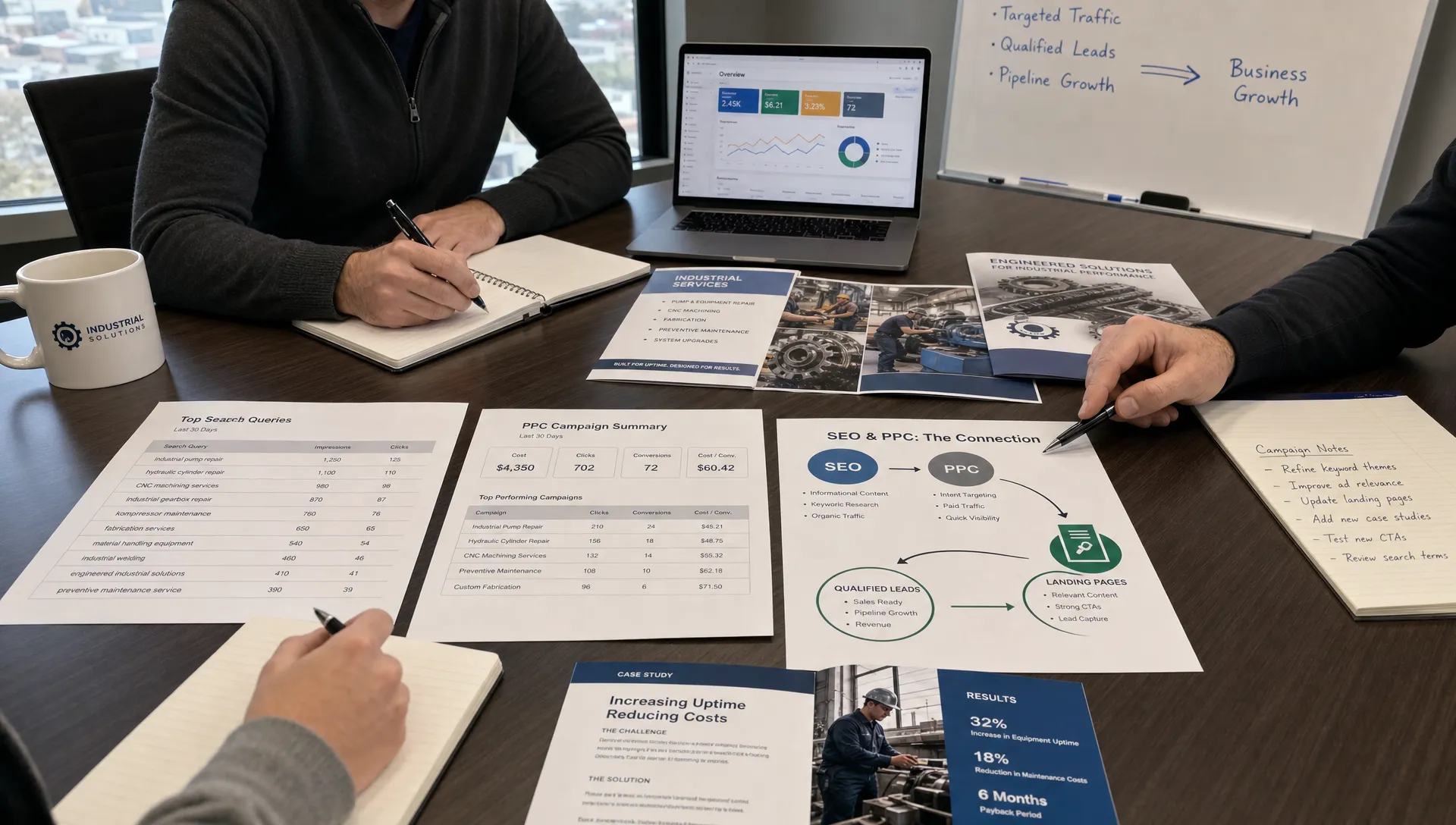
Search engine marketing is strongest when paid and organic teams share information. PPC can identify converting queries before a company commits months of content investment. SEO can reduce long-term dependence on paid clicks by earning visibility for recurring buyer questions. Together, they create more surface area in search results and more data for decision-making.
This is especially helpful in B2B markets where buyers return to search several times before contacting a vendor. A prospect might first read an educational article, later compare service options, then finally search your brand name before requesting a proposal. If you only measure the last click, you miss the role search played earlier in the journey.
The strategic value of combining channels is why many companies still see strong results from integrated SEO and PPC campaigns rather than treating each channel as a separate budget line.
| Channel | Best role | What to measure |
|---|---|---|
| Paid search | Immediate visibility and fast message testing | Qualified leads, cost per opportunity, search term quality |
| Organic SEO | Long-term authority and recurring demand capture | Rankings, engaged visits, assisted conversions, lead quality |
| Local search | Regional trust and service-area visibility | Calls, direction requests, local form fills, reviews |
| Content | Education and sales enablement | Time on page, scroll depth, return visits, influenced pipeline |
What Search Gets Right for B2B and Industrial Buyers
Search remains effective for B2B because buyers do so much independent research before they contact sales. Gartner has long reported that B2B buyers spend a limited share of their buying journey meeting with potential suppliers, which means vendors need to be discoverable before a sales conversation begins.
This is where search engine marketing fits naturally. It supports the way modern buyers behave. They investigate first, shortlist quietly, and only then reach out. If your company is absent during that research phase, you may never know you were considered.
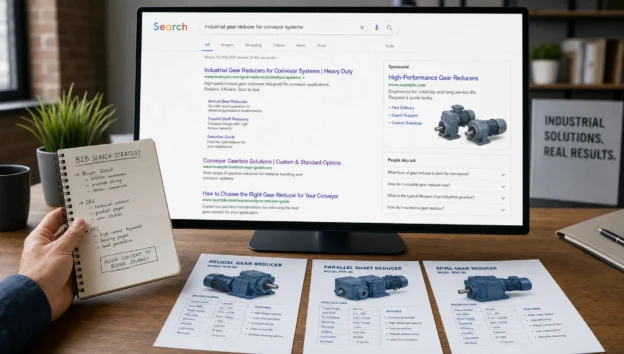
Industrial search behavior is often even more intent-rich than consumer search. Buyers may use part numbers, certifications, materials, service areas, technical problems, equipment names, or compliance terms. These searches might not generate huge traffic, but they can attract visitors with real operational needs.
For example, a broad phrase like “manufacturing marketing” may attract a wide audience. A specific phrase like “CNC machine repair service quote Houston” signals a very different level of readiness. Search engine marketing still gets this right because it allows companies to prioritize precision.
The same principle applies to content. A general article can build awareness, but a detailed page answering a specific purchasing or technical question may generate more qualified leads. In B2B, relevance is often more valuable than reach.
What Has Changed in 2026
The channels still work, but the playbook has changed. Search marketers need to adapt to a results page where answers, ads, local results, videos, and AI-generated experiences compete for attention.
AI-powered search has made answer quality more important. If your content is vague, generic, or copied from competitors, it is less likely to earn visibility in classic organic results or AI-influenced discovery experiences. This is why SEO, answer engine optimization, and generative engine optimization now overlap. The distinctions are useful, but the shared goal is simple: make your expertise clear enough for people and machines to understand. For a deeper discussion of that shift, see why SEO, AEO, and GEO are not just acronyms.
Privacy has also changed measurement. Marketers have less perfect visibility into every touchpoint. Cookie limitations, consent requirements, and platform modeling mean attribution is more directional than absolute. That does not make measurement useless. It means businesses need to combine analytics with CRM data, call tracking, form quality, sales feedback, and pipeline reporting.
The search results page has also become more competitive. Winning a click is no longer the only goal. Sometimes the goal is brand recognition, inclusion in the buyer’s shortlist, or visibility in a local pack. Sometimes a buyer sees your company several times before taking action. Search engine marketing in 2026 needs to account for those assisted moments.
A Practical 2026 SEM Playbook
The companies getting the most from search engine marketing now are not chasing every trend. They are building disciplined systems around buyer intent, content quality, and measurable business outcomes.
- Map searches to the buying journey: Separate educational, comparison, local, and quote-ready searches so each page or campaign has a clear purpose.
- Prioritize high-intent terms: Do not ignore low-volume technical terms if they indicate a serious buyer problem or service need.
- Build pages before scaling spend: A strong landing page with clear proof, service details, and a focused call to action usually improves both PPC and SEO results.
- Use PPC data to guide SEO: Search terms, ad copy tests, and conversion patterns can reveal which topics deserve organic content investment.
- Use SEO data to improve PPC: Organic pages that attract engaged visitors can inspire paid campaign structure, negative keywords, and better landing page copy.
- Measure lead quality: Track which forms, calls, and quote requests become real opportunities, not just which campaigns generate the most clicks.
- Strengthen trust signals: Include clear service areas, industry experience, certifications, process details, testimonials where appropriate, and easy contact options.
- Review monthly, not annually: Search behavior, competitors, and ad costs shift too quickly for a set-it-and-forget-it approach.
This playbook is not flashy, but it is durable. The basics still matter because B2B buyers still need clear answers, credible vendors, and a low-friction way to make contact.
Mistakes Search Marketers Should Leave Behind
Some older SEM habits are less effective in 2026. The most common problem is optimizing for platform metrics instead of business outcomes. A campaign can have a high click-through rate and still produce weak leads. A blog post can attract traffic and still fail to support sales.
Another mistake is separating content from conversion. Educational pages should not read like aggressive sales pitches, but they should still guide the reader toward a sensible next step. That might be a related service page, a contact form, a quote request, or a deeper technical resource.
It is also risky to rely too heavily on automation without strategy. Automated bidding and AI-assisted campaign tools can help, but they need clean conversion data, relevant landing pages, and human oversight. If the system is optimizing toward low-quality form fills, it can spend efficiently in the wrong direction.
Finally, companies should stop treating SEO as a one-time website project. Search visibility is an ongoing asset. Competitors publish new content, Google changes how results appear, and buyer questions evolve. The companies that review and improve consistently tend to outperform those that redesign once and disappear.
Frequently Asked Questions
Is search engine marketing still worth it in 2026? Yes. Search engine marketing is still valuable because it reaches buyers who are actively researching problems, vendors, services, or solutions. The strongest results come from combining paid search, SEO, useful content, and lead-quality measurement.
Is SEM the same as PPC? Not always. Some marketers use SEM to mean paid search only, while others use it more broadly to include SEO, PPC, landing pages, and search-focused conversion strategy. For B2B growth, it is usually more useful to think of SEM as the full system for gaining visibility in search.
How has AI changed search engine marketing? AI has made search results more answer-focused and competitive. Businesses now need clearer expertise, better structured content, and stronger authority signals. Generic content is less effective, while specific and helpful content has become more important.
Should B2B companies invest in SEO or PPC first? It depends on goals and timelines. PPC can generate immediate visibility and useful data, while SEO builds long-term authority and lowers dependence on paid clicks. Many B2B companies benefit from using both together.
What should industrial companies measure beyond clicks? Industrial companies should measure qualified form submissions, phone calls, quote requests, cost per qualified lead, sales accepted leads, opportunity value, and influenced pipeline. Clicks are useful, but they are not the final business outcome.
Bring Search Engine Marketing Back to Business Growth
Search engine marketing still works in 2026 because buyers still search when they need answers. What has changed is the level of discipline required. Winning now means understanding intent, improving content quality, aligning SEO and PPC, and measuring the leads that actually matter.
For B2B and industrial companies that want a more practical search strategy, B2B Inbound Marketing helps businesses improve online visibility through SEO, PPC, inbound marketing, and related web marketing services. If search is bringing traffic but not enough qualified leads, it may be time to rebuild the strategy around buyer intent and measurable growth.