

832-677-4620 / 281-570-5804
It's not about JUST BEING Online, Its about BEING FOUND Online

Category Archives: B2B Marketing inbound marketing Industrial Marketing

A search query path moves through content and proof blocks to a clear inquiry card for B2B buyers.

Content Writing for SEO That Supports B2B Conversions

Content writing for SEO is not just a traffic play for B2B companies. In industrial, technical and professional service markets, the real goal is to attract buyers who are already trying to solve a business problem, then give them enough clarity and confidence to take the next step.

That next step may be a quote request, a technical consultation, a distributor inquiry or a conversation with sales. The content has to do more than rank. It has to support the buyer’s internal decision process.

For Houston B2B companies and industrial firms competing in search, this means writing content that connects three things at once: the way buyers search, the way they evaluate vendors and the way they justify contacting a supplier. Strong SEO content sits at the intersection of visibility and conversion.

Why B2B SEO Content Has to Work Harder

B2B search behavior is rarely simple. A consumer may search, compare and buy in one sitting. A B2B buyer may spend weeks collecting information, checking specifications, sharing options with colleagues and building a business case before ever filling out a form.

That changes the role of SEO writing. A page that only explains what a service is may earn some traffic, but it may not create a qualified inquiry. B2B content needs to answer practical questions buyers care about before they talk to sales, including whether your company understands their industry, whether your solution fits their use case and whether there is enough proof to reduce perceived risk.

This is especially true for industrial marketing. Engineers, plant managers, procurement teams and business owners are not looking for generic promotional copy. They want specific, credible information that helps them decide whether a company belongs on the shortlist.

That is why content writing for SEO should be planned with conversion in mind from the start. Keyword research matters, but it is only the entry point. The page also needs a purpose inside the sales journey.

Start With Buyer Intent, Not Word Count

Many underperforming SEO pages have the same problem: they were written to target a keyword, not to help a buyer make progress. Word count, headings and keyword placement are useful only when they serve the intent behind the search.

A B2B prospect searching “industrial SEO services” is probably in a different mindset than someone searching “why is my manufacturing website not generating leads.” One is closer to vendor evaluation, while the other is diagnosing a problem. The content should reflect that difference.

Before writing, define the intent of the page. Is the reader learning, comparing, validating or preparing to contact a provider? That decision shapes the structure, tone, proof points and call to action.

Search intent What the buyer needs Role of the content Best conversion path
Problem research A clear explanation of the issue Build awareness and trust Related guide, diagnostic offer or consultation prompt
Solution research Options, tradeoffs and criteria Position your approach Service page, case evidence or inquiry form
Vendor comparison Differentiation and credibility Help the buyer shortlist Proposal request, discovery call or capabilities page
Technical validation Details, specifications and risk reduction Support internal approval Contact form, downloadable information or direct conversation

This intent-first approach keeps SEO content from becoming a disconnected collection of blog posts. It also helps each page support lead generation in a measurable way. For a broader view of this relationship, see how search engine optimization services drive B2B leads by matching search intent with content and conversion structure.

Write for the Questions Buyers Actually Ask

Good B2B SEO writing starts with the buyer’s real questions, not a list of phrases forced into the copy. In technical markets, those questions often come from sales calls, proposal conversations, customer service emails and trade show discussions.

A buyer may wonder whether your process works for their facility, whether your service is suitable for regulated environments or whether your team understands legacy equipment. Those concerns may not appear as neat keywords in a research tool, but they often influence whether a prospect contacts you.

Your content should capture those concerns in plain language. That does not mean simplifying the subject until it loses technical value. It means writing so that a technical reader can trust the details and a business reader can understand the commercial relevance.

For example, a technical service provider such as BKL needs to communicate capabilities across safety, engineering, production, inspection and services in a way that helps buyers understand both technical fit and business value. The same principle applies to any B2B company selling complex services: describe what you do, explain why it matters and make the next step clear.

Build Pages Around Proof, Not Claims

B2B buyers are skeptical of broad statements. Phrases like “industry-leading,” “best-in-class” and “full-service provider” do not carry much weight unless the page explains what those claims mean.

Conversion-focused SEO content should replace vague positioning with evidence. That evidence can come from process details, industry experience, project examples, certifications, service areas, technical constraints you understand or the way your team manages risk.

Instead of saying “we deliver reliable solutions,” explain how your process reduces downtime, improves lead quality, simplifies vendor selection or supports long-term visibility. Instead of saying “we are experts,” show the reader what you know by addressing the problems they face in detail.

This kind of writing improves both user trust and search relevance. Search engines need clear topical signals. Human readers need proof that your company understands their situation. A page that provides both has a better chance of attracting qualified visitors and turning them into inquiries.

Structure SEO Content for Skimming and Decision-Making

Even serious B2B buyers skim. They may be reading between meetings, comparing multiple vendors or forwarding a page to another stakeholder. Strong structure helps them find what matters quickly.

Use headings that describe the value of each section. Avoid clever labels that hide the point. A heading like “How Our PPC Management Reduces Wasted Spend” is more useful than “Smarter Campaigns.” It tells the reader what they will learn and gives search engines a clearer signal about the page topic.

Paragraphs should be focused and easy to scan. Long blocks of text create friction, especially on service pages where visitors are trying to decide whether to act. Use tables when comparisons matter. Use short lists when sequence or criteria matter. Keep the page moving toward a decision.

The best B2B SEO pages usually include a few core elements:

  • A clear opening that confirms the reader is in the right place
  • A direct explanation of the problem or opportunity
  • Specific service, process or solution details
  • Proof that reduces risk and builds confidence
  • Calls to action that match the buyer’s stage

The call to action should not appear only at the bottom. Buyers may be ready at different points. A mid-page prompt for a consultation, audit or proposal inquiry can help qualified prospects act when the content has answered enough of their questions.

A B2B marketing team reviews website content, keyword notes, and conversion goals across a conference table with printed drafts and analytics charts.

Connect SEO Writing With Page Design

Content does not convert in isolation. The words, page layout, navigation, form placement and visual hierarchy all affect whether a visitor becomes a lead.

A technically accurate page can still fail if the call to action is buried, the mobile experience is poor or the page does not make the company’s offer obvious. Likewise, a beautifully designed page will struggle if the copy does not match search intent or explain why the company is credible.

This is where SEO and web design need to work together. Service pages should be built around how buyers evaluate information, not just how a company wants to describe itself. The page should guide visitors from recognition to understanding to action without making them work too hard.

For B2B companies updating their websites, it is worth considering how SEO and web design work together to drive better conversions. The content plan should influence the site structure, and the design should make the content easier to consume.

Use Calls to Action That Match the Buyer’s Readiness

Not every visitor is ready to request a proposal. Some are still researching. Others are comparing vendors. A conversion-focused SEO strategy gives each reader a logical next step.

For early-stage visitors, a useful next step might be a related article, a service overview or a planning conversation. For mid-stage visitors, it may be an assessment, consultation or comparison of service options. For late-stage visitors, a proposal request or direct contact form makes sense.

The CTA should be specific. “Contact us” is acceptable, but it is often less persuasive than a prompt tied to the page topic. If a visitor is reading about SEO for industrial lead generation, a CTA that invites them to discuss lead quality or website visibility is more relevant.

The wording around the CTA matters as much as the button itself. Give the visitor a reason to act. Explain what they can expect after submitting the form. Reduce uncertainty by making the next step feel practical rather than high pressure.

If a page is getting traffic but not producing inquiries, the issue may not be search visibility. It may be weak alignment between content, offer and conversion path. In that case, website optimization services that improve conversion rates can help identify where visitors are losing momentum.

Balance Technical Depth With Readability

B2B content often needs technical detail, but technical detail should not become a barrier. The goal is not to remove complexity. The goal is to organize complexity so buyers can understand it.

A good approach is to lead with the business problem, then explain the technical factors behind it. For example, a page about responsive web design for industrial companies might begin with lost mobile inquiries, poor usability and weak search performance. It can then explain page speed, mobile layout, content hierarchy and technical SEO in more detail.

This structure respects both audiences. Executives and business owners can quickly see why the topic matters. Technical stakeholders can continue reading for substance. Procurement teams can understand the value without needing every implementation detail.

Readability also affects trust. Clear writing signals that your company can explain complicated work. In B2B sales, that matters. Buyers often assume that a company that communicates clearly before the sale will be easier to work with after the sale.

Measure Content by Lead Quality, Not Only Rankings

Ranking reports and traffic numbers are useful, but they do not tell the full story. A B2B SEO content program should also be judged by the quality of inquiries it supports.

Useful performance questions include whether the page attracts visitors from the right industries, whether visitors engage with the content, whether they continue to service pages and whether form submissions match your ideal customer profile.

If a page ranks well but brings poor-fit leads, the content may be targeting the wrong intent. If a page attracts qualified visitors but few inquiries, the issue may be the conversion offer, page layout or CTA clarity. If visitors leave quickly, the opening may not match what they expected from the search result.

B2B SEO is a long-term system. Content should be reviewed, improved and connected to sales feedback. The strongest pages become assets that keep answering buyer questions, supporting sales conversations and improving search visibility over time.

Common Mistakes in B2B SEO Content Writing

Many companies have enough expertise to publish useful content, but the way they package that expertise limits results. The most common mistakes are usually fixable.

One mistake is writing too broadly. A general article about “digital marketing” is less likely to convert than a focused page about PPC management for industrial lead generation or SEO content for B2B manufacturers. Specificity attracts better-fit readers.

Another mistake is separating SEO from sales. The best content often comes from listening to the questions prospects ask before they buy. If marketing writes without input from sales, pages may rank for terms that do not reflect real buying conversations.

A third mistake is treating every page like a blog post. Some search terms need educational articles. Others need service pages, landing pages, comparison pages or local pages. The format should match the intent.

Finally, many B2B pages end too passively. They explain the topic, but they do not guide the visitor toward action. Conversion-focused content should make the next step obvious without sounding pushy.

Frequently Asked Questions

What is content writing for SEO in B2B marketing? Content writing for SEO in B2B marketing is the process of creating search-optimized content that attracts qualified business buyers, answers their decision-making questions and encourages them to take a relevant next step.

How is B2B SEO writing different from regular SEO writing? B2B SEO writing usually supports longer sales cycles, multiple stakeholders and higher-risk decisions. It needs more proof, clearer positioning and stronger alignment with the buyer journey than basic traffic-focused content.

Should B2B SEO content focus on keywords or conversions? It should focus on both, but in the right order. Keywords help the right buyers find the page, while conversion strategy determines whether those visitors become inquiries. Ranking without conversion rarely creates business value.

What types of content help B2B conversions? Service pages, industry pages, comparison articles, technical guides, case-style content, FAQs and landing pages can all support conversions when they match the buyer’s intent and include a clear next step.

How often should SEO content be updated? B2B SEO content should be reviewed regularly, especially when services change, rankings decline, conversion rates drop or sales teams hear new buyer objections. Updating existing pages can be as valuable as publishing new ones.

Turn SEO Content Into Qualified B2B Inquiries

Content writing for SEO should help your company get found, but it should also help the right prospects understand why they should contact you. That requires more than keywords. It takes clear positioning, useful explanations, credible proof and conversion paths built around how B2B buyers actually make decisions.

B2B Inbound Marketing helps businesses improve online visibility through SEO, PPC, inbound strategy, web content writing and related digital marketing services. If your website is attracting traffic but not enough qualified inquiries, the next step is to align your content with buyer intent and conversion goals.

A stack of industrial SEO notes, capability pages, and a Houston location card shows how buyers research suppliers before contacting sales.

Why Organic SEO Still Matters for Industrial Companies

Industrial companies have always relied on relationships, distributor networks, trade shows, referrals, and repeat customers. Those channels still matter. But they no longer cover the full buying journey.

Today, an engineer, plant manager, procurement lead, or operations executive often starts with search before reaching out to sales. They compare technical options, check supplier credibility, look for local or regional partners, and narrow the field long before a phone call. That is why organic SEO still matters for industrial companies, especially those selling complex products, technical services, or high-value B2B solutions.

Organic SEO is not just about ranking for a few broad keywords. For industrial businesses, it is about being discoverable when a serious buyer searches for a specific capability, material, process, certification, part, application, or problem. Done well, it helps your company show up at the moments when buyers are actively trying to solve something.

Industrial buyers research before they contact sales

Industrial sales cycles can be long, technical, and committee-driven. A buyer may not be ready to request a quote on the first visit. They may be trying to understand whether a process is feasible, whether a supplier works with their industry, or whether a product meets their specifications.

If your company does not appear during that research stage, your competitors get the first opportunity to educate the buyer. They also get the chance to frame the criteria the buyer will use later.

Organic search gives industrial companies a way to appear before the sales conversation begins. A well-structured website can answer questions about applications, materials, tolerances, service areas, lead times, capabilities, maintenance issues, and compliance requirements. That kind of content does more than attract traffic. It builds familiarity and trust.

Google's SEO Starter Guide reinforces a practical point that still applies in 2026: websites need to be understandable to both search engines and users. For industrial companies, that means clear page structure, relevant content, crawlable pages, descriptive titles, and pages that actually help buyers make progress.

Organic search fits the industrial sales cycle

Paid advertising can produce fast visibility, but industrial companies often need visibility that compounds over time. A buyer may search today, return three months later, share a page with an engineering team, and only contact vendors after internal approval.

Organic SEO supports this reality because useful pages can keep working long after they are published. A strong capability page, technical article, application guide, or service page can attract qualified visitors repeatedly without requiring a paid click every time.

That does not mean organic search replaces PPC. In many industrial markets, the best strategy combines both. Paid search can test messaging and capture immediate demand. Organic SEO builds durable visibility and reduces dependence on paid traffic over time. For a deeper look at the compounding value of organic visibility, the same principle is explained in this article on organic search engine optimization for long-term growth.

Industrial business reality How organic SEO helps
Long sales cycles Keeps your company visible during research, comparison, and vendor selection
Technical buying criteria Lets you explain capabilities, materials, processes, and applications in detail
Multiple decision-makers Gives engineers, procurement, and executives content they can evaluate and share
High-value leads Attracts buyers searching for specific solutions rather than casual visitors
Trust-sensitive decisions Builds confidence through useful content, clear service pages, and proof points

It captures specific, high-intent searches

Industrial search behavior is often much more specific than consumer search behavior. A buyer might not search for a general phrase like manufacturing company. They may search for CNC machining for aerospace parts, industrial pump repair in Houston, ASME pressure vessel fabrication, corrosion-resistant coating contractor, or replacement conveyor belt supplier.

Those long-tail searches may have lower search volume, but they often reveal stronger intent. The person searching is not browsing casually. They are trying to solve a business problem.

This is where many industrial websites fall short. They may have a homepage, an about page, and a generic services page, but not enough depth to match the way buyers search. Organic SEO helps close that gap by aligning pages with real buying questions.

For example, a strong industrial SEO strategy may include pages for:

  • Core services: Pages that clearly explain each major product or service instead of grouping everything into one broad page.
  • Industries served: Content that shows relevance to oil and gas, manufacturing, logistics, construction, energy, chemicals, or other verticals.
  • Applications and use cases: Pages that explain how a capability solves a specific operational problem.
  • Location relevance: Pages and signals that help regional buyers understand whether you serve their market.
  • Technical resources: Articles, FAQs, guides, and comparison content that help buyers evaluate options.

For Houston-area industrial firms, local and B2B relevance often overlap. A company may need to rank for both technical capability and geographic intent. That is why a focused approach to SEO Houston for B2B companies is different from a generic local SEO campaign.

It builds credibility before a sales call

Industrial buyers are risk-conscious. A poor supplier choice can create downtime, quality issues, safety concerns, missed deadlines, or expensive rework. That means buyers are not only looking for a vendor. They are looking for evidence that the vendor can be trusted.

Organic SEO helps because it forces clarity. To rank and convert, pages need to explain who you serve, what you do, where you operate, what makes your process credible, and how a buyer can take the next step. Search visibility and buyer confidence often improve together when a website becomes more useful.

This principle applies beyond heavy industry. Any service business that wants to be chosen online needs clear service information, coverage areas, proof points, and a simple path to request a quote. For instance, Malerhøj's painting contractor website shows how a service-focused business can present services, location coverage, customer confidence signals, and a contact path in one place. Industrial companies need the same kind of clarity, adapted to more technical and B2B buying needs.

For manufacturers, distributors, and industrial service providers, credibility signals might include certifications, industries served, equipment lists, safety standards, project examples, quality control processes, testimonials, downloadable resources, and clear contact options. Organic SEO works best when those elements are not buried or vague.

Technical SEO still matters for industrial websites

Many industrial websites have strong real-world expertise but weak site structure. Pages may be slow, hard to navigate, thin on content, difficult to crawl, or built around internal terminology that buyers do not use. In other cases, a website redesign unintentionally removes important pages or breaks rankings that took years to earn.

Technical SEO is the foundation that helps search engines discover, understand, and rank your content. It also affects the user experience for buyers who need information quickly. If a procurement manager cannot find a capability page, or an engineer cannot access a technical resource on mobile, the website loses value even if the company behind it is excellent.

Key technical areas include crawlability, internal linking, page speed, mobile usability, indexation, clean URL structure, redirects, duplicate content control, and logical navigation. These details may sound tactical, but they influence whether your best content can perform. Industrial companies planning a redesign should be especially careful because web design and SEO alignment can protect both rankings and lead generation.

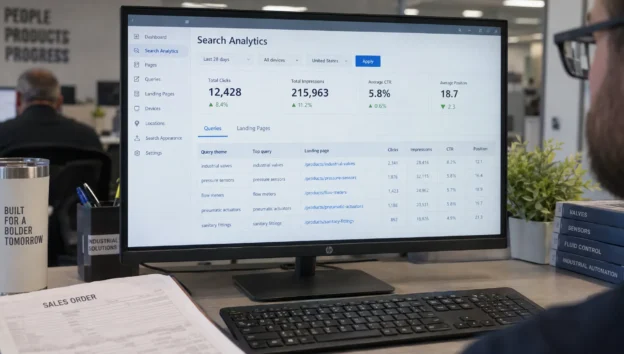
A clean industrial manufacturing floor with machinery, metal components, safety markings, and a laptop on a workbench displaying search analytics for industrial SEO.

Organic SEO strengthens paid search and sales enablement

Organic SEO is often treated as separate from paid search, but the two can support each other. PPC campaigns reveal which search terms, offers, and landing pages attract leads. Organic SEO can turn those insights into durable content and stronger service pages. At the same time, organic content can support paid campaigns by giving visitors more context after they land on the website.

Sales teams also benefit. When a prospect asks about a capability, application, or process, a salesperson can share a relevant page instead of relying only on a brochure or email explanation. That content works as a silent sales asset. It educates prospects, answers repeated questions, and helps maintain consistency across the buying journey.

For industrial companies with complex offerings, this matters. Buyers may need to justify a vendor recommendation internally. A useful technical page, case example, or comparison guide gives them something credible to pass along.

What industrial companies should prioritize now

Organic SEO works best when it is tied to business goals, not vanity traffic. Ranking for broad, popular phrases is less important than attracting the right buyers with the right intent. The goal is not simply more visitors. The goal is more qualified opportunities.

Start by identifying the searches that connect most closely to revenue. These often include product categories, service capabilities, industry applications, location-specific searches, replacement needs, repair needs, and problem-based searches. Then evaluate whether your website has a page that deserves to rank for each of those searches.

A practical industrial SEO plan should focus on these priorities:

  • Build specific service and capability pages: Each important offering should have its own clear page with useful detail.
  • Write for buyer language: Use the terms customers, engineers, and procurement teams actually search, not only internal company terminology.
  • Improve conversion paths: Make it easy to request a quote, ask a technical question, or contact the right team.
  • Strengthen proof points: Add certifications, industries served, case examples, process details, and other trust signals where relevant.
  • Maintain technical health: Fix crawl issues, broken links, slow pages, redirect problems, and thin or duplicate pages.
  • Measure qualified actions: Track quote requests, phone calls, form submissions, downloads, and other meaningful conversions.

The companies that win in organic search are usually not the ones that publish the most content. They are the ones that publish the most useful content for the buying situations that matter.

The cost of waiting is higher than it looks

Organic SEO takes time because search engines need to crawl, evaluate, and compare pages. Buyers also need repeated exposure before they trust a supplier. That is why delaying SEO can create a lasting disadvantage.

If a competitor has spent years building useful pages, earning links, improving site structure, and answering buyer questions, they may already own the search results your prospects use. Catching up is possible, but it requires strategy, consistency, and patience.

In 2026, search is also more blended than it used to be. Buyers may encounter traditional results, map results, review signals, AI-generated summaries, videos, images, and paid listings in the same research path. Organic SEO still matters because it gives your business a stronger foundation across that ecosystem. A clear, authoritative, well-structured website is easier for both people and search systems to understand.

Frequently Asked Questions

Does organic SEO still work for industrial companies in 2026? Yes. Organic SEO still works when it is focused on buyer intent, technical clarity, useful content, and trust. Industrial buyers continue to use search to research suppliers, compare capabilities, and validate vendors before contacting sales.

How long does organic SEO take for an industrial company? Timelines vary based on competition, website condition, content depth, and market size. Some improvements can help quickly, especially technical fixes and better conversion paths, but meaningful organic growth often takes months of consistent work.

Should industrial companies invest in SEO or PPC? Many should use both. PPC can create immediate visibility for priority searches, while organic SEO builds long-term discoverability and trust. The right mix depends on budget, competition, sales cycle, and lead quality goals.

What types of pages are most important for industrial SEO? Service pages, product pages, capability pages, industry pages, application pages, location-relevant pages, technical resources, FAQs, and case-based content are often the most valuable. The best pages match how real buyers search and evaluate suppliers.

Can a smaller industrial company compete in organic search? Yes, especially by targeting specific services, niches, applications, and regional searches. Smaller companies often struggle when they chase broad keywords, but they can compete effectively with focused, helpful pages that match high-intent searches.

Make organic search part of your industrial growth strategy

Organic SEO still matters because industrial buyers still search, compare, evaluate, and verify online. The companies that show up with useful, credible, and technically sound content are more likely to earn attention before the sales conversation begins.

If your industrial business needs better visibility, stronger lead quality, and a search strategy that supports long B2B sales cycles, B2B Inbound Marketing can help connect SEO, PPC, inbound strategy, content, and web-related marketing into a practical growth plan.

What to Look for in a B2B SEO Agency in 2026 - Main Image

What to Look for in a B2B SEO Agency in 2026

Choosing a B2B SEO agency in 2026 is no longer just a question of who can improve rankings. Rankings still matter, but the real test is whether the agency can help your business get found by the right buyers, support a complex sales cycle, and turn search visibility into qualified opportunities.

For B2B, industrial, manufacturing, distribution, technical services, and professional service companies, SEO has to work harder than it does in many consumer markets. Search volume may be lower. Keywords may be more technical. Buyers may research quietly for weeks or months before contacting sales. A single lead can be worth far more than hundreds of unqualified visits.

That is why the best B2B SEO agency in 2026 should bring more than keyword research and blog production. It should understand business development, buyer intent, technical website performance, content quality, paid search alignment, and measurable lead generation.

Why B2B SEO agency selection is different in 2026

Search has become more competitive and more fragmented. Buyers still use Google, but they also compare vendors across industry directories, LinkedIn, YouTube, AI-generated search summaries, review sites, and supplier websites. At the same time, search engines are getting better at rewarding content that demonstrates expertise, clarity, and usefulness.

For B2B companies, this creates both risk and opportunity. A generic SEO vendor may chase high-volume keywords that look impressive in reports but do little for revenue. A specialized B2B SEO agency should focus on the actual buying journey, including problem awareness, product comparison, vendor evaluation, technical specifications, compliance concerns, and local or regional search intent.

In 2026, the strongest agencies are not asking, “How many keywords can we rank for?” They are asking, “Which searches indicate a real business need, and how do we help those buyers move closer to a conversation?”

1. Look for strategy built around buyer intent, not traffic alone

The first sign of a strong B2B SEO agency is how it talks about strategy. If the conversation starts and ends with traffic growth, that is a warning sign. Traffic is useful only when it is connected to the right audience and the right stage of the buying process.

A qualified agency should want to understand your ideal customer profile, sales cycle, target industries, geographic markets, product categories, competitive positioning, and lead qualification process. For example, the search behavior of a plant manager researching replacement equipment is different from the behavior of a procurement team comparing suppliers or an executive evaluating long-term service partners.

A practical B2B SEO strategy should map keywords and content to intent levels.

Buyer intent stage What the buyer is trying to do Useful SEO content
Problem awareness Understand a challenge or symptom Educational articles, troubleshooting guides, industry explainers
Solution research Compare possible ways to solve the issue Service pages, comparison content, technical guides
Vendor evaluation Decide which provider is credible Case studies, capability pages, certifications, FAQs
Local or regional selection Find a nearby or market-specific provider Location pages, industry landing pages, local proof points
Sales validation Confirm trust before contacting sales Testimonials, project examples, team expertise, clear calls to action

A good agency will not treat all keywords equally. It will separate informational searches from commercial searches and prioritize pages that support revenue, not just visibility.

2. Demand real understanding of B2B and niche markets

B2B SEO often requires fluency in specialized language. The agency does not need to know every technical detail on day one, but it should know how to learn your market quickly and accurately. That includes interviewing sales teams, reviewing product documentation, analyzing competitor positioning, and identifying the phrases your buyers actually use.

This matters because many B2B and industrial buyers do not search in broad marketing language. They search with model numbers, use cases, performance requirements, material types, compliance terms, industry acronyms, location modifiers, and urgent problem descriptions.

Niche fluency matters in other considered-purchase categories too. A regional business such as a San Antonio manufactured homes dealer needs search content that addresses local buying intent, financing questions, model comparisons, and trust signals, not only generic housing keywords. The same principle applies to industrial suppliers, engineering firms, specialty contractors, and B2B service providers.

When interviewing an agency, ask how it handles technical subject matter. The answer should include collaboration with internal experts, a review process for accuracy, and content briefs that reflect real buyer questions.

3. Make sure technical SEO and content work together

Content cannot perform well if the website has major technical barriers. Likewise, a technically clean website will not generate qualified leads if the content does not answer real buyer questions. In 2026, you should expect a B2B SEO agency to connect both sides of the work.

Technical SEO should cover crawlability, indexation, page structure, internal linking, mobile usability, site speed, duplicate content, structured data where appropriate, and conversion paths. For B2B companies, technical SEO also includes making sure important service pages, industry pages, product pages, and location pages are easy for both search engines and human buyers to understand.

Content SEO should cover messaging, keyword intent, topical depth, clarity, sales alignment, and calls to action. The best content does not simply repeat keywords. It explains the problem, shows expertise, answers objections, and gives the buyer a reason to take the next step.

If you operate in a competitive local or regional market, this connection becomes even more important. For a deeper look at the Houston market specifically, this guide on SEO Houston for B2B companies explains why local relevance, search intent, and conversion quality matter more than generic optimization.

4. Evaluate their readiness for AI search and changing results pages

Search results in 2026 are not limited to ten blue links. Buyers may see AI-generated summaries, featured snippets, maps, videos, knowledge panels, image results, discussion threads, and paid ads before they reach organic listings. A modern B2B SEO agency should understand how these search experiences affect visibility.

That does not mean the agency should promise instant rankings in AI answers. Be cautious with anyone guaranteeing placement in AI-generated results. Instead, look for an agency that focuses on the fundamentals that support visibility across search experiences.

Those fundamentals include clear page structure, original expertise, concise answers to common questions, credible supporting details, strong internal linking, useful schema markup where relevant, and content that is specific enough to be cited, summarized, or trusted.

A 2026-ready agency should also understand that brand visibility matters. If buyers repeatedly see your company name connected to useful content, industry topics, and relevant searches, SEO begins to support awareness before the buyer is ready to fill out a form.

5. Reporting should connect SEO activity to leads and pipeline

One of the most important things to look for in a B2B SEO agency is reporting discipline. Monthly reports should not be a pile of keyword screenshots and traffic charts with no business interpretation. You need to know what changed, why it changed, and what the agency recommends next.

Good reporting connects SEO work to business outcomes. That may include organic sessions, keyword movement, conversions, form submissions, calls, quote requests, assisted conversions, landing page performance, and lead quality feedback from sales.

Reporting area What it should show Why it matters
Visibility Keyword growth, impressions, rankings, featured placements Shows whether your market presence is expanding
Engagement Organic sessions, time on page, entry pages, scroll behavior when available Shows whether searchers find the content useful
Conversion Forms, calls, quote requests, downloads, demo requests Shows whether SEO supports lead generation
Lead quality Sales feedback, qualified leads, industry fit, deal potential Shows whether traffic is attracting the right buyers
Next actions Priorities, tests, technical fixes, new content opportunities Turns reports into decisions

For B2B companies, lead quality matters as much as lead quantity. If organic traffic increases but sales says the inquiries are irrelevant, the strategy needs adjustment. A capable agency will welcome that feedback because it helps refine keyword targeting, page messaging, and conversion paths.

You can also review how search engine optimization services drive B2B leads to see how intent, content, and conversion-focused pages work together.

A strategy table with printed keyword maps, content briefs, industry notes, and lead pipeline charts laid out for review.

6. Ask how SEO fits with PPC, content, web design, and sales

SEO should not operate in isolation. In many B2B markets, the strongest results come when organic search, paid search, content writing, website design, and sales follow-up support the same buyer journey.

For example, PPC can test messaging before SEO content is expanded. SEO data can reveal new paid search opportunities. Sales teams can identify objections that should become website FAQs. Website redesign work can improve conversion rates on pages that already receive traffic.

A strong B2B SEO agency should be able to collaborate across these areas without losing focus. It should know when SEO is the right channel, when PPC can accelerate results, and when the website itself is limiting performance. If you are evaluating a broader search partnership, this article on what to expect from a search engine marketing agency can help you understand the discovery, planning, setup, reporting, and collaboration process.

This is especially important for companies with long sales cycles. A buyer may first discover an educational blog post, later return through a branded search, click a paid ad during vendor comparison, and finally convert on a service page. Your agency should understand how these touchpoints work together.

7. Review their process before you review their promises

Promises are easy. Process is harder to fake. Before hiring a B2B SEO agency, ask how work actually gets done after the contract is signed.

A reliable agency should be able to explain its discovery process, audit methodology, keyword research approach, content planning, technical implementation, communication rhythm, reporting schedule, and decision-making framework. You do not need every tactical detail before starting, but you should understand how the agency thinks.

Useful questions include:

  • How do you learn our industry, products, and buyers?
  • How do you decide which keywords are worth targeting?
  • How do you balance technical SEO with content creation?
  • What do you need from our sales or subject matter experts?
  • How do you measure qualified leads, not just traffic?
  • How often will we review performance and priorities?
  • What does success typically look like in the first 90, 180, and 365 days?

The answers should be specific enough to build confidence but honest enough to avoid unrealistic expectations. SEO is a long-term channel, especially in competitive B2B markets. A serious agency will explain what can be improved quickly and what will require sustained effort.

8. Watch for red flags that signal a poor fit

Not every SEO provider is equipped for B2B work. Some may be excellent for local consumer businesses but weak in technical industries. Others may rely on outdated tactics that create short-term movement but long-term risk.

Be careful if an agency promises guaranteed rankings, avoids discussing your sales process, focuses only on blog volume, cannot explain its link-building approach, offers vague reports, or recommends major website changes before understanding your market.

Another red flag is a one-size-fits-all content plan. B2B buyers can tell when content is generic. If your agency produces surface-level articles that could apply to any company in any industry, the content is unlikely to build trust with serious buyers.

You should also be cautious if the agency treats AI-generated content as a complete replacement for expertise. AI can support research, outlining, and efficiency, but B2B content still needs accuracy, judgment, review, and differentiation.

9. Compare agencies using a decision checklist

When you are comparing proposals, it helps to evaluate each agency against the same criteria. Price matters, but it should not be the only deciding factor. The lowest-cost option can become expensive if it attracts the wrong traffic, creates weak content, or ignores technical problems.

Use this checklist as a practical starting point.

Selection criteria What to look for
B2B experience Evidence that the agency understands long sales cycles, niche search behavior, and lead quality
Strategic discovery Questions about buyers, revenue goals, markets, competitors, and sales process
Technical capability Ability to audit and improve crawlability, site structure, speed, and page performance
Content quality Clear process for expert input, accuracy, differentiation, and buyer-focused writing
Measurement Reporting that connects visibility to conversions, qualified leads, and next actions
Channel integration Ability to align SEO with PPC, website improvements, content, and sales feedback
Communication Clear timelines, responsibilities, reporting cadence, and expectations
Ethical approach No guaranteed rankings, hidden tactics, or risky shortcuts

The right agency should make you feel more informed, not more confused. It should be able to translate SEO into business priorities while still respecting the technical details that make SEO work.

Frequently Asked Questions

What makes a B2B SEO agency different from a general SEO agency? A B2B SEO agency should understand long buying cycles, technical subject matter, smaller search volumes, higher-value leads, and the need to connect SEO with sales outcomes. General SEO tactics may help visibility, but B2B SEO needs stronger alignment with buyer intent and lead quality.

How long does B2B SEO take to show results in 2026? Some improvements, such as technical fixes or optimization of existing pages, can create early movement. Competitive organic growth usually takes several months of consistent work. The timeline depends on your current website condition, competition, content depth, authority, and market focus.

Should a B2B SEO agency also manage PPC? Not always, but it is helpful when the agency understands both SEO and PPC. Paid search can generate faster data, test messaging, and support high-intent keywords while organic visibility grows. The key is making sure both channels support the same business goals.

What should I ask before hiring a B2B SEO agency? Ask how the agency defines success, how it researches your buyers, how it measures qualified leads, how it handles technical SEO, how it creates content, and what it needs from your internal team. The best answers will be specific, realistic, and tied to business outcomes.

Ready to choose a stronger SEO partner in 2026?

The right B2B SEO agency should help your company become easier to find, easier to understand, and easier to trust. In 2026, that means combining search strategy, technical SEO, useful content, conversion thinking, and clear reporting.

If your business operates in Houston, serves industrial or B2B markets, or needs a more accountable approach to SEO, PPC, and inbound marketing, B2B Inbound Marketing can help you evaluate where your search presence stands and where the best opportunities are. Start by looking for a partner that understands not just rankings, but the buyers behind the searches.

Search Engine Optimization for Business Growth That Lasts - Main Image

Search Engine Optimization for Business Growth That Lasts

Most business owners do not need more random website visitors. They need the right people finding the right pages at the right moment, then taking a useful next step. That is where search engine optimization for business growth becomes more than a marketing tactic. Done well, SEO becomes a long-term system for visibility, trust, lead generation, and sales support.

For B2B and industrial companies, the stakes are especially high. Buyers often research quietly for weeks or months before contacting a vendor. They compare technical capabilities, service areas, certifications, use cases, and proof of performance long before they are ready to request a quote. If your business is absent during that research process, competitors shape the conversation for you.

Lasting SEO growth is not about chasing every keyword or publishing content for the sake of activity. It is about building a durable online presence that matches real buyer intent, supports the sales process, and compounds over time.

Why SEO should be treated as a business growth asset

Paid advertising can create fast visibility, and it has an important role in many marketing programs. But once the budget stops, the traffic usually stops too. SEO is different. A well-structured page, technical improvement, or useful guide can continue attracting qualified visitors long after the initial work is done.

That does not mean SEO is free or effortless. It requires strategy, research, writing, technical upkeep, measurement, and patience. The advantage is that those efforts can build equity. Over time, your website becomes a library of answers, proof points, and conversion paths that support buyers across the full decision journey.

For business leaders, the question is not simply, “Can we rank higher?” A better question is, “Can search help us become easier to find, easier to trust, and easier to choose?”

That shift changes the entire SEO conversation. Rankings still matter, but they are not the finish line. The real objective is profitable visibility.

What lasting SEO growth actually means

Lasting growth does not mean your rankings never move. Search results change constantly as competitors publish new content, algorithms evolve, and buyer behavior shifts. Durable SEO means your business has enough authority, relevance, and technical strength to keep earning visibility through those changes.

A lasting SEO program usually produces several business outcomes:

  • More qualified organic traffic from people with real buying intent
  • Better visibility for niche products, services, and technical capabilities
  • Stronger trust signals before prospects ever speak with sales
  • Lower dependence on one traffic source, such as paid search or referrals
  • A website structure that can support new markets, services, and content
  • Better data for understanding what buyers are researching

For industrial companies, this can mean ranking for specific applications, materials, service capabilities, or geographic markets. For B2B service firms, it can mean showing up when executives search for a problem they need solved, not just when they already know your company name.

If you want a deeper look at the compounding value of organic visibility, this guide to organic search engine optimization for long-term growth explains why SEO should be built as a sustained business channel.

The durable SEO growth framework

Search engine optimization for business growth works best when it connects marketing activity to business priorities. A page can attract traffic and still fail if it targets the wrong audience, lacks credibility, or gives visitors no clear next step.

A practical framework includes five connected layers.

SEO growth layer Business question it answers What the work includes Growth outcome
Market intent What are buyers searching before they contact us? Keyword research, competitor analysis, customer language review Clearer demand opportunities
Content architecture Do we have the right pages for each buying stage? Service pages, industry pages, guides, FAQs, case-focused content More relevant organic visibility
Technical foundation Can search engines crawl, understand, and evaluate the site? Site speed, indexing, internal links, structured pages, mobile usability Fewer hidden performance barriers
Trust and conversion Does the page help visitors believe and act? Proof points, clear calls to action, expert content, contact paths Better lead quality and conversion rates
Measurement Are we learning what drives pipeline? Rankings, traffic, form fills, calls, attribution review Smarter investment decisions

When these layers work together, SEO becomes more resilient. If one keyword fluctuates, the entire strategy does not collapse. If one page underperforms, the data tells you what to improve next.

Start with profitable search intent, not search volume

One of the most common SEO mistakes is prioritizing keywords only because they have high search volume. Large search numbers can look attractive, but they often hide weak intent. A broad informational phrase might bring traffic, while a more specific phrase with lower volume may bring buyers who are closer to action.

For example, an industrial supplier may not need thousands of visitors searching generic educational terms. It may get more value from a smaller group of searchers looking for a specific part, tolerance, material, certification, or emergency service capability.

The same principle applies across many industries. A niche brand introducing a new category, such as a specialized wellness company using warm-air herbal vaporization, needs content that explains the concept, answers early questions, and helps searchers understand why the offering is different. B2B companies face a similar challenge when their products or services are technical, unfamiliar, or highly specialized.

Good SEO research should identify more than keywords. It should identify the reason behind the search. Is the person learning, comparing, validating, troubleshooting, or preparing to buy?

Map content to the full buyer journey

Business buyers rarely move from first search to sales call in one step. They may begin with a problem, move into solution research, compare vendors, and then look for proof that one company is the safer choice.

That journey needs different types of pages.

Early-stage content answers broad but relevant questions. It builds awareness and helps prospects understand the problem. Mid-stage content explains options, use cases, processes, and decision criteria. Late-stage content supports vendor selection with service pages, industry pages, case examples, technical details, testimonials, and clear contact opportunities.

A healthy SEO strategy includes all three stages. If you only publish educational articles, you may attract readers who never convert. If you only build sales pages, you may miss prospects earlier in their research. Lasting growth comes from connecting the full path.

A business marketing team reviews a website content map on a conference table, with printed search intent notes, service page outlines, and lead conversion goals organized into clear sections, viewed from above.

For B2B companies that need SEO to produce more than surface-level traffic, the connection between search intent and lead generation is critical. This article on how search engine optimization services drive B2B leads explores that relationship in more detail.

Build pages that answer real business questions

Search engines reward useful, relevant content, but buyers reward clarity. A page that ranks but confuses visitors will not support growth. The best business SEO pages are specific, credible, and action-oriented.

A strong service or industry page should quickly answer practical questions. What does the company do? Who does it serve? What problems does it solve? What makes its approach credible? What should a qualified prospect do next?

For technical or industrial businesses, useful details often matter more than polished slogans. Buyers may want to know about capabilities, materials, tolerances, industries served, turnaround expectations, locations, compliance needs, or project fit. Those details help search engines understand the page, but they also help human buyers qualify your company.

Blog content should be held to the same standard. Instead of publishing generic posts that repeat obvious advice, focus on the questions your sales team hears repeatedly. If a prospect asks about cost drivers, lead times, vendor selection, implementation risks, or common mistakes, that topic may deserve a search-optimized article.

Strengthen the technical foundation

Content cannot perform well if the website foundation is weak. Technical SEO helps search engines discover, crawl, render, and understand your pages. It also improves the user experience, which directly affects whether visitors stay, read, and convert.

Core technical priorities include clear site architecture, crawlable navigation, fast-loading pages, mobile usability, clean URLs, accurate title tags, useful meta descriptions, internal linking, and index management. None of these elements should be treated as one-time tasks. Websites change, plugins update, pages get removed, redirects break, and competitors improve.

For businesses, technical SEO is less about obscure jargon and more about removing friction. If an important page is buried, slow, duplicated, or not indexed, it cannot contribute reliably to growth.

Technical improvements can also make paid campaigns and referral traffic perform better. A faster, clearer, better-organized website helps every channel, not just organic search.

Use authority signals to build trust before the sales call

SEO is not only about what you say. It is also about whether the market has reasons to believe you. Search engines evaluate many signals of credibility, and human buyers do the same.

Trust signals may include detailed service information, leadership expertise, customer examples, industry experience, certifications, useful resources, clear contact information, and consistent brand presence. For local or regional businesses, accurate business information and location relevance also matter.

Backlinks can support authority, but they should be earned through relevance and quality rather than shortcuts. A few strong mentions from industry sites, associations, partners, or respected publications can be far more valuable than dozens of weak links.

The most sustainable authority strategy is to become genuinely useful in your market. Publish content that helps buyers make better decisions. Clarify complex topics. Share practical insights. Show that your company understands the problems your customers are trying to solve.

Make conversion part of the SEO plan

Traffic without conversion is an incomplete result. A business website should guide visitors toward meaningful next steps without forcing every visitor into the same action.

Some prospects are ready to request a quote. Others may want to ask a question, download a resource, compare services, or learn more about a specific capability. SEO pages should include calls to action that match the visitor’s stage of awareness.

A strong conversion path often includes clear page headings, visible contact options, concise forms, relevant proof points, and internal links to related pages. The goal is not to pressure every visitor. The goal is to make it easy for a qualified buyer to continue.

This is especially important for B2B and industrial companies, where the buying process can involve several stakeholders. Your website may need to serve engineers, purchasing managers, operations leaders, executives, and local decision-makers. Each may care about different information before they engage.

Measure SEO by business impact, not vanity metrics

Rankings and traffic are useful indicators, but they do not tell the whole story. A business growth SEO program should connect organic visibility to pipeline whenever possible.

Useful SEO measurements include organic leads, assisted conversions, calls, form submissions, quote requests, high-intent page visits, engagement on key pages, indexed pages, ranking improvements for priority terms, and organic traffic quality by landing page.

Business leaders should also look for directional trends. Are more qualified prospects finding service pages? Are organic visitors engaging with high-value content? Are sales conversations improving because prospects arrive more educated? Are paid search costs easier to manage because organic visibility is stronger?

SEO attribution is rarely perfect, especially in longer B2B sales cycles. A prospect may read a guide, return through a branded search, visit from a paid ad, and later submit a form. The goal is not to oversimplify attribution. The goal is to understand how organic search supports the larger revenue system.

For teams that need executive buy-in, it helps to frame SEO in financial and strategic terms. This guide on how to build an SEO marketing business case can help connect search investment to business priorities.

Common reasons business SEO fails to last

Many companies have tried SEO before and felt disappointed. In most cases, the problem is not that SEO cannot work. The problem is that the strategy was too narrow, too short-term, or disconnected from the business model.

Common failure points include targeting keywords that do not match buyers, publishing thin content, ignoring technical issues, treating SEO as a one-time website project, measuring only rankings, and failing to update pages as the market changes.

Another frequent issue is lack of patience. SEO can show early gains, especially when technical problems are fixed, but durable growth usually requires months of consistent improvement. The companies that win often treat SEO as an operating discipline, not a seasonal campaign.

How to make SEO growth more durable in 2026 and beyond

Search has changed significantly with richer results, AI-assisted discovery, more competitive content, and higher expectations from users. Still, the fundamentals of lasting business growth remain familiar. Be findable. Be useful. Be credible. Be easy to contact.

To make SEO more durable, businesses should prioritize clarity over volume. Build pages around real buyer needs. Keep technical performance healthy. Refresh important content before it becomes outdated. Use data to improve what already exists before constantly chasing new topics.

It is also wise to integrate SEO with other channels. PPC can test keyword value quickly. Social media can distribute expertise. Email can nurture visitors who are not ready to buy. Web design can improve conversions. Inbound marketing can connect content, search, and sales follow-up into one system.

The more connected these efforts become, the less SEO operates in isolation. That is when search engine optimization for business growth becomes a reliable part of the company’s long-term marketing engine.

Frequently Asked Questions

How long does SEO take to support business growth? Most businesses should expect SEO to build gradually over several months, although technical fixes and improvements to existing pages can sometimes show earlier gains. The timeline depends on competition, website condition, content quality, and the consistency of execution.

Is SEO better than PPC for long-term growth? SEO and PPC serve different purposes. PPC can create immediate visibility, while SEO builds compounding organic visibility over time. Many businesses use both, with PPC supporting short-term demand and SEO building a more durable traffic and lead generation channel.

What makes B2B SEO different from consumer SEO? B2B SEO often involves longer sales cycles, more technical search terms, multiple decision-makers, and higher-value conversions. Content must educate, build trust, and support buyers who may not contact sales until they have completed significant research.

How often should business SEO content be updated? Priority pages should be reviewed regularly, especially service pages, industry pages, and articles that support lead generation. Updates may include better examples, clearer calls to action, new internal links, fresher information, or improved alignment with current search intent.

Can a local Houston business benefit from SEO? Yes. Local and regional companies can use SEO to appear for service, industry, and location-based searches. For B2B and industrial businesses in Houston, strong organic visibility can help attract buyers who are actively looking for specialized providers.

Build growth that does not disappear when the campaign ends

Sustainable SEO is not a quick trick. It is a long-term business asset built through strategy, useful content, technical strength, and consistent improvement. When those pieces work together, your website can become a dependable source of qualified visibility and better leads.

If your company wants to strengthen organic search, improve lead quality, or connect SEO with PPC and inbound marketing, B2B Inbound Marketing can help you build a practical strategy focused on lasting business growth.

How to Build an SEO Marketing Business Case That Wins - Main Image

How to Build an SEO Marketing Business Case That Wins

An SEO budget request rarely fails because leadership hates SEO. It fails because the request sounds like a marketing preference instead of a business investment.

Executives hear phrases like “we need more content,” “rankings are down,” or “competitors are outranking us,” and they immediately ask the right question: what does this mean for revenue, pipeline, margin, and risk?

A winning SEO marketing business case answers that question before it is asked. It connects search visibility to qualified demand, sales opportunities, cost efficiency, and measurable growth. For B2B, industrial, manufacturing, SaaS, and professional service companies, this is especially important because SEO rarely produces value from vanity traffic alone. It wins when it attracts the right buyer at the right stage of the decision process.

Below is a practical framework for building an SEO marketing business case that earns buy-in from owners, executives, sales leaders, and finance teams.

Start with the business problem, not the SEO tactic

The weakest SEO proposals begin with tactics: more blog posts, more backlinks, more technical fixes, more landing pages. Those may be necessary, but they are not the business case.

Start with the commercial problem leadership already cares about. For example, the company may need to reduce dependence on paid ads, enter a new regional market, increase quote requests, support distributors, improve visibility for high-margin services, or generate more qualified leads for a long sales cycle.

Once the business problem is clear, SEO becomes the mechanism for solving it. A Houston industrial supplier, for instance, may not need “more traffic” in general. It may need more visibility for high-intent searches from procurement managers, plant engineers, maintenance teams, or operations leaders looking for a specific service.

This is where your business case should define the opportunity in plain language:

  • Which revenue goal will SEO support?
  • Which buyer segments are searching?
  • Which products, services, or regions matter most?
  • Which competitors are currently capturing that demand?
  • What will the company gain if it becomes more visible?

If you need to sharpen this foundation, it helps to first develop a clear SEO value proposition that explains why organic search matters to your specific market, not just why SEO is useful in general.

Map search intent to revenue intent

A winning SEO marketing business case separates keywords by business value. Not every search deserves equal investment.

For example, “what is industrial filtration” may be useful for awareness, but “industrial filtration company Houston” or “custom filtration system manufacturer” is closer to a buying decision. The first search may educate the market. The second may produce a sales conversation.

Your goal is to group search demand by intent so leadership can see where SEO connects to revenue. A simple model can divide keywords into four categories.

Search intent Buyer mindset Example SEO asset Business value
Educational Learning about a problem Technical guide or explainer Builds early trust
Comparison Evaluating options Service comparison page Influences vendor selection
Commercial Looking for a provider Product or service landing page Drives leads and inquiries
Support Needs help after purchase FAQ or troubleshooting content Reduces friction and supports retention

This makes your SEO plan more credible because it shows that the strategy is not based on chasing random traffic. It is based on matching content and optimization work to buyer behavior.

Google’s own guidance emphasizes creating helpful, reliable, people-first content, and the Google SEO Starter Guide is a useful reference when explaining to non-marketers why search performance depends on site quality, relevance, and accessibility.

Search intent applies across industries. A manufacturer may need content for technical buyers, while a travel company might need destination pages, itinerary content, and trust signals for a high-consideration journey such as a Uganda Safari 2026. The principle is the same: strong SEO connects what people are actively searching for with a credible page that helps them take the next step.

Size the opportunity with conservative assumptions

Executives do not need a perfect forecast. They need a reasonable forecast that shows the size of the opportunity and the assumptions behind it.

Avoid promising rankings or exact traffic numbers. Instead, use a scenario model. Start with the search terms that matter most, estimate monthly search demand, apply a realistic click-through range, estimate conversion rates, and translate that into lead or revenue potential.

A simple formula can look like this:

Estimated monthly organic visits = monthly search volume x expected click-through rate

Estimated monthly leads = estimated organic visits x website conversion rate

Estimated revenue opportunity = estimated leads x close rate x average deal value

The model becomes more useful when you show a conservative, moderate, and aggressive case. This allows leadership to evaluate risk without feeling like the entire proposal depends on a best-case scenario.

Scenario Ranking assumption Traffic assumption Conversion assumption Use in business case
Conservative Modest visibility gains Low click-through estimate Current conversion rate Sets the minimum viable case
Moderate Page one visibility for priority terms Mid-range click-through estimate Slight conversion improvement Shows realistic upside
Aggressive Strong rankings across key clusters Higher click-through estimate Improved conversion path Shows long-term growth potential

This is also where you should identify the gap between current performance and potential performance. If competitors dominate the search results for profitable queries, your business case can quantify the cost of inaction. The company is not simply “missing rankings.” It is allowing competitors to intercept demand that already exists.

A boardroom wall display showing charts, keyword clusters, revenue projections, and campaign notes for an executive marketing planning session, with a side table of printed documents in view.

Build the cost side with the same discipline

A credible SEO marketing business case does not hide the investment required. It makes the cost visible, structured, and tied to outcomes.

SEO costs usually fall into several categories: strategy, technical improvements, content creation, on-page optimization, local or regional SEO, analytics setup, conversion improvements, and ongoing management. Depending on the company, there may also be web development needs, product page rewrites, photography, video, or subject matter expert interviews.

Rather than presenting one vague budget line, organize costs by function.

Investment area What it covers Why it matters
SEO strategy Research, prioritization, roadmap Focuses effort on business value
Technical SEO Crawlability, speed, structure, indexing Helps search engines access and understand the site
Content Service pages, guides, FAQs, case studies Matches buyer questions and search intent
Conversion support Calls to action, forms, page flow Turns visits into leads
Reporting Dashboards, tracking, analysis Connects activity to results

This structure helps finance and leadership understand that SEO is not a single task. It is an operating system for being found, trusted, and contacted online.

Compare SEO to paid media fairly

A strong business case does not attack PPC. In fact, for many B2B and industrial companies, SEO and PPC work best together.

Paid search can generate immediate visibility, test messaging, and support short-term campaigns. SEO builds durable visibility, improves authority, and reduces the long-term cost of acquiring qualified traffic. The business case should show how the two channels complement each other.

For example, PPC data can reveal which keywords convert before you invest heavily in organic content. SEO can then target those proven themes with stronger landing pages, educational content, and technical optimization. Over time, the company may become less dependent on paying for every click while still using PPC for competitive terms, new markets, or seasonal demand.

The executive-friendly framing is simple: PPC rents visibility, while SEO builds an owned demand asset. Most growing companies need both, but the balance should reflect cost per lead, sales cycle, market maturity, and competitive pressure.

Define the timeline realistically

One reason SEO business cases fail is that they either promise results too quickly or leave the timeline too vague. Neither approach builds trust.

A practical SEO roadmap should separate early activity, leading indicators, and business outcomes.

Timeframe Focus What leadership should expect
First 30 days Audit, strategy, analytics, priority mapping Clear baseline and roadmap
Days 31 to 90 Technical fixes, content updates, landing page improvements Better crawlability, stronger relevance, early ranking movement
Months 4 to 6 Content expansion, authority building, conversion refinement Increased impressions, clicks, and qualified traffic
Months 7 to 12 Scaling what works Stronger lead contribution and compounding organic growth

This kind of timeline protects the credibility of the proposal. SEO is not instant, but it should not be mysterious. Leadership should know what progress looks like before revenue impact fully appears.

Choose KPIs that match executive priorities

Rankings matter, but they are not enough. An SEO marketing business case should include both leading and lagging indicators.

Leading indicators show whether the strategy is gaining traction. These include impressions, indexed pages, keyword visibility, click-through rates, organic sessions, engagement, and technical health improvements.

Lagging indicators show whether the strategy is producing business value. These include form submissions, quote requests, booked calls, marketing qualified leads, sales qualified leads, pipeline value, closed revenue, customer acquisition cost, and organic conversion rate.

The most persuasive business cases connect SEO metrics to sales outcomes through a reporting chain:

Keyword visibility leads to organic traffic. Organic traffic leads to conversions. Conversions lead to sales opportunities. Sales opportunities lead to revenue.

If your organization is already asking financial questions, reviewing the ROI of an SEO campaign can help frame SEO performance in terms that executives and finance teams understand.

Address risk before leadership does

Every investment has risk. If you ignore risk, decision makers will assume the case is incomplete. If you address risk directly, you look prepared.

Common SEO risks include slow implementation, limited internal subject matter expertise, technical barriers, weak tracking, competitive pressure, and unrealistic expectations. Your business case should identify each risk and explain how it will be managed.

Risk Why it matters Mitigation
Slow internal approvals Content and site changes get delayed Set a review schedule and assign owners
Poor tracking ROI becomes hard to prove Configure analytics, goals, CRM source tracking, and call tracking where appropriate
Thin content Pages fail to earn trust Use subject matter experts and real customer questions
Technical site issues Search engines struggle to crawl or understand pages Prioritize technical fixes early
Unrealistic expectations Leadership loses patience Use phased goals and scenario forecasts

This section is especially important for B2B and industrial firms because internal expertise is often distributed across sales, engineering, operations, and leadership. SEO success may depend on extracting knowledge from those teams and turning it into useful, searchable content.

Make the final recommendation easy to approve

Once you have built the analysis, simplify the decision. Do not hand executives a complicated SEO document and expect them to translate it into an approval.

Your final recommendation should include the business goal, target audience, priority opportunities, required investment, expected timeline, forecast scenarios, KPIs, risks, and next step. Keep it concise enough that a non-marketing executive can explain it to another decision maker.

A strong final recommendation might sound like this:

“Organic search is a practical growth investment because our target buyers are actively searching for high-value services where we have limited visibility today. By improving technical SEO, strengthening priority service pages, and publishing content around buyer questions, we can increase qualified organic traffic, reduce dependence on paid clicks, and create a measurable pipeline source over the next 6 to 12 months.”

That is much stronger than saying, “We need to do SEO because rankings are important.”

Know when to bring in an SEO partner

Some companies can build the business case internally. Others need outside support to quantify the opportunity, identify technical issues, prioritize content, and create a roadmap that leadership can trust.

The right partner should understand strategy, implementation, reporting, and commercial outcomes. For B2B and industrial businesses, industry familiarity also matters. Technical products, long buying cycles, distributor relationships, and complex service offerings require more than generic keyword research.

If you are evaluating support, this guide on choosing the best search engine optimization companies can help you assess strategic fit, transparency, and execution quality before making a decision.

Frequently Asked Questions

What is an SEO marketing business case? An SEO marketing business case is a structured argument for investing in SEO. It connects organic search opportunities to business goals, expected costs, forecasted returns, timelines, risks, and measurement.

How long should an SEO business case forecast be? Most companies should forecast across 6 to 12 months because SEO needs time to compound. A 90-day view is useful for implementation milestones, but a longer view is better for revenue impact.

What metrics should be included in an SEO business case? Include impressions, rankings, organic sessions, conversion rate, leads, pipeline value, closed revenue, customer acquisition cost, and ROI. The best metric set connects marketing activity to sales outcomes.

How do you make SEO easier for executives to approve? Tie SEO to a known business priority, show conservative assumptions, define costs clearly, explain risk, and present a simple next step. Executives approve SEO faster when it feels measurable and commercially relevant.

Should SEO replace PPC? Usually, no. SEO and PPC often work better together. PPC can support immediate visibility and testing, while SEO builds long-term organic visibility and can reduce reliance on paid clicks over time.

Build a business case that turns search into revenue

A winning SEO marketing business case is not built on hype. It is built on clear priorities, realistic assumptions, measurable outcomes, and a practical plan for execution.

If your business needs stronger visibility, better qualified leads, or a clearer path from search rankings to revenue, B2B Inbound Marketing can help you turn SEO into a structured growth strategy. The right case does more than win approval. It gives your team a roadmap for being found by the buyers who are already searching.

Organic Search Engine Optimization for Long-Term Growth - Main Image

Organic Search Engine Optimization for Long-Term Growth

Organic search engine optimization is one of the few marketing investments that can keep producing value long after the first campaign is launched. For B2B and industrial companies, that matters. Buyers often research quietly for weeks or months, compare technical options, involve multiple decision-makers, and return to search several times before they ever contact a supplier.

Paid ads can create immediate visibility, but organic SEO builds a durable presence where your prospects are already looking. The goal is not simply to rank for more keywords. The goal is to become discoverable, credible, and useful at every stage of the buyer journey.

What organic SEO really means for long-term growth

Organic SEO is the practice of improving your website so search engines can understand, trust, and rank your pages without paying for each click. It includes content strategy, technical website improvements, on-page optimization, internal linking, authority building, and conversion planning.

For a B2B company, organic SEO should connect three things:

  • What your ideal customers are searching for
  • What your company is genuinely qualified to solve
  • What content, pages, and site structure help turn searchers into leads

That last point is important. Traffic without fit is a vanity metric. A manufacturer, engineering firm, SaaS provider, distributor, or industrial service company does not need random visitors. It needs the right prospects, with the right problems, at the right stage of evaluation.

If you need a simpler framework for the discipline, this overview of SEO’s three core building blocks, content, code, and credibility, is a useful foundation: what search engine optimization is and how it works.

Why organic search compounds over time

A strong organic search program works like a business asset. Each helpful page can rank, attract visitors, answer questions, support sales conversations, and strengthen the relevance of related pages. Over time, a well-structured site can build topical authority in the markets it serves.

That compounding effect is especially valuable in B2B because the same questions come up repeatedly. Prospects search for product specifications, industry standards, installation considerations, maintenance issues, pricing factors, comparison points, vendor qualifications, and proof of experience. If your website answers those questions clearly, it can influence buyers before your sales team ever joins the conversation.

The value is not limited to top-of-funnel education. Organic search can support the entire pipeline, from early problem discovery to supplier selection.

Growth factor How organic SEO supports it Why it matters for B2B companies
Visibility Helps your pages appear for relevant searches Buyers can find you before they know your brand
Trust Publishes useful, specific, expertise-driven content Technical buyers want evidence and clarity
Lead quality Targets intent, not just broad traffic Better alignment between searchers and services
Sales enablement Creates pages sales teams can share Content answers common objections and questions
Cost efficiency Reduces dependence on paid clicks over time Organic traffic can keep producing after publication

This is why organic SEO should not be treated as a quick campaign. It is a long-term growth system.

Organic SEO vs. paid search: why the best strategy often uses both

Organic search and paid search are not enemies. In many cases, they work best together. Paid search can help you test messaging, generate visibility for competitive terms, and capture immediate demand. Organic search builds the foundation for sustainable discovery and credibility.

The difference is in how the value is created.

Channel Strength Limitation Best use
Paid search Fast visibility and precise targeting Traffic often stops when spend stops Launches, high-intent offers, market testing
Organic SEO Compounding visibility and trust Requires time, consistency, and technical discipline Long-term lead generation and authority building
Inbound content Educates and qualifies prospects Needs strong distribution and optimization Complex B2B buying journeys
Website optimization Improves conversion from all channels Requires ongoing testing and refinement Turning traffic into inquiries and opportunities

For companies with long buying cycles, the smartest approach is usually not choosing one channel forever. It is using paid search where speed is needed and organic SEO where durability is needed.

Start with search intent, not search volume

One of the most common organic SEO mistakes is chasing the largest keywords without asking whether those searches can realistically become business opportunities. A broad keyword may bring traffic, but a precise query may bring a qualified prospect.

For example, an industrial company might be tempted to target broad terms such as “valves,” “automation,” or “metal fabrication.” Those terms are competitive and vague. A more strategic approach might target searches tied to application, industry, problem, location, specification, or vendor evaluation.

Search intent typically falls into four practical categories:

  • Informational intent: The prospect is learning about a problem or process.
  • Commercial intent: The prospect is comparing methods, products, or providers.
  • Transactional intent: The prospect is ready to request a quote, consultation, demo, or supplier conversation.
  • Navigational intent: The prospect is looking for a known company, product, or resource.

The best organic SEO strategies map content to all four. Early-stage content builds awareness. Comparison and application pages support evaluation. Service and product pages convert demand.

Search intent is not limited to industrial markets. A site offering Mexico tours and travel has to organize content around different needs such as destinations, day tours, private tours, transfers, and multi-day experiences. B2B companies should apply the same discipline to product categories, applications, industries, service areas, and buyer questions.

Build the right organic growth assets

Long-term SEO growth depends on having the right pages on your website. Blog posts matter, but they are only one part of the picture. A strong B2B site usually needs a mix of commercial, educational, and trust-building content.

Page type Purpose Example use case
Core service pages Explain what you offer and who it helps SEO services for industrial companies
Product or category pages Capture demand for specific solutions Custom fabrication, components, software modules
Application pages Match searches tied to use cases Corrosion control for marine environments
Industry pages Show relevance to a vertical market Marketing for manufacturers, energy, logistics, SaaS
Educational articles Answer research-stage questions How to choose a supplier, compliance considerations
Comparison pages Help buyers evaluate options In-house vs. outsourced service, product A vs. product B
Proof pages Build credibility Case studies, certifications, project examples

The strongest sites connect these assets through internal links. An educational article should not sit alone. It should guide the reader toward a related service page, industry page, resource, or next step. That structure helps both users and search engines understand the relationship between your content.

Technical SEO turns good content into discoverable content

Even excellent content can underperform if the website is difficult for search engines to crawl or difficult for users to navigate. Technical SEO is the infrastructure behind organic growth.

Important technical priorities include clean URL structures, fast-loading pages, mobile usability, indexable content, logical headings, structured internal linking, accurate metadata, image optimization, and clear calls to action. None of these elements should be treated as isolated tasks. They affect how people experience the website and how search engines interpret it.

This is also where design and SEO overlap. A beautiful website that buries important content, loads slowly, or makes conversion difficult will limit organic growth. A search-optimized website should help visitors find what they need quickly and understand what to do next. That is why web design and search engine optimization should be planned together from the start.

An organic SEO roadmap laid out on a conference table with keyword clusters, buyer questions, content briefs, conversion goals, and technical SEO notes printed on paper.

Credibility matters more in competitive B2B markets

Organic rankings are not built on content volume alone. Search engines also evaluate signals of credibility, usefulness, and authority. In competitive B2B markets, trust can be the difference between a page that ranks and a page that disappears.

Credibility can come from many legitimate sources: expert-written content, detailed service information, original insights, clear author or company expertise, customer proof, certifications, industry associations, case studies, strong internal linking, and relevant third-party mentions.

For industrial and technical companies, specificity is a major trust signal. Generic content such as “we offer high-quality solutions” does very little. Better content explains materials, tolerances, safety considerations, regulatory issues, implementation challenges, maintenance needs, or procurement factors. It reflects the reality of the buyer’s work.

This is where subject matter expertise becomes a competitive advantage. Marketing teams can optimize structure and language, but the best content often starts with interviews, sales call notes, customer questions, field experience, and technical documentation.

Measure organic SEO by business impact, not rankings alone

Rankings matter, but they are not the whole scorecard. A keyword ranking can look impressive while producing little business value. A long-tail page with modest traffic can produce highly qualified leads.

The right metrics depend on the company, sales cycle, and website maturity, but a balanced organic SEO dashboard should include both leading and lagging indicators.

Metric What it tells you Why it matters
Organic impressions Whether search visibility is expanding Early sign of search market reach
Qualified organic clicks Whether the right people are visiting More useful than traffic volume alone
Rankings for intent-rich terms Whether strategic pages are gaining traction Shows progress on business-relevant searches
Engagement by page type Whether visitors find content useful Helps refine content and internal links
Organic form submissions or calls Whether SEO is creating direct leads Connects visibility to demand generation
Assisted conversions Whether SEO supports longer buyer journeys Important for B2B sales cycles
Pipeline or revenue influence Whether organic search contributes to growth The ultimate business measure

It is also important to segment performance. A blog article, product page, case study, and service page should not all be judged the same way. Each plays a different role in the journey.

Avoid shortcuts that damage long-term growth

Because organic SEO takes time, shortcuts can be tempting. But tactics such as thin AI-generated content, irrelevant backlinks, doorway pages, keyword stuffing, and copied competitor pages usually create risk instead of durable growth.

Shortcuts often fail for a simple reason: they optimize for the algorithm while ignoring the buyer. Sustainable SEO does the opposite. It starts with the buyer’s problem and then makes the content accessible, technically sound, and credible for search engines.

If your goal is lasting visibility, the safer path is to build steadily. Publish useful pages. Improve weak content. Strengthen technical performance. Earn relevant links and mentions. Add proof. Clarify conversion paths. Review performance and adjust. This is the same principle behind improving rankings through sustainable methods rather than hacks, as explained in this article on how to improve search engine rankings without shortcuts.

A practical 90-day organic SEO roadmap

Long-term growth does not mean waiting a year to take action. A focused 90-day plan can create momentum while building the foundation for future gains.

Timeline Priority What to accomplish
Days 1 to 30 Audit and strategy Review technical issues, rankings, competitors, analytics, lead sources, and buyer intent
Days 31 to 60 Page optimization Improve priority service pages, metadata, headings, internal links, calls to action, and content depth
Days 61 to 90 Content expansion Publish or refresh high-intent articles, application pages, FAQs, and supporting resources

This kind of roadmap works best when it is tied to revenue goals. Instead of asking, “How do we get more traffic?” ask, “Which organic searches could bring the right prospects into our sales process?”

That question changes the strategy. It leads to better keyword selection, stronger page planning, more useful content, and clearer conversion paths.

What long-term organic growth requires from your team

Organic SEO is not only a marketing task. It often requires input from leadership, sales, operations, technical teams, and customer-facing staff. Sales teams know the objections. Engineers know the specifications. Service teams know the recurring problems. Executives know the market direction.

When that knowledge is turned into optimized content, your website becomes more than a digital brochure. It becomes a search-visible sales asset.

The companies that win organic search over time usually share a few habits. They document buyer questions, update old content, improve page quality, track lead outcomes, and treat SEO as an ongoing business process. They do not stop after publishing a few blog posts.

Frequently Asked Questions

How long does organic search engine optimization take to show results? Most companies should expect meaningful progress over several months, not days. Timelines depend on competition, site quality, technical issues, content depth, and authority. Early gains may appear through better indexing and improved pages, while stronger lead growth usually requires sustained effort.

Is organic SEO better than PPC for B2B lead generation? It depends on the goal. PPC is useful for fast visibility and controlled targeting. Organic SEO is better for long-term visibility, trust building, and reducing dependence on paid clicks. Many B2B companies benefit from using both channels strategically.

What type of content works best for industrial SEO? Specific, expertise-driven content usually performs best. Application pages, product category pages, technical explainers, comparison articles, FAQs, case studies, and service pages can all support industrial SEO when they match real buyer intent.

Can SEO help a local Houston B2B company compete nationally? Yes, but the strategy must be deliberate. Local visibility can support regional lead generation, while industry, application, and service content can help reach national buyers. The website needs strong structure, clear positioning, and content that proves relevance beyond geography.

Turn organic search into a growth channel

Organic SEO is not a one-time project. It is a long-term system for being found, trusted, and chosen by the right buyers. For B2B and industrial companies, that system can support stronger visibility, better lead quality, and more efficient growth over time.

B2B Inbound Marketing helps businesses improve online visibility through SEO, PPC, inbound strategy, social media marketing, web content, and website-related marketing services. If your company wants to build a more durable search presence, now is the time to make organic SEO part of your growth plan.

Copywriting SEO Tips That Turn Visits Into Inquiries - Main Image

Copywriting SEO Tips That Turn Visits Into Inquiries

Getting found is only half the job. If your page earns a click but leaves the visitor unsure, skeptical, or stuck, SEO has created attention but not a business opportunity. Strong copywriting SEO closes that gap by helping the right people understand your value, trust your expertise, and take the next step toward an inquiry.

For B2B and industrial companies, this matters even more. Your visitors may be engineers, plant managers, procurement teams, distributors, owners, or operations leaders. They are not looking for clever slogans. They are looking for proof that you understand their problem, can meet their requirements, and will make the buying process easier.

The goal is not to write more words. The goal is to write the right words in the right order, with enough search relevance to be found and enough persuasive clarity to convert.

Why copywriting SEO must focus on inquiries, not just traffic

A visit is a weak metric by itself. A qualified inquiry is much closer to revenue. That is why SEO copy should be built around two questions at the same time:

  • What is this buyer searching for?
  • What does this buyer need to believe before contacting us?

Many companies answer the first question with keyword research, then stop. They create pages that mention the target phrase, explain the service in general terms, and hope the contact form does the rest. That approach can bring impressions and clicks, but it often fails to generate serious inquiries because the copy does not reduce risk for the buyer.

A good SEO page should qualify, educate, and persuade. It should tell visitors whether they are in the right place, show why your company is credible, and make the inquiry step feel logical. This is especially important when the sale involves custom specifications, long buying cycles, technical review, or multiple decision makers.

If your business already invests in search visibility, it is worth connecting that visibility to lead quality. This is the same principle behind using an SEO strategy to attract better fit prospects, not just more visitors, as discussed in this guide to how an SEO marketing service improves lead quality.

Start with buyer intent before you write a word

SEO copy that converts begins before the draft. You need to understand the visitor's intent, because the same keyword can hide very different needs.

Someone searching for “industrial pump repair” may want emergency service, maintenance guidance, a local vendor, or cost comparisons. Someone searching for “B2B SEO agency Houston” may want a partner, a pricing benchmark, or proof that SEO works for complex businesses. If your page treats every search the same way, the copy will feel generic.

Use the table below to map intent before writing.

Search intent What the visitor is thinking Best copy angle Strong inquiry path
Problem awareness “Why is this happening?” Explain causes, risks, and options Offer a consultation or assessment
Solution research “What type of service do I need?” Compare approaches and explain fit Invite them to discuss requirements
Vendor evaluation “Who can handle this?” Show expertise, process, proof, and service scope Ask for specs, goals, or a quote request
Urgent need “Who can help quickly?” Lead with availability, responsiveness, and next steps Make phone and form options highly visible
Technical validation “Can they meet our requirements?” Provide details, standards, use cases, and constraints Offer a technical conversation

This step prevents a common copywriting mistake: writing from the company's point of view instead of the buyer's point of view. The buyer does not care that you offer a “full suite of solutions” until they understand how those solutions solve a real problem.

Use customer language, not internal language

The best SEO copy often comes from the words buyers already use. Sales calls, inquiry forms, customer emails, service tickets, reviews, trade show conversations, and distributor questions all reveal language that is more specific than most marketing copy.

Look for phrases that repeat. Do prospects mention downtime, lead time, compliance, replacement parts, local support, quality control, shipping delays, installation, reporting, training, or responsiveness? Those details should shape your headings, body copy, FAQs, and calls to action.

You can also learn from public conversations in niche communities, industry forums, and social platforms. For example, some marketing teams use lead research tools such as Redditor AI to identify relevant discussions and better understand how prospects describe their needs before they ever fill out a form.

When you use real buyer language, two things happen. First, search engines get clearer topical signals because your page reflects the vocabulary of the market. Second, visitors feel understood because the page sounds like it was written for their situation, not for a generic audience.

Build every page around one clear conversion promise

A page that tries to do everything usually converts poorly. Before writing, define one main promise for the page. This is not the same as a slogan. It is the practical reason a qualified visitor should continue reading and contact you.

For example, a weak promise says, “We provide high quality industrial services.” A stronger promise says, “Get a reliable repair partner for hydraulic equipment with clear diagnostics, responsive communication, and support for demanding production environments.”

The stronger version is more useful because it speaks to risk, context, and outcome. It gives the visitor a reason to believe the company understands their world.

A conversion focused SEO page usually needs these elements:

  • A headline that matches the search intent and states the value clearly
  • An opening section that confirms the problem and explains who the page is for
  • Proof that the company understands the buyer's industry, process, or requirements
  • Details that help the visitor evaluate fit without needing a sales call first
  • A clear call to action that tells the visitor what to send or expect next

The more complex the service, the more important this structure becomes. B2B buyers often do not inquire because they are excited. They inquire because the page has removed enough uncertainty.

Write headings that work for both scanners and search engines

Headings are not decoration. They are signposts for readers and structure for search engines. A visitor should be able to scan your H2s and understand the page's value in less than a minute.

Avoid headings that are clever but vague, such as “Built for Performance” or “Solutions That Work.” These can sound polished, but they do not help a technical buyer decide whether to keep reading. Specific headings perform better because they answer real questions.

Vague heading Stronger SEO copywriting heading
Our Services Industrial SEO Services for Manufacturers and B2B Suppliers
Why Choose Us Why B2B Companies Choose a Search Strategy Built Around Lead Quality
What We Do SEO, PPC, and Inbound Campaigns That Help Buyers Find Your Business
Get Started Request a Marketing Review for Your Website and Lead Goals

This does not mean every heading needs to be stuffed with keywords. It means headings should be clear, useful, and aligned with the buyer's path to action.

Printed website copy sections, search intent notes, and call to action cards arranged on a conference table for a B2B website planning session, viewed from above.

Make technical copy easier to act on

Industrial and B2B copy often becomes hard to read because companies confuse expertise with complexity. Buyers may need technical detail, but they still value clarity. The easier your copy is to understand, the easier it is for a visitor to decide whether to inquire.

Use plain language first, then add technical depth where it matters. If you mention a capability, explain the business value. If you mention a process, explain what the buyer can expect. If you mention a specification, clarify why it matters.

For example, instead of writing, “Our optimized methodology supports scalable implementation across diversified operational contexts,” write, “We build SEO campaigns that can support multiple service lines, locations, and buyer types without creating confusing website content.”

That second sentence is easier to trust because it is specific and grounded. Good SEO copy does not oversimplify the work. It removes friction from understanding it.

Use proof where buyers feel risk

Most visitors do not convert because they still have doubts. They may wonder if your company understands their industry, if the service will work for their situation, if your team can communicate clearly, or if the results will justify the investment.

Your copy should identify those risk points and answer them before the visitor reaches the form.

Useful proof can include:

  • Clear descriptions of relevant industries served
  • Before and after examples where appropriate
  • Case studies or project summaries
  • Certifications, standards, or process details when relevant
  • Testimonials that mention specific outcomes or working experience
  • Photos, diagrams, or examples that show real work rather than stock claims

For service businesses, proof should not be limited to a testimonial slider at the bottom of the page. It should appear near the claim it supports. If you say your team improves lead quality, show how. If you say your process is responsive, explain the communication steps. If you say you know industrial marketing, demonstrate that knowledge in the copy itself.

Align SEO copy with web design and user experience

Even excellent copy can fail if the page design hides the message. SEO brings the right people to the page, but layout, navigation, speed, and visual hierarchy help determine whether they stay and inquire.

A strong page should make the next step obvious without making the visitor feel pushed. Place calls to action after important decision points, such as after the service overview, proof section, FAQ, and final summary. Use descriptive buttons rather than generic labels. “Request an SEO consultation” is more meaningful than “Submit.” “Send project details” is more useful than “Learn more.”

For B2B websites, copy and design should be planned together. A long paragraph may contain valuable information, but if it appears as a dense block on a mobile device, many visitors will skip it. The same is true for forms. If your form asks for too much information too early, it may reduce inquiries. If it asks for too little, it may produce poor quality leads.

This is why SEO and design should not be treated as separate projects. The relationship between rankings, page structure, and conversion is covered in more detail in this article on how SEO and web design services drive better conversions.

Write calls to action that reduce hesitation

A call to action is not just a button. It is a moment of decision. The visitor is asking, “Is this worth my time?” Your CTA copy should make the answer easier.

Generic CTAs create uncertainty. “Contact us” does not explain what happens next. “Get started” may feel too vague. Better CTAs clarify the action and, when possible, the value of taking it.

Examples include:

  • Request a website and SEO review
  • Ask about improving B2B lead quality
  • Send your project requirements
  • Schedule a marketing strategy call
  • Discuss SEO, PPC, and inbound campaign goals

The supporting text around the CTA matters too. A short sentence like “Tell us what you want to improve, and we will review the best next step for your website and campaigns” feels more helpful than a button floating alone.

For industrial companies, the CTA may need to invite detail. Buyers may want to share specifications, service areas, product categories, or timing. If that is the case, the form and copy should make that easy.

Optimize the details that influence clicks and conversions

Copywriting SEO also includes the smaller page elements that shape how visitors find and evaluate your content. These details may not carry the entire strategy, but together they improve relevance and trust.

Your title tag should communicate the topic and value of the page. Your meta description should give searchers a reason to click. Your opening paragraph should quickly confirm that the page matches the search. Image alt text should describe the image accurately and support accessibility. Internal links should guide visitors to related information when it helps them make a decision.

For example, a service page about search engine optimization should not only explain SEO. It should connect SEO to business outcomes, lead quality, web design, content, and conversion paths. If your website structure makes those connections easy, visitors can self educate and move closer to an inquiry. That is one reason search focused website planning can support better leads, as explained in this guide to search engine optimization website design.

The key is to optimize for usefulness, not just visibility. A page that ranks but disappoints visitors will not support long term growth.

Measure the copy by inquiry quality

Once your SEO copy is live, do not judge it only by rankings. Rankings matter, but they are one part of the funnel. You need to know whether the page attracts the right visitors and whether those visitors take meaningful action.

Track performance from search result to sales conversation.

Metric What it tells you What to improve if weak
Impressions Search visibility for relevant queries Topic coverage, technical SEO, authority
Click through rate Whether the title and description attract clicks Title tag, meta description, search intent match
Engagement Whether visitors find the page useful Opening copy, structure, readability, proof
Form starts Whether visitors are considering action CTA placement, offer clarity, form visibility
Completed inquiries Whether visitors are willing to contact you Trust signals, form length, CTA wording
Sales qualified leads Whether SEO copy attracts the right buyers Keyword targeting, page promise, qualification copy

This is where many SEO programs uncover hidden opportunities. A page may rank well but produce weak inquiries because the copy is too broad. Another page may receive fewer visits but produce better leads because it addresses a high intent need. The best strategy improves both visibility and inquiry quality over time.

Common copywriting SEO mistakes to avoid

Some SEO copy mistakes are easy to miss because the page still looks professional. The issue is not always poor writing. Often, it is unclear positioning.

Watch for these problems:

  • The page talks mostly about the company instead of the buyer's problem
  • The keyword appears often, but the page does not answer the search intent
  • The CTA is delayed until the very bottom of the page
  • Claims like “trusted,” “experienced,” or “quality” appear without proof
  • The copy is too general for a technical or industrial buyer
  • The form does not match the seriousness of the inquiry

If you fix only one thing, fix clarity. Visitors should know what you do, who you help, why it matters, and what to do next. That is the foundation of copywriting SEO that turns visits into inquiries.

Frequently Asked Questions

What is copywriting SEO? Copywriting SEO is the practice of writing website content that can rank in search engines while also persuading qualified visitors to take action, such as submitting an inquiry, requesting a quote, or scheduling a consultation.

How is SEO copywriting different for B2B companies? B2B SEO copywriting usually needs more proof, detail, and buyer education because decisions often involve higher stakes, longer sales cycles, and multiple stakeholders.

Should every page have a call to action? Yes, every important SEO page should give visitors a logical next step. The CTA can vary by intent, from requesting a consultation to downloading information or sending project details.

How many keywords should I use on a page? Focus on one primary topic and related natural phrases. The page should sound useful to a buyer first. If the copy fully answers the searcher's need, relevant keywords usually appear naturally.

How do I know if my SEO copy is working? Look beyond rankings. Track organic inquiries, form completions, inquiry quality, sales qualified leads, and whether visitors engage with the page before contacting you.

Turn search traffic into better B2B inquiries

If your website gets visits but not enough qualified inquiries, the issue may not be traffic alone. Your pages may need sharper positioning, clearer buyer intent, stronger proof, and calls to action that make the next step easier.

B2B Inbound Marketing helps businesses improve online visibility through SEO, PPC, inbound strategy, content, and web related marketing services. If you want your website copy to support both rankings and lead generation, visit Andy Alagappan to explore how a more focused search marketing strategy can help your business get found and contacted by better fit prospects.

Search Engine Optimization Website Design for Better Leads - Main Image

Search Engine Optimization Website Design for Better Leads

A website can rank well and still fail to create sales conversations. For B2B and industrial companies, that problem is expensive because every unqualified inquiry can pull time away from estimators, sales engineers, distributors, or executives.

That is why search engine optimization website design should not be treated as two separate projects. SEO helps the right buyers find you. Website design helps those buyers understand, trust, and contact you. When both are planned together, your website becomes more than an online brochure. It becomes a lead qualification system.

The goal is not just more traffic. The goal is better leads: people who understand what you offer, match your service area or industry, have a real need, and are ready to take the next step.

Better leads start before the visitor lands on your site

Many businesses think lead quality depends only on the contact form. In reality, lead quality starts with the search results page.

A buyer searching for “industrial pump repair Houston” has different intent than someone searching for “what is a centrifugal pump.” Both searches may be valuable, but they should not land on the same type of page or see the same call to action. One visitor may need a service quote. The other may need educational content before becoming a sales opportunity.

SEO-focused web design maps those differences into the structure of the website. Instead of building pages around internal departments, it builds pages around buyer intent, market segments, and decision stages.

For B2B companies, that usually means designing for several audiences at once:

  • Engineers who need specifications and technical confidence.
  • Procurement teams who need vendor fit and documentation.
  • Operations leaders who need uptime, safety, and response time.
  • Executives who need ROI, credibility, and risk reduction.

If your design speaks only to one of those groups, your website may generate traffic but still lose the buying committee.

What search engine optimization website design really means

Search engine optimization website design is the process of creating a site that is easy for search engines to understand and easy for qualified buyers to use. It includes page architecture, copy, technical performance, mobile experience, conversion paths, and trust signals.

Google’s own Search Essentials emphasize helpful, accessible content and technically sound pages. For businesses, the practical takeaway is simple: a website should help users accomplish their goal without confusion, delay, or unnecessary friction.

Good SEO web design answers three questions quickly:

  1. Can search engines discover and understand the page? The page needs crawlable navigation, descriptive titles, logical headings, internal links, and useful content.
  2. Can visitors instantly see that this is relevant to them? The message should match the search intent, industry, geography, and problem.
  3. Can qualified prospects take the next step easily? The design should guide users toward calls, forms, quote requests, downloads, or consultations without making them hunt.

When those three elements work together, rankings and conversions support each other instead of competing for attention.

Design your site architecture around buyer intent

Site architecture is one of the most overlooked parts of lead generation. A clean homepage is not enough if your service pages, industry pages, and landing pages are buried or poorly organized.

For B2B and industrial websites, a strong architecture often includes:

  • Core service pages for what you sell.
  • Industry pages for who you serve.
  • Location pages when geography affects buying decisions.
  • Resource pages for educational searches.
  • Case studies or project examples for proof.
  • Contact and quote pages designed for easy conversion.

This structure gives search engines more context and gives buyers a clearer path. A plant manager searching for a specific service should not have to decode a generic capabilities page. A procurement manager comparing vendors should be able to find certifications, service scope, response times, and relevant experience.

A well-planned structure also helps internal linking. When service pages connect naturally to industry pages, blog articles, and conversion pages, users can move through the site in a way that mirrors their decision process. If you want a deeper look at how SEO supports qualified demand, this guide on how search engine optimization services drive B2B leads explains the connection between intent, content, and lead generation.

Build pages that qualify prospects before they contact sales

A better lead is not just someone who fills out a form. It is someone who arrives with a clearer understanding of your capabilities and fit.

Your web design should help qualify visitors by answering important buying questions before they reach sales. That does not mean overwhelming the page with every detail. It means presenting the right information in the right order.

For example, a strong B2B service page should usually include:

  • A clear headline that states the service and market fit.
  • A short explanation of the problem you solve.
  • Specific capabilities, industries, or use cases.
  • Proof such as case studies, testimonials, certifications, or project examples.
  • A simple call to action matched to the visitor’s readiness.

The design should make this information scannable. Buyers rarely read a page from top to bottom on the first visit. They scan headings, compare claims, look for proof, and decide whether the company is worth contacting.

The Nielsen Norman Group has long documented that web users often scan pages rather than read every word, which makes clear headings, concise copy, and visual hierarchy critical for usability. In B2B, this matters even more because visitors may be under time pressure and comparing multiple vendors.

Use technical performance as a lead generation advantage

Page speed, mobile usability, and site stability are not just technical SEO topics. They directly affect trust.

If a site loads slowly, breaks on mobile, or feels outdated, buyers may question whether the company is responsive in other areas too. That is especially damaging for industrial, engineering, logistics, manufacturing, and professional service firms where reliability is part of the brand promise.

Technical SEO and design should work together on:

  • Fast-loading pages with compressed images and efficient code.
  • Responsive layouts that work on phones, tablets, and desktops.
  • Clear navigation that does not depend on complicated menus.
  • Accessible text, buttons, and forms.
  • Secure pages with HTTPS.
  • Clean URL structures that make sense to users and search engines.

These improvements help rankings, but they also reduce friction. A buyer who can load your site quickly, find the right service page, and submit a short form is more likely to convert than someone who has to fight the website.

SEO design element Why it matters for search Why it matters for leads
Clear page structure Helps search engines understand topics and hierarchy Helps buyers find the right information faster
Fast load time Supports crawl efficiency and user experience signals Reduces abandonment before visitors contact you
Service-specific pages Matches pages to high-intent searches Attracts prospects looking for a defined solution
Strong calls to action Clarifies the next step on each page Encourages qualified visitors to request help
Trust signals Adds relevance and credibility Reduces perceived risk for B2B buyers

A B2B website planning workspace showing a sitemap, service page wireframes, keyword notes, and lead form sketches arranged on a conference table to represent SEO-focused web design for lead generation.

Match calls to action to the buyer’s stage

Not every qualified visitor is ready to request a proposal. Some are still researching options, some are comparing vendors, and some need internal approval before contacting you.

That is why one generic “Contact Us” button is usually not enough.

A better approach is to match calls to action to intent. High-intent service pages can use direct CTAs such as “Request a Quote” or “Schedule a Consultation.” Educational pages can offer softer next steps such as downloading a checklist, viewing a case study, or asking a technical question.

For industrial and B2B companies, the form itself also matters. If the form asks for too much too soon, visitors may leave. If it asks for too little, your sales team may receive vague or low-quality inquiries. The right balance depends on the complexity of the sale.

A quote form for a specialized industrial service may need fields for company name, project type, location, timeline, and basic requirements. A newsletter or resource download should ask for less. The design should respect the level of commitment the visitor is ready to make.

Add proof where buyers are making decisions

Trust signals should not be hidden on a separate page. They should appear close to the points where buyers evaluate risk.

For example, if a visitor is reading about your industrial maintenance services, that page should include relevant proof about response time, industries served, safety standards, or project experience. If a visitor is evaluating a professional service, the page should show expertise, process, testimonials, or results.

Good proof can include:

  • Case studies that explain the problem, solution, and outcome.
  • Industry certifications or compliance-related information.
  • Client logos, when permission is available.
  • Testimonials with specific details.
  • Photos of real projects, facilities, or teams.
  • Clear explanations of process, timeline, and deliverables.

For companies in regulated industries, content governance also matters. Claims about compliance, security, environmental standards, or certifications should be accurate and reviewable. Teams that manage complex requirements may benefit from tools that support AI-powered compliance workflows, especially when marketing content needs to stay aligned with changing rules and internal policies.

The key is to make proof specific. “We are the best” is weak. “Serving Gulf Coast manufacturers since 2008” or “24-hour emergency response for existing maintenance clients” is more useful because it helps the buyer judge fit.

SEO content often fails when it is written only for algorithms. Website copy should sound like a helpful expert, not a keyword spreadsheet.

That said, structure still matters. Search engines and users both benefit when pages are organized around clear topics. Each important page should have one primary purpose. Headings should reflect real questions and decisions. Paragraphs should be concise. Technical terms should be used accurately, but explained when needed.

For example, a manufacturer’s service page should not simply list equipment names. It should explain the problems solved, the environments served, the process followed, and the next step for buyers. A software or professional services page should clarify business outcomes, implementation fit, and common objections.

This is where web content writing becomes part of design. The best layout cannot rescue vague messaging. Strong copy guides the visitor from recognition to confidence to action.

If your current site gets traffic but produces weak inquiries, the issue may not be traffic volume. It may be that your pages are not filtering, educating, or persuading the right people. This article on how an SEO marketing service improves lead quality explores that problem in more detail.

Measure lead quality, not just rankings

Rankings are useful, but they are not the final score. A page that ranks number one for an irrelevant term may produce little business value. A page with modest traffic from a high-intent search can generate excellent leads.

To understand whether SEO website design is working, track both search performance and sales outcomes.

Useful metrics include:

  • Organic traffic to service and landing pages.
  • Conversion rate by page and traffic source.
  • Form submissions that match your ideal customer profile.
  • Phone calls from high-intent pages.
  • Quote requests by service, industry, or location.
  • Sales-qualified leads from organic search.
  • Closed revenue influenced by organic visits.

The most important question is not “Are we getting more visitors?” It is “Are the right visitors becoming better conversations?”

This is where collaboration between marketing and sales is essential. Sales teams can identify which inquiries are a good fit, which are unqualified, and what information prospects still lack when they make contact. That feedback should guide future page design, content updates, and calls to action.

Common mistakes that weaken lead generation

Many B2B websites underperform because SEO and design decisions are made in isolation. A designer may create a beautiful site with thin content and weak crawlability. An SEO vendor may create keyword-heavy pages that do not build trust. A sales team may request more form fields without considering user friction.

The most common mistakes include vague service pages, slow mobile performance, unclear navigation, buried contact options, thin industry content, generic stock imagery, and calls to action that do not match buyer intent.

Another frequent issue is redesigning a website without protecting existing SEO value. Changing URLs, deleting pages, rewriting titles, or removing internal links without a migration plan can damage rankings and lead flow. If you are planning a redesign, treat SEO as a foundation rather than a final checklist.

For more practical conversion considerations, this guide to website optimization services that improve conversion rates covers performance, UX, and conversion improvements that can strengthen lead generation.

Frequently Asked Questions

What is search engine optimization website design? Search engine optimization website design is the practice of building a website so it can rank in search engines and convert qualified visitors into leads. It combines SEO structure, technical performance, content strategy, usability, and conversion-focused design.

Why is SEO important during a website redesign? SEO is important during a redesign because changes to navigation, URLs, content, internal links, and page speed can affect rankings. Planning SEO from the beginning helps protect existing visibility while improving lead generation.

How does web design improve lead quality? Web design improves lead quality by making the right information easier to find, guiding visitors to relevant pages, presenting proof, and matching calls to action to buyer intent. This helps prospects self-qualify before contacting sales.

Should every service have its own SEO page? In many B2B cases, yes. If a service has distinct buyer intent, search demand, use cases, or sales value, it often deserves a dedicated page. The page should be useful, specific, and written for real buyers, not created only to target a keyword.

How long does it take to see results from SEO-focused website design? Results vary based on competition, site history, content quality, and technical condition. Some conversion improvements can happen quickly after launch, while organic ranking gains usually build over months as search engines crawl, evaluate, and trust the improved site.

Turn your website into a better lead engine

Better leads do not happen by accident. They come from aligning search intent, site structure, technical performance, persuasive content, and clear conversion paths.

If your website looks good but does not generate the right inquiries, it may be time to rethink how SEO and design work together. B2B Inbound Marketing helps businesses improve visibility, rankings, and lead generation through SEO, PPC, inbound strategy, web content, and website optimization.

To start building a website that attracts better prospects and supports real sales conversations, visit Andy Alagappan and request a proposal enquiry.

Why Web Design and Search Engine Optimisation Must Align - Main Image

Why Web Design and Search Engine Optimisation Must Align

Your website can be beautiful and still invisible. It can also rank for the right terms and still fail to generate a single qualified inquiry. That is why web design and search engine optimisation must align from the first strategy conversation, especially for B2B and industrial companies where a website often supports long sales cycles, technical evaluation, and high-value purchasing decisions.

Too often, design and SEO are treated as separate steps. A designer creates the look and experience, then an SEO specialist is asked to “optimize” the finished site. By then, the most important decisions have already been made: navigation, page structure, URL paths, copy space, internal linking, mobile behavior, and conversion flow. If those decisions ignore search behavior and buyer intent, the site may look modern but struggle to get found.

The better approach is to build for visibility, usability, and lead generation at the same time.

What alignment really means

Aligning web design and SEO does not mean sacrificing visual quality for keyword placement. It means creating a website where every major design decision supports both the visitor and the search engine.

A well-aligned site should answer four questions clearly:

  • Can search engines crawl, understand, and index the most important pages?
  • Can visitors quickly find the information they came for?
  • Does the content match the intent behind the search query?
  • Does the page make the next step obvious, whether that is requesting a quote, downloading a spec sheet, calling sales, or reviewing capabilities?

For B2B and industrial websites, this is not just a marketing preference. Buyers may search for a capability, certification, material, application, part type, location, or vendor comparison. If your site architecture and content do not reflect those real search patterns, even a polished website can miss valuable opportunities.

If you are planning a new site or a redesign, it helps to understand why web design and SEO should be planned together before wireframes, copy, and development choices become difficult to change.

Why separating design and SEO creates problems

When SEO is added late, the result is usually a compromise. The SEO team has to work around design choices that were never built for search visibility. The design team may have prioritized style, animation, or minimal copy without understanding how buyers search. The development team may have built templates that look good but limit crawlability, speed, or content depth.

Weak site architecture hides important services

Search engines rely on clear structure. So do users. If your highest-value services are buried three or four clicks deep, grouped under vague navigation labels, or combined into one broad “Solutions” page, both Google and human visitors may have trouble understanding what you actually offer.

Industrial buyers are often specific. They are not just looking for “manufacturing services.” They may search for CNC machining for aerospace parts, custom metal fabrication in Houston, industrial pump repair, or B2B chemical blending services. A generic structure can prevent those pages from earning visibility.

Thin content fails to satisfy technical buyers

Minimalist design can be effective, but it becomes a problem when pages do not provide enough useful information. A B2B buyer may need details about applications, industries served, tolerances, materials, compliance, lead times, service areas, or engineering support. Search engines also need enough context to understand the relevance of the page.

A page with a large hero image, a short paragraph, and a contact form may look clean, but it often lacks the substance needed to rank or convert.

Slow pages reduce both rankings and trust

Performance is where design, development, and SEO overlap heavily. Oversized images, unnecessary scripts, heavy animations, and unoptimized third-party tools can slow a page down. Visitors may leave before the page finishes loading, and search engines may treat poor performance as a quality signal.

This matters even more on mobile. Many B2B searches begin on phones, even if the final inquiry happens later from a desktop. If the mobile version is frustrating, your business may lose the prospect before sales ever knows they existed.

Poor conversion flow wastes qualified traffic

SEO can bring the right visitors, but design determines what happens next. If calls to action are vague, forms are hard to use, trust signals are hidden, or technical resources are difficult to find, qualified traffic will not turn into leads.

A strong website needs both discoverability and persuasion. This is why SEO and web design services drive better conversions when they are planned as one system rather than two separate deliverables.

Design decisions that affect SEO performance

Many SEO issues begin as design or development decisions. The table below shows common examples.

Design or development decision SEO impact Better approach
Vague navigation labels Search engines and users struggle to identify core services Use descriptive labels based on real buyer intent
Image-heavy pages with little text Pages lack context and relevance Balance visuals with useful, specific copy
Large uncompressed media Slower load times and weaker user experience Compress images and use modern formats where appropriate
JavaScript-dependent content Important content may be harder to crawl Ensure key content is accessible in the page HTML
Removing old URLs during a redesign Loss of rankings, links, and referral traffic Map redirects before launch
Generic calls to action Lower lead conversion rates Match CTAs to the buyer’s stage and intent

The lesson is simple: SEO is not only about keywords, and design is not only about appearance. Both shape how a website performs in the real world.

The key places where design and SEO must work together

Search intent should shape the site structure

Before a designer builds the navigation, the team should understand how prospects search. That means reviewing keyword themes, buyer questions, competitor pages, service priorities, and sales conversations.

For example, a manufacturer may need separate pages for industries served, capabilities, materials, and geographic markets. A software company may need pages for use cases, integrations, and comparison searches. A distributor may need category pages that reflect how buyers identify products, not just how the company organizes inventory internally.

Good information architecture turns search demand into a clear website structure. It also helps visitors self-select the path that fits their problem.

Page templates should allow useful content

Design systems often rely on reusable templates. That is good for consistency, but templates need enough flexibility for SEO-rich content. A service page may need sections for applications, benefits, technical specifications, FAQs, case examples, and conversion prompts. A product category page may need filters, comparison guidance, and supporting copy.

This principle applies across industries. An ecommerce brand selling custom cushions for indoor and outdoor spaces needs pages that help buyers understand options such as size, fabric, use case, and customization. A B2B industrial company has a similar challenge, even if the product is more technical: the page must organize complexity in a way that helps search engines and buyers understand the offer.

A beautiful template that leaves no room for explanation can limit organic growth. A flexible template that supports scannable, useful content gives both SEO and sales a stronger foundation.

An overhead planning table with website wireframes, content cards, keyword notes, and conversion flow sketches arranged together to show web design and search engine optimisation being aligned before development.

Visual hierarchy should support decision-making

Visitors scan before they read. Strong design guides their attention to the most important information: what you offer, who it is for, why it is credible, and what to do next.

For SEO-driven pages, the visual hierarchy should make the content easy to consume. Headings should be descriptive. Sections should be clearly separated. Important details should not be hidden inside tabs that are difficult to access or elements that do not work well on mobile. Calls to action should appear at natural decision points, not only at the top or bottom of the page.

For industrial buyers, trust-building elements can be especially important. Certifications, industry experience, equipment lists, safety standards, technical documentation, and customer proof can help a visitor move from research to inquiry.

Technical performance should be designed in from the beginning

Performance is easier to protect during design than to fix after launch. A site can be visually strong without being bloated. That requires practical decisions about image sizes, font loading, scripts, hosting, caching, and mobile layouts.

Designers, developers, and SEO strategists should discuss performance before the site is built. For example, a full-width video background may look impressive, but it might not be the best choice for a service page that needs to load quickly and communicate technical value. A lighter visual treatment may deliver a better experience and better business outcome.

Content and CTAs should match the buyer journey

Not every visitor is ready to request a quote. Some are still learning, comparing options, or gathering requirements. Web design and SEO should create paths for different stages of intent.

A top-of-funnel visitor may need educational content. A mid-funnel visitor may want comparison pages, application guides, or FAQs. A bottom-of-funnel visitor may need a quote form, phone number, service area confirmation, or downloadable technical information.

When the design supports these paths, SEO traffic becomes more valuable. The website is no longer just attracting visitors. It is helping them move forward.

A practical workflow for aligning teams

The best results happen when SEO, design, content, and development collaborate early. A simple workflow can prevent many expensive problems.

Project stage SEO responsibility Design responsibility Shared goal
Discovery Identify search demand, priority pages, and technical risks Understand user needs, brand requirements, and conversion goals Define what the site must accomplish
Architecture Recommend page hierarchy, URL structure, and internal linking Create intuitive navigation and page flows Make the site easy to crawl and easy to use
Content planning Map keywords, search intent, and on-page requirements Plan layouts that support clear messaging Build pages that are useful and persuasive
Development Check crawlability, metadata, schema needs, redirects, and speed Preserve design quality across devices Launch a fast, indexable, conversion-ready site
Post-launch Monitor rankings, traffic, indexing, and conversions Refine UX based on behavior data Improve performance continuously

This workflow is especially important during redesigns. A redesign can improve a brand, but it can also damage organic visibility if URL changes, content removals, and redirects are handled carelessly.

Why alignment matters more for B2B and industrial companies

In B2B and industrial markets, a website is rarely just a brochure. It is often the first qualification step in a complex buying process. Engineers, operations managers, procurement teams, executives, and plant managers may all interact with the site for different reasons.

One visitor may search for a technical capability. Another may check whether you serve their industry. Another may look for proof that your company can handle a high-value project. If the website is designed only for visual presentation, it may not answer these questions. If it is built only for SEO traffic, it may not create enough trust to generate an inquiry.

The strongest B2B websites connect search intent to business value. They turn keyword research into pages that solve real buyer problems. They use design to make complex information understandable. They use technical SEO to protect visibility. They use conversion strategy to turn the right visits into the right leads.

That is also why search engine optimization services drive B2B leads most effectively when they are connected to the full website experience, not isolated as a traffic tactic.

Warning signs your design and SEO are out of sync

If your website is underperforming, the issue may not be traffic alone. Look for these signs:

  • Your site looks modern, but organic traffic has declined since launch.
  • Important services are grouped together on one broad page instead of having dedicated pages.
  • Visitors reach the site but rarely submit forms or call.
  • Mobile pages look attractive but load slowly or hide key content.
  • Blog posts get traffic, but service pages do not generate inquiries.
  • The design relies heavily on images, sliders, or animations while offering little crawlable text.
  • Your team cannot clearly connect each major page to a search intent and business goal.

These problems are fixable, but they are easier to prevent when strategy comes first.

Metrics that show whether alignment is working

Once design and SEO are aligned, measurement should go beyond rankings. Rankings matter, but they are only one part of performance.

Metric What it reveals
Organic traffic to priority pages Whether the right pages are gaining visibility
Qualified leads from organic search Whether traffic is converting into business opportunities
Engagement by page type Whether visitors find the content useful
Mobile performance Whether the experience works for real users across devices
Index coverage Whether search engines can access important pages
Conversion rate by landing page Whether design and messaging support action

The goal is not to chase every metric. The goal is to connect visibility, usability, and lead quality. A page that ranks but does not convert needs UX and messaging work. A page that converts well but gets little traffic may need stronger SEO. A page that gets traffic and leads is a model for future improvements.

Frequently Asked Questions

What does it mean to align web design and search engine optimisation? It means planning site structure, content, technical performance, user experience, and conversion paths together so the website can be found in search and persuade the right visitors to take action.

Should SEO be done before or after web design? SEO should begin before design. Keyword research, search intent, site architecture, URL planning, and content requirements should inform the design process rather than being added after launch.

Can a visually attractive website still perform poorly in search? Yes. A site can look excellent but struggle if it has weak content, slow load times, poor mobile usability, confusing navigation, missing metadata, or pages that do not match how buyers search.

How does web design affect B2B lead generation? Web design affects how quickly visitors understand your offer, find proof of credibility, access technical information, and take the next step. When design supports SEO intent, traffic is more likely to become qualified leads.

What should be checked before launching a redesigned website? Key checks include URL mapping, redirects, metadata, mobile performance, page speed, indexability, internal links, analytics tracking, form functionality, and whether important old content has been preserved or improved.

Bring SEO and design together before your next launch

If your website is due for a redesign, do not treat SEO as a final checklist item. Bring search strategy, content planning, design, and development into the same conversation from the beginning.

For B2B and industrial companies, that alignment can be the difference between a site that simply looks updated and a site that consistently supports visibility, trust, and lead generation. The best websites are not just designed well or optimized well. They are built as complete marketing assets, with every page serving both the buyer and the business.

How an Online Marketing Agency Supports B2B Growth - Main Image

How an Online Marketing Agency Supports B2B Growth

B2B growth rarely comes from a single campaign, a redesigned homepage, or a few social media posts. It comes from a repeatable system that helps the right buyers find your business, understand your expertise, trust your process, and take the next step with confidence.

That is where an online marketing agency can become a growth partner instead of just a vendor. For B2B companies, especially industrial, technical, and professional service firms, digital marketing has to do more than create awareness. It must support long buying cycles, educate multiple decision-makers, and turn complex offerings into clear reasons to start a conversation.

The best agencies help connect strategy, search visibility, paid campaigns, content, web experience, and lead generation into one measurable growth engine.

Why B2B growth needs a different marketing approach

B2B buyers behave differently from consumer buyers. They research heavily, compare options quietly, involve multiple stakeholders, and often delay direct contact until they already have a shortlist. In industrial and service-based markets, a buyer may need to evaluate technical capabilities, compliance requirements, location, delivery capacity, past performance, and pricing model before requesting a proposal.

That means your marketing has to work before your sales team ever speaks to the prospect.

A B2B growth strategy must answer questions such as:

  • Can prospects find your company when they search for a specific solution?
  • Does your website explain what you do clearly enough for technical and non-technical decision-makers?
  • Are your pages built to convert visitors into inquiries, quote requests, or consultation calls?
  • Do your campaigns target buyers by intent, industry, geography, and stage of the buying process?
  • Can you measure which activities are contributing to qualified leads and revenue opportunities?

An online marketing agency supports B2B growth by building the systems behind these answers. Rather than treating SEO, PPC, content, social media, and web design as disconnected activities, the agency aligns them around the buyer journey.

The agency’s first job: clarify positioning and buyer intent

Before campaigns begin, a strong agency works to understand your market. This is especially important in B2B, where the difference between a low-quality lead and a serious opportunity can be significant.

For example, a manufacturer, engineering firm, distributor, or industrial service provider may serve a narrow set of buyers with very specific problems. Ranking for broad keywords might generate traffic, but it may not generate sales-ready inquiries. The better opportunity is often found in high-intent searches that describe the application, location, problem, equipment type, compliance requirement, or service need.

This is why strategy comes before execution. An agency should help identify:

  • Your most profitable customer segments
  • The problems buyers are trying to solve
  • The phrases prospects use when researching solutions
  • The objections that prevent them from contacting sales
  • The content gaps between awareness and decision
  • The conversion points that make sense for your sales cycle

This foundation helps marketing support growth with precision. If you want a deeper look at visibility as the starting point, the article on whether your business is visible on the web explains why discoverability matters for B2B buyers before they contact a supplier or service provider.

How an online marketing agency supports the B2B growth system

A growth-focused agency does not simply bring more visitors to your website. It improves the full path from search to sale. Each marketing channel has a role, and each role should connect to a business outcome.

Growth area What the agency supports Why it matters for B2B
Market positioning Messaging, audience definition, value proposition, offer clarity Helps buyers quickly understand why your company is relevant
SEO Technical optimization, keyword strategy, content planning, on-page improvements Captures demand from prospects actively researching solutions
PPC Search ads, campaign targeting, landing pages, budget management Generates faster visibility for high-intent searches and priority markets
Content marketing Blog posts, service pages, case-style content, FAQs, educational resources Builds trust and supports long decision cycles
Website experience Page structure, calls to action, mobile usability, conversion paths Turns visitors into leads instead of losing them to confusion
Social and video marketing Distribution, credibility building, search-friendly media assets Expands reach and reinforces expertise across channels
Reporting Lead tracking, campaign performance, search visibility, conversion analysis Shows what is working and where to improve

For B2B companies, the most important word in that table is “system.” Growth becomes more predictable when every channel reinforces the others.

Search visibility turns buyer research into opportunity

Most B2B buyers begin with research. They may not search for your company name at first. They search for the problem, category, service, equipment, specification, or local provider they need.

Search engine optimization helps your business appear during that research process. A capable agency will usually look at technical SEO, site structure, service page quality, content depth, internal linking, local relevance, and the quality of calls to action. For B2B companies, SEO also means matching content to intent.

A buyer searching “industrial pump repair Houston” is much closer to action than someone searching “how pumps work.” Both may matter, but they should not be treated the same. The first search may need a service page, proof of capability, and a quote request. The second may need educational content that introduces expertise earlier in the journey.

This is why SEO for B2B should be tied to lead generation, not vanity traffic. The goal is to attract the right visitor and guide that person toward a useful next step. For more on that connection, see how search engine optimization services drive B2B leads through intent-focused content and conversion planning.

PPC helps B2B companies compete where timing matters

SEO builds durable visibility, but it takes time. Pay-per-click advertising can help B2B companies reach buyers faster, especially when entering a new market, promoting a priority service, or competing for high-value search terms.

For B2B, PPC should be managed carefully because clicks can be expensive and broad targeting can waste budget. An online marketing agency can support growth by refining keyword match types, excluding irrelevant searches, testing landing pages, tracking conversions, and adjusting spend based on lead quality.

Good PPC management also considers the buying stage. Some campaigns may target urgent service needs. Others may promote downloadable resources, consultation requests, or quote forms. The campaign structure should reflect the real sales process, not just the desire for more clicks.

A B2B marketing team reviews a growth strategy board showing search visibility, paid campaigns, content, website conversions, and qualified leads connected in a simple workflow, in a modern office setting with the board facing the camera and the team positioned around it.

Content builds trust before the sales conversation

In B2B markets, trust is often built through education. Buyers want to know whether your company understands their industry, their risks, their terminology, and their decision criteria. Content gives your business a way to demonstrate that expertise before a prospect fills out a form.

An agency can help turn internal knowledge into useful public-facing assets. This might include service pages, comparison articles, technical explainers, industry-specific blog posts, FAQ sections, landing page copy, and video-friendly content. The key is to write for real buyers, not just search engines.

Effective B2B content usually does one or more of the following:

  • Explains a complex service in plain language
  • Helps buyers evaluate options or requirements
  • Answers common sales questions before a call
  • Shows industry familiarity and credibility
  • Supports SEO by targeting relevant search intent
  • Gives sales teams useful material to share with prospects

This is where inbound marketing becomes especially valuable. Instead of interrupting buyers who may not be ready, inbound content attracts people already trying to solve a problem. If your team is building that foundation, this overview of inbound marketing online explains how SEO, content, and digital channels work together to attract targeted audiences.

Website design and conversion paths turn attention into leads

A website can generate traffic and still fail as a growth tool. If visitors cannot quickly understand your services, industries, location, credibility, or next step, they may leave without contacting you.

For B2B companies, website conversion does not always mean an immediate purchase. It might mean a consultation request, RFQ submission, phone call, contact form, downloadable resource, or proposal enquiry. The conversion path should match how buyers prefer to engage.

An online marketing agency can support better conversion by improving page hierarchy, calls to action, form placement, mobile responsiveness, trust signals, service page copy, and navigation. For industrial and technical companies, clarity is especially important. A buyer should not have to guess whether you serve their market or solve their problem.

Strong B2B web pages typically include:

  • A clear explanation of the service or solution
  • Industries or applications served
  • Specific problems addressed
  • Proof points such as experience, capabilities, or results when available
  • Practical next steps such as request a quote, schedule a consultation, or contact the team

The goal is not to make every page aggressive. The goal is to make every page useful and purposeful.

Lead quality improves when marketing and sales share feedback

B2B growth depends on lead quality, not just lead volume. A campaign that produces many unqualified inquiries can waste sales time. A campaign that produces fewer but better-fit opportunities may be far more valuable.

This is why an agency should pay attention to feedback from sales teams. Which leads became serious conversations? Which keywords produced poor-fit inquiries? Which landing pages attracted the right industries? Which questions came up repeatedly during sales calls?

When sales feedback informs marketing, campaigns improve over time. SEO content becomes more relevant. PPC budgets shift toward stronger terms. Website copy addresses real objections. Calls to action become more aligned with buyer readiness.

This feedback loop is one of the most overlooked advantages of working with an agency that understands B2B markets. Growth is not just launched. It is refined.

Compliance and trust are part of modern B2B marketing

As digital marketing becomes more data-driven, B2B companies must also consider privacy, governance, and responsible lead handling. Contact forms, analytics tools, email campaigns, advertising pixels, and customer data all create obligations that should not be ignored.

An online marketing agency can help coordinate marketing practices with your internal policies, but companies may also need specialized support for privacy and compliance requirements. Organizations operating across regulated markets can benefit from external governance, risk, and compliance guidance to ensure that marketing growth does not create unnecessary data protection risk.

Trust is a growth factor. Buyers want to work with companies that handle information professionally, communicate clearly, and operate responsibly.

The metrics that show whether B2B marketing is working

B2B marketing performance should be measured across the full funnel. Traffic matters, but it is only one signal. Rankings matter, but they are not the final business outcome. Leads matter, but only if they are qualified.

A good agency helps define the right metrics based on your goals, sales cycle, and available tracking.

Metric What it reveals Why it supports growth decisions
Organic visibility Whether your business appears for relevant searches Shows if SEO is expanding your reach with target buyers
Paid search conversion rate How well ads and landing pages turn clicks into inquiries Helps improve budget efficiency
Lead source Where inquiries originate Shows which channels contribute to pipeline
Form and call conversions How visitors take action Identifies website performance issues and opportunities
Content engagement Which pages attract and assist buyers Guides future content planning
Lead quality feedback Whether inquiries match sales criteria Keeps campaigns focused on revenue potential
Cost per qualified lead What it costs to generate a viable opportunity Supports smarter budget allocation

For many B2B companies, the most valuable reporting combines marketing data with sales context. If a report shows traffic growth but no improvement in inquiry quality, the strategy needs adjustment. If paid search produces fewer leads but stronger opportunities, the campaign may be doing its job.

What to look for in an online marketing agency for B2B growth

The right agency should understand that B2B marketing is not the same as e-commerce, local consumer marketing, or brand awareness alone. You want a partner that can think strategically, execute consistently, and communicate in business terms.

Look for an agency that can:

  • Connect SEO, PPC, content, and website improvements to lead generation goals
  • Understand technical or service-based buying processes
  • Build campaigns around buyer intent instead of generic traffic
  • Explain reporting clearly and honestly
  • Collaborate with sales teams to improve lead quality
  • Recommend practical next steps based on data
  • Balance short-term campaigns with long-term organic growth

It is also important to set realistic expectations. B2B growth takes time because trust, rankings, content authority, and sales pipeline all develop over months, not days. PPC can create faster visibility, but even paid campaigns need testing and refinement. SEO and inbound marketing build compounding value, but they require patience and consistency.

How B2B growth compounds over time

The strongest benefit of working with an online marketing agency is not one campaign. It is the compounding effect of coordinated improvements.

A better service page can improve SEO rankings, increase PPC conversion rates, support sales conversations, and reduce confusion for buyers. A helpful blog post can attract early-stage prospects, answer common questions, and internally link to a high-intent service page. A well-managed paid campaign can reveal keyword data that informs SEO strategy. A website redesign can increase the value of every visitor from every channel.

That is how digital marketing becomes a growth asset. Each improvement makes the next one more effective.

For B2B companies in competitive markets such as Houston, this matters. Buyers have more options, more information, and less patience for unclear messaging. A structured online marketing approach helps your business stay visible, credible, and ready when prospects begin searching.

Frequently Asked Questions

How does an online marketing agency help B2B companies grow? An online marketing agency helps B2B companies grow by improving search visibility, managing paid campaigns, creating useful content, strengthening website conversions, and tracking which channels generate qualified leads.

Is SEO or PPC better for B2B growth? Both can be valuable. SEO builds long-term visibility and authority, while PPC can generate faster traffic for high-intent searches. Many B2B companies benefit from using both together, with PPC providing immediate data and SEO building compounding value.

How long does B2B online marketing take to show results? Timelines vary by market, competition, website condition, budget, and sales cycle. PPC can often produce earlier signals, while SEO and inbound marketing typically require consistent work over several months to build stronger visibility and lead flow.

What makes B2B marketing different from B2C marketing? B2B marketing usually involves longer sales cycles, higher-value decisions, multiple stakeholders, technical evaluation, and a greater need for trust-building content. The strategy must focus on qualified opportunities, not just broad reach.

What should a B2B company prepare before hiring an agency? It helps to prepare information about your ideal customers, priority services, sales process, common buyer questions, competitive advantages, current website performance, and lead quality goals.

Build a more predictable B2B growth engine

An online marketing agency supports B2B growth by connecting strategy with execution. The value is not simply more traffic. The value is better visibility, clearer messaging, stronger conversion paths, and a marketing system that helps the right buyers take action.

If your company needs support with SEO, PPC, inbound marketing strategy, social media marketing, video SEO, web content, or website improvements, B2B Inbound Marketing can help you focus your digital efforts around visibility and lead generation. Start by reviewing your current online presence, then identify the gaps that are keeping qualified buyers from finding and contacting your business.

1 2 3 11