


Choosing an interactive marketing agency for B2B demos starts with a sales question: what should a qualified buyer understand or do after the experience? A polished product tour can attract clicks without helping an engineer verify fit, a buying committee compare options or a salesperson prepare for a useful conversation.
Interactive marketing lets visitors make choices and receive relevant responses. For B2B companies, that might mean exploring a product workflow, checking application requirements or estimating potential savings before requesting a meeting. The interaction should reduce uncertainty, not simply add motion to a landing page.
Use the selection process to test whether an agency can connect those experiences to your sales process. The strongest proposal will explain the buyer problem, the evidence required to solve it and the way your team will measure progress. Creative execution matters, but it is only one part of the decision.
What an interactive marketing agency should deliver
A general digital marketing agency may manage traffic, content and campaigns. A production studio may build an impressive digital experience. For this assignment, you need a partner that connects buyer participation to a useful sales outcome, whether it handles the build directly or coordinates specialist developers.
First, distinguish the experience from the conversion. A self-guided demo lets buyers explore independently. A booked demo is a meeting with sales. One can support the other, but completing a product tour does not automatically make someone sales-ready.
Different formats serve different buying questions. A guided software tour can demonstrate a workflow. A configuration guide can help visitors identify relevant options. A calculator can explore a business case, provided its assumptions are visible and its output is clearly an estimate.
Ask candidates to recommend one format and explain what they would deliberately leave out. Their answer should reflect your product complexity, available evidence and internal resources rather than their preferred software.
The proposed deliverables should cover discovery, interaction design, technical validation, development responsibilities, tracking and ongoing maintenance. If the experience also depends on attracting qualified traffic, evaluate how it fits your broader marketing approach for complex B2B sales, without letting channel planning replace the demo strategy itself.
Test discovery with a realistic buying scenario
Give each interactive marketing agency the same short brief. Include your target account profile, one buying role, a common objection and the next action you want that buyer to take. Consistent inputs make proposals easier to compare.
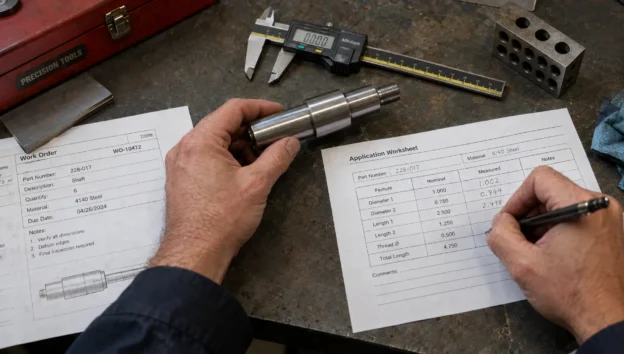
For an industrial example, consider the buying questions surrounding custom shafts and rollers from Jakom. Ask candidates how they would approach a hypothetical application guide for this type of manufacturer. A useful concept might help buyers organize requirements such as component dimensions, material, operating conditions and repair needs before an engineering discussion.
That is different from presenting a rotating product model with a contact button. The experience should help a buyer prepare a better inquiry without pretending that a website can certify suitability for a demanding application.
Listen for questions about who approves technical statements, which selections require engineering review and what information sales actually needs. An agency should also challenge unnecessary form fields rather than collecting every possible specification.
For software, use the same test with a role-specific workflow. Ask how the agency would demonstrate value without exposing customer data or promising integrations that have not been verified.
A strong discovery response produces a clear interaction outline, identifies unknowns and names the people needed to resolve them. A weak response jumps directly to visual effects or a platform license.
Demand evidence tied to sales outcomes
An interactive marketing agency should be able to explain what happened after visitors engaged, not just how many people clicked. Ask for an anonymized measurement example and a walkthrough of how the numbers were collected.
Separate three stages: experience engagement, qualified demo activity and sales progression. Completion rate can reveal usability problems, but it does not establish commercial value. Likewise, a calendar booking is not the same as an attended meeting with a suitable account.
Agree on definitions before comparing results. A qualified demo might require an account that fits your market, a relevant business need and an appropriate participant. Your sales team should help define those conditions and record rejection reasons consistently.
When reviewing a case study, ask for the measurement period, traffic sources, audience mix and any simultaneous campaign changes. A higher conversion rate may reflect better targeting rather than a better experience. Both can be valuable, but you need to understand the distinction.
For cost comparisons, use a clearly defined measure such as cost per qualified attended demo. Specify whether the numerator includes media spend, agency fees, software and allocated production costs.
Treat pipeline influence as evidence of association unless the evaluation design supports a stronger claim. Long B2B sales cycles make confident revenue promises especially questionable when an agency has only measured short-term engagement.
Audit integration, accessibility and data control
Before signing, ask the interactive marketing agency to demonstrate the path from a buyer's action to a usable sales record. A slide labeled “CRM integration” is not sufficient evidence that routing, field mapping and error handling will work.
Use a test record to check campaign attribution, qualification responses, meeting status and account matching. Confirm what happens when an existing contact returns or an integration fails. Your CRM integration requirements should shape the demo architecture, not become an afterthought after design approval.
Accessibility also belongs in evaluation. Ask candidates to show keyboard navigation, visible focus, clear form labels and an alternative to interactions that depend on dragging or precise pointer movement. The WCAG 2.2 accessibility guidelines provide a useful reference for agreeing on requirements. Automated checks alone do not demonstrate that a real buyer can complete the experience.
Clarify data ownership and handling in writing. Identify who controls analytics accounts, who can export responses and how long records remain in third-party tools. Avoid requesting confidential drawings or sensitive operating details unless there is an approved reason and a suitable handling process.
Finally, distinguish ownership from licensing. You may own the creative assets while depending on a vendor's proprietary platform to run them. Ask what remains usable if you change agencies, stop paying for a license or need to move the experience to another system.
Score an interactive marketing agency against observable evidence
Use a scorecard after discovery calls, not before you understand your requirements. The following weights are a suggested starting point, not an industry benchmark. Adjust them to reflect your sales motion and internal capabilities.
| Evaluation area | Suggested weight | Evidence to request |
|---|---|---|
| Buyer and technical discovery | 20% | A tailored interaction outline with unresolved questions |
| Qualification and sales handoff | 20% | Agreed criteria and a demonstrated routing workflow |
| Measurement quality | 15% | Event definitions, reporting examples and attribution limits |
| User experience and accessibility | 15% | A working sample tested through key buyer tasks |
| Integration and data control | 10% | Field mapping, export options and account ownership terms |
| Delivery and collaboration | 10% | Named responsibilities, review stages and change control |
| Total cost and maintainability | 10% | Itemized costs, dependencies and an exit plan |
Score each category from zero to five, with zero meaning no evidence, three meaning a documented approach and five meaning demonstrated capability. Multiply each score by its weight to compare candidates consistently.
Do not let an attractive total override a critical failure. Unacceptable data terms, unsupported technical claims or an unusable core interaction should block selection until resolved.
Treat directories and awards as sources of candidates, not proof of fit. Check whether placements are sponsored and whether a listed capability is supported by recent, relevant work.

Scope a pilot before committing to a broad rollout
A pilot should answer a specific uncertainty. For example, can a guided application experience help suitable buyers provide enough context for a productive technical consultation? Start with one audience, one use case and one next step.
Agree on acceptance criteria before production begins. These should cover both delivery quality and operational readiness:
- The selected buyer can complete the core task on supported devices and navigate it using a keyboard.
- Technical statements and calculation assumptions receive approval from the appropriate internal owner.
- Test submissions reach the correct sales destination with the required context.
- Analytics distinguish meaningful milestones from incidental clicks and exclude known test activity.
- Your team receives the agreed documentation, access and maintenance instructions.
Business performance needs a separate evaluation plan. Set a review period that reflects your traffic volume and sales cycle rather than assuming every pilot will produce enough qualified opportunities within a month.
If traffic is limited, combine observed buyer testing with sales feedback before making conversion claims. Ask representatives whether the new information improves preparation and whether visitors understand the experience's limitations.
The interactive marketing agency should explain what evidence would justify expansion, revision or cancellation. That decision rule protects both sides from extending an engagement simply because the initial build looks finished. It also makes a smaller, well-tested experience more valuable than an ambitious rollout with no reliable feedback.
Compare total cost and the working relationship
Request a cost breakdown that separates discovery, design, development, content, integration, software, testing and ongoing support. Media spend should be identified separately so you can distinguish the cost of attracting visitors from the cost of building the experience.
Ask which changes your team can make independently. Updating a product specification, adjusting qualification rules and fixing a broken integration may involve different skills and different charges. A lower initial quote can become expensive if every routine change requires custom development.
Your interactive marketing agency should also identify who does the work. Establish whether developers, writers and accessibility testers are employees, subcontractors or technology partners. Outsourcing is not automatically a problem, but accountability should remain clear.
On your side, name the product or engineering approver, sales owner, marketing lead and CRM administrator. Agree on review deadlines and a process for resolving conflicting feedback. Otherwise, technical approval can become the bottleneck regardless of agency quality.
Match the engagement to your resources. A smaller team may benefit from one maintainable experience with straightforward reporting. A company serving several industries may need a reusable framework, but should still validate one use case first.
Before signing, resolve ownership, license renewal, support coverage, change requests and termination assistance. Compare proposals over the same operating period rather than comparing one agency's launch fee with another's full-year estimate.
Frequently asked questions
Is an interactive demo the same as a recorded product video? No. A video usually follows a fixed sequence. An interactive demo lets buyers make choices that affect what they see or receive. Either can be useful, and a short video may be the better option when buyer participation adds little value.
Should we require experience in our exact industry? Relevant industry experience can shorten discovery, especially for technical products. Still, test whether the team can understand your buying process and validate claims. A similar sales motion may be more useful than a familiar client logo without comparable work.
Do we need to replace our website first? Not necessarily. A focused experience may work within your existing site if performance, accessibility and integration requirements can be met. Ask candidates to demonstrate the constraint before accepting a full redesign as a prerequisite.
Should every interaction require an email address? No. Gate information when the exchange is worthwhile and clearly explained. Buyers may need to explore basic fit before they are ready to identify themselves. Test where a form helps qualification and where it merely interrupts evaluation.
Bring a concrete demo brief to the first conversation
Choose an interactive marketing agency that can show how buyer participation improves evaluation and sales readiness. Bring one use case, a qualification definition, your current systems and a named internal owner. Ask for a proposed approach and its limits before discussing a larger rollout.
If your demo strategy also needs search visibility, paid acquisition or supporting web content, discuss those requirements with B2B Inbound Marketing. Clarify which responsibilities belong to your marketing partner, your technical team and any specialist demo provider before committing to the work.