



A buyer requests a quote through your website, receives a generic nurture email the next morning and gets calls from two sales representatives that afternoon. Omnichannel campaign management should prevent that collision. Its job is to connect buyer context, campaign activity and sales ownership so each interaction reflects what already happened.
For B2B and industrial businesses, the challenge is not simply connecting more channels. It is coordinating inside sales, territory representatives, account managers and marketing around the same buying process. Start with one bounded campaign, define the handoffs and expand only after the workflow holds up in practice.
1. Define the sales outcome and pilot boundaries
An omnichannel approach carries relevant context between channels. A multichannel campaign might run search ads, email and sales outreach independently. An integrated campaign changes the next action when a buyer responds, requests technical information or enters an active opportunity.
Choose a sales outcome before choosing automation. “Generate more engagement” does not tell representatives what to do. “Increase accepted discovery meetings among maintenance managers at target manufacturing accounts” provides a clearer operating goal.
Your pilot should identify one audience, one offer, the participating sales teams and an explicit stopping point. For example, a regional equipment supplier might promote a maintenance assessment to existing target accounts, using paid search, a focused landing page and sales follow-up.
Write down what makes a response sales-ready. A technical download alone may not justify a call. A request that includes an application, location and purchase timeframe deserves a different response.
The first deliverable for omnichannel campaign management is a shared campaign brief, not a software purchase. Include the qualification rule, success measure and exclusions so marketing and sales work toward the same result. Both teams should approve that brief before anyone builds audiences or launches outreach.
2. Assign ownership across sales teams
Campaign coordination breaks down when several people can contact an account but nobody owns the next step. Separate overall campaign accountability from individual account ownership.
The campaign owner coordinates launch decisions. The account owner controls the active commercial relationship. Revenue operations maintains routing and data rules. Those responsibilities can sit with the same person in a small business, but they should still be explicit.
| Responsibility | Suggested accountable role | Decision to document |
|---|---|---|
| Campaign scope and launch | Marketing campaign owner | Audience, offer and launch approval |
| Account assignment | Sales manager | Territory, named-account and partner rules |
| CRM fields and routing | Revenue operations or CRM administrator | Matching, assignment and exception handling |
| Buyer follow-up | Assigned sales representative | Next action, response status and disposition |
| Cross-team disputes | Named sales leader | Final ownership decision and escalation path |
Resolve overlapping coverage before launch. If a prospect belongs to a named account, that ownership might take precedence over geography. If a distributor manages the relationship, direct outreach may need approval. Choose rules that reflect your commercial agreements rather than assuming one hierarchy fits every business.
In omnichannel campaign management, ownership must survive a channel change. A LinkedIn response should not send an existing account into an unrelated sales queue.
Add a backup owner for absences and a visible exception queue for unmatched records. Otherwise, a technically successful integration can still leave buyers waiting.
3. Select channels around the buyer’s next task
Do not launch every available channel at once. Start with the smallest combination that helps buyers discover, evaluate and discuss the offer.
For an industrial campaign, search may capture an active application need, a landing page may explain compatibility and email may deliver requested documentation. A representative can then address suitability, installation constraints or procurement requirements. Each channel has a job beyond repeating the same message.
Prioritize channels using evidence from recent opportunities. Review where qualified buyers arrived, what information they requested and which activities your team can maintain. A channel with strong buyer relevance but no available follow-up capacity is not ready for the pilot.
Product requirements should travel with the conversation. For a hypothetical lighting-sales workflow, consider products such as the customizable pendant lights and chandeliers at BUYnBLUE. A buyer’s cable-length or color requirements should accompany an inquiry into the next conversation rather than requiring the buyer to repeat them. An industrial supplier can apply the same principle to voltage, materials or operating conditions.
Effective omnichannel campaign management preserves those useful details without forcing identical content everywhere. An engineer may need specifications while procurement needs lead times. Both should receive compatible answers from the same account context.
Avoid adding a channel until you can explain its purpose, its owner and the event that should move the buyer onward.
4. Establish a minimum CRM data contract
Your CRM needs a reliable operational record, not a copy of every click. Define the fields required to identify the buyer, assign responsibility and decide the next action.
A practical minimum includes:
- Identity and account: Contact identifier, company, account identifier and business email where available.
- Ownership: Assigned representative, territory or named-account status and backup queue.
- Campaign context: Campaign identifier, source, offer and latest meaningful response timestamp.
- Commercial status: Qualification outcome, open opportunity and agreed next action.
- Communication controls: Subscription status, applicable permission records and channel-specific restrictions.
Document which system controls each field and what happens when values conflict. For example, a form submission should not automatically overwrite an account owner assigned under a named-account agreement.
If your current tools cannot support these rules reliably, evaluate how an omnichannel platform fits your CRM before adding more integrations.
Make privacy rules operational
Omnichannel campaign management does not require every employee to access every interaction. Give teams the information needed for their work and restrict sensitive or unnecessary data.
Keep anonymous website activity separate from identified contact records unless you have a reliable, lawful basis for connecting them. A guessed identity can create inappropriate personalization and incorrect sales assignments.
Communication requirements vary by jurisdiction and channel. For US commercial email, the FTC’s CAN-SPAM guidance explains identification and opt-out obligations, including for B2B messages. Have the appropriate legal or privacy owner review your workflow rather than assuming one consent rule covers every market.
5. Turn omnichannel campaign management into routing rules
Build the workflow around buyer events rather than a fixed calendar alone. A scheduled email sequence should change when a person books a meeting, requests a quote or declines further contact.
For each meaningful event, document the trigger, eligibility conditions, owner, required action and exit condition. “Send to sales” is incomplete unless the receiving person knows why the record arrived and what response is expected.
Consider a quote-request workflow. The system checks for an existing contact and account, applies ownership rules and assigns the request. The representative receives the requested product, application details and relevant campaign context. Generic prospecting pauses while the request is being handled.
Agree on a service-level target that matches staffing. As an illustrative pilot rule, a team might require assignment within one business hour and a first human response within four business hours. These are examples, not universal benchmarks. Define working hours, time zones and holiday coverage before promising a response time.
Add rejection and recovery paths
Sales should be able to accept, return or disqualify a handoff using specific reasons. “Not qualified” is too vague to improve the campaign. “Outside service territory” or “Student research request” supports a concrete correction.
If nobody accepts the request within the agreed window, escalate it to the backup queue. If an integration fails, retain the event for review and prevent retries from creating duplicate tasks.
Suppression also needs precision. An open opportunity may justify pausing generic acquisition messages, but it should not block requested technical material or necessary service communication.
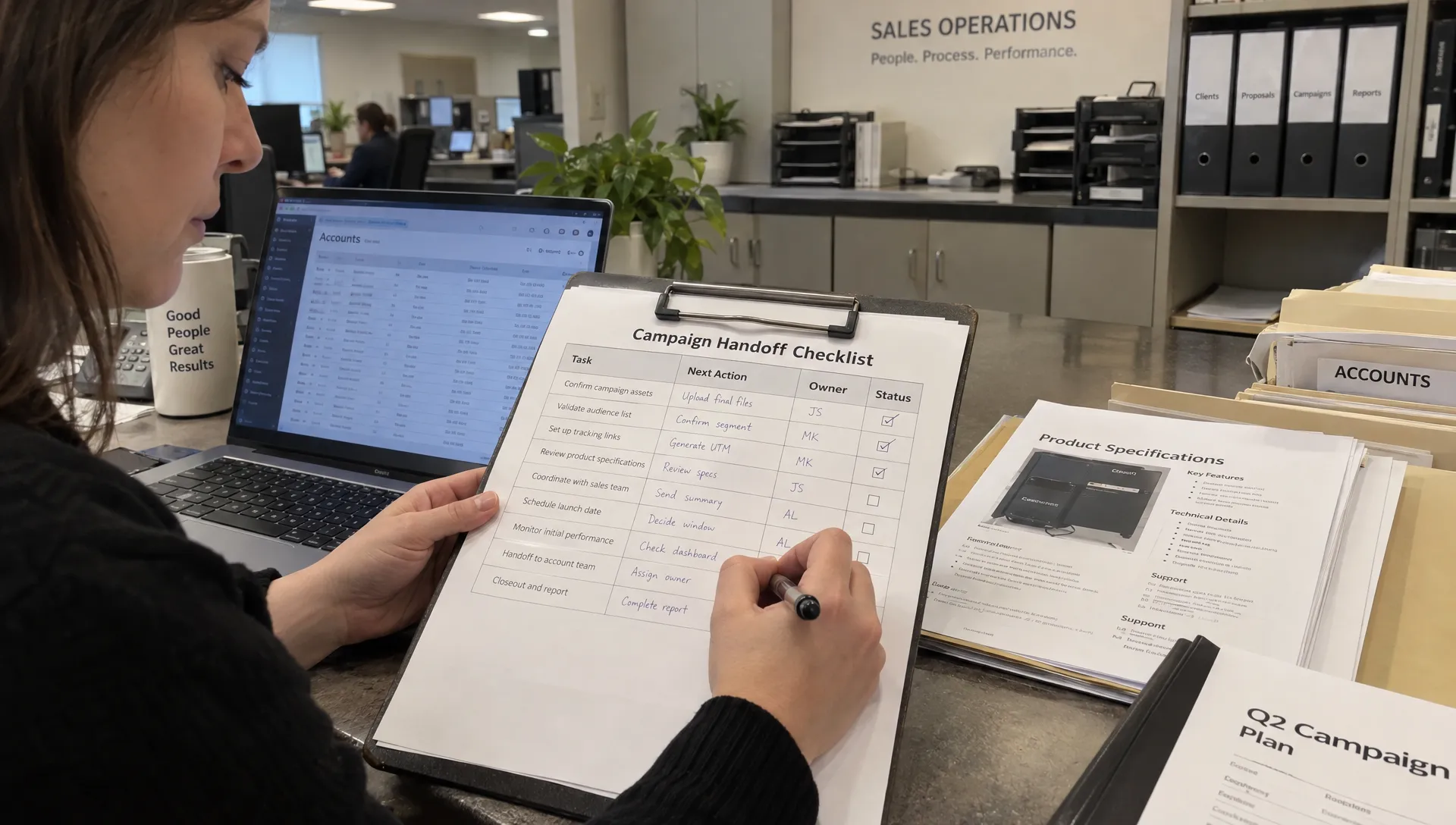
6. Rehearse complete buyer journeys before launch
Testing whether a form submits is not enough. Rehearse what happens afterward across every participating sales team.
Use test records representing a new prospect, an existing customer, an account with an open opportunity and a contact with a communication restriction. Include a record with incomplete company information and another that matches more than one possible account.
Follow each record from its first response through assignment, sales acceptance and the next communication. Confirm that the representative can see the context needed to act. Then check that the buyer does not receive conflicting follow-ups.
The acceptance test for omnichannel campaign management is continuity: does the next person or system respond appropriately to what already happened?
Pay particular attention to events arriving out of order. A meeting booking may reach the CRM before an earlier webinar attendance record. The older event should not restart prospecting or move the contact backward.
Have representatives review the workflow using realistic scenarios, not just screenshots of successful automation. Ask them to find the buyer’s request, identify the next action and return an incorrectly assigned record. If those tasks require workarounds, fix them before launch.
Keep a short failure log with an owner and retest date for each issue. Launch only when critical routing, permission and suppression checks pass.
7. Test whether coordination improves sales outcomes
A campaign can generate more recorded activity without improving the buying experience. Separate operational reliability from commercial impact.
Operational measures include assignment time, acceptance rate, duplicate outreach and overdue follow-up. Commercial measures include qualified meetings, accepted opportunities and progression to the next buying stage. Use definitions agreed upon before launch so teams cannot quietly change what counts as success.
To evaluate omnichannel campaign management, compare the coordinated workflow with a credible alternative. Where feasible, randomly assign comparable accounts to the integrated approach or your existing process. Keep the offer, eligibility criteria and observation period consistent.
Use account-level assignment when several contacts participate in one purchase. Splitting people from the same account across test groups can mix the experiences and weaken the comparison. Keep representatives’ instructions clear enough to avoid accidental crossover.
A small pilot may not establish a reliable revenue effect, especially with long industrial sales cycles. It can still reveal whether assignments are faster, conversations are better qualified and duplicate contact is declining. Report those findings without claiming they prove revenue lift.
For a broader reporting framework, use this guide to measuring omnichannel marketing success. During implementation, keep the review focused on a few decisions: fix a handoff, change a qualification rule or continue the test. Attribution reports alone cannot establish that integration caused an improvement.
8. Use a staged launch instead of a company-wide rollout
A bounded launch makes ownership problems easier to diagnose. Start with one segment and a manageable group of representatives, then add territories or channels after the process works consistently.
The schedule below is an illustrative four-week setup plan. Complex CRM environments, procurement requirements or privacy reviews may require more time.
| Period | Main work | Exit requirement |
|---|---|---|
| Week 1 | Agree on audience, outcome, ownership and qualification | Approved campaign brief and named owners |
| Week 2 | Configure fields, routing, permissions and suppression | Documented rules and working test connections |
| Week 3 | Rehearse journeys and train participating representatives | Critical test cases pass |
| Week 4 | Launch to the pilot audience and review exceptions | Reliable handoffs and a decision on next steps |
Treat omnichannel campaign management as an operating process after launch, not a completed integration project. During the pilot, review unassigned records, delayed responses and conflicting communications frequently enough to correct problems before they accumulate.
Expand only when the current workflow is stable. Adding another territory should include an ownership review; adding another channel should include permission, suppression and failure-recovery tests. Keep versioned documentation so everyone can identify which rules are currently in effect.
Frequently asked questions
How is this different from running several marketing channels? Multiple channels can operate independently. An omnichannel approach connects relevant context and changes subsequent actions. For example, a booked sales meeting should alter follow-up messaging rather than leaving the buyer in an unchanged prospecting sequence.
Who should own the process across sales teams? Name one campaign owner and a sales leader who can resolve account conflicts. Marketing can coordinate execution, but territory rules, account ownership and follow-up commitments require sales approval. A CRM administrator or revenue operations owner should maintain the underlying rules.
Do we need a new platform to get started? Not necessarily. Omnichannel campaign management can begin with your existing CRM, a small set of connected channels and clear responsibilities. Consider new software when a documented requirement cannot be handled reliably, not simply because another platform offers more features.
What should we automate first? Start with deterministic tasks such as ownership checks, assignment notifications, duplicate prevention and suppression after a meeting booking. Keep ambiguous qualification and sensitive commercial decisions under human review until the rules are proven.
Start with one campaign your sales team can support
Before expanding your channel mix, select one offer and agree on who owns each buyer response. Document the handoffs, rehearse exceptions and review the first results together.
If you need help connecting SEO, PPC and inbound campaign planning to your sales priorities, discuss your goals with Andy Alagappan. Begin with the workflow your team needs, then decide which channels and tools belong in it.