

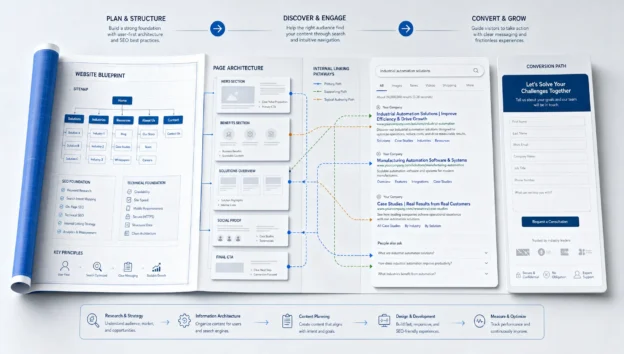
Your website can be beautiful and still invisible. It can also rank for the right terms and still fail to generate a single qualified inquiry. That is why web design and search engine optimisation must align from the first strategy conversation, especially for B2B and industrial companies where a website often supports long sales cycles, technical evaluation, and high-value purchasing decisions.
Too often, design and SEO are treated as separate steps. A designer creates the look and experience, then an SEO specialist is asked to “optimize” the finished site. By then, the most important decisions have already been made: navigation, page structure, URL paths, copy space, internal linking, mobile behavior, and conversion flow. If those decisions ignore search behavior and buyer intent, the site may look modern but struggle to get found.
The better approach is to build for visibility, usability, and lead generation at the same time.
What alignment really means
Aligning web design and SEO does not mean sacrificing visual quality for keyword placement. It means creating a website where every major design decision supports both the visitor and the search engine.
A well-aligned site should answer four questions clearly:
- Can search engines crawl, understand, and index the most important pages?
- Can visitors quickly find the information they came for?
- Does the content match the intent behind the search query?
- Does the page make the next step obvious, whether that is requesting a quote, downloading a spec sheet, calling sales, or reviewing capabilities?
For B2B and industrial websites, this is not just a marketing preference. Buyers may search for a capability, certification, material, application, part type, location, or vendor comparison. If your site architecture and content do not reflect those real search patterns, even a polished website can miss valuable opportunities.
If you are planning a new site or a redesign, it helps to understand why web design and SEO should be planned together before wireframes, copy, and development choices become difficult to change.
Why separating design and SEO creates problems
When SEO is added late, the result is usually a compromise. The SEO team has to work around design choices that were never built for search visibility. The design team may have prioritized style, animation, or minimal copy without understanding how buyers search. The development team may have built templates that look good but limit crawlability, speed, or content depth.
Weak site architecture hides important services
Search engines rely on clear structure. So do users. If your highest-value services are buried three or four clicks deep, grouped under vague navigation labels, or combined into one broad “Solutions” page, both Google and human visitors may have trouble understanding what you actually offer.
Industrial buyers are often specific. They are not just looking for “manufacturing services.” They may search for CNC machining for aerospace parts, custom metal fabrication in Houston, industrial pump repair, or B2B chemical blending services. A generic structure can prevent those pages from earning visibility.
Thin content fails to satisfy technical buyers
Minimalist design can be effective, but it becomes a problem when pages do not provide enough useful information. A B2B buyer may need details about applications, industries served, tolerances, materials, compliance, lead times, service areas, or engineering support. Search engines also need enough context to understand the relevance of the page.
A page with a large hero image, a short paragraph, and a contact form may look clean, but it often lacks the substance needed to rank or convert.
Slow pages reduce both rankings and trust
Performance is where design, development, and SEO overlap heavily. Oversized images, unnecessary scripts, heavy animations, and unoptimized third-party tools can slow a page down. Visitors may leave before the page finishes loading, and search engines may treat poor performance as a quality signal.
This matters even more on mobile. Many B2B searches begin on phones, even if the final inquiry happens later from a desktop. If the mobile version is frustrating, your business may lose the prospect before sales ever knows they existed.
Poor conversion flow wastes qualified traffic
SEO can bring the right visitors, but design determines what happens next. If calls to action are vague, forms are hard to use, trust signals are hidden, or technical resources are difficult to find, qualified traffic will not turn into leads.
A strong website needs both discoverability and persuasion. This is why SEO and web design services drive better conversions when they are planned as one system rather than two separate deliverables.
Design decisions that affect SEO performance
Many SEO issues begin as design or development decisions. The table below shows common examples.
| Design or development decision | SEO impact | Better approach |
|---|---|---|
| Vague navigation labels | Search engines and users struggle to identify core services | Use descriptive labels based on real buyer intent |
| Image-heavy pages with little text | Pages lack context and relevance | Balance visuals with useful, specific copy |
| Large uncompressed media | Slower load times and weaker user experience | Compress images and use modern formats where appropriate |
| JavaScript-dependent content | Important content may be harder to crawl | Ensure key content is accessible in the page HTML |
| Removing old URLs during a redesign | Loss of rankings, links, and referral traffic | Map redirects before launch |
| Generic calls to action | Lower lead conversion rates | Match CTAs to the buyer’s stage and intent |
The lesson is simple: SEO is not only about keywords, and design is not only about appearance. Both shape how a website performs in the real world.
The key places where design and SEO must work together
Search intent should shape the site structure
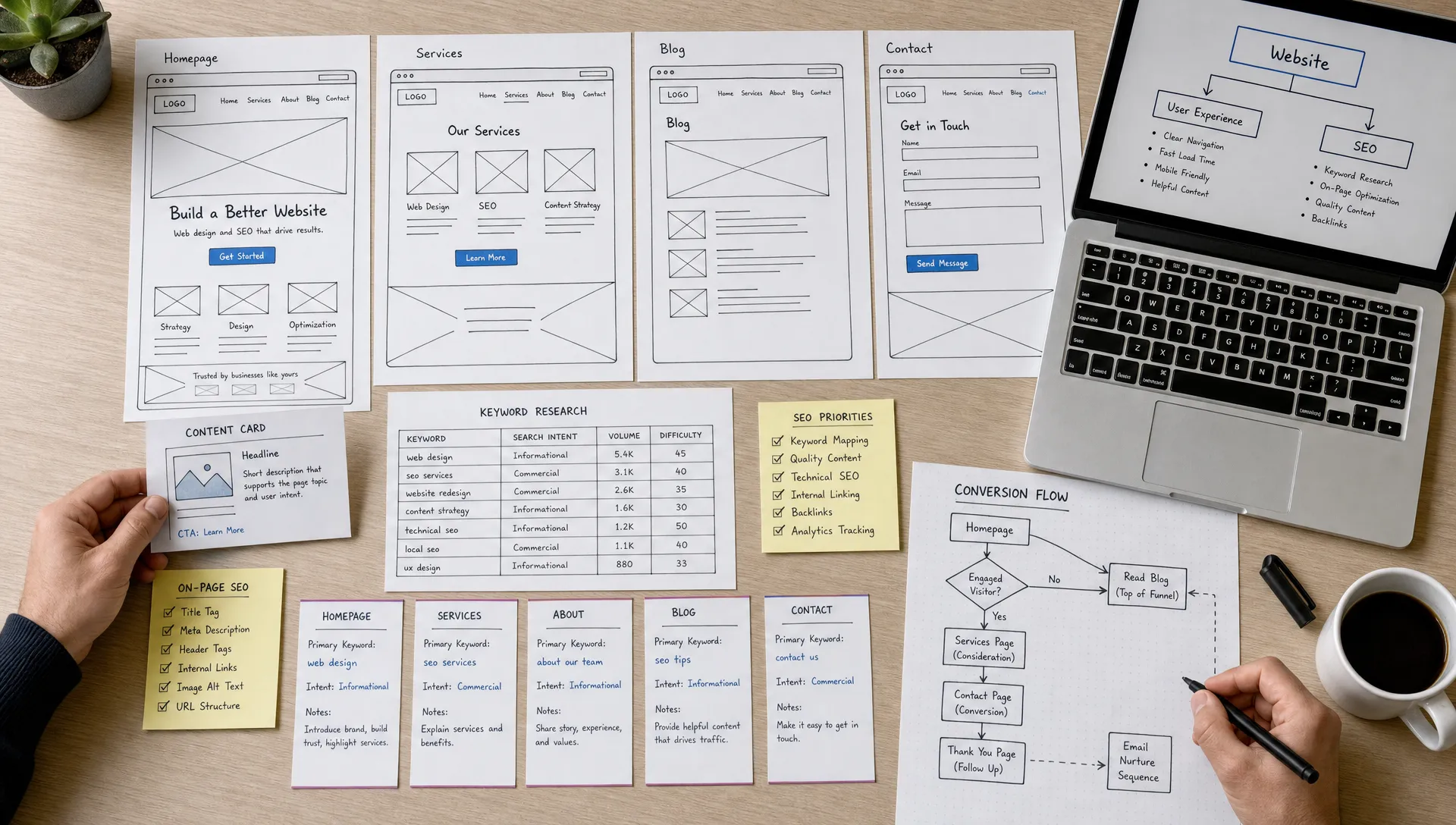
Before a designer builds the navigation, the team should understand how prospects search. That means reviewing keyword themes, buyer questions, competitor pages, service priorities, and sales conversations.
For example, a manufacturer may need separate pages for industries served, capabilities, materials, and geographic markets. A software company may need pages for use cases, integrations, and comparison searches. A distributor may need category pages that reflect how buyers identify products, not just how the company organizes inventory internally.
Good information architecture turns search demand into a clear website structure. It also helps visitors self-select the path that fits their problem.
Page templates should allow useful content
Design systems often rely on reusable templates. That is good for consistency, but templates need enough flexibility for SEO-rich content. A service page may need sections for applications, benefits, technical specifications, FAQs, case examples, and conversion prompts. A product category page may need filters, comparison guidance, and supporting copy.
This principle applies across industries. An ecommerce brand selling custom cushions for indoor and outdoor spaces needs pages that help buyers understand options such as size, fabric, use case, and customization. A B2B industrial company has a similar challenge, even if the product is more technical: the page must organize complexity in a way that helps search engines and buyers understand the offer.
A beautiful template that leaves no room for explanation can limit organic growth. A flexible template that supports scannable, useful content gives both SEO and sales a stronger foundation.
Visual hierarchy should support decision-making
Visitors scan before they read. Strong design guides their attention to the most important information: what you offer, who it is for, why it is credible, and what to do next.
For SEO-driven pages, the visual hierarchy should make the content easy to consume. Headings should be descriptive. Sections should be clearly separated. Important details should not be hidden inside tabs that are difficult to access or elements that do not work well on mobile. Calls to action should appear at natural decision points, not only at the top or bottom of the page.
For industrial buyers, trust-building elements can be especially important. Certifications, industry experience, equipment lists, safety standards, technical documentation, and customer proof can help a visitor move from research to inquiry.
Technical performance should be designed in from the beginning
Performance is easier to protect during design than to fix after launch. A site can be visually strong without being bloated. That requires practical decisions about image sizes, font loading, scripts, hosting, caching, and mobile layouts.
Designers, developers, and SEO strategists should discuss performance before the site is built. For example, a full-width video background may look impressive, but it might not be the best choice for a service page that needs to load quickly and communicate technical value. A lighter visual treatment may deliver a better experience and better business outcome.
Content and CTAs should match the buyer journey
Not every visitor is ready to request a quote. Some are still learning, comparing options, or gathering requirements. Web design and SEO should create paths for different stages of intent.
A top-of-funnel visitor may need educational content. A mid-funnel visitor may want comparison pages, application guides, or FAQs. A bottom-of-funnel visitor may need a quote form, phone number, service area confirmation, or downloadable technical information.
When the design supports these paths, SEO traffic becomes more valuable. The website is no longer just attracting visitors. It is helping them move forward.
A practical workflow for aligning teams
The best results happen when SEO, design, content, and development collaborate early. A simple workflow can prevent many expensive problems.
| Project stage | SEO responsibility | Design responsibility | Shared goal |
|---|---|---|---|
| Discovery | Identify search demand, priority pages, and technical risks | Understand user needs, brand requirements, and conversion goals | Define what the site must accomplish |
| Architecture | Recommend page hierarchy, URL structure, and internal linking | Create intuitive navigation and page flows | Make the site easy to crawl and easy to use |
| Content planning | Map keywords, search intent, and on-page requirements | Plan layouts that support clear messaging | Build pages that are useful and persuasive |
| Development | Check crawlability, metadata, schema needs, redirects, and speed | Preserve design quality across devices | Launch a fast, indexable, conversion-ready site |
| Post-launch | Monitor rankings, traffic, indexing, and conversions | Refine UX based on behavior data | Improve performance continuously |
This workflow is especially important during redesigns. A redesign can improve a brand, but it can also damage organic visibility if URL changes, content removals, and redirects are handled carelessly.
Why alignment matters more for B2B and industrial companies
In B2B and industrial markets, a website is rarely just a brochure. It is often the first qualification step in a complex buying process. Engineers, operations managers, procurement teams, executives, and plant managers may all interact with the site for different reasons.
One visitor may search for a technical capability. Another may check whether you serve their industry. Another may look for proof that your company can handle a high-value project. If the website is designed only for visual presentation, it may not answer these questions. If it is built only for SEO traffic, it may not create enough trust to generate an inquiry.
The strongest B2B websites connect search intent to business value. They turn keyword research into pages that solve real buyer problems. They use design to make complex information understandable. They use technical SEO to protect visibility. They use conversion strategy to turn the right visits into the right leads.
That is also why search engine optimization services drive B2B leads most effectively when they are connected to the full website experience, not isolated as a traffic tactic.
Warning signs your design and SEO are out of sync
If your website is underperforming, the issue may not be traffic alone. Look for these signs:
- Your site looks modern, but organic traffic has declined since launch.
- Important services are grouped together on one broad page instead of having dedicated pages.
- Visitors reach the site but rarely submit forms or call.
- Mobile pages look attractive but load slowly or hide key content.
- Blog posts get traffic, but service pages do not generate inquiries.
- The design relies heavily on images, sliders, or animations while offering little crawlable text.
- Your team cannot clearly connect each major page to a search intent and business goal.
These problems are fixable, but they are easier to prevent when strategy comes first.
Metrics that show whether alignment is working
Once design and SEO are aligned, measurement should go beyond rankings. Rankings matter, but they are only one part of performance.
| Metric | What it reveals |
|---|---|
| Organic traffic to priority pages | Whether the right pages are gaining visibility |
| Qualified leads from organic search | Whether traffic is converting into business opportunities |
| Engagement by page type | Whether visitors find the content useful |
| Mobile performance | Whether the experience works for real users across devices |
| Index coverage | Whether search engines can access important pages |
| Conversion rate by landing page | Whether design and messaging support action |
The goal is not to chase every metric. The goal is to connect visibility, usability, and lead quality. A page that ranks but does not convert needs UX and messaging work. A page that converts well but gets little traffic may need stronger SEO. A page that gets traffic and leads is a model for future improvements.
Frequently Asked Questions
What does it mean to align web design and search engine optimisation? It means planning site structure, content, technical performance, user experience, and conversion paths together so the website can be found in search and persuade the right visitors to take action.
Should SEO be done before or after web design? SEO should begin before design. Keyword research, search intent, site architecture, URL planning, and content requirements should inform the design process rather than being added after launch.
Can a visually attractive website still perform poorly in search? Yes. A site can look excellent but struggle if it has weak content, slow load times, poor mobile usability, confusing navigation, missing metadata, or pages that do not match how buyers search.
How does web design affect B2B lead generation? Web design affects how quickly visitors understand your offer, find proof of credibility, access technical information, and take the next step. When design supports SEO intent, traffic is more likely to become qualified leads.
What should be checked before launching a redesigned website? Key checks include URL mapping, redirects, metadata, mobile performance, page speed, indexability, internal links, analytics tracking, form functionality, and whether important old content has been preserved or improved.
Bring SEO and design together before your next launch
If your website is due for a redesign, do not treat SEO as a final checklist item. Bring search strategy, content planning, design, and development into the same conversation from the beginning.
For B2B and industrial companies, that alignment can be the difference between a site that simply looks updated and a site that consistently supports visibility, trust, and lead generation. The best websites are not just designed well or optimized well. They are built as complete marketing assets, with every page serving both the buyer and the business.