Tag Archives: SEO

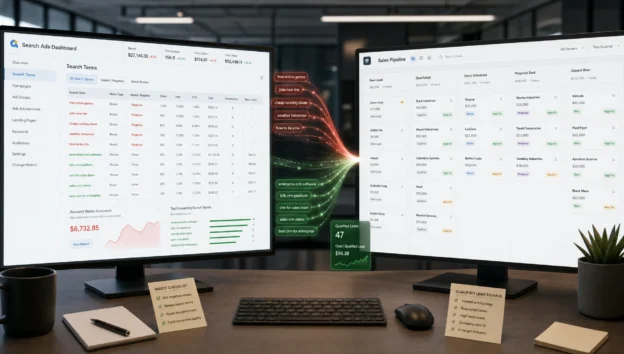
How to Fix a Pay Per Click Campaign That Wastes Budget - Main Image

How to Fix a Pay Per Click Campaign That Wastes Budget

A pay per click campaign can look healthy on the surface while quietly draining budget underneath. Clicks are coming in. Impressions are growing. The ads seem active. Yet the sales team is not seeing better conversations, the form submissions are weak, and the cost per qualified lead keeps climbing.

For B2B and industrial companies, this problem is especially expensive because one poor click can cost far more than it would in a consumer campaign. If your buyers are engineers, procurement managers, plant operators, distributors, or technical decision-makers, you cannot afford broad traffic that never had buying intent.

The fix is not always to spend less. The fix is to make the account more accountable. A budget-wasting PPC campaign usually has leaks in tracking, keyword intent, match types, bid strategy, landing pages, or lead qualification. Here is how to find those leaks and correct them before you increase spend.

Start by defining what “wasted budget” really means

A campaign is not wasting money simply because the cost per click is high. In many B2B markets, expensive clicks can be profitable if they generate qualified opportunities with strong lifetime value.

Budget waste happens when spend does not move the business closer to revenue. That can show up as:

  • High clicks with few conversions
  • Many form fills but poor lead quality
  • Calls from consumers instead of businesses
  • Traffic from the wrong cities, states, or countries
  • Search terms that are informational, not commercial
  • Strong conversion numbers in Google Ads but weak CRM pipeline
  • Landing page visits that bounce because the offer does not match the ad

Before making changes, separate “expensive but valuable” from “cheap but useless.” A $40 click from a procurement manager looking for a custom industrial supplier may be better than 100 low-cost clicks from students, job seekers, or DIY researchers.

Fix tracking before you fix bidding

If conversion tracking is wrong, every optimization decision becomes suspect. Automated bidding may chase bad signals. Manual bid changes may reward the wrong keywords. Reports may show growth while sales sees no improvement.

Google Ads describes conversion tracking as the way to understand what happens after someone interacts with your ad, such as purchases, calls, form submissions, or other valuable actions. For B2B campaigns, the key word is “valuable.” Not every form submission deserves the same weight.

At minimum, verify these items:

  • Conversion actions: Track quote requests, contact forms, phone calls, demo requests, and other actions tied to sales potential.
  • Duplicate conversions: Make sure thank-you page reloads or repeated button clicks are not inflating results.
  • Phone calls: Track calls from ads and calls from landing pages, especially if your buyers prefer to speak with someone before requesting pricing.
  • CRM alignment: Compare Google Ads conversions with actual leads, sales-qualified leads, opportunities, and closed deals.
  • Lead source visibility: Make sure the sales team can identify which campaign, keyword, or landing page produced a lead.

If your account is optimizing for newsletter signups, accidental button clicks, or low-intent downloads, the campaign may look better as it gets worse. Clean tracking is the foundation for every other PPC repair.

Audit search terms, not just keywords

Keywords are what you target. Search terms are what people actually typed before clicking your ad. That difference is where a large amount of PPC waste hides.

The Google Ads search terms report helps advertisers see which searches triggered ads. In a budget audit, this report is often more revealing than the keyword list itself.

For example, an industrial services company bidding on “pump repair” may discover searches such as “pool pump repair,” “washing machine pump repair,” or “DIY pump repair video.” The keyword looked relevant, but the actual queries were not aligned with the buyer.

Review search terms for these patterns:

  • Consumer searches when you serve businesses
  • Job-related searches such as “careers,” “salary,” or “training”
  • Research terms such as “definition,” “how does it work,” or “diagram”
  • Competitor terms that cost too much without producing qualified leads
  • Location mismatches outside your service area
  • Product categories you do not sell or support

Then build a disciplined negative keyword list. Negative keywords are not a one-time cleanup. They should be reviewed regularly, especially after launching new campaigns, changing match types, expanding locations, or increasing budget.

Rebuild keyword intent around the buyer journey

A pay per click campaign wastes budget when all keywords are treated as equal. Someone searching “what is industrial automation” is in a very different stage than someone searching “industrial automation integrator Houston quote.” Both may be relevant to your market, but only one is likely ready to speak with sales now.

A practical PPC structure separates intent levels so budgets and bids can match the value of each search.

Intent level Example search pattern Budget priority Best offer
High commercial intent “industrial pump repair Houston” or “custom metal fabrication quote” Highest Quote request, consultation, phone call
Comparison intent “best valve suppliers for chemical plants” Medium Capability page, buyer guide, consultation
Research intent “how does a centrifugal pump work” Low or SEO-focused Educational content, newsletter, retargeting
Wrong intent “pump repair jobs” or “DIY pump repair” Exclude Negative keyword

This is also where PPC and SEO should work together instead of competing. PPC is often best for high-intent, time-sensitive searches where you want visibility now. SEO can support informational and comparison searches that build trust earlier in the buying process. If you are deciding how both channels should work together, the article on the benefits of SEO and PPC campaigns provides useful context.

Tighten match types and campaign structure

Broad match can be useful in mature accounts with strong conversion data, but it can also create waste if the account lacks clean tracking and a strong negative keyword strategy. If your budget is leaking, review match types carefully.

Exact match and phrase match usually give you more control while you diagnose quality problems. Broad match should be tested with caution, especially in technical B2B markets where a single word can apply to several unrelated industries.

Campaign structure matters too. If your account has one campaign targeting multiple services, multiple buyer types, and multiple locations, budget control becomes difficult. Separate campaigns or ad groups by meaningful business categories, such as service line, geography, margin, or buyer intent.

A cleaner structure helps answer important questions:

Which service produces the best cost per qualified lead? Which region is wasting spend? Which keywords produce calls instead of form fills? Which campaigns influence real opportunities in the CRM?

If the structure cannot answer those questions, it is too broad.

Repair the landing page experience

Many PPC problems are blamed on keywords when the real issue is the landing page. If the ad promises “industrial equipment repair in Houston” but the landing page sends visitors to a generic homepage, the buyer has to work too hard.

A strong PPC landing page should continue the conversation started by the search and the ad. It should immediately answer three questions: Am I in the right place? Can this company solve my problem? What should I do next?

For B2B and industrial campaigns, landing pages should include clear service descriptions, relevant industries served, proof of capability, service area details, and a simple conversion path. Forms should be easy to complete, but not so vague that they produce unqualified leads. If you are seeing traffic but not inquiries, it may be worth reviewing whether your website is losing leads because of weak calls-to-action, confusing pages, or too much friction.
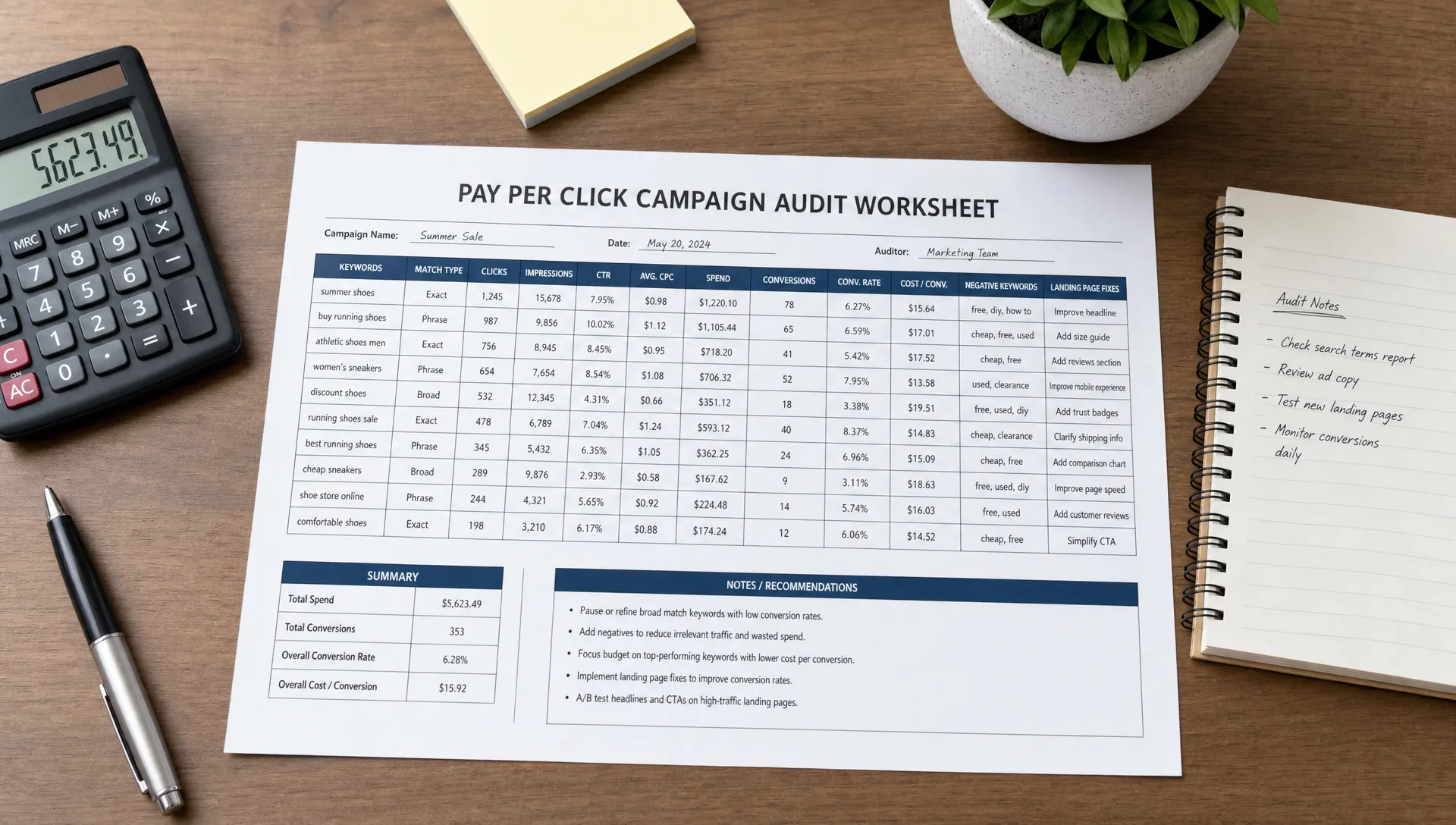
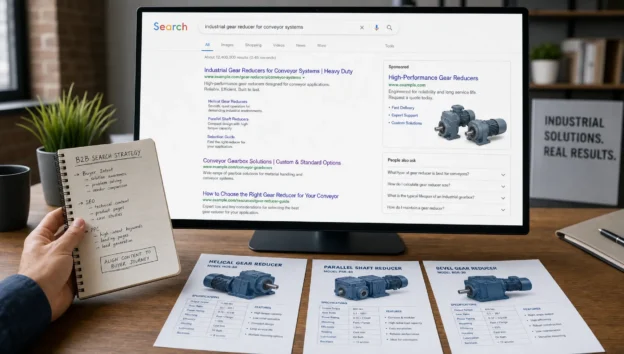
A pay per click campaign audit worksheet spread across a desk with columns for keywords, spend, conversions, negative keywords, and landing page fixes, next to a calculator and notebook.

Adjust bids and budgets based on quality, not activity

Clicks are activity. Leads are better. Qualified opportunities are better still. A budget-wasting PPC campaign often overfunds activity and underfunds quality.

Start by segmenting performance instead of making broad changes. Look at device, location, time of day, audience, campaign, ad group, keyword, and search term performance. A campaign that looks unprofitable overall may contain a few high-performing pockets worth protecting.

Common budget fixes include reducing bids on weak segments, excluding poor-performing locations, pausing keywords with spend and no qualified leads, and reallocating budget to campaigns with stronger sales outcomes. Be careful with sudden drastic changes if the account uses automated bidding, since major edits can disrupt learning and make performance harder to interpret.

A good budget decision answers this question: “If we spend another dollar here, what type of lead or opportunity are we most likely to get?”

Improve ad copy so it filters the wrong clicks

Ad copy is not only for attracting clicks. It should also repel the wrong clicks.

This is especially important when your market has overlap between consumer and B2B searches. If you only write generic copy such as “fast service” or “affordable solutions,” you may attract people who are not a fit. More specific copy can reduce wasted spend by making the offer clearer before someone clicks.

Use ad language that qualifies the buyer:

  • Mention B2B, industrial, commercial, or enterprise when relevant
  • Include service areas if geography matters
  • Reference the specific equipment, process, or application you support
  • Use “request a quote,” “speak with an engineer,” or “schedule a consultation” when those actions match the sales process
  • Clarify what you do not offer if irrelevant traffic is a recurring problem

The goal is not always the highest click-through rate. The goal is the highest rate of qualified clicks that can become real pipeline.

Look beyond cost per lead

Cost per lead is useful, but it can be misleading. A campaign that produces $80 leads may be worse than a campaign that produces $300 leads if the cheaper leads never become opportunities.

For B2B PPC, measure the campaign across the full path from search to revenue. That does not mean every metric needs to be perfect. It means the account should be judged by business outcomes, not just ad platform activity.

Metric What it tells you Why it matters
Click-through rate Whether ads match search interest Useful for relevance, but not proof of lead quality
Conversion rate Whether visitors take action Helps evaluate landing pages and offers
Cost per conversion What each tracked action costs Helpful only if conversions are meaningful
Qualified lead rate How many leads fit your sales criteria Shows whether targeting is attracting the right people
Cost per opportunity What sales pipeline costs to create Better for B2B decision-making than cost per form fill
Close rate by campaign Which campaigns become customers Helps justify budget allocation

If you do not yet have closed-loop reporting, start by having sales rate PPC leads. Even a simple monthly review can reveal which campaigns produce serious buyers and which produce noise.

Use a 30-day PPC waste recovery plan

Trying to fix everything at once can create confusion. A focused 30-day plan is usually more effective.

Week 1: Tracking and lead quality audit

Confirm conversion tracking, review CRM lead quality, identify duplicate or low-value conversions, and define what counts as a qualified lead. Do not scale budget until this is clear.

Week 2: Search term and negative keyword cleanup

Review the highest-spend search terms first. Add negative keywords, pause obvious mismatches, and identify high-intent terms that deserve stronger coverage.

Week 3: Landing page and ad message alignment

Match each major ad group to the most relevant page. Rewrite ads so they reflect buyer intent, service area, and the action you want the visitor to take.

Week 4: Budget reallocation and testing

Shift spend toward campaigns and keywords with better qualified lead potential. Test revised landing pages, new ad copy, and tighter match types. Keep changes documented so you know what caused performance movement.

After 30 days, review results based on qualified leads and opportunities, not just lower spend. A campaign that spends less but also produces fewer good conversations may not be fixed. A campaign that spends the same but produces better-fit leads is moving in the right direction.

Know when the issue is strategy, not settings

Sometimes the PPC account is not broken because of a setting. It is broken because the strategy is unclear.

If you are targeting too many markets at once, using generic landing pages, lacking a clear offer, or sending traffic to a website that does not support the sales process, campaign edits will only help so much. PPC works best when it is part of a broader inbound marketing system that includes strong positioning, useful content, conversion-focused web pages, and sales follow-up.

This is often where an outside review helps. If your internal team is too close to the account, an experienced partner can spot structural problems faster and connect paid search to broader demand generation and inbound goals. If you are weighing that option, this guide on why to hire a digital marketing agency may help clarify when expert support makes sense.

Frequently Asked Questions

How do I know if my pay per click campaign is wasting budget? Your campaign is likely wasting budget if spend is increasing without qualified leads, search terms are irrelevant, conversion tracking is inflated, or sales reports that PPC leads are a poor fit. Review both ad platform data and CRM outcomes before deciding.

Should I pause a PPC campaign that is wasting money? Pause only the parts that are clearly wasteful, such as irrelevant keywords, poor locations, or low-quality search terms. If the campaign has some profitable segments, it is usually better to isolate and protect them while fixing the leaks.

How often should I review negative keywords? Review negative keywords weekly during new launches or major campaign changes. Mature campaigns can often be reviewed less frequently, but search term checks should remain part of ongoing PPC management.

Is a high cost per click always bad? No. In B2B and industrial markets, high cost per click can be acceptable if the traffic converts into qualified opportunities and profitable customers. The more important question is whether the click has real commercial intent.

What is the fastest way to reduce wasted PPC spend? The fastest starting point is usually the search terms report. Identify irrelevant queries, add negative keywords, tighten match types, and shift budget away from segments that spend without producing qualified leads.

Turn wasted PPC spend into a clearer growth channel

A pay per click campaign should not be a guessing game. When tracking is accurate, keywords reflect buyer intent, landing pages match the offer, and budgets are tied to lead quality, PPC becomes much easier to manage and improve.

If your campaigns are generating clicks but not the right conversations, B2B Inbound Marketing can help review your PPC strategy, improve campaign structure, and connect paid search with SEO and inbound marketing. Start with a focused audit, fix the leaks, and make every dollar work harder toward qualified pipeline.
What Search Engine Marketing Still Gets Right in 2026 - Main Image

What Search Engine Marketing Still Gets Right in 2026

Search engine marketing has been declared “changed forever” so many times that it is easy to assume the old fundamentals no longer matter. AI answers, privacy restrictions, rising ad costs, zero-click search, and more crowded results pages have all changed how buyers discover vendors.

Yet for B2B and industrial companies, search is still one of the most practical ways to reach buyers when they are actively looking for a solution. A plant manager searching for “industrial pump repair Houston,” a procurement team comparing vendors, or an operations leader researching compliance requirements is not casually browsing. They are signaling a need.

That is what search engine marketing still gets right in 2026: it connects your business to visible buyer intent. The tactics have evolved, but the underlying advantage remains. If your company understands what buyers search, builds useful answers, and measures outcomes beyond clicks, search can still become a dependable source of qualified leads.

Search Engine Marketing Still Captures Stated Intent

Search engine marketing works because it starts with a query. Unlike many forms of digital advertising that interrupt someone’s attention, search responds to a question, problem, comparison, or purchase need the buyer has already expressed.

For B2B companies, this matters because buying cycles are long and complex. Buyers may not be ready to speak with sales during their first search. They may be trying to understand a process, diagnose a problem, compare service providers, or justify a budget internally. Search gives your company a way to be useful at each of those moments.

In practical terms, search engine marketing includes paid search campaigns, organic SEO, landing pages, content strategy, local visibility, and conversion tracking. The strongest programs do not treat these as separate silos. They use search behavior to understand demand and then build a path from discovery to lead generation.

That is why keyword volume alone is no longer the best measure of opportunity. A low-volume technical search can be more valuable than a broad keyword with thousands of impressions if the technical search reveals buying intent. In industrial and B2B marketing, specificity often beats scale.

Paid search remains valuable in 2026 because it can test demand quickly. Organic visibility takes time, especially in competitive industries. A PPC campaign can help a company learn which search terms convert, which messages attract qualified prospects, and which landing pages create friction.

This does not mean every click is worth buying. CPC inflation and automated bidding have made discipline more important. Smart advertisers are more selective. They separate brand, competitor, service, and informational campaigns. They exclude irrelevant searches. They use landing pages built around the visitor’s intent rather than sending every click to the homepage.

Paid search is also useful when a business needs visibility for high-intent terms where organic rankings are not yet strong. If your company is launching a new service area, entering a new market, or competing in a local industrial niche, PPC can create immediate presence while SEO builds over time.

SEM advantage Why it still matters in 2026 Practical use
Intent data Search terms reveal what buyers actually ask for Use PPC and SEO data to refine content and offers
Speed Paid campaigns can test demand quickly Validate service pages, messaging, and calls to action
Compounding value Organic content can keep attracting qualified traffic Build durable pages around recurring buyer questions
Local relevance Many B2B searches still include location or service area Optimize for regional visibility and trust signals
Measurability Search can be tied to forms, calls, quotes, and pipeline Track qualified leads, not just traffic

The biggest mistake is treating paid search as a traffic machine instead of a learning system. The best campaigns teach you which problems matter, which offers resonate, and which visitors are close enough to a buying decision to justify more investment.

SEO Still Compounds When It Is Built Around Usefulness

Organic search has become harder, but not less important. Google’s results now include more rich snippets, AI-generated summaries, local packs, video results, shopping modules, and forum-style content. That means a business cannot rely on thin service pages or repetitive blog posts and expect steady growth.

What still works is useful, well-structured content that answers real buyer questions better than competing pages. Google’s own guidance emphasizes creating helpful, reliable, people-first content, which is still the right standard for long-term search performance. Technical SEO, site speed, crawlability, internal linking, page experience, and clear topical coverage all support that goal.

For a B2B company, the opportunity is not just to rank for broad keywords. It is to create a search presence around the complete buying journey. That may include educational articles, industry-specific service pages, comparison pages, FAQs, case-oriented content, local pages, and conversion-focused quote pages.

If your foundation needs work, a practical comprehensive SEO checklist can help identify gaps in technical optimization, content quality, and on-page structure before you invest more heavily in campaigns.

The key is to stop asking, “How many keywords can we rank for?” and start asking, “Which buyer problems should we be known for?” That shift keeps SEO aligned with business development rather than vanity traffic.

SEO and PPC Still Work Better Together

Search engine marketing is strongest when paid and organic teams share information. PPC can identify converting queries before a company commits months of content investment. SEO can reduce long-term dependence on paid clicks by earning visibility for recurring buyer questions. Together, they create more surface area in search results and more data for decision-making.

This is especially helpful in B2B markets where buyers return to search several times before contacting a vendor. A prospect might first read an educational article, later compare service options, then finally search your brand name before requesting a proposal. If you only measure the last click, you miss the role search played earlier in the journey.

The strategic value of combining channels is why many companies still see strong results from integrated SEO and PPC campaigns rather than treating each channel as a separate budget line.

Channel Best role What to measure
Paid search Immediate visibility and fast message testing Qualified leads, cost per opportunity, search term quality
Organic SEO Long-term authority and recurring demand capture Rankings, engaged visits, assisted conversions, lead quality
Local search Regional trust and service-area visibility Calls, direction requests, local form fills, reviews
Content Education and sales enablement Time on page, scroll depth, return visits, influenced pipeline

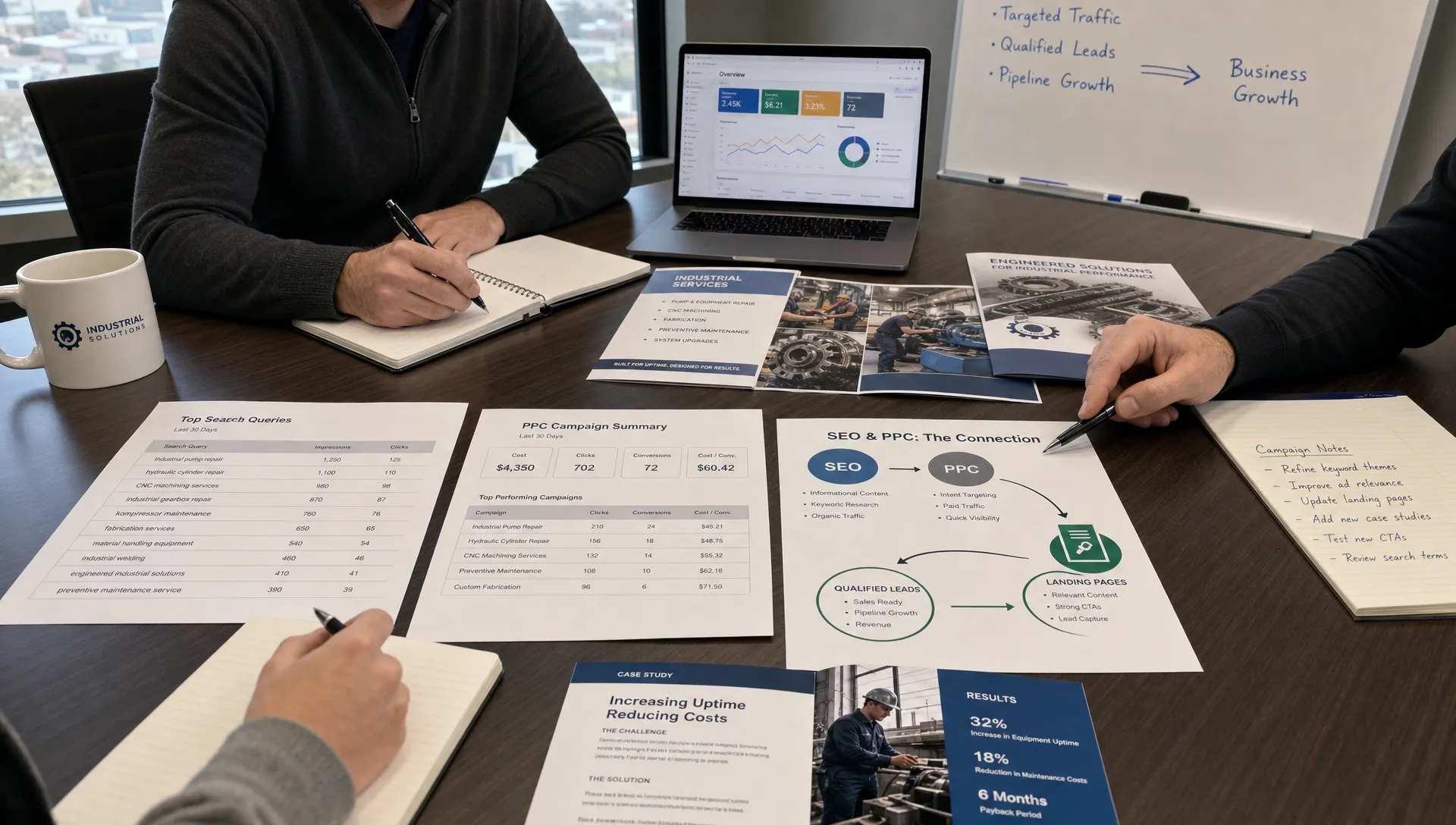
A meeting room table covered with printed search query reports, campaign notes, industrial service brochures, and simple charts showing how SEO and PPC insights connect to qualified B2B leads.

What Search Gets Right for B2B and Industrial Buyers

Search remains effective for B2B because buyers do so much independent research before they contact sales. Gartner has long reported that B2B buyers spend a limited share of their buying journey meeting with potential suppliers, which means vendors need to be discoverable before a sales conversation begins.

This is where search engine marketing fits naturally. It supports the way modern buyers behave. They investigate first, shortlist quietly, and only then reach out. If your company is absent during that research phase, you may never know you were considered.

Industrial search behavior is often even more intent-rich than consumer search. Buyers may use part numbers, certifications, materials, service areas, technical problems, equipment names, or compliance terms. These searches might not generate huge traffic, but they can attract visitors with real operational needs.

For example, a broad phrase like “manufacturing marketing” may attract a wide audience. A specific phrase like “CNC machine repair service quote Houston” signals a very different level of readiness. Search engine marketing still gets this right because it allows companies to prioritize precision.

The same principle applies to content. A general article can build awareness, but a detailed page answering a specific purchasing or technical question may generate more qualified leads. In B2B, relevance is often more valuable than reach.

What Has Changed in 2026

The channels still work, but the playbook has changed. Search marketers need to adapt to a results page where answers, ads, local results, videos, and AI-generated experiences compete for attention.

AI-powered search has made answer quality more important. If your content is vague, generic, or copied from competitors, it is less likely to earn visibility in classic organic results or AI-influenced discovery experiences. This is why SEO, answer engine optimization, and generative engine optimization now overlap. The distinctions are useful, but the shared goal is simple: make your expertise clear enough for people and machines to understand. For a deeper discussion of that shift, see why SEO, AEO, and GEO are not just acronyms.

Privacy has also changed measurement. Marketers have less perfect visibility into every touchpoint. Cookie limitations, consent requirements, and platform modeling mean attribution is more directional than absolute. That does not make measurement useless. It means businesses need to combine analytics with CRM data, call tracking, form quality, sales feedback, and pipeline reporting.

The search results page has also become more competitive. Winning a click is no longer the only goal. Sometimes the goal is brand recognition, inclusion in the buyer’s shortlist, or visibility in a local pack. Sometimes a buyer sees your company several times before taking action. Search engine marketing in 2026 needs to account for those assisted moments.

A Practical 2026 SEM Playbook

The companies getting the most from search engine marketing now are not chasing every trend. They are building disciplined systems around buyer intent, content quality, and measurable business outcomes.

  1. Map searches to the buying journey: Separate educational, comparison, local, and quote-ready searches so each page or campaign has a clear purpose.
  2. Prioritize high-intent terms: Do not ignore low-volume technical terms if they indicate a serious buyer problem or service need.
  3. Build pages before scaling spend: A strong landing page with clear proof, service details, and a focused call to action usually improves both PPC and SEO results.
  4. Use PPC data to guide SEO: Search terms, ad copy tests, and conversion patterns can reveal which topics deserve organic content investment.
  5. Use SEO data to improve PPC: Organic pages that attract engaged visitors can inspire paid campaign structure, negative keywords, and better landing page copy.
  6. Measure lead quality: Track which forms, calls, and quote requests become real opportunities, not just which campaigns generate the most clicks.
  7. Strengthen trust signals: Include clear service areas, industry experience, certifications, process details, testimonials where appropriate, and easy contact options.
  8. Review monthly, not annually: Search behavior, competitors, and ad costs shift too quickly for a set-it-and-forget-it approach.

This playbook is not flashy, but it is durable. The basics still matter because B2B buyers still need clear answers, credible vendors, and a low-friction way to make contact.

Mistakes Search Marketers Should Leave Behind

Some older SEM habits are less effective in 2026. The most common problem is optimizing for platform metrics instead of business outcomes. A campaign can have a high click-through rate and still produce weak leads. A blog post can attract traffic and still fail to support sales.

Another mistake is separating content from conversion. Educational pages should not read like aggressive sales pitches, but they should still guide the reader toward a sensible next step. That might be a related service page, a contact form, a quote request, or a deeper technical resource.

It is also risky to rely too heavily on automation without strategy. Automated bidding and AI-assisted campaign tools can help, but they need clean conversion data, relevant landing pages, and human oversight. If the system is optimizing toward low-quality form fills, it can spend efficiently in the wrong direction.

Finally, companies should stop treating SEO as a one-time website project. Search visibility is an ongoing asset. Competitors publish new content, Google changes how results appear, and buyer questions evolve. The companies that review and improve consistently tend to outperform those that redesign once and disappear.

Frequently Asked Questions

Is search engine marketing still worth it in 2026? Yes. Search engine marketing is still valuable because it reaches buyers who are actively researching problems, vendors, services, or solutions. The strongest results come from combining paid search, SEO, useful content, and lead-quality measurement.

Is SEM the same as PPC? Not always. Some marketers use SEM to mean paid search only, while others use it more broadly to include SEO, PPC, landing pages, and search-focused conversion strategy. For B2B growth, it is usually more useful to think of SEM as the full system for gaining visibility in search.

How has AI changed search engine marketing? AI has made search results more answer-focused and competitive. Businesses now need clearer expertise, better structured content, and stronger authority signals. Generic content is less effective, while specific and helpful content has become more important.

Should B2B companies invest in SEO or PPC first? It depends on goals and timelines. PPC can generate immediate visibility and useful data, while SEO builds long-term authority and lowers dependence on paid clicks. Many B2B companies benefit from using both together.

What should industrial companies measure beyond clicks? Industrial companies should measure qualified form submissions, phone calls, quote requests, cost per qualified lead, sales accepted leads, opportunity value, and influenced pipeline. Clicks are useful, but they are not the final business outcome.

Bring Search Engine Marketing Back to Business Growth

Search engine marketing still works in 2026 because buyers still search when they need answers. What has changed is the level of discipline required. Winning now means understanding intent, improving content quality, aligning SEO and PPC, and measuring the leads that actually matter.

For B2B and industrial companies that want a more practical search strategy, B2B Inbound Marketing helps businesses improve online visibility through SEO, PPC, inbound marketing, and related web marketing services. If search is bringing traffic but not enough qualified leads, it may be time to rebuild the strategy around buyer intent and measurable growth.

What’s the ROI of S E O Campaign?

What’s the ROI of S E O Campaign?

The ROI of S E O varies from one industry to the next. How valuable would it be to your business to come up as the top recommendation when your customers are actively searching for your services?

Let’s look at an example. 320 people search for the exact phrase “event venue Houston” every month (not to mention those who search for slight variants, like “event venues Houston” etc).

Being the first result on Google would bring ~110 people to your website every month who were actively searching for event venues in Houston, many of whom had never heard of your brand before. Assuming 0.5% of those people booked an event venue JUST ONCE, this one search term would bring you 6-7 new customers every year.

Search engines look at 3 primary factors when trying to understand all of the websites in their index: authority, relevancy, and crawlability. 

Authority is a measure of how reputable your website is in the eyes of Google and other search engines. 

Relevancy helps Google to understand what your website is about so it can send the right people to your website.

If you type “shoes ” into Google, Google will sift through trillions of web pages and order them based on how trustworthy they are, and how relevant they are to “shoes .”

 S E O campaign is all about helping Google to better understand your website, while also increasing your authority so you start appearing for the search terms that are most valuable to your business.

 Content marketing is the cornerstone of S E O: Search engines like Google are obsessed with giving searchers what they’re looking for. When search engines find websites that provide useful information, they reward those websites by ranking them higher in search results.

The more high-quality content you write, the higher you will rank for the search terms that your customers are looking for.

Contact us:  www.B2Binboundmarketing.net

We are An Award winning digital marketing and leads generation agency. 

Andy Alagappan @ 832 677 4620