

Tag Archives: SEO Houston

How SEO and Web Design Services Drive Better Conversions - Main Image

How SEO and Web Design Services Drive Better Conversions

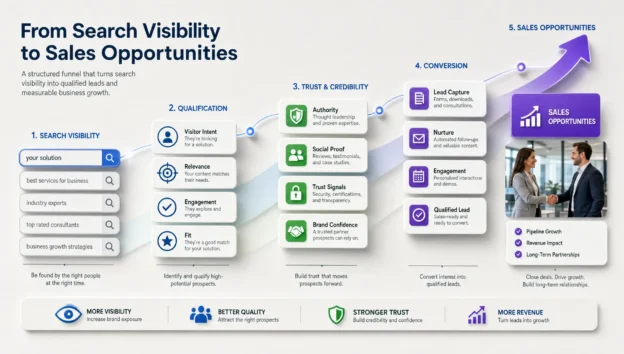
Getting more traffic is useful, but it is not the finish line. For B2B and industrial companies, the real goal is turning the right visitors into qualified inquiries, quote requests, consultations, demo bookings, distributor leads, or sales conversations.

That is where SEO and web design services become more powerful together than they are separately. SEO helps the right audience find your business at the right stage of the buying journey. Web design helps those visitors understand your value, trust your company, and take the next step without friction.

When these two disciplines are aligned, your website stops acting like a digital brochure and starts functioning like a conversion engine.

Why SEO Alone Is Not Enough

A page can rank well and still fail to produce leads. This happens more often than many companies expect. The site may attract search traffic, but visitors leave because the page loads slowly, the message is unclear, the call to action is buried, or the design does not support buyer confidence.

For industrial and B2B buyers, this matters even more. These visitors often evaluate technical expertise, reliability, safety, capability, service coverage, and procurement fit before they make contact. If your website does not answer those concerns quickly, search visibility will not translate into revenue.

SEO brings demand to the door. Web design determines whether that demand becomes a lead.

A strong SEO strategy should therefore be connected to conversion-focused page design from the beginning. Keyword research, site architecture, landing page layout, content hierarchy, forms, page speed, and trust signals should all support the same goal: helping the buyer move forward with confidence.

How Web Design Improves SEO Performance

Search engines are increasingly focused on whether users can access and engage with helpful content. A website that is hard to use, slow to load, or poorly structured creates problems for both search visibility and conversion rates.

Google’s guidance on Core Web Vitals highlights the importance of loading speed, interactivity, and visual stability. These factors are not just technical SEO concerns. They affect how people experience your website in the first few seconds.

Good web design supports SEO in several practical ways:

  • It makes important content easy for users and search engines to find.
  • It improves mobile usability for buyers researching from phones or tablets.
  • It reduces friction by making navigation, forms, and calls to action clear.
  • It reinforces trust through professional layout, proof points, and consistent branding.
  • It helps search engines understand page purpose through clean structure and internal linking.

This is especially important for businesses with long sales cycles. A visitor may not convert on the first visit, but a clear, professional, useful website increases the chance they return, share the page internally, or contact your company when the need becomes urgent.

How SEO Strengthens Web Design Decisions

Design should not be based only on visual preference. A beautiful website can still miss the mark if it is not built around what buyers are actually searching for.

SEO data gives web design direction. It reveals how prospects describe their problems, which services they compare, what questions they ask before contacting a vendor, and where they are in the buying process.

For example, a manufacturer searching for “industrial pump repair Houston” is likely closer to action than someone searching “how to maintain centrifugal pumps.” Both searches may matter, but they require different page types, layouts, and calls to action.

A service page should make it easy to request a quote or consultation. An educational blog article should answer the question fully, then guide the reader toward a relevant next step. A comparison or capability page should reduce uncertainty by showing experience, process, certifications, industries served, and proof of results.

This is why an effective website redesign should begin with search intent, not just color palettes and page templates.

The Conversion Path: From Search Query to Qualified Lead

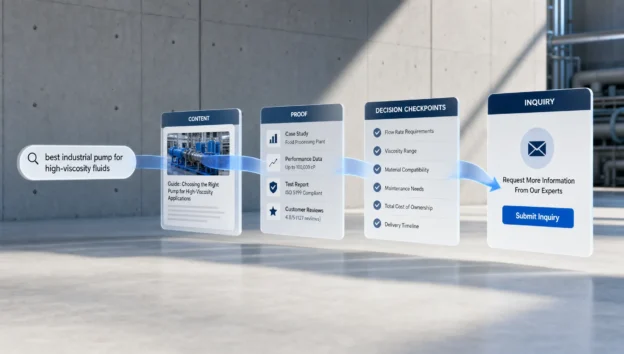
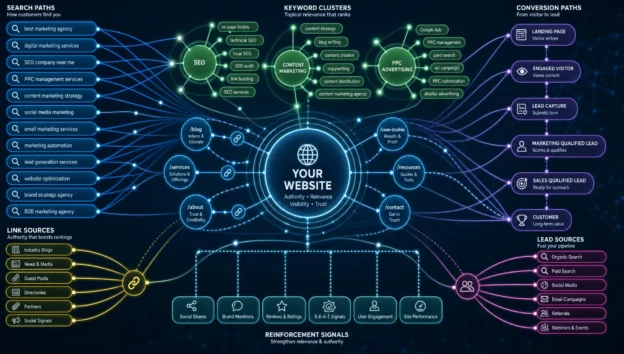
A conversion-focused website connects each stage of the search journey to the right page experience. In B2B marketing, that path often looks like this:

Buyer stage Search behavior Best page experience Conversion goal
Awareness Searches for a problem, trend, or basic explanation Educational article or guide Newsletter signup, related service click, resource download
Consideration Compares methods, vendors, or solutions Service page, comparison page, industry page Consultation request, quote form, case study view
Decision Searches for a specific provider, service, or urgent need High-intent landing page Phone call, proposal request, form submission
Retention Looks for support, specifications, or follow-up information Resource hub, FAQ, support page Repeat inquiry, account contact, service request

The goal is not to force every visitor into the same generic contact form. The goal is to match the page, message, and action to the buyer’s intent.

That is why companies often see better results when they treat SEO and web design as one connected system. If you want a deeper look at conversion improvements beyond design alone, this article on website optimization services that improve conversion rates explains several practical areas that influence performance.

Key Website Elements That Turn SEO Traffic Into Conversions

Once visitors land on your site, they make quick decisions. They ask, often subconsciously, “Is this company relevant to my problem? Do they look credible? Can they handle our needs? What should I do next?”

The following elements help answer those questions.

Clear Above-the-Fold Messaging

The top of a page should immediately explain what you do, who you help, and why the visitor should keep reading. Avoid vague language like “innovative solutions for tomorrow.” Instead, use specific language that matches the buyer’s need.

For a B2B or industrial company, strong messaging might clarify the service category, geographic market, technical specialty, or business outcome. The visitor should not need to scroll through several sections to understand whether they are in the right place.

Fast, Stable Page Performance

Speed affects both user experience and lead generation. If a page is slow, visitors may leave before they ever see your offer. This is particularly important for mobile users and buyers working from job sites, facilities, or while traveling.

Page speed improvements often include compressing images, reducing unnecessary scripts, improving hosting, simplifying design elements, and cleaning up bloated code. These are web design and technical SEO decisions at the same time.

Strong Calls to Action

A call to action should be easy to find, specific, and relevant to the page. “Contact us” is acceptable, but often too generic by itself. Stronger options may include “Request a consultation,” “Ask for a quote,” “Schedule a site assessment,” or “Discuss your project.”

The right CTA depends on the business and buying process. A complex industrial sale may need a lower-friction option, such as speaking with a specialist, while a local service page may benefit from a direct phone call prompt.

A B2B marketing team reviews a website conversion journey on a conference room wall, with search traffic, landing pages, trust signals, and lead forms connected in a simple flow.

Trust Signals That Reduce Buyer Risk

B2B buyers are careful. Their decisions may affect operations, budgets, compliance, safety, or customer commitments. Your website should reduce perceived risk through visible proof.

Useful trust signals can include years of experience, industries served, certifications, customer logos, project examples, case studies, testimonials, safety standards, technical documentation, and clear company contact information.

Do not hide these elements on one “About” page. Place relevant proof where visitors are making decisions, especially on service pages and landing pages.

Forms That Respect the Buyer’s Time

Lead forms should collect enough information to qualify the inquiry without creating unnecessary friction. A visitor requesting a detailed proposal may expect to provide more information. A visitor asking an early question may prefer a shorter form.

For many B2B websites, form quality is more important than form quantity. The best approach is to align each form with the visitor’s level of intent.

The Role of Content in SEO and Web Design

Content is the bridge between search visibility and conversion. It is not enough to publish keyword-focused pages if those pages do not help real buyers make decisions.

High-performing B2B content usually does three things well. It answers the search query, explains the business value, and guides the reader toward a logical next step. The design of the page should make that content easy to scan, with helpful headings, short paragraphs, comparison tables, internal links, and visible CTAs.

For example, a page targeting a high-intent service keyword should include practical information such as:

  • What the service includes
  • Who the service is best for
  • Common problems it solves
  • What happens after a prospect contacts you
  • Why your company is qualified to help

At the same time, the page should avoid overwhelming the reader. Strong web design organizes content so buyers can find what matters to them quickly.

This is also where search intent matters. A page built for lead generation should not read like a generic encyclopedia entry. It should educate, but it should also position your company as a credible solution.

For more detail on using search strategy to generate the right kind of inquiries, see this guide on how search engine optimization services drive B2B leads.

Common Mistakes That Hurt Conversions

Many websites lose leads for reasons that are fixable. The challenge is that these problems often sit between SEO, design, content, and sales, so no single team owns them.

Common conversion problems include unclear service pages, weak page titles, slow mobile performance, generic stock messaging, hidden phone numbers, forms that ask too much too soon, and navigation that does not reflect how buyers search.

Another frequent issue is sending all traffic to the homepage. Homepages are important, but they are rarely the best landing page for every query. A visitor searching for a specific service should land on a page built around that service, not a general overview that forces them to hunt for details.

A third mistake is designing pages without considering lead quality. More form submissions are not always better. If the wrong audience is converting, your sales team spends time filtering poor-fit inquiries. A better approach is to align keywords, page copy, proof points, and forms around the customers you actually want.

This is why conversion strategy should include both quantity and quality metrics. If lead quality is a concern, this article on how an SEO marketing service improves lead quality offers a useful next step.

What to Measure When SEO and Web Design Work Together

If you want better conversions, you need to measure more than rankings. Rankings are useful, but they do not show the full business impact of your website.

Important metrics include organic traffic by page, conversion rate by landing page, form submissions, phone calls, quote requests, assisted conversions, engagement with key service pages, and lead quality feedback from sales.

For B2B companies, it is also useful to track which pages influence leads before they convert. A buyer may first read an educational article, return later to view a service page, then submit a form after visiting a case study. That full journey gives more useful insight than looking only at the final click.

You should also review qualitative signals. Ask your sales team what prospects mention during calls. Are they referencing a specific service page? Are they confused about what you provide? Are they better informed than before? These insights can guide both SEO content and web design improvements.

Growth-focused agencies often approach this as a continuous testing process rather than a one-time website launch. For example, growth marketing and innovation teams typically look for ways to improve acquisition, activation, and learning loops over time, which is a useful mindset for B2B conversion work as well.

SEO and Web Design for Industrial and B2B Companies

Industrial and B2B websites have different conversion challenges than e-commerce or consumer sites. The purchase is often more complex, the timeline is longer, and multiple stakeholders may be involved.

A plant manager may care about uptime and response time. A procurement team may care about vendor qualifications and documentation. An executive may care about cost, risk, and long-term reliability. A technical buyer may care about specifications and process details.

SEO and web design services should account for these different perspectives. That means building pages that are technically useful, easy to navigate, and commercially persuasive.

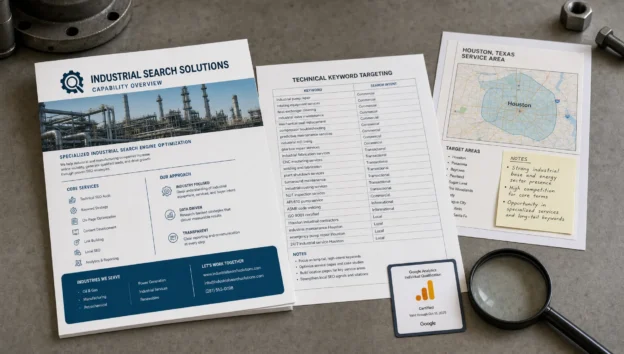
For Houston-based B2B and industrial businesses, local relevance can also matter. Service areas, regional experience, local project examples, and clear contact information can help buyers understand whether your company is a practical fit. This does not mean stuffing city names into every sentence. It means showing genuine relevance to the markets and industries you serve.

How to Align SEO and Web Design Before a Redesign

A redesign is one of the best times to improve conversions, but it is also a time when SEO mistakes can damage visibility if not handled carefully. Before rebuilding a website, it is important to review current rankings, top organic landing pages, backlinks, page performance, conversion paths, and technical issues.

A smart process usually includes these steps:

  1. Audit current SEO performance and conversion data.
  2. Identify the most valuable services, industries, and buyer segments.
  3. Map keywords and search intent to the right pages.
  4. Create page layouts around messaging, proof, and CTAs.
  5. Preserve or redirect important URLs during launch.
  6. Test speed, mobile usability, forms, analytics, and tracking.
  7. Continue improving pages after launch based on real performance.

The most important principle is simple: do not separate design decisions from search and conversion strategy. A redesigned website should look better, but it should also rank, persuade, and convert better.

Frequently Asked Questions

How do SEO and web design services work together? SEO attracts qualified visitors through search visibility, while web design improves the experience those visitors have after they arrive. Together, they help more visitors understand the offer, trust the company, and take action.

Can better web design improve search rankings? Yes, in many cases. Better structure, mobile usability, page speed, internal linking, and content organization can support SEO performance. Design alone is not a ranking strategy, but poor design can limit the effectiveness of SEO.

What conversion rate should a B2B website aim for? There is no universal benchmark because conversion rates vary by industry, offer, traffic source, and buying stage. A better goal is to improve conversion quality and rate over time by measuring each key landing page separately.

Should a business redesign its website before investing in SEO? Not always. If the current site has serious technical, usability, or conversion problems, a redesign may be necessary. If the site is structurally sound, targeted SEO and landing page improvements may produce results faster.

What is the biggest mistake companies make with SEO and web design? The biggest mistake is treating them as separate projects. SEO determines how buyers find the site, and design determines how they experience it. Both should be planned around the same conversion goals.

Turn Your Website Into a Better Lead Generation Asset

Better conversions do not happen by accident. They come from aligning search intent, technical performance, persuasive content, professional design, and clear next steps.

For B2B and industrial companies, the opportunity is significant. When SEO and web design services work together, your website can attract more of the right visitors, answer their questions faster, build trust earlier, and generate better qualified leads.

If your website is getting traffic but not enough inquiries, or if you are planning a redesign and want to protect SEO performance, Andy Alagappan’s Houston-based B2B inbound marketing services can help connect strategy, SEO, PPC, content, and web improvements around measurable lead generation goals.

SEO Houston for B2B Companies: What Matters Most - Main Image

SEO Houston for B2B Companies: What Matters Most

For B2B companies in Houston, SEO is not just a traffic channel. It is a way to be visible when engineers, procurement teams, operations managers, founders, and executives are researching a problem long before they speak with sales.

That matters because B2B buying cycles are rarely simple. A prospect may start with a broad question, compare vendors weeks later, involve multiple stakeholders, and only then request a quote or consultation. Good SEO helps your company show up at each of those moments with the right page, the right message, and a clear next step.

The challenge is that “SEO Houston” can mean very different things depending on the business. A local professional services firm, industrial manufacturer, SaaS provider, distributor, and engineering company do not need the same SEO plan. What matters most is building a search strategy around buyer intent, technical performance, content quality, local relevance, and measurable lead generation.

Why B2B SEO in Houston is different

Houston is a competitive B2B market with strong concentrations in energy, manufacturing, logistics, industrial services, construction, technology, healthcare, and professional services. Many companies are not selling impulse purchases. They are selling high-consideration solutions that require trust, proof, and repeated exposure.

That changes how SEO should be planned. A B2B company should not judge SEO success only by total traffic. A small increase in qualified visits from the right audience can be more valuable than thousands of low-intent visits from people who will never buy.

B2B search behavior also tends to be more specific. Buyers search for problems, specifications, certifications, comparisons, service areas, integration needs, compliance questions, cost drivers, and implementation concerns. Your SEO strategy should reflect those real questions, not just generic high-volume keywords.

Google’s own guidance emphasizes creating helpful, reliable, people-first content. In B2B, that means content that demonstrates real expertise, answers practical buyer questions, and makes it easy for a serious prospect to understand whether your company is a fit.

What matters most for SEO Houston campaigns

A strong B2B SEO campaign has many moving parts, but some factors consistently matter more than others. If your company has limited time or budget, prioritize the fundamentals that directly influence discoverability, credibility, and lead quality.

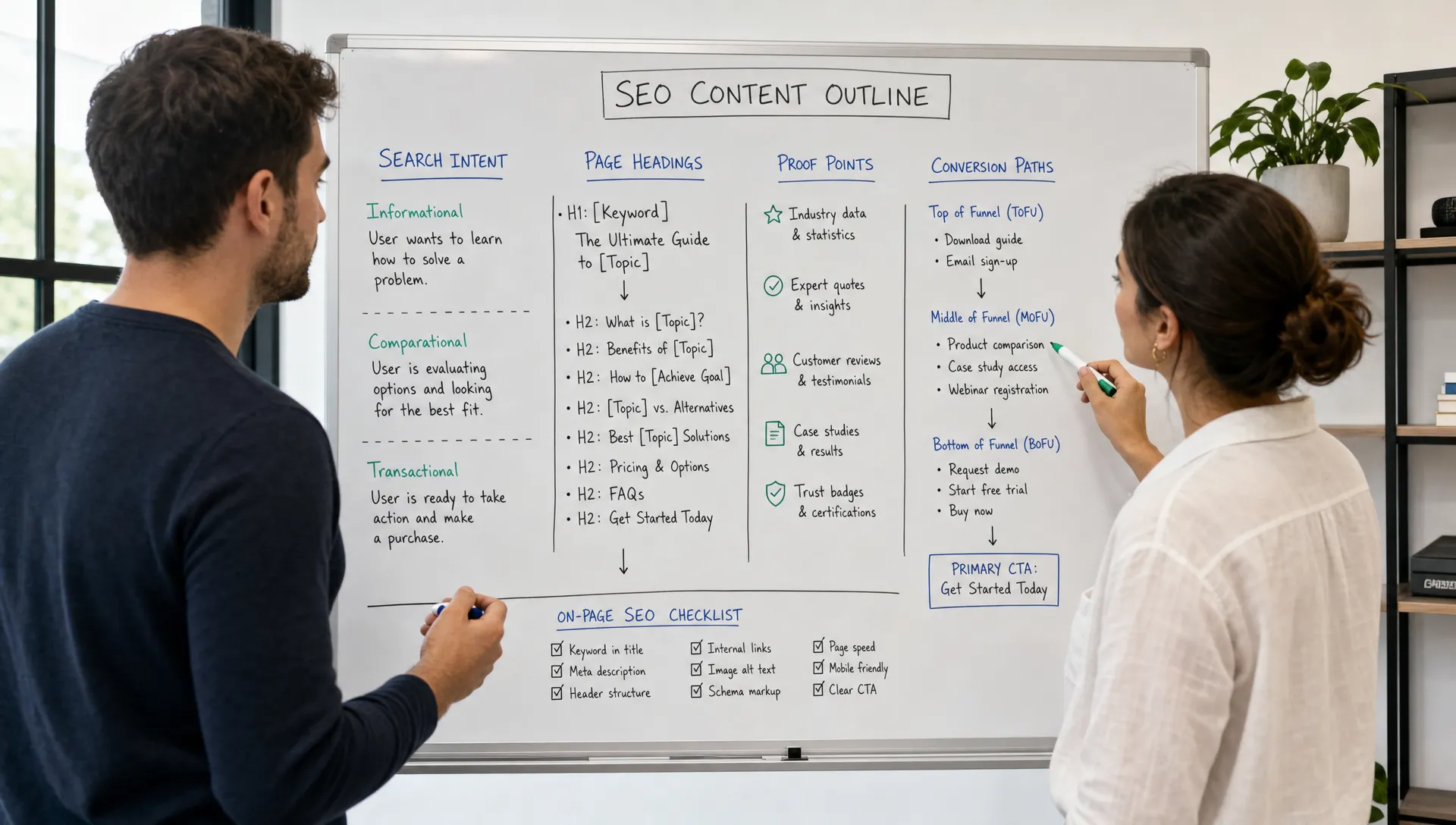
1. Search intent before keyword volume

Keyword research is still important, but keyword volume can be misleading in B2B. Many profitable terms have low search volume because they are highly specialized. A term with 30 searches per month may be more valuable than a broad keyword with 3,000 searches if it attracts decision-makers close to buying.

Instead of asking, “Which keyword has the most searches?” ask, “What is the buyer trying to accomplish?”

Common B2B search intent categories include:

  • Problem awareness: The buyer is trying to understand a challenge, such as production downtime, lead quality, software integration, or compliance risk.
  • Solution research: The buyer is comparing possible approaches, such as SEO vs. PPC, managed services vs. in-house teams, or custom manufacturing vs. off-the-shelf parts.
  • Vendor evaluation: The buyer is looking for providers, case studies, certifications, locations, pricing factors, or proof of experience.
  • Implementation support: The buyer wants checklists, specifications, best practices, or troubleshooting guidance.

When your content aligns with these stages, SEO becomes more than rankings. It becomes part of your sales process.

2. Technical SEO that lets Google and buyers access your site

Technical SEO is not glamorous, but it is essential. If search engines cannot crawl, index, and understand your website, even strong content can underperform.

For B2B companies, technical SEO should focus on speed, mobile usability, crawlability, secure browsing, clean site architecture, and structured data where appropriate. According to Google Search Central, search-friendly sites make it easier for Google to discover content and for users to navigate it.

A practical technical SEO review should look at:

  • Whether important service pages are indexable
  • Whether page titles and meta descriptions accurately describe each page
  • Whether navigation helps users find services, industries, resources, and contact options
  • Whether slow pages are hurting engagement and conversions
  • Whether duplicate or thin pages are diluting search relevance

Technical SEO also supports conversion. A fast, clear, easy-to-use website gives prospects confidence. A slow or confusing website can quietly reduce lead volume, even if rankings improve.

3. Local relevance without limiting your market

Many Houston B2B companies serve both local and national markets. That creates a strategic question: should SEO focus on Houston, the broader region, or industry-specific visibility across the country?

The answer depends on how buyers select vendors. If location matters because of service response times, local relationships, site visits, logistics, or regional expertise, Houston-focused SEO should be prominent. If your company sells nationally, local SEO should still support credibility but not restrict the entire content strategy.

For Houston SEO, the basics include accurate business information, location-relevant service pages, locally relevant content, consistent citations, and a well-maintained Google Business Profile where applicable. However, avoid creating thin city pages just to target every suburb. Strong local content should explain why your location benefits the buyer.

For example, a Houston industrial services company might discuss response times across the Gulf Coast, experience with petrochemical facilities, or knowledge of regional operating conditions. That is more persuasive than repeating “Houston” on a generic service page.

4. Content that proves expertise, not just visibility

B2B buyers are skeptical. They do not want vague marketing copy. They want evidence that you understand their industry, their constraints, and the cost of getting the decision wrong.

That is why the best B2B SEO content often includes use cases, comparison guides, technical explanations, FAQs, industry-specific landing pages, and case studies. Your website should answer the questions sales teams hear every week.

For example, a strong content plan may include pages such as:

  • Service pages that clearly describe who the service is for and what problems it solves
  • Industry pages for priority sectors, such as manufacturing, energy, SaaS, logistics, or professional services
  • Educational articles that explain how to evaluate solutions
  • Conversion pages built around consultations, audits, RFQs, or proposal requests
  • Proof pages featuring examples, results, certifications, or client types when available

If you want a deeper look at how SEO supports lead generation, this guide on how search engine optimization services drive B2B leads explains how intent, content, and conversion paths work together.

A practical SEO priority map for B2B companies

The best SEO strategies do not treat every page the same. Each page should have a job. Some pages attract early-stage researchers, while others convert prospects into leads.

Buyer stage What the buyer needs SEO content that helps Business goal
Awareness Understand the problem Educational blog posts, guides, FAQs Build visibility and trust
Consideration Compare approaches Service explainers, comparison content, industry pages Shape the buyer’s criteria
Evaluation Choose a provider Case studies, testimonials, proposal pages, contact pages Generate qualified leads
Decision support Justify the choice internally ROI pages, checklists, implementation resources Help sales close opportunities

This is where many B2B SEO campaigns fall short. They publish blog posts but neglect the pages that actually convert. Or they optimize service pages but never create content that helps buyers earlier in the journey. The strongest approach connects all stages.

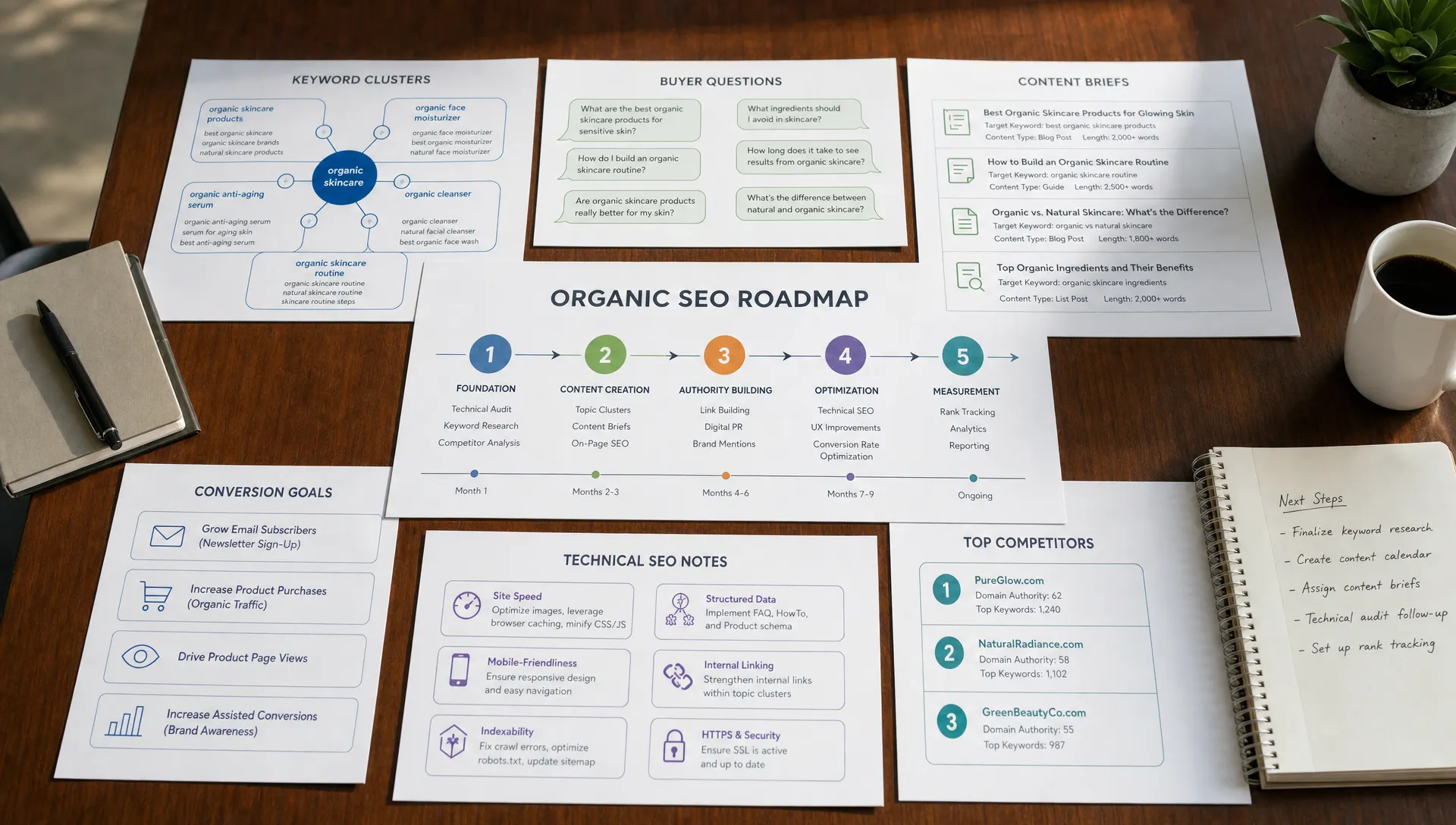
A Houston B2B marketing team reviewing search intent, website performance, and lead quality metrics around a conference table with notes, charts, and laptops facing them, in a modern office meeting room.

Conversion matters as much as rankings

Ranking on Google is only valuable if the right visitors take action. For B2B companies, conversion does not always mean an immediate purchase. It may mean requesting a proposal, booking a consultation, downloading a guide, calling the office, or submitting an RFQ.

Your website should make those actions obvious and low-friction. Each important page should answer three questions quickly: who you help, what problem you solve, and what the visitor should do next.

Strong conversion elements include clear calls to action, short forms, visible phone numbers, trust signals, relevant proof, and copy that speaks to the buyer’s industry. For complex B2B offers, it can also help to include qualifying details such as service areas, project types, minimum fit criteria, or typical engagement models, as long as they are accurate.

SEO and conversion rate optimization should not be separated. A page can rank well and still fail if it does not persuade. If your site attracts traffic but does not produce enough inquiries, the issue may be messaging, layout, form friction, or offer clarity. This is why website optimization services that improve conversion rates are often a key part of an SEO plan.

Authority is built through relevance and trust

Backlinks still matter, but B2B companies should think beyond link quantity. A relevant mention from an industry publication, association, vendor, customer, partner, or local business organization can be more meaningful than dozens of low-quality directory links.

Authority also comes from the people behind the business. Subject matter experts, leadership perspectives, technical insights, and real-world experience all help strengthen credibility. Search engines and buyers are both looking for signals that your company is legitimate, knowledgeable, and active in its market.

For companies growing into new regions or building stronger go-to-market teams, SEO also depends on having the right people in sales, marketing, client service, and leadership roles. In some cases, working with specialist executive search partners for sales and marketing leadership can support the broader growth engine that turns search visibility into revenue.

The key is alignment. SEO should not operate in isolation from sales, hiring, product, operations, or customer service. The best content often comes from real conversations with prospects, customers, and internal experts.

Common mistakes B2B companies make with SEO

Many B2B companies invest in SEO but do not get the results they expect. Often, the problem is not that SEO does not work. The problem is that the strategy is too generic.

One common mistake is targeting broad keywords that attract unqualified visitors. A Houston company may rank for general informational terms but fail to attract decision-makers in its target industries. Another mistake is publishing content without a clear conversion path. If a visitor reads an article and has no obvious next step, the opportunity may be lost.

Other frequent issues include neglecting technical SEO, ignoring local search signals, using thin service pages, failing to update outdated content, and measuring success only by rankings. Rankings are useful, but they are not the full story.

A mature B2B SEO program should connect search performance to business outcomes. That means tracking not only impressions and clicks, but also inquiries, lead quality, sales conversations, and pipeline influence.

How to measure what matters most

SEO measurement should be simple enough to guide decisions but detailed enough to reveal what is actually working. For B2B companies, the most important metrics usually sit between marketing activity and sales outcomes.

Metric Why it matters What to watch
Organic impressions Shows whether visibility is growing Growth for relevant non-branded searches
Organic clicks Shows whether searchers choose your result Click-through rate and page relevance
Qualified traffic Shows whether the right people are visiting Industry, geography, landing pages, engagement
Conversions Shows whether SEO creates action Forms, calls, RFQs, consultations, downloads
Lead quality Shows whether traffic matches sales needs MQLs, SQLs, close rates, deal size
Pipeline influence Shows revenue impact Opportunities sourced or assisted by organic search

Google Search Console can help you understand search queries and page visibility. Analytics tools can show engagement and conversions. Your CRM should connect leads back to sales outcomes wherever possible.

Do not expect every valuable SEO touchpoint to be the final conversion source. In B2B, organic search often assists the journey by educating prospects, supporting vendor evaluation, and reinforcing credibility before a lead is submitted.

Choosing the right SEO approach in Houston

The right SEO approach depends on your business model, sales cycle, target industries, and internal resources. A small professional services firm may need a focused local SEO and content strategy. An industrial supplier may need technical service pages, product category optimization, and industry-specific content. A SaaS company may need scalable topic clusters, comparison pages, and conversion-focused landing pages.

Before investing in SEO, clarify these points:

  • Which industries, accounts, or buyer roles matter most?
  • Which services or solutions are most profitable?
  • Which geographic markets should SEO support?
  • What questions do prospects ask before they contact sales?
  • What counts as a qualified lead?
  • How will marketing and sales follow up with inbound inquiries?

If you are comparing agencies or consultants, look for a partner that understands business goals, not just keywords. This article on how to choose the best search engine optimization companies covers practical criteria for evaluating fit, strategy, and credibility.

Frequently Asked Questions

What makes SEO for B2B companies different from B2C SEO? B2B SEO usually involves longer buying cycles, multiple decision-makers, more specialized search terms, and a stronger need for proof. The goal is not just more traffic, but more qualified leads and better sales conversations.

Is local SEO important for Houston B2B companies? Yes, if location affects trust, service delivery, response time, or vendor selection. Even companies serving national markets can benefit from Houston-specific credibility, especially when local relationships matter.

How long does B2B SEO take to work? SEO is typically a long-term channel. Some technical and on-page improvements can help sooner, but meaningful growth often takes several months of consistent work, especially in competitive markets.

Should B2B companies invest in SEO or PPC first? It depends on your goals. PPC can create faster visibility, while SEO builds durable organic presence over time. Many B2B companies use both, with PPC supporting immediate demand and SEO building long-term lead generation.

What is the most important SEO metric for a B2B company? Qualified leads and pipeline influence matter more than raw traffic. Rankings and clicks are useful indicators, but the real test is whether SEO attracts prospects that match your target customer profile.

Ready to make SEO work harder for your B2B pipeline?

For Houston B2B companies, SEO works best when it is tied to buyer intent, technical strength, expert content, conversion strategy, and measurable business outcomes. Rankings matter, but qualified opportunities matter more.

If your company needs help improving search visibility, generating better leads, or connecting SEO with inbound marketing, PPC, web content, and website optimization, Andy Alagappan’s B2B Inbound Marketing can help you build a practical strategy around your market and goals.

How to Choose the Best Search Engine Optimization Companies - Main Image

How to Choose the Best Search Engine Optimization Companies

Choosing an SEO company is not a search for the flashiest pitch deck. It is a business decision that affects how prospects find you, how your sales team receives leads, and how your brand is perceived in a market where buyers research long before they contact a vendor.

For B2B, industrial, SaaS, manufacturing, and professional service companies, the stakes are even higher. A weak SEO partner may generate traffic that never converts. A strong partner understands buyer intent, technical content, search visibility, and the handoff from website visit to sales opportunity.

The challenge is that many agencies sound similar. They promise audits, keyword research, content, reporting, and higher rankings. The best search engine optimization companies separate themselves by how they diagnose your business, prioritize work, explain tradeoffs, and connect SEO to revenue.

Start by defining what best means for your company

The best SEO company for an ecommerce brand may not be the best SEO company for a precision machining firm, a software provider, or a Houston-based industrial distributor. Before comparing proposals, define what success looks like.

A useful SEO goal is not simply more traffic. It should connect to business outcomes such as qualified quote requests, demo bookings, distributor inquiries, technical document downloads, or inbound calls from the right service territory.

For B2B companies, this matters because buying cycles are longer and search journeys are more complex. A prospect might first search a problem, then compare specifications, then look for a local or industry-specific provider, then finally submit an RFQ. If your agency only optimizes for broad, high-volume keywords, it may miss the searches that actually influence pipeline.

If lead quality is the main objective, it helps to understand how search engine optimization services drive B2B leads before choosing a provider. That perspective shifts the conversation from rankings alone to the full path from search intent to conversion.

Build a shortlist around fit, not fame

Large agencies, boutique SEO firms, freelancers, local specialists, and industry-focused consultants can all be effective. The right choice depends on the complexity of your website, your internal resources, your sales process, and how competitive your search market is.

A company with thousands of product pages may need deep technical SEO and structured content operations. A regional B2B service company may need local SEO, conversion-focused landing pages, and strong Google Business Profile optimization. An industrial manufacturer may need a partner who can turn technical expertise into content that engineers, procurement teams, and plant managers actually trust.

When you compare agencies, look for evidence that their specialty matches your business model. For example, if local visibility and emerging AI search discovery are important to your strategy, studying an AEO & SEO agency in Orange County can show how some firms position local SEO, answer engine optimization, web services, and lead generation together.

For industrial companies in particular, industry fit is often the difference between content that ranks and content that resonates. A firm that understands technical buyers can help translate complex products or services into search-friendly pages without oversimplifying the expertise your customers expect. This is one reason the choice of agency is so important for companies evaluating how the right SEO firm helps industrial brands grow.

What the best search engine optimization companies do differently

The strongest SEO companies do not start with a package. They start with diagnosis. They want to know your market, competitors, sales cycle, website history, analytics setup, and internal constraints before recommending a plan.

Use the following table as a practical evaluation framework when reviewing agencies.

Evaluation area What to look for Why it matters
Business understanding They ask about margins, customers, territories, sales cycle, and lead quality SEO priorities should reflect revenue opportunities, not just keyword volume
Technical SEO They can explain crawlability, indexation, site speed, schema, redirects, and site architecture Technical issues can prevent strong content from performing
Content strategy They map content to buyer questions, decision stages, and expertise B2B search success depends on relevance and credibility
Industry knowledge They show experience with similar markets or a clear process for learning yours Specialized buyers need accurate, useful, and trustworthy information
Reporting They report on rankings, traffic, conversions, leads, and business impact Rankings alone do not prove ROI
Link and authority building They use ethical methods such as digital PR, partnerships, and useful resources Authority still influences competitive search visibility
Conversion focus They review calls to action, landing pages, forms, and user experience More traffic is wasted if visitors do not take the next step
Collaboration process They define responsibilities, timelines, approvals, and communication rhythm SEO requires input from sales, subject matter experts, and leadership
AI search readiness They consider answer engines, featured snippets, structured content, and topical authority Search behavior is expanding beyond traditional blue links
Transparency They explain what they are doing and why You should understand the strategy you are funding

The goal is not to find an agency that says yes to everything. The goal is to find a partner that can prioritize. Good SEO involves tradeoffs. A mature agency can tell you when to fix technical issues first, when to create new content, when to refresh old pages, and when paid search should support organic growth while SEO gains traction.

Ask for strategy before you ask for deliverables

Many companies compare SEO proposals by counting deliverables. One agency offers four blog posts per month. Another offers ten keywords and monthly reporting. Another promises a technical audit, backlinks, and on-page optimization.

Deliverables matter, but they do not tell you whether the work is valuable. A blog post that targets the wrong intent is not an asset. A backlink from an irrelevant website can create risk. A dashboard full of vanity metrics can hide the fact that leads are not improving.

Instead of asking only what is included, ask why each activity belongs in the strategy. The best search engine optimization companies can explain how each recommendation supports visibility, authority, conversion, or revenue.

Here are strong questions to ask in a sales conversation:

Question What a strong answer sounds like
How would you prioritize the first 90 days? They identify discovery, analytics review, technical fixes, keyword and intent research, and quick wins based on your site
How do you choose keywords? They discuss search intent, competition, business value, funnel stage, and conversion potential
How do you measure SEO success? They include qualified traffic, conversions, lead quality, ranking movement, engagement, and pipeline influence where available
How do you handle technical recommendations? They explain how they audit issues, work with developers, and prioritize fixes by impact
How do you create content for technical or specialized industries? They use subject matter expert interviews, sales insights, customer questions, and credible sources
What do you need from our team? They are clear about approvals, access, expertise, sales feedback, and implementation support
What should we not expect? They avoid guarantees and set realistic timelines for competitive keywords

A good SEO provider should be comfortable discussing uncertainty. Search results change, competitors invest, and Google updates its systems regularly. What should not change is the agency's ability to make informed decisions, communicate clearly, and adapt the plan.

A conference table with printed SEO proposal scorecards, keyword research notes, analytics charts, and a laptop closed beside notebooks, representing a business team evaluating SEO companies.

Watch for red flags before signing

Some SEO warning signs are obvious. Others sound persuasive until you look closer. Be cautious when an agency relies on shortcuts or vague promises instead of a clear process.

Common red flags include:

  • Guaranteed number one rankings, especially in a specific timeframe
  • Secret methods they refuse to explain at a high level
  • Pricing that is far below the level of work required for your market
  • Reports that focus only on impressions or rankings without conversions
  • Content plans that ignore subject matter expertise
  • Link building that depends on spammy directories, private networks, or irrelevant sites
  • No discussion of technical SEO, analytics, or website conversion paths
  • A one-size-fits-all package that does not reflect your business model

Google's own guidance on hiring an SEO notes that no one can guarantee a number one ranking on Google, and it recommends understanding the changes an SEO wants to make before granting access. That advice is still one of the simplest ways to separate credible firms from risky ones.

Another red flag is an agency that talks about traffic but not the quality of that traffic. For B2B companies, 1,000 visits from students, job seekers, or irrelevant geographies are less valuable than 50 visits from engineers, procurement managers, plant operators, or executives actively evaluating a solution.

Evaluate their content process, not just their writing samples

Content is often the visible part of SEO, but the best content is built on research, expertise, and structure. This is especially true in industrial and technical markets where buyers can quickly detect generic writing.

Ask how the agency gathers source material. Do they interview your sales team? Do they review real customer questions? Do they understand product specifications, compliance requirements, industry terminology, and common objections? Do they know how to create pages for both early-stage research and decision-stage inquiries?

Strong SEO content usually includes a mix of page types. Service pages capture commercial intent. Comparison pages help buyers evaluate options. Educational articles answer problem-aware searches. Case studies build trust. Technical resources support specification-driven buyers. Location pages help regional companies appear for local intent.

The best search engine optimization companies also know when not to create new content. Sometimes the highest-impact move is refreshing an existing page, consolidating overlapping articles, improving internal links, adding clearer calls to action, or aligning a page with a better keyword intent.

Make reporting practical and tied to decisions

Reporting should help you decide what to do next. A monthly SEO report is not useful if it only lists rankings and traffic without explaining why performance changed or what action follows.

A useful SEO report should answer four questions:

  • What improved, declined, or stayed flat?
  • What work was completed and what impact is expected?
  • What did we learn from rankings, traffic, and conversions?
  • What are the next priorities and why?

For B2B organizations, reporting should also include lead indicators where possible. That may mean form submissions, calls, quote requests, demo requests, newsletter signups, downloads, or visits to high-intent pages. If sales feedback is available, the agency should be interested in which leads were qualified and which were not.

This is where SEO and website optimization overlap. A page can rank well and still fail if the offer is unclear, the form is too long, the call to action is weak, or the page does not address buyer objections. Choosing an SEO firm that understands conversion can prevent traffic from becoming a dead end.

Compare proposals with a weighted scorecard

When you are down to two or three agencies, a weighted scorecard can make the decision less emotional. Adjust the weights based on your goals, but use the same categories for every provider.

Category Suggested weight What to score
Strategic fit 25% Understanding of your business, market, customers, and revenue goals
Technical capability 15% Ability to audit, explain, and prioritize technical SEO issues
Content and expertise process 20% Approach to keyword intent, subject matter input, and useful content
Reporting and measurement 15% Clarity of KPIs, conversion tracking, and business-focused reporting
Industry or local relevance 10% Experience with similar buyers, regions, or competitive conditions
Communication and accountability 10% Responsiveness, ownership, timelines, and collaboration style
Ethical practices 5% Transparency, compliance with search guidelines, and sustainable tactics

Price should be evaluated, but not in isolation. The cheapest provider can become expensive if it wastes six months on low-impact work. The most expensive provider is not automatically the best if the team lacks your industry context or hands the account to junior staff without oversight.

A practical way to think about cost is opportunity. What is one qualified lead worth? What is one closed deal worth? How long is your average sales cycle? How many missed opportunities are caused by poor visibility, weak landing pages, or a website that does not support buyer research?

Understand timelines and expectations

SEO is a long-term channel, but that does not mean you should wait a year to see evidence of progress. Early movement may include technical fixes, improved indexing, better engagement, stronger rankings for long-tail queries, and more visibility for pages that were already close to performing.

Competitive keywords, authority building, and content-driven growth often take longer. A trustworthy agency will explain the difference between early indicators and mature ROI. They will also identify opportunities for faster wins, such as improving existing high-impression pages, optimizing service pages, fixing conversion blockers, or aligning PPC data with SEO keyword targeting.

For companies that need leads now, SEO can work alongside PPC and inbound marketing. Paid search can provide immediate visibility while organic improvements build durable long-term traffic. The important point is that both channels should inform each other rather than operate in separate silos.

Frequently Asked Questions

How do I know if an SEO company is reputable? A reputable SEO company explains its process clearly, avoids ranking guarantees, provides realistic timelines, uses ethical tactics, and ties reporting to business outcomes. It should also be willing to discuss what it needs from your team to succeed.

Should I choose a local SEO company or a national agency? Choose based on fit. A local firm may be valuable if your business depends on regional visibility, local competitors, or in-person knowledge of your market. A national agency may be useful for larger, more complex websites. The best choice is the one with the right expertise, process, and accountability.

How long does it take to see SEO results? Some improvements can appear within weeks, especially after technical fixes or page updates. More competitive organic growth often takes several months. Timelines depend on your website history, competition, content quality, authority, and implementation speed.

What should be included in an SEO proposal? A strong proposal should include discovery findings, goals, recommended priorities, technical and content approach, reporting methods, communication rhythm, responsibilities, timeline, and pricing. It should explain why the work matters, not just list tasks.

Are the best search engine optimization companies always the most expensive? No. Higher cost can reflect deeper expertise or more resources, but price alone does not prove quality. Evaluate strategic fit, industry understanding, transparency, execution process, and how well the agency connects SEO to qualified leads and revenue.

Choose a partner that can connect search visibility to sales

The best search engine optimization companies do more than improve rankings. They help the right buyers find you, understand your value, trust your expertise, and take the next step.

For B2B and industrial companies, that requires a partner who understands technical content, search intent, conversion paths, and the realities of longer sales cycles. It also requires steady execution, clear reporting, and a willingness to adapt as competitors and search behavior change.

If your company is evaluating SEO, PPC, inbound strategy, website content, or digital visibility, B2B Inbound Marketing can help you think through the right approach for your market and goals. Start with the business outcome you need, then choose the SEO partner best equipped to help you get there.

How an SEO Marketing Service Improves Lead Quality - Main Image

How an SEO Marketing Service Improves Lead Quality

Most B2B teams do not have a lead problem. They have a lead-fit problem.

A website can generate form fills, phone calls, demo requests, and newsletter subscribers while still leaving sales frustrated. If those leads lack budget, do not match your ideal customer profile, or are too early in the buying process, more traffic simply creates more follow-up work.

That is where an SEO marketing service changes the conversation. Strong SEO is not just about ranking for more keywords. It is about attracting the right searches, answering the right questions, and guiding qualified prospects toward the right next step. For B2B, industrial, and technical businesses, that difference can have a direct impact on sales efficiency and revenue quality.

What Lead Quality Actually Means in SEO

Lead quality measures how closely an inquiry matches the kind of customer your sales team can realistically win and serve profitably. A high-quality lead is not always ready to buy today, but it should have a real business problem, a relevant need, and a reasonable fit with your offer.

In SEO, quality starts before a visitor ever reaches your website. It begins with the words they search, the intent behind those searches, and the content they choose to engage with.

Lead quality factor What it means How SEO influences it
Ideal customer fit The company matches your best-fit industries, size, geography, or use case Keyword and content strategy focus on relevant buyer segments
Search intent The visitor is looking for a solution, not just general education Pages are built around commercial and problem-aware queries
Problem clarity The prospect understands the pain point they need to solve Content helps buyers diagnose and define the issue
Engagement depth The visitor views meaningful pages or takes a qualified action Internal linking and conversion paths guide deeper evaluation
Sales readiness The lead is ready for a quote, consultation, audit, or proposal Calls-to-action match the buyer stage
Revenue potential The opportunity is large enough to justify sales effort SEO prioritizes profitable services, products, and markets

When an SEO campaign is built around these signals, it attracts fewer casual visitors and more serious buyers.

Why SEO Sometimes Generates Low-Quality Leads

SEO gets blamed when organic traffic does not convert into strong sales opportunities, but the real issue is usually strategy. Many campaigns focus on visibility without enough attention to buyer fit.

A common mistake is targeting broad keywords because they have higher search volume. For example, a manufacturer might rank for a general educational term that attracts students, job seekers, and DIY researchers. Traffic increases, but the sales pipeline does not. A better approach is to target specific commercial searches tied to the company’s capabilities, applications, materials, industries, or service area.

Another problem is content that answers a question but does not guide the visitor anywhere useful. A blog post may bring in traffic, but if it does not connect to a relevant service page, case study, quote request, or technical resource, the visitor leaves without becoming a qualified lead.

Low-quality leads also happen when the website makes no distinction between different buyer types. A procurement manager, plant engineer, operations leader, and business owner may all influence the same buying decision, but they look for different information. A generic page rarely satisfies all of them.

How an SEO Marketing Service Improves Lead Quality

An effective SEO marketing service improves lead quality by aligning search visibility with business value. Instead of asking only which keywords can we rank for, it asks which searches are most likely to become profitable conversations.

It Targets Buyer Intent, Not Just Search Volume

Search intent is one of the strongest predictors of lead quality. Someone searching what is industrial automation is likely in research mode. Someone searching industrial automation company for food processing plant is much closer to evaluating vendors.

A qualified SEO marketing service separates keywords by intent and business priority. It identifies informational, comparison, local, problem-based, and transactional searches, then builds content for the right stage of the buying journey.

For B2B companies, this often means prioritizing keywords that include:

  • Industry-specific applications
  • Product or service categories
  • Technical problems and failure points
  • Location modifiers, especially for regional service businesses
  • Commercial phrases such as provider, consultant, supplier, quote, service, or company

This is why SEO for B2B lead generation should be planned differently from SEO for a high-volume consumer website. The goal is not the largest possible audience. The goal is the most relevant audience.

If you want a broader look at how intent, technical SEO, and content work together, this guide on how search engine optimization services drive B2B leads explains the lead generation side of the process in more detail.

It Builds Content for Real Buying Committees

B2B buyers rarely make decisions alone. Industrial purchases, software evaluations, consulting engagements, and specialized services often involve multiple stakeholders. Each one brings different concerns.

An engineer may care about specifications and reliability. A purchasing manager may care about lead time and vendor risk. An executive may care about ROI and operational impact. A safety manager may care about compliance and documentation.

A strong SEO marketing service turns those concerns into a content roadmap. Instead of publishing random articles, it creates a search-driven library that supports the buying committee at different stages.

That may include comparison pages, service pages, FAQ-driven content, technical explainers, case-study style pages, application pages, and location-specific pages. The more accurately that content reflects buyer concerns, the more qualified the inquiries tend to become.

It Qualifies Visitors Before They Contact Sales

Good SEO does not try to convert everyone. It helps the right visitors understand whether your business is a fit.

This happens through clear positioning, specific service descriptions, industry language, proof points, and conversion paths. A page that says we help businesses grow is too vague. A page that explains which industries you serve, which problems you solve, and what kind of engagement you offer does a better job of filtering visitors.

The same principle applies to calls-to-action. A generic contact us button may produce more inquiries, but a more specific CTA such as request a consultation, ask for a quote, schedule an SEO assessment, or submit a project inquiry gives visitors a clearer expectation.

For companies that already have traffic but are not seeing enough conversions, website optimization services that improve conversion rates can help connect SEO traffic to better on-page performance.

It Improves the Technical Foundation Behind Qualified Traffic

Technical SEO may not sound connected to lead quality, but it matters. If search engines cannot properly crawl, understand, or index your most valuable pages, the wrong pages may rank instead.

For example, a blog post may rank for a service-related query while the actual service page remains buried. Visitors land on an informational page, do not see a clear next step, and leave. Technical optimization helps make sure the right page is eligible to rank for the right query.

A technical SEO review often looks at page structure, internal links, crawlability, indexation, page speed, mobile usability, metadata, duplicate content, and content hierarchy. These improvements do not just support rankings. They help buyers reach the most relevant information faster.

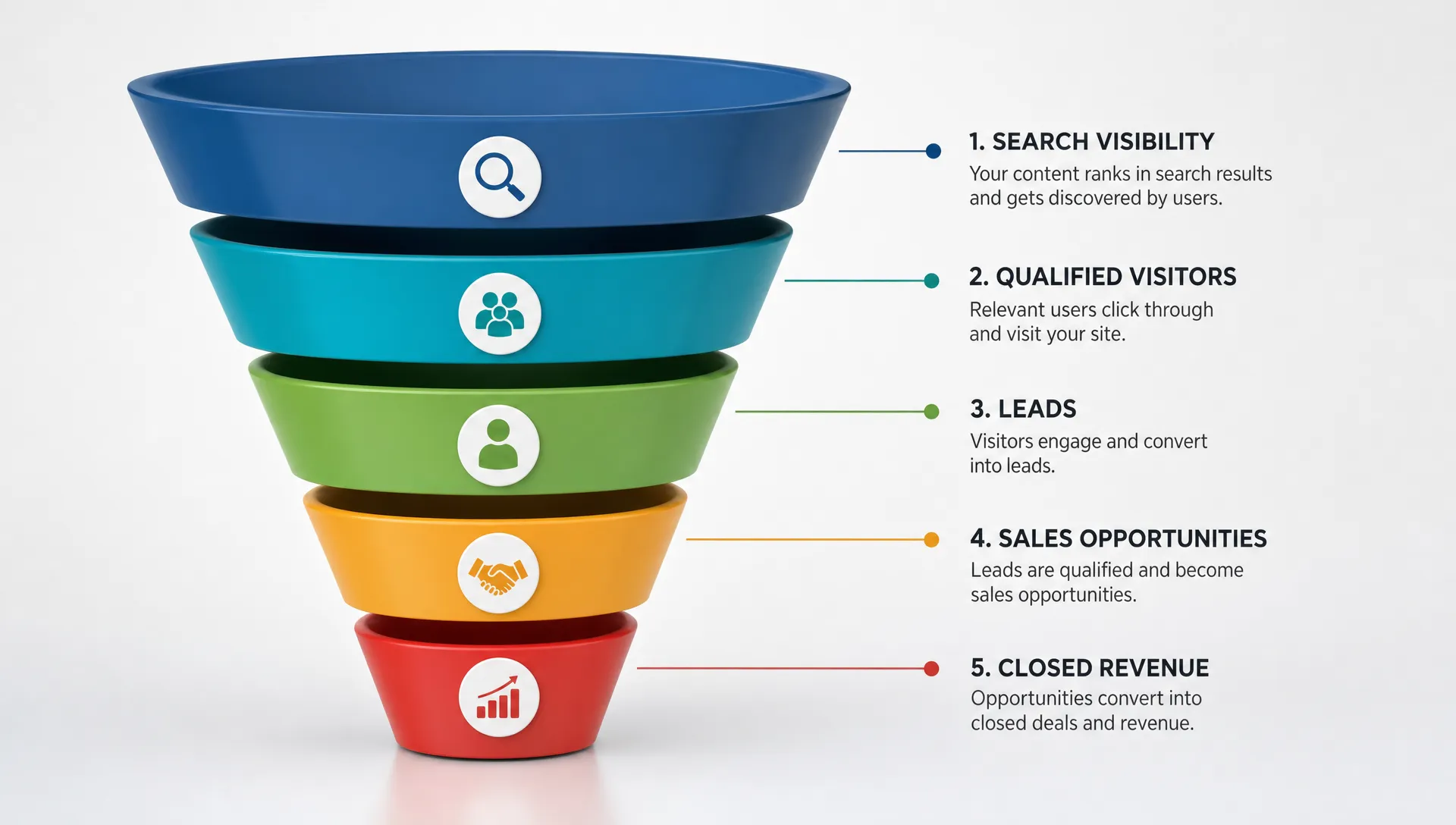
A B2B lead quality funnel showing search intent at the top, qualified website visits in the middle, and sales-ready opportunities at the bottom, with industrial and business service icons beside each stage, presented as a clean vertical diagram on a wall display.

Better SEO Creates a Better Sales Feedback Loop

Lead quality improves fastest when marketing and sales share information. SEO data can show which pages and keywords attract leads, but sales teams know whether those leads are actually valuable.

A smart SEO marketing service uses that feedback to refine the campaign. If organic leads from one page are consistently too small, too early, or outside your service area, that page may need stronger qualification language. If another page produces fewer leads but more serious opportunities, it may deserve more internal links, content support, or paid search reinforcement.

This feedback loop can include notes from sales calls, CRM status updates, form field analysis, call tracking insights, and close-rate data by landing page. Over time, the SEO strategy becomes more precise because it is based on revenue signals, not just rankings.

Because improving lead quality touches content writers, sales teams, web developers, and subject-matter experts, campaign coordination matters. Teams working inside Google Workspace can keep SEO tasks, page updates, and sales feedback organized with Google Workspace project management software, especially when multiple people are responsible for moving optimization work forward.

SEO Marketing Service vs. Basic SEO: The Lead Quality Difference

Not all SEO work is designed to improve lead quality. Basic SEO may focus on rankings, metadata, and traffic growth. Those are useful, but they are incomplete if the business needs better sales opportunities.

A lead-quality-focused SEO service connects optimization to pipeline outcomes.

Basic SEO focus Lead-quality SEO focus
Increase organic traffic Increase qualified organic inquiries
Rank for high-volume keywords Rank for buyer-intent keywords
Publish general blog content Build content around ICP pain points and buying stages
Track keyword positions Track lead source, conversion rate, MQL rate, and sales outcomes
Optimize pages for clicks Optimize pages for fit, trust, and action
Treat all visitors the same Segment content by industry, need, geography, or decision role

This does not mean traffic is unimportant. Traffic is still the top of the funnel. But in B2B marketing, the best SEO campaigns measure traffic in context. One hundred visits from the right buyers can be more valuable than ten thousand visits from people who will never purchase.

The Metrics That Reveal Lead Quality

If you only measure organic sessions and keyword rankings, you may miss whether SEO is improving the pipeline. Lead quality requires a more complete measurement system.

Useful metrics include organic conversion rate, qualified lead rate, MQL-to-SQL conversion rate, sales accepted leads, proposal requests, close rate, average deal value, and revenue influenced by organic search. For local or regional companies, phone calls, service-area matches, and form submissions by geography can also be important.

Metric Why it matters
Organic conversions by landing page Shows which pages generate inquiries
Qualified lead rate Separates useful leads from low-fit submissions
MQL-to-SQL rate Measures whether marketing leads become sales opportunities
Pipeline value from organic search Connects SEO to revenue potential
Close rate by source Shows whether organic leads turn into customers
Form completion quality Reveals whether prospects share enough useful information

The key is to judge SEO by business progress, not vanity metrics alone. A campaign that increases qualified opportunities by 20 percent may be more valuable than a campaign that doubles traffic but creates no new revenue.

For more practical ideas on improving fit after a lead enters your funnel, these actionable tips to improve lead quality are a helpful next step.

How SEO Supports B2B and Industrial Sales Cycles

Industrial and B2B buyers often take longer to convert. They research quietly, compare vendors, involve internal stakeholders, and revisit the website multiple times before contacting sales.

That makes SEO especially valuable. Paid campaigns can create immediate visibility, but organic content can support the long research process. A well-structured SEO strategy ensures your company appears when buyers first define the problem, when they compare options, and when they are finally ready to speak with a provider.

This is particularly important in competitive markets like Houston, where industrial services, engineering firms, manufacturers, logistics providers, and B2B technology companies may all compete for specialized searches. An SEO marketing service with B2B and industrial experience can help translate complex services into search-friendly content without oversimplifying the buyer’s needs.

The result is not just more website activity. It is more informed prospects who already understand your expertise before they fill out a form or make a call.

Signs Your SEO Is Attracting the Wrong Leads

If your sales team is busy but frustrated, your SEO may need a lead-quality review. Warning signs include a high number of form fills with low sales acceptance, inquiries from outside your service area, prospects asking for services you do not provide, repeated price-shopping behavior, or organic traffic growth with flat pipeline value.

Another sign is a mismatch between your best customers and your highest-traffic pages. If your most visited pages target broad educational topics but your strongest buyers search for specific services, your content strategy may be upside down.

A lead-quality-focused SEO review should examine which pages generate leads, what those leads look like, whether the messaging filters for fit, and where qualified buyers may be dropping off. Sometimes the fix is keyword strategy. Sometimes it is landing page clarity. Often, it is both.

What to Expect From a Lead-Quality SEO Strategy

A strong SEO marketing service should be able to explain how its work supports qualified lead generation. That means connecting research, content, technical improvements, analytics, and conversion strategy into one system.

The process typically starts with understanding your ideal customer profile, profitable services, sales cycle, competitive landscape, and current website performance. From there, the SEO team can prioritize pages and keywords that are more likely to attract buyers with real intent.

Over time, you should see stronger alignment between organic traffic and sales conversations. You may not always see overnight lead volume growth, especially in specialized B2B markets, but you should see better page engagement, more relevant inquiries, and clearer data on which SEO activities influence pipeline.

Frequently Asked Questions

How does an SEO marketing service improve lead quality? It improves lead quality by targeting buyer-intent keywords, creating content for the right audience, optimizing conversion paths, and using sales feedback to refine the strategy over time.

Is lead quality more important than traffic volume? For most B2B and industrial companies, yes. Traffic matters, but qualified traffic is what creates sales opportunities. A smaller number of high-fit visitors can be more valuable than a large audience with no buying intent.

How long does it take for SEO to improve lead quality? Some improvements, such as clearer landing pages and better calls-to-action, can help quickly. Broader gains from keyword targeting, content development, and authority building usually take several months.

Can SEO reduce unqualified leads? Yes. SEO can reduce unqualified leads by clarifying who your services are for, targeting more specific searches, improving page messaging, and using forms or calls-to-action that set better expectations.

What should a B2B company track besides rankings? B2B companies should track qualified lead rate, organic conversions by page, MQL-to-SQL rate, pipeline value, close rate, and feedback from the sales team.

Turn Organic Traffic Into Better Sales Conversations

An SEO marketing service improves lead quality when it is built around buyer intent, website clarity, technical performance, and sales feedback. Rankings are still important, but they are only one part of the bigger goal: attracting prospects who are more likely to become customers.

If your website is getting traffic but not enough qualified inquiries, B2B Inbound Marketing can help align SEO, inbound strategy, content, and conversion improvements around the leads your sales team actually wants. The right SEO strategy should not just make your business easier to find. It should make your best buyers more likely to choose you.

Website Optimization Services That Improve Conversion Rates - Main Image

Website Optimization Services That Improve Conversion Rates

More traffic is valuable only when the website is built to turn that traffic into opportunities. For many B2B and industrial companies, the real problem is not a lack of visitors. It is that the right visitors land on the site, browse for a few seconds, and leave without requesting a quote, booking a consultation, or contacting sales.

That is where website optimization services become different from basic web maintenance. Optimization is not just fixing broken links or refreshing a homepage banner. It is a structured process that improves visibility, user experience, page performance, messaging, and conversion paths so more visitors take the next step.

For Houston-area B2B companies, manufacturers, distributors, SaaS firms, and professional service providers, a conversion-focused website can support a longer sales cycle, educate multiple stakeholders, and generate qualified leads around the clock.

What website optimization services actually include

Website optimization is often misunderstood as a purely technical service. Speed, mobile performance, and code quality matter, but they are only part of the picture. A website can load quickly and still fail to convert if the offer is unclear, the navigation is confusing, or the contact form feels like work.

The most effective website optimization services connect three areas:

  • Search visibility so the right buyers can find the site.
  • User experience so visitors can understand the company and move through the site easily.
  • Conversion strategy so each important page encourages a measurable business action.

In practical terms, this may include technical SEO, landing page improvements, conversion rate optimization, analytics setup, mobile usability, content refinement, call-to-action updates, form optimization, and page speed improvements.

If your business already invests in SEO or PPC, optimization becomes even more important. Paid and organic traffic are expensive to earn. Every weak landing page, vague service description, or confusing form reduces the return from that investment.

Why conversion rate should guide website decisions

A website should not be judged only by sessions, rankings, or impressions. Those numbers matter, but they do not tell the full story. A B2B company can rank for valuable keywords and still lose revenue if visitors do not understand what to do next.

Conversion rate optimization, often called CRO, focuses on improving the percentage of visitors who complete a desired action. That action might be submitting an RFQ, calling a sales team, downloading a technical guide, requesting a demo, or filling out a proposal form. For a deeper introduction to the business value of CRO, see this overview of the importance and benefits of implementing conversion rate optimization.

The goal is not to pressure every visitor into an immediate sale. In B2B markets, buyers often compare vendors, gather specifications, involve purchasing teams, and return multiple times before contacting sales. A well-optimized website supports that process by answering questions clearly and reducing friction at every stage.

Core website optimization services that improve conversions

Technical performance and page speed

Slow websites lose attention fast. Page speed affects user experience, paid campaign performance, and organic search visibility. Google also uses Core Web Vitals to evaluate aspects of real-world page experience, including loading performance, interactivity, and visual stability, as explained in Google Search Central's Core Web Vitals documentation.

For conversion-focused optimization, technical work often includes compressing images, improving server response time, cleaning up unused scripts, reducing layout shifts, and making pages easier to crawl. These changes are not just technical wins. They help visitors reach key content without delay.

This is especially important for mobile users. Even in industrial and B2B sectors, buyers may first research vendors from a phone while traveling, attending a job site, or checking options between meetings. If the mobile experience is slow or hard to navigate, the lead may never return on desktop.

Search intent and content alignment

SEO brings visitors to the website, but the page must match what the searcher expected to find. Someone searching for industrial pump repair, B2B inbound marketing, custom fabrication, or SaaS implementation help is usually looking for a specific answer. If the landing page gives a generic company overview instead, the visitor may bounce.

Strong website optimization services review keyword intent, page structure, internal linking, headings, and calls to action. The question is simple: does each page satisfy the reason the visitor came?

For B2B companies, this often means creating or improving pages for specific industries, services, technical applications, buyer problems, and geographic markets. If lead generation is the goal, your SEO strategy should connect visibility to buyer intent, as explained in this article on how search engine optimization services drive B2B leads.

Landing page and message clarity

A visitor should understand what you do, who you help, and why you are credible within seconds. Many low-converting websites bury the value proposition under vague language such as solutions for your business or quality service you can trust. Those phrases do not explain enough.

Conversion-focused landing pages usually need:

  • A clear headline tied to the visitor's problem.
  • Supporting copy that explains the service in plain language.
  • Proof points such as certifications, project types, industries served, or testimonials.
  • Calls to action that match the visitor's stage of research.
  • Visuals that clarify the offer rather than decorate the page.

For example, a business selling technical or customized products should make product categories, specifications, ordering steps, turnaround expectations, and contact options easy to find. A site offering custom woven labels and patches shows why product clarity matters, because visitors often need to compare materials, formats, and use cases before they are ready to request or place an order.

The same principle applies to industrial service providers. If a maintenance manager needs emergency repair, the page should prioritize response time and contact options. If an engineering team is evaluating a long-term vendor, the page should provide capabilities, standards, case evidence, and technical depth.

High-impact optimization areas at a glance

Optimization area Why it affects conversion rate Common improvements Useful metrics
Page speed Visitors leave when pages feel slow or unstable Image compression, script cleanup, hosting improvements Load time, Core Web Vitals, bounce rate
Landing page copy Buyers need to quickly understand fit and value Clear headlines, stronger service descriptions, better proof points Engagement rate, form submissions, scroll depth
Calls to action Visitors need an obvious next step Better CTA text, improved placement, stage-based offers Click-through rate, lead rate
Forms Long or confusing forms create friction Fewer unnecessary fields, clearer labels, better mobile layout Form completion rate, abandonment rate
Mobile experience Many visitors research from phones or tablets Responsive design, readable text, tap-friendly buttons Mobile conversion rate, mobile engagement
Analytics Teams need reliable data to improve decisions Event tracking, goal setup, CRM source tracking Conversion rate, cost per lead, lead quality

A B2B marketing team reviews a website performance dashboard and landing page wireframes on a conference table, with charts showing visitor flow, lead forms, and conversion metrics.

Form optimization and lead capture

Forms are one of the most common places where leads are lost. A visitor may be interested, but if the form asks for too much too soon, has unclear fields, fails on mobile, or does not explain what happens after submission, conversion rates suffer.

In B2B, form strategy should match the value of the offer. A contact form for a sales conversation can ask for company name, email, phone number, and project details. A top-of-funnel guide or checklist should usually ask for less. The more effort you require, the more value you need to provide in return.

It also helps to add reassurance near forms. Simple details such as response time, who will follow up, or what information the sales team needs can reduce hesitation. For industrial buyers, a short note such as include pressure range, material type, application, or required delivery date may improve lead quality without making the form feel longer.

If your site is getting traffic but inquiries are declining, the issue may not be the market. It may be that the website is creating friction. This is one of the problems discussed in the article on why a website may be losing leads.

Trust signals that help B2B visitors take action

B2B visitors are risk-aware. They are not only asking whether you offer a service. They are asking whether your company can be trusted with a budget, deadline, compliance requirement, or operational problem.

Trust signals reduce that perceived risk. Depending on the business, these may include industry experience, certifications, safety records, client logos, testimonials, case studies, before-and-after examples, technical documentation, media mentions, or leadership credentials.

The key is relevance. A generic testimonial is less persuasive than proof tied to a specific problem or industry. A manufacturing company may benefit from showing equipment capabilities, quality processes, tolerances, and delivery experience. A B2B marketing agency may benefit from showing strategy, campaign structure, channel expertise, and measurable lead outcomes.

Trust also comes from consistency. If your ads promise one thing, your landing page says another, and your contact form leads to a vague thank-you page, confidence drops. Website optimization should make the entire path feel connected.

Analytics and testing turn opinions into decisions

Many website redesigns fail because decisions are based on preferences rather than evidence. One person likes a certain homepage layout. Another prefers a different call-to-action color. A third wants more copy above the fold. Without data, these debates can go in circles.

Optimization services should include measurement. At minimum, a business should know where leads come from, which pages assist conversions, which forms perform best, and where visitors exit. More advanced tracking can connect website behavior to CRM stages, revenue, or lead quality.

Testing does not always mean large, complex A/B testing programs. For many B2B websites, the first improvements come from fixing obvious friction. After that, controlled tests can compare headlines, CTA language, page layouts, form length, and offer types.

The strongest optimization programs combine qualitative and quantitative insight. Analytics show what is happening. Sales conversations, customer questions, heatmaps, and user feedback help explain why it is happening.

How website optimization supports SEO and PPC ROI

SEO and PPC are often treated as traffic channels, but their profitability depends heavily on the website experience after the click. If a paid search campaign sends buyers to a weak page, cost per lead rises. If an SEO page ranks well but lacks a clear next step, organic traffic becomes underused potential.

Website optimization improves marketing ROI by increasing the value of existing traffic. For example, if a landing page receives 2,000 monthly visits and converts at 1 percent, it produces 20 leads. Improving that rate to 2 percent doubles leads from the same traffic volume. That can be more efficient than doubling ad spend or waiting months for additional rankings.

For B2B companies with long sales cycles, the benefits can extend beyond the initial form submission. Better educational content can improve lead quality. Clearer service pages can reduce unqualified inquiries. Stronger trust signals can shorten early sales conversations. Better tracking can show which campaigns deserve more investment.

Signs your business needs website optimization services

Not every website needs a full redesign. Sometimes focused optimization is enough. Your company may benefit from professional optimization if you notice these issues:

  • Traffic is increasing, but leads are flat or declining.
  • PPC campaigns generate clicks but few qualified inquiries.
  • Important service pages have high bounce rates.
  • Mobile visitors convert far worse than desktop visitors.
  • Sales teams say leads are confused about services or pricing factors.
  • Forms receive spam, incomplete submissions, or low-quality inquiries.
  • The website looks professional but does not clearly explain value.

These symptoms often point to a mismatch between traffic, messaging, user experience, and conversion paths. Optimization helps identify where that mismatch occurs and what to improve first.

Choosing the right website optimization partner

The right partner should understand that conversion rate improvement is not one tactic. It is a combination of marketing strategy, technical execution, content quality, and measurement.

When evaluating website optimization services, ask how the provider diagnoses problems before recommending changes. A credible process should include analytics review, SEO review, page experience analysis, content evaluation, conversion path mapping, and discussion with your sales or leadership team.

You should also look for B2B experience if your sales process involves technical buyers, RFQs, long consideration cycles, or multiple decision-makers. B2B websites need different conversion paths than simple consumer ecommerce sites. A request a quote button, technical download, consultation form, phone call, and nurture sequence may all play different roles.

Finally, make sure optimization work is tied to business outcomes. A prettier website is not enough. The goal is more qualified leads, better campaign performance, clearer buyer journeys, and stronger return from SEO, PPC, and inbound marketing.

Frequently Asked Questions

What are website optimization services? Website optimization services improve a site's performance, search visibility, user experience, content, and conversion paths so more visitors take valuable actions such as calling, submitting a form, requesting a quote, or booking a consultation.

How do website optimization services improve conversion rates? They reduce friction and increase clarity. Common improvements include faster pages, clearer landing page messaging, stronger calls to action, better mobile layouts, simpler forms, trust-building content, and more accurate tracking.

Is website optimization the same as SEO? Not exactly. SEO focuses on helping the right visitors find your website through search engines. Website optimization includes SEO, but also addresses what happens after visitors arrive, including usability, page speed, content quality, and lead capture.

How long does it take to see results from conversion optimization? Some technical and form improvements can produce results quickly, especially on high-traffic pages. Larger gains from SEO, content changes, and testing usually build over time as more data is collected and more pages are improved.

Do B2B companies need different website optimization than B2C companies? Yes. B2B buyers often compare vendors, involve multiple stakeholders, and need technical or business justification before contacting sales. B2B optimization should support education, trust, lead quality, and a longer decision process.

Turn your website into a stronger lead generation asset

A high-performing website is not just visible. It is clear, fast, trustworthy, measurable, and built around the way your buyers make decisions.

B2B Inbound Marketing helps businesses improve online visibility and lead generation through SEO, PPC, inbound marketing strategy, social media marketing, web content writing, responsive web design, and website redesign services. If your website is attracting visitors but not producing enough qualified leads, focused optimization can help convert more of that attention into real business opportunities.

What Do CMO’s See As Their Biggest Challenges?

According to a recent IBM Survey:

Growth of Channels and Devices – connecting all of the various sales, marketing and business
intelligence systems to enable a coherent flow of information and analysis where and when it’s
needed
Customer Collaboration and Influence – building relationships between customers, sales teams
and customer service reps and delivering the right information to increase sales and reduce churn
Targeting – delivering the right content at the right time to support the purchase decisions of
potential customers and upgrade candidates
Big Data – leveraging proprietary and external data sources to quickly gather and analyze
marketing data to streamline sales and customer service processes and increase revenues
ROI Accountability – enabling executives to understand the value of marketing initiatives and
channels and make the right decisions
Alignment – making sure that sales and marketing messaging, qualification criteria and data
exchange are on the same page
Expertise – According to Forrester, 40% of CMOs state that their number one area in which to
improve board level influence is technology-savviness

B2B Sales cycle stats

Why Web Site Video SEO ?

After spending money and to produce an engaging video for your web site. With a well copywriter crafted a script that was engaging and effective. The video has helped you explain your value proposition in a clear and concise manner , usually in a min long video. When producing videos always make sure you show your web address, logo, phone .The next thing to do though.Distribute it to You Tube! and social media channels .

It’s always important to distribute any video that you produce to all the major video networks including You Tube, Metacafe, Revver, AOL Video, Yahoo Video, Etc …Etc. Also, post in your niche video sites that relate to your industry. Also, make sure to tie keyword tags to the video to help with organic web site SEO. The reason is that Google indexes video separately. So, if distributed properly and tagged correctly you may have two listings within Google. One with a link to your web site and one with a link to your YouTube video (which then links to your web site). It’s not a guarantee as some keywords can be very competitive. However, it’s very useful to always get your name out there and set yourself up in a position to get indexed by Google. We always help encourage our clients to take advantage of our Video SEO Distribution packages as it’s cost effective and very useful .

Video SEO Techniques

By Andy Alagappan : Call US for a FREE 30 MIN web site analysis and Video Strategy consulting @ 281-570-5804