


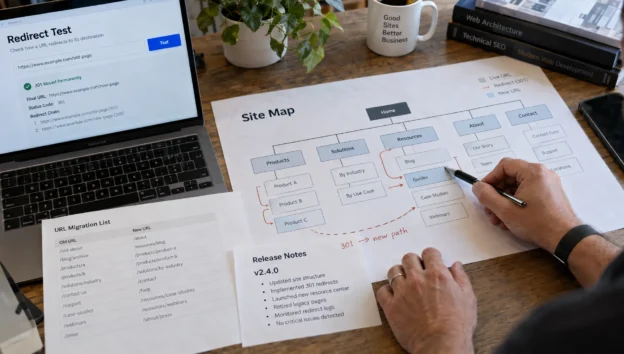
Searching for “web agency seo” can turn up convincing portfolios, impressive traffic charts and promises of a faster website. None of those proves an agency can diagnose an indexing problem, protect organic traffic during a redesign or work effectively with your developers.
For B2B and industrial companies, the consequences matter. An overlooked canonical tag can keep a product page out of search. A poorly planned migration can disconnect years of valuable backlinks from their destination pages. Before hiring, ask candidates to demonstrate how they investigate problems, prioritize fixes and verify production changes. This guide gives you a practical way to evaluate those capabilities without becoming a technical SEO specialist yourself.
What web agency SEO competence actually means
Technical SEO helps search engines discover, crawl, render and understand the pages you want customers to find. It also addresses technical conditions that affect page usability and search eligibility.
A capable agency should distinguish those responsibilities from content strategy, paid advertising and visual design. They overlap, but a redesigned homepage or a list of new blog topics does not resolve broken redirects or inaccessible product information.
The standard is not whether an agency can find warnings. It is whether it can prove a problem, recommend an appropriate fix and confirm that the fix works.
Ask candidates to explain a previous technical issue using that sequence. They should identify the affected pages, describe the evidence and explain what changed after implementation. Confidential client details can remain private. The diagnostic reasoning should still be clear.
Start with a live diagnostic, not a sales presentation
Give shortlisted agencies the same representative URLs: a service page, a product or category page and a page that concerns you. Include a URL from your existing site rather than allowing every demonstration to use a polished portfolio example.
Ask the person who would perform the work to walk through one URL. A useful demonstration might compare its HTTP response, source HTML, rendered content, indexing directives and internal links.
Listen for a distinction between observation and diagnosis. “This page has a canonical pointing elsewhere” is an observation. Explaining whether that canonical is intentional, which page should be indexed and what evidence supports a change demonstrates judgment.
A credible web agency SEO team should also acknowledge what it cannot establish from public access alone. Search Console data, server logs or CMS configuration may be needed before recommending a fix.
For an initial evaluation, use public pages and sanitized examples. If deeper investigation requires access, create named accounts with appropriate permissions. Do not share an administrator password simply to receive a proposal.
Ask for evidence that goes beyond a crawler export
Automated crawlers are useful, but they report symptoms and patterns. Their issue counts do not establish business impact, and their severity labels are not a substitute for analysis.
Request a redacted technical ticket, an implementation specification and a completed validation record. These artifacts reveal more about delivery capability than a slide listing familiar SEO tools.
| Evidence to request | What a strong example demonstrates | What should concern you |
|---|---|---|
| Technical finding | Affected URLs, reproducible evidence and likely impact | A warning copied from a tool without investigation |
| Prioritized backlog | Business relevance, dependencies and implementation effort | Every issue marked urgent |
| Developer ticket | Expected behavior, proposed change and acceptance criteria | Instructions such as “improve indexing” |
| Validation record | Production checks and relevant follow-up observations | A task closed immediately after deployment |
For example, a hypothetical duplicate-product ticket might explain which URL should remain indexable, why parameter versions exist and how canonical tags, internal links and sitemap entries should align.
This is where web agency SEO proposals become comparable: you can evaluate the quality of the work rather than the number of pages in the audit.
Test their understanding of crawling and indexing
Ask the candidate to explain what happens when an important product page is not appearing in Google. A sound investigation checks discovery paths, response status, crawling restrictions, indexing directives, canonical selection and page content before prescribing a solution.
Two distinctions are especially revealing. First, robots.txt controls crawling, not reliable removal from search results. If crawling is blocked, Google may not see a page-level noindex directive. Second, a canonical tag signals a preferred URL; it does not guarantee that Google will select it.
Ask how the agency would inspect those conditions using both site evidence and Search Console. Google’s documentation on robots meta tags and indexing controls provides a useful reference for checking their explanation.
A strong web agency SEO practitioner will not promise to index every URL. Filter combinations, internal search results and duplicate variants may not deserve independent search visibility.
Likewise, not every 404 response needs a redirect. A discontinued page with no relevant replacement may appropriately return 404 or 410. Redirecting every missing URL to the homepage is not a thoughtful recovery strategy.
The evaluation question is whether the agency can distinguish an intentional exclusion from a technical barrier affecting a commercially important page.
Check JavaScript rendering and performance knowledge
Modern websites can look complete in a browser while exposing different content or links during crawling and rendering. Ask the agency how it checks whether essential product descriptions, navigation and specifications are available to search engines.
Candidates should be able to compare initial HTML with rendered output and investigate content loaded only after interaction. They should also inspect whether important navigation uses crawlable links rather than relying entirely on scripted controls.
Performance requires similar precision. Ask them to distinguish laboratory tests from real-user field data. A single desktop Lighthouse score does not establish how mobile visitors experience your site.
Google’s Core Web Vitals guidance defines good thresholds as Largest Contentful Paint of 2.5 seconds or less, Interaction to Next Paint of 200 milliseconds or less and Cumulative Layout Shift of 0.1 or less, assessed at the 75th percentile. These metrics measure different aspects of experience, not an overall promise of rankings.
For a web agency SEO assessment, request one example showing the measured bottleneck, the proposed engineering change and the method used to verify improvement. “Install a caching plugin” is not a complete diagnosis, particularly when third-party scripts, image delivery or application code are responsible.
Verify that they can ship changes safely
Technical knowledge is insufficient if the agency cannot implement recommendations without creating new problems. Ask who modifies templates, approves changes, deploys releases and checks production afterward.
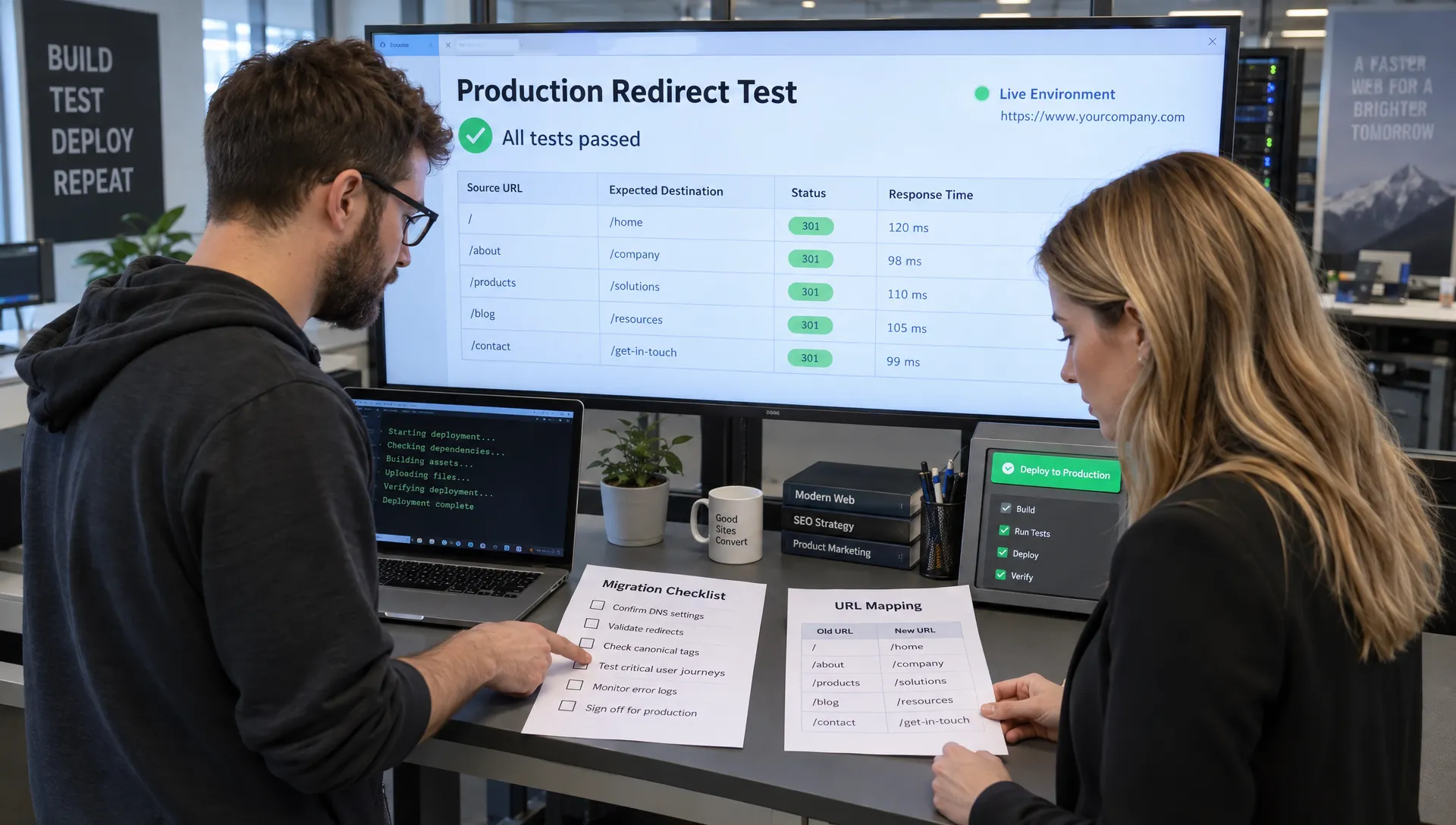
A useful test is a hypothetical website migration. Have the candidate explain how it would preserve valuable URLs and handle necessary changes. Expect discussion of URL mapping, relevant redirects, internal links, canonicals, sitemaps and prelaunch checks.
The agency should also explain how it prevents staging restrictions from reaching production. A launch can fail because a sitewide noindex directive remains active or important assets are blocked, even when the new design looks correct.
Reliable web agency SEO delivery includes a rollback plan and post-launch monitoring. Ask what would trigger a rollback, who can authorize it and how quickly the responsible team can act.
Acceptance criteria should be observable. For example: an old product URL redirects directly to its approved replacement, the destination returns a successful response and its canonical references the intended production URL. “Migration completed successfully” is too vague to verify.
Match the evaluation to your business model
An agency may be technically competent yet poorly matched to your website. A manufacturer with thousands of product variants needs different investigation priorities from a local service business with a small set of appointment pages.
For an industrial catalog, ask about faceted navigation, duplicate specifications, discontinued products and the relationship between HTML pages and downloadable PDFs. For a B2B services site, examine service-page discoverability, location-page differentiation and inquiry tracking.
To test adaptability, ask how priorities would change for a local practice such as Dr. Monica Filipescu’s digital orthodontics clinic in Bucharest. The discussion should shift toward making relevant service and location information accessible and preserving consultation paths, rather than assuming a large product-catalog problem. This is a comparison exercise, not a claim about that website’s technical condition.
A relevant web agency SEO evaluation connects technical choices to the way customers buy. If engineers search by part number and procurement teams request quotations, those journeys should influence which templates, links and conversion paths receive attention first.
Ask candidates to explain what they would deliberately deprioritize. Sensible exclusions often reveal more judgment than an expansive list of proposed work.
Put implementation ownership in writing
A technical audit can stall when the agency assumes your developer will implement everything and your developer assumes implementation is included in the agency fee.
Before approving work, establish who owns diagnosis, ticket writing, code changes, testing, deployment and monitoring. Identify which steps require your IT team, hosting provider or CMS vendor.
Document the client’s responsibilities too. These may include providing access, explaining product relationships, approving redirect mappings and scheduling development resources. An agency cannot responsibly decide whether two industrial components are interchangeable without subject-matter input.
For a web agency SEO engagement, the scope should distinguish recommendations from implemented changes. It should also explain how newly discovered issues enter the backlog and how priorities are approved.
Use the same discipline when reviewing what belongs in an SEO agency contract, especially around deliverables, account ownership and work performed outside the original scope.
You should retain control of your domain, hosting and primary analytics properties. Agency access should support delivery without making your business dependent on one vendor for basic account administration.
Require reporting that connects fixes to outcomes
Technical reporting should distinguish completed activity, verified changes and business results. These are related, but they are not interchangeable.
A closed ticket shows activity. A production check confirms implementation. Improved visibility or qualified inquiries may indicate business value, although other changes can influence those outcomes.
Ask for reporting by relevant page group rather than only sitewide totals. Product pages, service pages and resource articles can perform differently, and branded traffic can conceal weak performance for commercial searches.
Useful reporting might track the indexing eligibility of priority pages, organic landing-page performance and valid RFQ submissions. Analytics events should be tested so duplicate submissions or spam do not inflate apparent progress.
When comparing web agency SEO case studies, request the baseline, comparison period, affected pages and other major changes made during the same period. A traffic increase following a redesign does not prove every technical recommendation contributed to it.
For a more rigorous discussion of attribution and validation, review how to assess a website optimization provider’s testing methods. Strong candidates should explain uncertainty rather than attributing every favorable movement to their own work.
Use red flags to narrow the shortlist
Some problems should outweigh an attractive presentation:
- Guaranteed rankings or indexing: The agency cannot control Google’s final decisions.
- Proprietary scores presented as business results: A higher tool score does not prove more qualified demand.
- Unreviewed bulk changes: Sitewide directives and redirects require testing and approval.
- No access to the delivery team: Sales assurances cannot substitute for technical explanations.
- No production validation: A recommendation is not finished merely because someone deployed code.
Use a short, consistent scorecard across candidates: diagnostic reasoning, evidence quality, business relevance, implementation clarity and validation. Require acceptable answers on each rather than allowing a polished portfolio to compensate for unsafe practices.
If two candidates remain close, consider a paid, limited-scope diagnostic covering one important template or problem. The deliverable should include evidence, priorities, implementation requirements and acceptance criteria. That gives you a concrete basis for deciding before committing to a broader engagement.
Frequently asked questions
Does a web design agency automatically understand technical SEO? No. Visual design, development and search diagnostics are distinct capabilities. Ask who performs technical analysis and request examples of work that person has completed.
Which tools should a technically capable agency use? There is no mandatory commercial tool stack. Look for an appropriate combination of crawling, browser inspection, Search Console, performance testing and analytics. Server logs can help with some investigations. The important question is whether the tools support a sound diagnosis.
How quickly should technical fixes improve rankings? Implementation can be verified immediately, but search effects depend on recrawling, processing, competition and the nature of the issue. An agency should give you a verification schedule without guaranteeing a ranking deadline.
Should we hire an agency if our internal team handles development? Potentially. The agency can diagnose and specify changes while your developers implement them. Define the handoff, approval process and responsibility for post-release validation before work begins.
Choose demonstrated capability over promises
The strongest evidence is a clear chain from problem to diagnosis, implementation and verification. Ask every candidate to demonstrate that chain on work relevant to your business.
If you are evaluating SEO alongside a B2B website project, discuss your requirements with Andy Alagappan. Bring representative URLs, your platform details and your development constraints so the conversation starts with scope and evidence rather than generic promises.