

832-677-4620 / 281-570-5804
It's not about JUST BEING Online, Its about BEING FOUND Online

Category Archives: Uncategorized

How Search Engine Optimization Services Drive B2B Leads - Main Image

How Search Engine Optimization Services Drive B2B Leads

For B2B companies, the best leads often begin long before a prospect fills out a form or speaks with sales. A plant manager searches for a more reliable supplier. A procurement team compares technical specifications. A founder looks for software that solves a workflow problem. In each case, search is where intent becomes visible.

That is why search engine optimization services are not just about rankings. Done well, SEO connects your business with buyers who are already researching a problem, evaluating options, or preparing to contact a vendor. For B2B and industrial companies, this can turn a website from a digital brochure into a steady source of qualified opportunities.

Why SEO matters so much in B2B lead generation

B2B buying cycles are usually longer, more technical, and more committee-driven than consumer purchases. A prospect may visit your site multiple times, compare competitors, download resources, and review your expertise before ever making contact.

According to Gartner research on the B2B buying journey, buyers spend only a small portion of their purchase journey meeting with potential suppliers. Much of the decision-making happens independently through online research, internal discussions, and content review.

SEO helps your business appear during that independent research phase. If your website answers the right questions, proves credibility, and makes the next step easy, search traffic becomes a lead generation asset instead of just a traffic metric.

For companies that sell complex services, industrial products, SaaS solutions, or high-value B2B offers, visibility is not optional. If your business is not showing up when buyers search, competitors are shaping the conversation before your sales team gets a chance.

How SEO services turn search intent into B2B leads

Search engines reveal what buyers care about in real time. A prospect searching for industrial pump repair Houston has a different level of intent than someone searching how industrial pumps work. Both searches can matter, but they require different content, calls-to-action, and follow-up paths.

Professional SEO services help map those searches to the buyer journey. Instead of chasing every keyword with search volume, a strong B2B SEO strategy prioritizes terms that indicate business relevance, decision intent, and lead potential.

Buyer stage Search behavior SEO opportunity Lead generation goal
Awareness Searches symptoms, problems, or educational topics Publish helpful guides and explainers Build trust and attract early demand
Consideration Compares solutions, methods, vendors, or categories Create comparison pages and service content Capture qualified prospects researching options
Decision Searches providers, pricing signals, locations, case studies, or consultations Optimize landing pages and conversion paths Generate form fills, calls, quote requests, or meetings
Post-research validation Looks for reviews, expertise, credentials, and proof Strengthen authority content and brand visibility Reduce friction before sales contact

The value of SEO in B2B is not simply that it brings visitors. It brings visitors with context. A buyer arrives through a keyword that shows what they need, how urgent the need may be, and what information will move them closer to action.

The core SEO services that drive lead quality

Effective SEO is a system. Rankings, content, technical performance, analytics, and conversion strategy all support each other. When one part is weak, leads suffer.

Technical SEO makes your website easier to find and use

Before content can generate leads, search engines need to crawl, understand, and index your pages. Technical SEO addresses issues such as site structure, page speed, mobile usability, indexation, redirects, broken links, and schema markup where appropriate.

For B2B websites, technical problems can quietly block growth. A service page may not rank because it is buried too deep in the site. A slow landing page may lose buyers before the form loads. Duplicate or thin pages may confuse search engines about which page should rank.

Good technical SEO improves both search visibility and user experience. That matters because B2B buyers often review your website during work hours, on multiple devices, and under time pressure. If the site feels outdated, slow, or difficult to navigate, it can damage trust before the sales conversation starts.

If your team is still building the foundation, it can help to revisit the basics of search engine optimization fundamentals before investing heavily in content or paid campaigns.

Keyword strategy focuses on business intent, not vanity volume

Many businesses make the mistake of targeting broad keywords because they receive more searches. But in B2B SEO, a smaller-volume keyword can be far more valuable if it reflects a buyer with a specific need.

For example, an industrial company may get more value from ranking for custom metal fabrication for oil and gas equipment than from a broad term like metal fabrication. A software company may prefer CRM implementation consultant for manufacturers over CRM tips.

A B2B keyword strategy should consider:

  • Buyer role, such as engineer, procurement manager, operations leader, founder, or marketing director
  • Industry language, including technical terms, compliance requirements, part names, and service categories
  • Geographic intent, especially for regional service providers or Houston-based industrial businesses
  • Commercial signals, such as vendor, consultant, quote, service, supplier, agency, cost, or near me
  • Pain points that indicate urgency, such as downtime, low conversion rate, poor rankings, failed campaigns, or lost leads

The goal is to build a keyword map that reflects how real buyers search, not just what SEO tools show as high volume.

Content builds trust before the sales conversation

B2B prospects rarely convert after reading one page. They need evidence that your company understands their problem, has relevant experience, and can guide them toward a solution.

That is where content becomes a lead generation tool. Service pages capture commercial demand. Blog articles answer common questions. Case studies demonstrate results. FAQs remove friction. Comparison content helps prospects evaluate options. Technical resources support buyers who need to justify a decision internally.

Google’s own guidance encourages creating helpful, reliable, people-first content. For B2B companies, that means content should not be generic. It should reflect real industry knowledge, buyer objections, implementation concerns, and practical next steps.

A strong SEO content plan usually includes a mix of:

  • Core service pages that clearly explain what you offer and who it is for
  • Educational articles that answer early-stage buyer questions
  • Industry-specific landing pages for high-value verticals
  • Case studies or proof pages that support sales conversations
  • Conversion-focused pages for consultations, quotes, demos, or audits

When content matches the buyer journey, SEO does more than attract traffic. It warms up prospects so sales teams spend less time explaining the basics and more time discussing fit.

Conversion-focused SEO turns visits into leads

Traffic alone does not pay the bills. A page can rank well and still fail if visitors do not understand what to do next. That is why lead-focused SEO includes conversion rate optimization, not just keyword rankings.

A good B2B landing page should make the value proposition clear within seconds. It should explain who the service is for, what problem it solves, what makes the provider credible, and how the buyer can take the next step. Forms should be simple enough to complete, calls-to-action should be visible, and trust signals should be easy to find.

For industrial and professional service companies, common conversion actions include quote requests, consultation forms, phone calls, downloadable guides, newsletter signups, product inquiries, and assessment requests. Not all conversions are equal, but each one can help identify where a buyer is in the journey.

If your website already receives traffic but does not produce enough inquiries, the issue may not be visibility. It may be messaging, page layout, weak calls-to-action, or a complicated form. The article on whether your website is losing leads explores several practical fixes that can support stronger conversion performance.
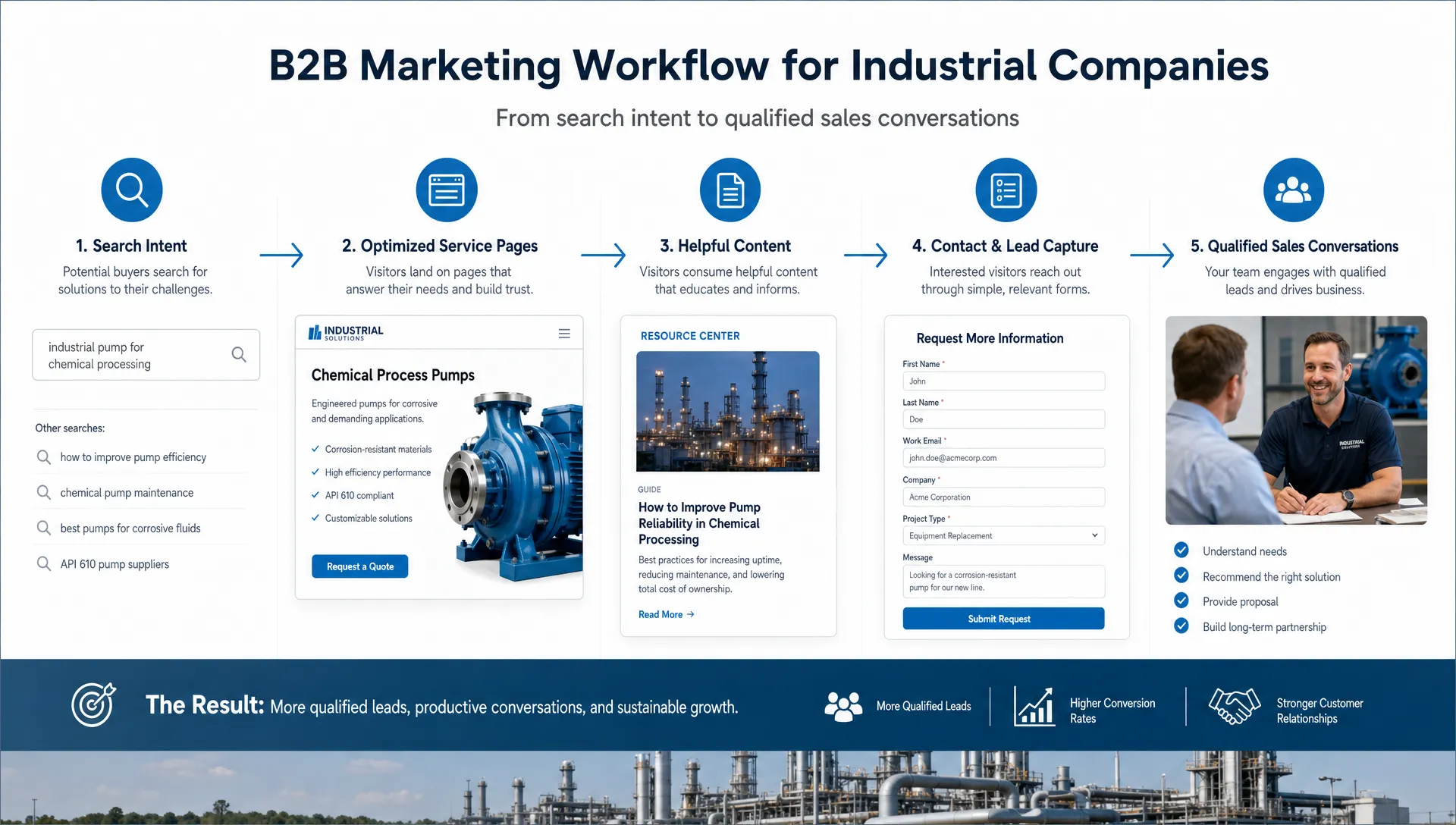
A B2B marketing workflow showing search intent flowing into optimized service pages, helpful content, contact forms, and qualified sales conversations for an industrial company.

Local and industry SEO can increase lead relevance

For many B2B firms, especially in Houston and industrial markets, location and industry relevance are major lead quality factors. A national keyword may bring traffic, but a regional or sector-specific keyword may bring buyers who are easier to serve and more likely to convert.

Local SEO can help companies appear for searches tied to a city, service area, or nearby supplier need. This includes optimizing location signals, service pages, business listings, and content that reflects local market expertise. For a Houston-based B2B company, this can be especially valuable when prospects prefer a partner familiar with regional industries such as energy, manufacturing, logistics, construction, engineering, or professional services.

Industry SEO goes a step further by aligning content with vertical-specific language. A general page about marketing services may attract broad interest. A page about industrial SEO for manufacturers, engineering firms, or B2B service providers can attract buyers who immediately recognize the relevance.

The more precisely your SEO strategy reflects the market you want to serve, the more likely your traffic is to become qualified leads.

SEO and PPC work better together for B2B demand

SEO is a compounding channel. PPC is a faster feedback channel. In many B2B campaigns, the two work best together.

PPC can test keyword intent, messaging, offers, and landing pages before SEO content has had time to rank. SEO can then use those insights to build long-term organic visibility around terms that prove they attract qualified traffic. At the same time, organic rankings can reduce dependence on paid clicks over time, while PPC can support priority campaigns, competitive keywords, and remarketing.

This is especially useful in B2B markets where search volumes are lower and every qualified lead matters. If a paid search campaign shows that a specific term produces strong quote requests, that keyword may deserve a dedicated SEO page. If an SEO article generates traffic but few leads, PPC landing page testing may reveal a better call-to-action.

For businesses weighing both channels, the guide on the benefits of SEO and PPC campaigns explains why combining them can improve visibility, traffic, and lead generation.

Measuring SEO leads the right way

B2B SEO measurement should go beyond ranking reports. Rankings matter because they create visibility, but the real business question is whether SEO is helping generate qualified pipeline.

At minimum, a B2B SEO program should track organic traffic, keyword growth, form submissions, phone calls, conversion rates, and assisted conversions. More mature programs should connect SEO activity to CRM data so the company can see which keywords, pages, and campaigns produce sales-qualified leads and revenue opportunities.

Metric What it tells you Why it matters for B2B leads
Organic sessions Whether search visibility is bringing visitors Shows audience growth from non-paid search
Ranking keywords Which topics and pages are gaining visibility Helps evaluate content and optimization progress
Organic conversions Forms, calls, downloads, or inquiries from SEO traffic Connects SEO to lead generation
Conversion rate by page Which pages turn visitors into leads Identifies pages that need stronger messaging or CTAs
Lead quality Whether inquiries match your ideal customer profile Prevents traffic growth from becoming a vanity metric
Pipeline influence Opportunities and revenue connected to organic search Shows the business impact of SEO

The most useful SEO reporting answers three questions: Are we attracting the right audience? Are those visitors converting? Are those leads valuable to sales?

For a deeper look at business impact, review the discussion on ROI benefits from an SEO campaign, especially if your leadership team needs to compare SEO against other marketing investments.

What to look for in B2B search engine optimization services

Choosing an SEO partner is not just about finding someone who can improve rankings. For B2B lead generation, the provider needs to understand your buyers, your sales cycle, and your commercial goals.

A strong SEO service provider should ask about your ideal customer profile, margins, sales process, geographic priorities, high-value services, competitive landscape, and current lead quality. If the conversation is only about traffic, backlinks, or keyword counts, the strategy may not be aligned with revenue.

Look for an approach that includes clear discovery, technical review, keyword strategy, content planning, on-page optimization, conversion recommendations, reporting, and ongoing refinement. B2B SEO is rarely a one-time project. Search behavior changes, competitors publish new content, and your business priorities evolve.

The best SEO campaigns become more effective over time because they build data. You learn which topics attract the right visitors, which landing pages convert, which offers generate sales conversations, and which industries respond best to your message.

Common mistakes that prevent SEO from generating leads

Many companies invest in SEO but do not see meaningful lead growth because the campaign is not connected to buyer intent or conversion strategy.

One common mistake is publishing blog content without supporting service pages. Educational articles may attract visitors, but if the site lacks strong commercial pages, buyers may not know what you offer. Another mistake is optimizing for broad keywords that bring unqualified traffic. This can make reports look positive while sales teams see little improvement.

Weak calls-to-action are also a major issue. If a buyer reads a helpful article but cannot easily request a quote, schedule a consultation, or find a relevant service page, the lead opportunity may be lost. Similarly, companies often ignore older content that already ranks. Updating those pages with better information, internal links, and clearer conversion paths can produce faster gains than starting from scratch.

Finally, some businesses measure SEO success too early or too narrowly. Organic search takes time, especially in competitive B2B markets. But once pages gain authority and rankings stabilize, they can produce leads month after month without paying for every click.

Frequently Asked Questions

How long does it take for SEO services to generate B2B leads? Most B2B SEO campaigns need several months to build momentum, especially if the website has technical issues, limited content, or strong competitors. Some improvements, such as optimizing existing pages or fixing conversion problems, can create earlier gains.

Are search engine optimization services better than PPC for B2B leads? SEO and PPC serve different roles. SEO builds long-term organic visibility and trust, while PPC can generate faster traffic and test offers. Many B2B companies get better results by using both channels together.

What makes B2B SEO different from consumer SEO? B2B SEO usually targets longer buying cycles, niche keywords, multiple decision-makers, and higher-value conversions. The content must educate, build trust, and support sales conversations, not just attract quick clicks.

How do you know if SEO leads are qualified? Track more than form volume. Compare organic leads against your ideal customer profile, sales conversations, opportunity creation, deal size, and close rate. CRM integration can make this much clearer.

Do industrial companies need SEO? Yes. Industrial buyers often research suppliers, specifications, services, and solutions online before contacting vendors. SEO helps industrial companies appear during that research and convert relevant searches into inquiries.

Turn search visibility into qualified B2B opportunities

B2B SEO works best when it is tied directly to lead generation. The right strategy helps your company appear for valuable searches, educate buyers, build credibility, and guide prospects toward a sales conversation.

If your business wants to improve rankings, attract better-fit visitors, and turn your website into a stronger lead generation channel, B2B Inbound Marketing can help with SEO, PPC, inbound strategy, web content, and related digital marketing services for B2B and industrial companies.

Stop Thinking of SEO as just “Keywords.”

Stop Thinking of SEO as just “Keywords.” It’s Your Entire Digital Infrastructure. 🛑
If your digital marketing strategy relies solely on “turning on ads,” you are building a house on rented land. Rent goes up, algorithms shift, and the moment you stop paying, the lights go out.
SEO isn’t a line item. It is the foundation of your brand’s digital authority.

Here is what actual, modern SEO looks like—and why skipping it is costing you revenue:

• 🏆 Top Keyword Rankings = Intent-Driven Traffic Being on Page 1 isn’t a vanity metric; it’s about capturing users at the exact moment they are ready to buy. If you aren’t there, your competitor is.
• 👁️ Strong Brand Visibility = Instant Trust Consumers rarely buy on the first touchpoint. Appearing consistently at the top of search results builds passive authority. When they see your name everywhere, you become the default choice.
• ⚡ Lightning-Fast Website Load Speed = Retaining Revenue A brilliant product won’t save a slow website. If your site takes longer than 3 seconds to load, half your traffic bounces. Speed is user experience, and Google rewards it.
• 🎨 Seamless UI/UX = Conversion Optimization Getting traffic to your site is only half the battle. A clean, intuitive User Interface (UI) and smooth User Experience (UX) turn casual browsers into paying customers. Good SEO gets them to the door; good UI/UX invites them in and closes the deal.
• 📍 Google Business Profile (GBP) Optimization = Owning the Local Market For local businesses, your GBP is your digital storefront. Optimizing your local
presence ensures you show up in the “Map Pack” precisely when nearby customers search for what you offer.

The Bottom Line

SEO isn’t a quick fix or a one-time project. It’s an appreciating asset. Every piece of optimized content, every speed upgrade, and every local review builds
an algorithmic moat around your business.

Invest in your organic presence today, or spend twice as much chasing rented clicks tomorrow.
Is your website working for you, or against you? Drop your URL below, and let’s do a quick audit. 👇
#DigitalMarketing #SEO #BusinessGrowth #WebDevelopment #UIUX #LocalSEO #ConversionRateOptimization

Develop a clear SEO value proposition

This guide delves into the essential components of crafting a compelling SEO value proposition, from identifying your unique selling points and utilizing keyword research to refining your messaging based on audience feedback and actionable insights. Discover the strategies that can elevate your brand and drive measurable results.

Frequently Asked Questions

What is a SEO value proposition and its benefits?
A SEO value proposition is a clear and concise statement that outlines the specific benefits a business offers through their SEO services. It is used to differentiate a business from its competitors and to tailor its message to a specific target audience.

How can I articulate the specific benefits I offer through my SEO services?
To articulate the specific benefits of your SEO services, you must first understand the needs and pain points of your target audience. Then, you can highlight how your services can address these concerns and provide tangible results such as increased website traffic, higher search engine rankings, and improved sales or leads.

Why is it important to differentiate myself from competitors in my SEO value proposition?
In today’s competitive market, it is crucial to stand out from the crowd. By differentiating yourself from your competitors in your SEO value proposition, you can showcase what makes your services unique and valuable, and why potential clients should choose you over others.

How do I tailor my message to my target audience in my SEO value proposition?
The key to tailoring your message to your target audience is to understand their demographics, interests, and pain points, ensuring relevancy and enhancing messaging clarity. This will allow you to create a message that resonates with them and speaks directly to their needs. You can also use language and tone that appeals to your specific audience, aligning with your overall SEO strategy and outreach strategy.

Can I have multiple SEO value propositions for different target audiences?
Yes, you can have multiple SEO value propositions for different target audiences, each with a focus on local SEO and trustworthiness. It is important to understand that different audiences may have different needs and priorities, so tailoring your message to each group can be beneficial in attracting and converting them into clients, enhancing brand loyalty and improving the customer journey.

Understanding SEO Value Proposition and Market Positioning

A well-defined SEO value proposition effectively conveys the significance of your content, facilitating the attraction and retention of the appropriate audience while enhancing search visibility and online reputation.

Definition and Importance of Communication Strategy

An SEO value proposition is a precise statement that articulates the unique advantages of your content, effectively communicating to users why they should engage with it.
To formulate a compelling SEO value proposition, it is essential to focus on addressing the audience’s pain points and demonstrating how your content provides solutions to these challenges. For example, HubSpot’s value proposition highlights the importance of inbound marketing, showcasing how its resources can effectively nurture leads.
It is important to incorporate keywords that are relevant to your niche while ensuring that the statement remains clear and impactful. Utilizing tools such as SEMrush can assist in the identification of appropriate keywords, while Google Analytics can aid in evaluating user engagement and refining your messaging as necessary, ensuring that it resonates effectively with the target audience.

Key Components of a Successful Content Strategy

The essential components of a compelling SEO value proposition encompass clarity, relevance, uniqueness, and measurable outcomes that effectively engage the target audience, thereby enhancing customer perception.
To develop an effective SEO value proposition, one should begin by ensuring clarity in messaging-removing jargon and employing straightforward language that directly addresses the target market while emphasizing the user-centric approach.
Next, it is crucial to emphasize relevance by conducting thorough market research on keywords and trends that align with audience needs, utilizing tools such as Google Trends and SEMrush.

Uniqueness can be achieved by establishing a distinct brand voice or offering innovative services, such as personalized content strategies and storytelling techniques.
Finally, it is important to define measurable outcomes by setting clear key performance indicators (KPIs), such as increased organic traffic and higher conversion rates, which enable the effective demonstration of success and ROI.

Articulating Specific Benefits and Enhancing Brand Identity
Articulating specific benefits requires identifying unique selling points and quantifying results with data to effectively convey value.

Quantifying Results

Quantifying results entails the systematic collection of data that illustrates the effectiveness of your SEO value proposition through measurable metrics.
To effectively track performance, it is advisable to utilize tools such as Google Analytics to monitor visitor behavior and identify traffic sources. Establishing goals within Google Analytics can facilitate the measurement of conversions, including sign-ups or purchases.

For a more in-depth analysis, Optimizely offers A/B testing capabilities to determine which on-page elements yield higher conversion rates, with pricing starting at $49 per month. For instance, a technology blog experienced a 30% increase in engagement following the testing of various call-to-action buttons on their landing pages.

Regularly reviewing this data allows for informed adjustments to your SEO strategy, ultimately enhancing your site’s performance and online visibility.

The SEO Value Proposition Metrics offer a comprehensive view of the critical factors influencing the effectiveness of SEO strategies, including the importance of user intent and goal setting. By examining these key areas, businesses can understand the impact of SEO on their online visibility, user engagement, and market competitiveness.
User Engagement and Performance metrics highlight that the average organic Click-Through Rate (CTR) is 10%, indicating the effectiveness of page titles and meta descriptions in attracting clicks from search results. A 50% industry average bounce rate suggests that half of the visitors leave after viewing only one page, which emphasizes the importance of content relevance, audience engagement, and user experience. With a median of 4.7 pages per session, users are engaging with multiple pages, which is a positive indicator of content engagement and site navigation.

• Market Insights: A 30% conversion impact from SEO underscores the power of organic traffic in driving business goals and revenue, demonstrating that well-implemented SEO can significantly influence conversions and enhance customer acquisition. The identification of common exit pages at 65% provides insights into where users are leaving the site, offering opportunities to optimize these pages for better retention strategies. A 5% improvement in keyword rankings signifies the ongoing need for keyword strategy optimization to enhance visibility and search rankings.
• Traffic Metrics: The 20% increase in organic traffic reflects successful SEO efforts in attracting more visitors through improved search engine rankings. A 60% SERP visibility score shows how often a site appears in relevant search results, indicating room for growth and a competitive edge in search landscapes.
• Backlinks and Authority: With an average domain authority of 70, the site is recognized as credible and trustworthy by search engines. A 15% growth in backlinks indicates successful link-building strategies, which are essential for enhancing domain authority and improving search rankings.

In summary, the SEO Value Proposition Metrics provide a detailed analysis of engagement, market insights, traffic, and authority. By leveraging these performance metrics, businesses can refine their SEO strategies to increase visibility, improve user experience, and enhance overall site performance, ultimately driving greater business success.

Tailoring Your Message

It is essential to tailor your message to suit your audience in order to maximize engagement and ensure that your SEO value proposition resonates with your target market, promoting communication effectiveness.

Defining Your Target Audience
Defining the target audience necessitates comprehensive demographic research, psychographic analysis, and an understanding of user intent to develop relevant content for lead generation.

To begin, it is advisable to utilize tools such as Facebook Audience Insights to analyze demographic factors, including age, gender, and location. For psychographic data, conducting surveys through platforms like Google Forms can provide valuable insights into interests and preferences. This information should be synthesized to create detailed customer personas.

For example, a fitness brand may discover that its audience primarily consists of health-conscious individuals aged 25 to 35, who are particularly interested in nutrition tips and workout routines, enhancing customer loyalty.

This understanding can effectively inform content creation, ensuring it resonates with the target audience and ultimately enhances engagement and conversion rates.

Gathering Feedback

Gathering feedback from your audience is essential for understanding their perceptions and enhancing your SEO value proposition accordingly, fostering user feedback.
To effectively collect feedback, it is advisable to employ various strategies. Utilizing tools such as SurveyMonkey for surveys can be beneficial, as it offers a free basic plan to create customized questionnaires. Additionally, actively monitoring social media platforms allows for the assessment of audience comments and sentiment.

To optimize an SEO strategy, it is advisable to begin by analyzing the website’s performance using Google Analytics, focusing on traffic generation and optimization techniques.
Attention should be directed toward metrics such as bounce rate and average session duration to gain insights into user engagement.

Subsequently, changes should be implemented based on A/B testing; for example, adjusting headlines or call to action buttons to determine which versions yield superior performance.
After modifications are made, it is crucial to measure the return on investment (ROI) through conversion tracking to confirm that the adjustments produce measurable results.
A case study of an e-commerce website demonstrated that consistent testing led to a 25% increase in conversions over a six-month period, highlighting the efficacy of this method in enhancing the sales funnel.

How often should I review and update my SEO value proposition?

It is recommended to review and update your SEO value proposition regularly, especially when there are changes in your target audience, market trends, or your own services, ensuring your efforts are aligned with business objectives and ROI. By keeping your value proposition relevant and up-to-date, you can continue to attract and retain clients for your SEO business, leveraging SEO tactics, keyword optimization, and content marketing for performance optimization.

10 Reasons Why Your Business Absolutely Needs SEO

10 Reasons Why Your Business Absolutely Needs SEO

Introduction

In today’s digital age, having a strong online presence is essential for the success of any business. One of the most effective ways to improve your online visibility and attract more customers is through Search Engine Optimization (SEO). In this blog post, we will discuss the top 10 reasons why your business absolutely needs SEO.

Reason 1: Increased Website Traffic

Having a well-optimized website allows search engines like Google to easily find and index your content. This means that when potential customers search for products or services related to your business, your website will appear higher in the search results, leading to increased organic traffic.

Reason 2: Improved User Experience

SEO involves optimizing your website’s design, structure, and content to provide a seamless user experience. A website that is easy to navigate, loads quickly, and offers valuable information will not only attract more visitors but also keep them engaged and encourage repeat visits.

Reason 3: Higher Brand Credibility

When your website ranks high in search engine results, it gives the impression that your business is reputable and trustworthy. Users tend to trust websites that appear on the first page of search results, which can significantly boost your brand credibility.

Reason 4: Better Conversion Rates

SEO helps to target specific keywords and phrases that are relevant to your business. By optimizing your website for these keywords, you can attract highly targeted traffic that is more likely to convert into paying customers. This can result in higher conversion rates and ultimately, increased sales and revenue.

Reason 5: Cost-Effective Marketing Strategy

Compared to traditional marketing methods such as print ads or TV commercials, SEO offers a cost-effective way to promote your business. While it may require an initial investment, the long-term benefits of SEO far outweigh the costs. Once your website starts ranking high in search results, you can enjoy a steady stream of organic traffic without having to spend money on advertising.

Reason 6: Stay Ahead of the Competition

In today’s competitive business landscape, it’s crucial to stay ahead of your competitors. By implementing effective SEO strategies, you can outrank your competitors in search engine results and attract more customers to your website. This gives you a significant advantage and helps you establish yourself as a leader in your industry.

Reason 7: Long-Term Results

Unlike other marketing strategies that provide temporary results, SEO offers long-term benefits. Once your website starts ranking high in search results, it will continue to attract organic traffic even if you reduce your SEO efforts. This means that you can enjoy sustained visibility and increased brand exposure for years to come.

Reason 8: Mobile Optimization

With the increasing use of smartphones, mobile optimization has become crucial for businesses. SEO includes optimizing your website for mobile devices, ensuring that it is responsive and user-friendly on all screen sizes. This is not only important for providing a positive user experience but also for improving your search engine rankings, as Google considers mobile-friendliness as a ranking factor.

Reason 9: Build Trust and Authority

When your website consistently appears in top search results, it builds trust and authority among users. People tend to trust search engines and assume that the websites appearing at the top are the most relevant and reliable. By investing in SEO, you can establish your business as an industry leader and gain the trust of potential customers.

Reason 10: Adapt to Changing Algorithms

Search engine algorithms are constantly evolving, and what works today may not work tomorrow. By staying updated with the latest SEO trends and best practices, you can adapt to these changes and ensure that your website remains optimized for search engines. This allows you to maintain your visibility and continue attracting organic traffic.

Conclusion

In conclusion, SEO is an essential strategy for any business looking to succeed in the digital landscape. From increasing website traffic to improving user experience and building brand credibility, the benefits of SEO are undeniable. By investing in SEO, you can stay ahead of the competition, attract more customers, and achieve long-term success.

Remember, your website is the online face of your business, and without proper optimization, it may remain hidden in the vast sea of the internet. So, don’t miss out on the opportunities that SEO can bring to your business. Start implementing effective SEO strategies today and watch your online presence soar!

This blog post was written by our talented team of SEO experts who are passionate about helping businesses thrive in the digital world.

How to Measure ROI in Social Media Marketing

How to Measure ROI in Social Media Marketing

Measuring return on investment (ROI) in social media marketing can be challenging, but it’s crucial for evaluating the effectiveness and success of your campaigns.

1. Track Website Traffic: A key metric to measure the ROI of social media marketing is website traffic. Monitor your website analytics to see how many visitors come from each social platform, and track changes in referral traffic over time.

2. Calculate Lead Generation: Analyze how many leads are generated from each social channel by tracking click-throughs from posts or ads that lead users directly to a form on your website.

3. Measure Engagement Levels: Look at the number of likes, comments, shares, and retweets for each post you make on different platforms as well as overall engagement levels with your brand across all channels combined. This will give you an idea of which types of content perform best on which networks and help inform future campaigns accordingly.

4. Compare Conversion Rates: Comparing conversion rates between different channels can also be useful in gauging the effectiveness of your efforts – compare sales numbers or sign-ups generated through Twitter versus those generated via Facebook, for example, to determine where most conversions are coming from and focus resources accordingly going forward.

Remember that measuring ROI in social media marketing is an ongoing process. Continuously monitor and analyze your metrics, make adjustments to your strategies, and refine your measurement methods based on the insights you gain.

Implement Demand Generation Campaign

Implement Demand Generation Campaign

Increasingly crucial for organizations seeking sustainable growth. Demand generation is a comprehensive marketing approach that combines multiple strategies and tactics to create awareness, interest, and ultimately drive revenue.

One of the primary benefits of demand generation campaigns is the alignment between sales and marketing teams. By working together towards common goals, these two departments can streamline processes and improve overall efficiency.

Moreover, demand generation allows businesses to target specific audiences more effectively through personalized content offerings. This not only helps in attracting potential customers but also fosters trust and credibility among them.

Additionally, successful demand generation campaigns are proven to increase brand visibility and engagement across various platforms. By leveraging social media channels, email marketing efforts, SEO optimization techniques, and innovative technologies like automation tools or chatbots – companies can stay ahead in their respective industries.

Lastly, data-driven insights derived from analytics play an essential role in refining future campaigns by identifying areas of improvement both operationally as well as strategically.

In conclusion: Implementing a robust demand-generation campaign is vital for organizations aiming to establish themselves as industry leaders while driving long-term revenue growth. With an integrated approach encompassing various aspects such as targeting the right audience segments with personalized messaging –

Maximize your marketing ROI with an effective demand generation campaign! Get ready to see significant growth in lead quality, conversion rates, and customer acquisition—learn how now! Businesses have enormous opportunities for success with demand generation campaigns!

Andy Alagappan 832.677.4620, Data-driven inbound marketing (epromotionz.lpages.co)

Benefits of SEO and PPC campaigns

Benefits of SEO and PPC campaigns

To maximize your online growth and revenue, implementing both SEO and PPC campaigns with increased visibility and brand recognition is a smart choice. Improving website traffic and obtaining a higher ROI becomes more effective compared to traditional advertising with targeted audience engagement. Additionally, better conversion rates are a significant advantage of combining both SEO and PPC.

Increased visibility and brand recognition
Optimizing SEO and running comprehensive PPC campaigns can enhance online visibility and brand recognition. These initiatives pave the way for your business to reach potential customers and increase website traffic organically. With effective placement in search engine results, businesses gain credibility and trust among consumers. Additionally, a strong PPC campaign aligns with the right keywords, potentially leading to higher conversion rates and a well-established foothold within the competitive market.

Moreover, SEO creates sustained long-term recognition while PPC builds immediate brand awareness through paid advertising campaigns. These techniques go hand-in-hand in bolstering your online identity while giving a significant boost to your digital marketing efforts.

It is essential for online businesses to prioritize an organic approach towards increasing brand reputation as it provides sustainable growth over time rather than pay-per-click advertising (PPC), which can be expensive on many occasions.

According to Statista’s study in 2021, Google accounts for 92.71% of worldwide internet searches. Thus proper optimization through SEO and advanced PPC campaigns helps optimize Google’s algorithm, making it more likely people will find what they’re looking for quickly and efficiently, ultimately improving overall user experience.

More website traffic means more potential customers, but also more potential for your server to crash and burn – just like your hopes and dreams.

Increased website traffic
By implementing SEO and PPC campaigns, the influx of visitors to your website can surge exponentially. The augmentation of website traffic can help you generate leads, conversions and revenue growth. Users who engage with your website through such campaigns tend to be a higher quality audience qualified by their interest in your services or products.

Alongside driving traffic through targeted organic and paid efforts, SEO boosts the usability of your website which can enhance user experience; engaging for them is paramount.

Investing in SEO focuses on creating informative content, relatable metatags containing keywords relative to your business and adjusting Keywords based on high performing queries.The goal is to appear at the top of search engine results pages but also offer solutions for the keyword used.

PAID PER CLICK (PPC), similarly focuses on targeting users with relevant ads; however, it ensures a guarantee through payment that those items will appear under prominent spots/portions/top positions/introduced websites/third party ads rather than solely depending on organic means.Evaluating keywords which have deep purchase intent receive larger investments since they lead directly towards sales.

Simply put, don’t snooze on an opportunity to choose between one over the other as both are effective enough separately; However when combined pack a double-sized punch! Companies promote their brand more effectively when utilizing these techniques together; naturally yielding more customers!

There was once a small leather jacket company which decided innovation was key in promoting their business.Having never implemented a PPC campaign alongside SEO before – they were hesitant about crossing platforms & shelling out extra coin for aggressive advertising measures.They finally did after discontent with dwindling sales numbers- low visitor engagement rates.Days after launching their first campaign, they saw numerous sign-ups and consistently arrived at number one searches. They now utilize both strategies regularly & share advertisements with strong ties to eachother!

Benefits of using case studies for software services

Benefits of using case studies for software services

To increase your credibility and trust, highlight the unique value proposition of your software service, address customer pain points effectively, and showcase success stories, you should use case studies. In this section, we’ll discuss the benefits of using case studies for software services and introduce four sub-sections that provide a deeper explanation of these benefits.

Increase credibility and trust

Case studies are a powerful tool for validating software services. Presenting concrete examples of successful implementation and impressive results can enhance an organization’s reputation, and confidence levels of potential clients and deepen their trust in the software provider. This is to say that case studies serve as proof points that deliver evidence-based demonstrations about how the specific service has benefited other clients.
Moreover, these success stories highlight real-world scenario challenges so that potential customers can appreciate the value proposition of the service. It helps if the case study features an organization operating within a similar industry, which allows potential buyers to get more insights into software usage and results despite possible differences in organizational setups and processes.

By offering first-hand accounts from satisfied customers, organizations using case studies amplify their trustworthiness to prospective customers compared to traditional marketing techniques. A well-crafted case study with verified data can foster a sense of comfort with buyers looking for significant investments by showcasing the benefits before any commitments are made.

According to Forbes (2022), featuring customer stories on websites improves lead quality and increases Website traffic by 56%.
Using case studies for software services is like finding a unicorn – a rare and valuable gem that showcases your unique value proposition.

Highlight unique value proposition

Crafting and showcasing a distinctive value proposition is significant to establish a successful brand identity. In the software industry, demonstrating the exceptional value of services is indispensable for gaining customers’ trust. Utilizing case studies for software services can be an effective way to highlight the essence of your service offerings.

Case studies are real-life examples that represent how your software service delivered value to a customer. These demonstrate how your service helped resolve the customer’s problem in a unique manner by showcasing facts, figures and testimonials. Also, they create credibility of your services and provide insight into how your team works on different challenges.

Incorporating case studies as a marketing strategy can benefit any size of a software company by illustrating personalized solutions in various situations and empowering easy dissemination of relevant information. With their help, businesses can showcase their expertise in solving complex business requirements and differentiate from competitors.

By leveraging comprehensive case studies, firms can make it easy for potential customers to visualize how they too can benefit from similar strategies. This high impact content presents clients with interactive ways to engage with your brand, which could potentially turn them into loyal patrons.

So, if you want to secure an edge over others and attract new prospects towards your software service offering, utilizing prominent case studies should be an integral part of your brand marketing strategy. It will enable you to create personalization at scale along with social proof that appeals highly to new audiences.
Addressing customer pain points is like acupuncture for software services – a little prick can go a long way in providing relief.

Omni channel demand generation

Demand generation is the process of creating interest in a product or service through marketing activities in omni channels.
It involves using various tactics, such as content creation, email campaigns, SEO + PPC Campaigns, webinars, and more to build brand awareness about the company’s offerings and attract potential customers.

The goal is to drive conversions from leads into paying customers.

Here are some steps that can be taken to implement a demand-generation strategy:

1) Identify target audience – Before you start any demand generation activity it’s important to have an understanding of who your target audience is. Researching your customer base will help you determine their needs so that you can create messaging that resonates with them.

2) Develop compelling content – Once you know who your target audience is, develop content pieces (like blog posts, eBooks or whitepapers) that will appeal to them. Content should be tailored to the interests and needs of the reader while also showcasing why they should choose your business over others in the industry.

3) Utilize digital channels – Take advantage of digital channels such as social media platforms like LinkedIn or Twitter for promoting your content pieces and engaging with potential customers directly. Additionally use search engine optimization techniques on all website pages so users can easily find what they are looking for when searching online for related topics or products/services offered by your business..

4) Measure results – Tracking metrics like page views, time spent on page/site visits etc., will give insight into how effective different strategies have been in generating demand among prospective customers. This data will allow businesses to adjust their approach accordingly if needed in order to maximize ROI from their efforts going forward.

Andy Alagappan 832.677.4620, Data-driven inbound marketing (epromotionz.lpages.co)

How to Boost Your Customer Acquisition Efforts on Facebook and Instagram

With over 3.5 billion active users combined, Facebook and Instagram have established themselves as essential social media platforms for businesses looking to engage with their audiences and acquire new customers. However, simply being present on these platforms isn’t enough to guarantee success. A well-thought-out customer acquisition strategy is critical for standing out from the competition and growing your business.

To help you achieve your customer acquisition goals on Facebook and Instagram, we’ve put together some fresh and unique tips that go beyond the standard advice you often hear.

Create a Compelling Brand Story

A compelling brand story is the foundation of any successful customer acquisition strategy. Your brand story should capture the essence of your brand and communicate why it matters to your audience. This can be achieved through creative storytelling techniques, such as using authentic customer stories or creating a compelling narrative around your brand’s mission.

Build a Community Around Your Brand

One of the most effective ways to acquire new customers on Facebook and Instagram is to build a community around your brand. This means creating content that encourages engagement and fosters a sense of belonging among your followers. Host giveaways, contests, and other interactive experiences to incentivize your followers to engage with your brand and share it with others.

Leverage Influencers and Collaborations

Partnering with influencers and other brands can help you reach new audiences and acquire customers more efficiently. Collaborating with influencers can be particularly effective in niches where influencers have a significant impact, such as beauty or fitness. By tapping into their established audiences, you can quickly expand your reach and acquire new customers who are already interested in your product or service.

Use Retargeting and Lookalike Audiences

Retargeting and lookalike audiences are two powerful tools that can help you acquire new customers on Facebook and Instagram. Retargeting allows you to show ads to people who have already engaged with your brand or visited your website, while lookalike audiences allow you to target people who are similar to your existing customers. By using these tools, you can ensure that your ads are being shown to people who are most likely to be interested in your product or service.

Use Video Content

Video content is a highly effective way to grab the attention of your target audience and convey your brand message in a dynamic and engaging way. In fact, studies show that video content on Facebook and Instagram receives higher engagement rates compared to other types of content. Experiment with different video formats, such as product demos, behind-the-scenes footage, or customer testimonials to see what resonates best with your audience.

Run Promotions and Offers

Everyone loves a good deal, and promotions and offers are a great way to incentivize people to try your products or services and ultimately, boost customer acquisition. To make your promotions more effective, consider offering a discount or freebie that is only available for a limited time. This creates a sense of urgency that encourages people to take action and try your brand..

Provide Exceptional Customer Service

Customer service is a critical component of any successful business, and it’s especially important when it comes to customer acquisition on social media. Make sure you are responding to customer inquiries and comments promptly, and providing helpful and informative responses that demonstrate your commitment to customer satisfaction.

Analyze Your Results

Finally, it’s essential to analyze your results to understand what’s working and what’s not when it comes to customer acquisition on Facebook and Instagram. Use analytics tools to track your performance metrics, such as engagement rates, click-through rates, and conversion rates, and make adjustments to your strategy accordingly.

In addition to these strategies, there are a few other things to keep in mind when it comes to customer acquisition on Facebook and Instagram:

• Stay on top of trends: Social media platforms are constantly evolving, and it’s essential to stay up-to-date with the latest trends and best practices. Make sure you’re following industry thought leaders, attending relevant conferences and events, and reading industry publications to stay informed.
• Build relationships with your audience: Social media is a two-way conversation, and it’s important to build relationships with your audience by engaging with them on a regular basis. Respond to comments and messages promptly, ask for feedback, and show your appreciation for your followers by sharing user-generated content or hosting giveaways.
• Be authentic: Finally, it’s important to be authentic and genuine in your social media efforts. Your audience can sense when you’re being insincere or inauthentic, so make sure your messaging and branding are consistent and true to your values.

Ultimately, the best types of promotions and offers will depend on your brand and target audience. Consider experimenting with different tactics to see what resonates best with your audience and drives the most conversions.

Wrapping up… Facebook and Instagram offer a wealth of opportunities to acquire new customers and grow your business. Remember to stay authentic and engaging with your audience and always prioritize their needs and preferences. With persistence and a bit of creativity, you can achieve long-term success on these platforms.