

Organic search engine optimization is one of the few marketing investments that can keep producing value long after the first campaign is launched. For B2B and industrial companies, that matters. Buyers often research quietly for weeks or months, compare technical options, involve multiple decision-makers, and return to search several times before they ever contact a supplier.
Paid ads can create immediate visibility, but organic SEO builds a durable presence where your prospects are already looking. The goal is not simply to rank for more keywords. The goal is to become discoverable, credible, and useful at every stage of the buyer journey.
What organic SEO really means for long-term growth
Organic SEO is the practice of improving your website so search engines can understand, trust, and rank your pages without paying for each click. It includes content strategy, technical website improvements, on-page optimization, internal linking, authority building, and conversion planning.
For a B2B company, organic SEO should connect three things:
- What your ideal customers are searching for
- What your company is genuinely qualified to solve
- What content, pages, and site structure help turn searchers into leads
That last point is important. Traffic without fit is a vanity metric. A manufacturer, engineering firm, SaaS provider, distributor, or industrial service company does not need random visitors. It needs the right prospects, with the right problems, at the right stage of evaluation.
If you need a simpler framework for the discipline, this overview of SEO’s three core building blocks, content, code, and credibility, is a useful foundation: what search engine optimization is and how it works.
Why organic search compounds over time
A strong organic search program works like a business asset. Each helpful page can rank, attract visitors, answer questions, support sales conversations, and strengthen the relevance of related pages. Over time, a well-structured site can build topical authority in the markets it serves.
That compounding effect is especially valuable in B2B because the same questions come up repeatedly. Prospects search for product specifications, industry standards, installation considerations, maintenance issues, pricing factors, comparison points, vendor qualifications, and proof of experience. If your website answers those questions clearly, it can influence buyers before your sales team ever joins the conversation.
The value is not limited to top-of-funnel education. Organic search can support the entire pipeline, from early problem discovery to supplier selection.
| Growth factor | How organic SEO supports it | Why it matters for B2B companies |
|---|---|---|
| Visibility | Helps your pages appear for relevant searches | Buyers can find you before they know your brand |
| Trust | Publishes useful, specific, expertise-driven content | Technical buyers want evidence and clarity |
| Lead quality | Targets intent, not just broad traffic | Better alignment between searchers and services |
| Sales enablement | Creates pages sales teams can share | Content answers common objections and questions |
| Cost efficiency | Reduces dependence on paid clicks over time | Organic traffic can keep producing after publication |
This is why organic SEO should not be treated as a quick campaign. It is a long-term growth system.
Organic SEO vs. paid search: why the best strategy often uses both
Organic search and paid search are not enemies. In many cases, they work best together. Paid search can help you test messaging, generate visibility for competitive terms, and capture immediate demand. Organic search builds the foundation for sustainable discovery and credibility.
The difference is in how the value is created.
| Channel | Strength | Limitation | Best use |
|---|---|---|---|
| Paid search | Fast visibility and precise targeting | Traffic often stops when spend stops | Launches, high-intent offers, market testing |
| Organic SEO | Compounding visibility and trust | Requires time, consistency, and technical discipline | Long-term lead generation and authority building |
| Inbound content | Educates and qualifies prospects | Needs strong distribution and optimization | Complex B2B buying journeys |
| Website optimization | Improves conversion from all channels | Requires ongoing testing and refinement | Turning traffic into inquiries and opportunities |
For companies with long buying cycles, the smartest approach is usually not choosing one channel forever. It is using paid search where speed is needed and organic SEO where durability is needed.
Start with search intent, not search volume
One of the most common organic SEO mistakes is chasing the largest keywords without asking whether those searches can realistically become business opportunities. A broad keyword may bring traffic, but a precise query may bring a qualified prospect.
For example, an industrial company might be tempted to target broad terms such as “valves,” “automation,” or “metal fabrication.” Those terms are competitive and vague. A more strategic approach might target searches tied to application, industry, problem, location, specification, or vendor evaluation.
Search intent typically falls into four practical categories:
- Informational intent: The prospect is learning about a problem or process.
- Commercial intent: The prospect is comparing methods, products, or providers.
- Transactional intent: The prospect is ready to request a quote, consultation, demo, or supplier conversation.
- Navigational intent: The prospect is looking for a known company, product, or resource.
The best organic SEO strategies map content to all four. Early-stage content builds awareness. Comparison and application pages support evaluation. Service and product pages convert demand.
Search intent is not limited to industrial markets. A site offering Mexico tours and travel has to organize content around different needs such as destinations, day tours, private tours, transfers, and multi-day experiences. B2B companies should apply the same discipline to product categories, applications, industries, service areas, and buyer questions.
Build the right organic growth assets
Long-term SEO growth depends on having the right pages on your website. Blog posts matter, but they are only one part of the picture. A strong B2B site usually needs a mix of commercial, educational, and trust-building content.
| Page type | Purpose | Example use case |
|---|---|---|
| Core service pages | Explain what you offer and who it helps | SEO services for industrial companies |
| Product or category pages | Capture demand for specific solutions | Custom fabrication, components, software modules |
| Application pages | Match searches tied to use cases | Corrosion control for marine environments |
| Industry pages | Show relevance to a vertical market | Marketing for manufacturers, energy, logistics, SaaS |
| Educational articles | Answer research-stage questions | How to choose a supplier, compliance considerations |
| Comparison pages | Help buyers evaluate options | In-house vs. outsourced service, product A vs. product B |
| Proof pages | Build credibility | Case studies, certifications, project examples |
The strongest sites connect these assets through internal links. An educational article should not sit alone. It should guide the reader toward a related service page, industry page, resource, or next step. That structure helps both users and search engines understand the relationship between your content.
Technical SEO turns good content into discoverable content
Even excellent content can underperform if the website is difficult for search engines to crawl or difficult for users to navigate. Technical SEO is the infrastructure behind organic growth.
Important technical priorities include clean URL structures, fast-loading pages, mobile usability, indexable content, logical headings, structured internal linking, accurate metadata, image optimization, and clear calls to action. None of these elements should be treated as isolated tasks. They affect how people experience the website and how search engines interpret it.
This is also where design and SEO overlap. A beautiful website that buries important content, loads slowly, or makes conversion difficult will limit organic growth. A search-optimized website should help visitors find what they need quickly and understand what to do next. That is why web design and search engine optimization should be planned together from the start.
Credibility matters more in competitive B2B markets
Organic rankings are not built on content volume alone. Search engines also evaluate signals of credibility, usefulness, and authority. In competitive B2B markets, trust can be the difference between a page that ranks and a page that disappears.
Credibility can come from many legitimate sources: expert-written content, detailed service information, original insights, clear author or company expertise, customer proof, certifications, industry associations, case studies, strong internal linking, and relevant third-party mentions.
For industrial and technical companies, specificity is a major trust signal. Generic content such as “we offer high-quality solutions” does very little. Better content explains materials, tolerances, safety considerations, regulatory issues, implementation challenges, maintenance needs, or procurement factors. It reflects the reality of the buyer’s work.
This is where subject matter expertise becomes a competitive advantage. Marketing teams can optimize structure and language, but the best content often starts with interviews, sales call notes, customer questions, field experience, and technical documentation.
Measure organic SEO by business impact, not rankings alone
Rankings matter, but they are not the whole scorecard. A keyword ranking can look impressive while producing little business value. A long-tail page with modest traffic can produce highly qualified leads.
The right metrics depend on the company, sales cycle, and website maturity, but a balanced organic SEO dashboard should include both leading and lagging indicators.
| Metric | What it tells you | Why it matters |
|---|---|---|
| Organic impressions | Whether search visibility is expanding | Early sign of search market reach |
| Qualified organic clicks | Whether the right people are visiting | More useful than traffic volume alone |
| Rankings for intent-rich terms | Whether strategic pages are gaining traction | Shows progress on business-relevant searches |
| Engagement by page type | Whether visitors find content useful | Helps refine content and internal links |
| Organic form submissions or calls | Whether SEO is creating direct leads | Connects visibility to demand generation |
| Assisted conversions | Whether SEO supports longer buyer journeys | Important for B2B sales cycles |
| Pipeline or revenue influence | Whether organic search contributes to growth | The ultimate business measure |
It is also important to segment performance. A blog article, product page, case study, and service page should not all be judged the same way. Each plays a different role in the journey.
Avoid shortcuts that damage long-term growth
Because organic SEO takes time, shortcuts can be tempting. But tactics such as thin AI-generated content, irrelevant backlinks, doorway pages, keyword stuffing, and copied competitor pages usually create risk instead of durable growth.
Shortcuts often fail for a simple reason: they optimize for the algorithm while ignoring the buyer. Sustainable SEO does the opposite. It starts with the buyer’s problem and then makes the content accessible, technically sound, and credible for search engines.
If your goal is lasting visibility, the safer path is to build steadily. Publish useful pages. Improve weak content. Strengthen technical performance. Earn relevant links and mentions. Add proof. Clarify conversion paths. Review performance and adjust. This is the same principle behind improving rankings through sustainable methods rather than hacks, as explained in this article on how to improve search engine rankings without shortcuts.
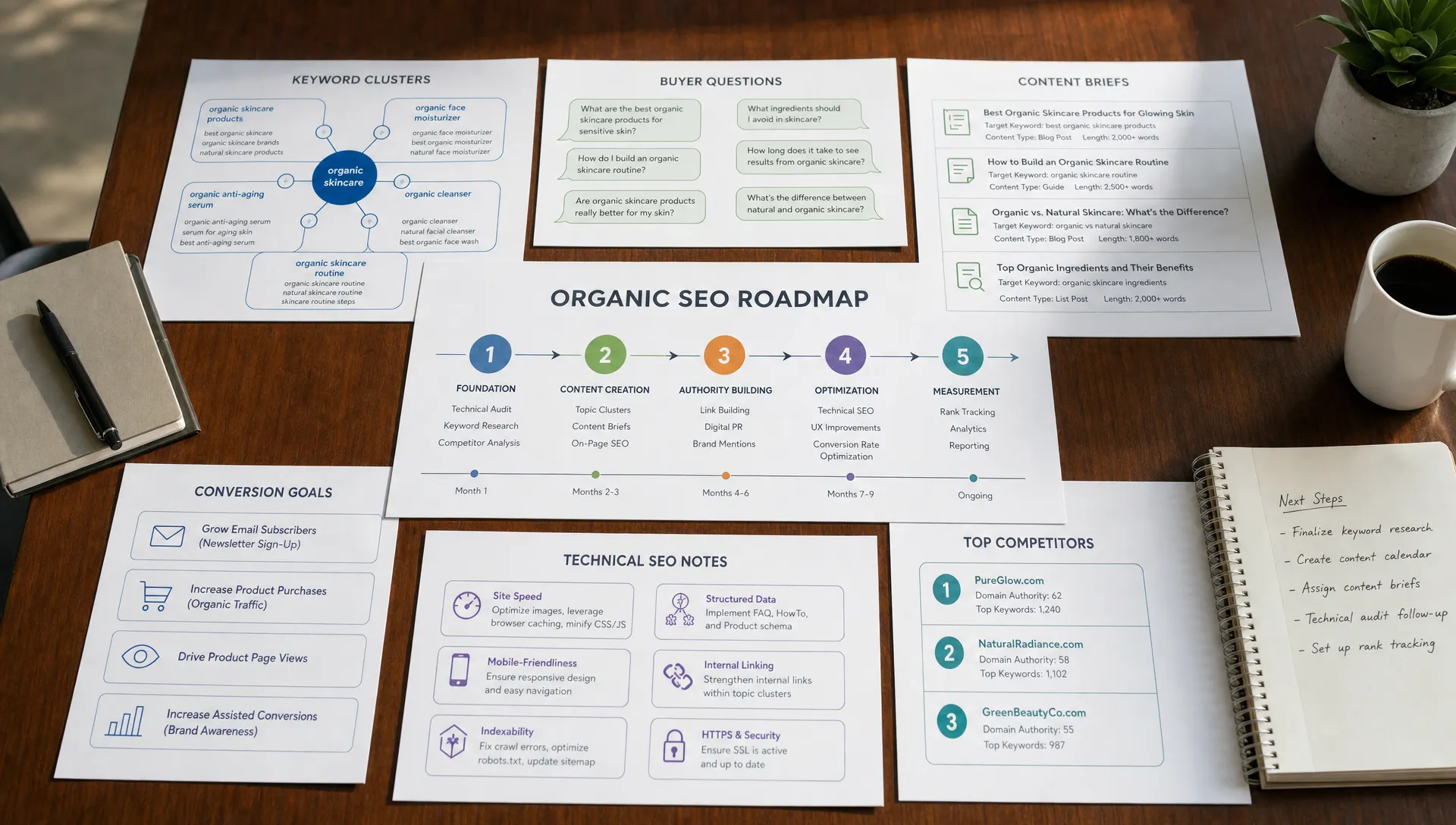
A practical 90-day organic SEO roadmap
Long-term growth does not mean waiting a year to take action. A focused 90-day plan can create momentum while building the foundation for future gains.
| Timeline | Priority | What to accomplish |
|---|---|---|
| Days 1 to 30 | Audit and strategy | Review technical issues, rankings, competitors, analytics, lead sources, and buyer intent |
| Days 31 to 60 | Page optimization | Improve priority service pages, metadata, headings, internal links, calls to action, and content depth |
| Days 61 to 90 | Content expansion | Publish or refresh high-intent articles, application pages, FAQs, and supporting resources |
This kind of roadmap works best when it is tied to revenue goals. Instead of asking, “How do we get more traffic?” ask, “Which organic searches could bring the right prospects into our sales process?”
That question changes the strategy. It leads to better keyword selection, stronger page planning, more useful content, and clearer conversion paths.
What long-term organic growth requires from your team
Organic SEO is not only a marketing task. It often requires input from leadership, sales, operations, technical teams, and customer-facing staff. Sales teams know the objections. Engineers know the specifications. Service teams know the recurring problems. Executives know the market direction.
When that knowledge is turned into optimized content, your website becomes more than a digital brochure. It becomes a search-visible sales asset.
The companies that win organic search over time usually share a few habits. They document buyer questions, update old content, improve page quality, track lead outcomes, and treat SEO as an ongoing business process. They do not stop after publishing a few blog posts.
Frequently Asked Questions
How long does organic search engine optimization take to show results? Most companies should expect meaningful progress over several months, not days. Timelines depend on competition, site quality, technical issues, content depth, and authority. Early gains may appear through better indexing and improved pages, while stronger lead growth usually requires sustained effort.
Is organic SEO better than PPC for B2B lead generation? It depends on the goal. PPC is useful for fast visibility and controlled targeting. Organic SEO is better for long-term visibility, trust building, and reducing dependence on paid clicks. Many B2B companies benefit from using both channels strategically.
What type of content works best for industrial SEO? Specific, expertise-driven content usually performs best. Application pages, product category pages, technical explainers, comparison articles, FAQs, case studies, and service pages can all support industrial SEO when they match real buyer intent.
Can SEO help a local Houston B2B company compete nationally? Yes, but the strategy must be deliberate. Local visibility can support regional lead generation, while industry, application, and service content can help reach national buyers. The website needs strong structure, clear positioning, and content that proves relevance beyond geography.
Turn organic search into a growth channel
Organic SEO is not a one-time project. It is a long-term system for being found, trusted, and chosen by the right buyers. For B2B and industrial companies, that system can support stronger visibility, better lead quality, and more efficient growth over time.
B2B Inbound Marketing helps businesses improve online visibility through SEO, PPC, inbound strategy, social media marketing, web content, and website-related marketing services. If your company wants to build a more durable search presence, now is the time to make organic SEO part of your growth plan.