

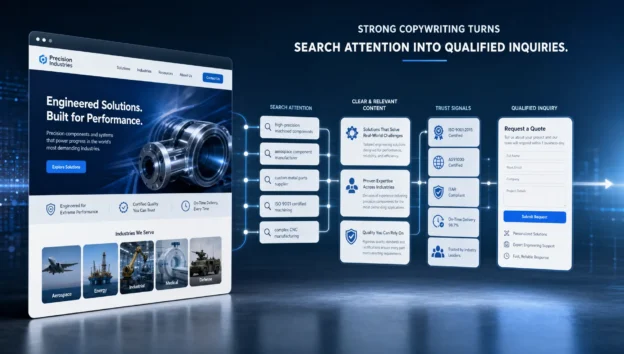
Getting found is only half the job. If your page earns a click but leaves the visitor unsure, skeptical, or stuck, SEO has created attention but not a business opportunity. Strong copywriting SEO closes that gap by helping the right people understand your value, trust your expertise, and take the next step toward an inquiry.
For B2B and industrial companies, this matters even more. Your visitors may be engineers, plant managers, procurement teams, distributors, owners, or operations leaders. They are not looking for clever slogans. They are looking for proof that you understand their problem, can meet their requirements, and will make the buying process easier.
The goal is not to write more words. The goal is to write the right words in the right order, with enough search relevance to be found and enough persuasive clarity to convert.
Why copywriting SEO must focus on inquiries, not just traffic
A visit is a weak metric by itself. A qualified inquiry is much closer to revenue. That is why SEO copy should be built around two questions at the same time:
- What is this buyer searching for?
- What does this buyer need to believe before contacting us?
Many companies answer the first question with keyword research, then stop. They create pages that mention the target phrase, explain the service in general terms, and hope the contact form does the rest. That approach can bring impressions and clicks, but it often fails to generate serious inquiries because the copy does not reduce risk for the buyer.
A good SEO page should qualify, educate, and persuade. It should tell visitors whether they are in the right place, show why your company is credible, and make the inquiry step feel logical. This is especially important when the sale involves custom specifications, long buying cycles, technical review, or multiple decision makers.
If your business already invests in search visibility, it is worth connecting that visibility to lead quality. This is the same principle behind using an SEO strategy to attract better fit prospects, not just more visitors, as discussed in this guide to how an SEO marketing service improves lead quality.
Start with buyer intent before you write a word
SEO copy that converts begins before the draft. You need to understand the visitor's intent, because the same keyword can hide very different needs.
Someone searching for “industrial pump repair” may want emergency service, maintenance guidance, a local vendor, or cost comparisons. Someone searching for “B2B SEO agency Houston” may want a partner, a pricing benchmark, or proof that SEO works for complex businesses. If your page treats every search the same way, the copy will feel generic.
Use the table below to map intent before writing.
| Search intent | What the visitor is thinking | Best copy angle | Strong inquiry path |
|---|---|---|---|
| Problem awareness | “Why is this happening?” | Explain causes, risks, and options | Offer a consultation or assessment |
| Solution research | “What type of service do I need?” | Compare approaches and explain fit | Invite them to discuss requirements |
| Vendor evaluation | “Who can handle this?” | Show expertise, process, proof, and service scope | Ask for specs, goals, or a quote request |
| Urgent need | “Who can help quickly?” | Lead with availability, responsiveness, and next steps | Make phone and form options highly visible |
| Technical validation | “Can they meet our requirements?” | Provide details, standards, use cases, and constraints | Offer a technical conversation |
This step prevents a common copywriting mistake: writing from the company's point of view instead of the buyer's point of view. The buyer does not care that you offer a “full suite of solutions” until they understand how those solutions solve a real problem.
Use customer language, not internal language
The best SEO copy often comes from the words buyers already use. Sales calls, inquiry forms, customer emails, service tickets, reviews, trade show conversations, and distributor questions all reveal language that is more specific than most marketing copy.
Look for phrases that repeat. Do prospects mention downtime, lead time, compliance, replacement parts, local support, quality control, shipping delays, installation, reporting, training, or responsiveness? Those details should shape your headings, body copy, FAQs, and calls to action.
You can also learn from public conversations in niche communities, industry forums, and social platforms. For example, some marketing teams use lead research tools such as Redditor AI to identify relevant discussions and better understand how prospects describe their needs before they ever fill out a form.
When you use real buyer language, two things happen. First, search engines get clearer topical signals because your page reflects the vocabulary of the market. Second, visitors feel understood because the page sounds like it was written for their situation, not for a generic audience.
Build every page around one clear conversion promise
A page that tries to do everything usually converts poorly. Before writing, define one main promise for the page. This is not the same as a slogan. It is the practical reason a qualified visitor should continue reading and contact you.
For example, a weak promise says, “We provide high quality industrial services.” A stronger promise says, “Get a reliable repair partner for hydraulic equipment with clear diagnostics, responsive communication, and support for demanding production environments.”
The stronger version is more useful because it speaks to risk, context, and outcome. It gives the visitor a reason to believe the company understands their world.
A conversion focused SEO page usually needs these elements:
- A headline that matches the search intent and states the value clearly
- An opening section that confirms the problem and explains who the page is for
- Proof that the company understands the buyer's industry, process, or requirements
- Details that help the visitor evaluate fit without needing a sales call first
- A clear call to action that tells the visitor what to send or expect next
The more complex the service, the more important this structure becomes. B2B buyers often do not inquire because they are excited. They inquire because the page has removed enough uncertainty.
Write headings that work for both scanners and search engines
Headings are not decoration. They are signposts for readers and structure for search engines. A visitor should be able to scan your H2s and understand the page's value in less than a minute.
Avoid headings that are clever but vague, such as “Built for Performance” or “Solutions That Work.” These can sound polished, but they do not help a technical buyer decide whether to keep reading. Specific headings perform better because they answer real questions.
| Vague heading | Stronger SEO copywriting heading |
|---|---|
| Our Services | Industrial SEO Services for Manufacturers and B2B Suppliers |
| Why Choose Us | Why B2B Companies Choose a Search Strategy Built Around Lead Quality |
| What We Do | SEO, PPC, and Inbound Campaigns That Help Buyers Find Your Business |
| Get Started | Request a Marketing Review for Your Website and Lead Goals |
This does not mean every heading needs to be stuffed with keywords. It means headings should be clear, useful, and aligned with the buyer's path to action.
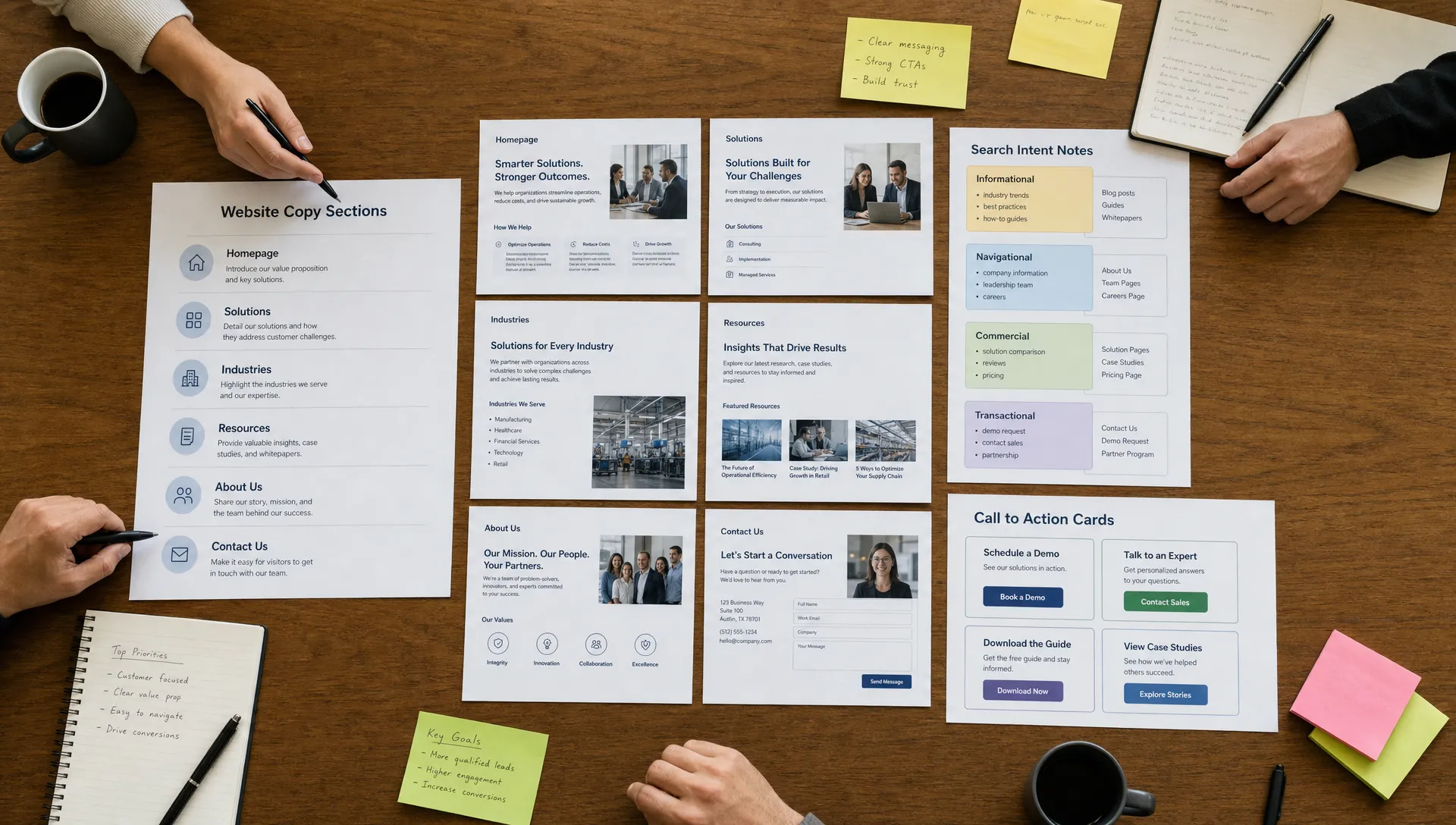
Make technical copy easier to act on
Industrial and B2B copy often becomes hard to read because companies confuse expertise with complexity. Buyers may need technical detail, but they still value clarity. The easier your copy is to understand, the easier it is for a visitor to decide whether to inquire.
Use plain language first, then add technical depth where it matters. If you mention a capability, explain the business value. If you mention a process, explain what the buyer can expect. If you mention a specification, clarify why it matters.
For example, instead of writing, “Our optimized methodology supports scalable implementation across diversified operational contexts,” write, “We build SEO campaigns that can support multiple service lines, locations, and buyer types without creating confusing website content.”
That second sentence is easier to trust because it is specific and grounded. Good SEO copy does not oversimplify the work. It removes friction from understanding it.
Use proof where buyers feel risk
Most visitors do not convert because they still have doubts. They may wonder if your company understands their industry, if the service will work for their situation, if your team can communicate clearly, or if the results will justify the investment.
Your copy should identify those risk points and answer them before the visitor reaches the form.
Useful proof can include:
- Clear descriptions of relevant industries served
- Before and after examples where appropriate
- Case studies or project summaries
- Certifications, standards, or process details when relevant
- Testimonials that mention specific outcomes or working experience
- Photos, diagrams, or examples that show real work rather than stock claims
For service businesses, proof should not be limited to a testimonial slider at the bottom of the page. It should appear near the claim it supports. If you say your team improves lead quality, show how. If you say your process is responsive, explain the communication steps. If you say you know industrial marketing, demonstrate that knowledge in the copy itself.
Align SEO copy with web design and user experience
Even excellent copy can fail if the page design hides the message. SEO brings the right people to the page, but layout, navigation, speed, and visual hierarchy help determine whether they stay and inquire.
A strong page should make the next step obvious without making the visitor feel pushed. Place calls to action after important decision points, such as after the service overview, proof section, FAQ, and final summary. Use descriptive buttons rather than generic labels. “Request an SEO consultation” is more meaningful than “Submit.” “Send project details” is more useful than “Learn more.”
For B2B websites, copy and design should be planned together. A long paragraph may contain valuable information, but if it appears as a dense block on a mobile device, many visitors will skip it. The same is true for forms. If your form asks for too much information too early, it may reduce inquiries. If it asks for too little, it may produce poor quality leads.
This is why SEO and design should not be treated as separate projects. The relationship between rankings, page structure, and conversion is covered in more detail in this article on how SEO and web design services drive better conversions.
Write calls to action that reduce hesitation
A call to action is not just a button. It is a moment of decision. The visitor is asking, “Is this worth my time?” Your CTA copy should make the answer easier.
Generic CTAs create uncertainty. “Contact us” does not explain what happens next. “Get started” may feel too vague. Better CTAs clarify the action and, when possible, the value of taking it.
Examples include:
- Request a website and SEO review
- Ask about improving B2B lead quality
- Send your project requirements
- Schedule a marketing strategy call
- Discuss SEO, PPC, and inbound campaign goals
The supporting text around the CTA matters too. A short sentence like “Tell us what you want to improve, and we will review the best next step for your website and campaigns” feels more helpful than a button floating alone.
For industrial companies, the CTA may need to invite detail. Buyers may want to share specifications, service areas, product categories, or timing. If that is the case, the form and copy should make that easy.
Optimize the details that influence clicks and conversions
Copywriting SEO also includes the smaller page elements that shape how visitors find and evaluate your content. These details may not carry the entire strategy, but together they improve relevance and trust.
Your title tag should communicate the topic and value of the page. Your meta description should give searchers a reason to click. Your opening paragraph should quickly confirm that the page matches the search. Image alt text should describe the image accurately and support accessibility. Internal links should guide visitors to related information when it helps them make a decision.
For example, a service page about search engine optimization should not only explain SEO. It should connect SEO to business outcomes, lead quality, web design, content, and conversion paths. If your website structure makes those connections easy, visitors can self educate and move closer to an inquiry. That is one reason search focused website planning can support better leads, as explained in this guide to search engine optimization website design.
The key is to optimize for usefulness, not just visibility. A page that ranks but disappoints visitors will not support long term growth.
Measure the copy by inquiry quality
Once your SEO copy is live, do not judge it only by rankings. Rankings matter, but they are one part of the funnel. You need to know whether the page attracts the right visitors and whether those visitors take meaningful action.
Track performance from search result to sales conversation.
| Metric | What it tells you | What to improve if weak |
|---|---|---|
| Impressions | Search visibility for relevant queries | Topic coverage, technical SEO, authority |
| Click through rate | Whether the title and description attract clicks | Title tag, meta description, search intent match |
| Engagement | Whether visitors find the page useful | Opening copy, structure, readability, proof |
| Form starts | Whether visitors are considering action | CTA placement, offer clarity, form visibility |
| Completed inquiries | Whether visitors are willing to contact you | Trust signals, form length, CTA wording |
| Sales qualified leads | Whether SEO copy attracts the right buyers | Keyword targeting, page promise, qualification copy |
This is where many SEO programs uncover hidden opportunities. A page may rank well but produce weak inquiries because the copy is too broad. Another page may receive fewer visits but produce better leads because it addresses a high intent need. The best strategy improves both visibility and inquiry quality over time.
Common copywriting SEO mistakes to avoid
Some SEO copy mistakes are easy to miss because the page still looks professional. The issue is not always poor writing. Often, it is unclear positioning.
Watch for these problems:
- The page talks mostly about the company instead of the buyer's problem
- The keyword appears often, but the page does not answer the search intent
- The CTA is delayed until the very bottom of the page
- Claims like “trusted,” “experienced,” or “quality” appear without proof
- The copy is too general for a technical or industrial buyer
- The form does not match the seriousness of the inquiry
If you fix only one thing, fix clarity. Visitors should know what you do, who you help, why it matters, and what to do next. That is the foundation of copywriting SEO that turns visits into inquiries.
Frequently Asked Questions
What is copywriting SEO? Copywriting SEO is the practice of writing website content that can rank in search engines while also persuading qualified visitors to take action, such as submitting an inquiry, requesting a quote, or scheduling a consultation.
How is SEO copywriting different for B2B companies? B2B SEO copywriting usually needs more proof, detail, and buyer education because decisions often involve higher stakes, longer sales cycles, and multiple stakeholders.
Should every page have a call to action? Yes, every important SEO page should give visitors a logical next step. The CTA can vary by intent, from requesting a consultation to downloading information or sending project details.
How many keywords should I use on a page? Focus on one primary topic and related natural phrases. The page should sound useful to a buyer first. If the copy fully answers the searcher's need, relevant keywords usually appear naturally.
How do I know if my SEO copy is working? Look beyond rankings. Track organic inquiries, form completions, inquiry quality, sales qualified leads, and whether visitors engage with the page before contacting you.
Turn search traffic into better B2B inquiries
If your website gets visits but not enough qualified inquiries, the issue may not be traffic alone. Your pages may need sharper positioning, clearer buyer intent, stronger proof, and calls to action that make the next step easier.
B2B Inbound Marketing helps businesses improve online visibility through SEO, PPC, inbound strategy, content, and web related marketing services. If you want your website copy to support both rankings and lead generation, visit Andy Alagappan to explore how a more focused search marketing strategy can help your business get found and contacted by better fit prospects.