

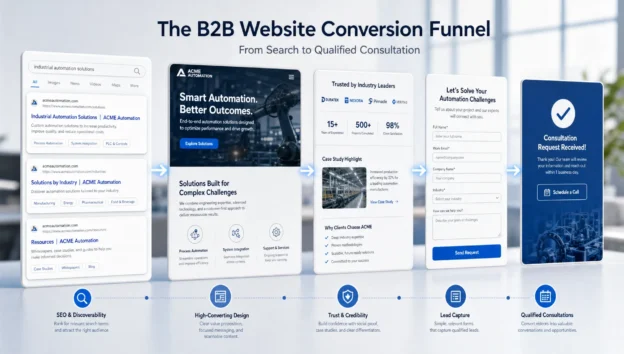
Getting more traffic is useful, but it is not the finish line. For B2B and industrial companies, the real goal is turning the right visitors into qualified inquiries, quote requests, consultations, demo bookings, distributor leads, or sales conversations.
That is where SEO and web design services become more powerful together than they are separately. SEO helps the right audience find your business at the right stage of the buying journey. Web design helps those visitors understand your value, trust your company, and take the next step without friction.
When these two disciplines are aligned, your website stops acting like a digital brochure and starts functioning like a conversion engine.
Why SEO Alone Is Not Enough
A page can rank well and still fail to produce leads. This happens more often than many companies expect. The site may attract search traffic, but visitors leave because the page loads slowly, the message is unclear, the call to action is buried, or the design does not support buyer confidence.
For industrial and B2B buyers, this matters even more. These visitors often evaluate technical expertise, reliability, safety, capability, service coverage, and procurement fit before they make contact. If your website does not answer those concerns quickly, search visibility will not translate into revenue.
SEO brings demand to the door. Web design determines whether that demand becomes a lead.
A strong SEO strategy should therefore be connected to conversion-focused page design from the beginning. Keyword research, site architecture, landing page layout, content hierarchy, forms, page speed, and trust signals should all support the same goal: helping the buyer move forward with confidence.
How Web Design Improves SEO Performance
Search engines are increasingly focused on whether users can access and engage with helpful content. A website that is hard to use, slow to load, or poorly structured creates problems for both search visibility and conversion rates.
Google’s guidance on Core Web Vitals highlights the importance of loading speed, interactivity, and visual stability. These factors are not just technical SEO concerns. They affect how people experience your website in the first few seconds.
Good web design supports SEO in several practical ways:
- It makes important content easy for users and search engines to find.
- It improves mobile usability for buyers researching from phones or tablets.
- It reduces friction by making navigation, forms, and calls to action clear.
- It reinforces trust through professional layout, proof points, and consistent branding.
- It helps search engines understand page purpose through clean structure and internal linking.
This is especially important for businesses with long sales cycles. A visitor may not convert on the first visit, but a clear, professional, useful website increases the chance they return, share the page internally, or contact your company when the need becomes urgent.
How SEO Strengthens Web Design Decisions
Design should not be based only on visual preference. A beautiful website can still miss the mark if it is not built around what buyers are actually searching for.
SEO data gives web design direction. It reveals how prospects describe their problems, which services they compare, what questions they ask before contacting a vendor, and where they are in the buying process.
For example, a manufacturer searching for “industrial pump repair Houston” is likely closer to action than someone searching “how to maintain centrifugal pumps.” Both searches may matter, but they require different page types, layouts, and calls to action.
A service page should make it easy to request a quote or consultation. An educational blog article should answer the question fully, then guide the reader toward a relevant next step. A comparison or capability page should reduce uncertainty by showing experience, process, certifications, industries served, and proof of results.
This is why an effective website redesign should begin with search intent, not just color palettes and page templates.
The Conversion Path: From Search Query to Qualified Lead
A conversion-focused website connects each stage of the search journey to the right page experience. In B2B marketing, that path often looks like this:
| Buyer stage | Search behavior | Best page experience | Conversion goal |
|---|---|---|---|
| Awareness | Searches for a problem, trend, or basic explanation | Educational article or guide | Newsletter signup, related service click, resource download |
| Consideration | Compares methods, vendors, or solutions | Service page, comparison page, industry page | Consultation request, quote form, case study view |
| Decision | Searches for a specific provider, service, or urgent need | High-intent landing page | Phone call, proposal request, form submission |
| Retention | Looks for support, specifications, or follow-up information | Resource hub, FAQ, support page | Repeat inquiry, account contact, service request |
The goal is not to force every visitor into the same generic contact form. The goal is to match the page, message, and action to the buyer’s intent.
That is why companies often see better results when they treat SEO and web design as one connected system. If you want a deeper look at conversion improvements beyond design alone, this article on website optimization services that improve conversion rates explains several practical areas that influence performance.
Key Website Elements That Turn SEO Traffic Into Conversions
Once visitors land on your site, they make quick decisions. They ask, often subconsciously, “Is this company relevant to my problem? Do they look credible? Can they handle our needs? What should I do next?”
The following elements help answer those questions.
Clear Above-the-Fold Messaging
The top of a page should immediately explain what you do, who you help, and why the visitor should keep reading. Avoid vague language like “innovative solutions for tomorrow.” Instead, use specific language that matches the buyer’s need.
For a B2B or industrial company, strong messaging might clarify the service category, geographic market, technical specialty, or business outcome. The visitor should not need to scroll through several sections to understand whether they are in the right place.
Fast, Stable Page Performance
Speed affects both user experience and lead generation. If a page is slow, visitors may leave before they ever see your offer. This is particularly important for mobile users and buyers working from job sites, facilities, or while traveling.
Page speed improvements often include compressing images, reducing unnecessary scripts, improving hosting, simplifying design elements, and cleaning up bloated code. These are web design and technical SEO decisions at the same time.
Strong Calls to Action
A call to action should be easy to find, specific, and relevant to the page. “Contact us” is acceptable, but often too generic by itself. Stronger options may include “Request a consultation,” “Ask for a quote,” “Schedule a site assessment,” or “Discuss your project.”
The right CTA depends on the business and buying process. A complex industrial sale may need a lower-friction option, such as speaking with a specialist, while a local service page may benefit from a direct phone call prompt.
Trust Signals That Reduce Buyer Risk
B2B buyers are careful. Their decisions may affect operations, budgets, compliance, safety, or customer commitments. Your website should reduce perceived risk through visible proof.
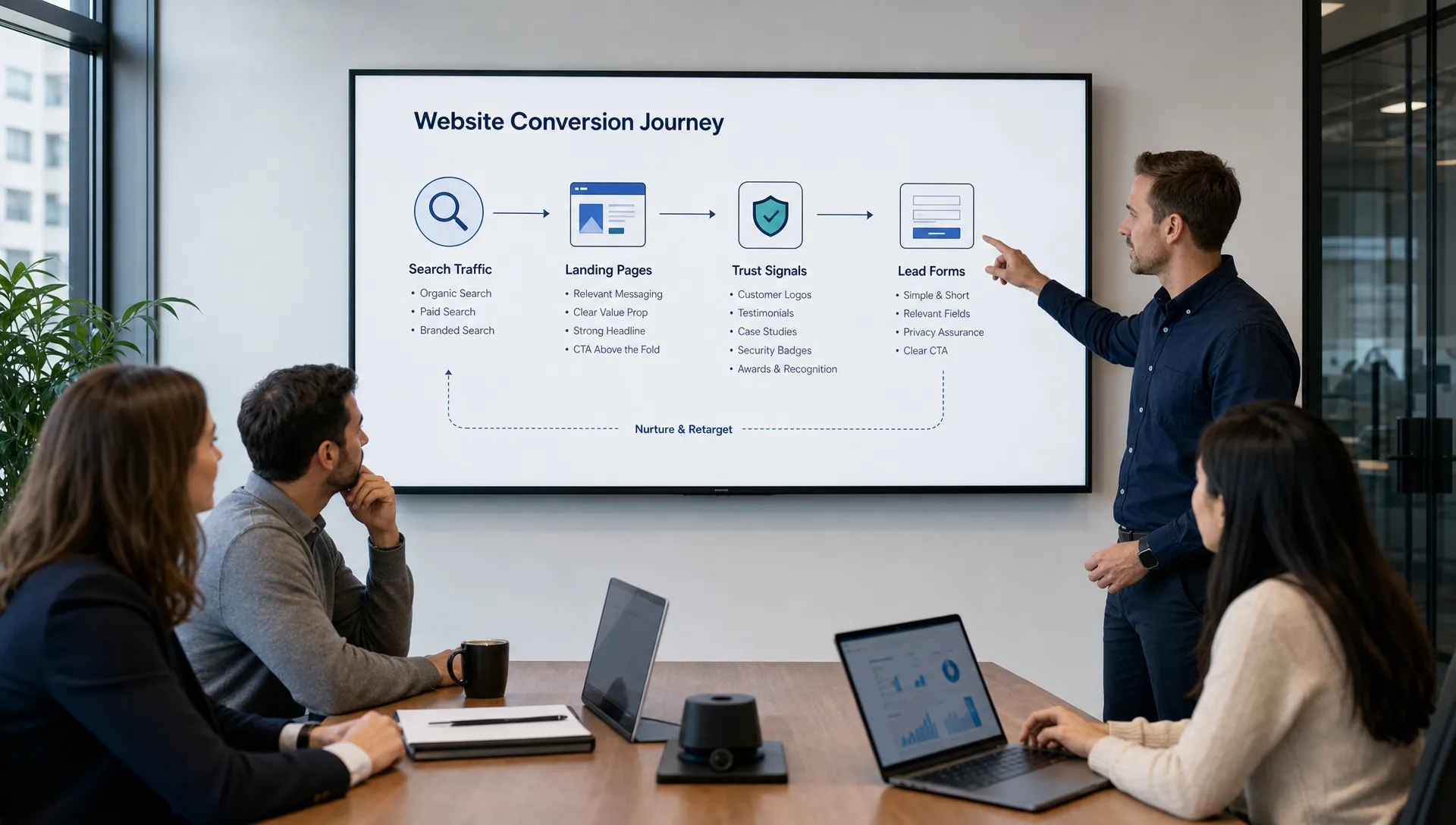
Useful trust signals can include years of experience, industries served, certifications, customer logos, project examples, case studies, testimonials, safety standards, technical documentation, and clear company contact information.
Do not hide these elements on one “About” page. Place relevant proof where visitors are making decisions, especially on service pages and landing pages.
Forms That Respect the Buyer’s Time
Lead forms should collect enough information to qualify the inquiry without creating unnecessary friction. A visitor requesting a detailed proposal may expect to provide more information. A visitor asking an early question may prefer a shorter form.
For many B2B websites, form quality is more important than form quantity. The best approach is to align each form with the visitor’s level of intent.
The Role of Content in SEO and Web Design
Content is the bridge between search visibility and conversion. It is not enough to publish keyword-focused pages if those pages do not help real buyers make decisions.
High-performing B2B content usually does three things well. It answers the search query, explains the business value, and guides the reader toward a logical next step. The design of the page should make that content easy to scan, with helpful headings, short paragraphs, comparison tables, internal links, and visible CTAs.
For example, a page targeting a high-intent service keyword should include practical information such as:
- What the service includes
- Who the service is best for
- Common problems it solves
- What happens after a prospect contacts you
- Why your company is qualified to help
At the same time, the page should avoid overwhelming the reader. Strong web design organizes content so buyers can find what matters to them quickly.
This is also where search intent matters. A page built for lead generation should not read like a generic encyclopedia entry. It should educate, but it should also position your company as a credible solution.
For more detail on using search strategy to generate the right kind of inquiries, see this guide on how search engine optimization services drive B2B leads.
Common Mistakes That Hurt Conversions
Many websites lose leads for reasons that are fixable. The challenge is that these problems often sit between SEO, design, content, and sales, so no single team owns them.
Common conversion problems include unclear service pages, weak page titles, slow mobile performance, generic stock messaging, hidden phone numbers, forms that ask too much too soon, and navigation that does not reflect how buyers search.
Another frequent issue is sending all traffic to the homepage. Homepages are important, but they are rarely the best landing page for every query. A visitor searching for a specific service should land on a page built around that service, not a general overview that forces them to hunt for details.
A third mistake is designing pages without considering lead quality. More form submissions are not always better. If the wrong audience is converting, your sales team spends time filtering poor-fit inquiries. A better approach is to align keywords, page copy, proof points, and forms around the customers you actually want.
This is why conversion strategy should include both quantity and quality metrics. If lead quality is a concern, this article on how an SEO marketing service improves lead quality offers a useful next step.
What to Measure When SEO and Web Design Work Together
If you want better conversions, you need to measure more than rankings. Rankings are useful, but they do not show the full business impact of your website.
Important metrics include organic traffic by page, conversion rate by landing page, form submissions, phone calls, quote requests, assisted conversions, engagement with key service pages, and lead quality feedback from sales.
For B2B companies, it is also useful to track which pages influence leads before they convert. A buyer may first read an educational article, return later to view a service page, then submit a form after visiting a case study. That full journey gives more useful insight than looking only at the final click.
You should also review qualitative signals. Ask your sales team what prospects mention during calls. Are they referencing a specific service page? Are they confused about what you provide? Are they better informed than before? These insights can guide both SEO content and web design improvements.
Growth-focused agencies often approach this as a continuous testing process rather than a one-time website launch. For example, growth marketing and innovation teams typically look for ways to improve acquisition, activation, and learning loops over time, which is a useful mindset for B2B conversion work as well.
SEO and Web Design for Industrial and B2B Companies
Industrial and B2B websites have different conversion challenges than e-commerce or consumer sites. The purchase is often more complex, the timeline is longer, and multiple stakeholders may be involved.
A plant manager may care about uptime and response time. A procurement team may care about vendor qualifications and documentation. An executive may care about cost, risk, and long-term reliability. A technical buyer may care about specifications and process details.
SEO and web design services should account for these different perspectives. That means building pages that are technically useful, easy to navigate, and commercially persuasive.
For Houston-based B2B and industrial businesses, local relevance can also matter. Service areas, regional experience, local project examples, and clear contact information can help buyers understand whether your company is a practical fit. This does not mean stuffing city names into every sentence. It means showing genuine relevance to the markets and industries you serve.
How to Align SEO and Web Design Before a Redesign
A redesign is one of the best times to improve conversions, but it is also a time when SEO mistakes can damage visibility if not handled carefully. Before rebuilding a website, it is important to review current rankings, top organic landing pages, backlinks, page performance, conversion paths, and technical issues.
A smart process usually includes these steps:
- Audit current SEO performance and conversion data.
- Identify the most valuable services, industries, and buyer segments.
- Map keywords and search intent to the right pages.
- Create page layouts around messaging, proof, and CTAs.
- Preserve or redirect important URLs during launch.
- Test speed, mobile usability, forms, analytics, and tracking.
- Continue improving pages after launch based on real performance.
The most important principle is simple: do not separate design decisions from search and conversion strategy. A redesigned website should look better, but it should also rank, persuade, and convert better.
Frequently Asked Questions
How do SEO and web design services work together? SEO attracts qualified visitors through search visibility, while web design improves the experience those visitors have after they arrive. Together, they help more visitors understand the offer, trust the company, and take action.
Can better web design improve search rankings? Yes, in many cases. Better structure, mobile usability, page speed, internal linking, and content organization can support SEO performance. Design alone is not a ranking strategy, but poor design can limit the effectiveness of SEO.
What conversion rate should a B2B website aim for? There is no universal benchmark because conversion rates vary by industry, offer, traffic source, and buying stage. A better goal is to improve conversion quality and rate over time by measuring each key landing page separately.
Should a business redesign its website before investing in SEO? Not always. If the current site has serious technical, usability, or conversion problems, a redesign may be necessary. If the site is structurally sound, targeted SEO and landing page improvements may produce results faster.
What is the biggest mistake companies make with SEO and web design? The biggest mistake is treating them as separate projects. SEO determines how buyers find the site, and design determines how they experience it. Both should be planned around the same conversion goals.
Turn Your Website Into a Better Lead Generation Asset
Better conversions do not happen by accident. They come from aligning search intent, technical performance, persuasive content, professional design, and clear next steps.
For B2B and industrial companies, the opportunity is significant. When SEO and web design services work together, your website can attract more of the right visitors, answer their questions faster, build trust earlier, and generate better qualified leads.
If your website is getting traffic but not enough inquiries, or if you are planning a redesign and want to protect SEO performance, Andy Alagappan’s Houston-based B2B inbound marketing services can help connect strategy, SEO, PPC, content, and web improvements around measurable lead generation goals.