


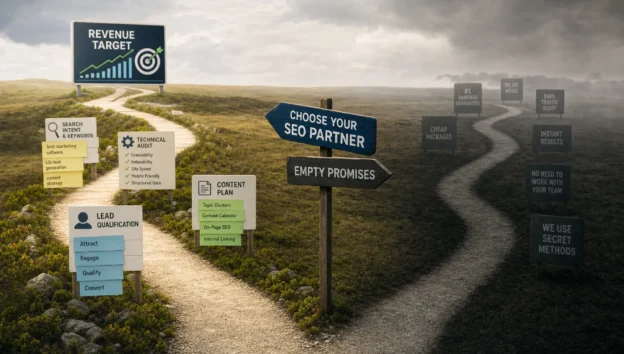
Choosing an SEO company is not a search for the flashiest pitch deck. It is a business decision that affects how prospects find you, how your sales team receives leads, and how your brand is perceived in a market where buyers research long before they contact a vendor.
For B2B, industrial, SaaS, manufacturing, and professional service companies, the stakes are even higher. A weak SEO partner may generate traffic that never converts. A strong partner understands buyer intent, technical content, search visibility, and the handoff from website visit to sales opportunity.
The challenge is that many agencies sound similar. They promise audits, keyword research, content, reporting, and higher rankings. The best search engine optimization companies separate themselves by how they diagnose your business, prioritize work, explain tradeoffs, and connect SEO to revenue.
Start by defining what best means for your company
The best SEO company for an ecommerce brand may not be the best SEO company for a precision machining firm, a software provider, or a Houston-based industrial distributor. Before comparing proposals, define what success looks like.
A useful SEO goal is not simply more traffic. It should connect to business outcomes such as qualified quote requests, demo bookings, distributor inquiries, technical document downloads, or inbound calls from the right service territory.
For B2B companies, this matters because buying cycles are longer and search journeys are more complex. A prospect might first search a problem, then compare specifications, then look for a local or industry-specific provider, then finally submit an RFQ. If your agency only optimizes for broad, high-volume keywords, it may miss the searches that actually influence pipeline.
If lead quality is the main objective, it helps to understand how search engine optimization services drive B2B leads before choosing a provider. That perspective shifts the conversation from rankings alone to the full path from search intent to conversion.
Build a shortlist around fit, not fame
Large agencies, boutique SEO firms, freelancers, local specialists, and industry-focused consultants can all be effective. The right choice depends on the complexity of your website, your internal resources, your sales process, and how competitive your search market is.
A company with thousands of product pages may need deep technical SEO and structured content operations. A regional B2B service company may need local SEO, conversion-focused landing pages, and strong Google Business Profile optimization. An industrial manufacturer may need a partner who can turn technical expertise into content that engineers, procurement teams, and plant managers actually trust.
When you compare agencies, look for evidence that their specialty matches your business model. For example, if local visibility and emerging AI search discovery are important to your strategy, studying an AEO & SEO agency in Orange County can show how some firms position local SEO, answer engine optimization, web services, and lead generation together.
For industrial companies in particular, industry fit is often the difference between content that ranks and content that resonates. A firm that understands technical buyers can help translate complex products or services into search-friendly pages without oversimplifying the expertise your customers expect. This is one reason the choice of agency is so important for companies evaluating how the right SEO firm helps industrial brands grow.
What the best search engine optimization companies do differently
The strongest SEO companies do not start with a package. They start with diagnosis. They want to know your market, competitors, sales cycle, website history, analytics setup, and internal constraints before recommending a plan.
Use the following table as a practical evaluation framework when reviewing agencies.
| Evaluation area | What to look for | Why it matters |
|---|---|---|
| Business understanding | They ask about margins, customers, territories, sales cycle, and lead quality | SEO priorities should reflect revenue opportunities, not just keyword volume |
| Technical SEO | They can explain crawlability, indexation, site speed, schema, redirects, and site architecture | Technical issues can prevent strong content from performing |
| Content strategy | They map content to buyer questions, decision stages, and expertise | B2B search success depends on relevance and credibility |
| Industry knowledge | They show experience with similar markets or a clear process for learning yours | Specialized buyers need accurate, useful, and trustworthy information |
| Reporting | They report on rankings, traffic, conversions, leads, and business impact | Rankings alone do not prove ROI |
| Link and authority building | They use ethical methods such as digital PR, partnerships, and useful resources | Authority still influences competitive search visibility |
| Conversion focus | They review calls to action, landing pages, forms, and user experience | More traffic is wasted if visitors do not take the next step |
| Collaboration process | They define responsibilities, timelines, approvals, and communication rhythm | SEO requires input from sales, subject matter experts, and leadership |
| AI search readiness | They consider answer engines, featured snippets, structured content, and topical authority | Search behavior is expanding beyond traditional blue links |
| Transparency | They explain what they are doing and why | You should understand the strategy you are funding |
The goal is not to find an agency that says yes to everything. The goal is to find a partner that can prioritize. Good SEO involves tradeoffs. A mature agency can tell you when to fix technical issues first, when to create new content, when to refresh old pages, and when paid search should support organic growth while SEO gains traction.
Ask for strategy before you ask for deliverables
Many companies compare SEO proposals by counting deliverables. One agency offers four blog posts per month. Another offers ten keywords and monthly reporting. Another promises a technical audit, backlinks, and on-page optimization.
Deliverables matter, but they do not tell you whether the work is valuable. A blog post that targets the wrong intent is not an asset. A backlink from an irrelevant website can create risk. A dashboard full of vanity metrics can hide the fact that leads are not improving.
Instead of asking only what is included, ask why each activity belongs in the strategy. The best search engine optimization companies can explain how each recommendation supports visibility, authority, conversion, or revenue.
Here are strong questions to ask in a sales conversation:
| Question | What a strong answer sounds like |
|---|---|
| How would you prioritize the first 90 days? | They identify discovery, analytics review, technical fixes, keyword and intent research, and quick wins based on your site |
| How do you choose keywords? | They discuss search intent, competition, business value, funnel stage, and conversion potential |
| How do you measure SEO success? | They include qualified traffic, conversions, lead quality, ranking movement, engagement, and pipeline influence where available |
| How do you handle technical recommendations? | They explain how they audit issues, work with developers, and prioritize fixes by impact |
| How do you create content for technical or specialized industries? | They use subject matter expert interviews, sales insights, customer questions, and credible sources |
| What do you need from our team? | They are clear about approvals, access, expertise, sales feedback, and implementation support |
| What should we not expect? | They avoid guarantees and set realistic timelines for competitive keywords |
A good SEO provider should be comfortable discussing uncertainty. Search results change, competitors invest, and Google updates its systems regularly. What should not change is the agency's ability to make informed decisions, communicate clearly, and adapt the plan.

Watch for red flags before signing
Some SEO warning signs are obvious. Others sound persuasive until you look closer. Be cautious when an agency relies on shortcuts or vague promises instead of a clear process.
Common red flags include:
- Guaranteed number one rankings, especially in a specific timeframe
- Secret methods they refuse to explain at a high level
- Pricing that is far below the level of work required for your market
- Reports that focus only on impressions or rankings without conversions
- Content plans that ignore subject matter expertise
- Link building that depends on spammy directories, private networks, or irrelevant sites
- No discussion of technical SEO, analytics, or website conversion paths
- A one-size-fits-all package that does not reflect your business model
Google's own guidance on hiring an SEO notes that no one can guarantee a number one ranking on Google, and it recommends understanding the changes an SEO wants to make before granting access. That advice is still one of the simplest ways to separate credible firms from risky ones.
Another red flag is an agency that talks about traffic but not the quality of that traffic. For B2B companies, 1,000 visits from students, job seekers, or irrelevant geographies are less valuable than 50 visits from engineers, procurement managers, plant operators, or executives actively evaluating a solution.
Evaluate their content process, not just their writing samples
Content is often the visible part of SEO, but the best content is built on research, expertise, and structure. This is especially true in industrial and technical markets where buyers can quickly detect generic writing.
Ask how the agency gathers source material. Do they interview your sales team? Do they review real customer questions? Do they understand product specifications, compliance requirements, industry terminology, and common objections? Do they know how to create pages for both early-stage research and decision-stage inquiries?
Strong SEO content usually includes a mix of page types. Service pages capture commercial intent. Comparison pages help buyers evaluate options. Educational articles answer problem-aware searches. Case studies build trust. Technical resources support specification-driven buyers. Location pages help regional companies appear for local intent.
The best search engine optimization companies also know when not to create new content. Sometimes the highest-impact move is refreshing an existing page, consolidating overlapping articles, improving internal links, adding clearer calls to action, or aligning a page with a better keyword intent.
Make reporting practical and tied to decisions
Reporting should help you decide what to do next. A monthly SEO report is not useful if it only lists rankings and traffic without explaining why performance changed or what action follows.
A useful SEO report should answer four questions:
- What improved, declined, or stayed flat?
- What work was completed and what impact is expected?
- What did we learn from rankings, traffic, and conversions?
- What are the next priorities and why?
For B2B organizations, reporting should also include lead indicators where possible. That may mean form submissions, calls, quote requests, demo requests, newsletter signups, downloads, or visits to high-intent pages. If sales feedback is available, the agency should be interested in which leads were qualified and which were not.
This is where SEO and website optimization overlap. A page can rank well and still fail if the offer is unclear, the form is too long, the call to action is weak, or the page does not address buyer objections. Choosing an SEO firm that understands conversion can prevent traffic from becoming a dead end.
Compare proposals with a weighted scorecard
When you are down to two or three agencies, a weighted scorecard can make the decision less emotional. Adjust the weights based on your goals, but use the same categories for every provider.
| Category | Suggested weight | What to score |
|---|---|---|
| Strategic fit | 25% | Understanding of your business, market, customers, and revenue goals |
| Technical capability | 15% | Ability to audit, explain, and prioritize technical SEO issues |
| Content and expertise process | 20% | Approach to keyword intent, subject matter input, and useful content |
| Reporting and measurement | 15% | Clarity of KPIs, conversion tracking, and business-focused reporting |
| Industry or local relevance | 10% | Experience with similar buyers, regions, or competitive conditions |
| Communication and accountability | 10% | Responsiveness, ownership, timelines, and collaboration style |
| Ethical practices | 5% | Transparency, compliance with search guidelines, and sustainable tactics |
Price should be evaluated, but not in isolation. The cheapest provider can become expensive if it wastes six months on low-impact work. The most expensive provider is not automatically the best if the team lacks your industry context or hands the account to junior staff without oversight.
A practical way to think about cost is opportunity. What is one qualified lead worth? What is one closed deal worth? How long is your average sales cycle? How many missed opportunities are caused by poor visibility, weak landing pages, or a website that does not support buyer research?
Understand timelines and expectations
SEO is a long-term channel, but that does not mean you should wait a year to see evidence of progress. Early movement may include technical fixes, improved indexing, better engagement, stronger rankings for long-tail queries, and more visibility for pages that were already close to performing.
Competitive keywords, authority building, and content-driven growth often take longer. A trustworthy agency will explain the difference between early indicators and mature ROI. They will also identify opportunities for faster wins, such as improving existing high-impression pages, optimizing service pages, fixing conversion blockers, or aligning PPC data with SEO keyword targeting.
For companies that need leads now, SEO can work alongside PPC and inbound marketing. Paid search can provide immediate visibility while organic improvements build durable long-term traffic. The important point is that both channels should inform each other rather than operate in separate silos.
Frequently Asked Questions
How do I know if an SEO company is reputable? A reputable SEO company explains its process clearly, avoids ranking guarantees, provides realistic timelines, uses ethical tactics, and ties reporting to business outcomes. It should also be willing to discuss what it needs from your team to succeed.
Should I choose a local SEO company or a national agency? Choose based on fit. A local firm may be valuable if your business depends on regional visibility, local competitors, or in-person knowledge of your market. A national agency may be useful for larger, more complex websites. The best choice is the one with the right expertise, process, and accountability.
How long does it take to see SEO results? Some improvements can appear within weeks, especially after technical fixes or page updates. More competitive organic growth often takes several months. Timelines depend on your website history, competition, content quality, authority, and implementation speed.
What should be included in an SEO proposal? A strong proposal should include discovery findings, goals, recommended priorities, technical and content approach, reporting methods, communication rhythm, responsibilities, timeline, and pricing. It should explain why the work matters, not just list tasks.
Are the best search engine optimization companies always the most expensive? No. Higher cost can reflect deeper expertise or more resources, but price alone does not prove quality. Evaluate strategic fit, industry understanding, transparency, execution process, and how well the agency connects SEO to qualified leads and revenue.
Choose a partner that can connect search visibility to sales
The best search engine optimization companies do more than improve rankings. They help the right buyers find you, understand your value, trust your expertise, and take the next step.
For B2B and industrial companies, that requires a partner who understands technical content, search intent, conversion paths, and the realities of longer sales cycles. It also requires steady execution, clear reporting, and a willingness to adapt as competitors and search behavior change.
If your company is evaluating SEO, PPC, inbound strategy, website content, or digital visibility, B2B Inbound Marketing can help you think through the right approach for your market and goals. Start with the business outcome you need, then choose the SEO partner best equipped to help you get there.