



A pay per click campaign can look healthy on the surface while quietly draining budget underneath. Clicks are coming in. Impressions are growing. The ads seem active. Yet the sales team is not seeing better conversations, the form submissions are weak, and the cost per qualified lead keeps climbing.
For B2B and industrial companies, this problem is especially expensive because one poor click can cost far more than it would in a consumer campaign. If your buyers are engineers, procurement managers, plant operators, distributors, or technical decision-makers, you cannot afford broad traffic that never had buying intent.
The fix is not always to spend less. The fix is to make the account more accountable. A budget-wasting PPC campaign usually has leaks in tracking, keyword intent, match types, bid strategy, landing pages, or lead qualification. Here is how to find those leaks and correct them before you increase spend.
Start by defining what “wasted budget” really means
A campaign is not wasting money simply because the cost per click is high. In many B2B markets, expensive clicks can be profitable if they generate qualified opportunities with strong lifetime value.
Budget waste happens when spend does not move the business closer to revenue. That can show up as:
- High clicks with few conversions
- Many form fills but poor lead quality
- Calls from consumers instead of businesses
- Traffic from the wrong cities, states, or countries
- Search terms that are informational, not commercial
- Strong conversion numbers in Google Ads but weak CRM pipeline
- Landing page visits that bounce because the offer does not match the ad
Before making changes, separate “expensive but valuable” from “cheap but useless.” A $40 click from a procurement manager looking for a custom industrial supplier may be better than 100 low-cost clicks from students, job seekers, or DIY researchers.
Fix tracking before you fix bidding
If conversion tracking is wrong, every optimization decision becomes suspect. Automated bidding may chase bad signals. Manual bid changes may reward the wrong keywords. Reports may show growth while sales sees no improvement.
Google Ads describes conversion tracking as the way to understand what happens after someone interacts with your ad, such as purchases, calls, form submissions, or other valuable actions. For B2B campaigns, the key word is “valuable.” Not every form submission deserves the same weight.
At minimum, verify these items:
- Conversion actions: Track quote requests, contact forms, phone calls, demo requests, and other actions tied to sales potential.
- Duplicate conversions: Make sure thank-you page reloads or repeated button clicks are not inflating results.
- Phone calls: Track calls from ads and calls from landing pages, especially if your buyers prefer to speak with someone before requesting pricing.
- CRM alignment: Compare Google Ads conversions with actual leads, sales-qualified leads, opportunities, and closed deals.
- Lead source visibility: Make sure the sales team can identify which campaign, keyword, or landing page produced a lead.
If your account is optimizing for newsletter signups, accidental button clicks, or low-intent downloads, the campaign may look better as it gets worse. Clean tracking is the foundation for every other PPC repair.
Audit search terms, not just keywords
Keywords are what you target. Search terms are what people actually typed before clicking your ad. That difference is where a large amount of PPC waste hides.
The Google Ads search terms report helps advertisers see which searches triggered ads. In a budget audit, this report is often more revealing than the keyword list itself.
For example, an industrial services company bidding on “pump repair” may discover searches such as “pool pump repair,” “washing machine pump repair,” or “DIY pump repair video.” The keyword looked relevant, but the actual queries were not aligned with the buyer.
Review search terms for these patterns:
- Consumer searches when you serve businesses
- Job-related searches such as “careers,” “salary,” or “training”
- Research terms such as “definition,” “how does it work,” or “diagram”
- Competitor terms that cost too much without producing qualified leads
- Location mismatches outside your service area
- Product categories you do not sell or support
Then build a disciplined negative keyword list. Negative keywords are not a one-time cleanup. They should be reviewed regularly, especially after launching new campaigns, changing match types, expanding locations, or increasing budget.
Rebuild keyword intent around the buyer journey
A pay per click campaign wastes budget when all keywords are treated as equal. Someone searching “what is industrial automation” is in a very different stage than someone searching “industrial automation integrator Houston quote.” Both may be relevant to your market, but only one is likely ready to speak with sales now.
A practical PPC structure separates intent levels so budgets and bids can match the value of each search.
| Intent level | Example search pattern | Budget priority | Best offer |
|---|---|---|---|
| High commercial intent | “industrial pump repair Houston” or “custom metal fabrication quote” | Highest | Quote request, consultation, phone call |
| Comparison intent | “best valve suppliers for chemical plants” | Medium | Capability page, buyer guide, consultation |
| Research intent | “how does a centrifugal pump work” | Low or SEO-focused | Educational content, newsletter, retargeting |
| Wrong intent | “pump repair jobs” or “DIY pump repair” | Exclude | Negative keyword |
This is also where PPC and SEO should work together instead of competing. PPC is often best for high-intent, time-sensitive searches where you want visibility now. SEO can support informational and comparison searches that build trust earlier in the buying process. If you are deciding how both channels should work together, the article on the benefits of SEO and PPC campaigns provides useful context.
Tighten match types and campaign structure
Broad match can be useful in mature accounts with strong conversion data, but it can also create waste if the account lacks clean tracking and a strong negative keyword strategy. If your budget is leaking, review match types carefully.
Exact match and phrase match usually give you more control while you diagnose quality problems. Broad match should be tested with caution, especially in technical B2B markets where a single word can apply to several unrelated industries.
Campaign structure matters too. If your account has one campaign targeting multiple services, multiple buyer types, and multiple locations, budget control becomes difficult. Separate campaigns or ad groups by meaningful business categories, such as service line, geography, margin, or buyer intent.
A cleaner structure helps answer important questions:
Which service produces the best cost per qualified lead? Which region is wasting spend? Which keywords produce calls instead of form fills? Which campaigns influence real opportunities in the CRM?
If the structure cannot answer those questions, it is too broad.
Repair the landing page experience
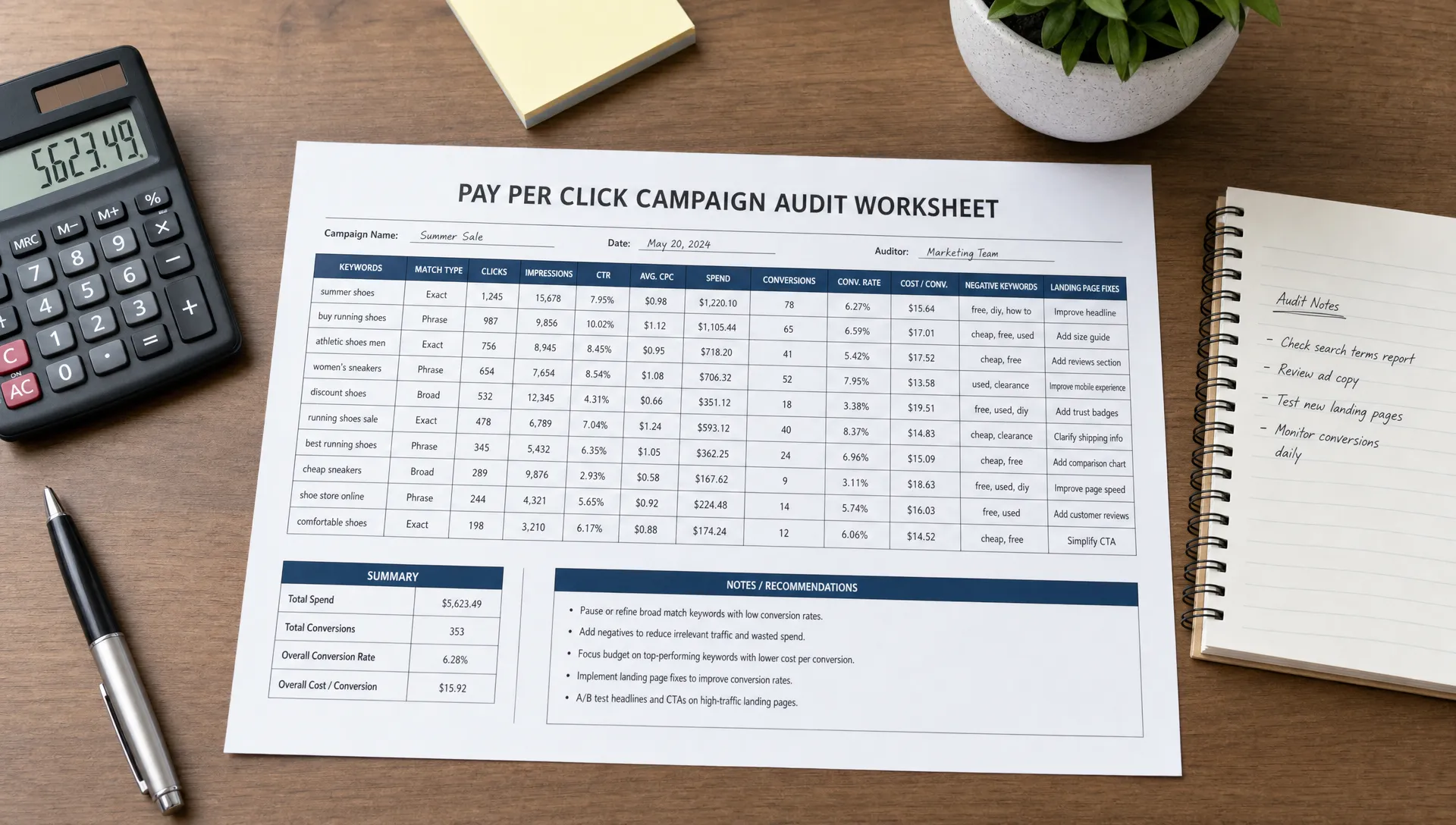
Many PPC problems are blamed on keywords when the real issue is the landing page. If the ad promises “industrial equipment repair in Houston” but the landing page sends visitors to a generic homepage, the buyer has to work too hard.
A strong PPC landing page should continue the conversation started by the search and the ad. It should immediately answer three questions: Am I in the right place? Can this company solve my problem? What should I do next?
For B2B and industrial campaigns, landing pages should include clear service descriptions, relevant industries served, proof of capability, service area details, and a simple conversion path. Forms should be easy to complete, but not so vague that they produce unqualified leads. If you are seeing traffic but not inquiries, it may be worth reviewing whether your website is losing leads because of weak calls-to-action, confusing pages, or too much friction.
Adjust bids and budgets based on quality, not activity
Clicks are activity. Leads are better. Qualified opportunities are better still. A budget-wasting PPC campaign often overfunds activity and underfunds quality.
Start by segmenting performance instead of making broad changes. Look at device, location, time of day, audience, campaign, ad group, keyword, and search term performance. A campaign that looks unprofitable overall may contain a few high-performing pockets worth protecting.
Common budget fixes include reducing bids on weak segments, excluding poor-performing locations, pausing keywords with spend and no qualified leads, and reallocating budget to campaigns with stronger sales outcomes. Be careful with sudden drastic changes if the account uses automated bidding, since major edits can disrupt learning and make performance harder to interpret.
A good budget decision answers this question: “If we spend another dollar here, what type of lead or opportunity are we most likely to get?”
Improve ad copy so it filters the wrong clicks
Ad copy is not only for attracting clicks. It should also repel the wrong clicks.
This is especially important when your market has overlap between consumer and B2B searches. If you only write generic copy such as “fast service” or “affordable solutions,” you may attract people who are not a fit. More specific copy can reduce wasted spend by making the offer clearer before someone clicks.
Use ad language that qualifies the buyer:
- Mention B2B, industrial, commercial, or enterprise when relevant
- Include service areas if geography matters
- Reference the specific equipment, process, or application you support
- Use “request a quote,” “speak with an engineer,” or “schedule a consultation” when those actions match the sales process
- Clarify what you do not offer if irrelevant traffic is a recurring problem
The goal is not always the highest click-through rate. The goal is the highest rate of qualified clicks that can become real pipeline.
Look beyond cost per lead
Cost per lead is useful, but it can be misleading. A campaign that produces $80 leads may be worse than a campaign that produces $300 leads if the cheaper leads never become opportunities.
For B2B PPC, measure the campaign across the full path from search to revenue. That does not mean every metric needs to be perfect. It means the account should be judged by business outcomes, not just ad platform activity.
| Metric | What it tells you | Why it matters |
|---|---|---|
| Click-through rate | Whether ads match search interest | Useful for relevance, but not proof of lead quality |
| Conversion rate | Whether visitors take action | Helps evaluate landing pages and offers |
| Cost per conversion | What each tracked action costs | Helpful only if conversions are meaningful |
| Qualified lead rate | How many leads fit your sales criteria | Shows whether targeting is attracting the right people |
| Cost per opportunity | What sales pipeline costs to create | Better for B2B decision-making than cost per form fill |
| Close rate by campaign | Which campaigns become customers | Helps justify budget allocation |
If you do not yet have closed-loop reporting, start by having sales rate PPC leads. Even a simple monthly review can reveal which campaigns produce serious buyers and which produce noise.
Use a 30-day PPC waste recovery plan
Trying to fix everything at once can create confusion. A focused 30-day plan is usually more effective.
Week 1: Tracking and lead quality audit
Confirm conversion tracking, review CRM lead quality, identify duplicate or low-value conversions, and define what counts as a qualified lead. Do not scale budget until this is clear.
Week 2: Search term and negative keyword cleanup
Review the highest-spend search terms first. Add negative keywords, pause obvious mismatches, and identify high-intent terms that deserve stronger coverage.
Week 3: Landing page and ad message alignment
Match each major ad group to the most relevant page. Rewrite ads so they reflect buyer intent, service area, and the action you want the visitor to take.
Week 4: Budget reallocation and testing
Shift spend toward campaigns and keywords with better qualified lead potential. Test revised landing pages, new ad copy, and tighter match types. Keep changes documented so you know what caused performance movement.
After 30 days, review results based on qualified leads and opportunities, not just lower spend. A campaign that spends less but also produces fewer good conversations may not be fixed. A campaign that spends the same but produces better-fit leads is moving in the right direction.
Know when the issue is strategy, not settings
Sometimes the PPC account is not broken because of a setting. It is broken because the strategy is unclear.
If you are targeting too many markets at once, using generic landing pages, lacking a clear offer, or sending traffic to a website that does not support the sales process, campaign edits will only help so much. PPC works best when it is part of a broader inbound marketing system that includes strong positioning, useful content, conversion-focused web pages, and sales follow-up.
This is often where an outside review helps. If your internal team is too close to the account, an experienced partner can spot structural problems faster and connect paid search to broader demand generation and inbound goals. If you are weighing that option, this guide on why to hire a digital marketing agency may help clarify when expert support makes sense.
Frequently Asked Questions
How do I know if my pay per click campaign is wasting budget? Your campaign is likely wasting budget if spend is increasing without qualified leads, search terms are irrelevant, conversion tracking is inflated, or sales reports that PPC leads are a poor fit. Review both ad platform data and CRM outcomes before deciding.
Should I pause a PPC campaign that is wasting money? Pause only the parts that are clearly wasteful, such as irrelevant keywords, poor locations, or low-quality search terms. If the campaign has some profitable segments, it is usually better to isolate and protect them while fixing the leaks.
How often should I review negative keywords? Review negative keywords weekly during new launches or major campaign changes. Mature campaigns can often be reviewed less frequently, but search term checks should remain part of ongoing PPC management.
Is a high cost per click always bad? No. In B2B and industrial markets, high cost per click can be acceptable if the traffic converts into qualified opportunities and profitable customers. The more important question is whether the click has real commercial intent.
What is the fastest way to reduce wasted PPC spend? The fastest starting point is usually the search terms report. Identify irrelevant queries, add negative keywords, tighten match types, and shift budget away from segments that spend without producing qualified leads.
Turn wasted PPC spend into a clearer growth channel
A pay per click campaign should not be a guessing game. When tracking is accurate, keywords reflect buyer intent, landing pages match the offer, and budgets are tied to lead quality, PPC becomes much easier to manage and improve.
If your campaigns are generating clicks but not the right conversations, B2B Inbound Marketing can help review your PPC strategy, improve campaign structure, and connect paid search with SEO and inbound marketing. Start with a focused audit, fix the leaks, and make every dollar work harder toward qualified pipeline.