


Industrial firms do not need a bigger pile of random form fills. They need a practical lead generation strategy that attracts the right engineers, plant managers, procurement teams and executives before a purchasing decision is already locked in.
That matters because industrial buying is rarely impulsive. A prospect may search for a supplier months before a capital project is approved. A maintenance manager may compare vendors after a production issue. A purchasing team may only contact companies that already look technically credible online. If your marketing does not support that full path, your sales team ends up chasing weak inquiries or competing on price at the last minute.
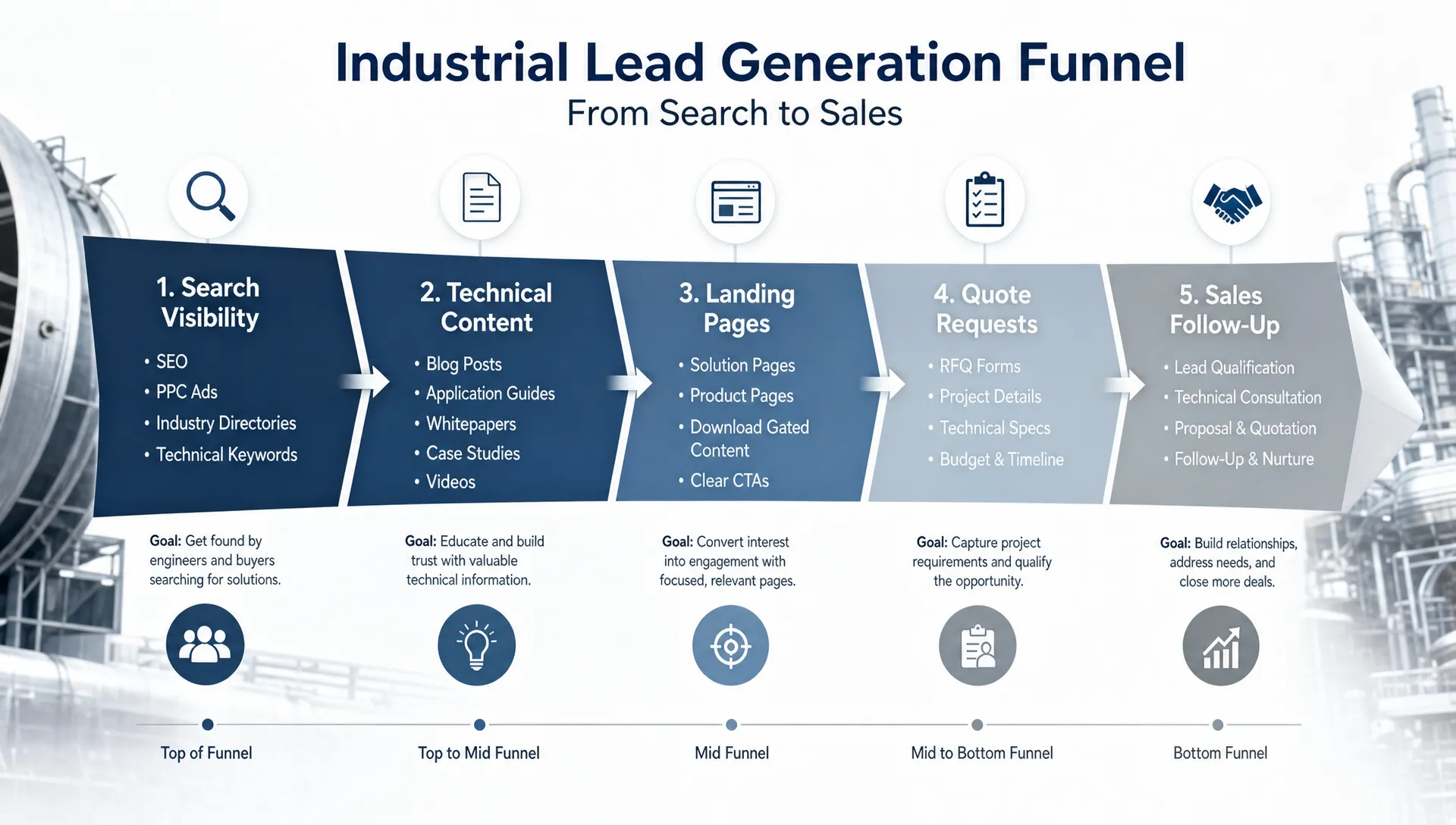
A strong industrial lead generation strategy should do four things well: make your firm findable, prove your technical fit, convert serious buyers and give sales enough context to follow up intelligently. The framework below keeps those goals practical.
Why industrial lead generation is different
Industrial marketing has a different rhythm from consumer marketing or many professional services. The audience is smaller, the stakes are higher and the buying process often includes multiple decision makers.
An industrial buyer may care about uptime, tolerances, compliance, delivery windows, replacement part availability, integration with existing equipment, safety documentation or total cost of ownership. The person who first finds your company may not be the final signer. An engineer may shortlist suppliers, operations may judge practicality, procurement may compare pricing and leadership may approve the spend.
That is why a successful lead generation plan cannot rely on one generic contact form or a handful of ads. It needs clear paths for different levels of intent. Some visitors want to learn. Some want to compare. Some are ready to request a quote. Your website, SEO, PPC and follow-up process should support all three.
If your current inbound activity produces sporadic leads, low-fit contacts or quote requests with missing information, the issue is usually not one tactic. It is a system problem. Andy Alagappan has also covered this from the troubleshooting angle in this guide to fixing inconsistent inbound leads generation.
Start by defining the right industrial lead
Before choosing channels, define the type of company you actually want to attract. This sounds basic, but many industrial firms skip it and then wonder why they are receiving inquiries from students, distributors, tiny one-off buyers or prospects outside their service area.
A useful industrial ideal customer profile should include more than company size. It should capture the conditions that make a buyer profitable, serviceable and likely to move forward.
| ICP element | What to clarify | Why it matters |
|---|---|---|
| Industry segment | Chemical, energy, food processing, aerospace, construction, manufacturing or another vertical | Industry language affects search behavior and content topics |
| Application or use case | Repair, replacement, custom fabrication, automation, parts supply, compliance support or installation | Buyers search by problem and application, not just by vendor category |
| Geography | Local, regional, national or export market | Determines SEO targeting, PPC settings and sales coverage |
| Technical requirements | Certifications, materials, tolerances, safety standards or equipment compatibility | Filters out poor-fit leads before sales spends time |
| Buying trigger | Breakdown, expansion, regulatory change, new project, cost reduction or supplier issue | Helps content match urgency and intent |
| Deal value | Minimum project size, recurring revenue potential or lifetime value | Keeps marketing focused on profitable opportunities |
Once this profile is clear, use it everywhere. It should shape your keyword strategy, landing pages, ad copy, downloadable resources, CRM fields and qualification questions. Your goal is not to attract every possible visitor. It is to attract the buyers who match the work your firm wants more of.
Build a conversion path for each buyer stage
Industrial buyers do not all arrive with the same level of readiness. A plant engineer searching for causes of pump failure is at a different stage than a procurement manager searching for a vendor that can quote a replacement assembly by Friday.
Your website should give both visitors a logical next step. That means creating offers and conversion points that match intent.
For early-stage visitors, useful offers might include troubleshooting guides, application explainers, maintenance checklists or comparison articles. These assets help buyers understand the issue and associate your firm with practical expertise.
For mid-stage visitors, stronger conversion points include specification sheets, capability pages, case studies, product comparison pages, project planning guides or engineering consultation requests. These help a buyer decide whether your company belongs on the shortlist.
For late-stage visitors, make the action direct. Use clear request for quote forms, phone numbers, project intake forms, sample requests, CAD file requests or appointment scheduling where appropriate. The conversion should feel easy, not hidden behind vague navigation.
The principle applies across service industries. A site like Gentle Dental Geelong makes key services and appointment paths easy to identify, which is the same conversion lesson industrial firms can apply to quote requests, service pages and buyer contact options.
The practical question is simple: when a serious buyer lands on your website, can they immediately see what you do, where you fit, why you are credible and how to take the next step?
Make SEO the foundation of industrial lead generation
Organic search is especially important for industrial firms because buyers often begin with a technical problem, not a brand name. They search for symptoms, specifications, product categories, replacement options, vendors near a location or ways to solve a production issue.
A practical SEO plan for industrial companies should include five types of pages:
- Core service or product pages that explain what you offer, who it is for and what technical factors matter
- Application pages that connect your capabilities to specific use cases, industries or equipment types
- Problem-solving content that answers real operational, engineering or maintenance questions
- Location pages where geography affects service, logistics or buyer preference
- Trust content such as case studies, certifications, process pages, quality documentation and team expertise
For industrial firms, the best SEO content is rarely fluffy. It should answer the questions buyers ask before contacting sales. Can this supplier handle my industry? Do they understand my equipment? Can they meet a specific tolerance, material, timeline or compliance need? Have they solved similar problems before?
This is also where many firms underinvest. They may have a clean website with broad claims, but no depth for search engines or buyers to evaluate. If you want a deeper look at why search still matters in long-cycle industrial sales, read this article on organic SEO for industrial companies.
Use PPC to capture high-intent demand
SEO builds durable visibility, but PPC can help you reach buyers who are actively searching right now. The key is to use paid search with discipline. Industrial PPC campaigns can waste money quickly if they are built around broad terms, vague landing pages or consumer-style copy.
Start with high-intent keywords tied to your actual offering. These may include service terms, equipment categories, repair phrases, emergency needs, quote terms, material-specific terms or location-based searches. Use negative keywords to filter out irrelevant traffic such as jobs, training, definitions, free templates or consumer products.
Each campaign should send traffic to a focused landing page rather than a generic homepage. The landing page should match the search query, explain your capabilities, provide proof and make conversion simple. For example, a campaign for industrial pump repair should lead to a pump repair page, not a general services page that forces the visitor to hunt.
Track calls, form submissions and quote requests by campaign. More importantly, connect those conversions to lead quality. A campaign that produces ten weak inquiries may be less valuable than one that produces two qualified opportunities.
Create content that helps buyers justify action
Many industrial buyers already know they have a problem, but they still need to justify action internally. Your content can help them build that case.
Strong industrial content often focuses on cost of downtime, maintenance risk, replacement timing, product selection, safety considerations, compliance requirements or performance tradeoffs. It should make the buyer smarter and give them language they can use with their own team.
Examples include:
- A guide to choosing the right material for a harsh operating environment
- A checklist for deciding whether to repair or replace equipment
- A comparison of custom fabrication versus off-the-shelf components
- A case study showing how a production bottleneck was reduced
- A technical FAQ that answers common pre-sales questions
This is where lead generation and demand generation overlap. Demand generation builds awareness and trust before a buyer is ready to convert, while lead generation captures and qualifies interest. If you want to compare the two more directly, this related article explains lead generation strategies and demand generation strategies in more detail.
Add LinkedIn and account-based outreach for targeted reach
Search captures active demand, but not every ideal account is searching today. LinkedIn and account-based outreach can help you stay visible to the companies and roles that matter most.
For industrial firms, this does not mean blasting generic messages to every operations manager in a region. It means identifying target accounts, mapping likely decision makers and sharing useful material that speaks to their responsibilities.
A practical LinkedIn and outreach plan may include thought leadership from technical leaders, posts that explain real project considerations, promoted content aimed at narrow job titles, connection requests to relevant buyers and follow-up emails tied to specific industry pain points.
The best outreach feels informed. A message to a food processing plant should not sound identical to a message to an oilfield services company. Personalization does not need to be long, but it should prove that you understand the account and the business context.
Improve landing pages before increasing traffic
Many firms try to solve lead generation by buying more traffic. That only works if the website can convert the right visitors once they arrive.
A strong industrial landing page should answer the buyer's first questions quickly. It should state the service or product clearly, list relevant capabilities, show industries served, address technical requirements and provide proof. It should also make the next step obvious.
Useful page elements include concise service descriptions, application examples, technical specifications, photos of real work or facilities where appropriate, certifications, customer types, FAQs, quote forms and phone numbers. Avoid filling the page with broad claims like quality solutions or industry-leading service unless those claims are backed by specifics.
Forms should be long enough to qualify the lead but not so long that serious buyers abandon them. For RFQ forms, ask for the information sales needs to respond well, such as application, part number, timeline, quantity, location, material or project notes. For softer conversion offers, keep the form shorter.
Align sales follow-up with marketing intent
Lead generation does not end at the form submission. The handoff to sales often determines whether the opportunity progresses or disappears.
Industrial buyers expect informed follow-up. If someone downloads a maintenance checklist, they should not receive the same response as someone requesting an urgent repair quote. If someone fills out a detailed RFQ, sales should have the context before making contact.
Create a simple lead handling process:
- Route urgent quote requests and service inquiries quickly
- Assign leads by territory, product line, industry or account owner
- Use CRM fields that capture source, page visited, offer downloaded and stated need
- Create email templates for common inquiry types, but personalize the technical details
- Nurture early-stage leads instead of forcing a sales call too soon
Speed matters, but relevance matters more. A fast generic response can still lose a serious buyer. A timely response that references the buyer's application, timeline or question signals competence.
Measure lead quality, not just lead count
Industrial firms often have smaller lead volumes than consumer companies, so the metrics must reflect quality and revenue potential. A monthly report that celebrates form fills without showing qualified opportunities is incomplete.
Use a mix of marketing and sales metrics. This gives you a clearer view of which channels create real pipeline.
| Metric | What it tells you | Why it matters |
|---|---|---|
| Organic search traffic to service pages | Whether qualified buyers are finding core offerings | Service-page traffic is often closer to buying intent |
| Conversion rate by page | Which pages persuade visitors to act | Helps prioritize redesign and content improvements |
| Cost per qualified lead | Paid media efficiency after filtering poor-fit inquiries | Prevents budget from shifting toward low-quality volume |
| RFQ completion rate | Whether quote forms are clear and usable | Friction here directly affects sales opportunities |
| Lead to opportunity rate | How many inquiries become serious sales conversations | Connects marketing activity to pipeline quality |
| Source by closed deal | Which channels influence actual revenue | Helps budget decisions become more objective |
You should also review lost opportunities. If leads often fail because of budget, geography, timeline or wrong-fit requests, marketing can be adjusted to filter earlier. If leads are qualified but do not close, the issue may be sales process, pricing, response speed or proof.
A practical 90-day rollout plan
A lead generation strategy is easier to implement when you break it into short phases. The goal is not to fix every channel at once. The goal is to build momentum without losing focus.
Days 1 to 30: Audit and focus
Start with your current website, analytics, CRM notes, search rankings and sales feedback. Identify the lead sources that already work, the pages that attract traffic and the inquiries that waste time. Interview sales or account managers to learn what buyers ask before purchasing.
Use this phase to define your ideal customer profile, choose priority services or product lines and identify the highest-value buyer problems. If your firm serves many markets, pick the segments with the best fit instead of spreading content and ad spend too thin.
Days 31 to 60: Build the core assets
Create or improve the pages that matter most. This usually includes service pages, application pages, RFQ forms, one or two high-value educational resources and landing pages for paid campaigns.
At the same time, clean up tracking. Make sure form submissions, calls and campaign sources are visible. Add basic CRM fields so sales can report which leads are qualified. Without this foundation, you will not know which improvements are working.
Days 61 to 90: Launch, test and optimize
Begin with a manageable SEO and PPC plan. Publish technical content around priority buyer questions. Launch paid campaigns only for the most relevant high-intent terms. Start a focused LinkedIn or email outreach effort for target accounts.
Review performance weekly at first. Look for search terms that do not fit, landing pages with low engagement, forms that are abandoned and leads that sales rates as weak. Then adjust. Industrial lead generation improves through iteration, not one big campaign launch.
Common mistakes to avoid
The most common mistake is treating all leads as equal. A student requesting information, a vendor trying to sell you something and a plant manager with an urgent need should not sit in the same reporting bucket.
Another mistake is building content only around what the company wants to say. Industrial buyers care about their application, risk, cost and timeline. Your content should connect your capabilities to those concerns.
Many firms also underuse their sales knowledge. Sales teams hear objections, technical questions and buying triggers every week. Those insights should shape SEO pages, PPC keywords, FAQs, case studies and email follow-up.
Finally, avoid separating marketing metrics from revenue conversations. A campaign is not successful because it generated traffic. It is successful when it attracts the right accounts, supports the buying process and contributes to qualified pipeline.
Frequently Asked Questions
What is the best lead generation strategy for industrial firms? The best strategy combines SEO, PPC, technical content, conversion-focused landing pages and a clear sales follow-up process. Industrial firms need quality over volume because buying cycles are longer and decisions often involve multiple stakeholders.
How long does industrial lead generation take to work? PPC can generate inquiries quickly when campaigns are well targeted, but SEO and content usually take longer to build momentum. A practical plan should show early learning within 30 to 90 days, then improve as data and content assets compound.
Should industrial companies gate their content? Gate only the assets that have enough value to justify a form, such as detailed guides, calculators or technical resources. Keep core service pages, application pages and trust-building information open so buyers and search engines can access them easily.
How can we improve lead quality instead of lead volume? Tighten your ideal customer profile, refine keywords, improve landing page messaging, add qualifying form fields and connect marketing data to sales outcomes. Lead quality improves when every channel is designed to attract the right buyer and filter poor-fit inquiries.
Build a lead generation system that sales can trust
A practical lead generation strategy for industrial firms is not about chasing every channel. It is about building a connected system where SEO, PPC, content, website conversion and sales follow-up all support the same buyer journey.
If your industrial company needs help improving visibility, lead flow or campaign performance, B2B Inbound Marketing can help with SEO, PPC, inbound strategy, web content and related digital marketing services. You can also explore these SEO optimization strategies that support better lead flow as a next step toward a stronger pipeline.