


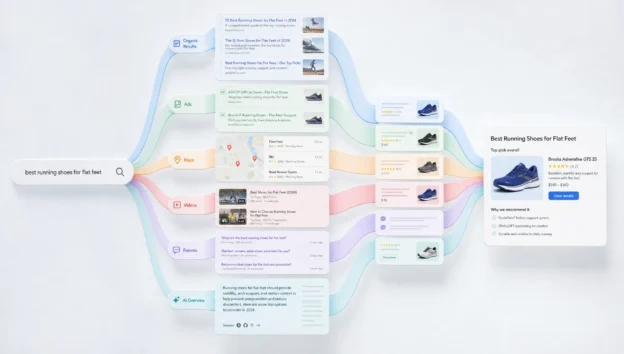
Rankings still matter in 2026, but the work that moves them has become more selective. Search results now blend organic listings, ads, maps, videos, AI-assisted summaries, forums and product results. A page does not win because it repeats a keyword more often. It wins when it gives search engines and buyers the clearest reason to trust it.
For Houston B2B and industrial companies, that distinction matters. Traffic is useful only if it brings engineers, plant managers, procurement teams, distributors or business owners closer to a conversation. The strongest SEO strategies in 2026 are not shortcuts. They are practical habits that make your website easier to understand, easier to verify and easier to choose.
What still moves rankings in 2026
Google continues to reward pages that match intent, demonstrate usefulness and provide a strong user experience. The difference is that weak content has less room to hide. Generic posts, thin service pages and outdated keyword pages are easier to ignore when search engines have more ways to compare quality.
A modern SEO plan needs to connect five areas: buyer intent, topical depth, technical performance, trust signals and lead outcomes. If one is missing, rankings may stall even when the rest of the site looks active.
| Ranking driver | Why it still matters in 2026 | What to check first |
|---|---|---|
| Buyer intent | Search engines need to match pages to the real task behind the query | Does the page answer the buyer's next question? |
| Content depth | Thin pages struggle against more complete resources | Does the site cover the topic from problem to purchase? |
| Technical clarity | Crawlers need clean access and users need fast pages | Are priority pages indexable, fast and mobile friendly? |
| Trust | Buyers compare claims before contacting sales | Are proof points visible and specific? |
| Lead quality | Rankings should support revenue, not vanity traffic | Do ranking pages generate qualified inquiries? |
1. Map every important page to buyer intent
The first strategy is also the easiest to overlook. A keyword is not a strategy. A keyword is a clue about what the buyer is trying to do.
A search for industrial pump repair cost has a different intent than emergency pump repair Houston. One query suggests budgeting and evaluation. The other suggests urgency. If both land on the same generic service page, the site misses a chance to be more useful than competitors.
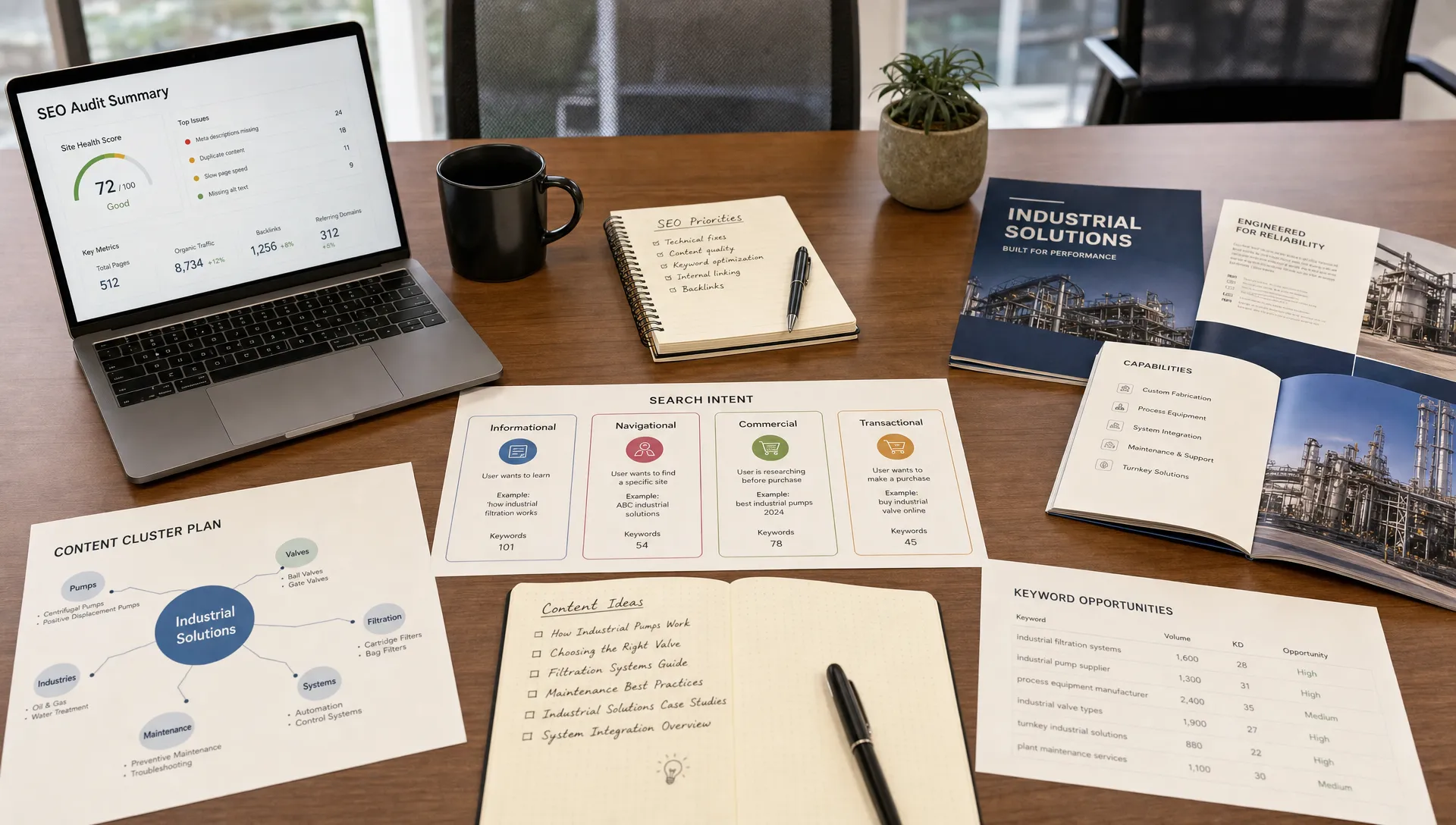
Start by separating priority search terms into intent groups such as problem research, product or service evaluation, supplier validation and contact-ready searches. Then make sure the page format matches the job. A blog article may work for a troubleshooting query. A detailed service page may work better for a high-intent local search. A comparison guide may fit a buyer who is choosing between technologies, vendors or service models.
The search result itself is a useful brief. If the top results are service pages, publishing another educational post may not move rankings. If the top results are guides, forcing a sales page into that result may underperform. Let intent shape the page before writing a word.
2. Build topical authority around revenue categories
Topical authority is not the same as publishing more blog posts. It means your site gives complete, organized coverage of the subjects that matter to your buyers and your business.
For a B2B or industrial company, one strong category may include a core service page, supporting technical explainers, application pages, maintenance content, location pages and FAQs. These pages should connect naturally so a visitor can move from early research to vendor evaluation without leaving your site.
A practical content cluster might include:
- A primary service page that explains the offer, industries served and next step.
- A technical guide that answers common buyer questions before a sales call.
- A comparison page that helps buyers understand options without exaggeration.
- A troubleshooting article that captures early research demand.
- A FAQ section that addresses procurement, timing, capabilities and fit.
This approach helps search engines see that your site is not covering a topic randomly. It also helps human buyers build confidence. If your website only has one short page on a high-value service, a competitor with a stronger content ecosystem has an advantage.
3. Refresh existing pages before adding more content
Many websites do not need another batch of blog posts. They need better versions of the pages they already have.
Content refreshes still move rankings because search intent changes, competitors improve and older pages often collect small issues over time. Titles become vague. Introductions get dated. Internal links point to old URLs. FAQs miss the questions sales teams hear every week. A page that once ranked well may lose ground simply because it no longer gives the best answer.
A strong refresh starts with pages that already have impressions, backlinks, conversions or strategic value. Improve the title tag and meta description so they match the searcher’s intent. Replace broad claims with specific information. Add missing details that buyers need to evaluate the offer. Remove duplicate sections that compete with other pages. Strengthen internal links to and from the page.
For a step-by-step way to audit these basics, this comprehensive SEO checklist is a useful companion to a refresh project. The goal is not to change content for the sake of activity. The goal is to make the page more accurate, complete and conversion ready.
4. Fix technical SEO issues that block performance
Technical SEO rarely gets attention until something breaks, but rankings depend on it. Search engines need to crawl, render, understand and index your pages without unnecessary friction. Users need pages that load quickly and work well on phones, tablets and desktops.
For B2B and industrial sites, technical issues often appear in predictable places. Product filters create duplicate URLs. Old PDF resources compete with newer HTML pages. Service pages sit too deep in the navigation. Images are oversized. Redirect chains slow down the crawl path. Important pages lack clear schema or have title tags that repeat across the site.
The most important technical checks include indexation, site speed, mobile usability, internal link depth, canonical tags, XML sitemaps, broken links and redirect hygiene. If your website has been redesigned, migrated or expanded over several years, a technical audit can reveal problems that content alone cannot solve.
Technical SEO does not replace good messaging. It makes sure good messaging can be found, crawled and used.
5. Put trust signals close to the claims they support
Trust is not only a branding issue. It affects how buyers behave on ranking pages. If a visitor cannot verify who you serve, what you do, where you operate or why your team is qualified, they may return to the search results and choose another supplier.
For industrial and B2B companies, trust signals should be specific. Mention industries served, real capabilities, service areas, standards, certifications, safety requirements, project types or measurable outcomes only when they are accurate. A vague claim like experienced team is weaker than a clear description of the equipment, process or market you support.
Trust architecture appears in many sectors, not just industrial marketing. The Colegio Pioneros in Chicureo website is a useful example of clear positioning because it communicates its bilingual model, adaptive approach and institutional recognition upfront. The SEO lesson is simple: when a visitor can quickly understand identity, credibility and fit, uncertainty drops.
Apply the same idea to your own ranking pages. Put proof near the claim it supports. If you say you serve manufacturers, show the relevant services or use cases. If you say you work in Houston, make your location and service area clear. If your product requires technical evaluation, give buyers enough detail to know whether a conversation is worth their time.
6. Strengthen internal linking around priority pages
Internal links are one of the most controllable ranking levers on your site. They help search engines understand which pages matter, how topics relate and what each page is about. They also guide buyers toward the next useful step.
The mistake is treating internal links as an afterthought. A priority service page should not sit alone. It should receive relevant links from educational articles, industry pages, FAQs, case-oriented content and related service pages. The anchor text should describe the destination naturally. A link that says industrial valve repair services is more informative than one that says learn more.
Internal linking also helps reduce content waste. If you publish a useful article but never connect it to a commercial page, the article may generate traffic without helping the business. If you have an important service page but no supporting content points toward it, the page may struggle to gain topical strength.
Review your site from the buyer’s perspective. After someone reads an article, where should they go next? After they land on a service page, what supporting proof or explanation would help them decide? Strong internal linking answers those questions without forcing the journey.
7. Use PPC and lead data to improve organic pages
SEO should not operate in isolation. PPC campaigns, sales conversations and lead quality data can reveal the exact language buyers use when they are close to action.
Search term reports from paid campaigns can show which phrases produce inquiries, not just clicks. Sales teams can identify recurring objections and missing information. Form submissions can show whether visitors are asking for the service your page intended to promote. These insights can improve titles, headings, FAQs, calls to action and page structure.
This is where search engine marketing still supports SEO. Paid search can test messaging faster than organic SEO can. If a PPC landing page converts well for a specific offer, that language can inform the organic service page. If paid traffic reveals irrelevant queries, organic content can be adjusted to filter better.
The same principle is discussed in more detail in what search engine marketing still gets right in 2026. The main point for SEO is that rankings are not the finish line. Qualified leads, better conversations and lower friction are the real measures of progress.
How to prioritize these SEO strategies
Not every site needs the same first move. The right priority depends on where rankings are stuck and what kind of lead flow the business needs.
| If your site has this problem | Start with this strategy | Main metric to watch |
|---|---|---|
| Pages get impressions but few clicks | Refresh titles, meta descriptions and intent alignment | Click-through rate and ranking movement |
| Traffic is growing but leads are weak | Rework pages around buyer intent and stronger calls to action | Qualified form submissions and calls |
| Important pages are not indexed | Fix technical SEO and crawl access | Indexed priority URLs |
| Competitors look more credible | Add specific trust signals and proof | Engagement, conversions and sales feedback |
| Blog posts are disconnected from services | Improve internal linking and content clusters | Assisted conversions and page paths |
The companies that see durable ranking gains usually treat SEO as an operating system, not a one-time campaign. They improve existing assets, publish with purpose, keep technical issues under control and use lead feedback to sharpen the next round of optimization.
Frequently Asked Questions
Are backlinks still important for SEO strategies in 2026? Yes, but quality matters more than volume. Relevant mentions, industry citations, local credibility and links from trusted sources are more valuable than generic link building that has no relationship to your market.
How long does it take for SEO rankings to improve? It depends on competition, site health, content quality and authority. Technical fixes can sometimes show impact faster, but competitive B2B rankings usually require consistent work over several months.
Should B2B companies use AI content for SEO? AI can help with research, outlines and content repurposing, but expert review is essential. Pages that affect buyer trust should include accurate details, real experience and clear positioning that generic AI output cannot provide on its own.
What is the biggest SEO mistake in 2026? The biggest mistake is chasing isolated keywords without connecting them to buyer intent, content depth, technical quality and lead outcomes. Rankings that do not support business goals are not enough.
Do SEO and PPC work better together? Yes. PPC can test offers, headlines and high-intent search terms quickly. SEO can turn those insights into durable organic pages that continue attracting qualified buyers over time.
Build rankings that support real lead flow
If your rankings have stalled or your traffic is not turning into qualified inquiries, the next step is not more random content. It is a focused SEO plan built around intent, technical health, trust and conversion.
B2B Inbound Marketing helps Houston and industrial companies improve online visibility through SEO, PPC, inbound strategy, content and web-related marketing services. A practical audit of your priority pages is often the best place to start.