


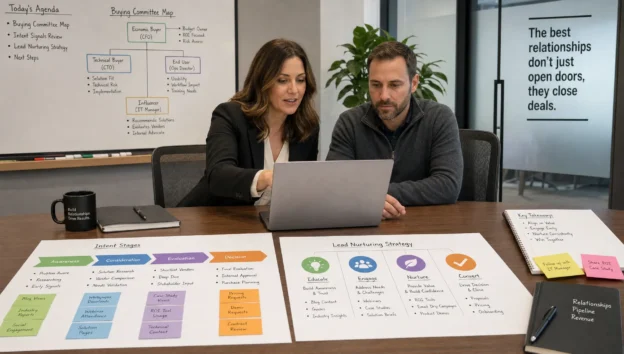
Complex B2B sales rarely move in a straight line. A buyer may discover your company through Google, compare you against three competitors, ask an engineer for technical feedback, involve finance, pause for budget approval and return months later through a branded search or retargeting ad.
That is why online marketing strategies for complex B2B sales need to do more than generate traffic. They need to educate a buying committee, reduce perceived risk, surface proof at the right time and help sales teams start better conversations.
Gartner has reported that B2B buyers spend only a small share of their buying journey meeting with potential suppliers, with much of the process happening through independent research and internal discussion. For long-cycle industrial, technical and professional service sales, your digital presence often shapes the shortlist before a prospect ever fills out a form.
The seven strategies below focus on building that digital presence into a measurable growth system.
What Makes Complex B2B Sales Different?
A complex B2B sale usually involves a higher contract value, multiple stakeholders, a longer evaluation period and meaningful business risk if the buyer chooses poorly. The buyer is not just asking, can this vendor do the job? They are also asking, can I defend this decision internally?
That means your marketing must address practical, financial and emotional concerns. A plant manager may care about uptime. A CFO may care about cost control. A technical buyer may care about specifications. A CEO may care about strategic fit and vendor reliability.
| Complex sales challenge | What marketing must support |
|---|---|
| Long sales cycles | Consistent education and follow-up over months |
| Multiple decision makers | Role-specific content and proof points |
| Technical evaluation | Clear service pages, specs, process details and FAQs |
| High perceived risk | Case studies, testimonials, compliance signals and consultation options |
| Competitive shortlists | SEO, PPC and brand visibility across the research journey |
The goal is not to overwhelm buyers with content. The goal is to make the next step feel safer, clearer and more useful.
1. Build Messaging Around the Buying Committee
Many B2B websites make the mistake of speaking to only one person. In complex sales, the person searching online may not be the final decision maker. They may be gathering vendors for a project owner, preparing a cost comparison for leadership or trying to understand whether a solution is technically viable.
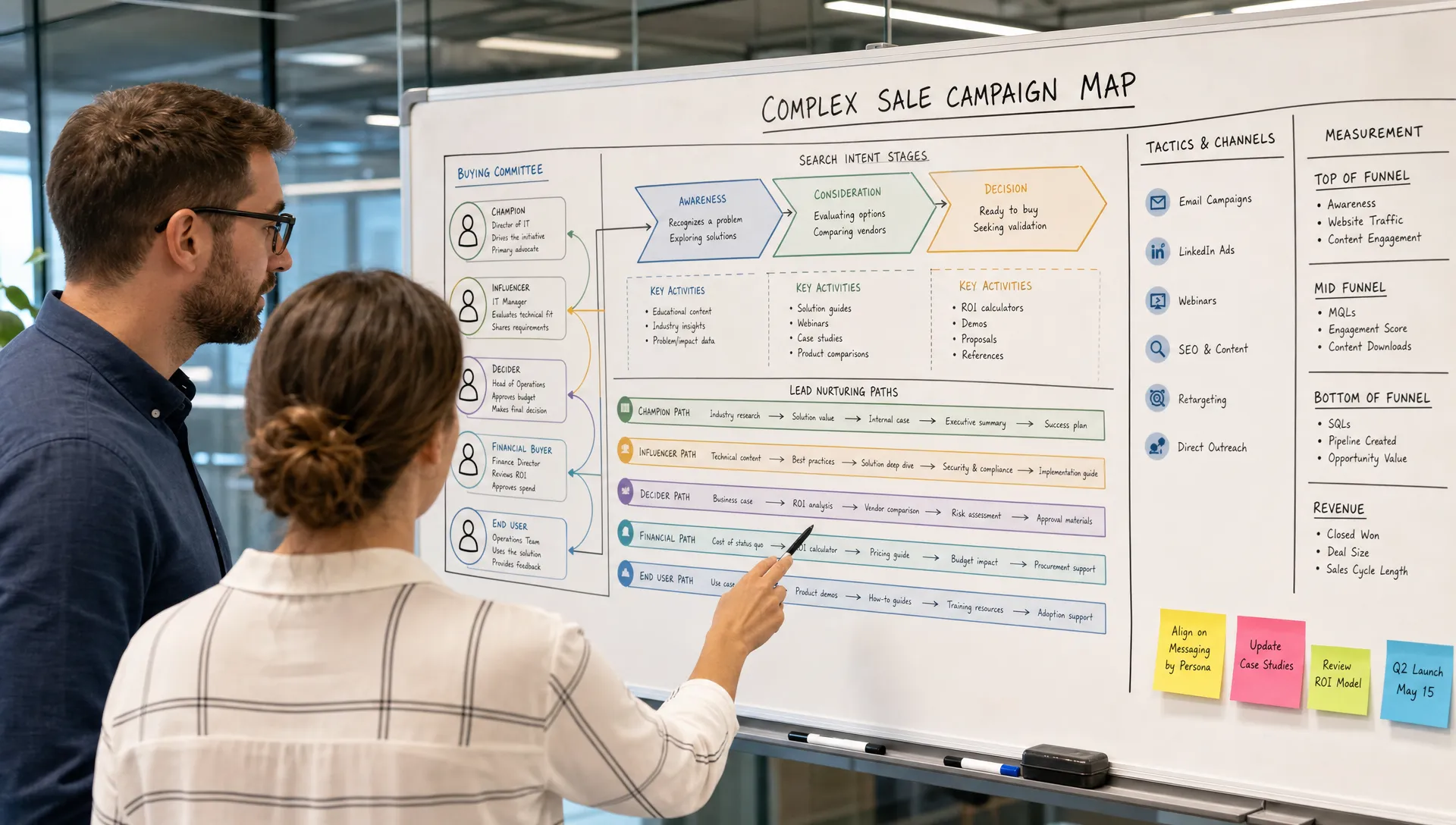
Start by mapping the buying committee before you plan campaigns. Document who participates in the decision, what each role needs to believe and what objections could slow the deal.
For example, an industrial services company may need different messages for operations, procurement, safety and executive leadership. Operations wants reliability. Procurement wants pricing clarity and vendor fit. Safety wants compliance and risk reduction. Leadership wants a business case.
A simple message map can keep campaigns aligned:
| Buyer role | Core concern | Best content asset |
|---|---|---|
| Operations leader | Will this reduce downtime or improve throughput? | Use case page or process guide |
| Procurement manager | Is this vendor credible and easy to evaluate? | Capability statement or comparison page |
| Technical evaluator | Can this meet our requirements? | Specifications, FAQs or implementation details |
| Finance leader | Is the investment justified? | ROI explanation or cost of inaction article |
| CEO or owner | Does this support growth or reduce business risk? | Case study or strategic consultation offer |
This messaging should appear across your homepage, service pages, landing pages, paid search ads, email nurturing and sales enablement materials. When your marketing reflects the full committee, prospects spend less time translating your value internally.
2. Use SEO to Capture High-Intent Research, Not Just Search Volume
SEO is often treated as a traffic channel. For complex B2B sales, it should be treated as a demand capture and trust-building channel.
The best opportunities are not always the keywords with the highest volume. A phrase searched 50 times per month by serious buyers can be more valuable than a broad phrase searched 5,000 times by students, vendors or early-stage researchers.
Prioritize search intent categories that match how B2B buyers research:
- Problem searches, such as how to reduce equipment downtime or improve lead quality for industrial services
- Solution searches, such as industrial SEO agency or B2B PPC management Houston
- Comparison searches, such as SEO vs PPC for B2B lead generation
- Vendor searches, such as agency reviews, service pages and branded queries
- Implementation searches, such as how to launch a demand generation campaign
For complex sales, SEO should also support topical authority. A single service page is rarely enough. You need a cluster of connected pages that answer the questions buyers ask before they contact sales. This includes educational articles, service pages, case studies, location pages and conversion-focused landing pages.
If organic search is a core growth channel, this breakdown of SEO strategies that still move rankings in 2026 is a useful companion to the broader marketing approach covered here.
The practical test is simple: if a serious prospect searches a major question related to your solution, does your company appear with a helpful answer? If not, a competitor has the chance to shape the buying criteria before you enter the conversation.
3. Create Content That Reduces Buyer Risk
Complex B2B buyers are not only looking for information. They are looking for confidence. Every useful article, guide, case study and landing page should reduce uncertainty in some way.
Risk-reducing content explains what will happen, what results are realistic, what problems to avoid and how a buyer should evaluate options. This is especially important for industrial marketing, construction, engineering, software, logistics, manufacturing and high-ticket professional services.
Strong content for complex sales often includes:
- Buying guides that explain how to evaluate a provider
- Comparison pages that help buyers understand tradeoffs
- Case studies with concrete context and outcomes
- Process pages that show what happens after an inquiry
- FAQ pages that address pricing, timing, implementation and risk
- Calculators or worksheets that help buyers estimate value
This applies across many high-consideration industries. A company offering commercial renovation and fit-out services in Dubai, for example, can build trust with project galleries, scope explanations, timeline guidance and content that helps facility owners understand what to expect before requesting a quote.
For B2B companies, the same principle applies. Buyers want to know that you understand their environment before they commit to a sales conversation. Content that answers specific operational questions will usually outperform generic thought leadership.
4. Use PPC to Capture Demand and Test Positioning Faster
SEO compounds over time, but PPC can help you reach active buyers immediately. For complex B2B sales, pay-per-click campaigns work best when they are tightly connected to buyer intent, landing page quality and sales follow-up.
The biggest PPC mistake in complex B2B marketing is sending every visitor to the homepage. A high-intent search deserves a focused landing page that matches the query, explains the offer and gives the visitor a relevant next step.
For example, someone searching for B2B SEO agency Houston should not land on a vague digital marketing page. They should see a page that speaks directly to B2B SEO, Houston market relevance, lead generation goals and credibility signals.
PPC also helps you test positioning. If one ad angle consistently earns stronger conversion rates, that insight can improve your SEO titles, landing page copy, email subject lines and sales scripts. In that sense, paid search is not just a lead channel. It is a market feedback tool.
Use PPC campaigns to test:
- Problem-based messaging versus service-based messaging
- Industry-specific landing pages versus general service pages
- Consultation offers versus audit or assessment offers
- Short forms versus longer qualification forms
- Search campaigns versus remarketing campaigns
For complex B2B sales, lead quality matters more than lead count. Ten qualified opportunities with clear buying intent are more valuable than one hundred weak form fills that never move past discovery.
5. Turn Your Website Into a Conversion Path, Not a Digital Brochure
A brochure-style website explains who you are. A conversion-focused website helps buyers take the next logical step.
For complex B2B sales, that step may not always be request a quote. Early-stage buyers may want a guide, checklist, audit, calculator or consultation. Later-stage buyers may want a proposal enquiry form, technical review or direct conversation.
Your website should create paths for different levels of readiness. A visitor reading a top-of-funnel article may need internal links to a related service page. A visitor comparing vendors may need proof, testimonials and a simple way to contact you. A returning visitor may need a direct call-to-action that removes friction.
Good conversion paths usually include clear service navigation, focused landing pages, visible contact options, trust signals and forms that ask for enough information to qualify the lead without making the process feel heavy.
This is where SEO, content and web design connect. Rankings matter, but traffic without a conversion path leaves revenue on the table. For a deeper look at this connection, see these SEO optimization strategies that support better lead flow.
A strong B2B website should answer five questions quickly:
| Visitor question | Website element that answers it |
|---|---|
| Do you solve my problem? | Clear positioning and service pages |
| Do you understand my industry? | Industry examples, use cases and relevant copy |
| Can I trust you? | Case studies, credentials, testimonials and process details |
| What happens next? | Consultation steps, proposal process or onboarding overview |
| How do I start? | Visible calls-to-action and simple forms |
The easier your website makes evaluation, the less pressure your sales team carries in the first conversation.
6. Nurture Leads Across the Full Sales Cycle
A complex B2B prospect may not be ready after one website visit. They may be researching for next quarter, building an internal business case or waiting for budget approval. If your marketing stops after the first form fill, many of those opportunities will go cold.
Lead nurturing keeps your company visible and useful while the buyer continues evaluating options. This can include email sequences, retargeting, LinkedIn content, webinar invitations, case study follow-ups and sales enablement assets.
The key is to match nurturing to intent. A prospect who downloaded a beginner guide should not receive the same follow-up as someone who requested a proposal. A visitor who viewed pricing-related content may need a business case. A visitor who viewed technical implementation pages may need proof that your process is reliable.
For B2B services, demand generation and lead nurturing are closely connected. Strong demand generation creates awareness and interest, while nurturing helps convert that interest into qualified opportunities. This guide to demand generation for B2B services expands on how to define the right audience and use targeted channels more effectively.
Sales and marketing should review nurturing content together. Ask the sales team which questions prospects ask repeatedly, which objections slow deals and which proof points help move opportunities forward. Those insights can become email content, retargeting messages and website FAQs.
7. Measure Pipeline Influence, Not Only Marketing Activity
Complex B2B sales cannot be managed by surface-level metrics alone. Traffic, impressions and clicks matter, but they do not prove that marketing is contributing to revenue.
A better measurement system connects online marketing activity to pipeline quality. This requires clean tracking, disciplined CRM usage and agreement between sales and marketing on what counts as a qualified opportunity.
Measure each stage of the journey, from visibility to revenue:
| Funnel stage | Useful metrics | What it tells you |
|---|---|---|
| Awareness | Organic impressions, paid reach, branded search growth | Whether the market is seeing your company |
| Engagement | Page depth, return visits, content downloads, video views | Whether buyers find the content useful |
| Conversion | Form fills, calls, booked consultations, proposal requests | Whether the website creates action |
| Qualification | Fit score, company size, industry, buying timeline | Whether leads match your ideal customer profile |
| Pipeline | Opportunities created, deal value, sales cycle length | Whether marketing supports revenue |
| Revenue | Closed-won deals, customer acquisition cost, retention signals | Whether campaigns produce profitable growth |
Do not expect perfect attribution. Complex deals often involve multiple visits, several stakeholders and offline conversations. The goal is not to assign all credit to one channel. The goal is to see which combinations of SEO, PPC, content, email and sales activity produce qualified pipeline.
This is also where campaign discipline matters. If every campaign uses different naming, landing pages and follow-up rules, reporting becomes difficult. Consistent tracking gives leadership a clearer view of what to scale, what to fix and what to stop.
How to Put These Strategies Together
The strongest online marketing strategies work as a system. SEO brings in buyers who are actively researching. PPC captures high-intent demand and tests messaging. Content reduces risk. The website converts visitors into leads. Nurturing keeps prospects engaged. Measurement shows what contributes to pipeline.
A practical 90-day plan might look like this:
| Timeframe | Priority | Outcome |
|---|---|---|
| Days 1 to 30 | Audit messaging, SEO, PPC, website conversion and tracking | Identify gaps that block qualified leads |
| Days 31 to 60 | Build or improve priority service pages, landing pages and content assets | Give buyers clearer paths to evaluate and convert |
| Days 61 to 90 | Launch targeted PPC, improve nurturing and review lead quality with sales | Create measurable learning and pipeline momentum |
This approach works because it respects how complex B2B buyers actually behave. They research independently, compare quietly, return through multiple channels and involve others before they talk to sales. Your marketing should support that reality instead of forcing every prospect into a single path.
Frequently Asked Questions
What are the best online marketing strategies for complex B2B sales? The best strategies include intent-focused SEO, targeted PPC, risk-reducing content, conversion-focused web design, lead nurturing, buying committee messaging and pipeline-based measurement.
How is B2B online marketing different from B2C marketing? B2B marketing usually involves longer sales cycles, higher purchase risk, more stakeholders and a stronger need for educational content. The goal is often qualified pipeline, not immediate transactions.
Should complex B2B companies invest in SEO or PPC first? It depends on the market, budget and timeline. PPC can generate faster learning and demand capture, while SEO builds compounding visibility. Many B2B companies benefit from using both together.
How do you measure success in complex B2B marketing? Measure qualified leads, opportunities created, deal value, sales cycle length, close rates and revenue influence. Traffic and clicks are useful, but they should be connected to pipeline quality.
Build a Smarter Growth System for Complex B2B Sales
Complex B2B sales need marketing that does more than create visibility. They need a connected system that helps the right buyers find you, trust you and move toward a sales conversation with confidence.
B2B Inbound Marketing in Houston helps companies improve online visibility, leads and rankings through SEO, PPC, inbound marketing, social media marketing, video SEO, responsive web design, website redesign and web content writing. If your sales cycle is long and your buyers need more education before they convert, a more strategic digital foundation can make every channel work harder.