



Technical buyers do not trust a page simply because it sounds confident. Effective website writing gives engineers, plant managers and procurement teams enough information to evaluate a claim, understand its limits and decide whether a supplier deserves further consideration. That means replacing broad promises with application details, traceable evidence and clear responsibility for the information presented.
For industrial and B2B companies, the practical goal is to reduce uncertainty before the first conversation. A buyer should be able to distinguish what your company knows, what it has demonstrated and what still requires an application-specific review.
Why technical buyers need more than polished claims
Technical purchases carry consequences beyond the purchase price. An unsuitable component can disrupt production. An integration problem can create additional engineering work. An unclear service scope can leave the customer responsible for tasks they assumed were included.
Your copy therefore needs to support several readers with different concerns. An engineer evaluates compatibility and performance. Procurement checks documentation and commercial requirements. Operations wants to understand installation, maintenance and support responsibilities.
Trust grows when a reader can verify your meaning without having to guess. “Built for demanding environments” leaves the buyer to define demanding. A documented operating range, its applicable conditions and a clear exception tell the buyer something useful.
Good website writing makes those distinctions visible rather than hiding them behind a request for a sales call. It also helps buyers recognize when a solution is not suitable, which can prevent wasted evaluation time on both sides.
A website writing framework for technical trust
State application fit and operating limits
Start with the application, not the adjective. Explain what the product or service does, where it is intended to work and which conditions affect suitability.
For an equipment page, relevant information might include operating conditions, compatible materials, installation requirements and maintenance access. For an engineering service, it might include supported systems, required customer inputs and deliverables. Publish only details your technical team can confirm.
Separate three kinds of statements: a verified specification, a recommended application and a result that depends on site conditions. These are not interchangeable. A laboratory result should not read like a promise about every customer installation.
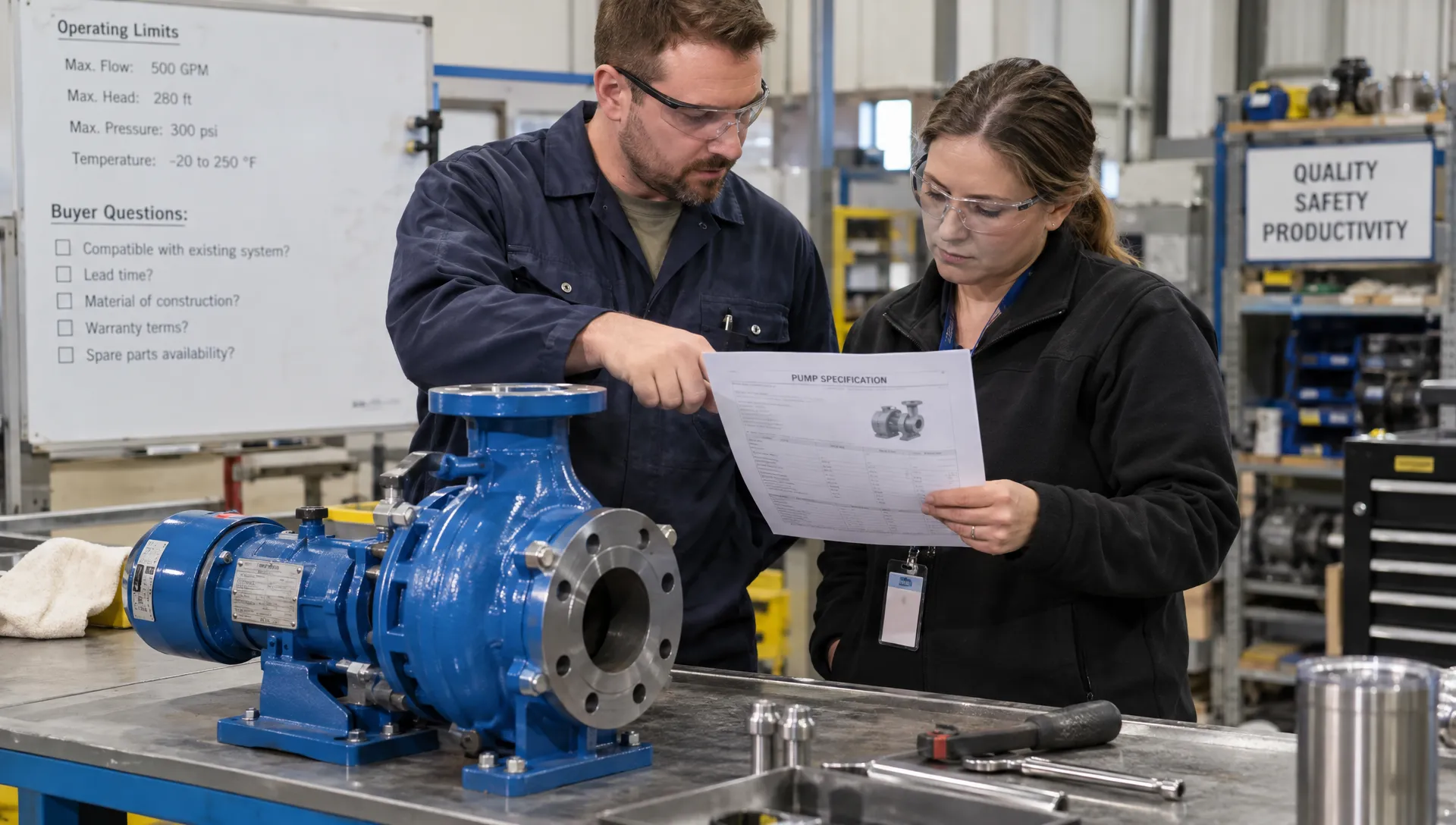
For example, a hypothetical pump supplier could explain that selection depends on fluid properties, required flow and operating pressure. That helps buyers prepare useful information without implying that one model fits every process.
Strong website writing also states exclusion criteria. If a material is unsuitable for a particular chemical or an installation requires conditions the buyer cannot provide, say so clearly. An honest boundary is more useful than a broad claim that leaves the qualification work to the customer.
Attach evidence to consequential claims
A claim deserves more scrutiny when it could influence safety, compatibility, cost or purchasing approval. Put its supporting information nearby instead of expecting readers to search through unrelated downloads.
The evidence should match the claim. A dimensional drawing supports an interface decision. A test report supports performance under its stated conditions. A case study describes an implementation, but does not automatically establish a universal outcome.
Certification language requires similar care. ISO’s explanation of ISO 9001 describes a quality management system standard. An ISO 9001 certification should not be presented as proof that every product meets every performance claim. Identify the certified organization and applicable scope accurately.
When publishing results, explain the baseline, measurement method and relevant operating conditions. If those details are unavailable, narrow the statement rather than replacing missing evidence with emphatic language.
Evidence-led website writing makes it possible to check a claim without treating marketing language as a technical guarantee. Where a report contains confidential information, describe what can be shared and how a qualified buyer can request it. Do not imply that documentation exists unless your team can actually provide it.
Show who owns the technical judgment
Buyers need to understand whose expertise sits behind a recommendation. Identify relevant technical reviewers where appropriate, explain their involvement and distinguish technical approval from editorial review.
A named author alone does not establish that a page has been checked for engineering accuracy. More useful information explains whether an application engineer reviewed the specifications, whether a quality representative confirmed certification language or whether a service manager approved the delivery scope.
Role clarity matters outside engineering, too. The French-language Choisir son rôle orientation program explores distinct leadership roles, including independent director, board advisor and operating partner. Its focus on responsibilities offers a useful communication principle: a professional title needs an explanation of what that person actually does.
Apply that principle to industrial pages. A sales contact, technical consultant and commissioning specialist may have different responsibilities and approval authority.
Accountable website writing explains who can answer an application question, who can confirm a commercial commitment and which decisions require further review. Avoid implying that a general contact form provides engineering approval or that an introductory conversation establishes final suitability.
Build pages that support independent evaluation
Organize technical pages around the questions a buyer must resolve, not around the sequence in which your company wants to tell its story.
Begin with a short application summary. Follow it with relevant specifications, conditions and exclusions. Place supporting documents beside the claims they substantiate. Then explain the next step and the information needed to make that step productive.
Keep essential facts in readable page text rather than placing everything inside a PDF. Downloads remain valuable for drawings, detailed reports and formal documentation, but the page should still help a reader determine whether those documents are relevant.
Consistency matters across formats. If the webpage lists one specification and the downloadable sheet lists another, buyers cannot know which to rely on. Identify document revisions and make superseded material distinguishable where it remains accessible.
Use descriptive document labels, such as “installation requirements” or “dimensional drawing,” rather than several identical “download” buttons. A buyer forwarding the page to a colleague should not need to explain where the evidence is hidden.
This approach to website writing also improves the handoff to sales. A request to “confirm compatibility” should explain what the buyer needs to provide, such as operating conditions or an existing system identifier. Ask only for information needed at that stage, and do not request sensitive process details through an unsuitable channel.
Replace vague claims with verifiable language
The following examples are editing patterns, not claims about any particular supplier. Use them to identify missing information before drafting replacement copy.
| Vague statement | What the buyer still needs | Better writing approach |
|---|---|---|
| “Works in harsh environments” | Which conditions and limits apply | Name verified environmental conditions and link to applicable documentation |
| “Integrates seamlessly” | Supported interfaces and required changes | Identify compatibility requirements, dependencies and validation steps |
| “Reduces downtime” | Baseline, circumstances and measurement method | Describe a documented result with its scope and conditions |
| “Full-service support” | Included tasks and customer responsibilities | Define service deliverables, exclusions and handoff points |
| “Industry-leading quality” | The basis for comparison | Replace the comparison with specific, substantiated quality practices |
A useful editing test is to ask whether a skeptical engineer could reasonably respond, “Under what conditions?” If the answer materially changes the claim, those conditions belong nearby.
Do not solve vagueness by adding technical vocabulary alone. Jargon can make an unsupported statement sound more precise without making it more informative.
Better website writing connects terminology to a decision. Define an unfamiliar acronym when needed, explain why a specification matters and distinguish a required condition from an optional capability. Readers should leave with less interpretation work, not merely a longer list of technical terms.
Review technical copy like a controlled document
Treat publication as a review process rather than the final step in drafting. Assign responsibility for checking facts, supporting documents and commercial promises before the page goes live.
Your review should cover these essentials:
- Every material claim has an identifiable source or responsible reviewer.
- Specifications match the applicable approved documentation.
- Results include the conditions needed to interpret them.
- Service scope separates supplier duties from customer duties.
- The next step does not imply an approval that has not occurred.
Sales input is especially useful for discovering recurring misunderstandings. A buyer may repeatedly mistake a standard option for an included feature or assume that installation is part of the quote. Those patterns show where the page needs a clearer explanation. Gathering the information a website content writer needs from your sales team can help identify those gaps without asking sales to validate engineering facts.
Maintain the page after publication. Product revisions, changes in service scope and expired documentation can make previously accurate copy misleading. Set review triggers around those changes and assign an owner rather than relying only on an annual check.
Reliable website writing is an ongoing responsibility. When a claim changes, review the related webpage, downloadable documents and inquiry language together. An isolated correction can leave buyers with conflicting information elsewhere in the same evaluation path.
Frequently asked questions
How technical should B2B website copy be? Include the detail needed for the decision the page supports. A category page can explain applications and selection criteria. A product page may need specifications, conditions and documentation. Make information easy to scan without removing details that affect suitability.
Should we publish limitations on a sales page? Yes, when they affect fit or interpretation. Clear exclusions help unsuitable buyers self-qualify and give suitable buyers confidence that your company understands the application. Keep limitations close to the claims they qualify.
What if customer results are confidential? Publish only approved information. An anonymized example can be useful if it explains the application, method and limitations accurately. Do not remove so much context that a specific result appears universally achievable.
Can website writing build trust without detailed case studies? Yes. Accurate specifications, clear service boundaries, relevant documentation and identifiable technical responsibility all help buyers evaluate a supplier. A case study is one form of evidence, not a substitute for the information needed to assess fit.
Make your technical pages easier to trust
Start with one high-value product or service page. Identify its consequential claims, check the evidence behind them and clarify the questions a buyer must resolve before contacting you.
For help turning verified technical information into clear, search-friendly content, explore Andy Alagappan’s B2B marketing services. Web content writing, SEO and inbound marketing can support a website that helps qualified buyers evaluate your business with greater confidence.