

Tag Archives: Industrial marketing

A purchasing professional checks a replacement component in a delivery yard while assessing an industrial supplier's fit.

Web SEO Fixes That Can Improve Qualified Traffic

More organic visits do not automatically mean more sales opportunities. For B2B and industrial companies, the most useful web seo fixes help the right buyers find the right pages, understand your capabilities and take a relevant next step. A maintenance engineer looking for a replacement component has different needs from a student researching how that component works.

The practical starting point is not a longer keyword list. It is identifying where search visibility breaks down between buyer demand, landing-page relevance and qualified inquiries. Use the fixes below to diagnose those gaps, prioritize repairs and measure whether your traffic becomes more commercially useful.

Start with the searches behind your traffic

Open Google Search Console and review search performance by both query and landing page. Separate branded searches from nonbranded searches so existing awareness does not hide weak visibility for your services.

Then classify the queries that matter to your business. For an industrial supplier, searches involving a component specification, application, supplier requirement or service location can indicate a closer fit than broad definitions. Intent still depends on context: a detailed technical question may come from an engineer evaluating a purchase.

Compare those patterns with inquiries your sales team considers worthwhile. Ask which products, applications and locations appear in accepted leads, then look for those same themes in search data.

A focused web seo review should identify three different problems: relevant searches that rarely surface your pages, relevant visits landing on unsuitable pages and substantial traffic from audiences you cannot serve.

Do not treat those problems as interchangeable. Low visibility needs an indexing or relevance investigation. A mismatched landing page needs clearer targeting. Unqualified traffic may require better service boundaries rather than more content.

Start with one service line and its associated pages. A narrow review produces a more actionable repair list than a sitewide export with hundreds of unexplained metrics. Keep educational pages that support real buyers, even when they are not the final conversion point.

Remove indexing barriers before rewriting content

A commercially valuable page cannot attract organic traffic if search engines cannot access or index it. Before changing its copy, check whether the intended URL is eligible to appear in search.

Google's URL Inspection tool helps you examine the indexed version of a page, test its current accessibility and investigate indexing status. Pay attention to unintended noindex directives, incorrect canonical signals and redirects that send visitors to a less relevant destination.

For example, a replacement website might leave an important service page marked noindex after launch. Another site might redirect several detailed capability pages to its homepage. Both issues deserve attention before another round of keyword edits.

The highest-value web seo fix in this situation is restoring access to the correct page, not adding more text to a page Google is being told to exclude.

Also inspect whether internal links and the XML sitemap point to the preferred URL. Conflicting signals can make diagnosis harder, especially when old URLs, parameterized pages and duplicate service pages remain accessible.

Avoid blanket changes. A filtered catalog page may intentionally stay out of the index, while a core product category should be discoverable. Record why each URL should or should not be indexed before changing its directives.

After a repair, verify the live page and monitor indexing over time. Requesting indexing does not guarantee inclusion or an immediate ranking improvement.

Give each landing page a distinct buying purpose

When several pages describe nearly the same service, buyers can struggle to tell which one answers their need. Search performance can also become fragmented across overlapping URLs.

Look for cases where different pages repeatedly appear for the same commercially important query group. That pattern is a reason to investigate, not proof that the pages are harming one another. They may legitimately serve different applications or buying stages.

Compare their actual purpose. A general machining page, an aerospace machining page and a materials guide can coexist when each provides distinct information. Three nearly identical pages targeting the same machining service are harder to justify.

Effective web seo work gives each priority page a clear role: one buyer problem, a defined service or product category and evidence that supports that particular decision.

For an industrial service page, that evidence might include supported materials, process capabilities, applicable tolerances, service coverage and quote requirements. Publish only details your team can substantiate. Do not add certifications, capacity figures or turnaround promises simply because competitors mention them.

If two pages serve the same purpose, consider improving one and consolidating the other with an appropriate redirect. If they serve different purposes, sharpen their titles, headings and content instead.

For the writing itself, these SEO copywriting techniques for turning visits into inquiries provide a useful companion to the page-mapping work. Resolve the overlap first, then improve the language on the page you intend buyers to find.

Make service boundaries visible before the inquiry

Qualified traffic depends partly on visitors recognizing whether your offer fits their situation. Vague promises such as “complete solutions for every business” hide the details buyers need to assess that fit.

State who you serve, where you operate and what your service includes. Where relevant, clarify minimum order requirements, supported applications, installation coverage or the information needed for an estimate. Those details help prevent expectations your business cannot meet.

The same principle applies outside industrial marketing. For a relocation provider such as Homeward Australia, describing rental and school support for families relocating to Australia communicates a much more specific need than general moving advice. That illustrates service specificity, not a claim about the website's search performance.

A practical web seo improvement is to replace broad service language with accurate details that match the conditions under which a customer can actually buy.

Translate that principle to your own offer. “Pump repair” may be too broad if your business only handles particular pump types within a defined service area. Explain those boundaries in the main content, not solely in an FAQ or after form submission.

Keep room for useful research content. Buyers often need technical education before contacting a supplier. The goal is to connect that education to relevant capabilities, not eliminate every visit that lacks immediate purchase intent.

Repair the routes to your commercial pages

A useful technical article can attract the right audience yet leave readers without a clear route to the service they need. Review internal links from your strongest informational pages to relevant product, application and service pages.

Make each link explain the relationship. In an article about corrosion resistance, a link to an applicable materials capability page is more useful than a generic instruction to contact the company. The destination should continue the reader's task.

Check for orphaned commercial pages, outdated links and links that lead through avoidable redirect chains. Important pages should be reachable through relevant navigation or contextual links, not only through a sitemap.

Internal linking supports web seo by helping search engines discover pages and understand their relationships, while giving buyers a more direct path from research to evaluation.

Avoid adding every service link to every article. Choose the destination that best answers the likely next question. If no existing page does that, record the gap before creating another broad article.

You can also work backward from valuable inquiries. Identify the landing pages associated with them, then assess whether related resources help visitors reach those pages. Use that evidence to improve the content paths you already have.

A developer tests a service page on a desktop monitor in a working web studio, with the screen facing the camera and showing page access and navigation controls.

Fix the friction that loses suitable buyers

Some changes improve acquisition; others help retain and convert the suitable visitors already arriving. Keep that distinction clear when evaluating results.

Test priority pages on mobile and desktop. Check whether specifications are readable, navigation works and inquiry forms can be completed without unnecessary effort. A technically detailed buyer may still be reviewing your site on a phone from a jobsite.

Use performance diagnostics to investigate delays rather than assuming every slow page has the same cause. Google's guidance on Core Web Vitals explains measures of loading performance, responsiveness and visual stability. Strong scores do not guarantee rankings, but usability problems can interfere with evaluation and inquiry completion.

Treat usability repairs as part of web seo when they help visitors access relevant content, while measuring their conversion effects separately from any change in organic visibility.

Forms deserve a practical test. Ask for enough information to route the inquiry, but avoid fields your team does not use. Product type, application and service location may be more useful than a long mandatory questionnaire.

If problems differ by device, review these responsive design mistakes that can cost leads before commissioning a full redesign. A targeted repair may address the immediate barrier.

Validate web seo fixes with a controlled measurement plan

Create a baseline before making changes. A 28-day window can be a starting point, but low-volume B2B sites may need a longer period. Account for seasonality, shutdown schedules and changes in sales activity when comparing results.

Use Search Console for query and page visibility. Use Google Analytics 4 for landing-page behavior and tracked inquiry events. Use CRM records or a consistently maintained lead log to judge whether those inquiries fit your business.

These systems answer different questions. Search Console query data is not a person-level record that can automatically be matched to an individual lead. Compare patterns at an appropriate aggregate level rather than claiming exact attribution you cannot support.

Judge web seo changes by whether they improve access to relevant demand and the quality of resulting inquiries, not simply whether total sessions rise.

Repair Early signal to monitor Business outcome to review
Remove an unintended indexing restriction Intended URL becomes indexed Relevant organic visits reach the page
Clarify a service page's scope Query themes better match the offer Fewer inquiries outside your capabilities
Improve contextual internal links Visitors reach relevant commercial pages More suitable inquiries from those journeys
Fix a mobile inquiry form Successful form completion improves More usable inquiries from mobile visitors

Record the URLs changed, the repair date and the expected outcome. Where practical, avoid changing targeting, layout and forms simultaneously. Otherwise, determining which change helped becomes difficult.

Review both lead counts and qualification rates. A higher qualification percentage can still accompany fewer worthwhile leads overall. Track the actual number of good-fit opportunities and note sales outcomes when your buying cycle allows.

Frequently asked questions

Which fix should come first? Start with barriers affecting important commercial pages, such as unintended indexing restrictions, broken URLs or inaccessible content. Once those pages are available, address search intent and offer clarity. Cosmetic edits rarely deserve priority over a page buyers cannot find or use.

Can qualified traffic improve while total traffic falls? Yes. More precise targeting may attract fewer irrelevant visits while increasing visits from suitable buyers. Check the absolute number of qualified inquiries, not just the percentage, before calling the change successful.

How long should we measure results? Match the review period to your traffic volume and sales cycle. Some usability changes can be evaluated sooner than organic visibility changes. Low-volume industrial websites need enough observations to avoid drawing conclusions from one unusual week.

Should we delete articles that do not generate leads? Not automatically. A web seo audit should consider whether those articles attract relevant researchers, support commercial pages or assist longer buying journeys. Improve their relevance and next-step links before deciding that direct inquiries are their only measure of value.

Build a repair list around your best buyers

Choose three commercially important pages. For each, document the audience it should attract, the gap preventing that outcome and the metric that will show progress.

If you need help connecting those repairs to SEO, paid search and website content, discuss your priorities with Andy Alagappan. Start with the services your business wants to sell and the inquiries your sales team wants to receive, then build the optimization plan around them.

A technician measures a machined part beside its drawing, checking the specifications an industrial buyer may need before requesting a quote.

How Inbound Lead Generation Builds a Predictable Pipeline

For industrial suppliers and B2B service companies, inbound lead generation becomes valuable when it does more than produce occasional inquiries. It should help your team estimate how many qualified opportunities are likely to enter the pipeline, when those opportunities could close and what it will take to keep the flow steady.

Predictability does not mean identical results every month. It means having a repeatable acquisition process, reliable conversion data and enough visibility to adjust before a weak month becomes a weak quarter. That requires connecting marketing activity to sales outcomes rather than treating website traffic as the finish line.

What a predictable pipeline actually means

A predictable pipeline has three practical characteristics: a reasonably consistent supply of relevant inquiries, understood conversion rates between sales stages and a realistic view of buying timelines.

For example, a manufacturer might receive fewer inquiries during a seasonal slowdown without facing a pipeline crisis. If those inquiries match its capabilities and follow the usual purchasing timeline, the business can still plan capacity and sales coverage. A sudden increase in poorly matched requests may be less useful, even when the marketing report looks stronger.

The purpose of inbound lead generation is therefore not to eliminate variation. It is to make variation explainable and manageable.

Marketing and sales need shared definitions before forecasting becomes useful. An accepted lead should meet agreed requirements, such as application fit, service territory and purchasing potential. An opportunity should represent a verified buying situation with an agreed next step, not simply someone who downloaded a document.

Those definitions keep optimistic reporting from hiding weak demand.

Build an inbound lead generation system around buying intent

A repeatable acquisition process starts with the questions prospects ask as they move toward a purchase. For industrial buyers, those questions often involve specifications, compatibility, operating conditions, delivery requirements and supplier reliability.

Map each question to a page that helps the buyer make a decision and offers an appropriate next step.

Buyer situation Useful website content Appropriate next step
Investigating an operating problem Application guide or troubleshooting article Review a relevant solution page
Comparing technical approaches Capability page, specification details or comparison guide Request a technical discussion
Evaluating a supplier Project evidence, quality documentation or process explanation Share requirements for a quotation

This structure gives educational content a commercial purpose without forcing every visitor into a sales conversation. A maintenance engineer researching a recurring failure needs different information from a purchasing manager preparing an RFQ.

For inbound lead generation to support forecasting, prioritize the topics that repeatedly connect to viable buying situations. Broad informational traffic can introduce your business, but commercial-intent pages deserve attention when the goal is near-term pipeline.

Start with sales conversations, customer questions and search queries associated with qualified opportunities. Build around those signals rather than publishing unrelated articles simply to maintain a content calendar.

Make the next step easy without weakening qualification

A buyer who finds the right page should understand what to do next. Avoid sending every visitor to a generic contact form with no explanation of what happens after submission.

On a technical service page, the next step might be submitting operating conditions for review. On a fabrication page, it could be sharing drawings and quantities. Explain which details are useful and who will respond, but only promise a response time your team can consistently meet.

A local-service example illustrates the principle: Bright Smiles Dentistry’s Mountain Creek and Currimundi clinics pair clearly identified locations with online appointment booking. Industrial purchasing requires a different action, but the underlying lesson applies: help visitors establish fit and make the next step clear.

Request enough information to route and assess an inquiry without turning the form into a procurement questionnaire. More detailed requirements can follow once a conversation begins.

In inbound lead generation, conversion friction and qualification must be balanced together. An easier form is not automatically better if it produces requests your team cannot serve. Evaluate changes against accepted leads and opportunities, not submissions alone.

Forecast from mature cohorts, not this month’s form fills

A forecast becomes more useful when it follows groups of leads acquired during the same period. These groups, called cohorts, reveal how acquisition translates into opportunities and bookings over time.

Build a simple conversion model

Use this model: Expected wins = inquiries × sales acceptance rate × opportunity creation rate × opportunity win rate.

Consider an illustrative cohort of 80 inquiries. If sales accepts 50%, 40% of accepted leads become opportunities and 25% of opportunities close, the expected outcome is four wins. At an assumed average contract value of $50,000, that represents $200,000 in expected booked contract value.

These figures are hypothetical planning inputs, not industry benchmarks or guaranteed results.

The timing matters as much as the arithmetic. If opportunities commonly take several months to close, inquiries acquired this month should not be treated as this month’s bookings. Measure conversion using cohorts that have had sufficient time to progress, and track how long each stage typically takes.

A forecast for inbound lead generation should reflect both conversion probability and the expected closing window. For a fuller view of stage performance, use these lead generation metrics beyond form fills to distinguish activity from commercial progress.

Use scenarios rather than a single promise

A base case is useful, but it should not be the only view presented to leadership. Model a conservative case to show how lower inquiry volume or weaker qualification changes the outcome.

Planning input Conservative case Base case
Inquiries acquired 60 80
Sales acceptance rate 40% 50%
Accepted leads becoming opportunities 35% 40%
Opportunity win rate 20% 25%
Expected wins after the cohort matures 1.68 4
Expected booked value at $50,000 per win $84,000 $200,000

Fractional wins represent an expected value across repeated cohorts, not part of a contract. Actual outcomes will be whole deals and may vary considerably, especially at low volumes.

This model forecasts booked value, not recognized revenue or cash collected. It also assumes a contract value that may differ substantially by application or customer segment. Separate large custom projects from smaller repeat purchases when their economics or sales cycles are materially different.

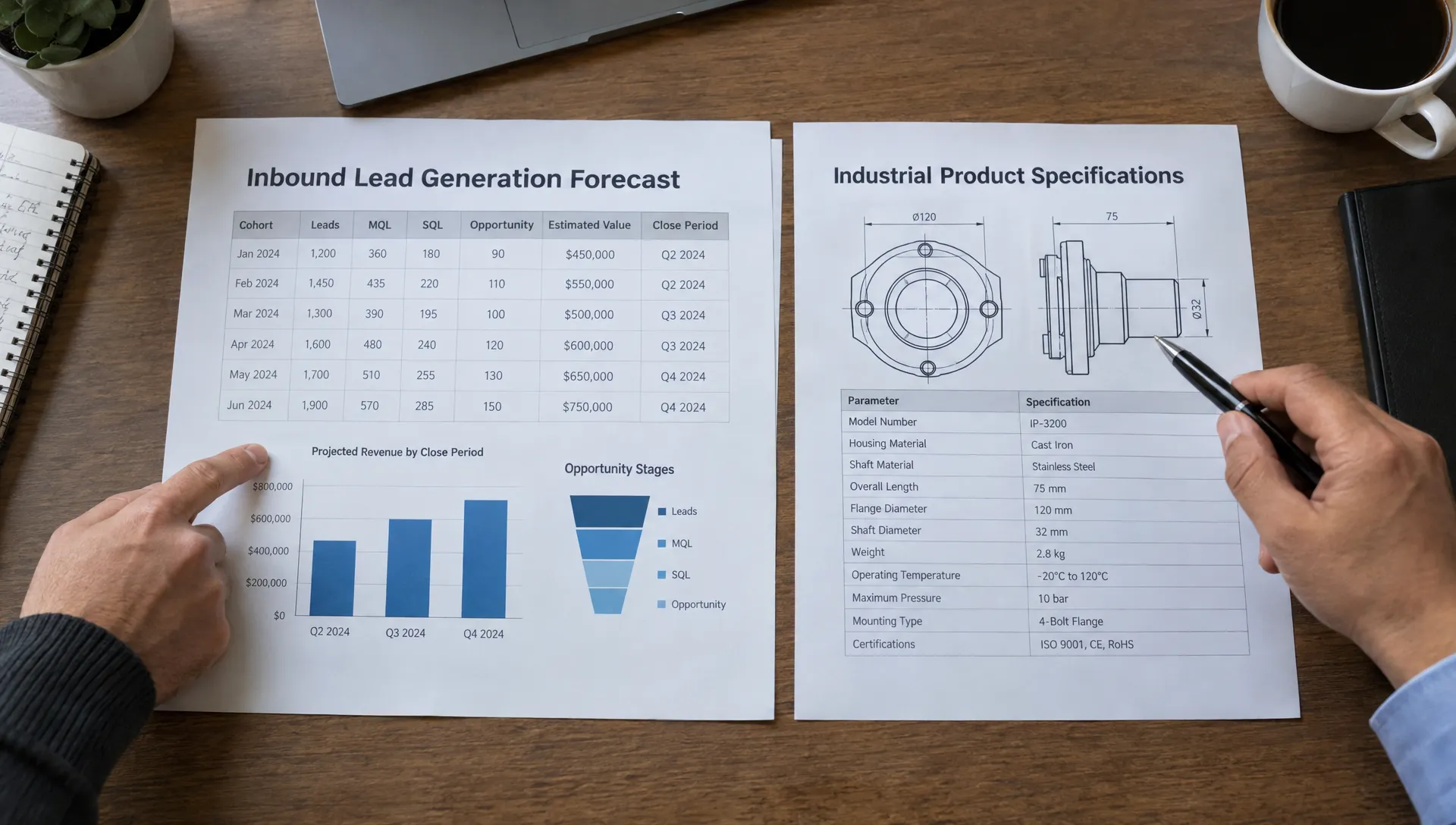
An overhead view of a printed inbound lead generation forecast beside industrial product specifications, with cohort rows, opportunity stages and closing periods visible as two colleagues' hands compare the pages.

Reduce dependence on any single acquisition channel

A pipeline can look steady until one channel changes. Search visibility may fluctuate, an advertising campaign may become more expensive or a referral source may stop sending business.

Use channels according to their role rather than expecting each one to produce identical results. SEO can help buyers discover useful application and capability content. PPC can reach active searches and test commercial messaging. Email follow-up can help relevant contacts return when a purchasing requirement becomes clearer.

The goal is not to add every available channel. It is to avoid relying on one fragile source while preserving a clear view of which sources produce qualified opportunities.

For inbound lead generation, compare channel performance using acceptance rates, opportunity creation and buying timelines alongside acquisition cost. A channel that produces inexpensive inquiries may be costly after sales spends time rejecting them.

Keep source tracking consistent and document its limitations. A prospect may discover your company through an article, return through a branded search and submit a form after a referral. Attribution is a planning aid, not a complete record of every influence on the purchase.

Establish a weekly operating rhythm

Predictability improves when teams inspect the system regularly instead of waiting for a disappointing quarterly report.

A weekly review should identify where progress is slowing. If inquiries fall but acceptance remains stable, investigate acquisition coverage. If inquiries hold steady while acceptance drops, inspect targeting and messaging. If accepted leads accumulate without meetings, check routing, response capacity and follow-up.

Keep the review focused on decisions:

  • Acquisition: Are commercially relevant pages and campaigns producing the expected inquiry range?
  • Qualification: Are prospects matching the applications, territories and project types the business can serve?
  • Progression: Are accepted leads reaching a verified next step, or sitting untouched?
  • Timing: Are opportunities moving within their usual stage durations, or slipping into later periods?

Assign an owner and a review date to each corrective action. Without that accountability, a dashboard simply describes the problem again next week.

When inbound lead generation becomes inconsistent, diagnose the stage that changed before replacing the entire strategy. This guide to fixing inconsistent inbound leads offers a useful starting point for investigating acquisition and conversion problems.

Start with one buying situation, then expand

A focused pilot produces cleaner learning than a broad launch across unrelated products and markets. Choose one commercially important application with a clear buyer, identifiable requirements and sufficient sales capacity to handle inquiries.

Build the essential content, connect the conversion path to your CRM and agree on qualification rules before promoting it. Record acquisition source, entry date, stage changes and reasons for rejection or loss.

Early reviews should check tracking accuracy, relevance and follow-up execution. Revenue evaluation must wait until enough opportunities have had time to mature. A long sales cycle cannot be validated by a short campaign test.

Expand when the process is working and the evidence supports it. Carry successful messaging and routing practices into adjacent applications, but recheck assumptions. Different buyers may have different approval processes, contract values and purchasing schedules.

Frequently asked questions

How long does it take to build a predictable inbound pipeline? It depends on acquisition performance, lead volume and sales-cycle length. You can improve tracking and routing early, but dependable conversion estimates require enough observations and time for opportunities to mature.

Can inbound lead generation work for low-volume industrial businesses? Yes, but forecasts should use wider ranges because a few deals can change results substantially. Segment opportunities by project type and evaluate both deal count and contract value.

Does inbound replace outbound sales? No. Inbound helps buyers discover and evaluate your business, while outbound can reach selected accounts that have not engaged. Both should use consistent qualification rules and feed a shared pipeline view.

Connect your marketing plan to a forecast you can use

Before increasing spend, identify the weakest measurable stage: attracting relevant buyers, converting visits into inquiries, qualifying requests or progressing opportunities. Set a baseline, name an owner and define what improvement would look like.

Andy Alagappan’s Houston-based B2B Inbound Marketing offers SEO, PPC management, inbound strategy and web content services. Discuss your inbound marketing needs with your target applications, current conversion data and sales-cycle assumptions in hand. Those inputs provide a practical starting point for a plan tied to pipeline performance rather than traffic alone.

A sales operations team works across a busy floor, monitoring inquiries as they move toward qualified opportunities and customers.

Lead Generation Metrics That Matter Beyond Form Fills

A campaign can generate hundreds of inquiries and still produce little business. Form submissions show that someone took an action, but they do not tell you whether your lead generation investment is reaching qualified buyers, creating sales opportunities or earning a financial return. For B2B and industrial companies, those distinctions matter because a technical question, a supplier solicitation and a genuine request for quotation can look identical in an analytics report.

A useful measurement system follows inquiries into the sales process. It connects marketing activity to buyer fit, pipeline progression, acquisition costs and closed business, without pretending every submission has equal value.

Replace Submission Totals With a Defined Buyer Journey

Before choosing metrics, agree on what each stage means. Otherwise, marketing may report a qualified lead when sales sees only an unverified contact.

A workable sequence is: valid inquiry, qualified inquiry, sales-accepted inquiry, opportunity and customer. Each transition needs an observable condition. A qualified inquiry might meet your service area, application and company-fit requirements. Sales acceptance means someone has reviewed it and agreed to pursue it. An opportunity requires a confirmed buying project and a documented next step.

Count buying projects, not repeated submissions. Three contacts from one manufacturer discussing the same equipment purchase should not automatically become three opportunities. Conversely, two genuinely separate projects at that manufacturer may deserve separate records.

Document exclusions too. Spam, job applications and existing-customer support requests should not inflate acquisition reporting. Keep those records available for operational purposes, but separate them from potential new business.

Which Lead Generation Metrics Belong on Your Scorecard?

Start with a small scorecard that answers three questions: Are the right buyers arriving? Are they advancing? Is the resulting business worth the acquisition investment?

Metric Calculation What it helps diagnose
Qualified inquiry rate Qualified inquiries ÷ valid inquiries Whether targeting attracts buyers who fit
Sales acceptance rate Sales-accepted inquiries ÷ qualified inquiries Whether marketing and sales agree on handoff quality
Accepted-to-opportunity rate New opportunities ÷ sales-accepted inquiries Whether accepted inquiries become real buying projects
Median first-response time Median elapsed time from inquiry to first meaningful human response Whether follow-up delays may be limiting conversion
Cost per opportunity Defined acquisition spend ÷ new opportunities The expense of generating sales-ready pipeline
Opportunity win rate Closed-won opportunities ÷ all closed opportunities Whether pipeline converts into business
Customer acquisition cost Allocated acquisition-related sales and marketing costs ÷ new customers The broader cost of acquiring a customer

Use consistent definitions, reporting windows and counting rules. A rate based on last month's inquiries should not casually use opportunities generated from much older inquiries as its numerator.

Qualification and Acceptance Reveal Where Volume Goes Wrong

Qualification rate helps distinguish a traffic problem from a targeting problem. If inquiries increase while buyer fit declines, investigate search terms, landing-page promises, geographic targeting and conversion offers before increasing the budget.

Sales acceptance adds a second check. A low acceptance rate can indicate weak qualification, but it can also reflect inconsistent routing or unclear ownership. Require a rejection reason rather than allowing records to disappear into an unworked queue.

For industrial lead generation, useful rejection categories include an unsupported application, an order below minimum requirements, an unavailable specification or a location outside the service territory. These reasons are more actionable than a generic “bad lead” label.

The distinction between contacts and genuine buying projects also informs industrial marketing that reaches real buyers. Your scorecard should make that distinction measurable rather than leaving it to anecdotal feedback.

Opportunity Progression Exposes Commercial Value

An accepted inquiry is not yet pipeline. Track how many accepted inquiries become opportunities with a defined need, plausible commercial value and a next action agreed with the buyer.

Measure the time between those stages as well. If accepted inquiries stall before discovery or quotation, investigate the handoff, technical qualification requirements and sales capacity. Adding more inquiries may simply enlarge the backlog.

Lead generation reporting should also show pipeline created, using a consistent value basis such as expected first-year contract value. Do not mix one-time equipment revenue with multiyear service-contract totals without identifying the difference.

Treat opportunity value as an estimate until business closes. Unweighted pipeline shows the face value of opportunities; probability-weighted pipeline applies stage probabilities. Neither is realized revenue, and weighted figures are only as useful as the assumptions behind them.

Evaluate Acquisition Economics, Not Just Cost Per Lead

Cost per lead is useful for monitoring campaign efficiency, but it cannot determine which channel deserves more investment. A cheaper inquiry can become an expensive customer if few inquiries advance.

Consider this hypothetical comparison of two campaigns promoting the same offer. Assume both inquiry cohorts have had enough time to close and follow the same qualification rules.

Measure Campaign A Campaign B
Campaign spend $6,000 $6,000
Valid inquiries 120 40
Opportunities 6 10
New customers 1 3
Cost per inquiry $50 $150
Cost per opportunity $1,000 $600
Campaign spend per new customer $6,000 $2,000
Closed-won contract value $12,000 $36,000

Campaign A wins on inquiry cost. Campaign B generates more opportunities and customers from the same spend.

Notice that “campaign spend per new customer” is not full customer acquisition cost. It excludes any uncounted sales labor, agency fees, software and other acquisition expenses. Labeling the narrower measure correctly prevents an artificially low CAC from entering financial discussions.

Add Margin and Deal Size to the Decision

Revenue alone can still reward the wrong lead generation campaign. A large contract with low gross margin may contribute less than a smaller, more profitable order.

Review acquired-customer revenue alongside gross profit over a defined period. Use your finance team's treatment of delivery costs and keep acquisition expenses separate unless your contribution calculation explicitly deducts them. Avoid presenting contract value divided by ad spend as profit or ROI.

The right economic unit can also differ by industry. For a property manager, one owner relationship may bring several managed units, making cost per acquired door useful alongside cost per customer. This comparison of lead generation services for property managers illustrates why service selection should connect to acquisition economics and company growth stage.

For an industrial business, the corresponding measure might be cost per new purchasing account, profitable project or service agreement. Choose the unit that reflects how your business earns money.

Compare Cohorts Before Ranking Channels

Long sales cycles make calendar-month reporting misleading. September inquiries may still be under evaluation while September wins originated six months earlier.

Create cohorts based on inquiry creation date, then follow their outcomes over time. Compare channels after similar amounts of time have elapsed. A 30-day cohort may tell you about qualification and initial response, while a longer observation window may be needed for opportunity creation and wins.

Your lead generation dashboard should distinguish immature cohorts from genuinely weak performance. Do not label every open inquiry a failure just because it has not closed within the reporting month.

Track the median time from inquiry to opportunity and from opportunity to close. If many records remain open, note that timing calculated only from completed transitions may underrepresent slower journeys.

For win rate, use closed-won divided by closed-won plus closed-lost opportunities. Show open opportunities separately. For inquiry-to-customer conversion, use a sufficiently mature inquiry cohort and state the observation period.

Separate Sourced Pipeline From Influenced Pipeline

Attribution answers a different question from conversion. A buyer may discover your business through organic search, return through a paid ad and submit an RFQ after receiving a referral.

Choose a primary sourcing rule for reporting, such as the first identifiable acquisition source. Preserve later interactions as influence data rather than crediting every channel with the full deal value.

When reviewing lead generation performance, compare sourced opportunities and wins using the same rule across channels. Report influenced pipeline separately, with a clear warning that overlapping influence totals are not additive.

Keep an “unknown source” category. Forcing unattributed calls or offline referrals into whichever campaign looks plausible produces false precision. Measuring demand generation campaign results provides a related framework for evaluating marketing activity beyond the final conversion event.

A marketing manager traces an inquiry cohort from its first response through opportunity stages on a wall-mounted sales dashboard in a project room.

Build a Dashboard Sales Can Reconcile

A dashboard is only useful if the sales team can trace its totals back to actual records. Connect website inquiries, tracked calls and other acquisition events to CRM records using stable identifiers wherever possible.

Capture the original source, campaign details when available, inquiry date, stage-entry dates, owner and qualification outcome. Opportunity records should include estimated value, expected close date, final outcome and loss reason. Customer reporting needs a reliable customer identifier so multiple won projects do not automatically become multiple new customers.

For lead generation measurement, audit a sample of records regularly. Check whether the source survived the handoff, duplicate inquiries were merged and stage dates reflect actual progression rather than a bulk cleanup.

Measure completeness too. If half your opportunities lack a source or loss reason, improving those fields may be more valuable than adding another dashboard chart.

Keep Operational Definitions Consistent

Specify whether response time uses business hours or elapsed clock time. An inquiry submitted on Friday evening should not be compared with a Tuesday morning inquiry without acknowledging the difference.

An automated receipt is not a meaningful sales response. Track it separately from the first human attempt to address the inquiry. Pair the median response time with the share of inquiries answered within your team's agreed service window so a small group of neglected inquiries does not remain hidden.

Keep acquisition and expansion separate. A repeat order can demonstrate customer value, but it is not a newly acquired customer. Likewise, use clear rules for reopened opportunities and revised quotes to avoid double-counting pipeline.

The integrity of lead generation metrics depends on those definitions staying stable. When a definition changes, document the change and avoid presenting the resulting jump as a campaign improvement.

Use Different Metrics for Weekly and Monthly Decisions

Weekly reviews should focus on issues the team can correct quickly: invalid inquiries, acceptance failures, unassigned records, response delays and missing data. These reviews help prevent avoidable pipeline leakage.

Monthly reviews can examine cost per opportunity, pipeline created and conversion by source. Revenue, win rate and customer acquisition cost need mature cohorts, which may require a longer review cadence for industrial sales cycles.

Attach an action to each finding. Weak qualification suggests a targeting or messaging review. Strong qualification but weak acceptance calls for a handoff discussion. Healthy opportunity creation with poor wins points toward sales execution, pricing, competitive fit or opportunity criteria.

Good lead generation reporting does not simply identify the channel with the lowest cost. It helps the team decide what to fix, what to investigate and where additional investment has a defensible chance of producing profitable business.

Frequently Asked Questions

What is the most useful metric beyond form fills? Cost per qualified opportunity is a practical starting point because it connects spend to verified sales potential. Pair it with win rate and customer acquisition cost so inexpensive opportunities do not hide weak commercial outcomes.

Should we stop tracking form submissions? No. Submission volume helps monitor demand capture and detect website problems. Separate submissions from valid inquiries, then connect those inquiries to qualification, opportunities and customers.

How do we measure results when the sales cycle is long? Follow inquiry cohorts and compare them at equivalent ages. Use qualification and opportunity progression as early indicators, then update acquisition costs and customer conversion as those cohorts mature.

What is a good lead generation conversion rate? There is no universal rate that reliably applies across B2B offers. Buyer intent, contract size, qualification rules and sales-cycle length change the denominator and outcome. Establish a baseline using consistent definitions, then compare similar segments over time.

Connect Your Marketing Reports to Sales Outcomes

Start with one inquiry cohort, one agreed stage dictionary and a scorecard your sales team can verify. That foundation makes budget decisions more useful than a report built around submission totals alone.

If your SEO, PPC and inbound campaigns need a clearer connection to qualified opportunities, Andy Alagappan's B2B marketing services offer a starting point for discussing strategy and campaign management.

A supplier's equipment demonstration area gives industrial buyers space to inspect machinery and assess a complex purchase.

Online Marketing Tactics That Support Long Sales Cycles

A long B2B sales cycle can make online marketing look ineffective even when it is reaching the right people. A prospect downloads a specification sheet, returns weeks later and then disappears while engineering, finance and procurement discuss the purchase. Counting only immediate inquiries misses much of that work. Counting every download as pipeline creates a different problem: apparent momentum without a credible buying opportunity.

The useful question is not simply how to generate more leads. It is how to help an account complete its next buying task, whether that means validating technical fit, securing budget or reducing implementation risk.

For industrial suppliers and other businesses selling complex solutions, that requires tactics built around decisions rather than a constant publishing schedule. The approach below focuses on practical execution: what to publish, which signals deserve follow-up, how to handle paused opportunities and what to measure before a deal closes. Start with actual sales conversations, then choose the channels that can resolve the obstacles those conversations reveal.

Make online marketing accountable for buying progress

Review recent opportunities with sales before planning campaigns. Include won deals, lost deals and opportunities that remain open without a scheduled next step. Record where each account slowed down and what information buyers requested at that point.

A label such as “needs nurturing” is too vague to guide execution. “Engineering has not approved operating requirements” gives marketing a specific job.

Buying obstacle Useful marketing asset Evidence of progress
Technical fit remains uncertain Application page with specifications and limitations Buyer requests an application review
Financial approval is missing Cost worksheet with visible assumptions Account discusses a budget range
Implementation risk is unresolved Deployment checklist and support details Operations joins a planning conversation
Procurement cannot evaluate the supplier Supplier qualification information Buyer requests required documentation
The project has been deferred Relevant update tied to the stated project window Buyer confirms a new review date

These are planning examples, not universal stage definitions. Adapt them to your sales process and the information you can genuinely provide.

Assign an owner to each recurring obstacle. Some require better content; others require a product specialist, a commercial decision or a clearer proposal. Marketing should not be expected to solve a pricing or product-fit problem by sending more emails.

Build landing pages around unresolved decisions

A service page can attract search traffic without helping a serious buyer evaluate the offer. For long-cycle purchases, online marketing needs pages that answer practical questions before visitors are ready to speak with sales.

Choose topics from proposal revisions, technical calls and lost-deal notes. Useful subjects might include compatibility requirements, installation preparation, maintenance responsibilities or the difference between two solution approaches.

Each page should identify who the solution suits, where it may not fit and what information is needed for an accurate recommendation. Limitations make the page more useful because buyers can eliminate unsuitable options without a lengthy exchange.

Match the call to action to the decision. An early researcher may need a preparation checklist. An engineer comparing options may want an application review. A buyer with approved requirements may be ready to request a quote. Sending all three visitors to the same generic contact form hides those differences.

Keep essential evaluation information accessible without registration when possible. Use a form when the next step involves personalized work or a meaningful exchange of information, not simply because every page is expected to produce a lead.

Track whether these pages contribute to qualified conversations, not just whether their forms collect more submissions.

Give your internal champion something worth forwarding

The person who first contacts you may not control the budget or approve the supplier. Your content therefore needs to work when forwarded to someone who has never visited your website.

A useful online marketing asset for this situation is a concise buying brief. It should explain the business problem, the proposed approach, the evidence supporting it and the decisions still required. Keep the document understandable without the original salesperson narrating every section.

Separate established facts from estimates. If a cost model uses assumed labor rates or downtime costs, label those inputs and let the buyer replace them. If a case study describes a particular installation, explain its scope rather than implying identical results for every customer.

Different stakeholders need different proof. Engineering may need operating constraints, finance needs defensible assumptions and operations needs implementation responsibilities. One short core brief can point to more detailed material for each role.

For a broader foundation, web content marketing that builds trust and pipeline connects useful information with commercial outcomes. The deal-level task here is more specific: make that information easy for a buyer to circulate internally.

Check the asset with sales before publishing. Ask whether a prospect could use it to explain the purchase accurately in an internal meeting. Remove claims that require unsupported promises or extensive verbal clarification.

Trigger follow-up from meaningful changes

A fixed email sequence is easy to automate but often ignores why an opportunity is waiting. A buyer awaiting capital approval does not need the same follow-up as someone trying to confirm technical compatibility.

Organize nurture around a known obstacle and a legitimate reason to contact the buyer. Online marketing becomes more relevant when the next message helps resolve that obstacle rather than merely keeping the brand visible.

For example, a requested installation checklist can lead to a message offering clarification on site preparation. A confirmed budget-review date can prompt a check-in shortly before that meeting. A newly published technical resource may justify an update when it directly addresses a previously raised concern.

Do not treat a page view as proof that an account is ready to buy. Visits can reflect research, existing-customer activity or unrelated interest. Use stronger context, such as an explicit request, a reply describing project timing or a conversation confirming requirements.

Give paused opportunities their own treatment. Record the reason for the pause, the expected review window and permission for future contact. Reduce frequency when there is nothing useful to add, and respect applicable consent requirements and opt-outs.

A small number of relevant messages is usually a better experience than an indefinite sequence that never acknowledges what the buyer already told you.

Run paid search on two different clocks

Paid media costs arrive immediately, while revenue from complex purchases may arrive much later. Evaluate online marketing on both an operating clock and a commercial clock so delayed revenue does not hide obvious campaign problems.

On the operating clock, inspect search terms, landing-page relevance, inquiry quality and geographic fit. Remove irrelevant traffic promptly. A campaign attracting job seekers or consumer inquiries should not receive months of patience simply because your sales cycle is long.

On the commercial clock, examine whether qualified accounts progress toward technical review, proposal evaluation and purchase. Those outcomes require more time and coordination with sales records.

Separate campaigns for immediate buying needs from campaigns supporting evaluation. A request-for-quote search should lead to a page that explains what the buyer needs to submit. A comparison search should receive a useful comparison, not an aggressive sales form with no supporting information.

Where remarketing is permitted and supported, use it selectively. Exclude converted audiences when appropriate, avoid excessive exposure and do not assume every platform allows indefinite audience retention.

Budget decisions should reflect both clocks. Keep fixing immediate waste while allowing an appropriate observation period for genuinely qualified opportunities to mature.

Printed technical specifications and a supplier buying brief lie beside a project calendar on a meeting table, ready to support decisions during a long industrial sales cycle.

Define a sales handoff for each important signal

A campaign can produce useful engagement and still fail commercially if nobody knows what should happen next. Define the response expected for each meaningful action before launching the campaign.

A quote request should have a named owner, a response target and a clear path for gathering missing information. A request for technical clarification may need a specialist rather than a generic sales reply. An existing opportunity asking for procurement documents should remain connected to its current account owner.

Record the original question and relevant context in the CRM. “Downloaded content” is less useful than “Requested installation requirements for an expansion planned next quarter,” provided the buyer actually supplied that information.

Keep qualification criteria explicit. Agree on factors such as application fit, service territory, project scope and the next decision the buyer is trying to make. Avoid treating an email address or job title as sufficient evidence of purchase intent.

This is where online marketing and sales coordination become operational rather than aspirational: someone receives the signal, understands its meaning and takes the appropriate next step.

Review rejected inquiries together. Repeated disqualification reasons can reveal a targeting problem, an unclear page or a form that fails to ask an essential question. Feed those findings back into campaign changes.

Judge referral partners by qualified outcomes

Industry associations, complementary suppliers and specialist publishers can introduce relevant buyers. But referral volume alone says little about whether those introductions will become suitable opportunities.

Define a qualified referral before establishing any performance-based compensation. Specify the evidence required, how duplicate introductions are handled and whether credit applies to an existing account. Review contracts, disclosure obligations and relevant commercial restrictions before launching a program.

The measurement principle appears in other sectors too. Spinlab’s explanation of partner tracking, commission rules and quality controls uses online casinos as its setting. That is a different regulatory and commercial environment, but the transferable lesson is narrow: connect partner attribution to validated outcomes before rewarding volume. Industrial firms should use their own qualification standards rather than copy gaming-specific practices or benchmarks.

For B2B online marketing, partner reporting should distinguish introductions, accepted opportunities and eventual revenue. Give sales a way to reject unsuitable referrals with a documented reason.

Start with a manageable number of partners whose audiences fit your offer. Expanding distribution before you can validate referral quality makes reporting harder and can reward activity that adds little commercial value.

Measure cohorts instead of expecting same-month payback

Comparing this month’s advertising spend with this month’s closed revenue can misrepresent a long sales cycle. Some revenue may come from accounts acquired much earlier, while recent qualified opportunities have barely started evaluation.

Group accounts by the period in which they first became qualified opportunities. Then compare cohorts at similar ages. This does not remove uncertainty, but it avoids treating a new cohort as though it has had the same selling time as an older one.

Useful measures include the cost per sales-accepted opportunity, progression to the next agreed stage, time spent without a next step and eventual win rate once the cohort has matured. Use consistent definitions and show the underlying account counts when samples are small.

Campaign platforms can also benefit from downstream outcomes. Google Ads documents offline conversion imports, which can connect outcomes occurring away from the website with advertising measurement. Validate identifiers, prevent duplicate records and follow applicable privacy and consent requirements before relying on uploaded data.

Treat attribution as evidence, not certainty. A tracked campaign may introduce the account, while a referral, internal discussion or sales conversation influences the eventual decision.

The goal of online marketing measurement is to improve allocation: identify which activities bring suitable accounts into the pipeline and which help them progress. Report what the data supports without assigning every dollar of revenue to a single visible touchpoint.

Put the approach into practice over 30 days

Week one: Review a manageable sample of recent opportunities with sales. Identify the most common unresolved buying decision and agree on what would count as meaningful progress. Establish a baseline from the records you already trust.

Week two: Build or revise one decision-focused page and one forwardable asset. Validate technical claims, assumptions and calls to action with the people who answer customer questions.

Week three: Connect the asset to a relevant campaign or follow-up workflow. Document routing, qualification rules and the response expected from sales. Test the process using sample submissions before sending traffic.

Week four: Review inquiry quality and execution. Fix irrelevant targeting, incomplete records and missed handoffs. Do not expect the month to prove revenue impact if the purchase normally takes much longer. It should prove that the process works and produces useful evidence.

Frequently asked questions

How often should you follow up during a long sales cycle? Use the buyer’s stated timing and unresolved questions rather than a universal schedule. A planned review date, requested resource or material project update provides a stronger reason to contact someone than another automated reminder.

Should every downloadable resource require a form? No. Public specifications and evaluation guidance can help buyers research and share information internally. Reserve forms for situations where identifying the visitor supports a useful next step, such as preparing a tailored recommendation.

Which online marketing metric matters before revenue arrives? Sales-accepted opportunities and their progression are usually more informative than raw lead counts. Pair them with qualification reasons, stage age and cost so increased activity does not conceal weaker commercial fit.

Can paid search work when deals take months to close? Yes, but assess traffic quality promptly and commercial results over a suitable observation period. Downstream reporting helps distinguish campaigns that generate suitable opportunities from those that merely produce inexpensive forms.

Connect campaigns to the decisions buyers need to make

Start with one recurring buying obstacle, one useful asset and one clearly owned next step. That creates a focused test without rebuilding every campaign at once.

If your team needs help with SEO, PPC, inbound strategy or web content, B2B Inbound Marketing offers those services. Bring the questions that stall your opportunities to the planning conversation so campaign priorities reflect how your customers actually buy.

A small-business owner reviews supplier inquiries over coffee to decide which prospects deserve sales follow-up.

How Lead Gen Services Improve Pipeline Quality

Good lead gen services improve pipeline quality by helping sales spend more time on accounts that can realistically buy. They do not just increase form submissions or booked meetings. They connect acquisition decisions to qualification evidence, remove unsuitable inquiries earlier and give marketing a clearer view of what becomes a real opportunity.

For B2B and industrial businesses, that distinction matters. A prospect may request a quote without meeting minimum order requirements, needing your capabilities or operating in a territory you serve. Counting that inquiry as pipeline creates activity without dependable commercial value.

The useful question is not simply whether a provider delivers more leads. It is whether those leads become better-supported opportunities, move through sales for identifiable reasons and justify the time and money spent acquiring them.

What lead gen services should change in your pipeline

Pipeline quality is the strength of the evidence behind your open opportunities. Contact details alone provide little evidence. A relevant account, a confirmed need and an agreed next step provide considerably more.

Keep these three stages separate:

Stage What it establishes What it does not establish
Inquiry Someone contacted the business or responded to a campaign Commercial fit or an active buying process
Sales-accepted lead Sales reviewed the inquiry and agreed that follow-up is worthwhile A qualified deal or likely revenue
Qualified opportunity A sales conversation established fit, a buying situation and a credible next step A guaranteed purchase

These are working definitions, not universal CRM rules. Your team should adapt them to its sales process and apply them consistently.

More inquiries are not automatically more pipeline. When lead gen services are evaluated against qualified opportunities rather than raw contacts, providers have a reason to improve targeting and qualification instead of optimizing only for inexpensive conversions.

Write acceptance rules before changing campaigns

A shared definition of an acceptable lead prevents disagreements after delivery. Translate your ideal customer profile into observable criteria: business type, service territory, application, purchasing role and any commercial requirements that determine whether an account is viable.

For an industrial supplier, a useful inquiry might identify the required material, operating conditions, estimated quantity and delivery location. Exact requirements depend on the business. Do not demand a complete procurement specification when buyers are still exploring options.

Separate required information from information sales can discover later. A service-area mismatch may justify immediate rejection. An unknown budget may simply require a conversation.

Document rejection reasons too. “Bad lead” is not specific enough to improve a campaign. “Outside service territory” or “Requested capability we do not offer” gives the provider something actionable.

Written acceptance rules make lead gen services accountable for commercial fit without requiring every prospect to arrive ready to sign a contract.

Make commercial scope visible before the inquiry

Qualification starts before the form. Landing pages should explain what you sell, who it is suitable for and where important limitations apply.

Product clarity is straightforward in consumer retail: MORALVE’s space-saving hanger range makes the product category explicit. B2B websites need the same clarity about their offering, then additional detail about applications, capabilities and purchasing constraints.

An industrial page describing a specific fabrication service should not imply that every material, tolerance or order size is supported. Clear boundaries help unsuitable visitors self-select out and give suitable buyers confidence that they have reached the right supplier.

Use form fields only where the answer changes routing or qualification. Adding fields that nobody reviews creates friction without improving quality.

Connect acquisition decisions to sales evidence

Preserve context from the first interaction

Lead gen services can make better acquisition decisions when campaign records connect to sales outcomes. A provider needs to know which inquiries became accepted leads, which became opportunities and why others failed to progress.

Where practical, preserve the original source, campaign, landing page and inquiry details in the CRM. Keep original acquisition information distinct from later interactions so a returning visit does not erase the first touch.

Additional account information can help sales prioritize, but it should not replace the buyer’s stated need. These lead enrichment tactics explain how added account and contact data can support that decision.

Label information by its reliability. A buyer-confirmed application is stronger evidence than an inferred interest based on browsing. Unknown information should remain unknown rather than becoming an unsupported qualification claim.

Return rejection reasons to the campaign owner

Sales feedback should change campaign decisions, not sit in a spreadsheet nobody uses.

Repeated requests for unsupported services may indicate ambiguous page copy or overly broad search targeting. Inquiries from unsuitable territories may point to location settings or unclear coverage information. Relevant accounts that repeatedly stop replying could indicate weak follow-up, a low-commitment conversion offer or buyers who are not ready yet.

Review patterns before making changes. One rejected inquiry does not establish that a channel is ineffective. A recurring reason across a meaningful group of leads deserves investigation.

For each change, record the hypothesis and expected outcome. For example, clarifying minimum order requirements should reduce undersized requests without materially reducing suitable inquiries. That creates a testable improvement rather than an unexplained campaign adjustment.

Measure quality using comparable groups of leads

The strongest evaluation of lead gen services follows groups of leads from acquisition through sales, rather than comparing this month’s spend with unrelated deals closing this month.

Group leads by acquisition period and source, then allow enough time for the normal sales process. Comparing a recent campaign with one that has had six months to mature can make the newer campaign look unfairly weak.

A focused scorecard can include:

Metric Calculation or definition What it helps evaluate
Sales acceptance rate Accepted leads divided by delivered leads Initial commercial fit
Opportunity creation rate Qualified opportunities divided by delivered leads Ability to produce viable sales conversations
Cost per qualified opportunity Defined acquisition costs divided by qualified opportunities Acquisition efficiency beyond form fills
Stage progression Opportunities moving to the next stage within a defined window Whether deals develop after qualification
Closed-opportunity win rate Won opportunities divided by won plus lost opportunities Outcomes among resolved deals

Use consistent definitions and cost categories. A comparison that includes agency fees for one provider but only media spend for another is not meaningful. Report unresolved opportunities alongside win rate so open deals do not disappear from the assessment.

A hypothetical comparison

Suppose two campaigns produce these results after the same observation period:

Result Campaign A Campaign B
Delivered leads 120 70
Sales-accepted leads 48 42
Qualified opportunities 12 14
Acquisition cost $6,000 $7,000
Sales acceptance rate 40% 60%
Lead-to-opportunity rate 10% 20%
Cost per qualified opportunity $500 $500

These figures are illustrative, not performance benchmarks. Campaign A delivers more contacts. Campaign B produces more qualified opportunities from fewer contacts, while both have the same acquisition cost per opportunity.

This is how lead gen services can improve sales efficiency without increasing lead volume. However, the comparison does not establish which campaign generates more profit. Deal size, margins, selling effort and eventual outcomes still matter.

A marketing manager and sales manager review printed campaign results, comparing accepted leads, qualified opportunities, and acquisition costs at a meeting table.

Protect the meaning of every pipeline stage

Do not count activity as buying progress

A meeting booked is not necessarily a meeting held. A meeting held is not necessarily a qualified opportunity. A proposal sent is not necessarily a proposal the buyer requested or intends to evaluate.

Define stage exit criteria around buyer evidence. An opportunity might require a confirmed application, a commercially suitable account and an agreed next step. A proposal stage might require a discussed scope and confirmation that the buyer wants pricing.

The exact criteria will vary, but the principle is consistent: a stage should reflect progress in the buying process, not just work performed by the seller.

Lead gen services improve reported pipeline quality only when qualification standards remain stable. Loosening those standards can increase opportunity counts while making the pipeline less dependable.

Watch aging and duplicate records

An opportunity that met qualification criteria three months ago may no longer have a credible next step. Review time in stage, the last meaningful buyer interaction and whether the original buying situation still exists.

Distinguish active opportunities from longer-term nurture. A suitable company with no current project can remain valuable without being included in active pipeline forecasts.

Also separate contacts from accounts and opportunities. Several people from one buying committee may be useful contacts, but they do not automatically represent several deals. Returning inquiries should be checked against existing records before being counted as new opportunities.

These controls prevent stale deals and duplicate records from making campaign results look stronger than they are.

Agree on a practical provider review process

Before hiring or renewing a provider, ask how performance will be reviewed after lead delivery. Lead gen services should be assessed on outcomes they can influence, with sales follow-up responsibilities defined alongside campaign responsibilities.

A workable review agenda includes:

  • Delivery quality: Review valid records, duplicates, commercial fit and agreed acceptance criteria.
  • Sales execution: Check routing, follow-up completion and whether qualification outcomes are recorded.
  • Opportunity development: Examine conversion rates, rejection patterns and stage progression for comparable lead groups.
  • Next actions: Assign specific targeting, content, form or process changes to named owners.

Weekly delivery checks and monthly quality reviews can be a starting point. Revenue assessments should follow the length of your sales cycle rather than an arbitrary reporting deadline.

If payment depends on lead delivery, the commercial definition deserves particular attention. This guide to selecting a pay-per-lead marketing agency covers related questions about sourcing, tracking and contract terms.

No provider can compensate indefinitely for ignored inquiries or missing sales feedback. Equally, prompt follow-up cannot turn an unsuitable account into a good prospect. Accountability needs to run in both directions.

Frequently asked questions

Can lead gen services guarantee better pipeline quality? They can commit to defined processes, targeting rules and delivery standards. They cannot guarantee that buyers will purchase. Evaluate documented improvements in acceptance, opportunity creation and downstream outcomes rather than promises of guaranteed revenue.

Should every delivered lead have a confirmed budget? Not necessarily. Early-stage B2B buyers may still be defining requirements. Whether budget is mandatory should depend on your qualification stage and sales process, not a blanket rule.

How long should we wait before judging results? Check delivery quality immediately, but allow sales outcomes to mature. Use your actual lead-to-opportunity and opportunity-to-close timing to set review windows, and distinguish early indicators from completed results.

Does improving quality always mean fewer leads? No. Better targeting can increase both volume and quality. However, fewer unsuitable inquiries can be a worthwhile improvement even if total lead volume falls.

Start with a pipeline quality review

Before increasing acquisition spend, review a recent group of inquiries with sales. Identify which became opportunities, which were rejected and which stalled because the next step was unclear.

For Houston-area B2B and industrial businesses, Andy Alagappan’s inbound marketing services include SEO, PPC, content and inbound strategy. Discuss your qualification requirements and sales feedback process alongside campaign goals, so improved visibility is directed toward commercially suitable buyers.

A pump test bay with gauges, valves and connected piping shows the conditions behind technical performance claims.

Website Writing That Builds Trust With Technical Buyers

Technical buyers do not trust a page simply because it sounds confident. Effective website writing gives engineers, plant managers and procurement teams enough information to evaluate a claim, understand its limits and decide whether a supplier deserves further consideration. That means replacing broad promises with application details, traceable evidence and clear responsibility for the information presented.

For industrial and B2B companies, the practical goal is to reduce uncertainty before the first conversation. A buyer should be able to distinguish what your company knows, what it has demonstrated and what still requires an application-specific review.

Why technical buyers need more than polished claims

Technical purchases carry consequences beyond the purchase price. An unsuitable component can disrupt production. An integration problem can create additional engineering work. An unclear service scope can leave the customer responsible for tasks they assumed were included.

Your copy therefore needs to support several readers with different concerns. An engineer evaluates compatibility and performance. Procurement checks documentation and commercial requirements. Operations wants to understand installation, maintenance and support responsibilities.

Trust grows when a reader can verify your meaning without having to guess. “Built for demanding environments” leaves the buyer to define demanding. A documented operating range, its applicable conditions and a clear exception tell the buyer something useful.

Good website writing makes those distinctions visible rather than hiding them behind a request for a sales call. It also helps buyers recognize when a solution is not suitable, which can prevent wasted evaluation time on both sides.

A website writing framework for technical trust

State application fit and operating limits

Start with the application, not the adjective. Explain what the product or service does, where it is intended to work and which conditions affect suitability.

For an equipment page, relevant information might include operating conditions, compatible materials, installation requirements and maintenance access. For an engineering service, it might include supported systems, required customer inputs and deliverables. Publish only details your technical team can confirm.

Separate three kinds of statements: a verified specification, a recommended application and a result that depends on site conditions. These are not interchangeable. A laboratory result should not read like a promise about every customer installation.

For example, a hypothetical pump supplier could explain that selection depends on fluid properties, required flow and operating pressure. That helps buyers prepare useful information without implying that one model fits every process.

Strong website writing also states exclusion criteria. If a material is unsuitable for a particular chemical or an installation requires conditions the buyer cannot provide, say so clearly. An honest boundary is more useful than a broad claim that leaves the qualification work to the customer.

Attach evidence to consequential claims

A claim deserves more scrutiny when it could influence safety, compatibility, cost or purchasing approval. Put its supporting information nearby instead of expecting readers to search through unrelated downloads.

The evidence should match the claim. A dimensional drawing supports an interface decision. A test report supports performance under its stated conditions. A case study describes an implementation, but does not automatically establish a universal outcome.

Certification language requires similar care. ISO’s explanation of ISO 9001 describes a quality management system standard. An ISO 9001 certification should not be presented as proof that every product meets every performance claim. Identify the certified organization and applicable scope accurately.

When publishing results, explain the baseline, measurement method and relevant operating conditions. If those details are unavailable, narrow the statement rather than replacing missing evidence with emphatic language.

Evidence-led website writing makes it possible to check a claim without treating marketing language as a technical guarantee. Where a report contains confidential information, describe what can be shared and how a qualified buyer can request it. Do not imply that documentation exists unless your team can actually provide it.

Show who owns the technical judgment

Buyers need to understand whose expertise sits behind a recommendation. Identify relevant technical reviewers where appropriate, explain their involvement and distinguish technical approval from editorial review.

A named author alone does not establish that a page has been checked for engineering accuracy. More useful information explains whether an application engineer reviewed the specifications, whether a quality representative confirmed certification language or whether a service manager approved the delivery scope.

Role clarity matters outside engineering, too. The French-language Choisir son rôle orientation program explores distinct leadership roles, including independent director, board advisor and operating partner. Its focus on responsibilities offers a useful communication principle: a professional title needs an explanation of what that person actually does.

Apply that principle to industrial pages. A sales contact, technical consultant and commissioning specialist may have different responsibilities and approval authority.

Accountable website writing explains who can answer an application question, who can confirm a commercial commitment and which decisions require further review. Avoid implying that a general contact form provides engineering approval or that an introductory conversation establishes final suitability.

Build pages that support independent evaluation

Organize technical pages around the questions a buyer must resolve, not around the sequence in which your company wants to tell its story.

Begin with a short application summary. Follow it with relevant specifications, conditions and exclusions. Place supporting documents beside the claims they substantiate. Then explain the next step and the information needed to make that step productive.

Keep essential facts in readable page text rather than placing everything inside a PDF. Downloads remain valuable for drawings, detailed reports and formal documentation, but the page should still help a reader determine whether those documents are relevant.

Consistency matters across formats. If the webpage lists one specification and the downloadable sheet lists another, buyers cannot know which to rely on. Identify document revisions and make superseded material distinguishable where it remains accessible.

Use descriptive document labels, such as “installation requirements” or “dimensional drawing,” rather than several identical “download” buttons. A buyer forwarding the page to a colleague should not need to explain where the evidence is hidden.

This approach to website writing also improves the handoff to sales. A request to “confirm compatibility” should explain what the buyer needs to provide, such as operating conditions or an existing system identifier. Ask only for information needed at that stage, and do not request sensitive process details through an unsuitable channel.

An industrial engineer and procurement specialist compare a printed pump specification with the assembled pump on a workbench, checking operating limits against buyer questions.

Replace vague claims with verifiable language

The following examples are editing patterns, not claims about any particular supplier. Use them to identify missing information before drafting replacement copy.

Vague statement What the buyer still needs Better writing approach
“Works in harsh environments” Which conditions and limits apply Name verified environmental conditions and link to applicable documentation
“Integrates seamlessly” Supported interfaces and required changes Identify compatibility requirements, dependencies and validation steps
“Reduces downtime” Baseline, circumstances and measurement method Describe a documented result with its scope and conditions
“Full-service support” Included tasks and customer responsibilities Define service deliverables, exclusions and handoff points
“Industry-leading quality” The basis for comparison Replace the comparison with specific, substantiated quality practices

A useful editing test is to ask whether a skeptical engineer could reasonably respond, “Under what conditions?” If the answer materially changes the claim, those conditions belong nearby.

Do not solve vagueness by adding technical vocabulary alone. Jargon can make an unsupported statement sound more precise without making it more informative.

Better website writing connects terminology to a decision. Define an unfamiliar acronym when needed, explain why a specification matters and distinguish a required condition from an optional capability. Readers should leave with less interpretation work, not merely a longer list of technical terms.

Review technical copy like a controlled document

Treat publication as a review process rather than the final step in drafting. Assign responsibility for checking facts, supporting documents and commercial promises before the page goes live.

Your review should cover these essentials:

  • Every material claim has an identifiable source or responsible reviewer.
  • Specifications match the applicable approved documentation.
  • Results include the conditions needed to interpret them.
  • Service scope separates supplier duties from customer duties.
  • The next step does not imply an approval that has not occurred.

Sales input is especially useful for discovering recurring misunderstandings. A buyer may repeatedly mistake a standard option for an included feature or assume that installation is part of the quote. Those patterns show where the page needs a clearer explanation. Gathering the information a website content writer needs from your sales team can help identify those gaps without asking sales to validate engineering facts.

Maintain the page after publication. Product revisions, changes in service scope and expired documentation can make previously accurate copy misleading. Set review triggers around those changes and assign an owner rather than relying only on an annual check.

Reliable website writing is an ongoing responsibility. When a claim changes, review the related webpage, downloadable documents and inquiry language together. An isolated correction can leave buyers with conflicting information elsewhere in the same evaluation path.

Frequently asked questions

How technical should B2B website copy be? Include the detail needed for the decision the page supports. A category page can explain applications and selection criteria. A product page may need specifications, conditions and documentation. Make information easy to scan without removing details that affect suitability.

Should we publish limitations on a sales page? Yes, when they affect fit or interpretation. Clear exclusions help unsuitable buyers self-qualify and give suitable buyers confidence that your company understands the application. Keep limitations close to the claims they qualify.

What if customer results are confidential? Publish only approved information. An anonymized example can be useful if it explains the application, method and limitations accurately. Do not remove so much context that a specific result appears universally achievable.

Can website writing build trust without detailed case studies? Yes. Accurate specifications, clear service boundaries, relevant documentation and identifiable technical responsibility all help buyers evaluate a supplier. A case study is one form of evidence, not a substitute for the information needed to assess fit.

Make your technical pages easier to trust

Start with one high-value product or service page. Identify its consequential claims, check the evidence behind them and clarify the questions a buyer must resolve before contacting you.

For help turning verified technical information into clear, search-friendly content, explore Andy Alagappan’s B2B marketing services. Web content writing, SEO and inbound marketing can support a website that helps qualified buyers evaluate your business with greater confidence.

A procurement manager and supplier representative discuss a replacement-parts inquiry that began with a paid-search result.

When Pay Per Click Is Worth the Investment for B2B

For a B2B company, pay per click is worth the investment when the customers it brings in generate enough profit to cover acquisition costs within an acceptable timeframe. Expensive clicks can still be economical for a specialized industrial supplier. Cheap clicks can be wasteful if they attract buyers your sales team cannot serve.

The decision should start with deal economics, evidence of demand and your ability to turn inquiries into business. This guide focuses on paid search and provides a practical framework for deciding whether to invest, run a limited test or put the budget elsewhere.

Start with the business case, not the channel

Paid search gives you access to people actively looking for something. It does not guarantee that enough of those people need your particular product, meet your minimum order requirements or have purchasing authority.

Before approving a budget, identify the commercial problem the campaign should solve. A manufacturer with unused production capacity might want additional RFQs for one profitable product line. A technical service provider entering Houston might need visibility among local procurement teams before its organic rankings develop.

In both cases, pay per click has a defined job: acquire suitable demand that the business can fulfill profitably. “Get more traffic” is not a sufficient investment case.

A useful starting question is whether acquiring one additional customer would create meaningful economic value after delivery costs, sales effort and marketing expenses. If that answer is unclear, work on the financial assumptions before buying traffic.

Check whether searchers are close enough to buying

Search demand and purchasing readiness are different. Someone researching equipment specifications may be months away from issuing an RFQ. Someone searching for an authorized replacement-parts supplier may have an immediate operational need.

Comparison searches sit between those extremes. Consider a shopper using an engagement-ring retailer comparison to evaluate suppliers, quality and customization. The search has commercial value, but the shopper may still need help choosing rather than an immediate checkout prompt.

B2B buyers make similar distinctions. “Industrial filtration options” and “custom filtration skid quote” call for different expectations and conversion paths. Fund the buying stages you can support, not every query that mentions your product category.

Calculate a pay per click investment ceiling

Start with the gross profit an acquired customer is likely to produce, not just contract revenue. Then decide how much of that profit the business can spend to acquire the customer while preserving its required return.

Suppose an initial contract produces $50,000 in revenue and carries a 40% gross margin after delivery costs. That leaves $20,000 in gross profit before sales and marketing expenses. Management might choose a $6,000 acquisition-cost ceiling to preserve room for overhead, risk and profit.

That ceiling is a business decision, not an industry benchmark. A company with tight cash reserves or unpredictable project costs may need a lower limit.

Use a consistent calculation:

Customer acquisition cost = total acquisition expenses ÷ customers won.

Include media spend, agency or internal campaign costs, landing-page work and attributable sales-handling expenses. Leaving those costs out can make an otherwise weak campaign look attractive.

Pressure-test the assumptions before spending

The following illustration assumes $6,000 in advertising spend at an average $20 cost per click, producing 300 visits. Another $2,000 covers campaign support, setup and attributable lead handling. Total acquisition expenses are therefore $8,000.

Assumption or outcome Base scenario Downside scenario
Visits 300 300
Visitor-to-qualified-lead rate 5% 3%
Qualified leads 15 9
Qualified-lead-to-customer rate 20% 10%
Expected customers 3 0.9
Cost per expected customer About $2,667 About $8,889

These are hypothetical assumptions, not typical B2B results. Fractional customers represent forecast averages, not actual sales outcomes.

Under the base scenario, pay per click falls below the $6,000 acquisition ceiling. Under the downside scenario, it exceeds that ceiling. The investment is therefore sensitive to conversion performance and needs validation before expansion.

A small sample can also produce substantially different realized results. Forecasting three customers does not mean a pilot will win exactly three deals.

Use realistic customer value and cash timing

Repeat purchases can improve the economics, but do not justify today's spending with an unsupported lifetime-value estimate. Start with the first contract or a conservative value based on documented repeat business.

For project-based industrial companies, gross margin may vary considerably by job. A large custom order can consume engineering time, expedited freight or installation support that reduces its contribution. Model the kinds of contracts the campaign is likely to attract, not your most profitable historical exception.

Cash timing matters too. An acquisition cost can be acceptable on paper while the business waits through a long sales cycle, delivery period and payment term. Set a maximum acceptable payback period alongside the acquisition-cost ceiling.

Confirm that the business can convert additional demand

A profitable forecast is useful only if operations can support it. Check whether the company has available capacity, can serve the target geography and can quote the work being advertised.

For pay per click to justify additional funding, sales must also be able to handle inquiries consistently. A campaign targeting urgent maintenance needs is a poor fit for a business that regularly takes several days to respond.

The landing page should make the offer and eligibility clear. Buyers need to understand what you supply, which applications you support and what information is required for a useful quote. Relevant specifications and service boundaries can matter more than polished but vague sales language.

Agree on what counts as a qualified lead

Marketing and sales should define qualification before the test begins. For example, an inquiry might qualify only if it matches your service area, product capability, minimum project size and purchasing need.

A form submission alone should not settle the question. Job seekers, students and requests for products you do not sell can inflate apparent performance without creating revenue potential.

Record rejection reasons as well as accepted leads. The website's guide to B2B PPC metrics that reflect commercial value provides additional context for evaluating results beyond clicks and form fills.

An industrial supplier's estimator checks a printed paid-search forecast beside a drafted quotation and cost calculations on a workshop bench.

Run a bounded test rather than an open-ended commitment

A pilot should answer a specific commercial question. For example: can paid search generate qualified RFQs for a particular service at an acquisition cost the business can sustain?

Choose a narrow offer and market so the result is interpretable. Combining unrelated product lines, locations and buyer types can conceal which parts of the investment work.

Treat pay per click as a controlled experiment with an agreed spending limit, review schedule and decision criteria. Separate initial setup expenses from recurring costs so you can evaluate both the pilot's total economics and the likely economics of continued operation.

Document the assumptions that matter most: expected click costs, qualified-lead rate, sales conversion rate and time to revenue. Use previous sales data where it applies, but recognize that referrals and paid-search leads may behave differently.

The test budget should be affordable even if it produces no customers. A pilot funded with money the company needs for payroll or essential operations carries the wrong level of risk.

Evaluate mature lead cohorts, not just the latest month

B2B sales often close after the advertising invoice has been paid. Comparing this month's spend only with this month's wins can make a developing campaign appear worse than it is. Counting every open opportunity as future revenue creates the opposite problem.

Track leads by the period in which they were acquired, then follow their progression through qualification, quoting and closed business. Where your systems support it, Google Ads offline conversion imports can help connect advertising interactions with later sales events.

With pay per click, early results should be judged against the stage the cohort has actually reached. A recent group of leads can reveal qualification quality and quoting activity, but it cannot yet establish a six-month sales conversion rate.

If there are too few accepted leads to support a reliable conclusion, report the uncertainty rather than labeling the campaign a success or failure.

Decide whether to scale, revise or stop

The next decision should follow the economics and sales evidence, not a platform's recommendation to increase spend.

Decision Evidence that supports it
Scale cautiously Mature customer acquisition cost is below the ceiling, payback is acceptable and fulfillment capacity remains available
Continue a limited test Qualified demand is appearing, but too few leads have completed the sales cycle
Revise the approach Sales feedback identifies a specific mismatch in offer, geography or buyer expectations
Pause investment Acquisition economics exceed the ceiling or the business cannot serve the demand profitably

Increase budgets in measured steps. Marginal traffic may cost more or convert differently from the initial audience, so a successful small campaign does not guarantee the same economics at a larger scale.

Pay per click also needs to compete with other uses of the budget. If the main obstacle is weak technical content or insufficient buyer education, organic work may deserve priority. The comparison of organic and paid marketing for B2B businesses can help clarify that allocation decision.

Frequently Asked Questions

Is paid search worth it for a business with a long sales cycle? It can be, provided customer value supports acquisition costs and the business can finance the wait for revenue. Track lead cohorts through the sales cycle instead of expecting every month's advertising spend to produce immediate closed deals.

How much should a B2B company spend on its first test? Set the budget around a focused commercial question, plausible traffic costs and the amount you can afford to lose. There is no universal minimum that makes a test reliable. Very limited traffic may leave substantial uncertainty even after the budget is spent.

Does a high cost per click mean the investment is poor? No. Click cost is only one input. A costly click that leads to a profitable contract can be worthwhile, while inexpensive traffic can fail to generate any suitable opportunities. Evaluate total acquisition cost and payback.

When should a company avoid paid search? Delay pay per click when margins are unclear, tracking cannot distinguish suitable inquiries or sales cannot respond effectively. It may also be a poor fit when relevant search demand is too limited or another channel offers a better route to the same buyers.

Build the investment case before launching

A defensible plan identifies the offer, the target buyer, the acquisition-cost ceiling and the evidence required to continue spending. It also states what would trigger a pause.

For Houston-based B2B and industrial businesses, B2B Inbound Marketing offers PPC management, SEO and inbound marketing strategy. When requesting a proposal, share your margins, sales-cycle length, target market and available capacity. Those inputs help frame the discussion around an affordable path to new business rather than traffic alone.

An industrial supplier's organized production and packing area gives buyers a view of the operation behind its online claims.

What Every SEO Website Needs to Convert More Buyers

An SEO website should do more than attract visitors. For a B2B or industrial business, it should help the right buyer confirm that you can handle the job, find evidence that reduces risk and take a useful next step. A high-ranking page that leaves those questions unanswered can generate traffic without producing qualified inquiries.

The most valuable improvements often sit between discovery and contact: clearer qualification information, more usable proof and a quote process that prepares both the buyer and your sales team.

Find the decision gaps that stop buyers

Start with a commercial page that receives relevant search traffic, such as a service, product category or manufacturing capabilities page. Review it as someone evaluating a supplier, not as someone checking keyword placement.

A prospective customer usually needs to make three decisions:

  • Fit: Can this company meet our technical requirements, location needs and purchasing constraints?
  • Confidence: Is there enough evidence to justify putting this supplier on our shortlist?
  • Action: What should we submit, and what happens after we contact them?

These decisions expose weaknesses that ranking reports cannot. A page might describe a service accurately but omit the materials supported. It might display customer logos without explaining the work completed. Or it might offer a contact form without saying whether it accepts requests for quotations.

Treat unanswered buying questions as conversion barriers. Fixing them helps visitors assess suitability before anyone spends time on a sales call.

Build an SEO website around buyer fit

The fastest route to more useful inquiries is not necessarily a more persuasive headline. It may be a clearer explanation of who you serve and which projects you can accept.

For industrial companies, suitability can depend on process capabilities, tolerances, materials, production volume or service territory. For professional services, it may depend on business size, project scope or the systems involved.

Place the most important qualification information on the relevant commercial page rather than requiring visitors to search through company information or downloadable brochures.

Buyer question Information that helps answer it
Can you handle our application? Supported applications, materials or project types
Does our order fit your operation? Actual volume requirements or project constraints
Can you serve our location? Clear delivery coverage or service territory
What affects timing and cost? The inputs needed to assess schedule and pricing
Are there requirements you cannot meet? Relevant exclusions and capability limits

Publish only information your team can stand behind. If lead times vary, explain what determines them instead of presenting an unreliable standard turnaround.

For example, someone exploring OEM manufacturing for a martial arts brand will have different purchasing questions from someone buying finished products at retail. Customization requirements, samples and production quantities become relevant considerations. The page should reflect that buying context rather than rely on generic claims about quality.

Put credible proof beside the claim it supports

An SEO website becomes easier to evaluate when evidence appears where the buyer needs it. A separate testimonials page can help, but it should not be the only place visitors encounter proof.

If a page claims experience with a particular application, include a relevant project example nearby. If it mentions a certification, identify its scope accurately and make supporting documentation available when appropriate.

Make project examples useful to a purchasing team

A strong example explains the customer's challenge, the work performed and the outcome you can substantiate. Photos of completed work may add context, but a photo alone does not explain whether your business can solve a similar problem.

When confidentiality limits what you can publish, describe the application without disclosing protected details. An anonymized account of a manufacturing challenge is more useful than an unsupported statement that you serve major companies.

Avoid implying that one project's result is guaranteed for every customer. Separate demonstrated experience from promises about future performance.

Replace broad assurances with specific information

“Reliable service” tells a buyer little. An explanation of your documented inspection process, project communication approach or quoting requirements gives them something to assess.

Your B2B content should support the conversion decision, not simply repeat sales language. Specific evidence helps a prospect explain internally why your company deserves consideration.

Help the whole buying group evaluate your business

The person who finds your company through search may not approve the purchase. An engineer might identify a supplier, procurement might compare terms and an operations manager might assess implementation risk.

An SEO website should give these people information they can share without losing the context of your offer. That does not require a separate page for every job title. It requires commercial pages that cover the distinct concerns involved in a purchase.

Make important pages easy to forward

Imagine a visitor emailing your capabilities page to a colleague. Would that colleague understand what you provide, what evidence supports your claims and how to request the next step?

A useful page stands on its own. It includes a clear service description, relevant qualification details and a specific contact route. Important information should not depend on a rotating banner or a conversation that has not happened yet.

Downloadable specification sheets can support this process when maintained, dated where appropriate and consistent with the web page. Keep essential information available on the page as well, so buyers do not have to download a document just to establish basic fit.

Shareability matters because B2B evaluation often continues after the original search session ends.

Offer a next step that matches the purchase

“Contact us” is sometimes sufficient, but complex purchases benefit from a more descriptive action. A buyer may need to request a quote, submit specifications or discuss project feasibility.

An SEO website should make the next step clear without asking visitors to commit beyond their current stage. Someone researching requirements may not be ready for a sales call, while someone with an approved project may want to submit drawings immediately.

Explain the request before presenting the form

Describe what the buyer should provide and how your team uses it. If drawings, quantities or delivery locations are needed to prepare a quotation, say so. If the first conversation determines feasibility rather than price, make that distinction clear.

Do not advertise response times unless your team can consistently meet them. A realistic explanation of the process is more credible than an unsupported promise of immediate contact.

Give research-stage visitors a useful alternative

A specifications page, application guide or relevant project example can help someone who is not ready to inquire. The alternative should advance their evaluation, not distract them with an unrelated newsletter signup.

Keep one primary action visually clear on each commercial page. Supporting actions can remain available without competing equally for attention.

A supplier capability sheet, redacted project example, and quote request checklist lie together on a conference table for evaluating an SEO website.

Remove friction without removing qualification

A shorter form is not automatically a better form. Removing every qualifying question may increase submissions while leaving sales with inquiries it cannot assess.

For an SEO website, the better goal is to ask for the smallest amount of information needed to take the promised next step. A general consultation request and a detailed quotation request should not necessarily use identical fields.

Make optional fields visibly optional. Explain unfamiliar requirements and use labels that remain visible while people type. Test the form on a phone, including error messages, file uploads and the confirmation state.

Check the experience beyond the form

Slow pages, broken phone links and inaccessible controls can interrupt an otherwise strong buying experience. Google’s Core Web Vitals guidance covers loading performance, responsiveness and visual stability, but passing those checks does not prove that a page answers purchasing questions.

Technical usability and decision clarity need separate reviews. A fast page can still leave buyers uncertain, and a persuasive page can still fail if its submission process breaks. A structured approach to website optimization for better conversion rates helps address both problems.

Connect the inquiry to a prepared sales response

The conversion experience continues after submission. A buyer who provides detailed requirements should not immediately receive a generic reply asking for the same information again.

An SEO website needs a reliable handoff between the page, the inquiry system and the person responsible for responding. Before adding more traffic, verify that legitimate submissions reach the right team and that important context survives the transfer.

Where your systems support it, retain the page associated with the inquiry, the requested service and the details the buyer submitted. Review privacy requirements before collecting or passing additional visitor information.

Define ownership and next steps

Assign responsibility for reviewing new inquiries. Establish how your team handles requests that are incomplete, outside your capabilities or ready for a quotation.

The confirmation message should acknowledge receipt and explain what happens next. It should not promise that every request will receive a quote if feasibility still needs to be checked.

This operational work directly affects the value of your marketing. Better page content cannot compensate for lost submissions or a follow-up process that ignores the buyer's needs.

Measure progress toward sales, not just form fills

More inquiries are valuable only when they support the business. Spam, supplier solicitations and unsuitable projects can make conversion reports look healthy without creating sales opportunities.

Evaluate an SEO website using both website behavior and downstream lead quality. Keep definitions consistent so a change in reporting does not look like an improvement in performance.

Measure What it helps you understand
Valid organic inquiries Whether search visits produce legitimate requests
Sales-accepted inquiries Whether those requests fit your agreed qualification criteria
Quote or opportunity progression Whether inquiries advance beyond initial contact
Common disqualification reasons Which expectations or requirements need clarification
Outcomes by landing page Which commercial pages support useful buyer actions

Review these measures together. If submissions rise but sales acceptance falls, the page may be attracting or encouraging the wrong prospects. If qualified inquiries arrive but rarely progress, investigate follow-up, pricing fit and missing decision information.

Use buyer feedback to choose the next change. Repeated questions about order quantities suggest a qualification gap. Repeated requests for the same documentation suggest that evidence is hard to find.

For low-traffic B2B pages, small differences between short reporting periods can be misleading. Combine quantitative data with inquiry reviews before declaring a change successful.

Frequently asked questions

Can an SEO website convert buyers without online checkout? Yes. In B2B markets, a meaningful conversion may be a qualified quote request, a specification submission or a project discussion. These actions support a purchase, but they should not be reported as completed sales.

Should pricing appear on every commercial page? Not necessarily. When pricing depends on specifications, volume or scope, explain those factors and what information is required for an estimate. Publish fixed prices or ranges only when they accurately represent the offer.

Which page should we improve first? Start with a commercial page that attracts relevant visitors but produces few qualified inquiries. Review buyer fit, supporting evidence, the next step and the inquiry handoff before changing cosmetic details.

How do we know whether a change worked? Compare valid inquiries and sales progression, not just total submissions. Also check whether recurring buyer questions or disqualification reasons have changed.

Turn your highest-value pages into better buying tools

Choose one important commercial page and review it with someone who handles customer inquiries. Identify the unanswered question that most often delays or disqualifies a purchase, then address it with accurate information.

For support connecting search visibility with buyer action, B2B Inbound Marketing offers SEO, inbound marketing strategy, web content writing and web design services for B2B and industrial businesses.

An engineer explains a pump application to a purchasing manager at a factory, sharing the expertise behind B2B search and social content.

Search Engine Optimization Social Media Strategies for B2B

For B2B companies, search engine optimization social media strategies should connect two buyer behaviors: searching for answers and evaluating expertise through professional networks. An engineer might find a technical guide through Google, notice the author's LinkedIn explanation later and share both with a purchasing manager. Those interactions can support the same sales opportunity, even when they happen weeks apart.

The goal is not to publish identical content everywhere or chase reactions. It is to make useful expertise discoverable, distribute it to relevant people and bring interested buyers back to a website that answers their next question.

For manufacturers, industrial suppliers and professional service firms, that requires a shared workflow between subject matter experts, content marketers and sales, with clear measures for qualified demand.

How search engine optimization social media strategies connect

SEO helps buyers discover pages that answer a search query. Social media helps distribute ideas, build familiarity and start conversations with people who may not be actively searching yet. They serve different functions, but they can draw from the same expertise.

Social engagement should not be treated as a direct Google ranking lever. A LinkedIn post receiving hundreds of reactions does not establish that the linked page deserves a higher search position. Public accessibility, crawlability and link treatment also vary across platforms.

The practical value of search engine optimization social media coordination comes from reaching relevant people who can read, share, cite or act on your content. Social conversations can also reveal questions worth answering on your website.

Google's SEO Starter Guide discusses promoting content to help interested people discover it. That supports a sensible distribution approach, not a promise that social popularity produces rankings.

Keep the distinction clear: optimize website content for search usefulness and use social channels to extend its reach among potential buyers.

Start with buyer questions, not a posting calendar

Collect language from sales and technical conversations

Before choosing post formats, identify what prospects need to understand before they can purchase. Sales calls, proposal questions, support requests and public industry discussions provide useful starting points.

For an industrial pump supplier, those questions might concern fluid compatibility, maintenance access or the information needed for a quotation. A purchasing manager may ask about availability and supplier reliability, while an engineer focuses on operating conditions.

Record the question, buyer role, decision stage and evidence needed to answer it. Then check relevant search results to see whether buyers encounter product pages, technical guides or comparison articles. This keeps content aligned with actual information needs rather than whichever topic generated the most reactions last week.

Build one source asset with several useful derivatives

A productive search engine optimization social media workflow begins with a substantial website resource, then adapts selected insights for each channel. The source might be a selection guide, application note, troubleshooting article or documented case study.

Give that resource a named technical reviewer where appropriate, clear explanations and evidence you have permission to publish. Do not invent performance figures or expose customer information to make the content more persuasive.

From the source, create a short expert explanation, a visual comparison and a demonstration clip. Each derivative should deliver useful information on its own, with a link when the website provides necessary detail.

The principles behind search-focused content writing help keep the main resource useful and structured. Social distribution then introduces specific parts of that resource to different audiences instead of repeating the same promotional summary.

Match distribution to the buying committee

B2B purchases often involve several people with different concerns. A technical post that interests an engineer may do little for a finance director unless it explains the operational or financial implications.

Use buyer roles to guide the angle, supporting evidence and next step. The following examples are planning suggestions, not guaranteed channel-performance outcomes.

Buyer role Website resource Social content angle Relevant next step
Engineer Application or selection guide Explain a design constraint and its trade-offs Review technical requirements
Operations manager Maintenance or implementation guide Show how to address an operational problem Discuss the application
Procurement lead Supplier evaluation checklist Explain documentation, service coverage or quotation requirements Request supplier information
Executive sponsor Documented business case Connect the project to cost, risk or capacity Explore project scope

A search engine optimization social media plan should prioritize channels where those people actually participate. LinkedIn can support professional discussion, YouTube can make demonstrations discoverable and specialist communities can surface detailed questions.

Start with one primary channel and one supporting format. Expand when your team can maintain useful participation, not simply because another platform exists. In industry communities, follow participation rules and answer the question before introducing a commercial link.

Make profiles and destination pages agree

A prospect should not have to reconcile conflicting descriptions of your company across Google, LinkedIn and your website. Keep the business name, service scope, locations and contact details consistent. Use profile descriptions that explain what you supply and who you serve.

A cross-industry example illustrates the value of this clarity: All About Smiles, serving Ettalong and Kincumber, presents its dental services, practice locations and booking options on its homepage. The transferable principle is making the service, location and next action easy to identify, not applying consumer dental marketing tactics to industrial sales.

For a B2B supplier, the equivalent might be stating product capabilities, supported regions and the information required for an enquiry. Make sure the social profile sends visitors to a page that fulfills that description.

Turn social conversations into better website answers

Publishing should start a feedback loop. Assign someone to review substantive comments and questions, then bring unresolved issues to a technical specialist.

For example, a post about equipment selection might generate questions about installation clearance. If the website guide does not address that constraint, add an explanation, a verified illustration or a link to the relevant specification. Reply to the original discussion with the useful answer rather than a generic invitation to contact sales.

This makes search engine optimization social media collaboration more valuable than a one-way publishing schedule: real questions improve the source material, and the improved material supports future distribution.

Track recurring themes, not isolated opinions. A question appearing repeatedly in sales conversations and social discussions deserves more attention than a provocative comment from someone outside your market.

Short demonstrations can help when a written explanation is difficult to follow. Show the relevant process and keep claims within what the demonstration establishes. For discoverability beyond the social feed, apply B2B video SEO tactics to titles, supporting page content and transcripts where appropriate.

An industrial engineer and marketer review a technical guide and buyer questions beside pump photographs at a worktable.

Measure qualified demand across both channels

Separate visibility from sales relevance

Search impressions, post reach and video views help explain exposure. They do not establish whether the right accounts are considering your business.

Measure the journey in stages: discovery, useful website engagement, enquiry and sales acceptance. Google Search Console can show search queries and page performance. Website analytics can show visits from social links and subsequent actions. CRM records can connect enquiries to account fit and opportunity progress when those details are captured.

For search engine optimization social media campaigns, a useful scorecard includes:

  • Search discovery: Relevant nonbranded queries and visits to the source resources.
  • Social relevance: Substantive engagement from target roles or identifiable target accounts.
  • Website response: Visits to related capability pages, enquiry starts and completed enquiries.
  • Sales quality: Enquiries accepted by sales and opportunities associated with the content journey.

Define these measures before publishing. Otherwise, a popular post can look successful even when it attracts people your company cannot serve.

Use campaign tags without overstating attribution

Apply consistent UTM parameters to links from social posts to your website. For example, utm_source=linkedin&utm_medium=social&utm_campaign=pump_selection provides a recognizable source, medium and campaign label. Keep naming conventions consistent and distinguish paid promotion from organic posting.

Do not add campaign tags to internal website links. Those links are part of the visitor's journey, not a new acquisition campaign.

Attribution remains incomplete. A buyer may see a post, return through branded search and later submit an enquiry from another device. Ask how prospects heard about you and preserve that answer alongside tracked source data rather than forcing one source to explain every interaction.

Once visitors arrive, the destination page must make the next step relevant. Connecting this measurement approach with SEO strategies that support better lead flow helps prevent distribution activity from ending at a page that leaves buyers unsure what to do.

Build a practical 90-day operating rhythm

Days 1–30: establish the source and baseline

Choose one priority offering, one buyer group and one recurring question. Review the existing website answer, current search visibility and available sales evidence. Assign a technical reviewer, a content owner and someone responsible for distribution and measurement.

Keep the first search engine optimization social media initiative narrow enough to evaluate: one strong resource, a small set of channel-specific derivatives and a clear enquiry path. Record baseline performance before making changes so later comparisons have context.

Days 31–60: distribute and participate

Publish the source resource and schedule derivative content around its distinct insights. Have knowledgeable team members contribute their own explanations when they are comfortable doing so, rather than requiring identical reposts.

Monitor relevant discussions and answer substantive questions. If you test paid social distribution, set a defined audience, budget and objective, then report it separately from organic activity. Review whether visitors find the linked content useful and whether the audience matches your intended buyer group.

Days 61–90: improve and decide what to repeat

Review search queries, social responses, website behavior and sales feedback together. Look for gaps: the right people may see the post but find the destination too general, or a useful guide may receive little distribution.

Improve the weakest step before increasing output. Update unclear explanations, replace weak hooks or make the next action more specific. Repeat topics that generate relevant questions and qualified enquiries, not merely high reach.

Ninety days is an operating cycle, not a guaranteed ranking or revenue timeline. B2B search competition, sales cycles and available evidence will affect what you can conclude.

Frequently asked questions

Does social media directly improve Google rankings? Do not assume likes, shares or follower counts directly increase a page's Google ranking. Social distribution can help people discover content and may lead to citations, links or business enquiries, but those outcomes are separate from the engagement count itself.

Which platform should a B2B company prioritize? Choose based on buyer participation and the content you can produce credibly. LinkedIn may suit professional conversations, YouTube may suit demonstrations and specialist communities may suit technical questions. Start where you can reach relevant people and participate consistently.

Should social posts copy the website article? Usually, adapt a specific insight to the platform instead. A search engine optimization social media strategy works better when the website contains the complete answer and each post offers a useful explanation suited to its audience. Link when readers need deeper detail, not as a substitute for providing value in the post.

How often should the team publish? Set a cadence your subject matter experts can support without sacrificing accuracy. A carefully reviewed resource with several useful follow-up posts can be more valuable than frequent generic updates. Adjust the schedule using audience response, team capacity and sales relevance.

Connect your content, distribution and enquiry strategy

If your SEO and social activity operate separately, start by choosing one buyer question and building a shared plan around it. Define the source resource, distribution angles, destination page and sales-quality measures before publishing.

B2B Inbound Marketing offers SEO, social media marketing, inbound strategy and web content writing. Discuss your priority offering and current enquiry process to identify where coordinated content and distribution could better support your business.

A purchasing manager and engineer discuss a product specification beside factory equipment, the kind of buyer conversation a B2B site should support.

How to Choose a Web Agency for a High-Performing B2B Site

Choosing a web agency for a B2B website means evaluating more than design quality. Your site must help technical buyers find relevant information, give procurement teams confidence and turn qualified interest into conversations your sales team can use. A polished homepage cannot compensate for missing specifications, confusing navigation or an inquiry form that never reaches the right person.

The strongest selection process starts with business requirements, tests an agency’s evidence and makes delivery expectations explicit. Use the framework below to compare candidates before committing to a redesign or new build.

Start with a measurable business brief

Before requesting proposals, define what the website needs to accomplish. “Modernize our website” is a design preference, not a business objective.

For an industrial supplier, the priority might be generating more suitable requests for quotes. For a professional services firm, it might be helping prospects understand expertise before booking a consultation. Those goals require different content, navigation and conversion paths.

Create a short brief covering four essentials:

  • Priority audiences: Identify the engineers, purchasing managers, executives or channel partners the site must serve.
  • Primary actions: Specify whether visitors should request a quote, download technical documents, contact a specialist or schedule a discussion.
  • Current obstacles: Document missing information, poor mobile usability, weak search visibility or unreliable inquiry handling.
  • Operational requirements: Name the systems, approval processes and internal teams involved in maintaining the site.

Include baseline data where available, such as qualified inquiries, form completion rates and the proportion of submissions sales accepts. Separate these business outcomes from launch requirements that can be tested immediately.

A web agency should translate your brief into a proposed approach, measurable deliverables and clear assumptions. If its response jumps straight to colors and page layouts, ask how those decisions support your business goals.

Test whether the team understands B2B buyers

B2B purchasing often involves several people evaluating different risks. An engineer may need tolerances and compatibility information. Procurement may need supplier credentials and delivery details. An executive may want evidence that your company can handle the engagement.

Ask candidates to explain how these needs will shape the site architecture. A useful answer identifies distinct journeys rather than treating every visitor as someone ready to submit a contact form.

For example, a manufacturer’s product page might need specifications, application guidance, downloadable drawings and a clear quote request. A consulting service page might need scope boundaries, project examples and an explanation of the engagement process.

Evaluate buyer journeys, not visual similarity

Portfolio examples from other industries can still reveal useful thinking. East Melbourne Dental Group offers a familiar service-business comparison: patients need to understand treatment options before choosing an appointment path. An industrial buyer likewise needs clear options, but may require technical evidence and internal approval before making an inquiry.

The comparison is about information needs, not evidence that a consumer-focused design will work unchanged for B2B.

Ask the web agency to walk through one realistic buying scenario from your business. Can it explain what the visitor needs to learn, which evidence reduces uncertainty and what an appropriate next step looks like? That discussion reveals more than a gallery of attractive homepages.

Ask for evidence beyond portfolio screenshots

A portfolio shows what an agency can display. It does not necessarily show what it planned, built or improved.

Choose two or three relevant projects and ask about the original problem, the team’s responsibilities and the decisions behind the finished site. Establish whether the agency handled strategy, content, development, migration or only visual design.

When a candidate reports increased conversions, ask how conversions were defined. More submissions can include spam, job applications and inquiries outside the client’s service area. Better evidence distinguishes total inquiries from leads that meet agreed qualification criteria.

Results also need context. Changes in advertising spend, traffic mix or sales follow-up can affect performance independently of the website. A credible explanation acknowledges those factors rather than attributing every improvement to the redesign.

Ask to speak with a client who had comparable complexity, such as a large product catalog, technical content or multiple internal approvers. Useful reference questions cover communication, scope changes, launch problems and post-launch support.

The web agency should also identify who will actually work on your project. Confirm the roles responsible for strategy, writing, design, development and quality assurance, including any subcontracted work. The people presenting the proposal may not be the people delivering it.

Set technical acceptance criteria before signing

Technical quality should be defined in the scope, not assumed from a responsive mockup. Ask how the team will test representative templates, key forms and important buyer journeys.

The web agency should propose acceptance criteria for mobile usability, accessibility, performance and inquiry handling. These criteria need a testing method and an owner, not simply a promise to follow best practices.

Area Evidence to request before launch
Mobile usability Tests of navigation, tables, downloads and forms on agreed device sizes
Performance Results for representative page types, with known limitations explained
Accessibility Agreed testing coverage for keyboard use, labels, contrast and error messages
Inquiry handling Successful test submissions, notifications and CRM routing where included
SEO migration An approved URL map, redirect testing and checks of indexability
Editing Demonstration that your team can update agreed content without developer assistance

For performance, Google’s Core Web Vitals guidance defines “good” thresholds as Largest Contentful Paint of 2.5 seconds or less, Interaction to Next Paint of 200 milliseconds or less and Cumulative Layout Shift of 0.1 or less, assessed at the 75th percentile of real user visits. A new site may not yet have sufficient field data, so distinguish pre-launch lab testing from post-launch monitoring.

Use WCAG 2.2 to define accessibility expectations, including the target conformance level and manual testing scope. An automated scan alone does not establish conformance.

For redesigns, require URL mapping and redirects where addresses change. These on-site SEO checks for B2B websites provide useful context when reviewing what the proposal includes.

How do you compare web agency proposals fairly?

Proposals are difficult to compare when one includes content migration and another assumes your staff will handle it. Normalize the scope before comparing prices.

Ask each candidate to specify page templates, content responsibilities, integrations, revision rounds, testing, training and post-launch support. Record exclusions alongside inclusions. “CRM integration,” for example, could mean anything from a simple form connection to more complex routing and data mapping.

Use an agreed scorecard to prevent presentation quality from dominating the decision. The weighting below is an example, not an industry benchmark. Adjust it to your project’s risks.

Selection criterion Evidence to evaluate Suggested weight
B2B strategy and audience understanding Discovery approach, buyer journeys and content plan 25%
Technical delivery Testing approach, integration experience and migration plan 25%
Relevant project evidence Comparable work, references and explained results 20%
Scope and commercial clarity Deliverables, exclusions, change process and ongoing costs 20%
Working relationship Named team, communication and approval process 10%

Score candidates against the same evidence rather than giving points for unsupported claims.

Compare total ownership costs as well as the initial build. Hosting, software licenses, maintenance and future content changes can materially affect the budget. Ask what happens when requirements change and how additional work is estimated and approved.

A higher fee may reflect more complete delivery, but price alone proves neither quality nor suitability.

A B2B marketing manager and industrial engineer compare an agency proposal with site navigation plans, product specifications and a scope checklist spread across a conference table.

Protect ownership and make ongoing work practical

A successful launch should not leave your company dependent on an outside team for every small change.

Confirm that your business controls its domain registration and has appropriate access to hosting, analytics, the content management system and other essential accounts. Ask who owns custom design assets and code, which components use third-party licenses and whether any proprietary system limits your ability to move providers.

The contract should distinguish your content and data from licensed software. It should also explain what is handed over if the relationship ends.

Verify the editing experience

Request a demonstration using tasks your staff will actually perform. These might include updating a product specification, adding a service page or replacing a technical document. A system can be technically editable while still being awkward for a marketing coordinator to use.

Check that training, documentation and access permissions are included where needed. Also clarify who handles software updates, backups, security monitoring and recovery, with responsibilities documented rather than assumed.

Before appointing a web agency, agree on the difference between correcting a defect and requesting an enhancement. Establish the support period, response expectations and billing process. That distinction helps prevent disagreements when a post-launch request falls outside the original scope.

Require a launch plan that includes sales and marketing

Launch is a coordinated change to a business system, not simply the moment a new design goes live.

Your sales team should test inquiry handling before launch. Marketing should verify tracking and campaign destinations. Subject-matter experts should approve technical claims. Assign one person on your side to consolidate feedback and authorize decisions.

A practical launch checklist should cover:

  • Inquiry testing: Check submissions, confirmation messages, notifications and any included CRM connections.
  • Search continuity: Verify important redirects, indexability, internal links and sitemap availability.
  • Campaign continuity: Confirm that active advertising links reach suitable pages and agreed tracking still works.
  • Content approval: Obtain sign-off on specifications, service descriptions, certifications and legal requirements.
  • Recovery planning: Document backups, rollback responsibilities and the escalation contact if something fails.

These tasks require coordination between SEO, PPC and website conversion, especially when paid campaigns are already driving visitors to the site.

Agree on post-launch review points to inspect technical issues, visitor behavior and lead quality. Early data may reveal problems, but a low-volume B2B site needs time to establish meaningful conversion trends.

The web agency should explain what it will monitor and how findings become prioritized improvements. Avoid making revenue guarantees a substitute for a delivery plan: sales outcomes also depend on demand, offer quality, traffic sources and follow-up.

Frequently asked questions

Should a B2B company choose a local agency? Local availability can help with workshops, facility visits and access to subject-matter experts. It is not a substitute for relevant capabilities. Compare industry understanding, delivery evidence and communication practices, whether the team is in Houston or working remotely.

How much should a B2B website cost? Cost depends on content volume, custom functionality, integrations, migration complexity and support requirements. Ask for itemized scope and ongoing costs rather than relying on a generic price range. Comparable proposals are more useful than a low headline quote with unclear exclusions.

How long does a B2B website project take? The schedule depends on discovery, content readiness, development complexity and approvals. A web agency should provide milestone dependencies and identify what your team must supply. Ask how delayed feedback or new requirements affect the launch date.

Should SEO be included in a redesign? SEO requirements should influence architecture, content and migration planning from the start. If another provider handles ongoing SEO, clarify responsibilities between teams. Existing traffic can be put at risk when important URLs or content change without a migration plan.

What is the biggest warning sign in a proposal? Unclear accountability. If a proposal does not identify deliverables, exclusions, testing responsibilities and ownership, you cannot reliably judge what you are buying. Ask for those details before signing, even when the portfolio looks strong.

Choose a partner against your business requirements

The right partner can explain how the site will support your buyers, demonstrate the ability to deliver and commit to clear responsibilities. Use your brief, evidence checks and acceptance criteria to make the decision.

For businesses considering a new site or redesign, discuss your B2B website goals with B2B Inbound Marketing. Its services include responsive web design, website redesign, SEO, PPC and inbound marketing, providing a starting point for evaluating your website alongside your wider lead-generation needs.