


When the deal size is high, LinkedIn lead generation works best as an account-based discipline, not a volume game. The goal is not to collect hundreds of disconnected names. The goal is to identify the right companies, understand the buying committee, create relevant reasons to connect and move qualified conversations into a sales process your team can actually support.
That distinction matters for B2B firms selling industrial services, complex technology, professional services, equipment, consulting or other high-consideration offers. These buyers rarely convert from one message. They need evidence, context and timing. LinkedIn gives marketers and sales teams a practical way to see who is involved, what they care about and when an account may be ready for outreach.
Why LinkedIn lead generation fits high-value B2B accounts
High-value B2B sales depend on narrow targeting. LinkedIn is useful because company size, role, seniority, geography, industry and career movement are often visible in one place. That does not make the platform a shortcut. It makes it a research environment where marketing and sales can coordinate around the same target accounts.
A practical program should connect four activities: account selection, profile positioning, content engagement and direct outreach. If any one of these is weak, the campaign usually becomes noisy. A great message sent to the wrong buyer will not create a qualified opportunity. A strong target list paired with a generic profile will also underperform.
For a broader foundation, Andy Alagappan’s article on why LinkedIn is essential for professional networking and lead generation is a useful companion. This article goes deeper into using LinkedIn for high-value accounts where precision is more important than volume.
Start with a tight account list before you message anyone
A strong LinkedIn lead generation program starts before the first connection request. Your team needs a shared definition of a high-value account, ideally based on revenue potential, fit, urgency and the likelihood that your company can deliver measurable value.
For many B2B firms, the best account list combines firmographic filters with buying signals. Firmographics tell you whether the account fits. Buying signals suggest whether the account may have a current reason to talk.
Useful account selection signals include:
- Industry, region, employee count and revenue range
- Installed technologies, facilities, equipment or certifications
- Recent hiring, expansion, funding, leadership changes or new locations
- Public pain points mentioned in posts, news, case studies or job descriptions
- Similarity to your best existing customers
Public websites can also sharpen your research. For example, if you sell scheduling software, financing tools or compliance services into healthcare, a provider such as a Melbourne CBD dentist can show service lines, patient financing cues, location context and operational complexity that help you understand what a similar account may value.
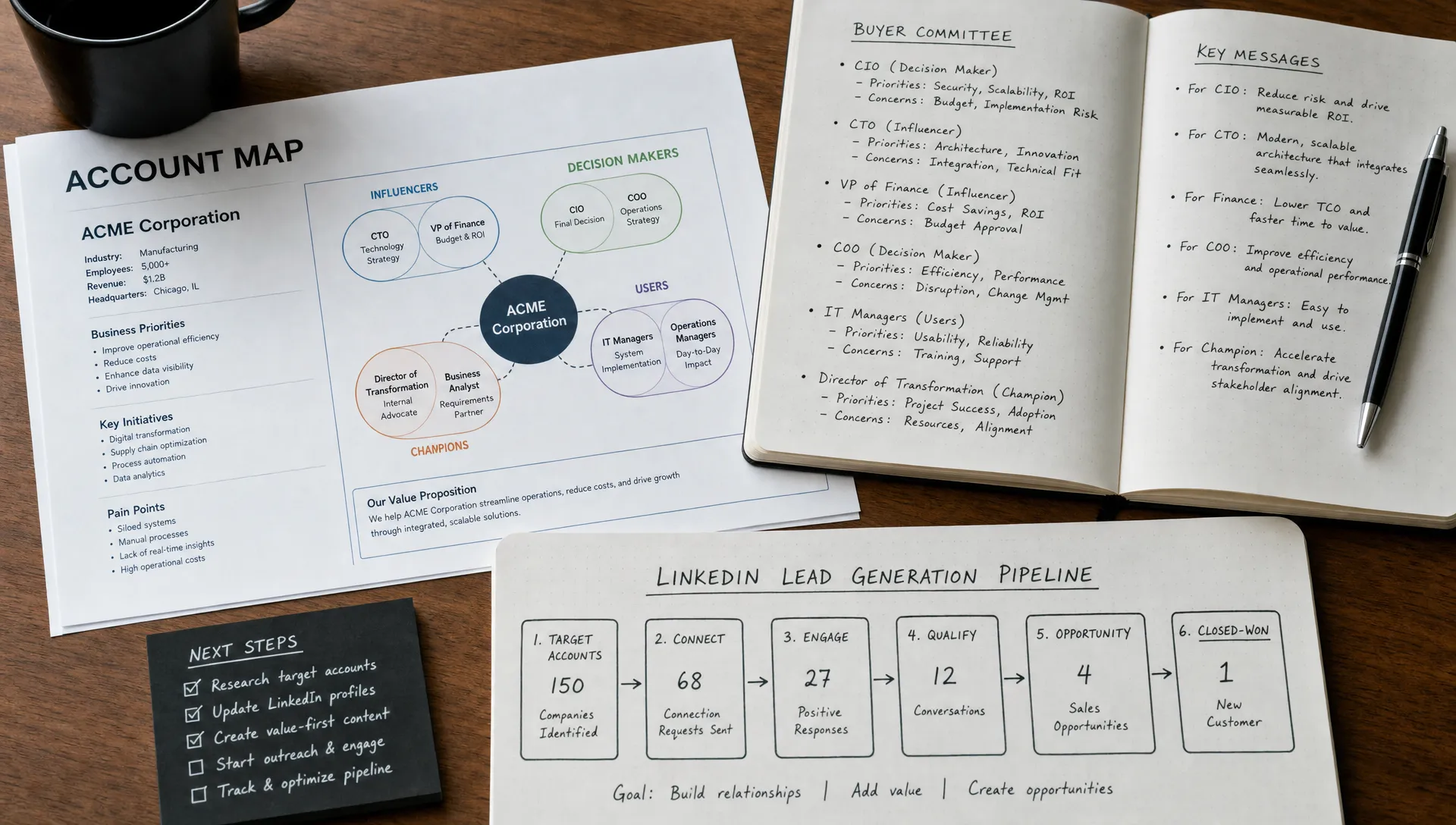
Map the buying committee, not just the decision maker
High-value B2B purchases rarely belong to one person. A plant manager may define the operational need. A CFO may challenge the cost. A technical director may assess feasibility. A CEO may only enter the process when risk or strategic fit becomes clear.
This is where account mapping matters. On LinkedIn, identify the people who influence the problem, the budget and the implementation. Then decide who should receive content, who should receive direct outreach and who should simply be monitored for signals.
| Buyer role | What they usually care about | LinkedIn approach |
|---|---|---|
| Economic buyer | ROI, risk, payback period and vendor credibility | Share proof, benchmarks and executive-level outcomes |
| Technical evaluator | Specifications, integrations, feasibility and reliability | Offer detailed resources and practical explanations |
| Day-to-day user | Workflow, ease of adoption and support | Address operational pain and process improvement |
| Internal champion | Building consensus and reducing objections | Provide content they can share with the buying group |
This approach also improves lead quality. If your current pipeline includes too many weak-fit contacts, Andy Alagappan’s guide to 10 actionable tips to improve lead quality can help tighten your qualification process.
Build a profile that supports the sales conversation
For high-value accounts, LinkedIn lead generation depends less on clever outreach and more on credibility. Before a buyer replies, they often inspect the profile behind the message. If the profile reads like a resume instead of a business case, the campaign loses momentum.
A strong LinkedIn profile for B2B selling should answer three questions quickly: who you help, what business problem you solve and why the buyer should trust you. That applies to company pages as well as individual profiles used by founders, consultants, account executives or subject matter experts.
Good profile positioning usually includes a clear headline, a buyer-focused about section, proof points, relevant services, strong featured content and a recent activity feed that reflects your expertise. The goal is not to make the profile overly promotional. The goal is to make it obvious that a conversation with you may be worth the buyer’s time.
Use outreach that earns a reply instead of forcing a pitch
Most failed LinkedIn outreach feels rushed. The sender connects, pitches, follows up with another pitch and then disappears. High-value buyers can spot automation quickly, especially when the message ignores their role, company and current priorities.
A better outreach sequence starts with relevance. Mention a business trigger, shared context, recent company move or industry-specific issue. Keep the first message short and avoid attaching every value proposition at once. If the account is worth pursuing, it is worth taking the time to personalize.
A simple outreach structure can look like this:
| Step | Purpose | Message focus |
|---|---|---|
| Connection request | Open the door | Shared industry, role relevance or account-specific context |
| First message | Start a conversation | One problem or opportunity likely relevant to the buyer |
| Value follow-up | Add usefulness | A short insight, benchmark, article or checklist |
| Conversion message | Invite the next step | A specific reason to compare notes or discuss fit |
Avoid asking for a meeting before the buyer has a reason to care. A short question about a real business issue often performs better than a polished paragraph about your company.
Use content to warm accounts before direct sales activity
Content is often the missing link between visibility and sales conversations. When your target buyers repeatedly see useful, specific insights from your company, outreach feels less abrupt. They may not be ready to buy today, but they begin to associate your team with the problem you solve.
For high-value accounts, content should be written around the buying committee’s actual concerns. A CFO may respond to cost reduction and risk management. An operations leader may care more about downtime, throughput or implementation burden. A technical evaluator may need evidence that your solution can work inside real-world constraints.
Content formats that support account-based selling include short LinkedIn posts, executive point-of-view articles, customer problem breakdowns, comparison guides, checklists, webinar clips, industry observations and concise case studies. The most effective content is not generic thought leadership. It gives the right buyer language to describe a problem internally.
Combine LinkedIn with search and PPC when intent is visible
For many B2B companies, LinkedIn lead generation performs best when it is connected to search marketing. LinkedIn is strong for account targeting and relationship building. Search is strong for capturing active demand when buyers look for a provider, solution or comparison.
This is especially important in high-value sales where one channel rarely carries the whole journey. A buyer may first notice your company through a LinkedIn post, later search for your category, then compare vendors through your website. If your SEO, PPC and landing pages do not support the same message, the journey becomes fragmented.
Paid search can also validate demand before you scale LinkedIn outreach. If certain pain points, industries or offers convert well in search, those insights can improve your LinkedIn messaging. For a deeper look at paid acquisition in complex sales, see Andy Alagappan’s guide to paid per click advertising for high-value B2B sales.
Measure quality, movement and revenue impact
The easiest way to mismanage LinkedIn lead generation is to measure only activity. Connection requests, impressions and profile views can indicate reach, but they do not prove pipeline value. High-value account programs need metrics that connect outreach and content to sales movement.
A useful reporting model should track leading indicators, qualification indicators and revenue indicators. This gives marketing and sales a shared view of what is working and where accounts are getting stuck.
| Metric category | What to track | Why it matters |
|---|---|---|
| Account coverage | Target accounts reached, roles engaged and buying committee depth | Shows whether the right people are aware of your company |
| Engagement quality | Comments, replies, content saves, document views and direct questions | Separates meaningful interaction from passive visibility |
| Sales movement | Meetings booked, opportunities created and next steps completed | Connects LinkedIn activity to pipeline progress |
| Fit and qualification | ICP match, budget potential, problem urgency and authority | Protects sales time from poor-fit leads |
| Revenue impact | Pipeline value, closed revenue and sales cycle influence | Shows whether the program supports business growth |
Attribution will not always be perfect. A buyer may engage with multiple posts, visit your website and speak with a referral before contacting sales. That is normal in B2B. The point is to measure enough context to make better decisions, not to pretend every touch can be reduced to one source.
Common mistakes that weaken high-value account campaigns
The easiest way to undercut LinkedIn lead generation is to treat it like cold email with a profile photo attached. LinkedIn has its own norms. Buyers expect relevance, professional context and some evidence that the sender understands their world.
Common mistakes include targeting too broadly, relying on generic automation, pitching too soon, ignoring the company page, posting content that is not tied to buyer pain and failing to coordinate with sales follow-up. Another frequent issue is chasing engagement from peers instead of attention from actual buyers.
Sales and marketing alignment is especially important. If marketing creates awareness but sales has no agreed follow-up process, accounts cool down. If sales messages accounts before marketing has built credibility, outreach feels abrupt. The strongest programs define who owns each stage and what action should happen when a target account shows interest.
Frequently Asked Questions
How long does LinkedIn lead generation take for high-value B2B accounts? Most high-value programs need several months to show reliable pipeline movement because the buying cycle is longer and more people are involved. You may see early replies within weeks, but qualified opportunities often depend on repeated exposure, timing and follow-up discipline.
Should we use Sales Navigator for account-based prospecting? Sales Navigator can be useful when your team needs advanced filters, saved account lists and lead alerts. It is not a replacement for strategy, but it can make research and monitoring more efficient when you already know your ideal customer profile.
How many prospects should we contact at each target account? In most complex B2B deals, contacting only one person is too narrow. Start by mapping economic buyers, technical evaluators, users and potential champions, then choose outreach based on relevance. The goal is to understand the buying committee, not spam everyone with the same message.
What content works best before direct outreach? Practical content usually works better than broad inspiration. Use posts, short articles, checklists and case-style breakdowns that address the buyer’s industry, operational pain, risk concerns or financial priorities.
Can LinkedIn replace SEO or PPC for B2B lead generation? No. LinkedIn is powerful for targeting and relationship building, but SEO and PPC capture buyers who are actively searching. The best approach often connects LinkedIn visibility with search visibility, strong landing pages and clear sales follow-up.
Turn LinkedIn activity into qualified B2B pipeline
High-value account growth does not come from more random outreach. It comes from disciplined targeting, credible positioning, useful content and coordinated follow-up across marketing and sales.
B2B Inbound Marketing helps companies improve visibility, lead quality and campaign performance through SEO, PPC, inbound strategy, content and web-related marketing services. If your team wants a more focused way to reach valuable B2B accounts online, use the proposal enquiry form on Andy Alagappan’s B2B marketing website to start the conversation.