


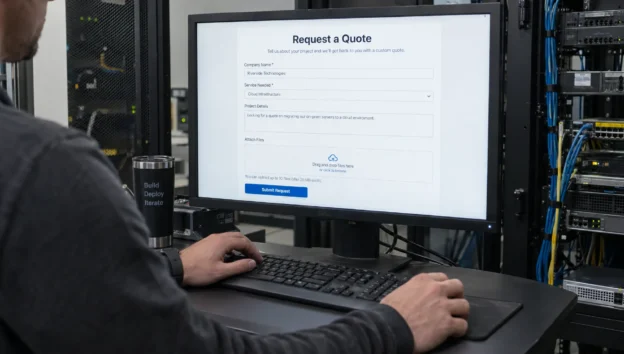
A useful web development and SEO services brief tells an agency what the website must accomplish, what it must preserve and how you will judge the work. Without those details, proposals can describe very different projects while appearing to promise the same result: a better website with more traffic.
For B2B and industrial companies, the brief should connect technical requirements to qualified inquiries, sales workflows and complex buying decisions. Use the sections below to give prospective partners a clear, comparable scope.
Start with business outcomes and buyer requirements
Describe your business before describing your preferred design. Include your priority services, profitable customer segments, geographic coverage and typical sales cycle. Explain who researches a purchase, who approves it and what information each person needs.
An industrial maintenance company might prioritize emergency service inquiries within its operating territory. An equipment manufacturer may care more about RFQs containing specifications, quantities and delivery requirements. Those goals call for different navigation, content and forms.
Record a baseline using the data you actually have. For example, a hypothetical goal could be increasing sales-accepted organic inquiries from 12 to 18 per month within nine months. Label that as a planning target, not a promised outcome.
If stakeholders have not agreed on the commercial objective, develop an SEO marketing business case before requesting proposals. An agency cannot resolve conflicting business priorities through page design alone.
Define the scope of your web development and SEO services
State whether the project is a new website, a redesign, a platform migration or an improvement to an existing site. Identify the current platform, approximate page count, languages and any functionality that must remain available.
Separate page templates from individual pages. Designing one product template and populating 150 product pages is not the same workload as building ten standalone service pages. Specify who enters the content and whether importing existing records is required.
Describe integrations by their required behavior, not just their product names. “Connect the CRM” leaves substantial room for interpretation. “Send each RFQ to the CRM with its requested service, company name and consent status” is easier to estimate and test.
Include known constraints, such as an existing ERP connection, approved hosting provider or internal IT review. Identify exclusions too. Photography, translation, product-data cleanup and ongoing publishing should not silently become someone else's responsibility.
Where uncertainty remains, ask the agency to price a discovery phase and explain which decisions it will resolve before committing to the full build.
Map priority pages, search intent and content ownership
Your web development and SEO services brief should identify which buyer needs deserve dedicated pages. Start with revenue priorities and real customer questions rather than asking for a separate page for every possible keyword variation.
For each priority page, record its audience, purpose, supporting evidence and next action. A custom fabrication page might need material capabilities, tolerances, certifications and an RFQ upload. A maintenance page may need service boundaries, response arrangements and a direct contact option.
The service mix at West Malling Dental & Implant Centre, including dental implants, Invisalign and emergency care, illustrates the same planning principle. Someone seeking urgent care needs a different path from someone researching a planned treatment. Apply that distinction to emergency equipment repair versus long-cycle capital purchases.
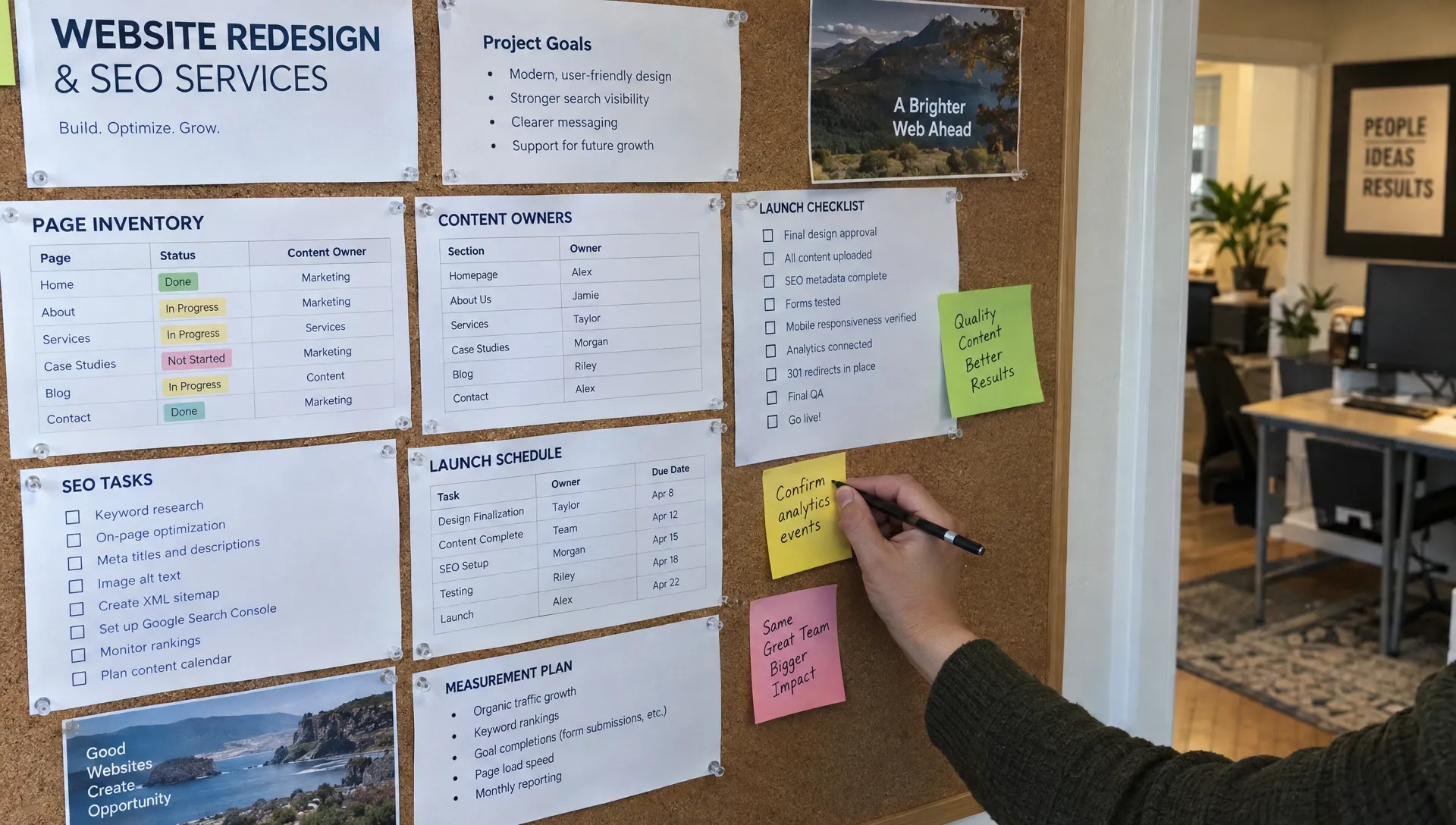
Assign content responsibilities explicitly. Who interviews subject-matter specialists, writes drafts, verifies technical claims and approves publication? If engineering or compliance review is required, include it in the schedule.
Ask for a page inventory or content map showing which existing pages will be retained, revised, consolidated or removed. This gives both parties a concrete scope and reduces the chance that valuable technical information disappears during a redesign.
Specify technical requirements that can be tested
Avoid requirements such as “fast,” “mobile-friendly” or “SEO-ready” without defining what they mean. A web development and SEO services scope needs observable deliverables, along with the method used to evaluate them.
Identify the browsers, devices and representative page types that must be tested. Describe important mobile tasks, such as opening specification documents, completing an RFQ and uploading a drawing. Specify file types and size limits where uploads are involved.
For performance, ask the agency to distinguish laboratory testing from real-user measurements. Google's Core Web Vitals guidance covers loading performance, responsiveness and visual stability. Agree on a testing approach before signing, including how third-party scripts will be handled. A prelaunch test cannot guarantee field results across every visitor's device and network.
The technical scope should also address crawlable navigation, editable titles and descriptions, canonical URLs, XML sitemaps and structured data where appropriate. Structured data must match visible page content and applicable eligibility requirements.
Specify accessibility expectations, HTTPS, backup arrangements and update responsibilities. If a particular accessibility standard is required, name the standard, testing scope and remediation process rather than relying on a plugin or an undefined promise of compliance.
Protect existing search visibility during a redesign
A redesign can remove useful pages, change URLs and interrupt measurement. Build migration protection into your web development and SEO services requirements, even when the new site stays on the same domain.
Request an inventory of existing URLs, search landing pages and important downloadable resources. Where data is available, identify pages earning organic clicks, relevant links and qualified inquiries. Do not assume a page has no value simply because its design looks dated.
Require an old-to-new URL map before launch. Changed URLs should use permanent redirects to the closest relevant replacement, not automatically send every visitor to the homepage. Update internal links so they point directly to the final destination.
The launch plan should explain how the team will check staging restrictions, robots directives, canonical tags, redirects and sitemap submission. A forgotten noindex directive can prevent intended pages from appearing in search results.
Assign responsibility for postlaunch checks and define a monitoring window. Include a rollback decision process for serious failures. Google's guidance on site moves with URL changes provides a useful reference, but the agency still needs to translate those principles into tasks for your specific site.
Define measurement, lead quality and account ownership
Reporting requirements belong in the brief, not in a conversation after launch. Ask how the web development and SEO services provider will distinguish visibility improvements from meaningful business results.
Agree on primary conversions, such as completed RFQs, consultation requests or qualified phone inquiries. Supporting actions, including specification downloads, can be useful, but should not automatically count as sales opportunities. A form submission also needs a clear definition of what makes it qualified.
Document the intended reporting chain: search visibility, landing-page visits, completed inquiries and sales acceptance. If CRM integration is outside scope, decide how someone will reconcile marketing inquiries with sales outcomes manually. Note any gaps in historical tracking before setting benchmarks.
Specify analytics and Search Console access, event naming and who tests tracking before launch. Phone tracking, consent management and cross-domain journeys may require additional work. Define those requirements with the appropriate privacy or legal reviewer rather than assuming every tracking method is suitable.
Finally, clarify control of the domain, hosting, analytics properties and website assets. State who owns custom code, what third-party licenses are required and what happens when the engagement ends. Use delegated access where possible instead of circulating shared passwords.
Separate project costs, ongoing work and delivery dependencies
Give agencies a budget range or ask them to present clearly separated options. Either approach is more useful than requesting an all-inclusive price without defining what “all” includes.
Separate discovery, design, development, content production and migration from recurring SEO work. Identify hosting, software subscriptions, maintenance and other third-party costs. Ask whether estimates depend on page counts, interview hours, integration complexity or the condition of existing content.
For ongoing work, request a description of the activities, reporting cadence and prioritization process. A monthly fee alone does not explain whether the engagement includes technical fixes, new content, content updates or implementation support.
The schedule should show dependencies and approval responsibilities, not just a launch date. Content delivery, engineering review, IT access and stakeholder feedback can all affect completion. Name one internal decision-maker who can consolidate feedback.
Define revision allowances and a written change-control process. If stakeholders request a distributor portal halfway through the project, both parties should know how its cost and schedule impact will be approved. Also distinguish the postlaunch defect-correction period from paid enhancements and ongoing maintenance.
Turn promises into acceptance criteria
For web development and SEO services, acceptance criteria should focus on work the provider can deliver and demonstrate. Rankings and revenue remain business outcomes to monitor, not substitutes for checking whether the agreed implementation is complete.
Use a short table like this in your brief, then refine it with the selected agency:
| Area | Required deliverable | Acceptance evidence |
|---|---|---|
| Page scope | Approved templates and agreed page inventory | Pages reviewed against the signed scope |
| Content | Final copy and approved technical claims | Named stakeholder approval recorded |
| Migration | URL map and permanent redirects | Redirect tests for mapped URLs and priority pages |
| Lead capture | Working forms and agreed routing | Test inquiries received with required fields |
| Measurement | Agreed conversion events | Successful tests without unintended duplicate events |
| Handover | Access, documentation and training | Client confirms access and receives agreed materials |
Pair the table with an issue-resolution process. Define who logs defects, how severity is assigned and which failures block launch. A broken RFQ form should receive different treatment from a minor spacing inconsistency.
An existing comprehensive SEO checklist can help identify review areas, but the contract should still name the checks relevant to your website. Broad checklists are not a replacement for project-specific acceptance criteria.
Use this copy-ready brief summary
Before circulating your web development and SEO services brief, put a one-page summary at the front. Keep the detailed inventories and technical requirements in supporting documents. The summary should let a prospective partner understand the project without guessing at the commercial priorities.
The following is an illustrative industrial-company example, not a description of an existing client:
Business objective: Generate more sales-accepted RFQs for our priority fabrication services within our approved service territory.
Audience: Procurement managers and engineers who need capability details, technical evidence and a straightforward drawing-submission process.
Project scope: Redesign the existing website, retain useful technical resources and implement the approved page inventory. The agency proposes template requirements during discovery.
Responsibilities: Our engineering team supplies technical evidence and approves claims. The proposal must identify responsibility for writing, data entry, integration testing and migration.
Success measures: Working lead capture and tracking at launch, followed by reporting on organic inquiries and sales acceptance against the agreed baseline.
Proposal requirements: Separate project and recurring costs, state assumptions and exclusions, identify dependencies and explain handover arrangements.
Attach your URL inventory, brand assets, available analytics exports and integration notes. Provide sensitive system access securely after the appropriate agreements are in place, not inside a document circulated to multiple bidders.
Frequently asked questions
How much should web development and SEO services cost? A useful estimate depends on page volume, content needs, integrations, migration risk and ongoing responsibilities. Ask bidders to price the same scope and separate one-time implementation from recurring work. A low total can conceal exclusions that another proposal includes.
Should the brief specify a content management system? Name an existing requirement if there is a business reason for it. Otherwise, describe editing needs, integrations, security constraints and ownership expectations, then ask the agency to justify its recommendation and explain recurring costs.
Should an agency guarantee first-page rankings? No provider controls Google's search results. Require specific deliverables, transparent reporting and a reasoned strategy instead. Evaluate progress against relevant search visibility and qualified inquiries without treating a ranking promise as a contractual quality standard.
Do we need ongoing SEO after launch? That depends on competition, site condition and growth goals. Launch establishes an implementation baseline. Content improvements, technical maintenance and performance analysis may continue afterward, but their scope and budget should be agreed separately rather than assumed.
Request a proposal against a shared scope
Before contacting agencies, confirm your business objective, page priorities, internal owner and acceptance criteria. Send every bidder the same brief and ask them to explain assumptions and exclusions.
To discuss a project, share those requirements with B2B Inbound Marketing. A defined scope gives both sides a stronger starting point for evaluating SEO, content and website development needs.