



An SEO website should do more than attract visitors. For a B2B or industrial business, it should help the right buyer confirm that you can handle the job, find evidence that reduces risk and take a useful next step. A high-ranking page that leaves those questions unanswered can generate traffic without producing qualified inquiries.
The most valuable improvements often sit between discovery and contact: clearer qualification information, more usable proof and a quote process that prepares both the buyer and your sales team.
Find the decision gaps that stop buyers
Start with a commercial page that receives relevant search traffic, such as a service, product category or manufacturing capabilities page. Review it as someone evaluating a supplier, not as someone checking keyword placement.
A prospective customer usually needs to make three decisions:
- Fit: Can this company meet our technical requirements, location needs and purchasing constraints?
- Confidence: Is there enough evidence to justify putting this supplier on our shortlist?
- Action: What should we submit, and what happens after we contact them?
These decisions expose weaknesses that ranking reports cannot. A page might describe a service accurately but omit the materials supported. It might display customer logos without explaining the work completed. Or it might offer a contact form without saying whether it accepts requests for quotations.
Treat unanswered buying questions as conversion barriers. Fixing them helps visitors assess suitability before anyone spends time on a sales call.
Build an SEO website around buyer fit
The fastest route to more useful inquiries is not necessarily a more persuasive headline. It may be a clearer explanation of who you serve and which projects you can accept.
For industrial companies, suitability can depend on process capabilities, tolerances, materials, production volume or service territory. For professional services, it may depend on business size, project scope or the systems involved.
Place the most important qualification information on the relevant commercial page rather than requiring visitors to search through company information or downloadable brochures.
| Buyer question | Information that helps answer it |
|---|---|
| Can you handle our application? | Supported applications, materials or project types |
| Does our order fit your operation? | Actual volume requirements or project constraints |
| Can you serve our location? | Clear delivery coverage or service territory |
| What affects timing and cost? | The inputs needed to assess schedule and pricing |
| Are there requirements you cannot meet? | Relevant exclusions and capability limits |
Publish only information your team can stand behind. If lead times vary, explain what determines them instead of presenting an unreliable standard turnaround.
For example, someone exploring OEM manufacturing for a martial arts brand will have different purchasing questions from someone buying finished products at retail. Customization requirements, samples and production quantities become relevant considerations. The page should reflect that buying context rather than rely on generic claims about quality.
Put credible proof beside the claim it supports
An SEO website becomes easier to evaluate when evidence appears where the buyer needs it. A separate testimonials page can help, but it should not be the only place visitors encounter proof.
If a page claims experience with a particular application, include a relevant project example nearby. If it mentions a certification, identify its scope accurately and make supporting documentation available when appropriate.
Make project examples useful to a purchasing team
A strong example explains the customer's challenge, the work performed and the outcome you can substantiate. Photos of completed work may add context, but a photo alone does not explain whether your business can solve a similar problem.
When confidentiality limits what you can publish, describe the application without disclosing protected details. An anonymized account of a manufacturing challenge is more useful than an unsupported statement that you serve major companies.
Avoid implying that one project's result is guaranteed for every customer. Separate demonstrated experience from promises about future performance.
Replace broad assurances with specific information
“Reliable service” tells a buyer little. An explanation of your documented inspection process, project communication approach or quoting requirements gives them something to assess.
Your B2B content should support the conversion decision, not simply repeat sales language. Specific evidence helps a prospect explain internally why your company deserves consideration.
Help the whole buying group evaluate your business
The person who finds your company through search may not approve the purchase. An engineer might identify a supplier, procurement might compare terms and an operations manager might assess implementation risk.
An SEO website should give these people information they can share without losing the context of your offer. That does not require a separate page for every job title. It requires commercial pages that cover the distinct concerns involved in a purchase.
Make important pages easy to forward
Imagine a visitor emailing your capabilities page to a colleague. Would that colleague understand what you provide, what evidence supports your claims and how to request the next step?
A useful page stands on its own. It includes a clear service description, relevant qualification details and a specific contact route. Important information should not depend on a rotating banner or a conversation that has not happened yet.
Downloadable specification sheets can support this process when maintained, dated where appropriate and consistent with the web page. Keep essential information available on the page as well, so buyers do not have to download a document just to establish basic fit.
Shareability matters because B2B evaluation often continues after the original search session ends.
Offer a next step that matches the purchase
“Contact us” is sometimes sufficient, but complex purchases benefit from a more descriptive action. A buyer may need to request a quote, submit specifications or discuss project feasibility.
An SEO website should make the next step clear without asking visitors to commit beyond their current stage. Someone researching requirements may not be ready for a sales call, while someone with an approved project may want to submit drawings immediately.
Explain the request before presenting the form
Describe what the buyer should provide and how your team uses it. If drawings, quantities or delivery locations are needed to prepare a quotation, say so. If the first conversation determines feasibility rather than price, make that distinction clear.
Do not advertise response times unless your team can consistently meet them. A realistic explanation of the process is more credible than an unsupported promise of immediate contact.
Give research-stage visitors a useful alternative
A specifications page, application guide or relevant project example can help someone who is not ready to inquire. The alternative should advance their evaluation, not distract them with an unrelated newsletter signup.
Keep one primary action visually clear on each commercial page. Supporting actions can remain available without competing equally for attention.
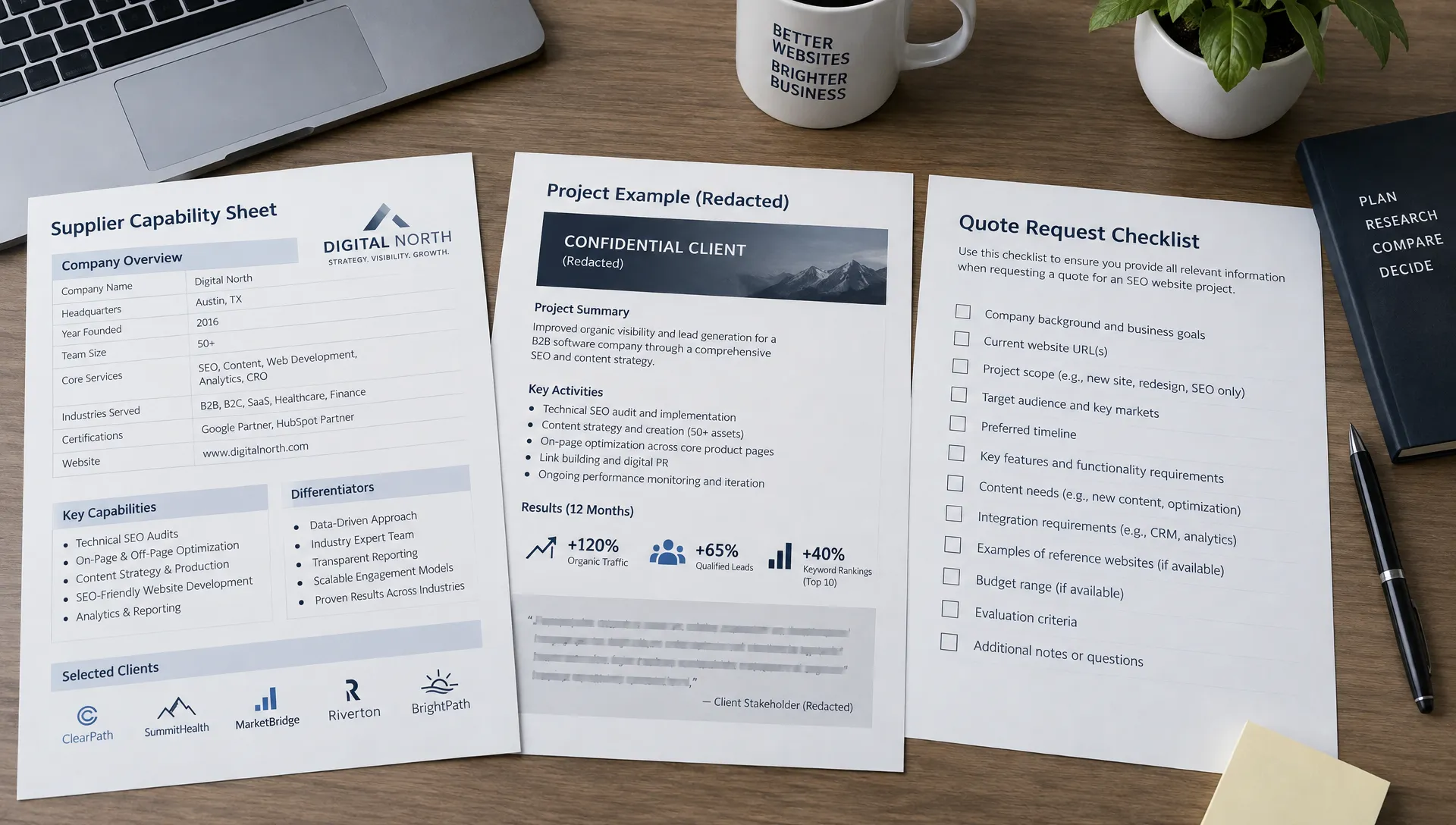
Remove friction without removing qualification
A shorter form is not automatically a better form. Removing every qualifying question may increase submissions while leaving sales with inquiries it cannot assess.
For an SEO website, the better goal is to ask for the smallest amount of information needed to take the promised next step. A general consultation request and a detailed quotation request should not necessarily use identical fields.
Make optional fields visibly optional. Explain unfamiliar requirements and use labels that remain visible while people type. Test the form on a phone, including error messages, file uploads and the confirmation state.
Check the experience beyond the form
Slow pages, broken phone links and inaccessible controls can interrupt an otherwise strong buying experience. Google’s Core Web Vitals guidance covers loading performance, responsiveness and visual stability, but passing those checks does not prove that a page answers purchasing questions.
Technical usability and decision clarity need separate reviews. A fast page can still leave buyers uncertain, and a persuasive page can still fail if its submission process breaks. A structured approach to website optimization for better conversion rates helps address both problems.
Connect the inquiry to a prepared sales response
The conversion experience continues after submission. A buyer who provides detailed requirements should not immediately receive a generic reply asking for the same information again.
An SEO website needs a reliable handoff between the page, the inquiry system and the person responsible for responding. Before adding more traffic, verify that legitimate submissions reach the right team and that important context survives the transfer.
Where your systems support it, retain the page associated with the inquiry, the requested service and the details the buyer submitted. Review privacy requirements before collecting or passing additional visitor information.
Define ownership and next steps
Assign responsibility for reviewing new inquiries. Establish how your team handles requests that are incomplete, outside your capabilities or ready for a quotation.
The confirmation message should acknowledge receipt and explain what happens next. It should not promise that every request will receive a quote if feasibility still needs to be checked.
This operational work directly affects the value of your marketing. Better page content cannot compensate for lost submissions or a follow-up process that ignores the buyer's needs.
Measure progress toward sales, not just form fills
More inquiries are valuable only when they support the business. Spam, supplier solicitations and unsuitable projects can make conversion reports look healthy without creating sales opportunities.
Evaluate an SEO website using both website behavior and downstream lead quality. Keep definitions consistent so a change in reporting does not look like an improvement in performance.
| Measure | What it helps you understand |
|---|---|
| Valid organic inquiries | Whether search visits produce legitimate requests |
| Sales-accepted inquiries | Whether those requests fit your agreed qualification criteria |
| Quote or opportunity progression | Whether inquiries advance beyond initial contact |
| Common disqualification reasons | Which expectations or requirements need clarification |
| Outcomes by landing page | Which commercial pages support useful buyer actions |
Review these measures together. If submissions rise but sales acceptance falls, the page may be attracting or encouraging the wrong prospects. If qualified inquiries arrive but rarely progress, investigate follow-up, pricing fit and missing decision information.
Use buyer feedback to choose the next change. Repeated questions about order quantities suggest a qualification gap. Repeated requests for the same documentation suggest that evidence is hard to find.
For low-traffic B2B pages, small differences between short reporting periods can be misleading. Combine quantitative data with inquiry reviews before declaring a change successful.
Frequently asked questions
Can an SEO website convert buyers without online checkout? Yes. In B2B markets, a meaningful conversion may be a qualified quote request, a specification submission or a project discussion. These actions support a purchase, but they should not be reported as completed sales.
Should pricing appear on every commercial page? Not necessarily. When pricing depends on specifications, volume or scope, explain those factors and what information is required for an estimate. Publish fixed prices or ranges only when they accurately represent the offer.
Which page should we improve first? Start with a commercial page that attracts relevant visitors but produces few qualified inquiries. Review buyer fit, supporting evidence, the next step and the inquiry handoff before changing cosmetic details.
How do we know whether a change worked? Compare valid inquiries and sales progression, not just total submissions. Also check whether recurring buyer questions or disqualification reasons have changed.
Turn your highest-value pages into better buying tools
Choose one important commercial page and review it with someone who handles customer inquiries. Identify the unanswered question that most often delays or disqualifies a purchase, then address it with accurate information.
For support connecting search visibility with buyer action, B2B Inbound Marketing offers SEO, inbound marketing strategy, web content writing and web design services for B2B and industrial businesses.