


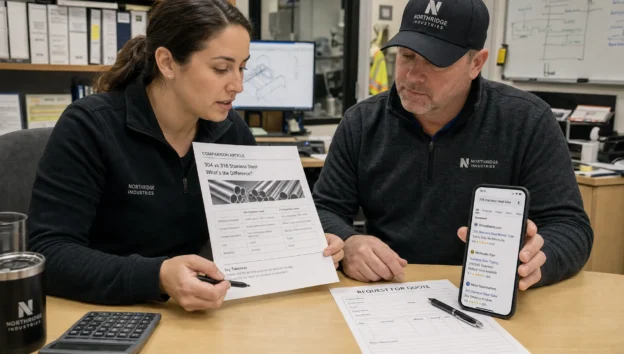
Industrial companies rarely suffer from a shortage of knowledge. They know their equipment, process controls, materials, tolerances, field conditions and compliance requirements. The problem is that buyers often cannot see that expertise until very late in the sales process. SEO marketing closes that gap by turning internal know-how into searchable content that attracts engineers, plant managers, procurement teams and executives before they are ready to request a quote.
In industrial markets, the buyer's first question is often technical, not promotional. Someone searches for a failure mode, a specification, a comparison between materials or a way to reduce downtime. If your website answers that question clearly, your company becomes part of the buying conversation earlier than competitors who only publish product brochures.
Why industrial expertise does not automatically become pipeline
Technical expertise usually lives in sales calls, engineering notes, maintenance manuals, project histories and the experience of senior people. That information helps close deals, but it does not create visibility if it remains offline or buried in PDFs that search engines and buyers struggle to use.
Industrial buyers also research with very specific language. A manufacturer looking for corrosion-resistant components may not search for a broad product category first. They may search by operating temperature, fluid type, standard, application or failure problem. A website that only says “high-quality solutions” misses the terms real buyers use when they have a concrete need.
This is why organic SEO remains essential for industrial companies that sell complex products or services. Search visibility gives your expertise a public path to the market. It turns answers you already provide privately into assets that can generate qualified demand over time.
How SEO marketing turns expertise into buyer-ready content
SEO marketing is most valuable for industrial firms when it does more than chase rankings. It should translate specialized knowledge into pages that match buyer intent, reduce uncertainty and guide prospects toward the next step.
Start with the problems buyers already search for
Good industrial content starts with the questions that appear before a purchase. These may include troubleshooting queries, product selection searches, safety concerns, capacity calculations or replacement questions. For example, a buyer may search “why pump seals fail in abrasive slurry” long before searching for a specific supplier.
The goal is not to publish generic educational content. The goal is to map your expertise to buying-stage questions. A top-of-funnel article can explain the problem, a comparison page can clarify options and an application page can show where your solution fits.
In industrial markets, SEO marketing works best when keyword research is paired with input from sales and technical teams. Sales can reveal objections. Engineers can explain constraints. Customer service can identify recurring problems. Search data then shows how buyers phrase those needs.
Translate technical depth into commercial proof
Industrial buyers need confidence. A page that explains a technical mechanism is useful, but a page that connects that mechanism to lower downtime, safer operation or better lifecycle cost is stronger. This is where expertise becomes pipeline instead of just information.
That translation matters because industrial buying decisions often involve multiple stakeholders. Engineering may care about performance, operations may care about reliability, finance may care about total cost and procurement may care about supplier risk. Teams that market complex products can learn from approaches like industrial marketing training for complex buying decisions, where stakeholder insight and trade-off thinking are central to better decisions.
A strong content program makes those trade-offs visible. Instead of saying a component is durable, explain the conditions that shorten service life, the design choices that improve reliability and the situations where one option is not the right fit. That kind of clarity builds trust.
Build a content architecture that mirrors the industrial buying process
A strong SEO marketing program does not rely on isolated blog posts. It organizes content around the way buyers move from problem recognition to vendor evaluation. Industrial prospects may take weeks or months to move through that journey, so your website needs useful entry points for each stage.
| Buyer stage | What the buyer needs | Useful content type | Pipeline role |
|---|---|---|---|
| Problem identification | Understand the issue and its cost | Troubleshooting guides, failure explanations | Attracts early-stage qualified traffic |
| Solution exploration | Compare approaches and constraints | Application pages, material comparisons | Builds preference and trust |
| Vendor evaluation | Reduce risk and validate fit | Case studies, capability pages, FAQs | Supports sales conversations |
| Purchase justification | Explain value to internal stakeholders | ROI pages, lifecycle cost content | Helps buyers make the business case |
This structure helps buyers self-educate without removing the need for sales. In fact, it often improves sales conversations because prospects arrive with context. They know the issue, understand possible solutions and can ask more specific questions.
The architecture also helps search engines understand your topical depth. A manufacturer with connected content around applications, specifications, industries and problems sends a clearer signal than a site with scattered posts that do not support core service pages.
Make conversion paths match buyer readiness
Traffic does not become pipeline by accident. Once a buyer reaches a useful page, the next step must match their level of readiness. An engineer reading a technical guide may not want a sales call yet, but they may download a specification sheet, use a calculator or ask for application guidance.
SEO marketing should connect each content type to a conversion path that feels natural. Early-stage pages can invite readers to compare options or review a technical resource. Mid-funnel pages can offer product selection help. Bottom-of-funnel pages should make quote requests, consultations or proposal inquiries easy to find.
For industrial companies, the quality of the conversion matters more than the raw number of form fills. A small number of relevant inquiries from plant managers, engineers or procurement teams is usually worth more than a large volume of vague contacts. That is the same principle behind industrial lead generation that reaches real buyers, where the focus is on fit rather than vanity metrics.

Use PPC, social and web design to strengthen organic pipeline
Search optimization is more effective when it is not treated as a separate channel. PPC can test which messages attract high-intent clicks. Social media can distribute technical content to niche audiences. A responsive website can make long-form content easier to read for buyers researching from job sites, airports or plant offices.
SEO marketing also benefits from paid search data because industrial keyword volumes can be small. A PPC campaign may quickly reveal which phrases bring serious prospects and which ones attract students, job seekers or unrelated buyers. Those insights can shape organic pages and improve conversion copy.
The website itself matters just as much. Slow pages, confusing navigation, weak calls to action and thin product information can waste qualified search traffic. Industrial buyers do not need flashy design, but they do need clarity, fast access to technical information and a path to contact someone who understands their application.
This is why SEO and online marketing work better together than as disconnected tasks. The strongest results come from aligning search visibility, paid campaigns, content, web design and conversion strategy around the same buyer journey.
Measure pipeline, not just rankings
Rankings are useful, but they are not the final measure of success. An industrial page can rank well for a broad term and still produce weak leads. Another page may draw fewer visitors but consistently attract high-value prospects because it matches a specific application or problem.
Good SEO marketing measurement connects search performance with business outcomes. Track which pages generate qualified inquiries, which topics appear in sales conversations and which organic leads progress into opportunities. If possible, connect form submissions and phone calls to CRM stages so marketing can see what becomes real pipeline.
Useful metrics include organic sessions from priority industries, conversions by page type, assisted conversions, quote requests, sales-qualified leads and opportunity value. Over time, these metrics show which expertise deserves more content investment.
A practical review rhythm can be simple. Each quarter, identify the pages that attract qualified visitors, the pages that rank but do not convert and the technical topics sales teams wish buyers understood sooner. That feedback loop keeps SEO tied to revenue instead of treating it as a reporting exercise.
Common mistakes that keep expertise from producing leads
The most common mistake is writing only about the company. Industrial buyers care about capabilities, but they usually begin with their own problem. Content that leads with “we are a leading provider” often misses the search intent behind real buying journeys.
Another mistake is making content too shallow. Buyers of industrial products can spot generic writing quickly. If a page could apply to any supplier in any industry, it probably will not build confidence. Specificity is an advantage when it explains materials, operating environments, tolerances, standards, service conditions or selection criteria.
Companies also lose pipeline when they hide useful information behind sales gates too early. Not every resource needs to be public, but buyers need enough detail to decide whether your company belongs on their shortlist. A balanced approach gives away practical guidance while reserving custom engineering, pricing and detailed recommendations for direct conversations.
Finally, many firms stop after publishing. SEO marketing requires maintenance because products change, competitors publish new content and buyer language evolves. Updating strong pages is often more valuable than constantly producing new pages with no clear purpose.
Frequently Asked Questions
How long does SEO marketing take to create industrial pipeline? Timelines vary by competition, website condition and content depth. Many industrial companies should think in quarters rather than weeks, especially when targeting technical topics and long sales cycles.
What type of industrial content generates the best leads? Application pages, troubleshooting guides, comparison pages and technical FAQs often perform well because they match specific buyer problems. The best format depends on how your buyers research solutions.
Should industrial companies use PPC while building SEO? Yes, PPC can create immediate visibility and provide keyword data while organic pages gain traction. It is especially useful for testing messaging in small or specialized markets.
Can SEO work for low-volume industrial keywords? Yes. Low-volume keywords can be highly valuable when they indicate a specific need, application or buying situation. One qualified inquiry from a narrow technical search can be worth far more than broad traffic.
Turn expertise into a searchable sales asset
Industrial firms already have the raw material for strong marketing: technical knowledge, field experience and proof that their solutions work. The opportunity is to make that expertise findable, understandable and connected to the buyer's next step.
If your company needs a practical plan for SEO, PPC, inbound strategy or web content that supports long industrial sales cycles, B2B Inbound Marketing in Houston can help turn search visibility into better conversations with real prospects.