

Pay per click can fill a sales team’s calendar quickly. It can also create a long list of weak form fills, mismatched buyers and expensive conversations that never become opportunities. The difference is rarely the ad platform alone. It comes from pay per click management that is built around pipeline quality instead of click volume.
For B2B and industrial companies, that distinction matters. A single closed deal may justify months of media spend, but only if campaigns attract the right buyer at the right stage. Search ads must connect technical intent, account fit, landing page relevance, lead handling and sales feedback into one measurable system.
That is why mature PPC management is not simply setting bids and writing ads. It is pipeline management through paid search.
What pipeline-focused pay per click management really means
Pipeline-focused PPC starts with a simple question: which paid clicks are likely to become qualified sales opportunities?
A lead-generation campaign that optimizes only for conversions can drift toward low-cost submissions. These may include students, job seekers, consumers, vendors, small buyers outside your service area or companies with no budget. The campaign looks efficient in Google Ads, but the CRM tells a different story.
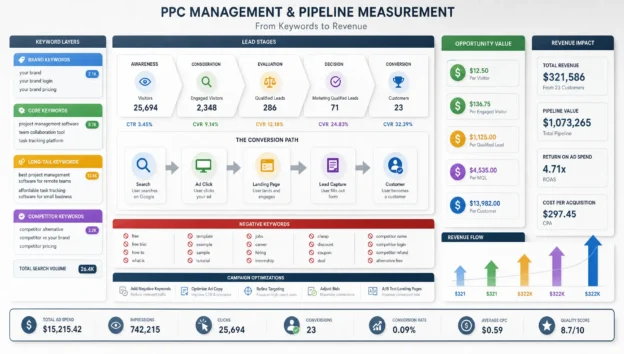
Pipeline-focused management looks at the full chain:
- The search query that triggered the ad
- The keyword and match type behind the query
- The landing page promise
- The form or call action
- The lead quality after sales review
- The opportunity value created in the CRM
- The eventual revenue or lost-deal reason
This approach is especially important for industrial suppliers, manufacturers, technical service providers, distributors, SaaS companies and professional B2B firms. Buyers often research quietly, compare vendors carefully and involve several stakeholders before making contact. The PPC program must respect that buying process rather than forcing every visitor into the same generic lead form.
Start with pipeline economics before choosing keywords
Before campaign structure, bidding or ad copy, define what a qualified opportunity is worth. Without that number, it is difficult to judge whether a $40 click is expensive or a bargain.
A niche industrial keyword may look costly compared with broad traffic. If that keyword produces quote requests from companies with real purchase intent, it may be the most profitable part of the account. A cheap keyword that generates unqualified traffic is still expensive if sales cannot use the leads.
Use the following inputs to set a realistic PPC model:
| Input | Why it matters for PPC management | Practical question to answer |
|---|---|---|
| Average deal value | Sets the ceiling for profitable acquisition cost | What is a typical first order, annual contract or project value? |
| Gross margin | Shows how much revenue can be reinvested into acquisition | How much profit remains after delivery costs? |
| Lead-to-opportunity rate | Separates form volume from real pipeline impact | What percentage of PPC leads become qualified opportunities? |
| Opportunity-to-close rate | Helps determine the value of each qualified lead | How often does sales close PPC-sourced opportunities? |
| Sales cycle length | Shapes reporting expectations | Do paid leads close in weeks, months or longer? |
| Geographic and service limits | Prevents waste from poor-fit locations | Where can the company actually sell, deliver or support? |
When these numbers are known, the account can be managed toward business outcomes instead of vanity metrics. Cost per lead still matters, but only in context. A higher CPL can be acceptable when the lead-to-opportunity rate and average deal value justify it.
Build campaigns around buying intent and account fit
Strong PPC management begins by separating buyers from browsers. In B2B search, the wording of a query often reveals where the buyer is in the decision process.
A search for industrial automation ideas is not the same as industrial automation integrator Houston. A search for what is ISO 9001 is not the same as ISO 9001 consulting firm for manufacturers. The closer the query gets to a vendor, quote, service, replacement, compliance or implementation need, the more carefully it deserves to be handled.
Campaigns should usually be grouped by intent, not just by product category. Useful categories include:
- High-intent service searches, such as vendor, supplier, consultant, company or near me modifiers
- Quote and pricing searches where buyers are actively evaluating cost
- Problem searches that indicate urgency, downtime, compliance risk or operational pain
- Product-specific searches that match a defined offer
- Competitor and alternative searches when comparison intent is commercially relevant
- Existing-market searches separated from expansion-market searches
This structure makes budget allocation easier. High-intent campaigns can receive stronger bidding and tighter landing pages. Research-stage terms can be handled with lower bids, remarketing audiences or SEO content instead of expensive direct-response ads.
If your campaigns are already active, a search terms audit is often the fastest way to find waste. The article on paid per click advertising for high-value B2B sales goes deeper into matching keyword choices with deal economics and buying intent.
Use negative keywords as a pipeline filter
Negative keywords are not just a cost-control tool. They are a qualification tool.
For B2B campaigns, common exclusions may include jobs, salary, training, free, DIY, template, consumer, residential, used, PDF, definition and school. The right list depends on the industry. An industrial repair company may need to exclude hobbyist searches. A software company may need to exclude open-source or student traffic. A distributor may need to exclude retail buyers if it only sells wholesale.
Negative keyword management should not be a one-time setup task. Search behavior changes as Google expands matching, competitors shift their messaging and buyers use new language. Review search terms on a fixed schedule, especially in the first 30 to 60 days of a campaign.
The goal is not to block every imperfect query. The goal is to remove patterns that repeatedly fail to produce qualified sales conversations.
Landing pages should qualify and convert
A PPC landing page has two jobs. It must persuade the right buyer to take action and discourage the wrong buyer from wasting sales time.
Many B2B campaigns fail because the landing page is too vague. It says the company provides quality solutions, experienced service or innovative support, but it does not clarify who the offer is for, what problem it solves or what happens after the form is submitted.
A stronger landing page usually includes:
- A clear statement of the service, product or solution
- Industry or use-case relevance
- Geographic coverage when location matters
- Technical capabilities, certifications or process details when they influence trust
- Proof points, such as project types, customer categories or measurable outcomes that can be stated accurately
- A specific call to action, such as request a quote, schedule a consultation or speak with a specialist
- Form fields that help qualify without creating unnecessary friction
For high-value B2B sales, the landing page should not behave like an e-commerce product page. Buyers may need a conversation, specification review, sample, site visit, demo or estimate. The page should make that next step clear.
Measure what sales can actually use
A campaign that reports 100 conversions may look successful until sales says only five were worth pursuing. That disconnect usually means the account is optimizing for the wrong event.
Basic tracking is still necessary. Form fills, calls, chat starts and quote requests should be captured accurately. But pipeline-focused PPC needs deeper reporting through CRM stages and sales outcomes.
| Metric | What it reveals | Bad sign | Management response |
|---|---|---|---|
| Cost per lead | Efficiency of initial conversion | CPL is low but sales rejects most leads | Tighten targeting, negatives and landing page qualification |
| Lead-to-opportunity rate | Quality of inquiries | Many leads never become real opportunities | Review query intent and form fields |
| Cost per opportunity | True pipeline acquisition cost | Spend rises without qualified pipeline growth | Reallocate budget by campaign and keyword intent |
| Opportunity value | Revenue potential from PPC | Many small or poor-fit deals enter the funnel | Adjust ad copy to signal ideal customer fit |
| Close rate by source | Sales effectiveness by channel | PPC opportunities close below other channels | Review lead expectations, follow-up speed and offer match |
| Lost-deal reasons | Why opportunities fail | Repeated losses due to price, geography or fit | Refine targeting and positioning |
Offline conversion tracking, CRM integration and disciplined UTM naming help connect ad spend to pipeline. Even if a company starts with a simple spreadsheet review between marketing and sales, the key is to move beyond platform-only reporting.

Sales feedback should guide campaign decisions
Sales teams often know within minutes whether a PPC lead is promising. That information should not stay in the sales inbox.
A practical feedback loop can be simple. Each week, marketing and sales review recent paid search leads and mark them as qualified, unqualified, unclear or duplicate. For unqualified leads, capture the reason. Was the buyer too small? Outside the service area? Looking for a job? Requesting a product the company does not offer? Comparing prices with no intent to buy?
These patterns should influence campaign management. If unqualified leads come from a specific location, adjust geographic targeting. If they come from one broad-match keyword, tighten match types. If leads misunderstand the offer, rewrite the ad and landing page. If good leads fail to progress, improve follow-up speed or sales enablement.
This is where experienced management matters. PPC platforms can automate bids, but they cannot understand your sales conversations without structured feedback.
Bidding should follow revenue signals, not just form fills
Automated bidding can be useful, but it depends on the quality of the conversion data. If the account tells Google that every form fill is equally valuable, the system will look for more form fills. It will not automatically know which inquiries become profitable customers.
For B2B campaigns, assign stronger value to actions that indicate higher intent. A quote request may be worth more than a newsletter signup. A call lasting several minutes may be more valuable than a short accidental click. A CRM-qualified opportunity is more meaningful than a raw lead.
When possible, optimize toward deeper funnel actions. If volume is too low for automated bidding, use manual controls or portfolio strategies cautiously while gathering better data. The right approach depends on conversion volume, sales cycle length and account maturity.
Budget should also follow pipeline value. If one campaign produces fewer leads but a higher opportunity rate, it may deserve more investment than a campaign generating cheap but weak inquiries. This is where many accounts improve quickly after a proper audit. The article on fixing a pay per click campaign that wastes budget outlines common causes of spend leakage in B2B and industrial campaigns.
Use PPC to test new markets without betting the whole budget
Paid search is valuable because it can test demand quickly. For companies expanding into new regions, industries or buyer segments, PPC can show which messages attract real inquiries before the company invests heavily in content, events, sales hiring or channel development.
A Houston industrial firm might test another regional market. A B2B software company might test a new vertical. A manufacturer might evaluate export demand, distributor interest or marketplace expansion in another country. In these cases, PPC should be paired with market readiness research, compliance checks, logistics planning and channel validation.
For consumer brands or manufacturers exploring international growth, an AI-powered market readiness and partner matching platform can help validate target countries and channel opportunities before paid media spend is scaled. That kind of upfront validation can make PPC testing more commercially useful because the campaign is pointed at markets the business can realistically serve.
For B2B advertisers, the same principle applies. Do not use PPC to create demand in a market where delivery, pricing, compliance or sales coverage is not ready. Use it to measure intent in markets where a qualified inquiry can be handled well.
Align PPC with SEO for stronger lead flow
PPC and SEO work best when they share data. PPC reveals which queries convert quickly. SEO builds durable visibility for the topics, problems and comparisons that buyers research over time.
In many B2B markets, the most efficient strategy is not choosing between paid and organic search. It is using PPC for speed, testing and high-intent demand while SEO develops long-term authority. If a paid keyword consistently produces qualified opportunities, it may deserve a permanent SEO landing page or supporting content. If an SEO page ranks well but conversion intent is high, PPC can protect visibility against competitors bidding on the same terms.
This is especially useful for companies with complex buying journeys. Early-stage content can educate buyers through organic search, while PPC captures later-stage demand when prospects search for suppliers, quotes, consultants or service providers. For a broader view, see how SEO and PPC campaigns can support each other across visibility, lead generation and conversion.
Signs your PPC management is not improving pipeline
A campaign can appear active and still underperform commercially. Watch for these warning signs:
- The account reports many conversions, but sales says lead quality is poor
- Broad keywords consume most of the budget without clear opportunity creation
- Search terms include jobs, education, consumer or unrelated research queries
- Landing pages use generic messaging that could apply to any company
- Campaigns are optimized to CPL without reviewing opportunity value
- No one compares PPC leads against CRM outcomes
- Sales feedback does not change keywords, ads or landing pages
- Geographic targeting includes areas the business cannot serve profitably
These issues are common in accounts that were set up for traffic generation rather than pipeline growth. They are fixable, but they require consistent management and honest reporting.
A practical 90-day PPC management plan for better pipeline
Improving B2B PPC does not require guessing. A focused 90-day plan can expose waste, improve qualification and create a stronger link between ad spend and sales opportunities.
| Timeframe | Primary focus | Key actions | Success indicator |
|---|---|---|---|
| Days 1 to 15 | Audit and baseline | Review tracking, search terms, landing pages, CRM stages and sales feedback | Clear view of where spend creates or fails to create pipeline |
| Days 16 to 30 | Qualification fixes | Add negatives, refine match types, update ad copy and tighten location targeting | Fewer irrelevant leads and cleaner search terms |
| Days 31 to 60 | Landing page and offer alignment | Improve page messaging, forms, proof points and calls to action | Higher qualified conversion rate and better sales acceptance |
| Days 61 to 75 | Pipeline optimization | Shift budget toward campaigns with stronger opportunity creation | Lower cost per qualified opportunity |
| Days 76 to 90 | Scale and systemize | Build reporting cadence, test new segments and document learnings | Repeatable PPC process tied to pipeline metrics |
This plan works because it starts with diagnosis before scaling. Many PPC accounts spend more money too early. The better path is to prove which campaigns create qualified sales conversations, then increase investment with confidence.
Frequently Asked Questions
What is pay per click management for B2B companies? Pay per click management is the ongoing planning, optimization and reporting of paid search campaigns. For B2B companies, it should focus on qualified leads, sales opportunities and revenue potential rather than clicks alone.
How does PPC improve B2B pipeline quality? PPC improves pipeline quality when campaigns target high-intent searches, filter out poor-fit traffic, use relevant landing pages and connect conversion data to CRM outcomes. Sales feedback is essential for refining the program.
What is a good cost per lead for B2B PPC? A good cost per lead depends on deal value, margin, close rate and sales cycle length. A higher CPL can be profitable if the leads become qualified opportunities with strong revenue potential.
How often should B2B PPC campaigns be optimized? Search terms, budgets and lead quality should be reviewed frequently, especially during the first 30 to 60 days. Mature campaigns still need regular optimization because competitors, buyer behavior and platform matching can change.
Should PPC and SEO be managed together? Yes. PPC provides fast keyword and conversion feedback, while SEO builds long-term visibility. Together, they can support stronger lead flow across the full B2B buying journey.
Turn paid search into a stronger B2B pipeline channel
Pay per click management works best when it is treated as a revenue discipline, not a media buying task. For B2B and industrial companies, the goal is not more traffic. The goal is more qualified conversations with buyers who match your market, budget, timing and offer.
Andy Alagappan helps B2B companies improve online visibility, paid search performance and inbound lead generation through SEO, PPC, content and web marketing strategy. If your campaigns are producing clicks but not enough pipeline, it may be time to review the account from a sales-quality perspective and rebuild around the opportunities that matter most.