



An SEO blog should do more than publish articles and wait for traffic. For B2B and industrial companies, the real goal is to attract people who have a defined problem, a business reason to solve it and enough trust in your company to start a conversation.
That changes how you plan the blog. Instead of chasing every keyword with search volume, you build a focused content system around buyer intent, technical questions, objections, comparison points and conversion paths. A strong SEO blog helps the right prospects find you before they fill out an RFQ, talk to sales or shortlist vendors.
Start With the Buyer You Actually Want
Before choosing blog topics, define what a qualified buyer means for your business. This is where many SEO blogs go wrong. They target broad informational searches because the numbers look attractive, then wonder why the traffic never turns into inquiries.
A qualified buyer is not just someone who reads a post. In a B2B setting, qualified usually means the person has a business need, fits your service area or market, has influence over the buying process and is searching with a level of specificity that suggests real intent.
For an industrial supplier, that may mean an engineer searching for a material compatibility question. For a professional service provider, it may be an owner comparing vendors. For a finance company offering smart mortgage solutions, it may be a borrower trying to understand refinancing options, loan requirements or how to choose the right lending path.
The industry changes, but the principle stays the same. Your blog should speak to the questions that come before a sales conversation, not just the questions that generate the largest audience.
Map Blog Topics to Buyer Intent
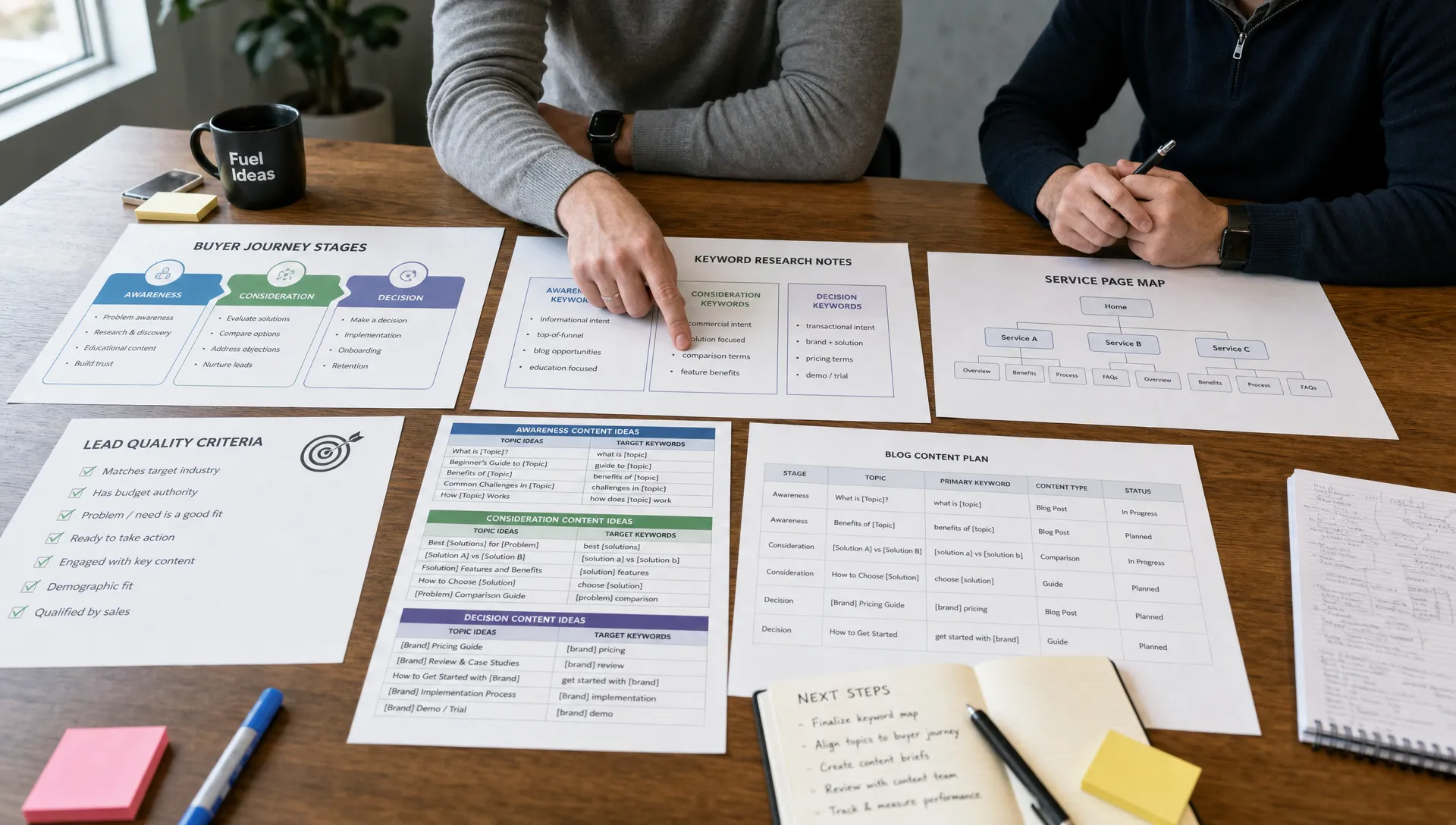
Every SEO blog needs a clear intent map. This keeps your content balanced between educational articles, evaluation content and posts that support bottom of funnel decisions.
Search intent is usually more important than search volume. A keyword with 150 monthly searches can be more valuable than a keyword with 5,000 monthly searches if the smaller query comes from someone closer to making a buying decision.
| Buyer stage | What the prospect is trying to do | Example blog angle | Best conversion path |
|---|---|---|---|
| Problem aware | Understand the issue and its impact | “Why Your Industrial Website Gets Traffic but No RFQs” | Related guide or consultation CTA |
| Solution aware | Compare ways to solve the problem | “SEO vs PPC for B2B Lead Generation” | Service page or strategy call |
| Vendor aware | Evaluate providers and proof | “What to Ask Before Hiring a B2B SEO Agency” | Case study, contact form or proposal request |
| Decision ready | Reduce risk before contacting sales | “How Long Does Industrial SEO Take to Generate Leads?” | Direct inquiry or proposal form |
This type of mapping also prevents your blog from becoming a collection of unrelated posts. Each article should have a reason to exist within the larger buyer journey.
Build Topics From Sales Conversations, Not Just Keyword Tools
Keyword tools are useful, but they rarely tell the whole story. They can show estimated demand, related queries and ranking difficulty. They cannot fully capture the objections your sales team hears, the questions buyers ask during technical evaluations or the language used in real purchasing conversations.
Start with sources that reveal buyer reality:
- Sales call notes and common objections
- RFQ messages and proposal questions
- PPC search term reports
- CRM notes from closed won and closed lost deals
- Customer service questions
- Competitor pages that rank for commercial topics
- Industry forums, trade publications and procurement language
For B2B companies, this process often uncovers better content opportunities than generic keyword research. A blog post that answers a procurement concern or technical qualification question may not bring thousands of visitors, but it can influence the exact people you want to reach.
If your current SEO program is generating traffic without the right inquiries, it may be worth reviewing how your content connects to lead quality. This is a major reason an SEO marketing service improves lead quality when strategy, content and sales feedback work together.
Choose Keywords With Commercial Clues
A qualified buyer often searches with context. They add industry terms, use case details, geographic qualifiers, technical specifications or comparison language. Those clues help you separate casual readers from serious prospects.
For example, a broad keyword like “content marketing” may attract students, freelancers, marketers and general readers. A more focused phrase like “industrial content marketing for lead generation” suggests a business context. It may have lower volume, but it is much more aligned with a B2B marketing goal.
Look for modifiers that reveal fit:
- Industry terms, such as industrial, manufacturing, construction, energy or B2B
- Buying terms, such as cost, provider, agency, consultant, quote or services
- Comparison terms, such as best, vs, alternatives or how to choose
- Problem terms, such as low lead quality, no inquiries, poor rankings or high cost per lead
- Technical terms, such as specifications, standards, integration, compliance or applications
Do not force every keyword into every article. The headline should guide the primary topic, then the article should use related terms naturally where they help explain the subject. Search engines have become much better at understanding topical relevance, so a clear, useful article often performs better than a page overloaded with repeated phrases.
Create a Blog Architecture That Supports Revenue Pages
An SEO blog should not sit apart from the rest of the website. It should support your service pages, product pages, industry pages and conversion pages through clear internal linking.
Think of the blog as a way to answer questions that are too specific, too early stage or too educational for a main service page. Then, when the reader is ready for the next step, the blog should guide them to a page that explains your offer in more detail.
A simple structure works well for many B2B companies:
| Content type | Purpose | Example |
|---|---|---|
| Core service page | Convert high intent visitors | “Industrial SEO Services” |
| Supporting blog post | Answer a specific question | “How Industrial SEO Helps Manufacturers Win Better Leads” |
| Comparison post | Help buyers evaluate options | “SEO vs PPC for Industrial Lead Generation” |
| Proof based post | Reduce perceived risk | “What B2B Buyers Look for Before Contacting a Vendor” |
| FAQ style post | Capture long tail searches | “How Long Does B2B SEO Take?” |
Internal links should feel useful, not forced. If a blog post explains how website structure affects conversion, it makes sense to connect readers to a deeper resource on search engine optimization website design. If an article covers writing style, buyer objections or calls to action, it may naturally point to guidance on content writing for SEO.
Write Each Post Like a Sales Enablement Asset
A blog post that attracts qualified buyers should feel practical. It should help the reader make a decision, understand a risk, diagnose a problem or prepare for an internal discussion.
That does not mean every article should sound like a sales pitch. In fact, the best B2B SEO posts often sell indirectly by being clear, specific and useful. They explain tradeoffs. They answer hard questions. They show that the company understands the buyer’s problem at a deeper level than a generic vendor.
Strong posts usually include:
- A clear answer near the beginning
- Headings that match real buyer questions
- Examples from the reader’s business context
- Specific decision criteria
- Proof points where available
- A logical next step for readers who need help
Weak posts often have long introductions, generic definitions and vague advice that could apply to any business in any industry. Qualified buyers are busy. If they land on your post and it does not quickly show relevance, they leave.
Balance Education With Conversion
An SEO blog should educate, but it should also create a path to action. The conversion path does not need to be aggressive. It does need to be visible and relevant.
For top of funnel articles, a softer CTA may work best. Invite readers to explore a related guide, review a service page or compare strategies. For bottom of funnel articles, use a more direct CTA, such as requesting a consultation or proposal.
The key is matching the offer to the reader’s stage. Someone searching “what is inbound marketing” may not be ready to request a proposal. Someone searching “B2B SEO agency for manufacturers” likely wants a clearer path to evaluating a provider.
Conversion elements can include short in text prompts, related service links, proof sections, contact forms and closing CTAs. Avoid cluttering every article with too many competing actions. One clear next step is usually better than five weak ones.
Use Proof to Build Trust Before the Inquiry
B2B buyers are risk sensitive. They may be comparing vendors, justifying budget or preparing to bring recommendations to leadership. Your blog can help reduce that risk before they ever contact you.
Proof does not always require a full case study. You can build credibility by showing process, explaining how decisions are made and demonstrating familiarity with the buyer’s environment.
Useful proof signals include examples, screenshots where appropriate, customer language, industry terminology, before and after explanations, transparent limitations and practical frameworks. If you make a claim, support it with a reason. If you recommend a tactic, explain when it applies and when it does not.
For industrial and B2B companies, specificity is a trust builder. A post about “how to get more leads” is easy to ignore. A post about “why industrial distributors get unqualified form submissions and how to fix the content path” feels much more relevant to the right reader.
Optimize the Page Without Over Optimizing the Writing
Technical and on page SEO still matter. A great article needs to be crawlable, structured and easy to understand. But optimization should support readability rather than interrupt it.
Use one clear H1 on the page, then organize the article with descriptive H2 and H3 headings. Include the primary keyword in the title, introduction and at least one heading if it fits naturally. Write a meta description that gives searchers a reason to click. Add internal links to relevant pages. Compress images and use descriptive alt text.
Also pay attention to user experience. If a blog post loads slowly, is difficult to scan or looks poor on mobile, qualified buyers may not stay long enough to engage. This matters even more for technical audiences who may judge your credibility by the quality of your website experience.
Build a Publishing Plan You Can Sustain
Consistency helps, but quality matters more than frequency. Publishing four strong articles per month is better than publishing twelve thin articles that repeat the same ideas.
A practical SEO blog plan should include a mix of content types:
- Buyer question articles that answer common pre sales concerns
- Comparison articles that help prospects evaluate options
- Problem diagnosis articles that attract readers with urgent pain points
- Industry specific articles that show relevance to target markets
- Conversion support articles that guide readers toward the next step
Plan content in clusters rather than isolated posts. If one service line is important to revenue, build a group of related articles around that service. Over time, this helps search engines and buyers understand what your company is known for.
Measure Qualified Buyer Signals, Not Just Blog Traffic
Traffic is useful, but it is not the final measure of an SEO blog. A post that brings 300 qualified visitors and five sales conversations may be more valuable than a post that brings 5,000 visitors and no inquiries.
Track metrics that connect content to business outcomes.
| Metric | What it tells you | Why it matters |
|---|---|---|
| Organic sessions | How much search visibility the blog earns | Shows reach and growth trends |
| Rankings for intent based terms | Whether the right queries are improving | Connects SEO progress to buyer demand |
| Assisted conversions | Which posts influence inquiries | Reveals content that supports the buying journey |
| Form submissions from blog paths | Which articles generate direct action | Helps identify bottom of funnel content |
| Lead quality feedback | Whether inquiries match your ideal customer | Keeps SEO aligned with sales |
| Internal link clicks | Whether readers move to service pages | Shows if the blog supports conversion paths |
Sales feedback is especially important. If the sales team says blog sourced leads are too early stage, your content may need more evaluation and decision stage topics. If leads are high intent but poorly informed, your posts may need better expectation setting. If traffic is growing but inquiries are flat, the issue may be conversion paths, page design or content relevance.
Refresh Older Posts Before They Decay
An SEO blog is not finished after publication. Rankings shift, competitors improve their content and buyer questions change. Regular content refreshes help protect the value of posts that already have visibility.
Review important blog posts at least twice a year. Update outdated examples, improve headings, add missing buyer questions, strengthen internal links and remove sections that no longer help. If several older posts overlap too heavily, consolidate them into one stronger resource and redirect the weaker pages when appropriate.
This is often one of the fastest ways to improve SEO performance because the page may already have authority, impressions and some rankings. A focused update can push it closer to the intent searchers expect today.
Avoid the Common Mistakes That Attract the Wrong Audience
Many SEO blogs fail because they are built around content volume instead of buyer quality. The team publishes frequently, but the topics are too broad, the articles are too generic and the CTAs are disconnected from the reader’s intent.
The most common mistakes include chasing high volume keywords with weak commercial relevance, writing for peers instead of buyers, publishing duplicate articles around the same idea, ignoring sales team input and sending readers to generic contact pages without context.
Another mistake is expecting every blog post to convert directly. Some articles build trust. Some support comparison. Some answer objections. Some generate first touch visibility months before a buyer is ready. The goal is not to make every post do the same job. The goal is to make the whole blog support a stronger buyer journey.
Frequently Asked Questions
How often should a B2B company publish SEO blog posts? Most B2B companies are better served by publishing fewer, stronger posts on a consistent schedule. Two to four high quality articles per month can be effective if each post targets a clear buyer question and supports a larger content strategy.
How long should an SEO blog post be? The post should be long enough to satisfy the search intent. Some focused questions can be answered well in 800 to 1,000 words, while comparison guides, technical topics and strategic how to articles may need 1,500 words or more.
Should every SEO blog post target a keyword? Yes, but the keyword should not control the article at the expense of usefulness. Start with buyer intent, then choose a keyword that matches the topic naturally.
How long does it take for an SEO blog to generate qualified buyers? Many B2B SEO programs need several months to build momentum, especially in competitive markets. Early signs include better rankings, more impressions for relevant queries, longer engagement and more movement from blog posts to service pages.
What is the biggest difference between a traffic focused blog and a buyer focused blog? A traffic focused blog prioritizes search volume. A buyer focused blog prioritizes intent, fit, trust and conversion paths. The second approach usually produces fewer irrelevant visits and better sales conversations.
Build a Blog That Supports Real Sales Conversations
An SEO blog can become one of the most valuable assets in your marketing system when it is built around qualified buyers. The work starts with understanding who you want to attract, what they search before they contact a vendor and what they need to believe before taking the next step.
If your blog is bringing traffic but not the right inquiries, the issue may not be SEO activity. It may be strategy, topic selection, content depth or conversion alignment. Andy Alagappan helps B2B and industrial companies improve search visibility through SEO, PPC, inbound strategy, web content and related digital marketing services. A stronger SEO blog can turn more of your search presence into conversations with buyers who are closer to fit, need and action.