

A sudden drop in search rankings can feel like a sales problem before it looks like an SEO problem. Qualified traffic slows, RFQ volume gets softer and sales teams start asking why familiar keywords no longer bring in the same opportunities.
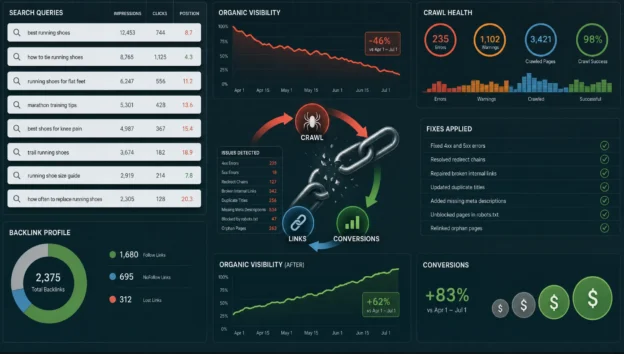
The good news is that most ranking drops are diagnosable. Some are caused by temporary volatility, but many come from a small group of issues: crawl problems, content decay, competitor gains, lost links, search intent changes or an algorithm update. Fast recovery starts with separating a real ranking loss from normal movement, then fixing the pages that matter most to revenue.
For B2B and industrial companies, the goal is not to chase every keyword. It is to restore visibility for the terms buyers use when they are researching vendors, specifications, capabilities, service areas or solutions.
First, confirm what actually dropped
Search rankings fluctuate every day. A one-position movement on a low-value keyword is not the same as losing page-one visibility for a high-intent service page. Before changing pages or launching a broad content rewrite, confirm whether the decline is in rankings, impressions, clicks, leads or all of them.
Google Search Console should be your first stop because it shows performance directly from Google Search. Google Analytics, CRM data and call tracking help you connect visibility loss to pipeline impact. If your site serves several markets, segment by product line, location and buyer intent rather than looking only at total organic sessions.
| Signal | What it may mean | Where to check first |
|---|---|---|
| Rankings dropped but impressions stayed stable | Competitors or SERP features are taking clicks | Search Console queries and SERP review |
| Impressions dropped sharply | Indexing, crawlability, demand shift or algorithm impact | Search Console pages, sitemaps and index reports |
| Clicks dropped but average position did not | Lower click-through rate, new ads or richer SERP features | Search Console and live search results |
| Traffic dropped but leads stayed stable | Lost low-intent visits, not necessarily a business problem | Analytics and CRM lead quality |
| Leads dropped faster than traffic | High-converting pages or forms may be affected | Analytics, form tracking and call tracking |
This distinction matters. If informational blog traffic fell but high-intent RFQ pages still perform, your recovery plan will look different from a situation where core product, service or location pages lost visibility.
Why search rankings drop
Ranking drops usually have more than one cause, but one factor often explains most of the damage. Start with the causes that can create the largest swing in the shortest time.
Technical changes blocked or confused search engines
A redesign, CMS migration, hosting change or plugin update can accidentally tell search engines to ignore important pages. Common issues include noindex tags, blocked robots.txt rules, broken redirects, incorrect canonical tags, missing internal links and slow server responses.
Technical mistakes can cause sudden ranking losses because Google may stop crawling, indexing or trusting the affected URLs. If the drop happened shortly after a launch, deployment or hosting change, treat technical SEO as the first suspect.
Content no longer matches buyer intent
Search intent changes over time. A page that ranked well two years ago may now be too shallow, too sales-heavy or too broad for the current results. In industrial SEO, this often happens when competitors add specification tables, application examples, tolerances, compliance details, FAQs or clearer service-area content.
Content decay is not always about age. A page can be recent and still miss intent if it does not answer the questions buyers ask before contacting a vendor.
Google changed how it evaluates the topic
Core updates and spam updates can shift search rankings across many pages at once. Google does not usually penalize a site during a core update in the traditional sense. More often, its systems reassess which pages are most helpful for a query.
If the timing lines up with a confirmed update and several page types declined together, read the drop as a relevance and quality signal. A short-term technical patch will not be enough. You will need to improve content usefulness, trust signals and topical coverage. For a deeper look at update-related changes, this related article on Google’s core update explains how broad updates can affect visibility.
Competitors improved their pages
Your rankings can drop even when you did nothing wrong. A competitor may publish a stronger buying guide, earn better links, improve page speed, add product data or consolidate several thin pages into one authoritative resource.
This is common in B2B markets where a few suppliers compete for the same high-value terms. If a competitor moved above you, compare the page experience, depth, internal links, supporting content and proof signals. Do not copy their page. Identify what they satisfy that your page currently leaves unanswered.
Important backlinks or internal links were lost
External backlinks still help Google understand credibility and relevance. If a strong industry directory, association profile, distributor listing or partner page removed its link to your site, rankings may soften. Internal links matter too. During redesigns, companies often remove navigation links to older but valuable pages, which weakens their importance in the site structure.
Lost links rarely explain every ranking change, but they can tip competitive pages out of the top positions.
The search results page changed
Sometimes rankings stay similar but traffic falls because the search results page changed. More ads, local packs, video results, AI summaries, shopping elements or featured snippets can reduce clicks to organic listings. For some queries, ranking number three today may produce fewer visits than ranking number five did in the past.
This is why you should review live SERPs for your most valuable terms instead of relying only on rank-tracking software.
A fast diagnostic workflow
Google’s own guide to debugging Search traffic drops recommends comparing performance by date range, query, page and search appearance. That is the right starting point because a total traffic chart hides the source of the problem.
Use a practical workflow that moves from broad signals to specific fixes:
- Mark the drop date: Identify the first day rankings, impressions or clicks declined. Compare it with known site changes, Google updates, server issues and marketing campaigns.
- Separate branded and non-branded queries: A drop in branded searches may point to demand, reputation or offline marketing changes. A drop in non-branded searches is more likely an SEO issue.
- Find the affected page types: Group losses by product pages, service pages, blog posts, location pages, case studies or technical resources.
- Check indexing and crawl signals: Look for noindex tags, canonical changes, redirect chains, crawl errors, sitemap exclusions and blocked resources.
- Compare current pages with cached assumptions: Review what changed in titles, headings, body copy, schema, internal links, page templates and conversion elements.
- Review the SERP manually: Search the affected terms and note whether competitors, ads, local results, videos or AI results changed the click opportunity.
- Prioritize by revenue impact: Fix high-intent, lead-generating pages before low-value informational pages.
The fastest recovery usually comes from technical fixes or restoring removed content. Content quality and authority issues take longer, but you can still make meaningful progress quickly by focusing on the pages that drive pipeline.

How to recover search rankings fast
Fast does not mean reckless. The worst response is to rewrite everything, change every title tag and disavow links without evidence. Recovery should be controlled, documented and tied to the likely cause.
Start with the first 48 hours
In the first two days, your job is to stop further damage and fix obvious blockers. Freeze unnecessary site changes until the issue is understood. Confirm that important pages are indexable, canonicalized correctly and linked from relevant areas of the website.
If a redesign or migration caused the drop, test redirects from old URLs to new URLs. A missing 301 redirect from an old high-performing page can erase years of earned value. Also check whether old page copy, technical details, FAQs or supporting sections were removed during the redesign. Many redesigns look better but rank worse because useful content was cut.
Restore what was working
If a page ranked well before a recent edit, compare the previous version with the current one. Restoring lost sections, internal links, product specifications or headings can recover visibility faster than creating a completely new page.
For B2B websites, do not remove practical information just because it looks dense. Buyers often want details before they contact sales. Capabilities, applications, materials, tolerances, industries served, standards and service areas can all help a page satisfy intent.
Refresh pages instead of rewriting blindly
When content decay is the issue, update pages with intent-matching improvements. Add missing buyer questions, clarify service fit, include proof points and make the page easier to scan. A strong page should help the visitor decide whether your company is relevant, qualified and worth contacting.
If you need a structured approach to improving page copy without over-optimizing, this guide to search engine optimization content writing that ranks covers how to align useful content with search visibility.
Strengthen internal links to priority pages
Internal links are one of the fastest levers you control. Link from relevant service pages, blog posts, case studies and navigation elements to the pages that lost rankings. Use natural anchor text that describes the page, not generic phrases.
For example, if a machining capabilities page dropped, link to it from related materials pages, industry pages and technical articles. This helps search engines understand which page is central to the topic and helps users move toward conversion.
Update titles and meta descriptions with care
Title tags can affect both relevance and click-through rate. If a title became vague during a redesign or no longer reflects the page’s main intent, improve it. Keep the primary topic clear, add a useful qualifier where appropriate and avoid stuffing terms.
Meta descriptions do not directly raise rankings, but they can influence clicks when they match the searcher’s need. A better snippet can soften traffic loss when the SERP becomes more competitive.
Rebuild authority where it is genuinely relevant
If competitors gained stronger industry links or you lost important references, rebuild authority through legitimate sources. Supplier profiles, industry associations, trade publications, customer resources, partner pages and high-quality thought leadership can help.
Avoid low-quality link packages. They can create more risk than value. For industrial and B2B companies, credible links usually come from real business relationships and useful expertise.
Recovery actions by likely cause
Use the table below to match the symptom with a practical recovery response.
| Likely cause | Common signs | Fast recovery action |
|---|---|---|
| Noindex or robots issue | Pages disappear from results or impressions fall sharply | Remove blocking directives, request indexing and resubmit sitemap |
| Bad redirects after migration | Old URLs lost rankings and new URLs do not replace them | Restore one-to-one 301 redirects and update internal links |
| Content removed during redesign | Rankings drop after launch but pages still index | Restore useful sections, FAQs, specs and supporting copy |
| Search intent shift | Competitors rank with deeper or differently structured pages | Expand the page to match buyer questions and current SERP expectations |
| Lost internal links | Important pages are harder to reach from navigation or hubs | Add contextual links from relevant high-authority pages |
| Competitor improvement | One or two competitors pass you across related terms | Improve topical depth, proof signals, UX and supporting content |
| Algorithm update | Several page types decline around the same date | Improve usefulness, trust, originality and site-wide quality signals |
| SERP layout change | Position is stable but clicks decline | Improve titles, descriptions, rich results eligibility and alternative content formats |
Not every fix produces an immediate bounce. Technical and indexing corrections can show movement within days, depending on crawl frequency. Content and authority improvements often need several weeks because search engines must recrawl, reassess and compare your page against alternatives.
What B2B and industrial companies should prioritize
A ranking drop is only urgent when it affects business outcomes. For an industrial supplier, one lost keyword tied to a high-margin service may matter more than hundreds of lost blog visits. Prioritize pages that support RFQs, distributor inquiries, local service calls or enterprise sales conversations.
The most valuable recovery work usually focuses on:
- Product and service pages that map to buyer intent
- Location pages that support local or regional demand
- Technical resources that earn trust before a sales call
- Case studies and proof pages that support evaluation
- Comparison or application pages that help buyers choose a solution
Trust content matters when a searcher needs proof before taking action. This is obvious in regulated industrial markets, but it is also true in public-facing technology efforts, including civic technology initiatives like JustSocial, where participation depends on clarity, transparency and confidence.
For B2B search, rankings are not just a visibility metric. They shape credibility before the first conversation. A buyer who repeatedly sees your company for relevant technical questions, service needs and local searches is more likely to recognize your brand when it is time to request a proposal.
If your recovery plan turns into a broader growth plan, focus on durable SEO rather than short-term tactics. The principles in search engine optimization for business growth that lasts are useful once the immediate ranking drop is under control.
Mistakes that slow down recovery
Panic changes can make diagnosis harder. If you change titles, rewrite copy, switch templates and adjust internal links all at once, you will not know what helped or hurt.
Avoid these common mistakes:
- Rewriting every page before identifying which URLs lost visibility
- Deleting older content that still earns qualified traffic
- Treating every ranking drop as a backlink problem
- Ignoring technical SEO after a redesign
- Measuring recovery only by total organic traffic instead of qualified leads
- Chasing high-volume keywords that do not match buyers
A disciplined recovery process creates a record of what changed, why it changed and what happened afterward. That record becomes valuable the next time rankings move.
How to prevent the next drop
You cannot prevent every algorithm shift or competitor move, but you can reduce the risk of avoidable losses. Create a simple SEO change-control process for redesigns, migrations and major content updates. Before launch, review redirects, indexation rules, page titles, heading structure, internal links, structured data and analytics tracking.
Schedule content reviews for your highest-value pages at least a few times per year. In B2B and industrial markets, offerings, certifications, equipment, applications and buyer questions change. Your content should change with them.
Also monitor rankings alongside business metrics. A lower ranking for a low-intent post may not matter. A small drop on a bottom-funnel page may need immediate action. The best SEO reporting connects search visibility to pipeline, not just sessions.
Frequently Asked Questions
How long does it take to recover from a rankings drop? Technical fixes can sometimes show improvement within days after Google recrawls the affected pages. Content, authority and algorithm-related recoveries usually take several weeks or longer, depending on competition and crawl frequency.
Should I wait before making changes after a Google update? Do not make random changes on day one. Confirm the affected pages and compare them with current top-ranking results. If the issue is clearly technical, fix it immediately. If it appears quality-related, plan thoughtful improvements.
Can a website redesign cause search rankings to drop? Yes. Redesigns can remove useful content, change URL structures, break redirects, weaken internal links or add crawl blockers. A redesign should include SEO testing before and after launch.
Are lost backlinks always the reason rankings fall? No. Backlinks can matter, but ranking drops often come from technical issues, content mismatch, competitor improvements, SERP changes or broader quality reassessment. Check links as part of the diagnosis, not as the only explanation.
When should a company bring in SEO help? Bring in help when the drop affects leads, spans several important pages, follows a migration or persists after basic technical checks. An outside review can shorten diagnosis and prevent costly trial-and-error changes.
Need help diagnosing a ranking drop?
If your search rankings have fallen and the cause is not obvious, B2B Inbound Marketing can help you identify what changed, prioritize the pages that affect revenue and build a practical recovery plan. The Houston-based team works with B2B and industrial companies on SEO, PPC, inbound strategy, web content and site improvements that support qualified lead generation.
If the decline is tied to a redesign, migration, algorithm update or long-term visibility loss, it may also be time to review when to hire search engine optimization consultants before the problem becomes harder to reverse. To discuss your site and next steps, visit B2B Inbound Marketing.