


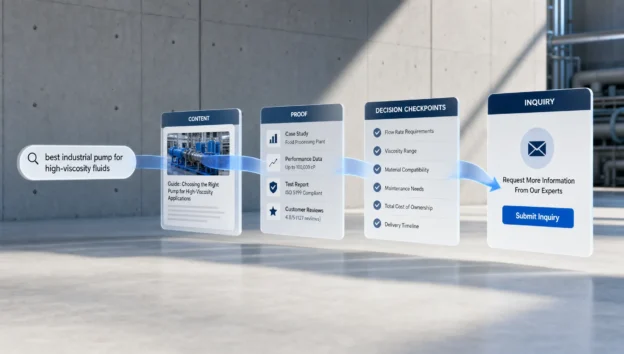
Content writing for SEO is not just a traffic play for B2B companies. In industrial, technical and professional service markets, the real goal is to attract buyers who are already trying to solve a business problem, then give them enough clarity and confidence to take the next step.
That next step may be a quote request, a technical consultation, a distributor inquiry or a conversation with sales. The content has to do more than rank. It has to support the buyer’s internal decision process.
For Houston B2B companies and industrial firms competing in search, this means writing content that connects three things at once: the way buyers search, the way they evaluate vendors and the way they justify contacting a supplier. Strong SEO content sits at the intersection of visibility and conversion.
Why B2B SEO Content Has to Work Harder
B2B search behavior is rarely simple. A consumer may search, compare and buy in one sitting. A B2B buyer may spend weeks collecting information, checking specifications, sharing options with colleagues and building a business case before ever filling out a form.
That changes the role of SEO writing. A page that only explains what a service is may earn some traffic, but it may not create a qualified inquiry. B2B content needs to answer practical questions buyers care about before they talk to sales, including whether your company understands their industry, whether your solution fits their use case and whether there is enough proof to reduce perceived risk.
This is especially true for industrial marketing. Engineers, plant managers, procurement teams and business owners are not looking for generic promotional copy. They want specific, credible information that helps them decide whether a company belongs on the shortlist.
That is why content writing for SEO should be planned with conversion in mind from the start. Keyword research matters, but it is only the entry point. The page also needs a purpose inside the sales journey.
Start With Buyer Intent, Not Word Count
Many underperforming SEO pages have the same problem: they were written to target a keyword, not to help a buyer make progress. Word count, headings and keyword placement are useful only when they serve the intent behind the search.
A B2B prospect searching “industrial SEO services” is probably in a different mindset than someone searching “why is my manufacturing website not generating leads.” One is closer to vendor evaluation, while the other is diagnosing a problem. The content should reflect that difference.
Before writing, define the intent of the page. Is the reader learning, comparing, validating or preparing to contact a provider? That decision shapes the structure, tone, proof points and call to action.
| Search intent | What the buyer needs | Role of the content | Best conversion path |
|---|---|---|---|
| Problem research | A clear explanation of the issue | Build awareness and trust | Related guide, diagnostic offer or consultation prompt |
| Solution research | Options, tradeoffs and criteria | Position your approach | Service page, case evidence or inquiry form |
| Vendor comparison | Differentiation and credibility | Help the buyer shortlist | Proposal request, discovery call or capabilities page |
| Technical validation | Details, specifications and risk reduction | Support internal approval | Contact form, downloadable information or direct conversation |
This intent-first approach keeps SEO content from becoming a disconnected collection of blog posts. It also helps each page support lead generation in a measurable way. For a broader view of this relationship, see how search engine optimization services drive B2B leads by matching search intent with content and conversion structure.
Write for the Questions Buyers Actually Ask
Good B2B SEO writing starts with the buyer’s real questions, not a list of phrases forced into the copy. In technical markets, those questions often come from sales calls, proposal conversations, customer service emails and trade show discussions.
A buyer may wonder whether your process works for their facility, whether your service is suitable for regulated environments or whether your team understands legacy equipment. Those concerns may not appear as neat keywords in a research tool, but they often influence whether a prospect contacts you.
Your content should capture those concerns in plain language. That does not mean simplifying the subject until it loses technical value. It means writing so that a technical reader can trust the details and a business reader can understand the commercial relevance.
For example, a technical service provider such as BKL needs to communicate capabilities across safety, engineering, production, inspection and services in a way that helps buyers understand both technical fit and business value. The same principle applies to any B2B company selling complex services: describe what you do, explain why it matters and make the next step clear.
Build Pages Around Proof, Not Claims
B2B buyers are skeptical of broad statements. Phrases like “industry-leading,” “best-in-class” and “full-service provider” do not carry much weight unless the page explains what those claims mean.
Conversion-focused SEO content should replace vague positioning with evidence. That evidence can come from process details, industry experience, project examples, certifications, service areas, technical constraints you understand or the way your team manages risk.
Instead of saying “we deliver reliable solutions,” explain how your process reduces downtime, improves lead quality, simplifies vendor selection or supports long-term visibility. Instead of saying “we are experts,” show the reader what you know by addressing the problems they face in detail.
This kind of writing improves both user trust and search relevance. Search engines need clear topical signals. Human readers need proof that your company understands their situation. A page that provides both has a better chance of attracting qualified visitors and turning them into inquiries.
Structure SEO Content for Skimming and Decision-Making
Even serious B2B buyers skim. They may be reading between meetings, comparing multiple vendors or forwarding a page to another stakeholder. Strong structure helps them find what matters quickly.
Use headings that describe the value of each section. Avoid clever labels that hide the point. A heading like “How Our PPC Management Reduces Wasted Spend” is more useful than “Smarter Campaigns.” It tells the reader what they will learn and gives search engines a clearer signal about the page topic.
Paragraphs should be focused and easy to scan. Long blocks of text create friction, especially on service pages where visitors are trying to decide whether to act. Use tables when comparisons matter. Use short lists when sequence or criteria matter. Keep the page moving toward a decision.
The best B2B SEO pages usually include a few core elements:
- A clear opening that confirms the reader is in the right place
- A direct explanation of the problem or opportunity
- Specific service, process or solution details
- Proof that reduces risk and builds confidence
- Calls to action that match the buyer’s stage
The call to action should not appear only at the bottom. Buyers may be ready at different points. A mid-page prompt for a consultation, audit or proposal inquiry can help qualified prospects act when the content has answered enough of their questions.

Connect SEO Writing With Page Design
Content does not convert in isolation. The words, page layout, navigation, form placement and visual hierarchy all affect whether a visitor becomes a lead.
A technically accurate page can still fail if the call to action is buried, the mobile experience is poor or the page does not make the company’s offer obvious. Likewise, a beautifully designed page will struggle if the copy does not match search intent or explain why the company is credible.
This is where SEO and web design need to work together. Service pages should be built around how buyers evaluate information, not just how a company wants to describe itself. The page should guide visitors from recognition to understanding to action without making them work too hard.
For B2B companies updating their websites, it is worth considering how SEO and web design work together to drive better conversions. The content plan should influence the site structure, and the design should make the content easier to consume.
Use Calls to Action That Match the Buyer’s Readiness
Not every visitor is ready to request a proposal. Some are still researching. Others are comparing vendors. A conversion-focused SEO strategy gives each reader a logical next step.
For early-stage visitors, a useful next step might be a related article, a service overview or a planning conversation. For mid-stage visitors, it may be an assessment, consultation or comparison of service options. For late-stage visitors, a proposal request or direct contact form makes sense.
The CTA should be specific. “Contact us” is acceptable, but it is often less persuasive than a prompt tied to the page topic. If a visitor is reading about SEO for industrial lead generation, a CTA that invites them to discuss lead quality or website visibility is more relevant.
The wording around the CTA matters as much as the button itself. Give the visitor a reason to act. Explain what they can expect after submitting the form. Reduce uncertainty by making the next step feel practical rather than high pressure.
If a page is getting traffic but not producing inquiries, the issue may not be search visibility. It may be weak alignment between content, offer and conversion path. In that case, website optimization services that improve conversion rates can help identify where visitors are losing momentum.
Balance Technical Depth With Readability
B2B content often needs technical detail, but technical detail should not become a barrier. The goal is not to remove complexity. The goal is to organize complexity so buyers can understand it.
A good approach is to lead with the business problem, then explain the technical factors behind it. For example, a page about responsive web design for industrial companies might begin with lost mobile inquiries, poor usability and weak search performance. It can then explain page speed, mobile layout, content hierarchy and technical SEO in more detail.
This structure respects both audiences. Executives and business owners can quickly see why the topic matters. Technical stakeholders can continue reading for substance. Procurement teams can understand the value without needing every implementation detail.
Readability also affects trust. Clear writing signals that your company can explain complicated work. In B2B sales, that matters. Buyers often assume that a company that communicates clearly before the sale will be easier to work with after the sale.
Measure Content by Lead Quality, Not Only Rankings
Ranking reports and traffic numbers are useful, but they do not tell the full story. A B2B SEO content program should also be judged by the quality of inquiries it supports.
Useful performance questions include whether the page attracts visitors from the right industries, whether visitors engage with the content, whether they continue to service pages and whether form submissions match your ideal customer profile.
If a page ranks well but brings poor-fit leads, the content may be targeting the wrong intent. If a page attracts qualified visitors but few inquiries, the issue may be the conversion offer, page layout or CTA clarity. If visitors leave quickly, the opening may not match what they expected from the search result.
B2B SEO is a long-term system. Content should be reviewed, improved and connected to sales feedback. The strongest pages become assets that keep answering buyer questions, supporting sales conversations and improving search visibility over time.
Common Mistakes in B2B SEO Content Writing
Many companies have enough expertise to publish useful content, but the way they package that expertise limits results. The most common mistakes are usually fixable.
One mistake is writing too broadly. A general article about “digital marketing” is less likely to convert than a focused page about PPC management for industrial lead generation or SEO content for B2B manufacturers. Specificity attracts better-fit readers.
Another mistake is separating SEO from sales. The best content often comes from listening to the questions prospects ask before they buy. If marketing writes without input from sales, pages may rank for terms that do not reflect real buying conversations.
A third mistake is treating every page like a blog post. Some search terms need educational articles. Others need service pages, landing pages, comparison pages or local pages. The format should match the intent.
Finally, many B2B pages end too passively. They explain the topic, but they do not guide the visitor toward action. Conversion-focused content should make the next step obvious without sounding pushy.
Frequently Asked Questions
What is content writing for SEO in B2B marketing? Content writing for SEO in B2B marketing is the process of creating search-optimized content that attracts qualified business buyers, answers their decision-making questions and encourages them to take a relevant next step.
How is B2B SEO writing different from regular SEO writing? B2B SEO writing usually supports longer sales cycles, multiple stakeholders and higher-risk decisions. It needs more proof, clearer positioning and stronger alignment with the buyer journey than basic traffic-focused content.
Should B2B SEO content focus on keywords or conversions? It should focus on both, but in the right order. Keywords help the right buyers find the page, while conversion strategy determines whether those visitors become inquiries. Ranking without conversion rarely creates business value.
What types of content help B2B conversions? Service pages, industry pages, comparison articles, technical guides, case-style content, FAQs and landing pages can all support conversions when they match the buyer’s intent and include a clear next step.
How often should SEO content be updated? B2B SEO content should be reviewed regularly, especially when services change, rankings decline, conversion rates drop or sales teams hear new buyer objections. Updating existing pages can be as valuable as publishing new ones.
Turn SEO Content Into Qualified B2B Inquiries
Content writing for SEO should help your company get found, but it should also help the right prospects understand why they should contact you. That requires more than keywords. It takes clear positioning, useful explanations, credible proof and conversion paths built around how B2B buyers actually make decisions.
B2B Inbound Marketing helps businesses improve online visibility through SEO, PPC, inbound strategy, web content writing and related digital marketing services. If your website is attracting traffic but not enough qualified inquiries, the next step is to align your content with buyer intent and conversion goals.