


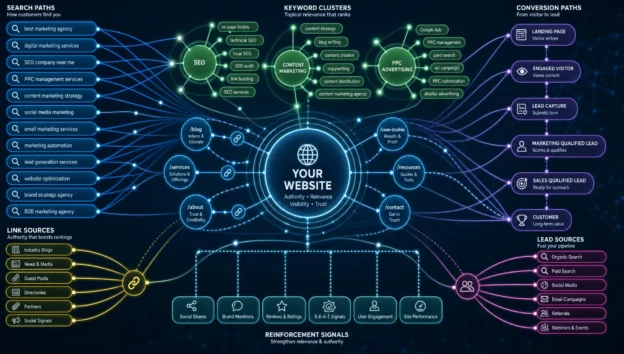
Choosing a B2B SEO agency in 2026 is no longer just a question of who can improve rankings. Rankings still matter, but the real test is whether the agency can help your business get found by the right buyers, support a complex sales cycle, and turn search visibility into qualified opportunities.
For B2B, industrial, manufacturing, distribution, technical services, and professional service companies, SEO has to work harder than it does in many consumer markets. Search volume may be lower. Keywords may be more technical. Buyers may research quietly for weeks or months before contacting sales. A single lead can be worth far more than hundreds of unqualified visits.
That is why the best B2B SEO agency in 2026 should bring more than keyword research and blog production. It should understand business development, buyer intent, technical website performance, content quality, paid search alignment, and measurable lead generation.
Why B2B SEO agency selection is different in 2026
Search has become more competitive and more fragmented. Buyers still use Google, but they also compare vendors across industry directories, LinkedIn, YouTube, AI-generated search summaries, review sites, and supplier websites. At the same time, search engines are getting better at rewarding content that demonstrates expertise, clarity, and usefulness.
For B2B companies, this creates both risk and opportunity. A generic SEO vendor may chase high-volume keywords that look impressive in reports but do little for revenue. A specialized B2B SEO agency should focus on the actual buying journey, including problem awareness, product comparison, vendor evaluation, technical specifications, compliance concerns, and local or regional search intent.
In 2026, the strongest agencies are not asking, “How many keywords can we rank for?” They are asking, “Which searches indicate a real business need, and how do we help those buyers move closer to a conversation?”
1. Look for strategy built around buyer intent, not traffic alone
The first sign of a strong B2B SEO agency is how it talks about strategy. If the conversation starts and ends with traffic growth, that is a warning sign. Traffic is useful only when it is connected to the right audience and the right stage of the buying process.
A qualified agency should want to understand your ideal customer profile, sales cycle, target industries, geographic markets, product categories, competitive positioning, and lead qualification process. For example, the search behavior of a plant manager researching replacement equipment is different from the behavior of a procurement team comparing suppliers or an executive evaluating long-term service partners.
A practical B2B SEO strategy should map keywords and content to intent levels.
| Buyer intent stage | What the buyer is trying to do | Useful SEO content |
|---|---|---|
| Problem awareness | Understand a challenge or symptom | Educational articles, troubleshooting guides, industry explainers |
| Solution research | Compare possible ways to solve the issue | Service pages, comparison content, technical guides |
| Vendor evaluation | Decide which provider is credible | Case studies, capability pages, certifications, FAQs |
| Local or regional selection | Find a nearby or market-specific provider | Location pages, industry landing pages, local proof points |
| Sales validation | Confirm trust before contacting sales | Testimonials, project examples, team expertise, clear calls to action |
A good agency will not treat all keywords equally. It will separate informational searches from commercial searches and prioritize pages that support revenue, not just visibility.
2. Demand real understanding of B2B and niche markets
B2B SEO often requires fluency in specialized language. The agency does not need to know every technical detail on day one, but it should know how to learn your market quickly and accurately. That includes interviewing sales teams, reviewing product documentation, analyzing competitor positioning, and identifying the phrases your buyers actually use.
This matters because many B2B and industrial buyers do not search in broad marketing language. They search with model numbers, use cases, performance requirements, material types, compliance terms, industry acronyms, location modifiers, and urgent problem descriptions.
Niche fluency matters in other considered-purchase categories too. A regional business such as a San Antonio manufactured homes dealer needs search content that addresses local buying intent, financing questions, model comparisons, and trust signals, not only generic housing keywords. The same principle applies to industrial suppliers, engineering firms, specialty contractors, and B2B service providers.
When interviewing an agency, ask how it handles technical subject matter. The answer should include collaboration with internal experts, a review process for accuracy, and content briefs that reflect real buyer questions.
3. Make sure technical SEO and content work together
Content cannot perform well if the website has major technical barriers. Likewise, a technically clean website will not generate qualified leads if the content does not answer real buyer questions. In 2026, you should expect a B2B SEO agency to connect both sides of the work.
Technical SEO should cover crawlability, indexation, page structure, internal linking, mobile usability, site speed, duplicate content, structured data where appropriate, and conversion paths. For B2B companies, technical SEO also includes making sure important service pages, industry pages, product pages, and location pages are easy for both search engines and human buyers to understand.
Content SEO should cover messaging, keyword intent, topical depth, clarity, sales alignment, and calls to action. The best content does not simply repeat keywords. It explains the problem, shows expertise, answers objections, and gives the buyer a reason to take the next step.
If you operate in a competitive local or regional market, this connection becomes even more important. For a deeper look at the Houston market specifically, this guide on SEO Houston for B2B companies explains why local relevance, search intent, and conversion quality matter more than generic optimization.
4. Evaluate their readiness for AI search and changing results pages
Search results in 2026 are not limited to ten blue links. Buyers may see AI-generated summaries, featured snippets, maps, videos, knowledge panels, image results, discussion threads, and paid ads before they reach organic listings. A modern B2B SEO agency should understand how these search experiences affect visibility.
That does not mean the agency should promise instant rankings in AI answers. Be cautious with anyone guaranteeing placement in AI-generated results. Instead, look for an agency that focuses on the fundamentals that support visibility across search experiences.
Those fundamentals include clear page structure, original expertise, concise answers to common questions, credible supporting details, strong internal linking, useful schema markup where relevant, and content that is specific enough to be cited, summarized, or trusted.
A 2026-ready agency should also understand that brand visibility matters. If buyers repeatedly see your company name connected to useful content, industry topics, and relevant searches, SEO begins to support awareness before the buyer is ready to fill out a form.
5. Reporting should connect SEO activity to leads and pipeline
One of the most important things to look for in a B2B SEO agency is reporting discipline. Monthly reports should not be a pile of keyword screenshots and traffic charts with no business interpretation. You need to know what changed, why it changed, and what the agency recommends next.
Good reporting connects SEO work to business outcomes. That may include organic sessions, keyword movement, conversions, form submissions, calls, quote requests, assisted conversions, landing page performance, and lead quality feedback from sales.
| Reporting area | What it should show | Why it matters |
|---|---|---|
| Visibility | Keyword growth, impressions, rankings, featured placements | Shows whether your market presence is expanding |
| Engagement | Organic sessions, time on page, entry pages, scroll behavior when available | Shows whether searchers find the content useful |
| Conversion | Forms, calls, quote requests, downloads, demo requests | Shows whether SEO supports lead generation |
| Lead quality | Sales feedback, qualified leads, industry fit, deal potential | Shows whether traffic is attracting the right buyers |
| Next actions | Priorities, tests, technical fixes, new content opportunities | Turns reports into decisions |
For B2B companies, lead quality matters as much as lead quantity. If organic traffic increases but sales says the inquiries are irrelevant, the strategy needs adjustment. A capable agency will welcome that feedback because it helps refine keyword targeting, page messaging, and conversion paths.
You can also review how search engine optimization services drive B2B leads to see how intent, content, and conversion-focused pages work together.

6. Ask how SEO fits with PPC, content, web design, and sales
SEO should not operate in isolation. In many B2B markets, the strongest results come when organic search, paid search, content writing, website design, and sales follow-up support the same buyer journey.
For example, PPC can test messaging before SEO content is expanded. SEO data can reveal new paid search opportunities. Sales teams can identify objections that should become website FAQs. Website redesign work can improve conversion rates on pages that already receive traffic.
A strong B2B SEO agency should be able to collaborate across these areas without losing focus. It should know when SEO is the right channel, when PPC can accelerate results, and when the website itself is limiting performance. If you are evaluating a broader search partnership, this article on what to expect from a search engine marketing agency can help you understand the discovery, planning, setup, reporting, and collaboration process.
This is especially important for companies with long sales cycles. A buyer may first discover an educational blog post, later return through a branded search, click a paid ad during vendor comparison, and finally convert on a service page. Your agency should understand how these touchpoints work together.
7. Review their process before you review their promises
Promises are easy. Process is harder to fake. Before hiring a B2B SEO agency, ask how work actually gets done after the contract is signed.
A reliable agency should be able to explain its discovery process, audit methodology, keyword research approach, content planning, technical implementation, communication rhythm, reporting schedule, and decision-making framework. You do not need every tactical detail before starting, but you should understand how the agency thinks.
Useful questions include:
- How do you learn our industry, products, and buyers?
- How do you decide which keywords are worth targeting?
- How do you balance technical SEO with content creation?
- What do you need from our sales or subject matter experts?
- How do you measure qualified leads, not just traffic?
- How often will we review performance and priorities?
- What does success typically look like in the first 90, 180, and 365 days?
The answers should be specific enough to build confidence but honest enough to avoid unrealistic expectations. SEO is a long-term channel, especially in competitive B2B markets. A serious agency will explain what can be improved quickly and what will require sustained effort.
8. Watch for red flags that signal a poor fit
Not every SEO provider is equipped for B2B work. Some may be excellent for local consumer businesses but weak in technical industries. Others may rely on outdated tactics that create short-term movement but long-term risk.
Be careful if an agency promises guaranteed rankings, avoids discussing your sales process, focuses only on blog volume, cannot explain its link-building approach, offers vague reports, or recommends major website changes before understanding your market.
Another red flag is a one-size-fits-all content plan. B2B buyers can tell when content is generic. If your agency produces surface-level articles that could apply to any company in any industry, the content is unlikely to build trust with serious buyers.
You should also be cautious if the agency treats AI-generated content as a complete replacement for expertise. AI can support research, outlining, and efficiency, but B2B content still needs accuracy, judgment, review, and differentiation.
9. Compare agencies using a decision checklist
When you are comparing proposals, it helps to evaluate each agency against the same criteria. Price matters, but it should not be the only deciding factor. The lowest-cost option can become expensive if it attracts the wrong traffic, creates weak content, or ignores technical problems.
Use this checklist as a practical starting point.
| Selection criteria | What to look for |
|---|---|
| B2B experience | Evidence that the agency understands long sales cycles, niche search behavior, and lead quality |
| Strategic discovery | Questions about buyers, revenue goals, markets, competitors, and sales process |
| Technical capability | Ability to audit and improve crawlability, site structure, speed, and page performance |
| Content quality | Clear process for expert input, accuracy, differentiation, and buyer-focused writing |
| Measurement | Reporting that connects visibility to conversions, qualified leads, and next actions |
| Channel integration | Ability to align SEO with PPC, website improvements, content, and sales feedback |
| Communication | Clear timelines, responsibilities, reporting cadence, and expectations |
| Ethical approach | No guaranteed rankings, hidden tactics, or risky shortcuts |
The right agency should make you feel more informed, not more confused. It should be able to translate SEO into business priorities while still respecting the technical details that make SEO work.
Frequently Asked Questions
What makes a B2B SEO agency different from a general SEO agency? A B2B SEO agency should understand long buying cycles, technical subject matter, smaller search volumes, higher-value leads, and the need to connect SEO with sales outcomes. General SEO tactics may help visibility, but B2B SEO needs stronger alignment with buyer intent and lead quality.
How long does B2B SEO take to show results in 2026? Some improvements, such as technical fixes or optimization of existing pages, can create early movement. Competitive organic growth usually takes several months of consistent work. The timeline depends on your current website condition, competition, content depth, authority, and market focus.
Should a B2B SEO agency also manage PPC? Not always, but it is helpful when the agency understands both SEO and PPC. Paid search can generate faster data, test messaging, and support high-intent keywords while organic visibility grows. The key is making sure both channels support the same business goals.
What should I ask before hiring a B2B SEO agency? Ask how the agency defines success, how it researches your buyers, how it measures qualified leads, how it handles technical SEO, how it creates content, and what it needs from your internal team. The best answers will be specific, realistic, and tied to business outcomes.
Ready to choose a stronger SEO partner in 2026?
The right B2B SEO agency should help your company become easier to find, easier to understand, and easier to trust. In 2026, that means combining search strategy, technical SEO, useful content, conversion thinking, and clear reporting.
If your business operates in Houston, serves industrial or B2B markets, or needs a more accountable approach to SEO, PPC, and inbound marketing, B2B Inbound Marketing can help you evaluate where your search presence stands and where the best opportunities are. Start by looking for a partner that understands not just rankings, but the buyers behind the searches.