
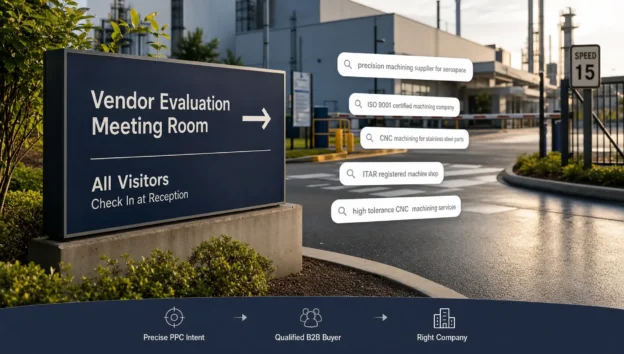
Pay per click can be a strong lead source for B2B companies, but only when the campaign is built around the way serious buyers actually search. In industrial, technical, and professional service markets, the goal is rarely to collect the highest number of form fills. The goal is to reach the right person at the right company, at the moment they are actively looking for a vendor, quote, part, service, or solution.
That is where pay per click advertising can outperform broader demand generation tactics. The phrase “ads pay per click” is often used as shorthand for paid search campaigns, but the real advantage is not the billing model. The advantage is intent. A well-structured campaign can put your company in front of buyers who are already describing their problem in the search bar.
For B2B marketers, sales leaders, and business owners, the question is not “Does PPC work?” A better question is: “When does PPC deliver better B2B leads than other channels?”
PPC Delivers Better B2B Leads When Search Intent Is Clear
The best PPC leads usually come from searches that reveal commercial intent. Someone searching “industrial pump supplier Houston,” “custom metal fabrication quote,” or “B2B SEO agency for manufacturers” is much closer to a sales conversation than someone reading a general awareness article.
This is why pay per click can work especially well in B2B markets with specialized products or services. Search volume may be lower than in consumer categories, but each qualified click can represent a real business opportunity.
Intent matters more than traffic volume. A campaign that generates 80 highly relevant visits from procurement managers, plant managers, engineers, or operations directors may be more valuable than a campaign that generates 2,000 broad visits from unqualified searchers.
| PPC scenario | Why lead quality can improve | Example search behavior |
|---|---|---|
| High-intent service searches | The buyer already knows they need outside help | “industrial SEO services” or “PPC management for B2B company” |
| Quote or pricing searches | The buyer may be shortlisting vendors | “request quote for CNC machining” |
| Emergency or urgent searches | The buyer needs a fast solution | “commercial equipment repair near me” |
| Niche product searches | The searcher is using specific technical language | “stainless steel pressure vessel manufacturer” |
| Local B2B searches | The buyer wants a provider in a defined market | “Houston inbound marketing agency for B2B” |
The more specific the search, the easier it is to match the ad, landing page, and call to action to the buyer’s need. That alignment is what turns PPC from a traffic channel into a lead generation channel.
PPC Works Best When the Buyer Already Understands the Problem
Pay per click is often strongest at the middle and bottom of the funnel. It can support awareness, but it usually delivers better B2B leads when prospects are already problem-aware or solution-aware.
A problem-aware buyer knows something is not working. Their website is not producing leads. Their current vendor is underperforming. Their internal marketing team needs help. Their plant needs a supplier who can meet a technical requirement. These buyers search with urgency and specificity.
A solution-aware buyer has gone one step further. They are comparing service providers, reading case studies, checking capabilities, and looking for proof. PPC can capture these buyers with ads that speak directly to their evaluation criteria.
For example, a broad search like “marketing ideas” may not produce strong B2B leads for an industrial marketing agency. A more specific search like “B2B PPC agency Houston” or “industrial marketing SEO services” is much more likely to come from a buyer evaluating vendors.
This is also why PPC and SEO should not be treated as enemies. SEO builds long-term visibility and authority, while PPC can capture immediate intent. If you are deciding how the two channels should work together, the article on the benefits of SEO and PPC campaigns explains why combining both can strengthen visibility and lead generation.
Better Leads Come From Better Keyword Discipline
Most PPC campaigns do not fail because paid search is ineffective. They fail because the keyword strategy is too loose.
In B2B, a single word can change the quality of a lead. “Software” may be broad. “ERP implementation consultant for manufacturers” is much more focused. “Marketing” is broad. “B2B inbound marketing agency for industrial companies” is much closer to a qualified search.
Strong PPC keyword planning usually separates searches into three groups:
- Commercial searches: These include terms such as “agency,” “consultant,” “supplier,” “manufacturer,” “services,” “quote,” “pricing,” “near me,” and location modifiers.
- Research searches: These include terms such as “how to,” “what is,” “guide,” and “examples,” which may be useful for retargeting or content offers but often convert more slowly.
- Poor-fit searches: These include job seekers, students, DIY users, free template searches, or consumer intent that does not match the company’s ideal customer.
The goal is not to eliminate all research intent. In long B2B buying cycles, early-stage searches can become valuable later. But if the campaign’s purpose is lead generation, budget should favor terms that signal business need, buying authority, or active vendor evaluation.
Google’s own documentation on conversion tracking reinforces an important point: advertisers need to measure what happens after the click. For B2B campaigns, that means tracking not only form submissions or phone calls, but whether those conversions become qualified opportunities.
Landing Pages Decide Whether the Click Becomes a Lead
Even a perfect keyword can underperform if it sends visitors to a weak page. In B2B PPC, the landing page has to quickly answer four questions:
- Does this company understand my industry or problem?
- Can they handle the type of work I need?
- Is there proof that they are credible?
- What should I do next if I want to talk?
A homepage can work in some cases, especially when it is clear and conversion-focused. But many PPC campaigns perform better with dedicated landing pages that match the searcher’s need. If someone searches for PPC management, the page should focus on PPC management, not every possible service the company provides.
The same principle applies to industrial and technical buyers. A visitor who searches for a specific service should not have to dig through several navigation menus to confirm that you offer it. Every extra step creates friction.
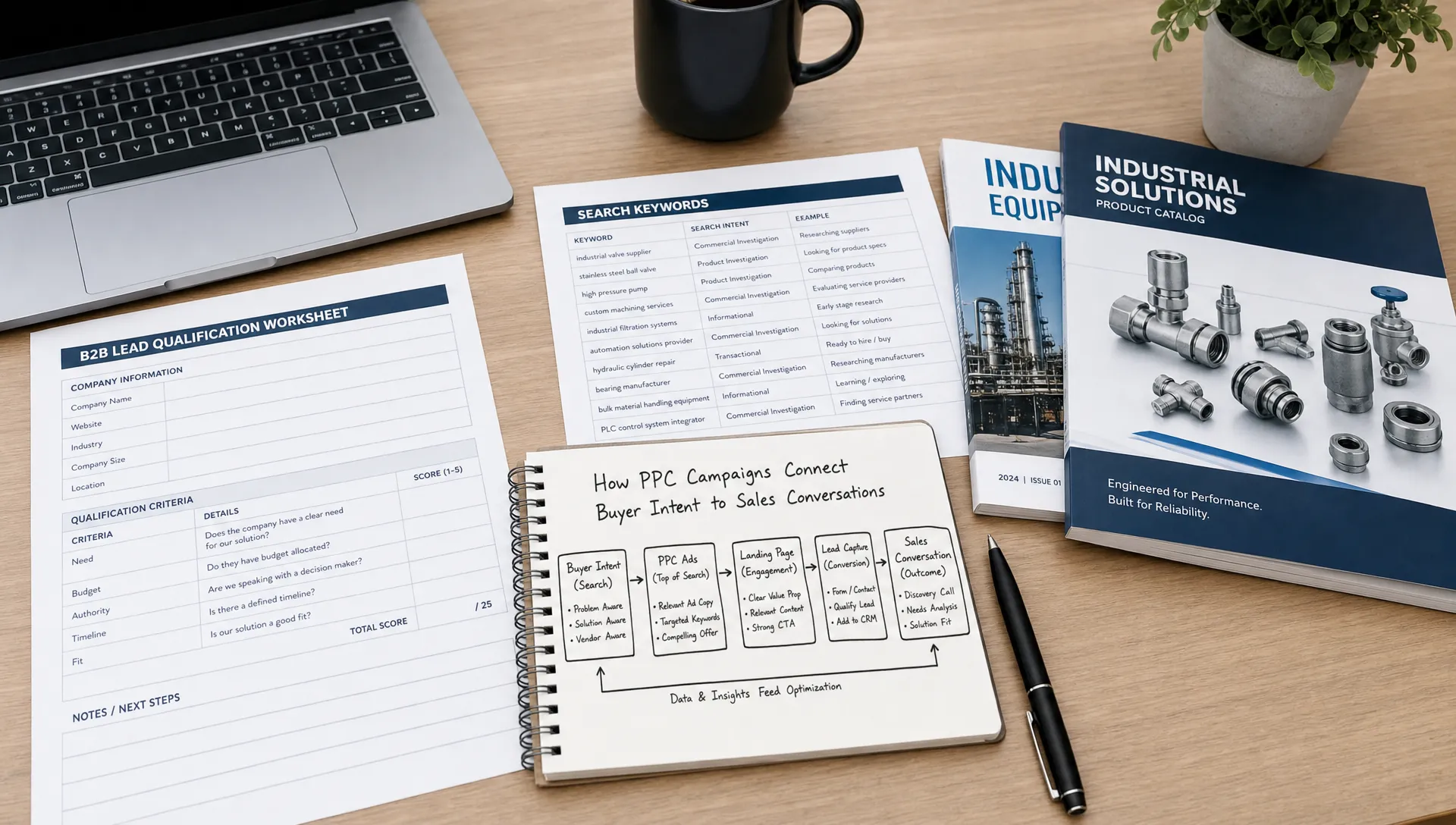
Good landing pages also reduce sales friction. They clarify who the service is for, what problems it solves, what industries are a fit, and what happens after the prospect submits a form. This is especially important in B2B because buyers may hesitate to contact a company if the next step feels vague.
If your ads are generating clicks but not inquiries, the issue may not be the campaign alone. The website may be leaking leads. The article on why your website may be losing leads covers practical conversion issues that can weaken campaign performance.
PPC Delivers Better B2B Leads When Sales Feedback Is Built In
A PPC dashboard can show clicks, cost per click, conversions, and cost per conversion. Those numbers are useful, but they do not tell the full story.
For B2B companies, the most important feedback often comes from the sales team. Were the leads real companies? Did the contact have buying influence? Was the project size appropriate? Did the inquiry match the services offered? Did the prospect have a realistic timeline?
Without that feedback loop, a campaign may optimize toward cheap conversions instead of valuable opportunities. A low cost per lead can look impressive until sales discovers that the leads are students, job seekers, consumers, or companies too small to buy.
A stronger PPC program connects marketing data with sales outcomes.
| Metric | What it tells you | Why it matters for B2B PPC |
|---|---|---|
| Click-through rate | Whether the ad matches search interest | Helpful, but not enough by itself |
| Conversion rate | Whether visitors take action | Shows landing page effectiveness |
| Cost per lead | What each inquiry costs | Useful only if lead quality is known |
| Qualified lead rate | How many leads meet sales criteria | Better indicator of campaign quality |
| Opportunity value | Pipeline created from PPC leads | Connects spend to business impact |
| Close rate | How many PPC leads become customers | Helps determine true ROI |
This is where demand generation measurement becomes important. If PPC is part of a broader growth strategy, it should be judged by lead quality and pipeline impact, not just platform-level conversions. For a broader view, see this guide on how to measure demand gen campaign results.
When PPC Can Beat SEO for B2B Lead Generation
SEO is essential for long-term organic visibility, especially in competitive B2B markets. However, PPC can deliver better leads in specific situations where speed, targeting, or search visibility matters immediately.
You are entering a new market
If your company is launching a new service, expanding into Houston, or targeting a new industrial segment, SEO may take time to build rankings. PPC can test demand quickly. You can learn which messages, keywords, and offers generate qualified conversations before investing heavily in long-term content.
You need leads faster than organic rankings can deliver
SEO compounds over time, but paid search can begin generating traffic as soon as campaigns are live. That speed matters when sales teams need pipeline support now, not six months from now.
Your organic competitors are strong
In some markets, competitors have years of SEO authority. PPC gives you a way to appear on the search results page while your organic presence grows. This can be especially useful for high-value keywords where ranking organically will require sustained effort.
Your buyers use very specific search terms
Industrial and technical buyers often search with precise terminology. PPC can target those searches directly, even if the monthly search volume is modest. In B2B, a low-volume keyword can still be profitable if one closed deal is worth thousands or tens of thousands of dollars.
You need to validate messaging
PPC is useful for testing headlines, offers, landing page copy, and calls to action. If one message consistently produces better qualified leads, that insight can inform SEO pages, sales collateral, email campaigns, and website content.
When PPC Does Not Deliver Better B2B Leads
Pay per click is not automatically a better lead source. It becomes expensive when campaigns are built around broad keywords, weak offers, poor tracking, or landing pages that do not match buyer intent.
PPC may underperform when the campaign targets too many informational keywords without a nurturing strategy. It may also struggle when the offer is unclear, the website lacks trust signals, or the sales team responds slowly to inquiries. In B2B, response speed matters because buyers often contact multiple vendors during the same research session.
Another common problem is failing to use negative keywords. If a campaign attracts searches for jobs, free resources, consumer products, or unrelated services, the budget can disappear quickly. Match types, location targeting, device performance, and search term reports all need regular review.
If your current campaign is producing clicks but not qualified opportunities, it may be time to audit where spend is going. This guide on how to fix a pay per click campaign that wastes budget explains common causes of wasted PPC spend and how to correct them.
The Best B2B PPC Campaigns Are Built Around Fit
Better B2B leads come from fit, not volume. A strong PPC campaign defines who should click and who should not.
That means your ads should not try to appeal to everyone. They should communicate the industry, service, location, or business problem clearly enough to attract qualified buyers and discourage poor-fit clicks. In many cases, specificity improves results.
For example, “Marketing Services” is broad. “B2B PPC Management for Industrial Companies” is more selective. It may receive fewer clicks, but the clicks are more likely to match the business.
The same idea applies to forms. A very short form may increase conversion volume, but it can also increase unqualified inquiries. A slightly more specific form can help filter leads by company type, project need, timeline, or budget range. The right balance depends on your sales process, but B2B companies should not judge forms by conversion rate alone.
A Practical PPC Readiness Check for B2B Companies
Before increasing PPC spend, review whether the campaign has the foundation needed to generate qualified leads. The following readiness check can help identify gaps.
| Readiness question | Why it matters |
|---|---|
| Do we know our ideal customer profile? | PPC targeting improves when the company knows which industries, roles, and account types are a fit. |
| Are our keywords grouped by intent? | High-intent searches should not be mixed with broad research terms without a clear strategy. |
| Do our ads qualify the click? | Specific ad copy can reduce irrelevant traffic and improve lead quality. |
| Does each landing page match the search? | Message match improves trust and conversion rates. |
| Are calls and forms tracked correctly? | Without tracking, it is hard to know which campaigns create real opportunities. |
| Does sales report lead quality? | Sales feedback helps optimize for revenue, not just form fills. |
| Are negative keywords reviewed regularly? | Search term audits prevent budget waste from irrelevant queries. |
If several answers are “no,” PPC may still work, but the campaign will likely need cleanup before it can deliver better B2B leads consistently.
Frequently Asked Questions
When does pay per click work best for B2B lead generation? Pay per click works best when buyers are already searching for a specific service, supplier, quote, or solution. It is especially effective when campaigns target high-intent keywords and send visitors to relevant landing pages.
Are PPC leads better than SEO leads? Not always. PPC can deliver faster and more targeted leads, while SEO often builds stronger long-term visibility. Many B2B companies get the best results by using PPC for immediate intent and SEO for sustained authority.
Why do some B2B PPC campaigns generate poor-quality leads? Poor lead quality usually comes from broad keywords, weak negative keyword lists, unclear landing pages, poor tracking, or optimizing for cheap conversions instead of qualified opportunities.
How should a B2B company measure PPC success? B2B companies should measure qualified lead rate, sales opportunities, pipeline value, and closed revenue in addition to clicks and cost per lead. Platform metrics are useful, but sales outcomes matter more.
Should industrial companies use PPC? Industrial companies can benefit from PPC when buyers search for specialized services, parts, suppliers, or technical solutions. The key is to target precise search terms and make the landing page highly relevant to the buyer’s need.
Turn PPC Clicks Into Better B2B Conversations
Pay per click delivers better B2B leads when it is built around buyer intent, lead quality, and sales feedback. The strongest campaigns do not chase every click. They focus on the searches most likely to become real business conversations.
For Houston-area B2B and industrial companies, a disciplined PPC strategy can support faster visibility, stronger lead flow, and better alignment between marketing and sales. If your paid search campaigns need sharper targeting, better landing pages, or a clearer inbound strategy, B2B Inbound Marketing can help you evaluate the next step.