


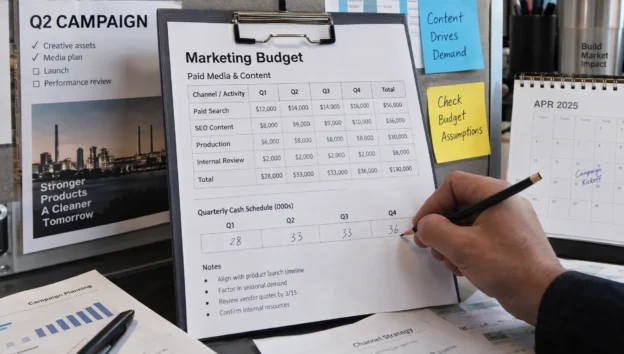
A budget for media marketing services should show more than how much you plan to spend on advertising. It should explain what each channel is expected to accomplish, what execution actually costs and how long the business can fund the work before revenue arrives.
For B2B and industrial companies, those decisions are connected. Paid search may generate inquiries quickly, but technical content, landing pages and sales follow-up determine whether those inquiries become opportunities. Meanwhile, SEO may require funding well before it contributes measurable pipeline.
The practical approach is to build one coordinated budget, separate working media from supporting costs and establish rules for adjusting spending without disrupting the entire program.
Define the full cost before choosing channels
Start by separating the budget into distinct cost categories. Otherwise, an attractive channel allocation can conceal an underfunded execution plan.
Working media is the money paid to platforms or publishers for distribution, such as search ads, sponsored social posts or trade publication placements. Agency management fees do not belong in this category.
Strategy and execution cover planning, campaign management, SEO work, copywriting and ongoing optimization. Production and conversion assets include photography, technical graphics, video, landing pages and forms.
Then account for measurement tools, CRM integration work and internal labor. An engineer reviewing application content or a sales manager qualifying inquiries contributes real capacity, even if that effort never appears on an agency invoice.
A complete budget for media marketing services also distinguishes recurring expenses from launch work. Website repairs, tracking setup and initial creative development can make the first quarter more expensive than subsequent quarters.
Keep two totals: the expected cash outlay and the fully loaded investment, including internal time. Finance needs the first for cash planning; management needs the second to understand the resources required.
Set a spending ceiling around sales capacity and cash flow
Before dividing funds among channels, identify the commercial constraint. It might be a limited number of available sales engineers, a narrow service territory, production capacity or a long delay between an inquiry and a paid invoice.
For media marketing services, an affordable monthly invoice is not the same as an affordable acquisition program. A company with a nine-month sales cycle may need to fund several quarters of activity before evaluating closed revenue from the earliest campaigns.
Use historical CRM data, where available, to estimate the opportunities needed to support the sales target. Then check whether sales can work that volume and whether operations can fulfill the resulting business. Where reliable history is missing, budget an initial learning phase rather than presenting an uncertain forecast as a commitment.
For example, if marketing generates 30 additional inquiries but sales can properly evaluate only ten, purchasing more traffic may worsen the bottleneck. Funding qualification, routing or better application information could be the more useful investment.
Set a quarterly authorization ceiling, a monthly cash schedule and a minimum operating commitment for work that depends on continuity. Keep the contingency reserve separate from money already committed to contracts.
Build a coordinated budget for media marketing services
The following allocation illustrates a hypothetical $20,000 monthly planning budget for an established industrial supplier. It is not a market-rate benchmark or a recommended minimum.
| Budget category | Monthly allocation | What the allocation covers |
|---|---|---|
| SEO and owned content | $4,500 | Technical SEO, service-page improvements and technical content |
| Paid search media | $5,000 | Advertising platform spend only |
| Paid social media | $1,500 | Targeted distribution to relevant professional audiences |
| Paid campaign management | $2,500 | Setup, optimization, testing and account oversight |
| Creative and landing pages | $2,500 | Advertising assets and conversion-focused page work |
| Measurement and tools | $1,000 | Reporting, tracking maintenance and agreed software costs |
| Internal review and sales coordination | $1,500 | Planned value of staff time, not necessarily additional cash expense |
| Uncommitted reserve | $1,500 | Approved tests or unexpected requirements |
| Total | $20,000 | Fully loaded planning allocation |
Only $6,500 goes directly to advertising platforms. Describing the entire $20,000 as an “ad budget” would create unrealistic expectations about traffic and reach.
The internal labor allowance may not require an additional payment, while the reserve is not an instruction to spend. Reconcile both with finance before turning this planning table into a cash forecast.
Adjust the allocation to the buying situation
Your mix should reflect the problem that needs solving. A company with strong search demand and weak service pages may prioritize paid search, SEO and conversion work. A supplier introducing an unfamiliar technology may need more application education, technical demonstrations and targeted distribution.
Do not divide media marketing services equally across channels simply to maintain a presence everywhere. Each funded channel should have a job, a defined audience and enough support to perform that job.
For a smaller budget, reduce the number of simultaneous initiatives rather than spreading production and management resources too thin. One well-supported search program can be more useful than search, social, display and video campaigns that lack suitable destinations.
Understanding when to use organic marketing versus paid marketing helps separate work intended to capture current demand from work intended to build future visibility.
Price the work behind each channel
SEO and technical content
An SEO allocation should identify the pages, problems and deliverables being funded. “Monthly SEO” is too vague for a useful budget discussion.
Specify whether the work includes technical fixes, keyword research, application pages, case studies or improvements to existing content. Confirm who implements recommendations. An audit that requires a separate developer can create an unfunded dependency.
When evaluating media marketing services, include the cost of subject-matter access. Industrial writing may require interviews, specification checks and approval from engineering or compliance teams. If those reviews take weeks, the production schedule and cash schedule should reflect that reality.
Also distinguish reusable assets from recurring output. A strong capability page may support organic discovery, paid campaigns and sales conversations. Its production cost should appear once, with shared use documented, rather than being charged independently to three channel budgets.
Paid search and paid social
Keep platform spend, management fees and creative production visible as separate lines. Ask whether fees change with spend, campaign count, geography or the number of products promoted.
A percentage-based management fee and a fixed retainer can both be workable. Compare the total cost at your planned spending level and at a higher or lower level, then examine what work is included.
Paid social may require different creative from paid search. Audience research, imagery and additional message variations should be scoped before launch, not treated as unexpected extras.
For media marketing services involving publisher placements or sponsorships, request the actual package details: placement dates, audience information, creative requirements and any reporting provided. A sponsored newsletter, directory listing and display campaign are not interchangeable purchases.
Landing pages, video and conversion support
The destination must fit the purchase process. A consumer storefront such as Beef Boutique’s online meat shop organizes products for direct purchase. An industrial supplier may instead need application details, specifications and a request-for-quote path. Those different buying journeys require different website investments.
Budget for the information buyers need before they can take the next step. That might mean downloadable drawings, a clearer capability page or a form that captures essential project requirements without becoming an obstacle.
Video also extends beyond filming. Scripting, technical review, editing, captions and distribution can each require resources. Decide whether the priority is a product demonstration, sales explanation or advertising asset before commissioning production.
Accessibility, mobile usability and consent requirements should be considered during planning. Retrofitting forms, captions or tracking controls after launch can consume money intended for campaign improvement.

Compare agency proposals on equivalent terms
Two proposals with the same monthly fee may purchase very different amounts of work. Normalize scope before comparing totals.
| Proposal item | What to clarify before approval |
|---|---|
| Setup | Research, account configuration, tracking and initial asset creation |
| Recurring delivery | Named outputs, quantities, cadence and revision limits |
| Implementation | Who publishes content, edits pages and fixes technical issues |
| Third-party costs | Platform spend, software, stock assets and publisher charges |
| Account ownership | Access to advertising accounts, analytics, creative files and data |
| Commercial terms | Contract length, cancellation, change requests and handover |
For media marketing services, ask providers to show the first 90 days of work rather than offering only a list of capabilities. That reveals whether the proposed fee funds meaningful execution or mainly recommendations.
Technical experience matters, but so does the approval process. Confirm who interviews specialists, resolves conflicting feedback and signs off on claims. A low production fee can become expensive if your team must repeatedly rewrite unsuitable content.
If SEO and social are being purchased together, scoping their deliverables as one coordinated service can help prevent duplicate research and unclear responsibilities.
Phase spending and define reallocation rules
A monthly allocation is a planning tool, not a requirement to spend the same amount every month. Build a 90-day schedule around readiness.
During setup, prioritize tracking, account access, landing-page readiness and essential creative. Launch paid distribution when its destination and lead-routing process are ready. Continue content and SEO work according to their production and implementation schedules.
Do not confuse a platform's daily budget setting with a fixed daily charge. For example, Google Ads explains that average daily budgets can produce spending fluctuations. Review the applicable spending limits when translating platform settings into a monthly cash plan.
Agree on a few operating rules for media marketing services before results create pressure to improvise:
- Pause affected campaigns when tracking, forms or lead routing fail.
- Release test funds only when the audience, offer and evaluation criteria are documented.
- Review spend against qualified outcomes, not just clicks or form submissions.
- Require approval for changes that alter the quarterly commitment or recurring scope.
Set review dates that match the available evidence. An early meeting can evaluate implementation and traffic relevance; it usually cannot establish the revenue contribution of a long-cycle industrial campaign.
Make reporting useful for the next budget decision
Reporting should help management decide what to maintain, change or stop. Structure it around delivery, demand quality and commercial progress.
First, confirm whether contracted work was completed and spending stayed within authorization. Then examine relevant engagement, qualified inquiries and sales acceptance. Finally, track opportunities and closed business as those cohorts mature.
Attach costs to the period in which they were incurred, but do not assume revenue arriving that month came from that month's marketing. Record lead creation dates and follow opportunities through the sales cycle.
When evaluating media marketing services, separate sourced pipeline from influenced pipeline. Both can be useful, but adding them together can double-count the same opportunity. Platform-reported conversions also need reconciliation with CRM records.
Sales should return rejection reasons, not simply mark leads as poor quality. Wrong geography, unsuitable project size and missing technical capabilities point to different budget decisions. That feedback makes the next allocation more defensible than a channel report based solely on traffic growth.
Frequently asked questions
What percentage of revenue should a B2B company spend on marketing? There is no single percentage that resolves the decision. Use revenue-based benchmarks only as context, then test the budget against growth goals, margins, sales capacity and cash flow. A mature supplier protecting existing demand has different requirements from a business entering a new market.
How much should go to advertising versus agency fees? The balance depends on the work required. A new program may need substantial setup, content and website investment before increasing distribution. Compare working media with the complete execution plan rather than imposing a universal ratio.
How often should the budget be reviewed? Monitor pacing regularly and use scheduled reviews for meaningful allocation changes. For media marketing services supporting long sales cycles, evaluate early delivery separately from later opportunity and revenue outcomes.
What should a smaller company fund first? Start with a specific audience, a credible offer, a usable conversion path and reliable measurement. Fund a manageable channel mix around those foundations instead of buying every available service.
Turn the allocation into a scoped plan
Bring your sales target, current channel spending, internal capacity and known website limitations to the planning discussion. Ask for a proposal that separates launch work, recurring delivery, advertising spend and optional tests.
Discuss your B2B marketing priorities with Andy Alagappan to connect SEO, PPC, content and website needs to a clearly defined scope and budget.