


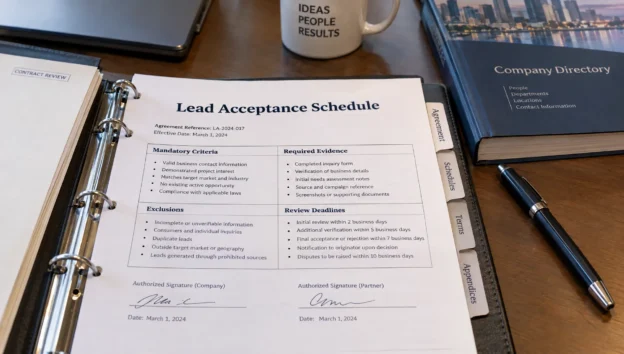
A contract with a b2b lead gen agency should define exactly when a prospect becomes a qualified, billable lead. “Qualified” cannot simply mean that a contact appears in your target market, completes a form or accepts a calendar invitation. The agreement needs observable criteria, supporting evidence and a process for resolving disagreements.
For Houston industrial suppliers and other B2B businesses, the expensive mistake is paying for apparent interest that sales cannot turn into a credible conversation. A purchasing contact might work for the right company but need a product you do not supply.
The following provisions turn qualification into a documented operating standard rather than a sales promise. Sample language and deadlines are negotiation examples, not legal advice or universal industry benchmarks. Have counsel adapt them to your engagement.
Define what your b2b lead gen agency actually delivers
Start by separating a contact record, an inquiry, a booked appointment, an attended meeting and a sales-accepted lead. These are different deliverables. The contract should identify which one triggers a fee, counts toward a guarantee or satisfies a monthly commitment.
Define marketing-qualified and sales-qualified leads within this engagement instead of relying on the acronyms MQL and SQL. An outsourced prospecting team may verify interest and account fit without having enough access to establish purchasing authority or an approved budget.
Qualification should also match the channel. Downloading a maintenance guide through an SEO campaign does not establish the same intent as requesting a quotation through a paid search landing page. Neither action automatically proves commercial viability.
Suggested language:
“A qualified lead is a prospect satisfying every mandatory criterion in Schedule A, supported by the required evidence and submitted through the agreed CRM workflow. A contact record, content download or calendar booking alone does not satisfy this definition.”
Attach the qualification schedule to the signed agreement. State which document controls if a proposal, dashboard or campaign brief uses different definitions. Otherwise, an attractive pitch can quietly become a much weaker delivery obligation.
Turn account fit into objective eligibility rules
Your b2b lead gen agency should work from an ideal customer profile that sales can test, not a description such as “decision-makers at growing businesses.” Convert targeting preferences into mandatory conditions and explicitly labeled preferences.
An industrial equipment supplier might require a serviceable plant location, a supported application and a relevant technical or purchasing role. Company size could remain a preference if smaller facilities still buy profitably. A contact’s headquarters address should not substitute for the actual installation site.
| Contract field | What to specify |
|---|---|
| Geography | Serviceable operating or project locations |
| Account fit | Industries, applications and excluded business types |
| Contact role | Relevant responsibilities or documented access to the buyer |
| Commercial need | Supported use case and evidence of a problem |
| Timing | Required purchase window, or explicitly permitted uncertainty |
AITEC’s managed IT and cloud services in the French Caribbean and French Guiana illustrate why geography matters. For a provider serving that market, a French-speaking contact elsewhere is not automatically a serviceable prospect. The contract should specify territory and delivery requirements rather than relying on language alone.
Require written approval before expanding these boundaries. Extra volume outside the agreed market should not become billable merely because the agency exhausted its original list.
Require evidence for every qualification claim
Ask the b2b lead gen agency to document how it knows a lead meets each mandatory condition. Email verification establishes something about deliverability, not purchasing intent. A job title can suggest influence without proving authority over the specific purchase.
Separate prospect statements from agency inference. “Requested specifications for a planned facility upgrade” is stronger evidence of an active requirement than “visited three product pages.” Both may be useful, but they should not receive the same qualification label.
An evidence package should identify the company, contact, relevant role, source, capture date and qualifying interaction. Add the stated need, relevant project location and any known constraints. If budget or timing is unknown, record “unknown” instead of substituting an estimate.
Use an evidence hierarchy: a direct statement, a documented interaction or an attributed inference. Set a freshness rule for time-sensitive claims and require revalidation when a project has stalled or the contact has changed roles.
Suggested language:
“Provider will identify the source and date of each qualifying fact. Inferences must be labeled and cannot satisfy criteria requiring direct prospect confirmation. Missing mandatory evidence makes the submission incomplete until corrected.”
That distinction lets sales audit quality without replaying every campaign interaction.
List exclusions before negotiating lead volume
The exclusions in a b2b lead gen agency contract are as important as its positive criteria. Spell out how the agency must handle competitors, vendors, job applicants, students, spam, existing customers and companies outside the agreed service area.
Do not treat every exclusion identically. An existing customer might be disallowed for net-new acquisition but eligible for a separately scoped expansion campaign. A consultant could be irrelevant in one market and a legitimate specification influencer in another.
Define duplicates at both contact and account level. Two employees from the same manufacturer may be valuable members of one buying group, but that does not automatically justify two acquisition fees. Establish a lookback period and rules for subsidiaries, branch locations and separate projects.
Suggested language:
“A submission is not net-new if the account has an open opportunity or the contact appears in the supplied suppression file, unless Client approves a documented exception before outreach.”
Specify who supplies suppression data, how often it refreshes and what happens when information arrives late. Require matching beyond exact email addresses where possible, using company domains and approved account identifiers. The agency should check duplicates before submission, not leave discovery to a frustrated salesperson.
Tie acceptance and billing to a review process
A b2b lead gen agency contract needs a review procedure that is fast enough to operate and specific enough to enforce. Name the client reviewer, the review window, permitted rejection reasons and the escalation contact.
An illustrative workflow gives sales five business days after receiving a complete submission to accept or reject it. A rejection must cite an agreed criterion and attach available evidence. Missing fields pause the review clock rather than forcing a premature decision.
Suggested language:
“Client may reject a submission that fails Schedule A by recording the applicable reason within the review period. Provider may cure missing evidence within three business days. Unresolved disputes go to the named representatives before the disputed charge becomes payable.”
Negotiate what silence means. Automatic acceptance can resolve administrative delays, but it should not validate fraudulent records, prohibited contacts or defects that were not reasonably discoverable during review. Define a separate window for those issues.
Then connect the process to invoices. State whether an invalid lead receives a credit, refund or replacement and when that remedy occurs. Prevent replacement leads from being charged again. For additional commercial context, evaluating a pay-per-lead agency should include this exact connection between qualification and payment.
Distinguish booked meetings from qualified conversations
If your b2b lead gen agency sells appointments, identify the precise event you are buying. A scheduled slot, an attended call and a conversation with a relevant buyer should not share one billing label.
Define meeting completion in operational terms: the required participant attends, the discussion concerns the supported offering and the prospect has not been misled about the purpose. A minimum duration may help document attendance, but minutes alone do not prove qualification.
Allocate no-show and rescheduling responsibility. If the prospect cancels before the meeting, decide whether the agency must rebook it before billing. If your salesperson misses an otherwise valid meeting, the agency should not automatically bear that loss.
Define whether rescheduled conversations retain the original submission identifier so one prospect cannot be counted repeatedly as several newly booked appointments.
Address incentives and deceptive outreach directly. A prospect accepting a gift or believing the call is a research interview has not necessarily expressed interest in buying. Require disclosure of the actual business purpose and prohibit unauthorized inducements.
Also distinguish “not ready now” from “never qualified.” A legitimate buyer whose project moved to next quarter is different from someone who never requested the discussion. The contract should allow the former to enter nurture without disguising the latter as a successful appointment.
Specify the CRM handoff and lead status rules
The handoff from a b2b lead gen agency should preserve evidence, not just push a name into your CRM. Define required fields, the submission timestamp, routing logic and responsibility for failed transfers.
At minimum, map account identity, contact details, source, campaign, qualification evidence and current status. Include the rejection reason and review deadline so neither team has to reconcile approval decisions from scattered email threads.
Use separate statuses for submitted, incomplete, accepted, rejected, nurtured and converted to opportunity. Make clear that “accepted” confirms the purchased deliverable, not a promise that sales will create an opportunity. “Nurtured” should not silently reverse a valid acceptance.
Preserve the original evidence snapshot even when sales updates the record. A later change in job title or project timing should not erase what was known when the lead was submitted. Define how corrected submissions retain their audit history.
Agree on technical failure handling, too. A successful form submission is not proof that the CRM received a usable record. Require transfer alerts, a named owner for repair and a reconciliation process before invoicing. Restrict integration permissions to what the workflow actually needs, especially where agency users can export contacts or edit opportunity records.

Give both sides measurable operating duties
Qualification is shared work, even when a b2b lead gen agency handles sourcing and outreach. Your team controls product knowledge, pricing boundaries, territory rules and sales follow-up. The contract should assign those inputs instead of assuming they will appear.
Set practical client obligations alongside agency obligations:
- The client supplies current exclusions, product limitations and approved claims before launch.
- The agency validates required criteria and submits complete evidence before requesting acceptance.
- Sales attempts follow-up within the agreed service window and records the outcome.
- Both parties review disputed submissions through named owners rather than informal account-team messages.
Choose deadlines that match staffing and sales coverage. A Friday evening submission should not automatically create a weekend response obligation unless both parties deliberately agree to it.
Separate follow-up failures from qualification defects. If sales never contacts a valid lead, poor conversion does not prove the agency supplied bad data. Conversely, slow follow-up does not excuse an agency sending the wrong industry or an unsupported application.
Specify consequences proportionately: pause delivery when suppression data is unavailable, escalate repeated missed reviews and document corrective actions before changing performance commitments. Avoid terms that shift every outcome risk to either party.
Make compliant sourcing part of qualification
A b2b lead gen agency should identify its data sources, outreach methods and subcontractors before launch. “Publicly available” is not a complete explanation of whether information can be collected, shared or used for a particular campaign.
For US commercial email, the FTC’s CAN-SPAM compliance guide explains requirements including accurate headers, a valid postal address and an effective opt-out mechanism. It also explains that hiring another company does not remove your legal responsibility for compliance.
Other channels and jurisdictions require separate analysis. Calling, texting, recording conversations and processing personal data may trigger different obligations. Have counsel identify applicable rules rather than inserting a blanket claim that every business contact is exempt.
Require documented suppression procedures, appropriate permission or lawful-basis records where applicable and controls on subcontractor access. If call recordings are qualification evidence, specify lawful collection, access restrictions and retention periods.
Suggested language:
“Provider will document approved sourcing and outreach methods, honor applicable suppression requests and notify Client of material compliance concerns. Records obtained through prohibited methods are ineligible, regardless of apparent commercial fit.”
Include security incident notification procedures and deletion obligations. A commercially relevant prospect should not become billable if the method used to obtain or contact that person violates the agreement.
Keep usable rights to data and exit records
Your b2b lead gen agency agreement should distinguish ownership from licensing and operational access. You may own campaign-created CRM records while the agency retains a preexisting database or licenses third-party data under separate restrictions.
Do not accept “client owns the leads” as the entire provision. Specify which records, qualification notes, outreach histories, source metadata and suppression records remain accessible during and after the engagement. Make third-party usage limits visible before approval.
Identify the systems under your control. Where appropriate, keep CRM accounts, advertising accounts and campaign assets in client-controlled environments, with agency permissions rather than shared credentials. The contract should say which assets are transferred and which are excluded.
Require an export format that preserves field relationships and evidence references. A spreadsheet of email addresses is not an adequate replacement for an auditable lead history. Set an export deadline, assistance responsibilities and any disclosed transition fees.
Finally, reconcile retention with deletion. Some records may need to be retained for legal or suppression purposes, while unnecessary copies should be removed. Define authorized retention, access limits and confirmation of deletion rather than demanding an impossible promise that every trace disappears immediately.
Separate qualification, attribution and revenue reporting
Reporting from a b2b lead gen agency should show whether the contract is being fulfilled before it claims business impact. Reconcile submissions, accepted leads, rejection reasons and billable units against the CRM each reporting period.
Use a defined denominator. Acceptance rate could mean accepted leads divided by all submissions, or accepted leads divided by reviewed submissions. Those formulas tell different stories when many records remain pending. Require the report to show pending volume separately.
Set attribution rules independently of qualification. Define sourced versus influenced opportunities, the lookback window, treatment of existing accounts and how multiple agencies receive credit. A new contact inside an existing opportunity is not automatically new agency-sourced pipeline.
Measure revenue from closed-won records under the agreed attribution rules, not from every deal that touched a campaign. State how reopened deals, delayed purchases and post-termination closes are handled. Never equate a lead guarantee with a revenue guarantee unless the contract explicitly creates one.
Review results by submission cohort so last month’s accepted leads are not judged against this month’s invoices. Longer industrial sales cycles make calendar-month comparisons particularly easy to misread.
Use lead generation metrics beyond form fills to evaluate commercial progress, while keeping billing eligibility tied to the signed qualification schedule. This prevents a weak revenue month from rewriting acceptance rules retrospectively and prevents impressive activity totals from concealing poor fit.
Control changes, remedies and termination obligations
A b2b lead gen agency should not be able to loosen qualification criteria to meet a volume target. Require written change approval covering the revised definition, effective date, pricing impact and treatment of leads already in progress.
Make the pilot a controlled test. Establish a review point after an agreed number of submissions or operating period, then inspect rejection patterns before scaling. If criteria are unrealistic, revise them prospectively rather than reclassifying previously rejected leads as successes.
Include remedies for repeated failure, not just individual bad records. Set escalation triggers, a corrective-action period and termination rights for persistent material breaches. Compliance violations, unauthorized data use and deliberate misrepresentation may need different treatment from ordinary targeting mistakes.
Address minimum terms, renewal notices, cancellation deadlines and outstanding credits. A replacement promise has little value if the contract ends before replacement delivery. Agree whether unused remedies convert to credits or refunds and how the final invoice is reconciled.
At termination, require the final export, pending acceptance decisions, access removal and transfer of active conversations. Specify whether already accepted leads remain payable and how disputed charges are resolved.
Qualification belongs in the signed statement of work, not just an account manager’s email. Review the acceptance schedule alongside payment and exit clauses so the documents operate as one agreement.
Frequently asked questions
Does BANT have to be the qualification standard? No. A b2b lead gen agency can use budget, authority, need and timing, but early-stage industrial purchases often involve incomplete budgets or shared authority. Make only the criteria needed for the purchased deliverable mandatory, then label missing information honestly.
Can a lead be qualified without an approved budget? Yes, if the signed criteria allow it. A relevant engineer investigating a supported application may be suitable for a discovery meeting even without purchasing approval. That does not make the person a procurement-ready opportunity.
Should the agency replace every lead that fails to close? No. Failure to close is not proof of failed qualification. Replacement should follow the agreed acceptance criteria and warranty terms, while conversion problems should be reviewed separately through sales outcomes and campaign evidence.
What if the contract only promises “qualified leads”? Ask for a signed schedule defining fit, required evidence, exclusions, review deadlines and remedies. If the provider will not make the deliverable testable, the commercial risk remains unresolved regardless of the promised volume.
Put qualification in writing before launch
Before approving a campaign, ask your sales leader and legal reviewer to test the qualification schedule against several realistic prospects. If they cannot independently reach the same acceptance decision, the definition needs work.
For Houston B2B and industrial companies evaluating a b2b lead gen agency, discuss your marketing requirements with Andy Alagappan. Bring your service boundaries, sales process and current lead examples so qualification can be part of the planning conversation, not an afterthought once invoices arrive.