

Building a demand generation marketing engine is not about launching more campaigns, buying more ads or publishing more blog posts. It is about creating a system that attracts the right buyers, teaches them why change is necessary, captures buying signals and gives sales a clear path to follow up. For B2B and industrial companies, that system must be practical enough to run every week, not just impressive in a planning deck.
That distinction matters because many B2B teams already have pieces of the puzzle. They may have a website, a PPC account, an email list, a CRM and some sales collateral. The problem is that those parts often work in isolation. A true engine connects them around one commercial goal: creating qualified pipeline from people and companies that are more likely to buy.
What a Demand Generation Marketing Engine Actually Does
A demand engine has four jobs. It creates awareness among the right audience, captures intent when buyers start looking for options, nurtures people who are not ready yet and helps sales prioritize the opportunities most likely to move forward.
In practical terms, demand generation marketing turns disconnected tactics into a repeatable operating system. The goal is not only to collect leads. The goal is to increase the number of informed buyers who understand the problem, trust your company and are ready for a productive sales conversation.
A simple engine includes these core parts:
- Audience definition: The industries, accounts, roles and buying committees you want to influence.
- Message strategy: The business problems, triggers and outcomes your company wants to be known for.
- Channel mix: The SEO, PPC, social, email and referral channels that reach buyers at the right moments.
- Conversion process: The offers, forms, follow-up steps and sales handoffs that turn interest into pipeline.
Campaigns vs. engines
A campaign has a start date and an end date. An engine keeps learning. Campaigns can still matter, especially for product launches, trade shows, seasonal budgets or account-based pushes. But if every month starts from scratch, your marketing team is rebuilding momentum instead of compounding it.
If your current demand generation marketing effort depends on one-off blasts or scattered ads, start by documenting the buyer journey. Identify what a prospect needs to understand before they talk to sales, then build assets and follow-up paths around those stages.
Start With the Market, Not the Channel
Many companies begin with the question, “Should we do SEO, PPC, LinkedIn or email?” That is understandable, but it is too early. The better starting point is the market: who you serve, what problem they have, what causes them to act and how they evaluate vendors.
Before investing in more channels, demand generation marketing needs a sharp ideal customer profile. For a Houston industrial supplier, that might include plant managers, procurement leaders, engineers, operations executives and safety decision-makers. For a B2B service company, it might include owners, marketing directors, CFOs and technical buyers.
A useful ICP goes beyond firmographics. Revenue, headcount, region and industry help with targeting, but they do not explain why a buyer changes. The stronger signals are pain points, operational triggers and business consequences. A company expanding into a new facility, replacing outdated equipment or struggling with compliance has a different level of urgency than a company browsing casually.
For a deeper planning angle, Andy Alagappan’s guide to a targeted demand generation strategy expands on how SEO, PPC, content syndication and nurture can work together around a defined audience.
Map the buying committee
B2B buying is rarely handled by one person. A technical evaluator may care about specifications. Finance may care about risk and total cost. Operations may care about downtime. Leadership may care about growth, reliability or market share.
| Buyer role | Main concern | Content that helps |
|---|---|---|
| Executive sponsor | Business impact, risk, growth | Industry insights, ROI narratives, strategic guides |
| Technical evaluator | Fit, compatibility, process | Product explainers, technical articles, comparison pages |
| Procurement | Pricing, vendor stability, terms | Qualification documents, proof points, case-style summaries |
| End user | Ease of use, reliability, support | How-to content, FAQs, workflow examples |
This mapping keeps your content from sounding generic. It also helps sales understand which questions a lead is likely to ask next.
Build a Content Architecture Around Buyer Intent
The content layer of demand generation marketing should match how buyers think, not how your internal teams are organized. A prospect does not wake up wanting a “solution page.” They search for symptoms, compare approaches, ask peers for recommendations and look for proof that a vendor understands their situation.
A strong content architecture usually has three layers. Educational content explains the problem and gives the buyer language to describe it. Evaluation content helps them compare options, methods and providers. Conversion content gives them the confidence to take the next step, such as requesting a consultation, proposal or technical discussion.
Clarity matters across industries, not only in B2B. For example, Ons Plekske’s clear service website quickly communicates who it serves, what activities it offers and how visitors can take the next step. B2B companies need the same kind of directness, even when the product or buying process is more complex.
Use content to remove friction
A demand engine should answer the questions that slow deals down. If sales repeatedly explains the same issue, marketing should turn that explanation into a page, article, email, PDF or video. If prospects hesitate because they do not understand pricing factors, implementation effort or risk, content should address those concerns before the sales call.
Good content is not just top-of-funnel traffic bait. It is a support system for the full revenue process. Blog posts, service pages, landing pages and nurture emails should all make the buyer more informed and more comfortable moving forward.
Choose Channels That Match the Buying Journey
Channel selection in demand generation marketing works best when every channel has a job. SEO captures active research. PPC accelerates visibility for priority topics or locations. LinkedIn and social media help stay present with defined audiences. Email nurtures known contacts. Retargeting brings visitors back when they are still comparing options.
The channel mix should reflect buying behavior. Industrial buyers may rely heavily on search when they need a specific capability, replacement part, compliance answer or technical service. B2B service buyers may compare firms across search, referrals, social proof and educational content before ever filling out a form.
| Channel | Best use | Common mistake |
|---|---|---|
| SEO | Capture research and high-intent searches over time | Publishing content without conversion paths |
| PPC | Test offers, capture urgent demand and support priority markets | Sending all traffic to the homepage |
| Email nurture | Educate known contacts and revive stalled opportunities | Sending only promotional messages |
| Social media | Build familiarity and distribute expertise | Posting without a clear audience or message |
| Webinars or events | Create trust and answer complex questions | Treating attendance as immediate sales intent |
A channel plan should also define how traffic converts. A PPC campaign without a relevant landing page will waste budget. An SEO article without a next step will create traffic but not pipeline. A webinar without follow-up becomes a one-time event instead of a demand asset.

Convert Attention Into Sales-Ready Opportunities
A demand generation marketing engine should not treat every form fill as equal. Someone downloading a beginner guide may be early in research. Someone requesting a quote, comparing vendors or returning to pricing-related content may be closer to a sales conversation.
This is where lead scoring, segmentation and handoff rules matter. You do not need a complicated system on day one. Start with a simple model based on fit and behavior. Fit includes industry, company size, role, geography and service match. Behavior includes pages visited, forms submitted, emails engaged with and repeat visits.
The most useful conversion paths often include a mix of low-friction and high-intent offers. Low-friction offers might include checklists, guides or educational resources. High-intent offers include consultations, assessments, demos, proposal requests or project conversations.
The key is to define what makes an opportunity sales-ready. Andy Alagappan’s article on demand generation that creates sales-ready opportunities is a helpful companion if your team is trying to improve lead quality instead of simply increasing lead volume.
Build the handoff before the leads arrive
Sales and marketing alignment fails when the rules are vague. If marketing sends every lead to sales immediately, reps may waste time on poor-fit contacts. If marketing holds too many leads back, real opportunities may go cold.
Create a basic service-level agreement. Define which actions require immediate sales follow-up, which leads stay in nurture and which accounts deserve special attention. Also define the feedback loop. Sales should report whether leads are qualified, what objections came up and which content helped move the conversation forward.
Connect Operations, CRM and Follow-Up
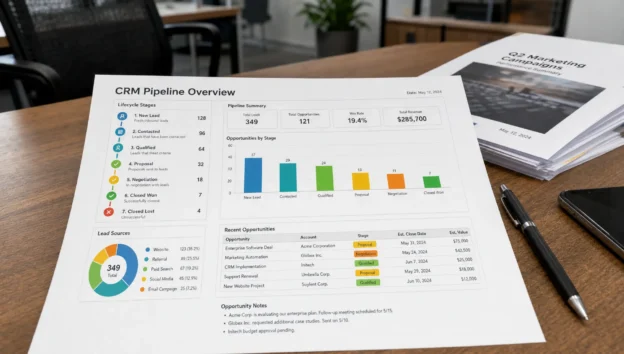
Operationally, demand generation marketing fails when the data is messy. If forms are not tagged, campaigns are not tracked, CRM fields are inconsistent or sales notes are missing, the team cannot see what is working.
At minimum, every engine needs clean source tracking, lifecycle stages, clear owner assignments and consistent follow-up tasks. When someone fills out a form, the team should know where they came from, what they requested, what happened next and whether that activity became pipeline.
Automation can help, but it should not replace strategy. A simple email workflow that sends relevant content based on interest is more valuable than a complex workflow that treats every buyer the same. The best systems use automation to keep the experience timely and consistent while preserving human follow-up where it matters.
Make the website part of the engine
Your website is not only a brochure. It is the central hub for search visibility, paid traffic, conversion, retargeting and sales enablement. Service pages should make your expertise clear. Blog content should answer buyer questions. Landing pages should match campaign intent. Forms should ask for enough information to qualify interest without creating unnecessary friction.
For industrial and B2B companies, responsive web design, website redesign and web content writing can directly affect demand performance. If the site is slow, unclear or hard to use on mobile, even strong campaigns will underperform.
Measure What Improves Revenue, Not Just Activity
Measurement keeps demand generation marketing honest. Traffic, impressions and clicks can help diagnose activity, but they do not prove business impact by themselves. The more important question is whether the engine is producing qualified conversations and revenue opportunities from the right accounts.
A practical scorecard should include leading indicators and revenue indicators. Leading indicators help you improve campaigns quickly. Revenue indicators show whether the engine is creating business value.
| Metric category | Examples | Why it matters |
|---|---|---|
| Visibility | Organic rankings, search impressions, paid impression share | Shows whether your audience can find you |
| Engagement | Time on page, return visits, email engagement | Shows whether the message is resonating |
| Conversion | Form submissions, consultation requests, landing page conversion rate | Shows whether interest is becoming identifiable demand |
| Quality | Qualified lead rate, sales acceptance rate, opportunity creation | Shows whether marketing is attracting the right buyers |
| Revenue | Pipeline value, close rate, cost per opportunity | Shows whether the engine supports growth |
Attribution does not need to be perfect to be useful. Start by comparing channels, offers and segments. Which topics create the best sales conversations? Which landing pages convert high-fit buyers? Which campaigns produce leads that sales accepts? For more detail, review this guide on how to measure demand gen campaign results.
A Practical 90-Day Build Plan
In the first 90 days, demand generation marketing should become more focused, more measurable and easier for sales to use. Do not try to rebuild everything at once. Start with the highest-impact gaps.
During the first month, audit your current assets, traffic sources, CRM fields and conversion paths. Identify your best-fit customer segments and the questions they ask before buying. Tighten your messaging so your homepage, service pages and core landing pages speak directly to those problems.
During the second month, build or improve the assets that support the buyer journey. This might include SEO pages for high-intent topics, PPC landing pages for priority offers, nurture emails for early-stage leads and sales enablement content for common objections.
During the third month, launch controlled campaigns and review performance weekly. Look at which audiences respond, which offers convert and which leads sales accepts. Use those insights to improve targeting, copy, content and follow-up.
A 90-day plan will not create a perfect engine. It should create a working version that can be improved every month.
Frequently Asked Questions
What is the difference between demand generation and lead generation? Demand generation creates awareness, interest and trust across the buyer journey. Lead generation focuses more narrowly on capturing contact information. A strong B2B engine usually needs both, but lead capture works better when demand has already been created.
How long does demand generation marketing take to show results? Paid campaigns can create activity quickly, but a full engine usually improves over months as SEO, content, nurture and sales feedback compound. The timeline depends on market competition, buying cycle length, budget, offer strength and follow-up quality.
What should a small B2B company build first? Start with a clear ICP, strong service pages, one or two high-intent conversion offers and reliable tracking. After that, add SEO content, PPC tests and nurture emails based on the questions your best prospects already ask.
Do industrial companies need social media for demand generation? Social media can help, but it should not be treated as the whole strategy. Industrial companies often benefit most when social supports technical content, trade show activity, recruiting, credibility and remarketing rather than relying on social posts alone to create pipeline.
Build an Engine You Can Actually Run
The best demand engine is not the most complicated one. It is the one your team can execute consistently, measure clearly and improve based on real buyer behavior.
B2B Inbound Marketing helps industrial and B2B companies improve visibility, leads and rankings through SEO, PPC, inbound marketing strategy, social media marketing, video SEO, responsive web design and web content. If your current marketing feels like a set of disconnected tactics, the next step is to turn those parts into a system that supports qualified pipeline and better sales conversations.