


For industrial suppliers and B2B service companies, inbound lead generation becomes valuable when it does more than produce occasional inquiries. It should help your team estimate how many qualified opportunities are likely to enter the pipeline, when those opportunities could close and what it will take to keep the flow steady.
Predictability does not mean identical results every month. It means having a repeatable acquisition process, reliable conversion data and enough visibility to adjust before a weak month becomes a weak quarter. That requires connecting marketing activity to sales outcomes rather than treating website traffic as the finish line.
What a predictable pipeline actually means
A predictable pipeline has three practical characteristics: a reasonably consistent supply of relevant inquiries, understood conversion rates between sales stages and a realistic view of buying timelines.
For example, a manufacturer might receive fewer inquiries during a seasonal slowdown without facing a pipeline crisis. If those inquiries match its capabilities and follow the usual purchasing timeline, the business can still plan capacity and sales coverage. A sudden increase in poorly matched requests may be less useful, even when the marketing report looks stronger.
The purpose of inbound lead generation is therefore not to eliminate variation. It is to make variation explainable and manageable.
Marketing and sales need shared definitions before forecasting becomes useful. An accepted lead should meet agreed requirements, such as application fit, service territory and purchasing potential. An opportunity should represent a verified buying situation with an agreed next step, not simply someone who downloaded a document.
Those definitions keep optimistic reporting from hiding weak demand.
Build an inbound lead generation system around buying intent
A repeatable acquisition process starts with the questions prospects ask as they move toward a purchase. For industrial buyers, those questions often involve specifications, compatibility, operating conditions, delivery requirements and supplier reliability.
Map each question to a page that helps the buyer make a decision and offers an appropriate next step.
| Buyer situation | Useful website content | Appropriate next step |
|---|---|---|
| Investigating an operating problem | Application guide or troubleshooting article | Review a relevant solution page |
| Comparing technical approaches | Capability page, specification details or comparison guide | Request a technical discussion |
| Evaluating a supplier | Project evidence, quality documentation or process explanation | Share requirements for a quotation |
This structure gives educational content a commercial purpose without forcing every visitor into a sales conversation. A maintenance engineer researching a recurring failure needs different information from a purchasing manager preparing an RFQ.
For inbound lead generation to support forecasting, prioritize the topics that repeatedly connect to viable buying situations. Broad informational traffic can introduce your business, but commercial-intent pages deserve attention when the goal is near-term pipeline.
Start with sales conversations, customer questions and search queries associated with qualified opportunities. Build around those signals rather than publishing unrelated articles simply to maintain a content calendar.
Make the next step easy without weakening qualification
A buyer who finds the right page should understand what to do next. Avoid sending every visitor to a generic contact form with no explanation of what happens after submission.
On a technical service page, the next step might be submitting operating conditions for review. On a fabrication page, it could be sharing drawings and quantities. Explain which details are useful and who will respond, but only promise a response time your team can consistently meet.
A local-service example illustrates the principle: Bright Smiles Dentistry’s Mountain Creek and Currimundi clinics pair clearly identified locations with online appointment booking. Industrial purchasing requires a different action, but the underlying lesson applies: help visitors establish fit and make the next step clear.
Request enough information to route and assess an inquiry without turning the form into a procurement questionnaire. More detailed requirements can follow once a conversation begins.
In inbound lead generation, conversion friction and qualification must be balanced together. An easier form is not automatically better if it produces requests your team cannot serve. Evaluate changes against accepted leads and opportunities, not submissions alone.
Forecast from mature cohorts, not this month’s form fills
A forecast becomes more useful when it follows groups of leads acquired during the same period. These groups, called cohorts, reveal how acquisition translates into opportunities and bookings over time.
Build a simple conversion model
Use this model: Expected wins = inquiries × sales acceptance rate × opportunity creation rate × opportunity win rate.
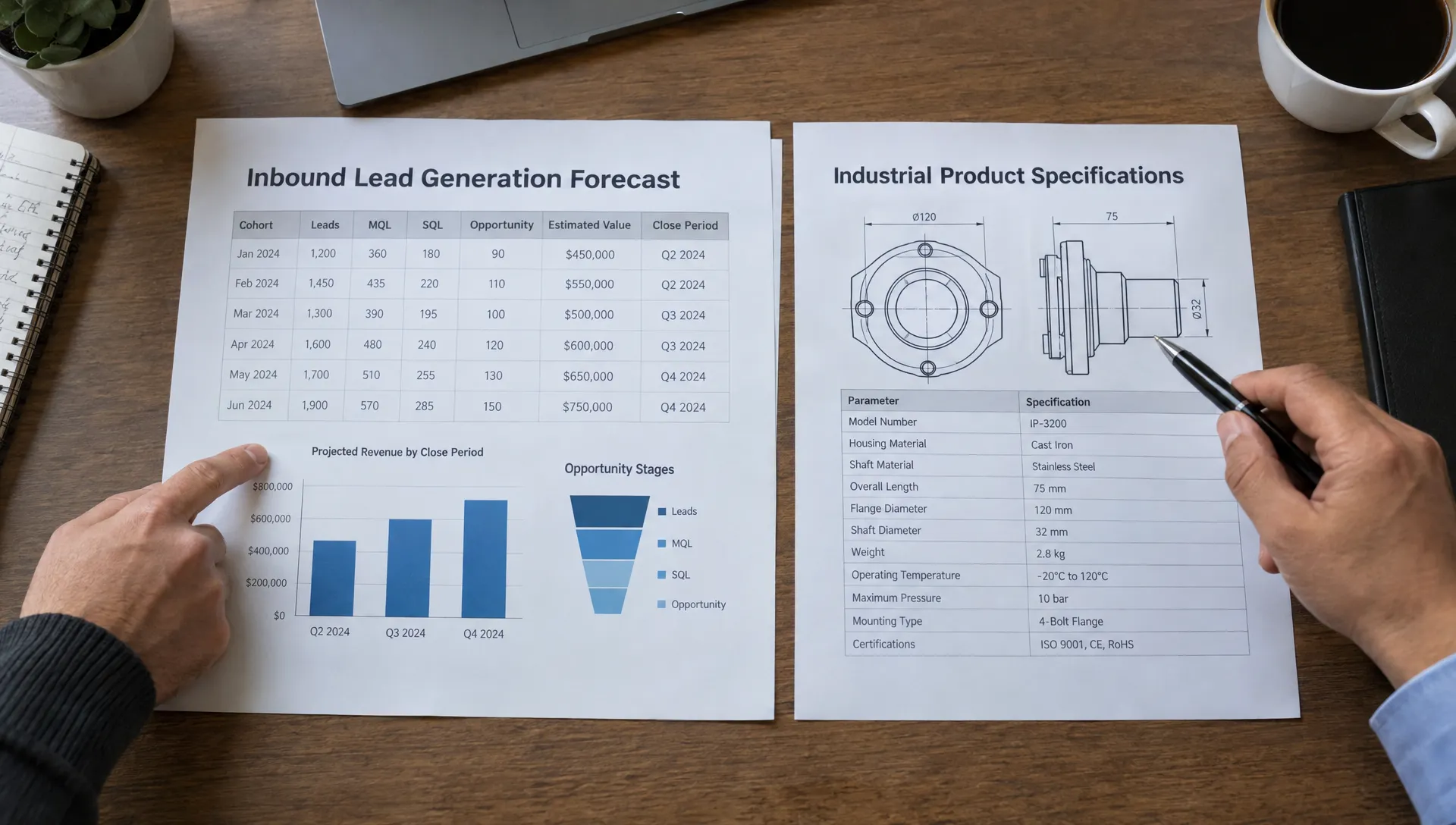
Consider an illustrative cohort of 80 inquiries. If sales accepts 50%, 40% of accepted leads become opportunities and 25% of opportunities close, the expected outcome is four wins. At an assumed average contract value of $50,000, that represents $200,000 in expected booked contract value.
These figures are hypothetical planning inputs, not industry benchmarks or guaranteed results.
The timing matters as much as the arithmetic. If opportunities commonly take several months to close, inquiries acquired this month should not be treated as this month’s bookings. Measure conversion using cohorts that have had sufficient time to progress, and track how long each stage typically takes.
A forecast for inbound lead generation should reflect both conversion probability and the expected closing window. For a fuller view of stage performance, use these lead generation metrics beyond form fills to distinguish activity from commercial progress.
Use scenarios rather than a single promise
A base case is useful, but it should not be the only view presented to leadership. Model a conservative case to show how lower inquiry volume or weaker qualification changes the outcome.
| Planning input | Conservative case | Base case |
|---|---|---|
| Inquiries acquired | 60 | 80 |
| Sales acceptance rate | 40% | 50% |
| Accepted leads becoming opportunities | 35% | 40% |
| Opportunity win rate | 20% | 25% |
| Expected wins after the cohort matures | 1.68 | 4 |
| Expected booked value at $50,000 per win | $84,000 | $200,000 |
Fractional wins represent an expected value across repeated cohorts, not part of a contract. Actual outcomes will be whole deals and may vary considerably, especially at low volumes.
This model forecasts booked value, not recognized revenue or cash collected. It also assumes a contract value that may differ substantially by application or customer segment. Separate large custom projects from smaller repeat purchases when their economics or sales cycles are materially different.
Reduce dependence on any single acquisition channel
A pipeline can look steady until one channel changes. Search visibility may fluctuate, an advertising campaign may become more expensive or a referral source may stop sending business.
Use channels according to their role rather than expecting each one to produce identical results. SEO can help buyers discover useful application and capability content. PPC can reach active searches and test commercial messaging. Email follow-up can help relevant contacts return when a purchasing requirement becomes clearer.
The goal is not to add every available channel. It is to avoid relying on one fragile source while preserving a clear view of which sources produce qualified opportunities.
For inbound lead generation, compare channel performance using acceptance rates, opportunity creation and buying timelines alongside acquisition cost. A channel that produces inexpensive inquiries may be costly after sales spends time rejecting them.
Keep source tracking consistent and document its limitations. A prospect may discover your company through an article, return through a branded search and submit a form after a referral. Attribution is a planning aid, not a complete record of every influence on the purchase.
Establish a weekly operating rhythm
Predictability improves when teams inspect the system regularly instead of waiting for a disappointing quarterly report.
A weekly review should identify where progress is slowing. If inquiries fall but acceptance remains stable, investigate acquisition coverage. If inquiries hold steady while acceptance drops, inspect targeting and messaging. If accepted leads accumulate without meetings, check routing, response capacity and follow-up.
Keep the review focused on decisions:
- Acquisition: Are commercially relevant pages and campaigns producing the expected inquiry range?
- Qualification: Are prospects matching the applications, territories and project types the business can serve?
- Progression: Are accepted leads reaching a verified next step, or sitting untouched?
- Timing: Are opportunities moving within their usual stage durations, or slipping into later periods?
Assign an owner and a review date to each corrective action. Without that accountability, a dashboard simply describes the problem again next week.
When inbound lead generation becomes inconsistent, diagnose the stage that changed before replacing the entire strategy. This guide to fixing inconsistent inbound leads offers a useful starting point for investigating acquisition and conversion problems.
Start with one buying situation, then expand
A focused pilot produces cleaner learning than a broad launch across unrelated products and markets. Choose one commercially important application with a clear buyer, identifiable requirements and sufficient sales capacity to handle inquiries.
Build the essential content, connect the conversion path to your CRM and agree on qualification rules before promoting it. Record acquisition source, entry date, stage changes and reasons for rejection or loss.
Early reviews should check tracking accuracy, relevance and follow-up execution. Revenue evaluation must wait until enough opportunities have had time to mature. A long sales cycle cannot be validated by a short campaign test.
Expand when the process is working and the evidence supports it. Carry successful messaging and routing practices into adjacent applications, but recheck assumptions. Different buyers may have different approval processes, contract values and purchasing schedules.
Frequently asked questions
How long does it take to build a predictable inbound pipeline? It depends on acquisition performance, lead volume and sales-cycle length. You can improve tracking and routing early, but dependable conversion estimates require enough observations and time for opportunities to mature.
Can inbound lead generation work for low-volume industrial businesses? Yes, but forecasts should use wider ranges because a few deals can change results substantially. Segment opportunities by project type and evaluate both deal count and contract value.
Does inbound replace outbound sales? No. Inbound helps buyers discover and evaluate your business, while outbound can reach selected accounts that have not engaged. Both should use consistent qualification rules and feed a shared pipeline view.
Connect your marketing plan to a forecast you can use
Before increasing spend, identify the weakest measurable stage: attracting relevant buyers, converting visits into inquiries, qualifying requests or progressing opportunities. Set a baseline, name an owner and define what improvement would look like.
Andy Alagappan’s Houston-based B2B Inbound Marketing offers SEO, PPC management, inbound strategy and web content services. Discuss your inbound marketing needs with your target applications, current conversion data and sales-cycle assumptions in hand. Those inputs provide a practical starting point for a plan tied to pipeline performance rather than traffic alone.