



A strong B2B website depends on a disciplined on site seo process, not just publishing more pages and hoping Google sorts them out. For industrial suppliers, professional service firms and Houston-area B2B companies, the real goal is not traffic alone. The goal is to help the right buyer understand what you do, trust your expertise and take the next step without friction.
Many B2B websites underperform because the problems are hiding in plain sight. A product page may have a vague title tag. A service page may target the wrong intent. A case study may have no internal links to a proposal form. A technically sound website can still lose qualified leads if the page structure, content and calls to action do not match how buyers search.
That is why on site seo should be treated as a revenue-supporting audit, not a one-time publishing task. The checks below focus on the areas that most often affect B2B visibility, lead quality and conversion readiness.
Start with the search intent behind each page
Every page should have a clear job. In B2B marketing, that job usually fits one of three intent categories: educate, evaluate or convert. A blog post may help an engineer compare options, while a service page may need to reassure a purchasing manager that your company can handle a specific project scope.
Before editing tags or adding keywords, ask whether the page satisfies the buyer’s actual search. A visitor searching for “industrial pump repair Houston” probably wants service coverage, response capability, technical qualifications and a way to request help. A visitor searching for “how to reduce downtime in manufacturing” may need a guide, checklist or diagnostic article before they are ready to speak with sales.
This is where many B2B sites drift. They write for internal language rather than customer language. Your checks should confirm that each page has one primary topic, one search intent and one next step.
The on site seo checks that matter most
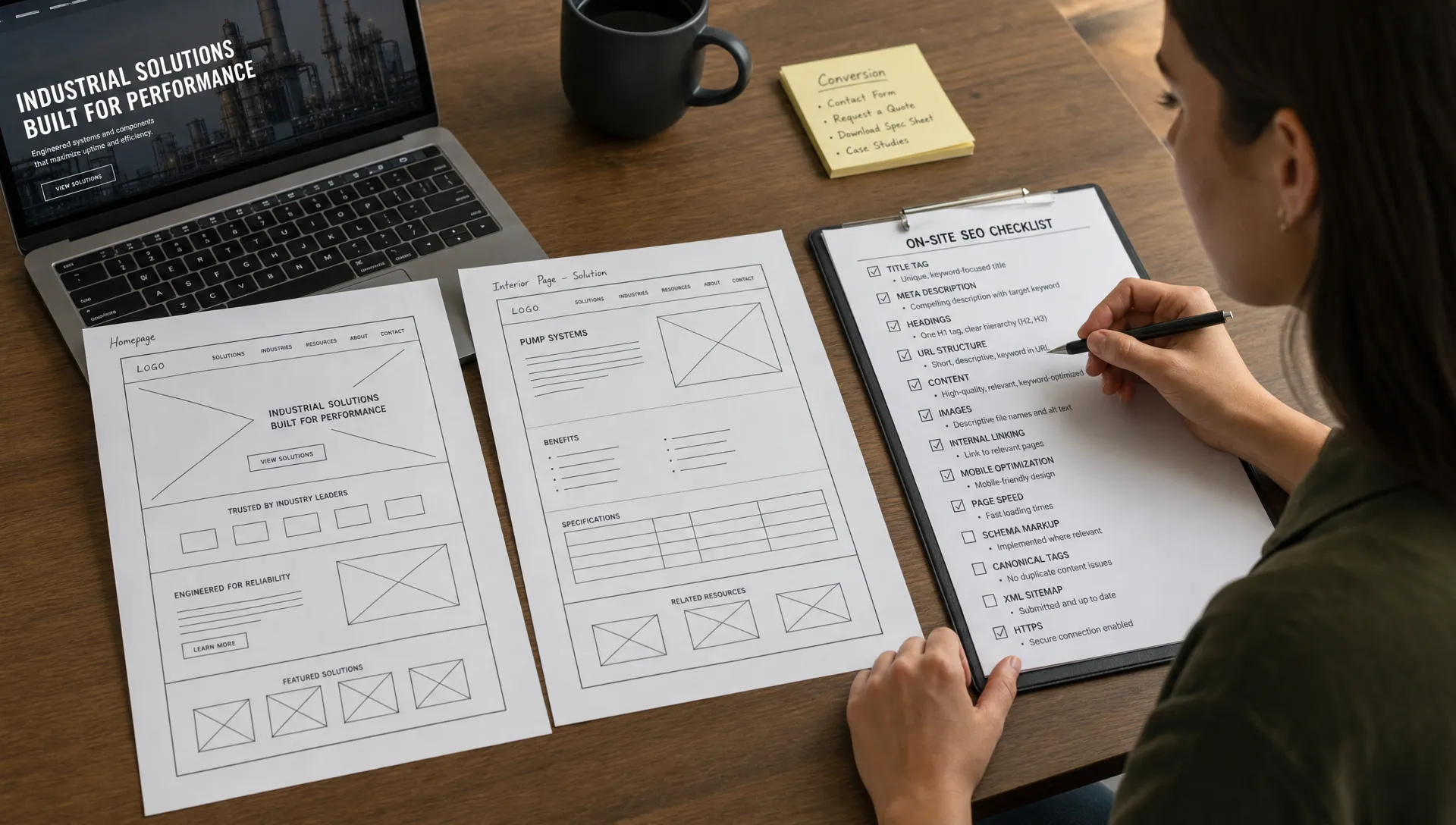
Once page intent is clear, the practical checks become much easier. Title tags, headings, internal links and body copy should all reinforce the same topic without repeating the same phrase unnaturally.
Start with the title tag. It should identify the subject of the page and give buyers a reason to click. For B2B pages, that often means combining the service, market or location with a value signal. A title like “Industrial Valve Repair in Houston for Processing Facilities” is more useful than “Services” because it tells both search engines and buyers what the page is about.
Meta descriptions do not directly control rankings, but they influence click behavior. A good description should summarize the page in plain language, include a relevant benefit and avoid generic claims. Headings should then support the page structure. Use one clear H1, followed by H2s and H3s that break the topic into decision-friendly sections.
If you want a broader audit framework, this comprehensive SEO checklist can help you organize additional page-level and technical reviews.
Check whether the content proves expertise
For B2B buyers, thin content is a trust problem. A page that says “we provide quality solutions” does not help a plant manager, procurement team or technical buyer decide whether you understand their situation.
Effective on site seo connects search relevance with evidence. That evidence may include process details, industries served, service limitations, standards followed, project examples, FAQs or comparison points. The more specialized the service, the more important specificity becomes.
For example, a niche event service such as large champagne glass pyramid displays needs to communicate the offer, visual impact, logistical credibility and proof of execution quickly because the buyer is evaluating something highly specific. B2B and industrial websites face a similar challenge, even when the subject is less visual. Buyers want to know whether your company can deliver in their environment.
Avoid adding filler just to increase word count. Instead, add the details a real buyer would need before contacting sales.
| Page element | What to check | Why it matters for B2B SEO |
|---|---|---|
| Title tag | Clear service, product or topic focus | Improves relevance and click clarity |
| H1 and headings | Logical structure with buyer-focused sections | Helps readers scan and search engines understand the page |
| Body content | Specific proof, examples and useful explanations | Builds trust with technical and business buyers |
| Internal links | Relevant links to supporting pages | Guides buyers through the decision path |
| Calls to action | Clear next step based on intent | Turns qualified visits into inquiries |
Review internal links and conversion paths
Internal links help search engines discover related content, but their bigger value for B2B sites is guiding buyers through a complex decision. A visitor may enter through an educational article, move to a service page, compare capabilities and then look for a contact form. If the site does not connect those steps, the buyer may leave before taking action.
A good internal link should feel like a natural next step. If a page explains a problem, link to a service page that solves it. If a service page mentions a technical challenge, link to a deeper article that explains your approach. If a blog post attracts local or regional buyers, link to location-relevant service content where appropriate.
This is also where SEO and design overlap. Strong navigation, scannable sections and visible calls to action can improve lead quality as much as rankings. The article on search engine optimization website design for better leads goes deeper into how site structure and conversion design work together.
When on site seo is aligned with conversion paths, the website stops acting like a brochure and starts acting like a guided sales assistant.
Inspect technical signals that affect page performance
Technical checks do not need to be mysterious, but they do need to be consistent. If search engines cannot crawl, index or render key pages correctly, strong content will not reach its full potential.
Begin with indexation. Important pages should be indexable, included in the XML sitemap and free from accidental noindex tags. Check canonical tags to make sure they point to the right version of each page. Review redirects, broken links and duplicate pages that may split ranking signals.
Performance also matters. Slow pages can hurt engagement, especially when B2B buyers are comparing vendors during a busy workday. Core Web Vitals, mobile usability, compressed images and clean code all contribute to a better experience. A responsive website is now basic infrastructure, not a design bonus.
Security is another trust signal. HTTPS should be standard across the entire website. Forms should work properly, especially proposal inquiries, quote requests and contact submissions. A ranking improvement is wasted if a buyer cannot complete the action that creates a lead.
Make local and industry relevance visible
B2B search is often shaped by geography, even when the sales cycle is national or regional. A Houston industrial company may serve clients across Texas, but a local presence can still influence credibility, search relevance and buyer confidence.
Your pages should make location and industry relevance clear where it is true. This may include service areas, facility location, industries served, local project experience or Houston-specific terminology. Do not create thin location pages with copied text. Instead, build pages that explain why your location matters to the buyer.
For companies competing in the Houston market, on site seo should connect local relevance with buyer intent. A manufacturer, distributor or B2B service provider will usually benefit from pages that speak to both the service category and the industries that need it.
For a deeper local perspective, see this guide to SEO Houston for B2B companies, which covers the signals that matter most in a competitive regional market.
Use media, schema and page formatting with purpose
Images, videos, charts and downloadable assets can improve B2B pages when they clarify the buying decision. A product photo, equipment image, process diagram or short explainer can make a technical offer easier to understand. The key is to optimize media without slowing the page.
Use descriptive file names and alt text for important images. Alt text should describe the image accurately, not repeat keywords mechanically. Compress images before publishing and avoid uploading oversized files that force mobile users to wait.
Schema markup can also help search engines understand page elements. Organization, LocalBusiness, FAQ and Article schema may be relevant depending on the page type. Schema does not replace strong content, but it can make structured information easier for search systems to interpret.
Formatting matters too. B2B readers scan before they commit. Short sections, descriptive subheadings, tables and clear CTAs make a page easier to evaluate. Good on site seo supports that behavior instead of forcing visitors through dense blocks of text.
Measure the checks that connect to leads
Rankings are useful, but they are not the finish line. B2B companies should track the metrics that show whether organic traffic is turning into business opportunity.
Look at impressions, clicks, average position and click-through rate in Google Search Console. Then connect those patterns to behavior in analytics: engaged sessions, form submissions, phone clicks, proposal inquiries and visits to high-intent pages. If a page ranks but does not generate action, the issue may be intent mismatch, weak proof, poor CTA placement or an offer that is too vague.
A simple monthly review can catch problems before they become expensive. Prioritize pages that target valuable services, receive impressions but low clicks or attract traffic without conversions. These pages often offer the best improvement opportunities because they already have some search visibility.
The best on site seo programs become part of ongoing marketing operations. They help your team decide what to update, what to consolidate, what to expand and what to promote through PPC or social campaigns.
Frequently Asked Questions
How often should a B2B website run on-site SEO checks? Most B2B websites should review key pages quarterly and run a deeper audit at least twice a year. High-value service pages, PPC landing pages and pages losing rankings may need more frequent attention.
What is the difference between on-site SEO and technical SEO? On-site SEO covers page content, headings, internal links, metadata, user experience and conversion clarity. Technical SEO focuses more narrowly on crawlability, indexation, site speed, redirects, structured data and code-level issues.
Do B2B websites need different SEO checks than consumer websites? Yes. B2B buyers usually have longer decision cycles, more stakeholders and more technical questions. That means pages need stronger proof, clearer industry relevance and conversion paths that support research as well as direct inquiries.
Can on-site SEO improve lead quality? Yes. When pages match buyer intent and explain the offer clearly, they tend to attract visitors who better understand what your company does. That can reduce irrelevant inquiries and improve the quality of sales conversations.
Turn SEO checks into better B2B lead flow
A website audit is only valuable if it leads to action. Fixing titles, headings, internal links, page speed and conversion paths can make a measurable difference, but the work should be prioritized around business value rather than vanity metrics.
If your B2B website needs stronger visibility, cleaner structure or a better path from search to inquiry, Andy Alagappan’s Houston-based inbound marketing services can help with SEO, PPC, content and campaign strategy. Start with the pages that matter most to your pipeline, then build a practical improvement plan that supports qualified lead flow over time.