


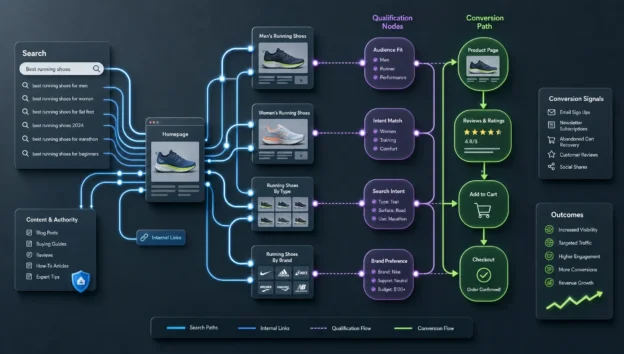
Improving SEO optimization for your website is not a one-time task or a quick keyword edit. For B2B, industrial and local service businesses, it is a practical process of making your site easier to find, easier to understand and easier to act on.
Search engines need to crawl your pages, interpret what each page is about and decide whether your content deserves to appear for a specific query. Visitors need something more direct: a page that answers their question, builds confidence and makes the next step obvious.
The strongest SEO work happens when both needs are handled together. Rankings matter, but qualified inquiries, quote requests, calls and sales conversations are the real goal.
Start With Search Intent, Not Keywords Alone
Keywords still matter, but they are only useful when they match the reason someone is searching. A visitor searching “industrial pump repair Houston” is not in the same mindset as someone searching “how centrifugal pumps work.” One is likely comparing vendors or looking for immediate help. The other is learning.
Before optimizing a page, decide what job that page should do. A homepage should usually explain who you serve and what you offer. A service page should show capability, process, proof and a conversion path. A blog article should answer a specific question and guide the reader toward a relevant next step.
This is where many websites lose momentum. They publish content around broad topics but do not connect that content to buyer intent. A better approach is to map each page to a searcher need:
| Search intent | Example query | Best page type | Primary goal |
|---|---|---|---|
| Informational | how to reduce manufacturing downtime | Blog article or guide | Educate and introduce expertise |
| Commercial | best SEO company for industrial business | Comparison or service page | Support evaluation |
| Local | B2B marketing agency Houston | Local service page | Generate inquiry |
| Transactional | request PPC management proposal | Landing page or form page | Convert lead |
When every page has a clear role, SEO becomes easier to manage. You can choose better titles, create more useful content and measure performance against the right outcome.
Make Your Site Structure Easy to Crawl and Understand
A search-friendly website starts with a logical structure. Search engines follow links to discover pages, but visitors also depend on menus, breadcrumbs and internal links to understand where they are.
For B2B and industrial companies, a simple structure often works best: homepage, main service pages, industry pages, case studies or proof pages, educational articles and contact or proposal pages. Each important service should have its own page instead of being hidden inside a general paragraph on the homepage.
Internal links also help search engines understand which pages matter most. If you publish a blog post about improving lead quality, it should naturally connect to the relevant service page or related article. For example, a deeper discussion of SEO optimization strategies that support better lead flow can help connect SEO work to measurable business outcomes.
Your site structure should avoid three common problems:
- Orphan pages that are not linked from menus, related content or service pages
- Duplicate pages that target nearly the same search phrase without a distinct purpose
- Deep pages that require too many clicks to reach from the homepage
A clean structure helps search engines index your content, but it also helps buyers move from awareness to action without confusion.
Improve On-Page SEO Fundamentals
On-page SEO is the part most people recognize: titles, headings, URLs, body copy and image descriptions. These elements help search engines classify a page and help visitors decide whether they are in the right place.
Start with the page title. It should include the main topic naturally and set a clear expectation. A title like “Industrial SEO Services for Manufacturers” is stronger than “Our Solutions” because it tells both Google and the reader what the page covers.
The meta description does not directly guarantee rankings, but it can improve clicks from search results when it is specific and compelling. It should summarize the value of the page, not repeat a list of keywords.
Headings should organize the page around useful questions and decision points. A service page might cover problems solved, industries served, process, proof, FAQs and a call to action. A blog post might move from explanation to checklist to next steps.
Also review these basic elements:
- Use short, descriptive URLs that reflect the page topic
- Add unique title tags and meta descriptions to important pages
- Include the primary topic in the H1 and related wording in subheadings
- Write alt text for meaningful images so they support accessibility and image search
- Link to related pages using natural anchor text, not generic phrases
These edits are not glamorous, but they compound over time. Many websites underperform simply because important pages have vague titles, weak headings and no internal links pointing to them.
Create Content That Proves Expertise
Content should answer real buyer questions better than a thin sales page can. That does not mean every article must be long. It means each page should be complete enough to help the reader make progress.
For B2B and industrial marketing, useful content often explains process, selection criteria, cost factors, risks, standards, timelines or common mistakes. Buyers may not convert on the first visit, especially for high-value services. Good content gives them a reason to trust your company before they speak to sales.
A practical content plan should include:
- Core service pages for your most important offerings
- Industry-specific pages when different markets have different needs
- Educational articles that answer early-stage questions
- Comparison or evaluation content for buyers choosing between options
- Case studies, project examples or proof points when available
Avoid publishing content only because a keyword tool shows volume. A phrase with modest search volume but strong buying intent can produce better leads than a broad phrase that attracts unqualified visitors.
For example, “SEO for industrial distributors” may bring fewer searches than “what is SEO,” but the first visitor is far more likely to fit an industrial marketing agency’s business goals.
Fix Technical SEO Issues That Hold Pages Back
Technical SEO makes your website easier for search engines to crawl and easier for users to experience. It does not replace strong content, but technical problems can limit how well strong content performs.
Start with indexability. Important pages should be crawlable, indexable and included in your XML sitemap. Pages blocked by robots.txt, marked noindex by mistake or buried behind scripts may struggle to appear in search.
Page speed also matters because users abandon slow sites. Google’s Core Web Vitals focus on loading performance, interactivity and visual stability. A site does not need to be perfect, but slow templates, oversized images, excessive scripts and unstable layouts can hurt both search visibility and conversions.
Mobile performance should be checked carefully. Many B2B websites are reviewed first on a desktop inside an office, but decision-makers often revisit pages on a phone between meetings or while traveling. If forms are hard to use, menus are cramped or calls to action disappear on mobile, SEO traffic can leak before it becomes a lead.
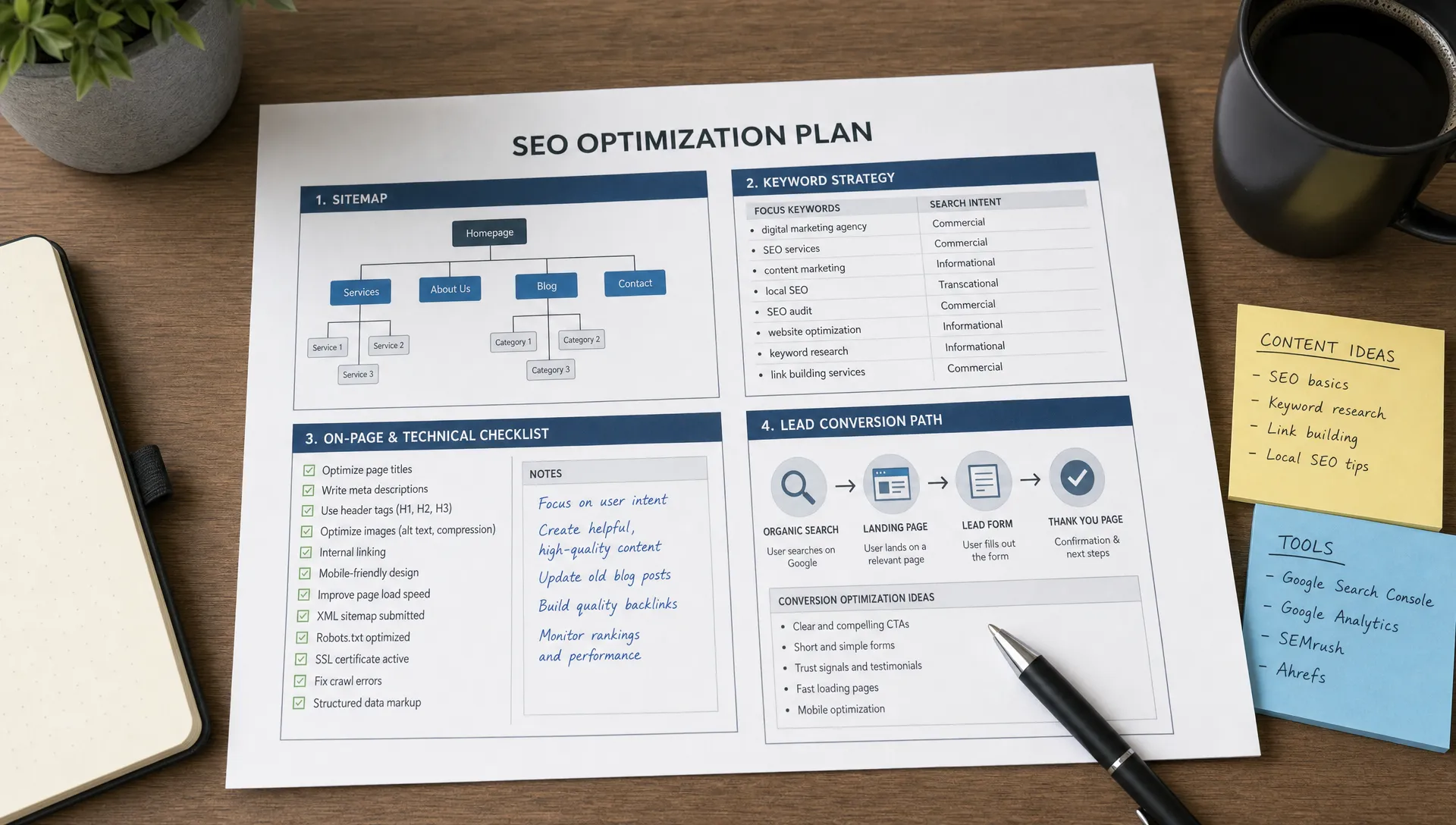
A technical SEO review should look at crawl errors, broken links, redirects, duplicate title tags, canonical tags, schema markup, mobile usability, page speed and security. If that sounds like a lot, prioritize pages that already receive impressions or support key services. Fixing a high-value page is usually more useful than polishing a page no one needs.
Strengthen Local and Industry Relevance
If your business serves a defined region, local SEO should be part of your website optimization plan. A Houston-based B2B agency, for example, should make its location and service area clear without stuffing city names into every sentence.
Local relevance comes from consistent business information, location-specific service pages where appropriate, a complete Google Business Profile, reviews, local citations and content that reflects the market you serve. A local service provider has to show relevance, proximity and trust. For instance, a dental clinic in Pakenham needs a different local SEO approach than a national industrial supplier because patients are usually searching for nearby care, appointment availability and service-specific trust signals.
The same principle applies to B2B. If you serve manufacturers, energy companies, distributors, medical suppliers or engineering firms, your content should reflect those buyers’ language and concerns. Generic marketing copy rarely performs as well as content that shows real understanding of the market.
Industry relevance can be strengthened through service examples, terminology, FAQs, project types, regulatory considerations and problem-specific pages. You do not need to overload the site with jargon, but you should sound credible to the people you want to reach.
Align SEO With Website Design and Conversion Paths
Traffic alone does not pay for marketing. Once the right visitor arrives, the page has to help them take the next step. That is why SEO and web design should not be treated as separate projects.
A high-performing SEO page needs a clear headline, fast loading experience, scannable structure, trust signals and a relevant call to action. It should be obvious whether the visitor should request a proposal, call, download a resource, view a service page or read a related guide.
This is especially important for industrial and B2B companies with longer sales cycles. Visitors may need to understand your capabilities, evaluate your experience and share the page internally before making contact. Strong page design supports that process by reducing friction.
If you are planning a redesign, include SEO before wireframes are finalized. Page hierarchy, navigation, content depth and calls to action all affect search performance. The article on planning SEO and website design together explains why design decisions can either support or weaken organic visibility.
Conversion-focused SEO asks two questions at the same time: can this page rank, and can this page persuade the right visitor to act? Both have to be true for SEO to become a reliable lead source.
Build Trust Signals Into Important Pages
Search visibility is stronger when your website looks credible to both users and search engines. Trust signals help visitors decide whether your company is real, experienced and capable.
For service pages, trust signals may include years in business, industries served, client types, certifications, testimonials, case studies, project photos, process details, team experience and clear contact information. Use only proof you can stand behind. Thin claims like “best in the industry” are less persuasive than specific experience and visible evidence.
Authoritative content also needs accuracy. If you discuss technical topics, cite known standards or name reputable sources when relevant. If regulations, platforms or best practices change, update older content so it does not mislead visitors.
For B2B marketing pages, trust can also come from transparency. Explain who your service is best for, what the process involves and what a prospect should expect after submitting a form. The more uncertainty you remove, the easier it is for qualified buyers to start a conversation.
Measure SEO Performance Beyond Rankings
Rankings are useful, but they are not the whole picture. A page can rank for the wrong query and deliver little business value. Another page may rank lower but attract visitors with stronger intent.
Track performance across the full path from search impression to lead. Google Search Console can show which queries produce impressions and clicks. Analytics tools can show engagement and conversion behavior. Your CRM or inquiry tracking can show whether those leads are qualified.
Useful SEO metrics include organic impressions, click-through rate, ranking movement, engaged sessions, form submissions, phone calls, proposal requests and lead quality. For B2B companies, lead quality should carry more weight than raw traffic.
Review your data monthly and look for practical decisions. If a page has many impressions but few clicks, improve the title and meta description. If a page gets traffic but no inquiries, review the offer, layout and call to action. If a page converts well but has low visibility, build supporting content and internal links around it.
For companies that want better performance from existing traffic, website optimization services that improve conversion rates can be just as important as adding new content.
A Simple SEO Improvement Checklist
If you want to improve SEO optimization for your website without getting overwhelmed, focus on the highest-impact areas first.
| Priority | Action | Why it matters |
|---|---|---|
| Page intent | Match each page to a clear searcher need | Helps attract qualified visitors |
| Site structure | Organize services, industries and resources logically | Improves crawling and user navigation |
| On-page SEO | Optimize titles, headings, URLs and internal links | Clarifies page relevance |
| Content quality | Answer buyer questions with useful detail | Builds trust and supports rankings |
| Technical health | Fix speed, mobile, crawl and index issues | Removes performance barriers |
| Conversion path | Add clear calls to action and proof | Turns traffic into inquiries |
| Measurement | Track leads, not only rankings | Connects SEO to revenue potential |
You do not need to fix everything in one week. Start with pages that matter most to revenue: core services, high-intent landing pages and pages already gaining impressions. Then build outward with supporting content and technical improvements.
Frequently Asked Questions
How long does it take to improve SEO optimization for a website? Some technical and on-page improvements can help quickly, especially if a site has obvious issues. Competitive organic growth usually takes several months because search engines need time to crawl changes, compare content quality and respond to new signals.
Should I optimize existing pages or create new content? Start with existing pages if they target important services or already receive impressions. Improving a page that has potential is often faster than publishing a new article. Create new content when you identify a real buyer question or search intent that your current site does not answer.
Is technical SEO more important than content? Technical SEO and content support each other. A technically clean website with weak content will struggle to persuade visitors. Strong content on a slow, confusing or poorly indexed site may not reach its audience. Prioritize the issue that is currently limiting performance most.
How often should SEO work be reviewed? Review core metrics monthly and perform deeper audits at least a few times per year. Also review SEO whenever you redesign the site, add major services, change business focus or notice a drop in impressions, clicks or leads.
Need Help Improving Your Website SEO?
If your website is not producing the visibility or leads your business needs, a structured SEO plan can help identify what is blocking performance. B2B Inbound Marketing helps businesses improve online visibility through SEO, PPC, inbound strategy, web content and related digital marketing services.
To discuss how your website can attract more qualified traffic and support better lead generation, visit Andy Alagappan and start with a practical review of where your site stands today.