


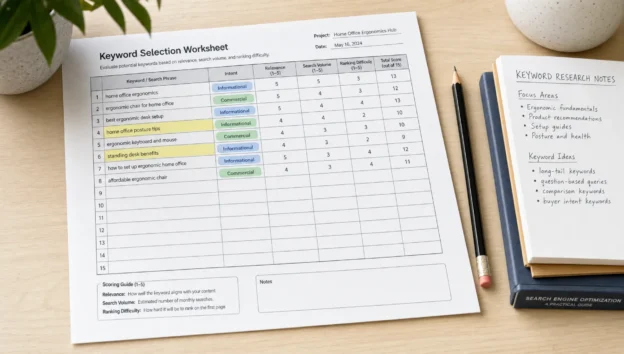
Choosing keywords for search engine optimization is not simply a research task. It is a business decision. The keywords you target influence the pages you create, the buyers you attract, the sales conversations you start and the leads your website can realistically generate.
For B2B, industrial, SaaS and professional service companies, the best keyword is rarely the one with the biggest search volume. A broad phrase may bring traffic, but a specific phrase tied to a service, problem, industry or location is often much closer to revenue. The goal is to choose keywords that connect search demand with your offer and your buyer’s stage of decision making.
Start With the Business Goal, Not the Keyword Tool
Before opening a keyword research platform, define what the website needs to achieve. A keyword list built without a business goal usually turns into a collection of disconnected phrases. Some may be popular, but they may not support sales.
Ask what kind of demand you want to capture. Are you trying to generate local service inquiries in Houston? Build authority in an industrial niche? Support a PPC campaign with organic landing pages? Educate early-stage buyers before they speak with sales?
A keyword can only be valuable if it supports a measurable outcome.
| Business goal | What to look for in keywords | Best page type |
|---|---|---|
| Generate service leads | Service, location and problem phrases | Service page or local landing page |
| Educate early-stage buyers | Questions, definitions and process phrases | Blog article or guide |
| Support complex B2B sales | Comparison, cost, ROI and use case phrases | Decision-stage article or solution page |
| Improve lead quality | Industry, application and buyer-role qualifiers | Specialized landing page |
This is especially important in industrial marketing, where a phrase with 50 monthly searches can be more valuable than a broad phrase with thousands if the searcher is looking for a specific capability.
Separate Search Intent From Search Volume
Search volume tells you how often a phrase is searched. Search intent tells you what the searcher wants to accomplish. Intent matters more because it determines whether your page can satisfy the searcher and produce a useful business result.
For example, someone searching for what is SEO may be learning. Someone searching for B2B SEO agency Houston is likely comparing providers. Someone searching for industrial SEO services may already understand the problem and want a vendor with specific experience.
| Intent type | What the searcher wants | Example keyword pattern | Best content approach |
|---|---|---|---|
| Informational | Learn or define a concept | What is keyword research | Clear educational article |
| Commercial investigation | Compare options or approaches | Best SEO strategy for manufacturers | Guide, comparison or checklist |
| Service intent | Find a provider or solution | Industrial SEO agency Houston | Service page with proof and CTA |
| Problem-solving | Fix a specific issue | Why industrial website traffic is not converting | Diagnostic article with next steps |
When choosing keywords, open the search results and study what currently ranks. If most results are service pages, Google is likely interpreting the query as vendor-driven. If the results are mostly tutorials or definitions, an educational article is a better fit.
Build a Seed List From Real Buyer Language
Keyword tools are useful, but they should not be your first source. Start with the language buyers already use when they talk to your sales team, submit forms, send RFQs or describe problems in discovery calls.
A strong seed keyword list can come from:
- Sales call notes and proposal requests
- Questions prospects ask before buying
- Product or service categories on your website
- Industry standards, applications and materials
- Customer pain points and objections
- PPC search term reports and Google Search Console data
- Competitor page titles and navigation labels
If you need a deeper foundation, this guide on what keyword research is and why it matters explains how keyword research connects search behavior with content planning.
At this stage, do not worry about perfect phrasing. Capture broad topics, service names, customer problems, industry terms and location modifiers. Refinement comes later.
Evaluate Keywords Using Business Value Criteria
A keyword is not good or bad in isolation. It is good if your company can create the right page, satisfy the searcher and convert some portion of that demand into a qualified next step.
Use these criteria before adding a keyword to your SEO plan.
| Criterion | What to ask | Why it matters |
|---|---|---|
| Relevance | Does this phrase match what we sell or want to be known for? | Prevents traffic that will not convert |
| Intent | Is the searcher learning, comparing or ready to contact a provider? | Determines content format and CTA |
| Specificity | Does the keyword include an industry, problem, location or use case? | Helps qualify visitors |
| Ranking difficulty | Can our site realistically compete for this term? | Keeps priorities practical |
| SERP fit | Can we create the type of page Google is rewarding? | Improves ranking potential |
| Conversion value | Would a lead from this search be worth pursuing? | Aligns SEO with revenue |
This approach keeps keyword selection grounded. It also helps prevent the common mistake of chasing impressive traffic numbers while ignoring sales fit.
Favor Specificity in B2B and Industrial SEO
Broad keywords are tempting because they look important. The problem is that they often attract mixed audiences. A phrase like manufacturing marketing could include students, job seekers, agencies, software vendors or manufacturers trying to solve a lead generation problem.
Specific keywords reduce ambiguity. They may include a location, industry, process, material, software category, application or buyer role.
| Broad keyword | More qualified keyword | Why the qualified version is stronger |
|---|---|---|
| SEO services | industrial SEO services Houston | Adds industry and location intent |
| inbound marketing | B2B inbound marketing agency | Filters for business buyers |
| website redesign | manufacturing website redesign | Connects to a specific market |
| PPC management | PPC management for industrial companies | Signals service fit and buyer need |
The same principle applies outside industrial markets. For example, a company in a specialized category such as music IP enforcement would not build its SEO strategy around a broad phrase like music marketing. A platform built to monitor IP usage across social platforms would choose keywords tied to rights holders, licensing workflows, unauthorized music use, sync opportunities and social UGC because those phrases reflect the buyer’s real problem.
Specificity does not mean using awkward, overlong phrases everywhere. It means choosing keywords that reflect how serious buyers describe their needs.
Create a Simple Keyword Priority Score
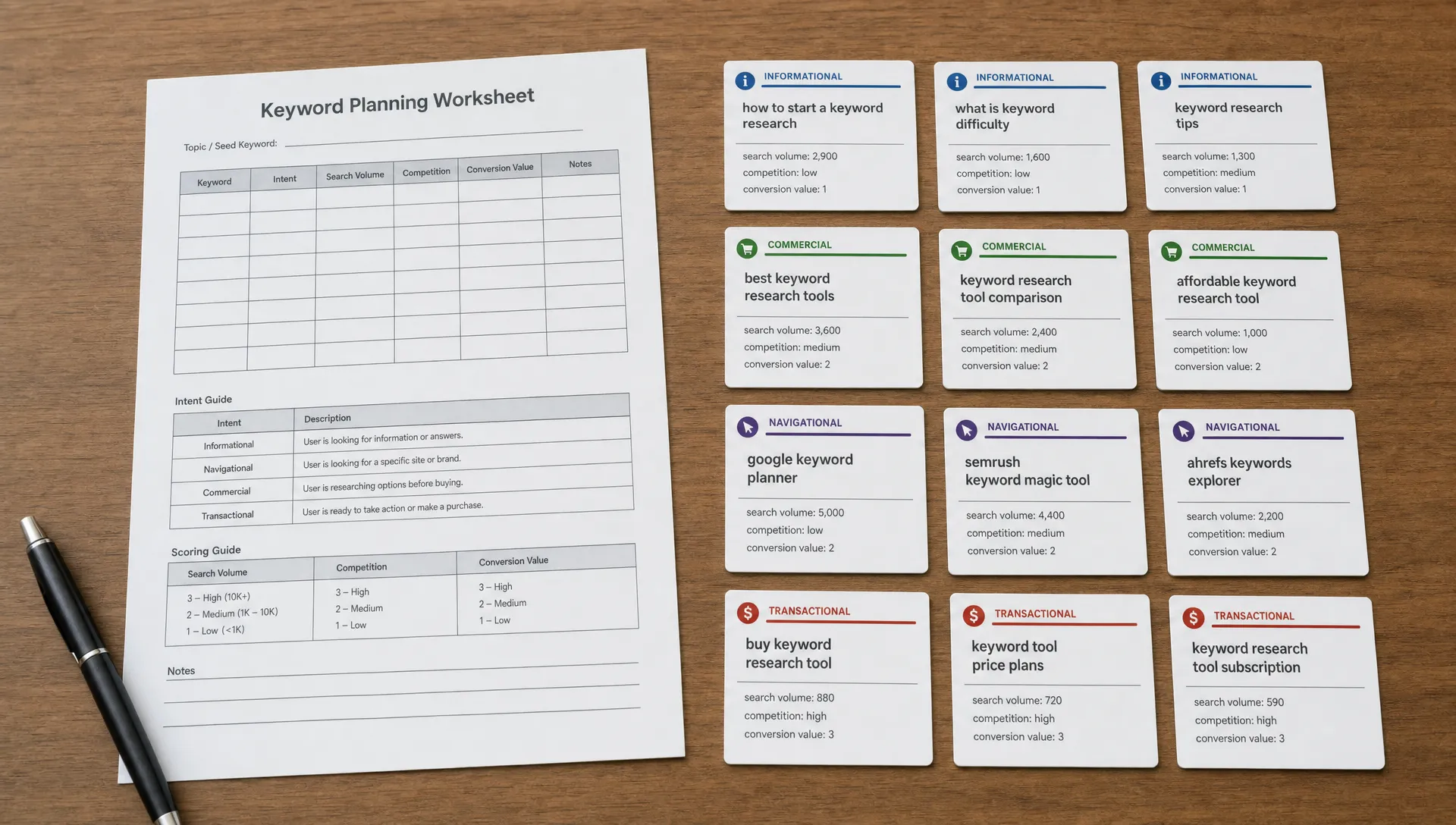
Once you have a keyword list, score each term so priorities are not based on opinion. A simple 1 to 5 score works well for most teams.
| Scoring factor | 1 point | 3 points | 5 points |
|---|---|---|---|
| Business relevance | Weak connection to offer | Related to a service area | Directly tied to revenue |
| Search intent | Mostly informational and broad | Mixed intent | Clear buyer or problem intent |
| Competition | Very difficult | Moderate | Realistic opportunity |
| Content fit | Hard to answer well | Possible with research | Strong internal expertise |
| Conversion potential | Unlikely to produce leads | Some lead potential | Strong lead potential |
Add the scores and rank the terms. A lower-volume keyword with a high business score should often outrank a high-volume keyword with poor relevance.
Match Each Keyword to the Right Page Type
Choosing the keyword is only half the work. The next step is deciding what kind of page should target it. A keyword with service intent should not usually be buried inside a blog post. A definition keyword should not be forced onto a sales page.
Google Search Central recommends creating helpful, reliable, people-first content, and that starts with matching the page to the searcher’s task. The page should answer what the searcher came to solve, then guide them to the next logical step.
| If the search result shows | The searcher likely wants | Create this type of page |
|---|---|---|
| Guides and definitions | Education | Blog article or resource page |
| Service providers | A vendor or quote | Service landing page |
| Comparison articles | Evaluation help | Comparison or buying guide |
| Local map results | Nearby provider | Local service page |
| Videos and visual results | Demonstration | Video-supported article or landing page |
If your keyword requires a content page, focus on depth, structure and usefulness rather than repeating the phrase. This article on search engine optimization content writing that ranks offers practical guidance on turning keyword intent into content that can compete.
Group Keywords Into Topics, Not Isolated Pages
Modern SEO works best when related keywords support each other. Instead of creating one thin page for every variation, group similar phrases into topical clusters.
For example, a company offering industrial SEO might build a topic cluster around industrial digital marketing. Supporting pages could cover industrial SEO, PPC for manufacturers, technical website audits, lead generation for manufacturers and website redesign for industrial companies. Each page has its own primary intent, but the cluster signals topical depth.
A practical cluster should include:
- One primary page for the main service or topic
- Supporting articles for common questions and objections
- Internal links between related pages
- Clear conversion paths from educational content to service pages
This prevents keyword cannibalization, where several pages compete against each other for the same search intent. It also makes your website easier for buyers to navigate.
Account for Local and Regional Search Intent
For Houston businesses, location can be a major keyword qualifier. A local modifier often signals that the buyer wants a provider with regional knowledge, availability or market familiarity.
That does not mean every page should repeat Houston unnaturally. Use location when it reflects genuine buyer intent. A phrase like B2B marketing Houston may deserve a service page. A national educational topic, such as how to choose keywords for SEO, may not need heavy local optimization.
Local keyword modifiers can include city names, nearby regions, industrial corridors, service areas and industry-specific local terms. Use them where they help the reader understand fit.
Validate Keywords With Real Performance Data
Keyword selection should improve over time. After publishing or optimizing pages, use performance data to refine your choices.
Review Google Search Console to see which queries generate impressions, clicks and position changes. Compare that with form submissions, calls, proposal requests or CRM data. The best SEO keyword is not always the one with the highest click-through rate. It is the one that attracts visitors who take meaningful next steps.
PPC data can also help. Paid search campaigns show which terms convert faster than organic SEO can. If a paid keyword consistently produces qualified leads, it may deserve an organic landing page or supporting article.
Sales feedback matters too. If your SEO content is producing leads that are too small, outside your service area or mismatched to your offer, the keyword strategy needs refinement.
Common Keyword Selection Mistakes to Avoid
Even experienced teams can choose the wrong SEO keywords when they rely too heavily on tools or assumptions.
Watch for these mistakes:
- Choosing keywords only because they have high search volume
- Targeting the same keyword with multiple pages
- Ignoring the type of content already ranking in search results
- Using internal jargon that buyers do not search for
- Treating every blog post as a lead generation page
- Forgetting local, industry or application qualifiers
- Building a keyword list once and never updating it
The strongest keyword strategies are reviewed regularly. Markets change, competitors publish new content, buyers use new language and your own services may evolve.
A Practical Keyword Selection Framework
If you want a simple process, use this sequence:
- Define the business goal for SEO.
- Identify your ideal buyers and the problems they search for.
- Build a seed list from customer language, sales data and existing pages.
- Expand the list with keyword tools and search result analysis.
- Score each keyword for relevance, intent, difficulty and conversion value.
- Map keywords to page types based on search intent.
- Group related keywords into topic clusters.
- Measure rankings, traffic and lead quality after publishing.
This framework keeps keyword selection practical. It also helps marketing and sales teams agree on which search opportunities deserve investment.
Frequently Asked Questions
How many keywords should I target on one page? Target one primary keyword or search intent per page, then include closely related variations naturally. A page can rank for many related terms, but it should have one clear purpose.
Should I choose high-volume or low-competition keywords? Choose keywords with the best mix of relevance, intent, realistic competition and conversion value. High volume is useful only when the traffic matches your business goals.
Are long-tail keywords better for B2B SEO? Long-tail keywords are often valuable in B2B because they reveal a more specific problem, industry or buying need. They usually attract less traffic, but the traffic can be more qualified.
How often should I update my keyword list? Review priority keywords at least quarterly, and update them whenever your services, market, competitors or sales feedback change. SEO keyword selection is an ongoing process, not a one-time task.
Do keywords still matter for search engine optimization? Yes. Keywords still help define topics, intent and page structure. The difference is that successful SEO uses keywords to serve the searcher, not to stuff repeated phrases into a page.
Turn Keyword Research Into Better Leads
Choosing the right keywords is the starting point. The real value comes from turning those keywords into useful pages, strong calls to action and a content strategy tied to qualified leads.
If your company needs help connecting SEO, PPC and inbound marketing strategy, B2B Inbound Marketing can help you build a practical search plan focused on visibility, rankings and lead generation.