


Choosing an SEO company is not a small marketing decision. For many B2B, industrial and local service companies, organic search affects how buyers discover your expertise, compare you against competitors and decide whether to submit a quote request or call your sales team.
Many businesses search for SEO optimization companies when traffic is flat, leads are inconsistent or competitors seem to appear everywhere in Google. The mistake is hiring the first firm with a polished pitch. A better approach is to evaluate whether the company can connect search visibility to business outcomes, especially in markets with technical products, long sales cycles and multiple decision-makers.
The right SEO partner should be able to explain what they will do, why it matters and how progress will be measured. They should also be comfortable telling you what SEO cannot fix by itself, such as weak positioning, poor sales follow-up or a website that does not convert qualified visitors.
Start with your business goal, not an SEO package
Before comparing proposals, define what success should look like. Ranking higher is useful only if those rankings bring the right audience. A manufacturer, distributor, engineering firm or B2B service provider may care more about qualified RFQs, consultation requests and search visibility for specific product categories than overall traffic volume.
Good SEO optimization companies will ask questions about margin, target industries, geography, sales cycle length, lead quality and current conversion paths. If the conversation starts and ends with keyword volume, backlinks and blog post counts, the strategy is probably too generic.
For B2B companies in the Houston area, local market context can also matter. Search demand, competitor density and buyer expectations often differ by city and industry. If local relevance is part of your growth strategy, review how Houston B2B SEO priorities affect technical optimization, service pages and content planning.
Look for buyer intent expertise
SEO is not just about attracting visitors. It is about matching your website to what buyers need at each stage of their decision process.
A strong SEO company should be able to separate broad informational searches from commercial, comparison and purchase-intent searches. For example, a search for how industrial filtration works has a different purpose than a search for industrial filtration supplier Houston. Both may be valuable, but they need different pages, calls to action and measurement.
Ask how the company maps keywords to the customer journey. You want to hear a clear explanation of which terms should support educational content, which should support product or service pages and which may deserve landing pages for paid search or remarketing. This is especially important for B2B companies because high-value buyers often research quietly before they ever contact sales.
If your company sells complex solutions, the SEO team should also understand the difference between traffic and influence. A technical article may not convert immediately, but it can establish credibility with engineers, plant managers, procurement teams or executives who later return through branded search.
Evaluate technical SEO depth
Technical SEO is where many proposals sound similar but differ sharply in quality. Nearly every agency can run an audit tool. Fewer can explain what the audit findings mean for crawlability, indexation, site speed, structured data, internal linking and conversion performance.
The company should review your website architecture, URL structure, mobile usability, duplicate content risks, page templates, metadata, redirects and Core Web Vitals. They should also know how to prioritize fixes. A long list of minor warnings is less useful than a focused plan for resolving the issues that block growth.
For established B2B websites, technical SEO often involves cleaning up years of accumulated problems: old product pages, thin service pages, inconsistent title tags, broken internal links and outdated redirects from previous redesigns. For newer websites, the priority may be building a scalable structure before content growth begins.
A capable firm will also collaborate with your developer or web team. SEO recommendations that cannot be implemented are not strategy. They are paperwork.
Check their content process, not just their writing samples
Content quality has become one of the clearest separators between average and effective SEO work. Google encourages site owners to create helpful, reliable, people-first content through its Search Central guidance. For B2B companies, that usually means content informed by subject matter expertise, not generic articles assembled from search results.
Ask how the SEO company gathers expertise from your team. Do they interview salespeople, engineers, founders, product managers or customer service staff? Do they review proposals, spec sheets, FAQs, sales objections and customer questions? Do they understand how to turn technical knowledge into pages that are both searchable and useful?
This matters because your best SEO content often comes from the questions prospects already ask before buying. A good agency should help turn those questions into service pages, comparison pages, industry pages, case-based articles and practical resources that support lead generation.
If the company promises a fixed number of posts every month without discussing topic selection, search intent or your sales process, be cautious. More content is not automatically better. Better content, placed in the right structure, is what compounds over time.
Test their ability to learn your industry
No SEO firm begins as an expert in every field. What matters is whether they have a disciplined process for learning specialized markets.
Ask the company to walk through how they would approach unfamiliar terminology, competitive research and buyer objections. A firm working with an industrial manufacturer should know how to handle product specifications, standards, applications and distributor relationships. A firm working with a professional service company should know how to build trust around expertise, outcomes and proof.
You can also test range by asking how they would optimize a niche ecommerce or specialty product site. For instance, a page offering professional-grade recovery and wellness devices requires a different content strategy than a local service page or an industrial product category. The SEO team should be able to explain how they would address product education, trust signals, technical details, internal links and conversion intent without forcing the same template onto every business.
That adaptability is a practical signal. SEO companies that rely on one playbook often struggle when a market requires nuance.
Demand reporting that ties to business results
Ranking reports have value, but they are not enough. You need to know whether SEO is creating better business opportunities.
Useful reporting should connect organic visibility to traffic quality, engagement, conversions and lead sources. For B2B companies, this may include form submissions, phone calls, quote requests, consultation bookings, gated content downloads or other meaningful actions. If your sales team qualifies leads manually, the SEO company should help you connect marketing data to lead quality over time.
The best reports do not bury clients in metrics. They explain what changed, why it changed, what was completed and what should happen next. They should also distinguish between early indicators and outcomes. Indexation improvements, keyword movement and impressions may matter in the first few months, but qualified lead flow becomes the real test over time.
For more on connecting organic search activity to pipeline outcomes, see these SEO optimization strategies for better lead flow.
Watch for ethical authority building
Backlinks still influence SEO, but link quality matters far more than volume. Be wary of any company that sells packages based on a fixed number of links without explaining relevance, placement quality or risk.
A credible SEO partner should talk about earning authority through useful content, digital PR, industry directories where appropriate, partner relationships, local citations, thought leadership and strong internal linking. They should avoid link schemes, private blog networks and tactics that exist only to manipulate rankings.
This is especially important for companies that depend on trust. A short-term bump from risky tactics is not worth long-term damage to your domain, brand or search visibility.
Compare red flags with better signals
A practical way to compare SEO optimization companies is to look for patterns in how they sell, diagnose and communicate. The table below summarizes common warning signs and what you should expect instead.
| Red flag | Better signal |
|---|---|
| Guarantees #1 rankings | Explains realistic scenarios, constraints and timelines |
| Starts with a package before discovery | Begins with business goals, website review and buyer intent |
| Sends only automated audit exports | Interprets technical issues and prioritizes fixes |
| Focuses on traffic alone | Connects SEO work to qualified leads and sales opportunities |
| Uses vague link-building language | Explains authority strategy, relevance and risk management |
| Produces generic content at scale | Builds content from subject matter expertise and search intent |
| Reports activity only | Reports outcomes, next steps and business impact |

Ask better questions before signing
The quality of your questions will often reveal the quality of the SEO company. Instead of asking only about price, ask questions that force the firm to explain its thinking.
Useful questions include:
- How will you decide which keywords and pages matter most for our business?
- What technical issues would you evaluate before recommending new content?
- How do you incorporate input from our internal subject matter experts?
- What does success look like in the first 90 days, 6 months and 12 months?
- How do you report on lead quality, not just traffic?
- What SEO work will require our team or developer to participate?
- How do you approach links and off-page authority?
- What would make you recommend PPC, web design or conversion improvements alongside SEO?
Strong companies welcome these questions. Weak companies often retreat into buzzwords or promises.
Review the proposal for strategic clarity
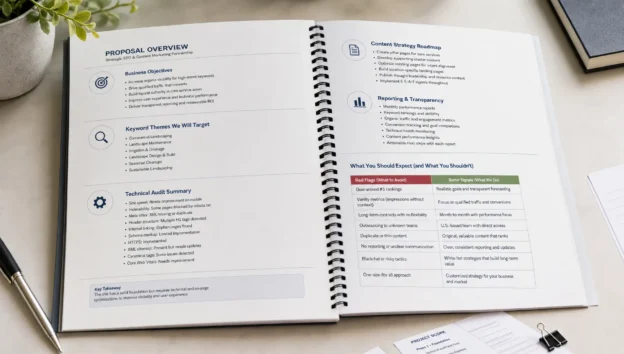
A good SEO proposal should not feel like a mystery. It should identify your current situation, explain the opportunity and outline the work required to improve performance.
Look for specific recommendations tied to your website and market. A proposal that could be sent to any company with only the logo changed is not enough. Even if the full strategy is developed after onboarding, the proposal should show that the company has done real thinking.
| Proposal element | What it should clarify |
|---|---|
| Business objectives | Which outcomes SEO is expected to support |
| Website findings | Key technical, content and conversion issues |
| Keyword and intent focus | Which search themes matter and why |
| Initial priorities | What will happen first and what can wait |
| Content direction | How topics, pages and expertise will be developed |
| Reporting plan | Which metrics will be reviewed and how often |
| Roles and responsibilities | What the agency handles and what your team must provide |
The proposal should also be honest about timeline. SEO can produce meaningful gains, but competitive markets rarely change overnight. If a company promises fast results without explaining the work behind them, the claim deserves scrutiny.
Consider whether you need a generalist or a specialist
Some businesses need a broad digital marketing partner. Others need a highly specialized SEO firm. The right choice depends on your internal resources and growth goals.
If you already have strong developers, writers and marketing operations, you may need senior SEO direction and technical oversight. If your team is small, you may need an agency that can support SEO, content, PPC, website improvements and inbound strategy together.
For B2B companies, specialization often matters because the buying process is more complex than simple ecommerce or consumer lead generation. If your audience includes engineers, facility managers, procurement teams or executive buyers, the agency must understand how search behavior changes across roles. This is why evaluating what to look for in a B2B SEO agency can help you assess fit beyond general SEO capabilities.
The goal is not to hire the biggest name. The goal is to hire the partner most capable of improving your search presence in the market where you actually compete.
Frequently Asked Questions
What should I look for first in SEO optimization companies? Start with strategy fit. The company should understand your business goals, target buyers, sales cycle and lead quality standards before recommending tactics.
How can I tell if an SEO company is using ethical methods? Ask how they build authority, create content and earn links. Ethical SEO companies explain their process clearly and avoid guaranteed rankings, private blog networks and vague link packages.
How long does it take to see SEO results? Timelines vary by competition, website condition and resources. Many companies see early movement within a few months, but meaningful lead growth often takes consistent work over 6 to 12 months.
Should an SEO company also understand PPC and web design? It helps, especially for lead generation. SEO brings qualified visitors, but PPC data, landing pages, site speed and conversion design can all influence whether those visitors become leads.
Is the cheapest SEO company usually a bad choice? Not always, but low-cost SEO often limits research, technical work, content quality and strategic attention. Compare value, clarity and accountability rather than price alone.
Ready to evaluate your SEO options?
If your business needs more qualified visibility in search, take time to evaluate fit before signing a contract. Look for a partner that understands buyer intent, technical SEO, content quality, reporting and how organic search supports lead generation.
B2B Inbound Marketing helps Houston and industrial companies improve online visibility through SEO, PPC, inbound marketing strategy, web content and related digital marketing services. If you want a practical conversation about where your website stands and what opportunities may exist, visit Andy Alagappan to start the discussion.