

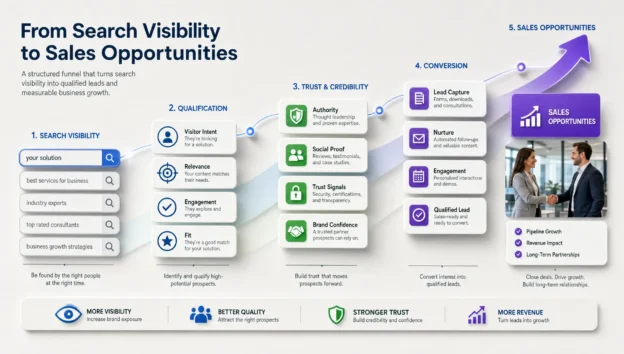
Search visibility is often discussed as a traffic metric, but for B2B and industrial companies it is a revenue lever. If the right buyers cannot find your website when they search for a problem, specification, service category or vendor comparison, your company may never enter the sales conversation.
That lost visibility does not always show up as an obvious loss. It appears as slower pipeline growth, higher dependence on paid ads, weaker brand recall, fewer inbound RFQs and sales teams spending more time chasing prospects who are not ready to buy. When your website search engine visibility improves, the opposite can happen: more qualified demand reaches your site, buyers understand your expertise earlier and your sales process starts with better context.
For companies in Houston and other competitive B2B markets, this matters because many buyers now research quietly before contacting sales. Your website has to perform as a discoverable sales asset, not just an online brochure.
What Website Search Engine Visibility Really Means
Website search engine visibility is the degree to which your pages appear in search results for the terms your buyers use throughout the buying journey. It includes rankings, impressions, click through rate, page relevance, local visibility, technical accessibility and whether the pages that rank can convert visitors into real opportunities.
Visibility is not limited to broad keywords such as “industrial marketing” or “B2B SEO.” A revenue focused search strategy also includes searches tied to:
- Problems buyers are trying to solve
- Product or service categories
- Industry applications
- Location based supplier needs
- Comparison and evaluation terms
- Technical specifications and compliance requirements
- Brand and competitor related searches
This is why search visibility has to be connected to business goals. Ranking for a high volume keyword that attracts students, job seekers or unqualified visitors may create traffic without revenue. Ranking for a lower volume phrase used by a purchasing manager, plant engineer or operations leader can have a much stronger commercial impact.
How Search Visibility Turns Into Revenue
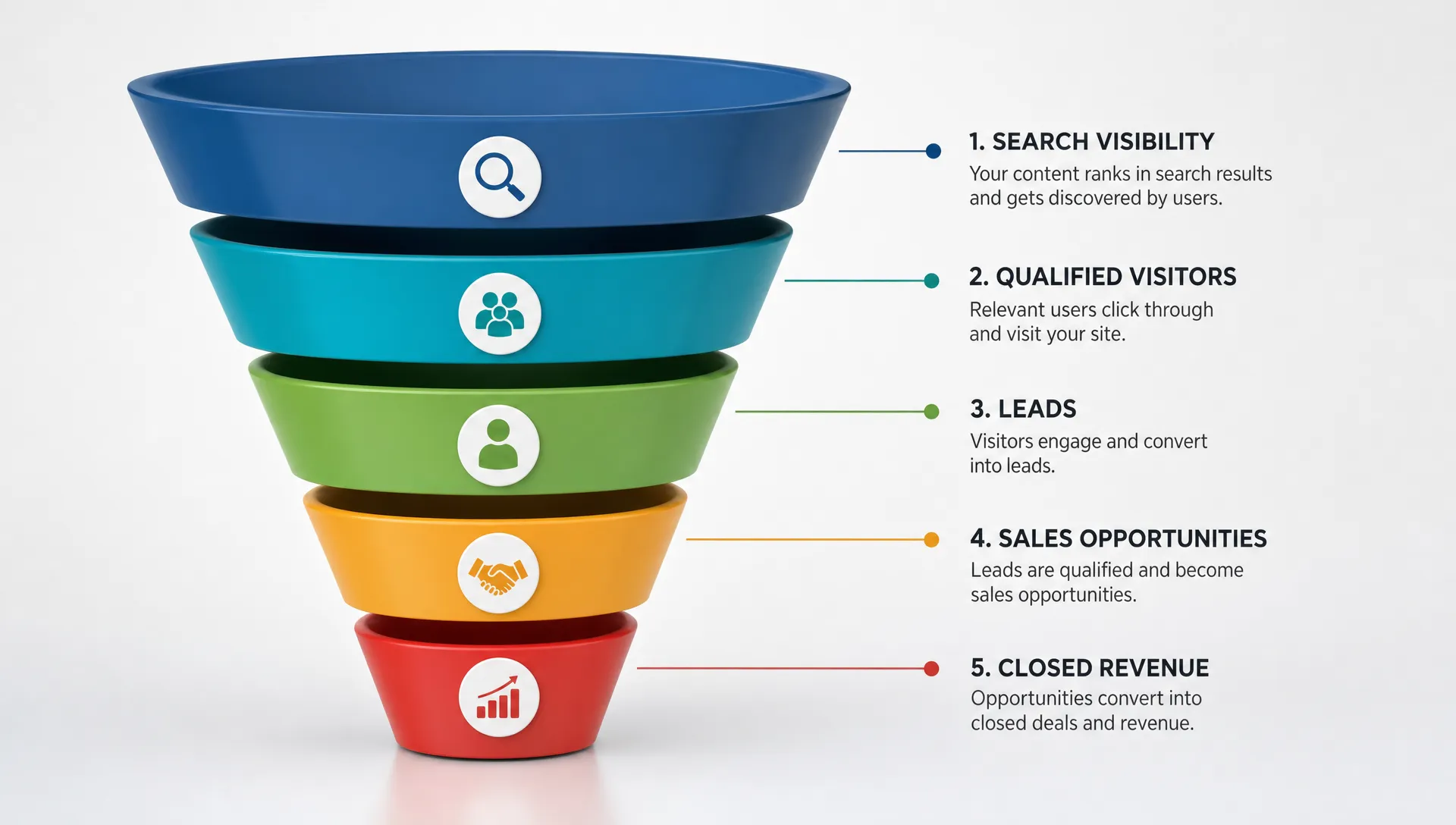
Search visibility affects revenue through a chain of events. A buyer has a need, searches for information, finds a relevant page, trusts what they see, takes an action and eventually becomes part of your pipeline. Every link in that chain can increase or reduce revenue.
A simple model looks like this:
Search revenue = search impressions x click through rate x visitor to lead rate x lead to opportunity rate x close rate x average deal value
You do not need perfect attribution to use this model. The point is to see how search performance moves downstream. Better visibility can increase impressions. Stronger titles and meta descriptions can improve clicks. Better landing pages can increase leads. Better content quality can improve sales readiness. Better fit can improve close rates.
| Visibility factor | What it influences | Revenue effect |
|---|---|---|
| Ranking for buyer intent terms | Qualified search impressions | More potential buyers discover the company |
| Relevant page titles and descriptions | Click through rate | More searchers choose your result over competitors |
| Strong service and industry pages | Visitor to lead rate | More visitors request information, quotes or consultations |
| Trust signals and useful content | Lead quality | Buyers arrive with more confidence and fewer basic objections |
| Technical SEO and site speed | Indexing, user experience and conversion | Fewer prospects are lost before engaging |
| Analytics and CRM tracking | Revenue attribution | Marketing spend is tied to pipeline and sales outcomes |
This is also why SEO should not be treated as an isolated marketing task. It is connected to sales messaging, website design, technical performance and business positioning. If you want a broader look at the long term value of SEO, this guide on search engine optimization for business growth that lasts explains how visibility compounds over time.
Visibility Puts You in the Buyer’s Consideration Set
Revenue starts before the first sales call. In many B2B categories, the buyer creates a shortlist before contacting vendors. If your company does not appear when buyers search, they may assume you are not a major option, even if you offer a better solution.
This is especially important in industrial and professional services markets where buyers often search with very specific intent. A facilities manager might search for a specialized maintenance provider. A manufacturer may look for a component supplier with experience in a certain application. An operations team may need a local service partner with cybersecurity, infrastructure or cloud expertise.
A managed IT and cybersecurity provider, for example, cannot depend only on referrals when companies search for urgent support or infrastructure planning. A firm like MDSI, which provides IT maintenance, cybersecurity, cloud and infrastructure services in La Réunion and Mayotte, gains commercial advantage when its site is visible for the exact service needs its market is already researching.
The same principle applies to Houston based B2B and industrial companies. If buyers are searching for your capabilities and your competitors own the search results, your sales team is starting from behind.
Poor Search Visibility Increases Customer Acquisition Cost
When organic visibility is weak, companies often compensate with paid advertising, outbound sales or referrals. Those channels can work, but relying on them alone can make growth more expensive and less predictable.
Paid search can generate fast demand, but every click has a direct cost. Outbound sales can create opportunities, but it requires heavy labor and often reaches buyers before they are ready. Referrals are valuable, but they are hard to scale. Organic search visibility gives your company a durable way to meet demand that already exists.
This does not mean SEO replaces PPC. In many cases, SEO and PPC work better together. Paid search can test messaging, cover competitive terms and support time sensitive campaigns. SEO builds a stronger foundation by capturing demand without paying for every single visit. Over time, stronger organic visibility can reduce blended acquisition cost because more leads come from assets you already own.
For revenue leaders, the question is not “How much traffic did SEO create?” The better question is “How much qualified pipeline did search visibility influence, and how much would we have paid to acquire the same opportunities through other channels?”
Search Visibility Shortens the Sales Cycle
A visible website can educate buyers before they talk to sales. This matters because many B2B purchases involve multiple stakeholders, technical requirements, budget reviews and risk concerns. If your site answers the questions buyers are already asking, your sales team does not have to start from zero.
Useful search content can clarify:
- Which problems your company solves
- Which industries or applications you understand
- What buyers should evaluate before choosing a vendor
- How your process works
- What outcomes customers can reasonably expect
- What makes one solution more reliable than another
When buyers find that information through search, they arrive more informed. They may still need a consultation, proposal or technical review, but they are less likely to ask only basic awareness questions. That can shorten early sales conversations and help your team focus on fit, scope and next steps.
Website Design Can Either Capture or Waste Visibility
A company can rank well and still lose revenue if the website does not support conversion. Search visibility brings people to the door, but page experience determines whether they trust you enough to take the next step.
Common conversion problems include unclear service pages, slow load times, weak calls to action, confusing navigation, missing proof points and content that talks more about the company than the buyer’s problem. For industrial companies, another common issue is hiding important technical information inside PDFs that search engines and users may not engage with as easily as well structured pages.
Strong website design supports search revenue by making the next step obvious. A visitor should quickly understand what you offer, who you serve, where you operate and why your company is credible. If they are ready to talk, the path to a consultation, quote or proposal should be simple.
This is where SEO and web design need to work together. The article on search engine optimization website design for better leads goes deeper into how site architecture, content and conversion paths can improve lead quality.
The Revenue Risk of Ranking for the Wrong Keywords
Not all visibility is valuable. Some companies chase broad keywords because they have higher search volume, but broad visibility can attract the wrong audience. The result is a reporting problem: traffic looks better, but revenue does not improve.
Revenue focused SEO starts with buyer intent. A search for “what is predictive maintenance” may be early stage research. A search for “predictive maintenance services for manufacturing plants” is much closer to commercial intent. Both can be useful, but they should be measured differently.
A balanced search strategy usually includes content for several stages:
| Buyer stage | Search intent | Best page type | Revenue role |
|---|---|---|---|
| Awareness | Understanding a problem | Educational article or guide | Builds trust and creates first touch visibility |
| Consideration | Comparing approaches | Comparison page, application page or case focused content | Helps buyers define requirements |
| Decision | Finding a provider | Service page, location page or industry page | Converts demand into leads |
| Retention and expansion | Solving related needs | Support content, FAQs or advanced guides | Creates additional value and repeat engagement |
The mistake is treating every keyword the same. A high level article may introduce your brand. A technical service page may generate RFQs. A comparison page may influence a late stage buyer. Revenue measurement should reflect those different jobs.
Search Visibility Builds Trust Before the First Conversation
Search results shape perception. If your website appears consistently for relevant searches, buyers begin to associate your company with expertise. If your competitors appear and you do not, they gain familiarity before your sales team ever speaks to the prospect.
Trust is built through more than rankings. Buyers evaluate the quality of your content, the clarity of your positioning, your case examples, your certifications, your service descriptions and whether your website feels current. A high ranking page with vague content may bring traffic, but it will not necessarily create confidence.
For B2B and industrial companies, trust signals can include industry experience, process clarity, technical depth, service area details, testimonials, project examples and useful educational content. These elements help search visitors decide whether your company belongs on the shortlist.
How to Measure Revenue Impact From Search Visibility
Many companies underinvest in SEO because they measure only rankings or traffic. Those metrics are useful, but they are not enough. Revenue impact becomes clearer when search data is connected to lead quality, pipeline and closed deals.
Important metrics include organic impressions, organic clicks, ranking movement for priority terms, organic conversion rate, form submissions, phone calls, qualified leads, sales accepted leads, opportunities created, pipeline value and closed revenue influenced by organic search.
The cleanest setup connects Google Search Console, website analytics and your CRM. Search Console shows how visible your pages are in Google search. Analytics shows how visitors behave on your site. The CRM shows whether those visits become revenue. Even if attribution is imperfect, the combined view is far more useful than traffic reports alone.
For executive teams, present SEO performance in business language. Instead of reporting only “organic traffic increased 22 percent,” connect the increase to qualified leads, opportunity value and cost savings compared with paid acquisition. If you need to secure leadership buy in, this framework for building an SEO marketing business case that wins can help translate search work into financial priorities.
Practical Ways to Improve Search Visibility for Revenue
Improving search visibility is not about publishing random blog posts or adding keywords to every page. It requires a revenue focused plan that connects demand, content, technical SEO and conversion.
Start with buyer intent research. Interview sales teams, review CRM notes, study proposal requests and identify the words prospects use when they describe problems. Then map those terms to pages that match the stage of the buyer journey.
Strengthen the pages closest to revenue first. For many B2B companies, that means service pages, industry pages, location pages and high intent comparison content. These pages should explain the problem, the solution, your process, proof of competence and the next step.
Improve technical health. Search engines need to crawl and understand your website, and visitors need pages to load quickly. Broken links, duplicate pages, poor mobile experience and unclear site structure can reduce visibility and conversions.
Align content with sales. If prospects ask the same questions during sales calls, those questions likely belong on your website. Good content can reduce friction, pre qualify buyers and reinforce your value proposition before a meeting.
Measure what matters. Track rankings and traffic, but do not stop there. Look at which pages create leads, which leads become opportunities and which opportunities turn into customers.
Why This Matters More in Competitive B2B Markets
In competitive markets like Houston, buyers have options. They can compare suppliers, agencies, consultants, manufacturers and service providers within minutes. If your website does not show up with clear, credible content, you are relying on buyers to already know your name.
That is a risky growth strategy. Strong website search engine visibility helps your company earn attention when buyers are actively looking. It supports brand awareness, lead generation, sales enablement and long term revenue growth. It also gives your marketing and sales teams a shared foundation: content that attracts the right audience and helps move them toward a business conversation.
Frequently Asked Questions
How does website search engine visibility affect revenue? It affects revenue by increasing the number of qualified buyers who find your company, improving trust before sales conversations and creating more opportunities for leads, proposals and closed deals.
Is more website traffic always better for revenue? No. Traffic only helps revenue when it comes from the right audience and reaches pages designed to convert. A smaller number of high intent visitors can be more valuable than a large volume of unqualified traffic.
How long does it take for SEO visibility to affect sales? It depends on competition, website condition, content quality and sales cycle length. Some technical and conversion improvements can help quickly, while authority building and competitive rankings usually take longer.
Should B2B companies use PPC if they are investing in SEO? Yes, PPC can support short term demand, test messaging and cover competitive searches. SEO and PPC often work best together when both are measured against lead quality and revenue outcomes.
What pages usually have the biggest revenue impact? Service pages, industry pages, location pages, comparison content and technically useful resources often have strong revenue impact because they align with buyers who are evaluating solutions or vendors.
Turn Search Visibility Into Sales Opportunity
Your website should not be a passive brochure. It should help the right buyers find you, understand your value and take the next step toward a business conversation.
If your B2B or industrial company needs stronger search visibility, clearer lead generation paths or a more revenue focused inbound strategy, Andy Alagappan can help with SEO, PPC, inbound marketing, web content and website related marketing services built around growth. Start by identifying where search visibility is already influencing revenue, then improve the pages and campaigns that can turn qualified demand into measurable pipeline.