


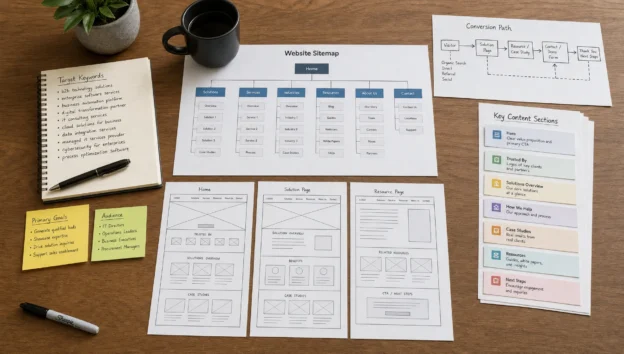
A business website is not just a digital brochure. For many B2B and industrial companies, it is the first sales conversation, the first proof of credibility, and the first filter prospects use before they contact a vendor. That is why web design and SEO should be planned together from the beginning, not treated as two separate projects.
When SEO is added after the design is finished, teams often discover problems that are expensive to fix: pages with no search intent, slow templates, weak internal linking, missing redirects, thin content, or beautiful layouts that make conversion harder. When design happens without SEO, the site may look better but rank worse. When SEO happens without design, the site may attract traffic but fail to move qualified visitors toward an inquiry.
For Houston industrial companies, manufacturers, distributors, and professional B2B firms, this alignment matters even more. Your buyers are researching complex solutions, comparing vendors, and looking for signs that your company understands their technical needs. A website has to serve search engines, human decision makers, and sales goals at the same time.
The problem with planning design first and SEO later
Many redesign projects begin with visual questions: What should the homepage look like? Which colors feel modern? What competitors have a better layout? Those questions matter, but they should not come before search strategy.
If the design team builds the site structure first, the SEO team may be forced to fit important content into a framework that was not made for discoverability. That can lead to crowded navigation, buried service pages, weak page titles, or landing pages that compete against one another for the same keywords.
The reverse can also happen. If SEO planning focuses only on keywords and ignores usability, the site can become text-heavy, confusing, or repetitive. Good SEO is not just about inserting terms into pages. If your team is still thinking that way, it may help to revisit why SEO is not just keywords but a broader strategy involving structure, relevance, experience, and trust.
The best results come when design, SEO, content, and conversion planning happen in the same conversation.
Search intent should shape the site architecture
Before wireframes are created, your team should understand what your prospects are searching for and what they expect to find. Search intent should influence the architecture of the website, including the main navigation, service pages, industry pages, resource sections, and calls to action.
For example, an industrial supplier may need separate pages for product categories, applications, materials, certifications, and industries served. A B2B service company may need pages for each core service, common client problems, geographic markets, and proof points such as case studies or technical resources.
When SEO and web design are planned together, site architecture answers practical questions:
- Which pages deserve top-level navigation because they match high-value search demand?
- Which topics need dedicated pages instead of being combined into one broad service page?
- How should users move from educational content to a quote, consultation, or proposal request?
- Which pages need technical depth for engineers, procurement teams, or business owners?
- How can the design make important content easy to scan without weakening SEO value?
This is where many redesigns succeed or fail. A clean-looking website with the wrong structure can make it harder for search engines to understand your expertise and harder for buyers to find the exact information they need.
Design decisions affect crawling, speed, and indexing
Search engines do not experience your website exactly like a human visitor does, but they do evaluate many of the same signals that influence user satisfaction. Google’s documentation on page experience makes clear that site usability, mobile performance, security, and helpful content all contribute to how visitors experience a page.
That means design decisions are SEO decisions. Large image files, unnecessary scripts, confusing mobile layouts, hidden content, poor heading structure, and broken internal links can all affect performance.
A web page can be visually impressive and still create SEO problems if it is built without search visibility in mind. Common examples include:
- Important content locked inside images instead of readable HTML text.
- Service pages with minimal copy because the design prioritizes empty space over clarity.
- Navigation menus that look sleek but make key pages difficult to reach.
- JavaScript-heavy elements that slow down the page or complicate indexing.
- Templates that use headings for styling instead of logical content structure.
A coordinated planning process prevents these issues before development begins. Designers can still create a professional, modern website, but they do it with performance, accessibility, crawlability, and search intent built into the plan.
Content planning should happen before the visual layout is final
Content is often treated as something to fill the boxes after the design is approved. That approach creates weak pages because the message must fit the layout instead of the layout supporting the message.
For B2B and industrial websites, content cannot be an afterthought. Buyers may need specifications, process explanations, compliance details, industry experience, FAQs, comparison points, and trust signals before they reach out. If the design does not make room for that information, the page may look attractive but fail to answer the questions that drive qualified leads.
Planning content early also helps prevent duplicate or thin pages. A strong SEO strategy identifies which topics need their own pages, which should be combined, and which should become supporting blog posts or resources. Then web design can present that content in a way that feels organized rather than overwhelming.
This is especially important for technical industries where a short page may not be enough to establish credibility. Prospects want to see that you understand their needs. Search engines also need enough context to match your pages to relevant queries.

SEO and UX have to support the same buyer journey
User experience and SEO are closely connected because both are concerned with helping people find what they need. A visitor who lands on your site from Google should immediately understand where they are, what you offer, and what action to take next.
That does not happen by accident. It requires planning the path from search result to page content to conversion action. If someone searches for a specific industrial service, lands on a general homepage, and has to hunt for relevant information, that visitor may leave. If they land on a focused page with clear headings, supporting details, proof points, and a relevant call to action, they are more likely to continue.
A strong website UX strategy helps connect these moments. It considers who the buyer is, what they need to know, what barriers may stop them, and how the website can reduce friction.
For B2B companies, the conversion may not be an immediate online purchase. It may be a quote request, consultation, technical discussion, RFQ, phone call, or proposal inquiry. The design should make that next step obvious without turning every page into an aggressive sales pitch.
Branding, SEO, and design should not compete
Some businesses worry that SEO will make their website sound generic or cluttered. Others worry that branding will make the site too abstract for search performance. Neither has to be true.
Good planning helps brand positioning and SEO work together. Your website should communicate what makes your company different while still using the language customers search for. A strong brand voice can make pages more memorable, while SEO research ensures that the message aligns with actual buyer demand.
This is also where outside brand strategy can be useful. Agencies that combine brand thinking with web and go-to-market planning, such as challenger brand growth partners, show how positioning, digital experience, and market visibility can support one another instead of living in separate silos.
For an industrial or B2B company, the goal is not to choose between technical clarity and brand differentiation. The goal is to explain your value in a way that is findable, credible, and persuasive.
What should be planned together before a redesign?
The earlier SEO enters the redesign process, the easier it is to avoid mistakes. Ideally, SEO strategy should begin before the first sitemap is approved. At minimum, it should be included before wireframes, content outlines, and development decisions are locked.
| Planning area | Why it matters for design | Why it matters for SEO |
|---|---|---|
| Site architecture | Creates intuitive navigation and page hierarchy | Helps search engines understand topic relationships |
| Keyword and intent research | Guides page layouts around buyer needs | Ensures pages target real search opportunities |
| Content outlines | Prevents empty or shallow page sections | Builds relevance, depth, and topical authority |
| Technical requirements | Supports fast, mobile-friendly templates | Protects crawlability, indexing, and performance |
| Internal linking | Helps users discover related services and resources | Distributes authority and clarifies content relationships |
| Conversion paths | Makes next steps clear and easy | Turns organic traffic into measurable inquiries |
| Redirect planning | Protects users from broken pages | Preserves existing rankings and link equity |
This table also shows why redesign projects should not be handed from one team to another in a straight line. SEO, design, development, and content teams need feedback loops.
The biggest SEO risks during a website redesign
A redesign can improve performance, but it can also damage rankings if important steps are missed. This is especially risky for established companies with older websites that already receive search traffic.
One common mistake is changing URLs without redirecting old pages. If high-performing pages are removed or renamed without a proper redirect strategy, search engines and users may hit dead ends. Another mistake is rewriting content so heavily that pages lose the relevance they previously had.
Other risks include removing internal links, replacing specific service pages with broad category pages, launching with missing title tags, blocking crawlers by accident, or overlooking mobile performance. Even a small technical error can affect visibility after launch.
A practical pre-launch SEO review should cover page titles, meta descriptions, headings, indexability, redirects, internal links, image optimization, schema where appropriate, page speed, mobile usability, analytics, and conversion tracking. If you want a broader framework, this comprehensive SEO checklist can help teams think through the details before problems become expensive.
How planning together improves PPC and inbound marketing too
The benefits go beyond organic search. When web design and SEO are aligned, your PPC and inbound marketing campaigns also become stronger.
Paid traffic performs better when landing pages are fast, relevant, and easy to use. Inbound campaigns work better when content is organized around buyer questions and connected to clear conversion paths. Social media and email campaigns become more effective when they send visitors to pages that match the promise of the campaign.
For example, if a PPC ad promotes a specific industrial service, the landing page should not send users to a generic services page. It should reinforce the exact message, answer common objections, show trust signals, and make the next step simple. The same page may also support SEO if it is planned as part of the broader site structure.
This is why website planning should not be limited to design preference. It should consider how the site will support SEO, PPC, content marketing, sales enablement, and future campaigns.
A practical workflow for aligning web design and SEO
A coordinated project does not have to be complicated. It simply requires the right order of operations.
Start with business goals and buyer profiles. Identify the services, industries, and geographic markets that matter most. Then research search demand, competitor visibility, and buyer questions. Use that insight to build the sitemap and page strategy before design begins.
Next, create content outlines for core pages. These outlines should include target intent, key questions to answer, proof points, calls to action, internal link opportunities, and any technical requirements. Designers can then build layouts that support real content instead of guessing how much space each section needs.
During development, SEO and design teams should review templates for speed, mobile usability, heading structure, indexability, and internal linking. Before launch, conduct a final SEO QA process and confirm that analytics and conversion tracking are working.
The best redesign process is collaborative. It gives every discipline a voice early enough to prevent rework.
Signs your current website was not planned with SEO in mind
If your website looks professional but is not generating enough qualified traffic or leads, the issue may not be the design alone. It may be the lack of alignment between design, content, and search strategy.
Warning signs include service pages that are too short, important pages buried deep in the navigation, blog posts with no internal links to commercial pages, slow mobile load times, unclear calls to action, duplicate page topics, or analytics showing traffic without inquiries.
Another sign is that your team struggles to explain which pages are supposed to rank for which searches. Every important page should have a purpose. If the purpose is unclear, the page may not be serving users or search engines well.
Frequently Asked Questions
Should SEO come before web design? SEO should begin before design decisions are finalized. Search intent, site architecture, content planning, and technical requirements should guide the design process so the finished website can attract and convert qualified visitors.
Can a beautiful website hurt SEO? Yes, if it is slow, hard to crawl, thin on content, poorly structured, or difficult to use on mobile devices. A strong design should support search visibility rather than work against it.
Do small B2B websites need SEO planning during a redesign? Yes. Even a small website needs clear page structure, relevant content, technical optimization, and conversion paths. Smaller sites often have less room for wasted pages, so planning matters.
How does web design affect lead generation? Design influences how quickly visitors understand your offer, trust your company, and take action. SEO brings qualified visitors to the site, while design and content help turn that traffic into inquiries.
What is the most common redesign SEO mistake? One of the most common mistakes is launching a new site without mapping old URLs to new URLs through proper redirects. This can cause ranking drops, broken links, and lost traffic.
Build a website that can be found, trusted, and acted on
Web design and SEO should be planned together because your website has to do more than look current. It has to help the right buyers find you, understand your expertise, and take the next step with confidence.
For B2B and industrial companies, that means aligning strategy, content, structure, technical performance, and user experience before the site is built. When those pieces work together, your website becomes a stronger foundation for SEO, PPC, inbound marketing, and lead generation.
If your company is planning a redesign or struggling to turn website traffic into qualified inquiries, B2B Inbound Marketing can help you approach the project with search visibility and business growth in mind. Start by reviewing your current site through the lens of SEO, UX, and conversion, then build a plan before the next design decision is locked in.