



When site engine optimization fails, the first symptom may be fewer search impressions, missing product pages or a decline in qualified inquiries. The cause is not always weak content. A misplaced indexing directive, conflicting URL signals or an inaccurate performance comparison can send your team toward the wrong fix.
The standard industry term is search engine optimization (SEO): helping search engines discover, understand and potentially surface your pages for relevant searches. For B2B and industrial companies, that means making technical capabilities, applications and purchasing information accessible to the right buyers.
Before rewriting your website or increasing your content budget, identify where visibility is breaking down. A manufacturer whose product pages disappeared after a redesign needs a different response from a distributor attracting students instead of purchasing managers. The errors below explain how to tell those situations apart and prioritize the work that matters.
1. Diagnosing site engine optimization with the wrong metrics
A traffic decline is a symptom, not a diagnosis. Looking only at total organic sessions can conceal which pages, queries or audiences changed.
Start in Google Search Console. Compare equivalent periods and separate branded searches from nonbranded searches. Then examine the affected landing pages, devices and countries. Seasonal demand, a lost branded query and a technical problem can produce similar-looking traffic charts but require different responses.
Use these distinctions when investigating:
- Impressions fell: Investigate changes in search demand, indexing, rankings and the queries associated with affected pages.
- Impressions stayed steady but clicks fell: Review click-through rate, page titles, ranking positions and changes in the search results.
- Clicks stayed steady but inquiries fell: Check traffic relevance, forms, tracking and the offer before assuming rankings are responsible.
Search Console and analytics measure different things, so their totals will not match exactly. Compare trends rather than expecting identical numbers.
Also distinguish visibility from commercial performance. Understanding how search visibility affects revenue helps keep a decline in low-value traffic from becoming an unnecessary emergency.
2. Accidentally blocking pages that should appear in search
An excellent service page cannot compete effectively if search engines cannot access or index it. This makes accessibility one of the first checks in a site engine optimization investigation.
Common problems include a production site retaining staging-site noindex directives, important pages requiring authentication or a template applying the wrong indexing settings across an entire product category. Server errors can also interrupt access.
Inspect a representative affected URL in Search Console. Check its indexing status, reported canonical URL and whether Google can retrieve the current page. Verify the live page's HTTP response and indexing directives rather than relying only on what the CMS interface displays.
Crawling and indexing are not the same control. A robots.txt rule restricts crawling, while noindex tells a supporting search engine not to index a page it can access. Google explains that a crawler must be able to retrieve a page to discover its noindex directive.
Keep intentional exclusions for private or unsuitable pages. The mistake is applying those exclusions to public pages that buyers need to find. A successful live test confirms accessibility, not guaranteed inclusion in search results.
3. Giving search engines conflicting URL signals
Industrial websites often publish several URLs for substantially the same content. Product filters, tracking parameters, alternate category paths and old addresses can all create competing versions.
Duplication is not automatically a penalty. The practical problem is losing control over which URL search engines treat as the representative page. Internal links may point to one version while a canonical tag identifies another and the sitemap lists a third.
During a site engine optimization review, compare those signals for important templates. A common migration error is a new service page that still declares an old URL as canonical. Another is applying a category-level canonical to distinct product pages that deserve their own search presence.
Google's canonicalization guidance explains how redirects, canonical annotations and sitemap inclusion help communicate preferred URLs. These signals should agree, though Google ultimately selects the canonical it considers most appropriate.
For a permanently replaced page, use an appropriate permanent redirect to a genuinely relevant replacement. Do not redirect every retired product to the homepage. That may leave buyers without an answer and may be treated as a soft 404 rather than a useful replacement.
4. Making one page serve incompatible buying needs
A page can mention the right words and still fail to answer the searcher's question. Buyers looking for pump specifications, emergency pump repair and replacement seals need different information.
A broad page that attempts to serve all three may lack the detail required for any one task. The opposite mistake is creating separate pages for minor wording variations that have the same purpose.
Build the distinction around the buying decision. A technical product page may need operating limits, materials, compatibility and documentation. A repair page needs service scope, equipment supported and a clear inquiry path.
For a concrete retail example, Velgensupermarkt’s wheel catalog includes alloy wheels, steel wheels and spare-wheel kits. Those categories reflect different purchasing needs. Industrial catalogs benefit from similarly meaningful distinctions rather than a single catch-all page or dozens of near-identical keyword pages.
This part of site engine optimization requires commercial judgment, not just keyword matching. Ask sales staff what information buyers need before requesting a quote. Then compare that requirement with the page and the kinds of results currently appearing for the query. Search results provide intent clues, not a template to copy.
5. Publishing interchangeable pages without useful evidence
It is easy to produce service pages that change only a city name, industry label or product phrase. It is harder to explain why a buyer should trust each page.
Thin differentiation creates two problems: visitors learn little and multiple pages may compete for the same searches. Adding more words does not solve either issue if the information remains generic.
For an industrial supplier, useful evidence might include verified material grades, dimensional constraints, applicable standards, supported applications or an approved project example. Publish only details your company can substantiate. Do not invent certifications, service territories or performance claims to make a page appear complete.
A sound site engine optimization strategy distinguishes between legitimate coverage and scaled duplication. Separate location pages make sense when they describe real, meaningfully different operations or service conditions. They are harder to justify when every page offers the same text and inquiry route with a different place name.
AI can help organize approved information or identify unanswered questions. It should not supply unsupported technical facts. Google's spam policies address scaled content created primarily to manipulate rankings, regardless of how it is produced.
6. Leaving valuable pages disconnected from the website
A page can be publicly accessible yet difficult to discover because few useful internal links lead to it. This often affects technical resources, older service pages and products buried behind internal search tools.
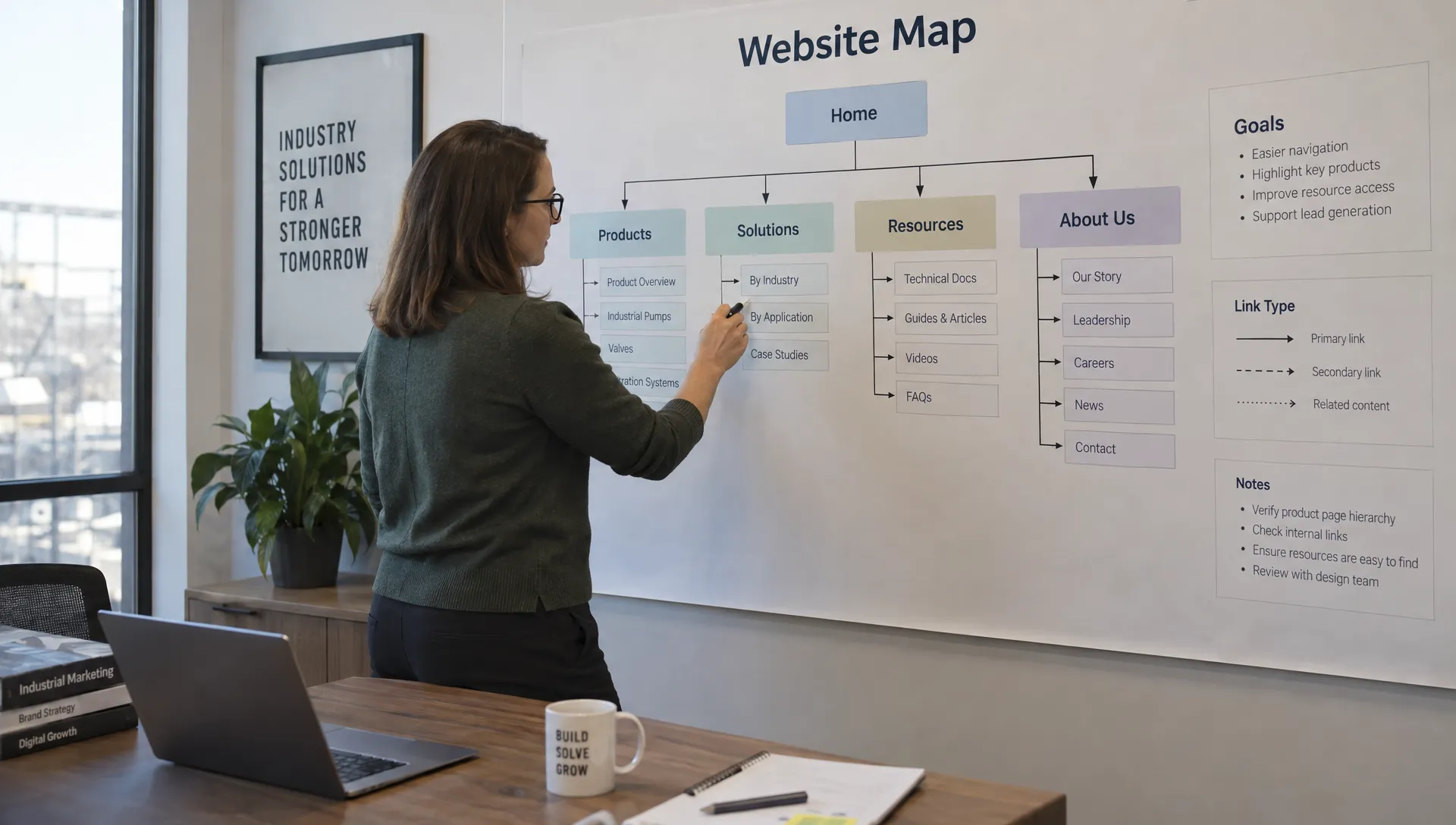
An XML sitemap helps identify URLs, but it does not replace a navigable website. Buyers should be able to move from a relevant category or application page to the information they need.
Review the route to each priority page. Does its parent category link to it? Do related resources reference it where useful? Are important links present as crawlable HTML links rather than available only through an interaction a crawler may not perform?
Use descriptive anchors that explain the destination. “High-temperature sealing materials” gives readers more context than “learn more.” Avoid linking every keyword to a sales page or adding unrelated links solely to increase link counts.
Also inspect links after deleting or moving content. An old application guide may still send buyers to a broken product URL. Correcting the destination improves the journey and removes an avoidable discovery problem.
7. Assuming a successful redesign preserves search visibility
A redesign can improve appearance while quietly removing the information that earned useful search traffic. Specifications may disappear into downloads, detailed service descriptions may be shortened or established URLs may change without appropriate redirects.
Google predominantly uses a site's mobile version for indexing. If the mobile experience omits important desktop content or navigation, inspect what is actually available to search engines and visitors. Content inside an expandable section is not inherently a problem; missing or inaccessible content is.
A redesign-related site engine optimization review should compare old and new URLs, headings, body content, internal links and indexing settings. Test representative page types, not just the homepage.
Performance matters too, but avoid treating a perfect speed score as a substitute for relevance or accessibility. Check real-user performance data where available and prioritize problems that interfere with using the page.
Finally, test inquiry forms on actual devices. A broken mobile form is primarily a conversion failure, not proof of a ranking problem. Keeping that distinction clear prevents wasted work. These responsive design SEO mistakes deserve separate attention when mobile traffic behaves differently from desktop traffic.
8. Buying ranking promises instead of earning relevant authority
Purchased link packages can look attractive when a website has useful content but limited visibility. The risk is confusing a vendor's link count or third-party authority score with evidence that the links will help your business.
Google's spam policies identify buying or selling links for ranking purposes as link spam. Legitimate advertising and sponsorships are different activities and should use appropriate link qualifications, such as rel="sponsored" or nofollow where applicable.
For B2B companies, worthwhile visibility can come from accurate manufacturer listings, relevant association profiles, useful technical contributions and coverage of genuine projects. None guarantees a ranking improvement, but each can have value beyond an SEO report.
Keep site engine optimization reporting focused on relevance and outcomes. Ask where a link appears, why that audience would care and whether the placement represents a real relationship or editorial decision.
Do not start mass link removal or submit a disavow file simply because a tool labels links “toxic.” Those scores are third-party assessments. Google's disavow tool is intended for limited circumstances, not routine cleanup of every unfamiliar referring domain.
Prioritize errors by impact, scope and confidence
Treating every audit warning as equally urgent wastes time. A blocked revenue-producing service page deserves attention before a cosmetic metadata issue on a low-priority archive.
Use a triage table to separate confirmed failures from optimization opportunities:
| Finding | Likely consequence | First response |
|---|---|---|
Accidental noindex on a priority page |
Page may be excluded from search | Verify the directive and remove it if unintended |
| Important URLs returning server errors | Buyers and crawlers cannot reliably access content | Investigate the hosting or application failure |
| Canonical points to an unrelated page | Conflicting preferred-URL signals | Review the template and intended canonical |
| Several pages address the same buying task | Overlap and unclear page ownership | Compare intent before merging or differentiating |
| Impressions hold steady but inquiries decline | Possible relevance, tracking or conversion issue | Test the inquiry path and review query quality |
For each site engine optimization fix, record the affected URLs, the evidence, the change and the date. Verify the live result before requesting recrawling where appropriate.
Then allow time for search engines to revisit and process the changes. Avoid changing titles, copy, canonical tags and navigation simultaneously unless an urgent repair requires it. Controlled changes make results easier to interpret.
Frequently asked questions
Which errors should be fixed first? Start with confirmed access and indexing problems affecting commercially important pages. Then address conflicting URL signals, missing buying information and weak internal discovery. Prioritize evidence of harm over the number of warnings an audit tool produces.
How long does recovery take after a correction? There is no universal timeline. Search engines must recrawl and process changes, and recovery depends on the underlying issue, competition and demand. A corrected technical error does not guarantee a particular ranking or traffic level.
Can ChatGPT handle site engine optimization? It can help draft audit questions, organize approved content and suggest checks. It cannot establish a site's current indexing state without reliable data, validate proprietary specifications or guarantee rankings. Have a qualified person verify recommendations before implementation.
Should every page be indexed? No. Private account pages, internal search results and some duplicate or low-value URLs may not belong in search. The goal is intentional indexing of useful public pages, not the largest possible indexed-page count.
Get a focused review of your search visibility
If your industrial or B2B website is losing visibility, start with a defined problem rather than a full-site rewrite. Identify the affected pages, confirm the evidence and agree on what improvement should look like.
Discuss your SEO priorities with Andy Alagappan to connect technical corrections, useful content and search marketing with the buyers your business needs to reach.